"a19e0535960bd083"{"id":"1002029","slug":"footstep-sound-component","title":"Footstep Sound Component","category":"Gameplay Features","engine":"5.0+","assetVersion":"","engineVersion":"Engine Version: 5.0+","tag":"Gameplay Features","accent":"blue","visual":"mech","summary":"Footstep Sound Component adds adaptive footstep audio, footprints, and surface particles across walking, climbing, and crawling locomotion in Unreal Engine.","platform":"Unreal Engine","publishedAt":"2026-10-26T13:32:14.260Z","updatedAt":"2026-10-26T13:32:14.260Z","sourceNotes":[],"fileContents":[],"compatibility":["Unreal Engine","Engine Version: 5.0+"],"featuredImage":{"alt":"Footstep Sound Component","src":"/wp-content/uploads/published/2026/10/fa85b92a2971-e682bedf-298c-409b-8d7a-2c869db23a4b-b40254c40b.webp"},"hasDownloadLink":true,"downloads":0,"terms":[{"taxonomy":"category","slug":"gameplay-features","name":"Gameplay Features"}],"galleryImages":[{"src":"/wp-content/uploads/published/2026/10/489ef28ca347-c293f2ed-5b0d-485e-bb40-1b9489bc3f96-73f993f7fc.webp","alt":"Footstep Sound Component"},{"src":"/wp-content/uploads/published/2026/10/c332816b498d-0fb8f177-fb49-430d-9f9f-e17188ad27c7-1bff811494.webp","alt":"Footstep Sound Component"},{"src":"/wp-content/uploads/published/2026/10/8c2e03e3bc0f-c07ecdc9-2088-4068-9e99-bd5216e02d29-6072ae87ae.webp","alt":"Footstep Sound Component"},{"src":"/wp-content/uploads/published/2026/10/3961b6a11013-6c899c2b-f288-4af8-800c-4d8d230ed5fa-d48a88d432.webp","alt":"Footstep Sound Component"},{"src":"/wp-content/uploads/published/2026/10/3c74bae29f5d-70bd3177-6413-4769-a321-cdcd31735791-c76a27990d.webp","alt":"Footstep Sound Component"},{"src":"/wp-content/uploads/published/2026/10/4fa1d3ee5a02-8aca02af-382b-48ec-a46e-9086185be685-083b1fae94.webp","alt":"Footstep Sound Component"},{"src":"/wp-content/uploads/published/2026/10/17486ee8831f-72e4b22c-a3c1-4a33-a769-0fbdd263eb9c-e4b38b30c1.webp","alt":"Footstep Sound Component"},{"src":"/wp-content/uploads/published/2026/10/815ee01f5430-644bfeff-8b01-4b6c-8fd2-29ab386fc501-dac5e3ee17.webp","alt":"Footstep Sound Component"},{"src":"/wp-content/uploads/published/2026/10/cc5b7f5f63ba-2c1e0423-b4ca-46b7-a12c-0985a2f34361-96a7d281e9.webp","alt":"Footstep Sound Component"}],"accessPanel":{"kind":"resource","title":"Download this resource","eyebrow":"Free Download","message":"Log in or create a free account to start your download.","fileName":"Content.7z","safetyNote":"Resources are manually reviewed before listing to improve quality and reduce obvious risks.","actionLabel":"Download Free","resourceType":"Resource archive"},"contentHtml":"\u003ch2\u003eLocomotion Tracing, Impact Detection, and Surface Responses\u003c/h2\u003e\n\u003cp\u003eFootstep Sound Component equips characters and physics-driven objects with reactive acoustic and visual responses whenever contact occurs with the environment. Rather than binding audio exclusively to simple downward triggers, the system implements both up-and-down and forward-and-backward tracing. This directional flexibility enables accurate impact detection whether an actor is traversing standard horizontal planes or negotiating vertical ascents during wall climbs.\u003c/p\u003e\n\u003cp\u003eThe trace logic calculates surface characteristics directly at the contact point, querying materials to trigger corresponding audio assets and visual effects. Locomotion in modern projects frequently moves past standard bipedal upright cycles, which makes strict vertical floor tracing insufficient. By evaluating horizontal and vertical trajectory vectors, the component accounts for varied physical poses including walking, running, crouching, crawling, and climbing. When a character crawls low along uneven terrain or shifts footing against a sheer cliff face during an active climb, forward and backward trace sweeps register contact against vertical obstacles, ledges, and slopes that standard vertical checks miss.\u003c/p\u003e\n\u003cp\u003ePhysical surface differentiation sits at the foundation of the component. The framework identifies environmental surface classifications including grass, dirt, and water, with support for additional layers. Each material category maps to discrete audio cues and visual payloads, ensuring that stepping onto mud, dry earth, lush vegetation, or shallow pools elicits an immediate, appropriate sound profile without requiring dedicated per-level scripting.\u003c/p\u003e \u003ch2\u003eParticle Sizes, Splash Systems, and Footprint Generation\u003c/h2\u003e\n\u003cp\u003eVisual feedback accompanies every registered step through integrated particle and decal deployment. Stepping onto granular or soft surfaces leaves persistent footprints behind the actor, marking the path of travel across terrain. The component aligns these footprints to match the surface normal and orientation established during the trace calculation, maintaining visual grounding across slanted hills, steps, and uneven ground planes.\u003c/p\u003e\n\u003cp\u003eParticle emission operates in tandem with physical movement velocities and locomotion postures. Instead of playing static visual effects regardless of how the pawn moves, the component alters particle sizes dynamically based on the current movement mode. A character creeping along in a silent crouch or slow crawl disturbs minimal debris, resulting in subtle, scaled-down dust or dirt puffs. In contrast, shifting into a high-speed sprint increases the particle volume and size, casting larger bursts of soil or sand around the contact point to mirror the physical force exerted.\u003c/p\u003e\n\u003cp\u003eWater transitions receive specialized treatment through a dedicated splash system. When feet, paws, or colliding objects make impact with water-designated layers, the component swaps dry surface particles for liquid splashes. Like the solid-surface debris system, splash intensity and visual sizing respond directly to the speed and weight of the movement state. Rapid wading or sprinting through water generates pronounced splashes, while slow wading suppresses splash scales to match the subdued pace of the character.\u003c/p\u003e \u003ch2\u003eAutomated Animation Notifies and Actor Integration\u003c/h2\u003e\n\u003cp\u003eManual asset implementation across dozens of animation sequences often creates a significant production bottleneck. Footstep Sound Component streamlines this pipeline through automated animation notify generation. Rather than requiring developers to open individual walk, run, crouch, and crawl assets to place timing markers by hand on every left and right foot strike, the component can automatically add notifies directly into the animation assets. This automated pass guarantees precise frame alignment with skeletal mesh motion while freeing technical animators from repetitive placement tasks.\u003c/p\u003e\n\u003cp\u003eWhile character locomotion represents the primary use case, the component is not restricted strictly to player pawns or standard humanoid skeletal meshes. It is designed to work with any actor in the world. Props, debris, interactive objects, and non-player creatures can utilize the exact same component structure to manage their environmental contact feedback. Attaching the component to a physics-simulated crate or dropped weapon enables the same surface-sensitive sound generation and particle spawning when the object impacts grass, dirt, or water.\u003c/p\u003e\n\u003cp\u003eThe architecture also maintains clean compatibility with companion tools, including the Dialogue Component, ensuring that ambient movement cues and conversational audio pipelines operate alongside one another without channel conflicts or blueprint hitches. For developers familiar with the minimal implementation found in The Immersive Template—which provides a stripped-back iteration restricted solely to default and grass layer footsteps—this standalone component represents the full, unconstrained framework containing the comprehensive surface matrix, dynamic particle scaling, and splash mechanics.\u003c/p\u003e \u003ch2\u003eTemplate Compatibility and Locomotion System Environments\u003c/h2\u003e\n\u003cp\u003eAdapting movement-driven audio frameworks into different project baselines can present integration friction. Footstep Sound Component resolves this by offering pre-configured compatibility and direct setup workflows across a wide range of standard gameplay configurations and marketplace locomotion architectures:\u003c/p\u003e\n\u003cul\u003e \u003cli\u003e\u003cstrong\u003eDefault Third Person Project:\u003c/strong\u003e Seamlessly hooks into standard third-person character blueprints to drive baseline walking, running, and jumping audio without re-rigging the character pawn.\u003c/li\u003e \u003cli\u003e\u003cstrong\u003eFirst Person Template:\u003c/strong\u003e Calibrates camera-relative spatial cues and immediate audio feedback tailored for isolated first-person arms and movement controllers.\u003c/li\u003e \u003cli\u003e\u003cstrong\u003eGame Animation Sample Project:\u003c/strong\u003e Interfaces with modern motion-matching setups, complex animation graphs, and layered locomotion states out of the box.\u003c/li\u003e \u003cli\u003e\u003cstrong\u003eSurvival Game Kit:\u003c/strong\u003e Links into survival-oriented mechanics where crawling, crouching, gear management, and resource traversal demand distinct surface reactions.\u003c/li\u003e \u003cli\u003e\u003cstrong\u003eClimbing, Sprinting - Open World Locomotion System:\u003c/strong\u003e Leverages the full power of forward and backward trace sweeps to reliably process footfalls and grip contacts across free-climb surfaces, high-speed sprints, and variable open-world terrain.\u003c/li\u003e\n\u003c/ul\u003e \u003ch2\u003eDebugging Traces and Surface Behavior\u003c/h2\u003e\n\u003cp\u003eEnsuring that physical materials report back correctly from line traces is critical during level blockout and polish phases. Footstep Sound Component includes built-in, easy debugging utilities that visually display trace lines, impact hits, and detected surface data in real time. Developers can activate debug displays to monitor precisely where the up/down and forward/backward line traces originate, where they strike geometry, and what physical material layer returns from the hit result.\u003c/p\u003e\n\u003cp\u003eThis visibility prevents silent failures caused by unassigned physical materials, misconfigured collision channels, or inverted surface normals. If a character runs across terrain and fails to produce dirt particles or water splashes, visual debug vectors immediately illustrate whether the trace missed the collider entirely or if the surface responded as an unrecognized material. By unifying collision tracing, velocity-responsive particle sizing, surface-layer mapping, and automated animation notify pipelines into a single framework, Footstep Sound Component handles character-world physical feedback across varied project scales.\u003c/p\u003e\n\n\u003ch2\u003eRelated Resources Worth Checking\u003c/h2\u003e\n\u003cul\u003e\n\u003cli\u003e\u003ca href=\"https://3dcghub.com/customizable-bodycam-component/\" title=\"Customizable Bodycam Component\"\u003eCustomizable Bodycam Component\u003c/a\u003e\u003c/li\u003e\n\u003cli\u003e\u003ca href=\"https://3dcghub.com/advanced-locomotion-component-v2-4/\" title=\"Advanced Locomotion Component v2.4\"\u003eAdvanced Locomotion Component v2.4\u003c/a\u003e\u003c/li\u003e\n\u003cli\u003e\u003ca href=\"https://3dcghub.com/advanced-bodycam-vhs-body-camera-component-with-video-effects/\" title=\"Advanced BodyCam / VHS - Body Camera Component with Video Effects\"\u003eAdvanced BodyCam / VHS - Body Camera Component with Video Effects\u003c/a\u003e\u003c/li\u003e\n\u003cli\u003e\u003ca href=\"https://3dcghub.com/voyager-cover-system/\" title=\"Voyager: Cover System\"\u003eVoyager: Cover System\u003c/a\u003e\u003c/li\u003e\n\u003cli\u003e\u003ca href=\"https://3dcghub.com/defender-melee-combat/\" title=\"Defender: Melee Combat\"\u003eDefender: Melee Combat\u003c/a\u003e\u003c/li\u003e\n\u003c/ul\u003e","contentTextLength":7766,"navigation":{"current":62,"total":4026,"previous":{"id":"1002030","slug":"forest-druid-girl","title":"Forest Druid Girl","category":"Characters \u0026 Creatures","platform":"Unreal Engine","updatedAt":"2026-10-26T13:33:04.443Z"},"next":{"id":"1002028","slug":"flipbook-maker","title":"FlipBook Maker","category":"Engine Tools","platform":"Unreal Engine","updatedAt":"2026-10-26T13:04:08.987Z"}},"relatedResources":[{"id":"1000048","slug":"customizable-bodycam-component","title":"Customizable Bodycam Component","category":"Gameplay Features","engine":"5.1+","assetVersion":"","engineVersion":"Engine Version: 5.1+","tag":"Gameplay Features","accent":"blue","visual":"mech","summary":"A Blueprint-driven camera component designed to deliver photorealistic, character-mirrored motion, exposed material parameters, and customizable VHS effects.","platform":"Unreal Engine","publishedAt":"2026-05-22T11:03:34.875Z","updatedAt":"2026-10-24T07:39:32.861Z","sourceNotes":[],"fileContents":[],"compatibility":["Unreal Engine","Engine Version: 5.1+"],"featuredImage":{"alt":"Customizable Bodycam Component","src":"/wp-content/uploads/published/2026/05/a8f60f9cccc0-8a5f4ac1-11c7-49f2-9fb6-a21c09403ba4-65699f7637.webp"},"hasDownloadLink":true,"downloads":5},{"id":"1001041","slug":"advanced-locomotion-component-v2-4","title":"Advanced Locomotion Component v2.4","category":"Gameplay Features","engine":"5.3+","assetVersion":"Asset Version: 2.4","engineVersion":"Engine Version: 5.3+","tag":"Gameplay Features","accent":"blue","visual":"animation","summary":"Advanced Locomotion Component v2.4 replaces complex ABP editing with DataTable-driven animation config, adds UE5 features like Distance Matching and Pose Warpin","platform":"Unreal Engine","publishedAt":"2026-08-27T10:43:05.017Z","updatedAt":"2026-08-27T10:43:05.017Z","sourceNotes":[],"fileContents":[],"compatibility":["Unreal Engine","Asset Version: 2.4","Engine Version: 5.3+"],"featuredImage":{"alt":"Advanced Locomotion Component v2.4","src":"/wp-content/uploads/published/2026/08/43450a572549-4a5891bf-a976-4a63-93e2-5f1d81294a8a-74689cbc73.webp"},"hasDownloadLink":true,"downloads":7},{"id":"1001935","slug":"advanced-bodycam-vhs-body-camera-component-with-video-effects","title":"Advanced BodyCam / VHS - Body Camera Component with Video Effects","category":"Gameplay Features","engine":"5.0+","assetVersion":"","engineVersion":"Engine Version: 5.0+","tag":"Gameplay Features","accent":"blue","visual":"mech","summary":"Add realistic body camera and VHS visual effects to character rigs using the drag-and-drop BPC_BodyCamComponent with exposed optical and motion settings.","platform":"Unreal Engine","publishedAt":"2026-10-24T11:12:27.777Z","updatedAt":"2026-10-24T11:12:27.777Z","sourceNotes":[],"fileContents":[],"compatibility":["Unreal Engine","Engine Version: 5.0+"],"featuredImage":{"alt":"Advanced BodyCam / VHS - Body Camera Component with Video Effects","src":"/wp-content/uploads/published/2026/10/6e34fe42e6f6-4f31419b-4b67-4d04-91d2-22b0beff1d20-a41ea00718.webp"},"hasDownloadLink":true,"downloads":0}]}
Gameplay Features
Footstep Sound Component
Footstep Sound Component adds adaptive footstep audio, footprints, and surface particles across walking, climbing, and crawling locomotion in Unreal Engine.
Locomotion Tracing, Impact Detection, and Surface Responses
Footstep Sound Component equips characters and physics-driven objects with reactive acoustic and visual responses whenever contact occurs with the environment. Rather than binding audio exclusively to simple downward triggers, the system implements both up-and-down and forward-and-backward tracing. This directional flexibility enables accurate impact detection whether an actor is traversing standard horizontal planes or negotiating vertical ascents during wall climbs.
The trace logic calculates surface characteristics directly at the contact point, querying materials to trigger corresponding audio assets and visual effects. Locomotion in modern projects frequently moves past standard bipedal upright cycles, which makes strict vertical floor tracing insufficient. By evaluating horizontal and vertical trajectory vectors, the component accounts for varied physical poses including walking, running, crouching, crawling, and climbing. When a character crawls low along uneven terrain or shifts footing against a sheer cliff face during an active climb, forward and backward trace sweeps register contact against vertical obstacles, ledges, and slopes that standard vertical checks miss.
Physical surface differentiation sits at the foundation of the component. The framework identifies environmental surface classifications including grass, dirt, and water, with support for additional layers. Each material category maps to discrete audio cues and visual payloads, ensuring that stepping onto mud, dry earth, lush vegetation, or shallow pools elicits an immediate, appropriate sound profile without requiring dedicated per-level scripting.
Particle Sizes, Splash Systems, and Footprint Generation
Visual feedback accompanies every registered step through integrated particle and decal deployment. Stepping onto granular or soft surfaces leaves persistent footprints behind the actor, marking the path of travel across terrain. The component aligns these footprints to match the surface normal and orientation established during the trace calculation, maintaining visual grounding across slanted hills, steps, and uneven ground planes.
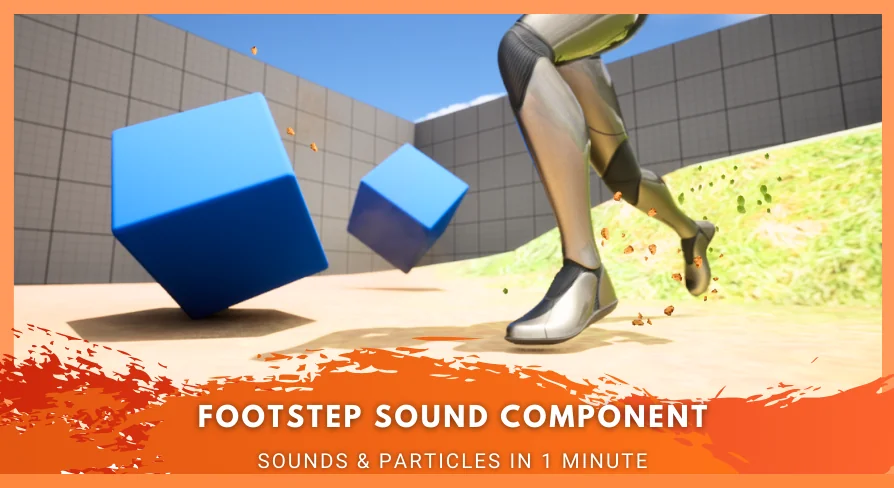
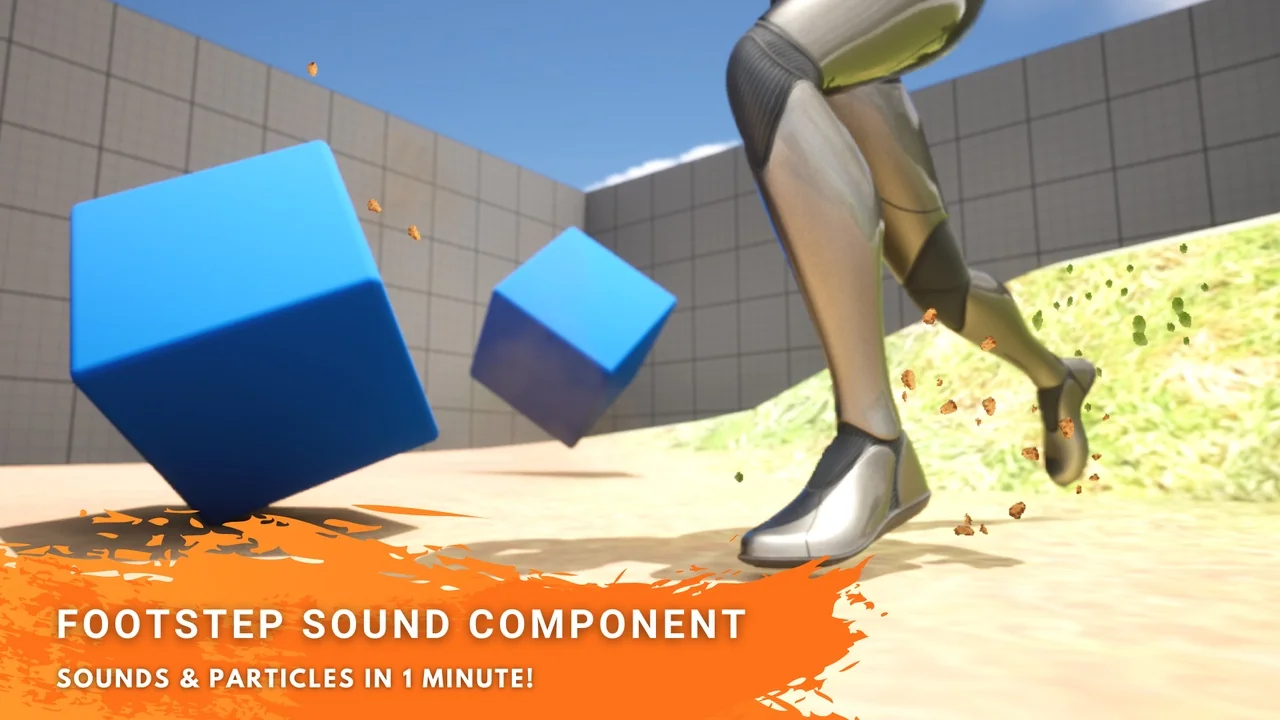
Particle emission operates in tandem with physical movement velocities and locomotion postures. Instead of playing static visual effects regardless of how the pawn moves, the component alters particle sizes dynamically based on the current movement mode. A character creeping along in a silent crouch or slow crawl disturbs minimal debris, resulting in subtle, scaled-down dust or dirt puffs. In contrast, shifting into a high-speed sprint increases the particle volume and size, casting larger bursts of soil or sand around the contact point to mirror the physical force exerted.
Water transitions receive specialized treatment through a dedicated splash system. When feet, paws, or colliding objects make impact with water-designated layers, the component swaps dry surface particles for liquid splashes. Like the solid-surface debris system, splash intensity and visual sizing respond directly to the speed and weight of the movement state. Rapid wading or sprinting through water generates pronounced splashes, while slow wading suppresses splash scales to match the subdued pace of the character.
Automated Animation Notifies and Actor Integration
Manual asset implementation across dozens of animation sequences often creates a significant production bottleneck. Footstep Sound Component streamlines this pipeline through automated animation notify generation. Rather than requiring developers to open individual walk, run, crouch, and crawl assets to place timing markers by hand on every left and right foot strike, the component can automatically add notifies directly into the animation assets. This automated pass guarantees precise frame alignment with skeletal mesh motion while freeing technical animators from repetitive placement tasks.
While character locomotion represents the primary use case, the component is not restricted strictly to player pawns or standard humanoid skeletal meshes. It is designed to work with any actor in the world. Props, debris, interactive objects, and non-player creatures can utilize the exact same component structure to manage their environmental contact feedback. Attaching the component to a physics-simulated crate or dropped weapon enables the same surface-sensitive sound generation and particle spawning when the object impacts grass, dirt, or water.
The architecture also maintains clean compatibility with companion tools, including the Dialogue Component, ensuring that ambient movement cues and conversational audio pipelines operate alongside one another without channel conflicts or blueprint hitches. For developers familiar with the minimal implementation found in The Immersive Template—which provides a stripped-back iteration restricted solely to default and grass layer footsteps—this standalone component represents the full, unconstrained framework containing the comprehensive surface matrix, dynamic particle scaling, and splash mechanics.
Template Compatibility and Locomotion System Environments
Adapting movement-driven audio frameworks into different project baselines can present integration friction. Footstep Sound Component resolves this by offering pre-configured compatibility and direct setup workflows across a wide range of standard gameplay configurations and marketplace locomotion architectures:
Default Third Person Project: Seamlessly hooks into standard third-person character blueprints to drive baseline walking, running, and jumping audio without re-rigging the character pawn.
First Person Template: Calibrates camera-relative spatial cues and immediate audio feedback tailored for isolated first-person arms and movement controllers.
Game Animation Sample Project: Interfaces with modern motion-matching setups, complex animation graphs, and layered locomotion states out of the box.
Survival Game Kit: Links into survival-oriented mechanics where crawling, crouching, gear management, and resource traversal demand distinct surface reactions.
Climbing, Sprinting - Open World Locomotion System: Leverages the full power of forward and backward trace sweeps to reliably process footfalls and grip contacts across free-climb surfaces, high-speed sprints, and variable open-world terrain.
Debugging Traces and Surface Behavior
Ensuring that physical materials report back correctly from line traces is critical during level blockout and polish phases. Footstep Sound Component includes built-in, easy debugging utilities that visually display trace lines, impact hits, and detected surface data in real time. Developers can activate debug displays to monitor precisely where the up/down and forward/backward line traces originate, where they strike geometry, and what physical material layer returns from the hit result.
This visibility prevents silent failures caused by unassigned physical materials, misconfigured collision channels, or inverted surface normals. If a character runs across terrain and fails to produce dirt particles or water splashes, visual debug vectors immediately illustrate whether the trace missed the collider entirely or if the surface responded as an unrecognized material. By unifying collision tracing, velocity-responsive particle sizing, surface-layer mapping, and automated animation notify pipelines into a single framework, Footstep Sound Component handles character-world physical feedback across varied project scales.
 Gameplay Features
 Gameplay Features
 Gameplay Features
 Gameplay Features