"b00678cacce53329"{"id":"1002860","slug":"fantasy-vfx-collection","title":"FANTASY VFX COLLECTION","category":"Variety","engine":"4.19+,5.0+","assetVersion":"","engineVersion":"Engine Version: 4.19+,5.0+","tag":"Variety","accent":"blue","visual":"mech","summary":"Fantasy VFX Collection provides a variety of elemental visual effects designed to build simple games, serving as the starting volume of a multi-part series.","platform":"Unreal Engine","indexPolicy":"index","publishedAt":"2026-11-20T12:40:56.633Z","updatedAt":"2026-11-20T12:40:56.633Z","sourceNotes":[],"fileContents":[],"compatibility":["Unreal Engine","Engine Version: 4.19+,5.0+"],"featuredImage":{"alt":"FANTASY VFX COLLECTION","src":"/wp-content/uploads/published/2026/11/e14710199cda-de197a71-672a-489c-9816-48e6e2a8210a-c2124c62fd.webp"},"fileSizeBytes":47349016,"hasDownloadLink":true,"downloads":0,"terms":[{"taxonomy":"category","slug":"variety-vfx","name":"Variety"}],"galleryImages":[{"src":"/wp-content/uploads/published/2026/11/70af445b9c7b-6ba46044-5a0c-4f71-9dde-1026a8819804-9a1da42acf.webp","alt":"FANTASY VFX COLLECTION"},{"src":"/wp-content/uploads/published/2026/11/60a3849a17c8-e74a7ec1-c429-4d27-868c-9a4e8d2b7992-8d08fb0840.webp","alt":"FANTASY VFX COLLECTION"},{"src":"/wp-content/uploads/published/2026/11/defda78a3428-092522a3-16b4-4012-9bbd-c5b9db59aa05-7e989ea6e1.webp","alt":"FANTASY VFX COLLECTION"},{"src":"/wp-content/uploads/published/2026/11/48fee5fa96c1-ad15c78c-a0ca-4e2b-902d-88a8f819f9c9-734f6d28bf.webp","alt":"FANTASY VFX COLLECTION"}],"accessPanel":{"kind":"resource","title":"Get this resource","safetyNote":"Resources are manually reviewed before listing to improve quality and reduce obvious risks.","fileName":"Content.7z","resourceType":"Resource archive","versions":[]},"contentHtml":"\u003ch2\u003eElemental Archetypes in the Fantasy VFX Collection\u003c/h2\u003e\n\u003cp\u003eElemental visuals serve as an essential visual foundation across real-time game combat, ability sequences, and interactive hazard setups. Fantasy VFX Collection provides an assortment of visual effects derived from core natural elements to support these fundamental project demands. Rather than focusing on hyper-specialized set pieces or isolated cinematic flourishes, the package concentrates on elemental variety. This gives developers a dependable visual vocabulary to depict kinetic force, natural energies, physical impacts, and magical interactions directly within a real-time environment.\u003c/p\u003e\n\u003cp\u003eVisual effects shaped by recognizable elemental themes allow players to instantly interpret incoming actions and outcomes during dynamic encounters. When an attack or interactive trigger carries a distinctive elemental signature, its nature, associated threat level, and mechanical role become immediately apparent. By gathering varied elemental manifestations into a single cohesive library, this collection supplies the primary visual feedback loops required for real-time actions, spellcasting execution, and reactive environmental occurrences.\u003c/p\u003e\n\u003cp\u003eAlso, grounding visual feedback in core elements simplifies the learning curve for players engaging with an unfamiliar gameplay system. Distinct energy signatures help differentiate offensive bursts from defensive barriers or lingering area-of-effect hazards. Because the collection focuses squarely on variety across these natural forces, developers can assign recognizable visual identities to opposing player classes, enemy archetypes, or divergent ability trees without needing to invent conflicting aesthetic treatments for each interaction.\u003c/p\u003e \u003ch2\u003eStructuring Real-Time Visuals in Fantasy Game Production\u003c/h2\u003e\n\u003cp\u003eDeveloping a focused, small-scale title requires assets that communicate primary game actions clearly without visually overwhelming the camera or demanding elaborate particle technicalities. The package is built specifically to assist in creating a simple game, providing enough elemental variation to populate player skills, obstacle triggers, and ambient events while keeping overall project scope manageable. A simple game relies on legible visual telegraphing to ensure players can track movement, anticipate enemy attacks, and react to rapid mechanical changes efficiently.\u003c/p\u003e\n\u003cp\u003eIn smaller interactive productions, visual clutter can quickly degrade the player experience. Overly dense or complex simulations can obstruct character silhouettes, conceal attack trajectories, and distract from core gameplay mechanics. Having access to a straightforward assortment of elemental effects enables creators to establish distinct combat roles, define projectile paths, and signal points of impact cleanly. This clarity is especially vital when constructing early game loops, iterating during rapid prototyping stages, or finishing complete indie titles that prioritize concise, readable encounters.\u003c/p\u003e\n\u003cp\u003eIn addition to runtime clarity, production efficiency is a primary advantage when working with targeted elemental packages. Creators building smaller projects often operate under tight resource budgets, where time spent engineering complex shaders or fine-tuning emitter parameters can detract from refining level layout, input responsiveness, and mechanic balance. Having ready-to-use elemental assets allows small teams to maintain continuous forward momentum during production cycles.\u003c/p\u003e \u003ch2\u003eIntegrating VFX Assets into Simple Gameplay Logic\u003c/h2\u003e\n\u003cp\u003eImplementing elemental effects into a playable build involves connecting them directly to character states, collision zones, and timing windows within the game engine. In a typical fantasy game loop, an elemental visual effect is tied to specific animation notifies, such as the apex of a staff swing, the moment a weapon strikes a collision surface, or the point at which an area-of-effect zone triggers. Because this collection provides an assortment of fundamental elemental forms, developers can easily map individual assets to matching logic gates and script triggers.\u003c/p\u003e\n\u003cp\u003eTiming remains critical across all real-time visual design. When an effect triggers, the duration of its initial burst, lingering presence, and final dissipation must align with the underlying hitboxes or collision checks running in the game code. Utilizing dedicated elemental visuals ensures that kinetic bursts, energetic discharges, or elemental surges correspond directly to active gameplay phases, giving the player precise visual confirmation when an ability connects, expires, or resets for another cycle.\u003c/p\u003e\n\u003cp\u003eBeyond instantaneous attack feedback, elemental assets play a vital role in communicating status effects and sustained states. A character affected by ongoing damage, an elemental shield, or an altered movement state requires continuous, readable particle signals that persist alongside the character mesh. By selecting matching elemental forms from the collection, developers can implement state indicators that remain coherent with the overall combat system and clearly legible against complex level backgrounds.\u003c/p\u003e \u003ch2\u003eThe Broader Lineage of the Fantasy VFX Series\u003c/h2\u003e\n\u003cp\u003eThis package stands as the starting point of an expansive multi-volume series dedicated to real-time fantasy visual design. While this initial release targets foundational elemental requirements, the development trajectory extends across several subsequent releases, including FantasyVFXCollection 2, FantasyVFXCollection 3, FantasyVFXCollection 4, and FantasyVFXCollection 5. Each subsequent entry continues the expansion of visual elements, supporting broader project needs as production scales upward.\u003c/p\u003e\n\u003cp\u003eThe progression across five dedicated releases reflects a modular design philosophy. Creators starting a project with the initial collection can maintain a consistent visual baseline while knowing that companion volumes exist to broaden their options. The creator has committed to bringing various additional effects in future installments, giving development teams a structured path for scaling up their spell lists, status indicators, and combat sequences without departing from the core aesthetic framework established in the opening volume.\u003c/p\u003e\n\u003cp\u003eThis sequential approach allows developers to manage project growth incrementally. Teams can validate their core combat systems and early levels using the initial elemental effects, only seeking out expanded volumes as their game demands deeper skill trees, more intricate boss mechanics, or diverse atmospheric encounters. By standardizing effect language across related releases, the series ensures visual consistency remains intact even as the scope of an interactive project widens.\u003c/p\u003e \u003ch2\u003eFantasy VFX Roles Across Scene Types and Prototypes\u003c/h2\u003e\n\u003cp\u003eBeyond active combat encounters, the elemental effects in Fantasy VFX Collection serve multiple utility roles within game environments and level design. Ambient zones often demand subtle natural phenomena, such as continuous elemental wisps, hazard markers indicating dangerous terrain, or interactive triggers that respond when a player approaches a puzzle element. The variety included across the package allows designers to dress these locations appropriately without crafting one-off visual assets from scratch.\u003c/p\u003e\n\u003cp\u003eFor teams building proof-of-concept builds or vertical slices, having ready access to elemental visual effects accelerates the validation of core mechanics. Instead of relying on placeholder gray-box materials or standard primitives to track projectile paths and hit confirmations, real-time effects can be placed immediately into the scene. This grounding helps designers, testers, and stakeholders evaluate the feel and responsiveness of character actions from the earliest stages of production through to final polish.\u003c/p\u003e\n\u003cp\u003eAlso, utilizing uniform elemental visuals across prototyping stages establishes an early baseline for camera framing, lighting interaction, and visual hierarchy. By observing how elemental bursts illuminate scene geometry and contrast against environment textures early in development, teams can refine their color palettes and post-processing setups long before entering the final optimization phase.\u003c/p\u003e\n\n\u003ch2\u003eRelated Resources Worth Checking\u003c/h2\u003e\n\u003cul\u003e\n\u003cli\u003e\u003ca href=\"https://3dcghub.com/vfx-attack-trails/\" rel=\"noopener noreferrer\"\u003eVFX Attack Trails\u003c/a\u003e\u003c/li\u003e\n\u003cli\u003e\u003ca href=\"https://3dcghub.com/magic-sigil-vfx-material-pack/\" rel=\"noopener noreferrer\"\u003eMagic Sigil VFX/Material Pack\u003c/a\u003e\u003c/li\u003e\n\u003cli\u003e\u003ca href=\"https://3dcghub.com/magic-explosions/\" rel=\"noopener noreferrer\"\u003eMagic Explosions\u003c/a\u003e\u003c/li\u003e\n\u003cli\u003e\u003ca href=\"https://3dcghub.com/fire-energy-vfx-pack/\" rel=\"noopener noreferrer\"\u003eFire Energy VFX Pack\u003c/a\u003e\u003c/li\u003e\n\u003cli\u003e\u003ca href=\"https://3dcghub.com/fantasy-vfx-collection-4/\" rel=\"noopener noreferrer\"\u003eFANTASY VFX COLLECTION \u0026#039;4\u0026#039;\u003c/a\u003e\u003c/li\u003e\n\u003c/ul\u003e","contentTextLength":8363,"navigation":{"current":20,"total":4797,"previous":{"id":"1002861","slug":"living-particles-niagara","title":"Living Particles Niagara","category":"Variety","platform":"Unreal Engine","updatedAt":"2026-11-20T12:42:01.224Z"},"next":{"id":"1002859","slug":"weapon-impact-fx","title":"Weapon Impact FX","category":"Variety","platform":"Unreal Engine","updatedAt":"2026-11-20T12:39:48.939Z"}},"relatedResources":[{"id":"1001915","slug":"vfx-attack-trails","title":"VFX Attack Trails","category":"Variety","engine":"4.26+,5.0+","assetVersion":"","engineVersion":"Engine Version: 4.26+,5.0+","tag":"Variety","accent":"blue","visual":"mech","summary":"Equip combat systems with VFX Attack Trails, featuring 13 Cascade and 13 Niagara trails, alongside hit and cast effects compatible with Modular Fantasy Knights.","platform":"Unreal Engine","indexPolicy":"index","publishedAt":"2026-10-22T11:52:25.654Z","updatedAt":"2026-10-22T11:52:25.654Z","sourceNotes":[],"fileContents":[],"compatibility":["Unreal Engine","Engine Version: 4.26+,5.0+"],"featuredImage":{"alt":"VFX Attack Trails","src":"/wp-content/uploads/published/2026/10/8eabaef1e52f-2148a916-d817-4ae5-aae6-5fac0b6a729c-214779413d.webp"},"fileSizeBytes":706228212,"hasDownloadLink":true,"downloads":2},{"id":"1002808","slug":"magic-sigil-vfx-material-pack","title":"Magic Sigil VFX/Material Pack","category":"Variety","engine":"4.24+,5.0+","assetVersion":"","engineVersion":"Engine Version: 4.24+,5.0+","tag":"Variety","accent":"blue","visual":"luts","summary":"Explore the Magic Sigil VFX/Material Pack, featuring 16 distinct sigils, 53 mix-and-match material states, and 20 pre-made stylized fantasy spell effects.","platform":"Unreal Engine","indexPolicy":"index","publishedAt":"2026-11-20T07:38:46.587Z","updatedAt":"2026-11-20T07:38:46.587Z","sourceNotes":[],"fileContents":[],"compatibility":["Unreal Engine","Engine Version: 4.24+,5.0+"],"featuredImage":{"alt":"Magic Sigil VFX/Material Pack","src":"/wp-content/uploads/published/2026/11/cd9b033897c1-41ce472d-c645-4e90-af38-106610feb0cb-3dcf0dcf2f.webp"},"fileSizeBytes":44536366,"hasDownloadLink":true,"downloads":0},{"id":"1002806","slug":"magic-explosions","title":"Magic Explosions","category":"Variety","engine":"4.19+,5.0+","assetVersion":"","engineVersion":"Engine Version: 4.19+,5.0+","tag":"Variety","accent":"blue","visual":"mech","summary":"Examine how the 16 particle effects in Magic Explosions support stylized game projects, fantasy combat, and time-based visual detonation dynamics.","platform":"Unreal Engine","indexPolicy":"index","publishedAt":"2026-11-20T07:36:38.300Z","updatedAt":"2026-11-20T07:36:38.300Z","sourceNotes":[],"fileContents":[],"compatibility":["Unreal Engine","Engine Version: 4.19+,5.0+"],"featuredImage":{"alt":"Magic Explosions","src":"/wp-content/uploads/published/2026/11/4bf6a8b76a51-7e4144aa-09e9-4479-abdc-375180eadbf4-7f28af9fe2.webp"},"fileSizeBytes":25075629,"hasDownloadLink":true,"downloads":0}]}
Resource screenshots
1 / 4
Join our channel
Follow 3DCGHUB on Telegram for new resource drops, migration updates, and community notices.
Resources are manually reviewed before listing to improve quality and reduce obvious risks.
No account required
Variety
FANTASY VFX COLLECTION
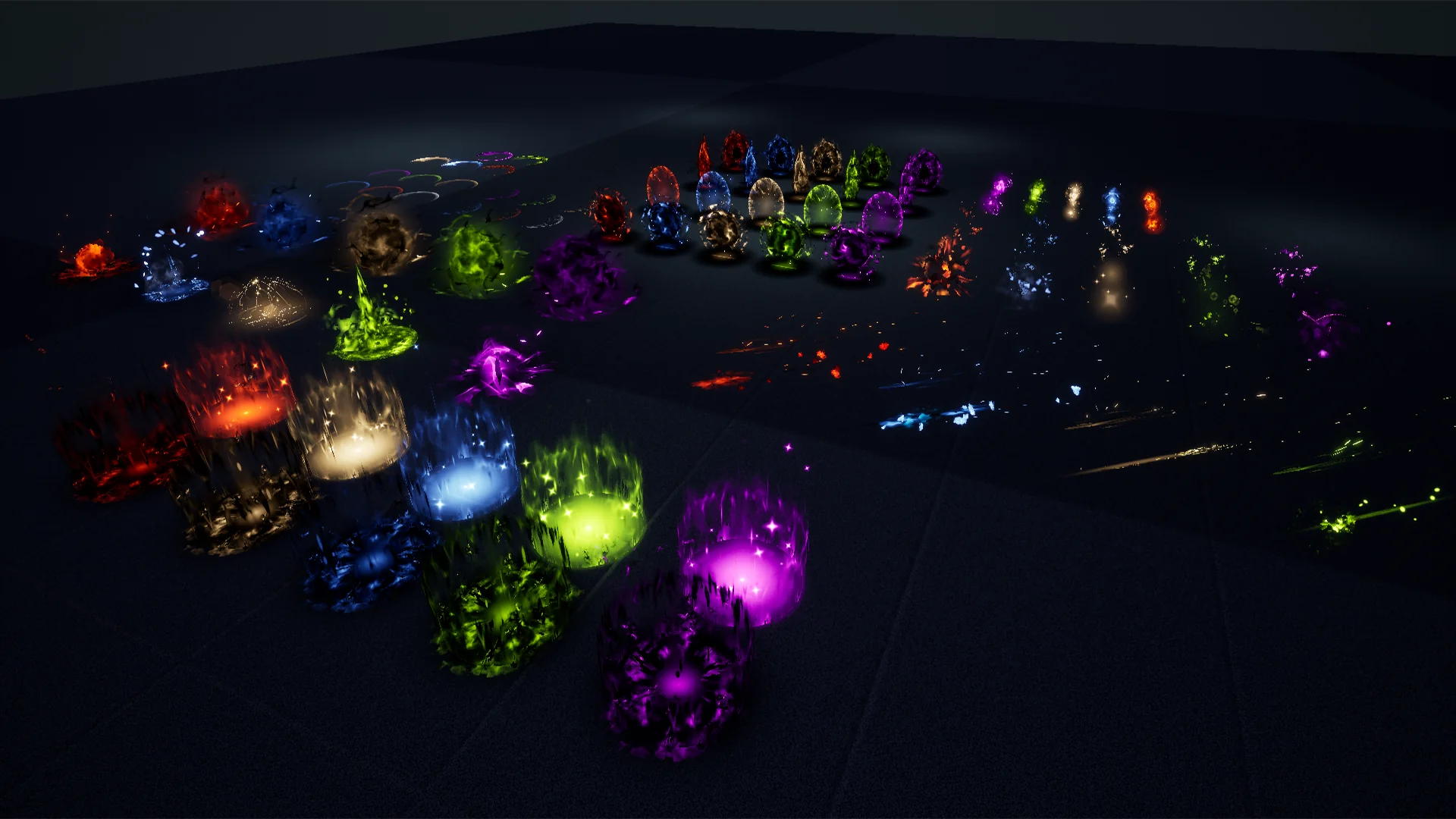
Fantasy VFX Collection provides a variety of elemental visual effects designed to build simple games, serving as the starting volume of a multi-part series.
Elemental Archetypes in the Fantasy VFX Collection
Elemental visuals serve as an essential visual foundation across real-time game combat, ability sequences, and interactive hazard setups. Fantasy VFX Collection provides an assortment of visual effects derived from core natural elements to support these fundamental project demands. Rather than focusing on hyper-specialized set pieces or isolated cinematic flourishes, the package concentrates on elemental variety. This gives developers a dependable visual vocabulary to depict kinetic force, natural energies, physical impacts, and magical interactions directly within a real-time environment.
Visual effects shaped by recognizable elemental themes allow players to instantly interpret incoming actions and outcomes during dynamic encounters. When an attack or interactive trigger carries a distinctive elemental signature, its nature, associated threat level, and mechanical role become immediately apparent. By gathering varied elemental manifestations into a single cohesive library, this collection supplies the primary visual feedback loops required for real-time actions, spellcasting execution, and reactive environmental occurrences.
Also, grounding visual feedback in core elements simplifies the learning curve for players engaging with an unfamiliar gameplay system. Distinct energy signatures help differentiate offensive bursts from defensive barriers or lingering area-of-effect hazards. Because the collection focuses squarely on variety across these natural forces, developers can assign recognizable visual identities to opposing player classes, enemy archetypes, or divergent ability trees without needing to invent conflicting aesthetic treatments for each interaction.
Structuring Real-Time Visuals in Fantasy Game Production
Developing a focused, small-scale title requires assets that communicate primary game actions clearly without visually overwhelming the camera or demanding elaborate particle technicalities. The package is built specifically to assist in creating a simple game, providing enough elemental variation to populate player skills, obstacle triggers, and ambient events while keeping overall project scope manageable. A simple game relies on legible visual telegraphing to ensure players can track movement, anticipate enemy attacks, and react to rapid mechanical changes efficiently.
In smaller interactive productions, visual clutter can quickly degrade the player experience. Overly dense or complex simulations can obstruct character silhouettes, conceal attack trajectories, and distract from core gameplay mechanics. Having access to a straightforward assortment of elemental effects enables creators to establish distinct combat roles, define projectile paths, and signal points of impact cleanly. This clarity is especially vital when constructing early game loops, iterating during rapid prototyping stages, or finishing complete indie titles that prioritize concise, readable encounters.
In addition to runtime clarity, production efficiency is a primary advantage when working with targeted elemental packages. Creators building smaller projects often operate under tight resource budgets, where time spent engineering complex shaders or fine-tuning emitter parameters can detract from refining level layout, input responsiveness, and mechanic balance. Having ready-to-use elemental assets allows small teams to maintain continuous forward momentum during production cycles.
Integrating VFX Assets into Simple Gameplay Logic
Implementing elemental effects into a playable build involves connecting them directly to character states, collision zones, and timing windows within the game engine. In a typical fantasy game loop, an elemental visual effect is tied to specific animation notifies, such as the apex of a staff swing, the moment a weapon strikes a collision surface, or the point at which an area-of-effect zone triggers. Because this collection provides an assortment of fundamental elemental forms, developers can easily map individual assets to matching logic gates and script triggers.
Timing remains critical across all real-time visual design. When an effect triggers, the duration of its initial burst, lingering presence, and final dissipation must align with the underlying hitboxes or collision checks running in the game code. Utilizing dedicated elemental visuals ensures that kinetic bursts, energetic discharges, or elemental surges correspond directly to active gameplay phases, giving the player precise visual confirmation when an ability connects, expires, or resets for another cycle.
Beyond instantaneous attack feedback, elemental assets play a vital role in communicating status effects and sustained states. A character affected by ongoing damage, an elemental shield, or an altered movement state requires continuous, readable particle signals that persist alongside the character mesh. By selecting matching elemental forms from the collection, developers can implement state indicators that remain coherent with the overall combat system and clearly legible against complex level backgrounds.
The Broader Lineage of the Fantasy VFX Series
This package stands as the starting point of an expansive multi-volume series dedicated to real-time fantasy visual design. While this initial release targets foundational elemental requirements, the development trajectory extends across several subsequent releases, including FantasyVFXCollection 2, FantasyVFXCollection 3, FantasyVFXCollection 4, and FantasyVFXCollection 5. Each subsequent entry continues the expansion of visual elements, supporting broader project needs as production scales upward.
The progression across five dedicated releases reflects a modular design philosophy. Creators starting a project with the initial collection can maintain a consistent visual baseline while knowing that companion volumes exist to broaden their options. The creator has committed to bringing various additional effects in future installments, giving development teams a structured path for scaling up their spell lists, status indicators, and combat sequences without departing from the core aesthetic framework established in the opening volume.
This sequential approach allows developers to manage project growth incrementally. Teams can validate their core combat systems and early levels using the initial elemental effects, only seeking out expanded volumes as their game demands deeper skill trees, more intricate boss mechanics, or diverse atmospheric encounters. By standardizing effect language across related releases, the series ensures visual consistency remains intact even as the scope of an interactive project widens.
Fantasy VFX Roles Across Scene Types and Prototypes
Beyond active combat encounters, the elemental effects in Fantasy VFX Collection serve multiple utility roles within game environments and level design. Ambient zones often demand subtle natural phenomena, such as continuous elemental wisps, hazard markers indicating dangerous terrain, or interactive triggers that respond when a player approaches a puzzle element. The variety included across the package allows designers to dress these locations appropriately without crafting one-off visual assets from scratch.
For teams building proof-of-concept builds or vertical slices, having ready access to elemental visual effects accelerates the validation of core mechanics. Instead of relying on placeholder gray-box materials or standard primitives to track projectile paths and hit confirmations, real-time effects can be placed immediately into the scene. This grounding helps designers, testers, and stakeholders evaluate the feel and responsiveness of character actions from the earliest stages of production through to final polish.
Also, utilizing uniform elemental visuals across prototyping stages establishes an early baseline for camera framing, lighting interaction, and visual hierarchy. By observing how elemental bursts illuminate scene geometry and contrast against environment textures early in development, teams can refine their color palettes and post-processing setups long before entering the final optimization phase.
 Variety
 Variety
 Variety