"b00678cacce53329"{"id":"1002789","slug":"fantasy-vfx-collection-4","title":"FANTASY VFX COLLECTION '4'","category":"Variety","engine":"4.19+,5.0+","assetVersion":"","engineVersion":"Engine Version: 4.19+,5.0+","tag":"Variety","accent":"blue","visual":"mech","summary":"An examination of Fantasy VFX Collection '4', exploring elemental visual effects, game feedback loops, and multi-part asset integration for simple games.","platform":"Unreal Engine","indexPolicy":"index","publishedAt":"2026-11-20T07:11:55.402Z","updatedAt":"2026-11-20T07:11:55.402Z","sourceNotes":[],"fileContents":[],"compatibility":["Unreal Engine","Engine Version: 4.19+,5.0+"],"featuredImage":{"alt":"FANTASY VFX COLLECTION '4'","src":"/wp-content/uploads/published/2026/11/469fe4753e8c-f53141c0-8b2d-4d33-841e-30db087bc31e-7a8be60ac6.webp"},"fileSizeBytes":64115801,"hasDownloadLink":true,"downloads":0,"terms":[{"taxonomy":"category","slug":"variety-vfx","name":"Variety"}],"galleryImages":[{"src":"/wp-content/uploads/published/2026/11/7b4f7f838155-2f0d50c1-b449-4db6-bcbe-2b3029d660c5-602d669479.webp","alt":"FANTASY VFX COLLECTION '4'"},{"src":"/wp-content/uploads/published/2026/11/5f98bb85ce68-c170497a-4b98-4044-a272-ca1f7e0675d4-c55888a35f.webp","alt":"FANTASY VFX COLLECTION '4'"},{"src":"/wp-content/uploads/published/2026/11/31a972c5b350-0b51ccec-80ee-43d6-92b4-7f1cb4e31254-5cb8fe19ff.webp","alt":"FANTASY VFX COLLECTION '4'"},{"src":"/wp-content/uploads/published/2026/11/3d7119f4a6b0-5192eaf7-0954-4961-bdd5-cadc0cf0042e-28f8d379f2.webp","alt":"FANTASY VFX COLLECTION '4'"},{"src":"/wp-content/uploads/published/2026/11/c7a40396fbcf-e3ee5481-422d-443b-8e19-6935ab203950-d8df0074e2.webp","alt":"FANTASY VFX COLLECTION '4'"}],"accessPanel":{"kind":"resource","title":"Get this resource","safetyNote":"Resources are manually reviewed before listing to improve quality and reduce obvious risks.","fileName":"Content.7z","resourceType":"Resource archive","versions":[]},"contentHtml":"\u003ch2\u003eElemental Systems in Fantasy VFX Collection '4'\u003c/h2\u003e\n\u003cp\u003eReal-time visual effects are the primary bridge between raw game logic and player comprehension. When a combat mechanic triggers or a spell resolves, the underlying mathematical calculations must translate into an immediate, unmistakable visual cue. Fantasy VFX Collection '4' addresses this requirement by providing a diverse range of elemental visual effects arranged to support the construction of a simple game. By focusing on elemental identities, the collection supplies the essential graphical vocabulary needed to denote different damage typologies, magical schools, and environmental interactions.\u003c/p\u003e\n\u003cp\u003eElemental themes have long formed the foundational structure of fantasy combat systems. Standardizing visual presentations around fire, frost, lightning, earth, wind, or related elemental forces allows developers to convey interactive information without relying on heavy interface markers or text callouts. A player encountering a burst of elemental energy instinctively reads the nature of the hazard or ability based on its color, motion, and visual persistence. Fantasy VFX Collection '4' targets these fundamental needs, providing modular effect assets that can be attached to character sockets, projectile actors, surface impact points, and area-of-effect triggers.\u003c/p\u003e \u003ch2\u003eIntegrating Fantasy VFX Collection '4' into Simple Game Frameworks\u003c/h2\u003e\n\u003cp\u003eDeveloping a focused, functional title requires strict attention to visual clarity. In simple games, where player attention is focused on tight play spaces or rapid combat exchanges, visual effects must balance readability with performance. Overly dense, opaque simulations can clutter the viewport, obscure character silhouettes, and make precise spatial judgment impossible. Conversely, understated or disconnected effects fail to reward the player or clarify mechanics. Fantasy VFX Collection '4' is specifically positioned to assist developers in establishing this equilibrium during production.\u003c/p\u003e\n\u003cp\u003eImplementing an elemental package into a simple game architecture typically begins with core mechanic mapping. A standard action or role-playing setup demands three major visual communication layers: preparation cues, active propagation, and impact confirmation. Preparation cues signal to both the player and opponents that an action is charging, active propagation gives form to projectiles or sweeping melee trails, and impact confirmation communicates whether the ability struck a target or the environment. Fantasy VFX Collection '4' provides the visual components necessary to populate these three phases across elemental categories, allowing programmers and designers to rig complete spell and ability loops without pausing to build custom shaders or particle textures from scratch.\u003c/p\u003e \u003ch2\u003eThe Multi-Part Fantasy VFX Collection Series Architecture\u003c/h2\u003e\n\u003cp\u003eFantasy VFX Collection '4' does not exist in isolation; it forms part of an expansive, sequential library that includes Fantasy VFX Collection '1', Fantasy VFX Collection '2', Fantasy VFX Collection '3', and Fantasy VFX Collection '5'. This multi-volume structure serves a deliberate production purpose. By breaking the asset line into distinct numbered releases, the developer enables creators to acquire and integrate specific functional subsets of visual effects rather than managing an unwieldy, monolithic repository.\u003c/p\u003e\n\u003cp\u003eWhen working across an interconnected series of releases, maintaining visual consistency across volumes is paramount. Projects that expand their scope over time often suffer from artistic fragmentation when assets from disparate creators are imported into the same scene. Because Fantasy VFX Collection '4' shares its design lineage with the surrounding collections in the series, it integrates smoothly alongside them. Studios expanding from a rudimentary prototype into a broader game world can draw from the earlier or later iterations to broaden their catalog of magic types, enemy abilities, and boss encounters while preserving a uniform aesthetic standard.\u003c/p\u003e \u003ch2\u003eVisual Feedback and Gameplay Readability\u003c/h2\u003e\n\u003cp\u003eIn mechanical design, player feedback relies heavily on the temporal staging of visual effects. Every effect must have an appropriate spawn curve, peak brightness, and dissipation time. An elemental explosion that lingers too long can falsely register as a continuing damage zone, whereas a lingering environmental hazard that vanishes too quickly leaves players confused when damage continues to tick. The assets within Fantasy VFX Collection '4' are structured to meet the pacing demands of active combat encounters, ensuring that each elemental blast, spark, or aura carries an intuitive duration.\u003c/p\u003e\n\u003cp\u003eColor space and luminescence also factor into how these elemental effects communicate priority. In a chaotic skirmish involving multiple active entities, critical visual feedback must cut through ambient lighting and scene geometry. The elemental variations included in this package allow for instant functional categorization. For example, defensive barriers require distinct spatial boundaries, while offensive bursts require sharp bursts of light to highlight point-of-impact coordinates. Utilizing a unified elemental suite ensures that these distinct interactions remain internally coherent, preventing confusion during frantic gameplay moments.\u003c/p\u003e \u003ch2\u003eProduction Utility and Prototyping Workflows\u003c/h2\u003e\n\u003cp\u003ePrototyping is often slowed down by the absence of functional visual assets. Mechanics tested with plain geometric primitives or static color changes can obscure whether an ability feels satisfying or whether its timing is tuned correctly. Integrating Fantasy VFX Collection '4' into the early stages of development allows technical designers to test hitboxes, animation notifies, and particle attachment points using representative visual elements. This immediate visual grounding provides clearer feedback during user testing, making it easier to evaluate weapon ranges, spell radiuses, and cast intervals.\u003c/p\u003e\n\u003cp\u003eBeyond initial testing, the collection provides the foundational polish needed to carry an indie game, game jam project, or vertical slice to completion. Rather than leaving particle creation as a bottleneck near the end of a milestone, teams can assign the elemental assets directly to their gameplay classes, blueprints, or state machines. This setup frees up engineering time to concentrate on core physics, character movement, enemy artificial intelligence, and level scripting, confident that the essential visual feedback loop is securely in place.\u003c/p\u003e\n\n\u003ch2\u003eContinue Browsing Similar Packs\u003c/h2\u003e\n\u003cul\u003e\n\u003cli\u003e\u003ca href=\"https://3dcghub.com/vfx-attack-trails/\" rel=\"noopener noreferrer\"\u003eVFX Attack Trails\u003c/a\u003e\u003c/li\u003e\n\u003cli\u003e\u003ca href=\"https://3dcghub.com/fantasy-vfx-collection-3/\" rel=\"noopener noreferrer\"\u003eFANTASY VFX COLLECTION \u0026#039;3\u0026#039;\u003c/a\u003e\u003c/li\u003e\n\u003cli\u003e\u003ca href=\"https://3dcghub.com/fantasy-wings/\" rel=\"noopener noreferrer\"\u003eFantasy Wings\u003c/a\u003e\u003c/li\u003e\n\u003cli\u003e\u003ca href=\"https://3dcghub.com/vfx-backgrounds/\" rel=\"noopener noreferrer\"\u003eVFX Backgrounds\u003c/a\u003e\u003c/li\u003e\n\u003cli\u003e\u003ca href=\"https://3dcghub.com/portal-pack-niagara-vfx/\" rel=\"noopener noreferrer\"\u003ePortal Pack -Niagara VFX\u003c/a\u003e\u003c/li\u003e\n\u003c/ul\u003e","contentTextLength":6672,"navigation":{"current":91,"total":4797,"previous":{"id":"1002790","slug":"fire-builder","title":"Fire Builder","category":"Variety","platform":"Unreal Engine","updatedAt":"2026-11-20T07:13:10.323Z"},"next":{"id":"1002788","slug":"fantasy-vfx-collection-3","title":"FANTASY VFX COLLECTION '3'","category":"Variety","platform":"Unreal Engine","updatedAt":"2026-11-20T07:11:07.062Z"}},"relatedResources":[{"id":"1001915","slug":"vfx-attack-trails","title":"VFX Attack Trails","category":"Variety","engine":"4.26+,5.0+","assetVersion":"","engineVersion":"Engine Version: 4.26+,5.0+","tag":"Variety","accent":"blue","visual":"mech","summary":"Equip combat systems with VFX Attack Trails, featuring 13 Cascade and 13 Niagara trails, alongside hit and cast effects compatible with Modular Fantasy Knights.","platform":"Unreal Engine","indexPolicy":"index","publishedAt":"2026-10-22T11:52:25.654Z","updatedAt":"2026-10-22T11:52:25.654Z","sourceNotes":[],"fileContents":[],"compatibility":["Unreal Engine","Engine Version: 4.26+,5.0+"],"featuredImage":{"alt":"VFX Attack Trails","src":"/wp-content/uploads/published/2026/10/8eabaef1e52f-2148a916-d817-4ae5-aae6-5fac0b6a729c-214779413d.webp"},"fileSizeBytes":706228212,"hasDownloadLink":true,"downloads":2},{"id":"1002860","slug":"fantasy-vfx-collection","title":"FANTASY VFX COLLECTION","category":"Variety","engine":"4.19+,5.0+","assetVersion":"","engineVersion":"Engine Version: 4.19+,5.0+","tag":"Variety","accent":"blue","visual":"mech","summary":"Fantasy VFX Collection provides a variety of elemental visual effects designed to build simple games, serving as the starting volume of a multi-part series.","platform":"Unreal Engine","indexPolicy":"index","publishedAt":"2026-11-20T12:40:56.633Z","updatedAt":"2026-11-20T12:40:56.633Z","sourceNotes":[],"fileContents":[],"compatibility":["Unreal Engine","Engine Version: 4.19+,5.0+"],"featuredImage":{"alt":"FANTASY VFX COLLECTION","src":"/wp-content/uploads/published/2026/11/e14710199cda-de197a71-672a-489c-9816-48e6e2a8210a-c2124c62fd.webp"},"fileSizeBytes":47349016,"hasDownloadLink":true,"downloads":0},{"id":"1002808","slug":"magic-sigil-vfx-material-pack","title":"Magic Sigil VFX/Material Pack","category":"Variety","engine":"4.24+,5.0+","assetVersion":"","engineVersion":"Engine Version: 4.24+,5.0+","tag":"Variety","accent":"blue","visual":"luts","summary":"Explore the Magic Sigil VFX/Material Pack, featuring 16 distinct sigils, 53 mix-and-match material states, and 20 pre-made stylized fantasy spell effects.","platform":"Unreal Engine","indexPolicy":"index","publishedAt":"2026-11-20T07:38:46.587Z","updatedAt":"2026-11-20T07:38:46.587Z","sourceNotes":[],"fileContents":[],"compatibility":["Unreal Engine","Engine Version: 4.24+,5.0+"],"featuredImage":{"alt":"Magic Sigil VFX/Material Pack","src":"/wp-content/uploads/published/2026/11/cd9b033897c1-41ce472d-c645-4e90-af38-106610feb0cb-3dcf0dcf2f.webp"},"fileSizeBytes":44536366,"hasDownloadLink":true,"downloads":0}]}
Resource screenshots
1 / 5
Join our channel
Follow 3DCGHUB on Telegram for new resource drops, migration updates, and community notices.
Resources are manually reviewed before listing to improve quality and reduce obvious risks.
No account required
Variety
FANTASY VFX COLLECTION '4'
An examination of Fantasy VFX Collection '4', exploring elemental visual effects, game feedback loops, and multi-part asset integration for simple games.
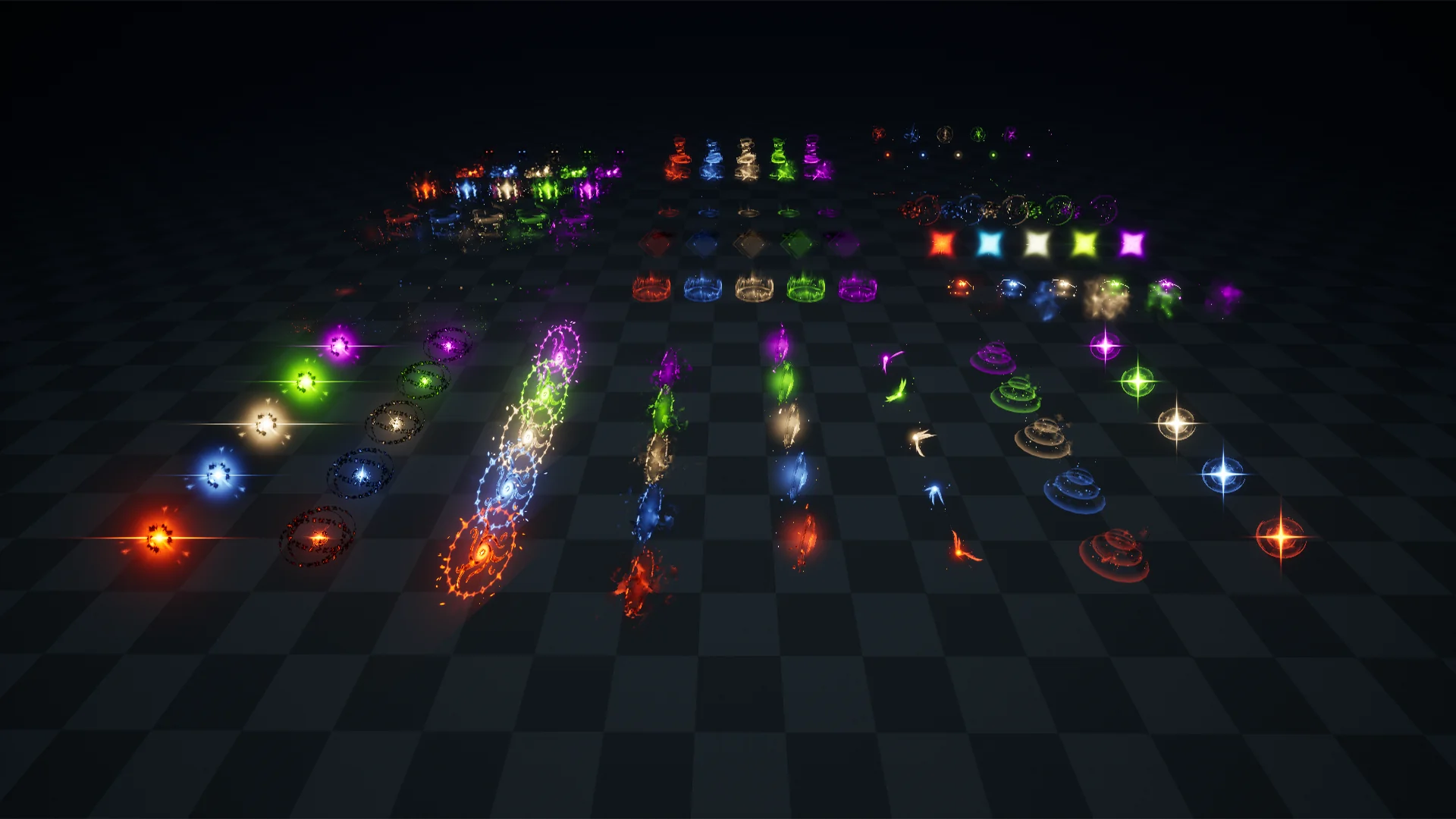
Real-time visual effects are the primary bridge between raw game logic and player comprehension. When a combat mechanic triggers or a spell resolves, the underlying mathematical calculations must translate into an immediate, unmistakable visual cue. Fantasy VFX Collection '4' addresses this requirement by providing a diverse range of elemental visual effects arranged to support the construction of a simple game. By focusing on elemental identities, the collection supplies the essential graphical vocabulary needed to denote different damage typologies, magical schools, and environmental interactions.
Elemental themes have long formed the foundational structure of fantasy combat systems. Standardizing visual presentations around fire, frost, lightning, earth, wind, or related elemental forces allows developers to convey interactive information without relying on heavy interface markers or text callouts. A player encountering a burst of elemental energy instinctively reads the nature of the hazard or ability based on its color, motion, and visual persistence. Fantasy VFX Collection '4' targets these fundamental needs, providing modular effect assets that can be attached to character sockets, projectile actors, surface impact points, and area-of-effect triggers.
Integrating Fantasy VFX Collection '4' into Simple Game Frameworks
Developing a focused, functional title requires strict attention to visual clarity. In simple games, where player attention is focused on tight play spaces or rapid combat exchanges, visual effects must balance readability with performance. Overly dense, opaque simulations can clutter the viewport, obscure character silhouettes, and make precise spatial judgment impossible. Conversely, understated or disconnected effects fail to reward the player or clarify mechanics. Fantasy VFX Collection '4' is specifically positioned to assist developers in establishing this equilibrium during production.
Implementing an elemental package into a simple game architecture typically begins with core mechanic mapping. A standard action or role-playing setup demands three major visual communication layers: preparation cues, active propagation, and impact confirmation. Preparation cues signal to both the player and opponents that an action is charging, active propagation gives form to projectiles or sweeping melee trails, and impact confirmation communicates whether the ability struck a target or the environment. Fantasy VFX Collection '4' provides the visual components necessary to populate these three phases across elemental categories, allowing programmers and designers to rig complete spell and ability loops without pausing to build custom shaders or particle textures from scratch.
The Multi-Part Fantasy VFX Collection Series Architecture
Fantasy VFX Collection '4' does not exist in isolation; it forms part of an expansive, sequential library that includes Fantasy VFX Collection '1', Fantasy VFX Collection '2', Fantasy VFX Collection '3', and Fantasy VFX Collection '5'. This multi-volume structure serves a deliberate production purpose. By breaking the asset line into distinct numbered releases, the developer enables creators to acquire and integrate specific functional subsets of visual effects rather than managing an unwieldy, monolithic repository.
When working across an interconnected series of releases, maintaining visual consistency across volumes is paramount. Projects that expand their scope over time often suffer from artistic fragmentation when assets from disparate creators are imported into the same scene. Because Fantasy VFX Collection '4' shares its design lineage with the surrounding collections in the series, it integrates smoothly alongside them. Studios expanding from a rudimentary prototype into a broader game world can draw from the earlier or later iterations to broaden their catalog of magic types, enemy abilities, and boss encounters while preserving a uniform aesthetic standard.
Visual Feedback and Gameplay Readability
In mechanical design, player feedback relies heavily on the temporal staging of visual effects. Every effect must have an appropriate spawn curve, peak brightness, and dissipation time. An elemental explosion that lingers too long can falsely register as a continuing damage zone, whereas a lingering environmental hazard that vanishes too quickly leaves players confused when damage continues to tick. The assets within Fantasy VFX Collection '4' are structured to meet the pacing demands of active combat encounters, ensuring that each elemental blast, spark, or aura carries an intuitive duration.
Color space and luminescence also factor into how these elemental effects communicate priority. In a chaotic skirmish involving multiple active entities, critical visual feedback must cut through ambient lighting and scene geometry. The elemental variations included in this package allow for instant functional categorization. For example, defensive barriers require distinct spatial boundaries, while offensive bursts require sharp bursts of light to highlight point-of-impact coordinates. Utilizing a unified elemental suite ensures that these distinct interactions remain internally coherent, preventing confusion during frantic gameplay moments.
Production Utility and Prototyping Workflows
Prototyping is often slowed down by the absence of functional visual assets. Mechanics tested with plain geometric primitives or static color changes can obscure whether an ability feels satisfying or whether its timing is tuned correctly. Integrating Fantasy VFX Collection '4' into the early stages of development allows technical designers to test hitboxes, animation notifies, and particle attachment points using representative visual elements. This immediate visual grounding provides clearer feedback during user testing, making it easier to evaluate weapon ranges, spell radiuses, and cast intervals.
Beyond initial testing, the collection provides the foundational polish needed to carry an indie game, game jam project, or vertical slice to completion. Rather than leaving particle creation as a bottleneck near the end of a milestone, teams can assign the elemental assets directly to their gameplay classes, blueprints, or state machines. This setup frees up engineering time to concentrate on core physics, character movement, enemy artificial intelligence, and level scripting, confident that the essential visual feedback loop is securely in place.
 Variety
 Variety
 Variety