"b00678cacce53329"{"id":"1002806","slug":"magic-explosions","title":"Magic Explosions","category":"Variety","engine":"4.19+,5.0+","assetVersion":"","engineVersion":"Engine Version: 4.19+,5.0+","tag":"Variety","accent":"blue","visual":"mech","summary":"Examine how the 16 particle effects in Magic Explosions support stylized game projects, fantasy combat, and time-based visual detonation dynamics.","platform":"Unreal Engine","indexPolicy":"index","publishedAt":"2026-11-20T07:36:38.300Z","updatedAt":"2026-11-20T07:36:38.300Z","sourceNotes":[],"fileContents":[],"compatibility":["Unreal Engine","Engine Version: 4.19+,5.0+"],"featuredImage":{"alt":"Magic Explosions","src":"/wp-content/uploads/published/2026/11/4bf6a8b76a51-7e4144aa-09e9-4479-abdc-375180eadbf4-7f28af9fe2.webp"},"fileSizeBytes":25075629,"hasDownloadLink":true,"downloads":0,"terms":[{"taxonomy":"category","slug":"variety-vfx","name":"Variety"}],"galleryImages":[{"src":"/wp-content/uploads/published/2026/11/460ed5866c3f-aed7c209-9cfb-4899-80ec-26f26edc26d7-21000456d3.webp","alt":"Magic Explosions"},{"src":"/wp-content/uploads/published/2026/11/bce444551568-bf673c34-9ca1-4d3e-a2d1-60aed3088556-79fda8fbea.webp","alt":"Magic Explosions"},{"src":"/wp-content/uploads/published/2026/11/6615e80c5d09-a480d198-fd2e-4789-9252-8b022f0a3361-0651ce3093.webp","alt":"Magic Explosions"},{"src":"/wp-content/uploads/published/2026/11/ea1c7c3a4bf5-5c952165-b500-4456-9eb6-d7a7994868d2-7cf4f2644b.webp","alt":"Magic Explosions"},{"src":"/wp-content/uploads/published/2026/11/7fb164b07cd7-ad4a642a-4a33-4dd0-acea-88a72abad82d-dbe5ee2cb9.webp","alt":"Magic Explosions"},{"src":"/wp-content/uploads/published/2026/11/80e7a7921675-665dc00a-0f8e-44e8-843e-329a955df9d9-29d7e8c7d4.webp","alt":"Magic Explosions"},{"src":"/wp-content/uploads/published/2026/11/1ba39692f890-bc9a18e2-0e13-44fb-9b5a-ed433a699e4e-662c7d4b15.webp","alt":"Magic Explosions"},{"src":"/wp-content/uploads/published/2026/11/ae6b7ec36cb7-234d26d4-b9e7-4d24-9d3d-887823be3780-487fe13896.webp","alt":"Magic Explosions"}],"accessPanel":{"kind":"resource","title":"Get this resource","safetyNote":"Resources are manually reviewed before listing to improve quality and reduce obvious risks.","fileName":"Content.7z","resourceType":"Resource archive","versions":[]},"contentHtml":"\u003ch2\u003eVisual Demands of Magic Explosions in Stylized Projects\u003c/h2\u003e\n\u003cp\u003eStylized game environments rely on clean silhouettes, readable color language, and distinct motion profiles to convey action. When combat sequences, spellcasting, or environmental hazards call for a sudden release of energy, standard combustion visuals rarely fit the established aesthetic. Realistic fiery detonations often incorporate heavy smoke, irregular soot, and photorealistic noise that clash directly with stylized rendering pipelines. Magic Explosions fills this specific visual requirement by offering sixteen particle effects tailored directly for non-photorealistic worlds that require fantastical energy detonations.\u003c/p\u003e\n\u003cp\u003eIn stylized action titles, magical blasts must communicate immediate visual feedback without muddying the screen. Every particle emitted during an explosion carries gameplay information, signaling to the player where the hazard originated, its current area of effect, and when the danger zone clears. By centering on magic-driven detonations, this asset set enables developers to represent unnatural, arcane, or supernatural forces erupting within the game world. The visual styling ensures that the blast radius remains legible against stylized terrain, stylized character models, and saturated environment palettes.\u003c/p\u003e \u003ch2\u003eTime and Detonation Profiles Across Particle Effects\u003c/h2\u003e\n\u003cp\u003eTime is an essential property of any visual detonation. An explosion cannot function as a static image; it is an animated sequence defined by its duration, acceleration, peak visual energy, and eventual falloff. Within the sixteen particle effects, temporal pacing defines how each burst feels during live gameplay. Fast, instantaneous eruptions deliver snappy, responsive visual confirmation for rapid-fire abilities, whereas slower, blossoming bursts suggest accumulated power, lingering danger, or high-tier spell impact.\u003c/p\u003e\n\u003cp\u003eControlling the passage of time across an effect allows visual artists to tune how players read threats. A magical explosion typically moves through distinct temporal phases. The first instant involves an intense flash or energy focus at the point of origin, immediately drawing the player's attention. This is followed by rapid radial expansion where particles shoot outward, carrying the energy of the blast. The final phase involves dissipation, where residual magical flecks, sparks, or energetic wisps fade into the atmosphere over a set duration. Having access to multiple effect variations gives creators the ability to match specific detonation timing profiles to their mechanics, whether an attack needs a split-second pop or an expansive, lingering burst.\u003c/p\u003e \u003ch2\u003eBridging Real Explosive Force and Fantasy Magic\u003c/h2\u003e\n\u003cp\u003eEffective stylized visual effects often borrow fundamental principles from real-world physics and recontextualize them through a fantasy lens. Real explosions involve violent displacement, pressure waves, rapid thermal expansion, and particle dispersal. When an effect ignores these physical instincts entirely, it risks feeling weightless or disconnected from the game world. Fantasy magic, on the other hand, breaks away from mundane chemistry by introducing vibrant colors, impossible motion curves, and ethereal behavior that real fire and fuel cannot produce.\u003c/p\u003e\n\u003cp\u003eBy balancing real explosive behavior with fantasy magic, these sixteen particle effects provide visual punch that still obeys intuitive expectations of physical force. The radial velocity, directional shock, and central core burst mirror the impact dynamics of real detonations, ensuring that players register an authentic sense of shock and kinetic release. Simultaneously, the stylized fantasy treatment replaces standard soot and dull debris with luminous magical elements. This hybrid approach ensures the effects feel satisfyingly heavy and impactful while preserving the whimsical, arcane, or mythic tone required by fantasy gameplay.\u003c/p\u003e \u003ch2\u003eDeploying 16 Particle Effects Across Gameplay Encounters\u003c/h2\u003e\n\u003cp\u003eHaving sixteen distinct particle effects gives developers enough range to build a clear visual hierarchy across an entire project. In combat-heavy stylized games, relying on a single explosion effect for every spell, trap, and enemy encounter rapidly creates visual repetition. Players lose the ability to differentiate between minor hazards and lethal attacks when every blast looks identical. With sixteen distinct configurations, a production team can map specific effects to varying tiers of power, distinct elemental affinities, or contrasting combat roles.\u003c/p\u003e\n\u003cp\u003eSmaller, tighter bursts can be assigned to basic player projectiles, quick counter-attacks, or breakable gameplay props that release magic upon destruction. Mid-sized detonations work naturally for area-of-effect spells, heavy melee impacts, or standard enemy charge-up attacks. The largest and most elaborate explosions in the set can be reserved for boss phase transitions, ultimate abilities, or climactic environmental events that require dominant visual presence on the screen. Because all sixteen effects share a coherent stylized fantasy direction, developers can distribute them across a game without breaking aesthetic consistency between different scenes and encounters.\u003c/p\u003e \u003ch2\u003eTarget Implementations for Magic Explosions\u003c/h2\u003e\n\u003cp\u003eProductions that benefit most from this collection are stylized fantasy role-playing games, arena combat titles, arcade brawlers, and top-down action projects that prioritize readability and stylized flair over photorealism. Solo developers and small teams working within stylized art pipelines often struggle to produce a consistent library of explosive magic effects from scratch, as tuning particle lifetimes, expansion curves, and fantasy colors demands dedicated visual-effects iteration. Deploying a cohesive pack of sixteen stylized magical explosions provides an immediate solution for combat feedback, spellcraft systems, and ambient magical hazards across any stylized fantasy game world.\u003c/p\u003e\n\n\u003ch2\u003eMore From The Same Workflow\u003c/h2\u003e\n\u003cul\u003e\n\u003cli\u003e\u003ca href=\"https://3dcghub.com/niagara-bigvfx-pack/\" rel=\"noopener noreferrer\"\u003eNiagara BigVFX Pack\u003c/a\u003e\u003c/li\u003e\n\u003cli\u003e\u003ca href=\"https://3dcghub.com/explosion-pack-1-nature-elements/\" rel=\"noopener noreferrer\"\u003eExplosion Pack #1 - Nature Elements\u003c/a\u003e\u003c/li\u003e\n\u003cli\u003e\u003ca href=\"https://3dcghub.com/explosion-blueprints/\" rel=\"noopener noreferrer\"\u003eExplosion Blueprints\u003c/a\u003e\u003c/li\u003e\n\u003cli\u003e\u003ca href=\"https://3dcghub.com/aoe-magic-abilities-vol-1/\" rel=\"noopener noreferrer\"\u003eAoE Magic Abilities Vol. 1\u003c/a\u003e\u003c/li\u003e\n\u003cli\u003e\u003ca href=\"https://3dcghub.com/runesvfx/\" rel=\"noopener noreferrer\"\u003eRunesVFX\u003c/a\u003e\u003c/li\u003e\n\u003c/ul\u003e","contentTextLength":6088,"navigation":{"current":74,"total":4797,"previous":{"id":"1002807","slug":"magic-fire-spells-with-sounds","title":"Magic Fire Spells with Sounds","category":"Spells \u0026 Combat","platform":"Unreal Engine","updatedAt":"2026-11-20T07:37:46.142Z"},"next":{"id":"1002805","slug":"m5-vfx-vol1-smoke-and-big-explosion-niagara","title":"M5 VFX Vol1. Smoke and Big Explosion(Niagara)","category":"Fire \u0026 Explosions","platform":"Unreal Engine","updatedAt":"2026-11-20T07:34:39.854Z"}},"relatedResources":[{"id":"17233","slug":"niagara-bigvfx-pack","title":"Niagara BigVFX Pack","category":"Variety","engine":"5.1+","assetVersion":"Engine version: 5.1+","engineVersion":"5.1","tag":"Variety","accent":"blue","visual":"mech","summary":"Enhance your digital projects with the Niagara BigVFX Pack. This collection provides high-quality visual effects including explosions and tornadoes, all featuring sequencer-driven parameter control.","platform":"Unreal Engine","indexPolicy":"noindex","publishedAt":"2026-03-13T14:04:01.000Z","updatedAt":"2026-04-19T15:43:35.000Z","sourceNotes":[],"fileContents":[],"compatibility":["Unreal Engine","Engine version: 5.1+"],"featuredImage":{"alt":"Niagara BigVFX Pack","src":"https://3dcghub.com/wp-content/uploads/2026/03/b749dc49-36d8-4ebd-9c4c-d469e096472b.webp"},"fileSizeBytes":106130247,"hasDownloadLink":true,"downloads":7},{"id":"1002808","slug":"magic-sigil-vfx-material-pack","title":"Magic Sigil VFX/Material Pack","category":"Variety","engine":"4.24+,5.0+","assetVersion":"","engineVersion":"Engine Version: 4.24+,5.0+","tag":"Variety","accent":"blue","visual":"luts","summary":"Explore the Magic Sigil VFX/Material Pack, featuring 16 distinct sigils, 53 mix-and-match material states, and 20 pre-made stylized fantasy spell effects.","platform":"Unreal Engine","indexPolicy":"index","publishedAt":"2026-11-20T07:38:46.587Z","updatedAt":"2026-11-20T07:38:46.587Z","sourceNotes":[],"fileContents":[],"compatibility":["Unreal Engine","Engine Version: 4.24+,5.0+"],"featuredImage":{"alt":"Magic Sigil VFX/Material Pack","src":"/wp-content/uploads/published/2026/11/cd9b033897c1-41ce472d-c645-4e90-af38-106610feb0cb-3dcf0dcf2f.webp"},"fileSizeBytes":44536366,"hasDownloadLink":true,"downloads":0},{"id":"1002785","slug":"explosion-pack-1-nature-elements","title":"Explosion Pack #1 - Nature Elements","category":"Variety","engine":"4.16+,5.0+","assetVersion":"","engineVersion":"Engine Version: 4.16+,5.0+","tag":"Variety","accent":"blue","visual":"mech","summary":"Explore Explosion Pack #1 - Nature Elements, featuring modular semi-realistic fire, ice, electric, and poison impacts for Unreal VR, AR, and VFX projects.","platform":"Unreal Engine","indexPolicy":"index","publishedAt":"2026-11-20T07:08:23.380Z","updatedAt":"2026-11-20T07:08:23.380Z","sourceNotes":[],"fileContents":[],"compatibility":["Unreal Engine","Engine Version: 4.16+,5.0+"],"featuredImage":{"alt":"Explosion Pack #1 - Nature Elements","src":"/wp-content/uploads/published/2026/11/63772c01f1c6-cfe5d090-a2e8-4d15-8089-866bc097ea14-6c59f3dcfd.webp"},"fileSizeBytes":17728972,"hasDownloadLink":true,"downloads":0}]}
Resource screenshots
1 / 8
Join our channel
Follow 3DCGHUB on Telegram for new resource drops, migration updates, and community notices.
Visual Demands of Magic Explosions in Stylized Projects
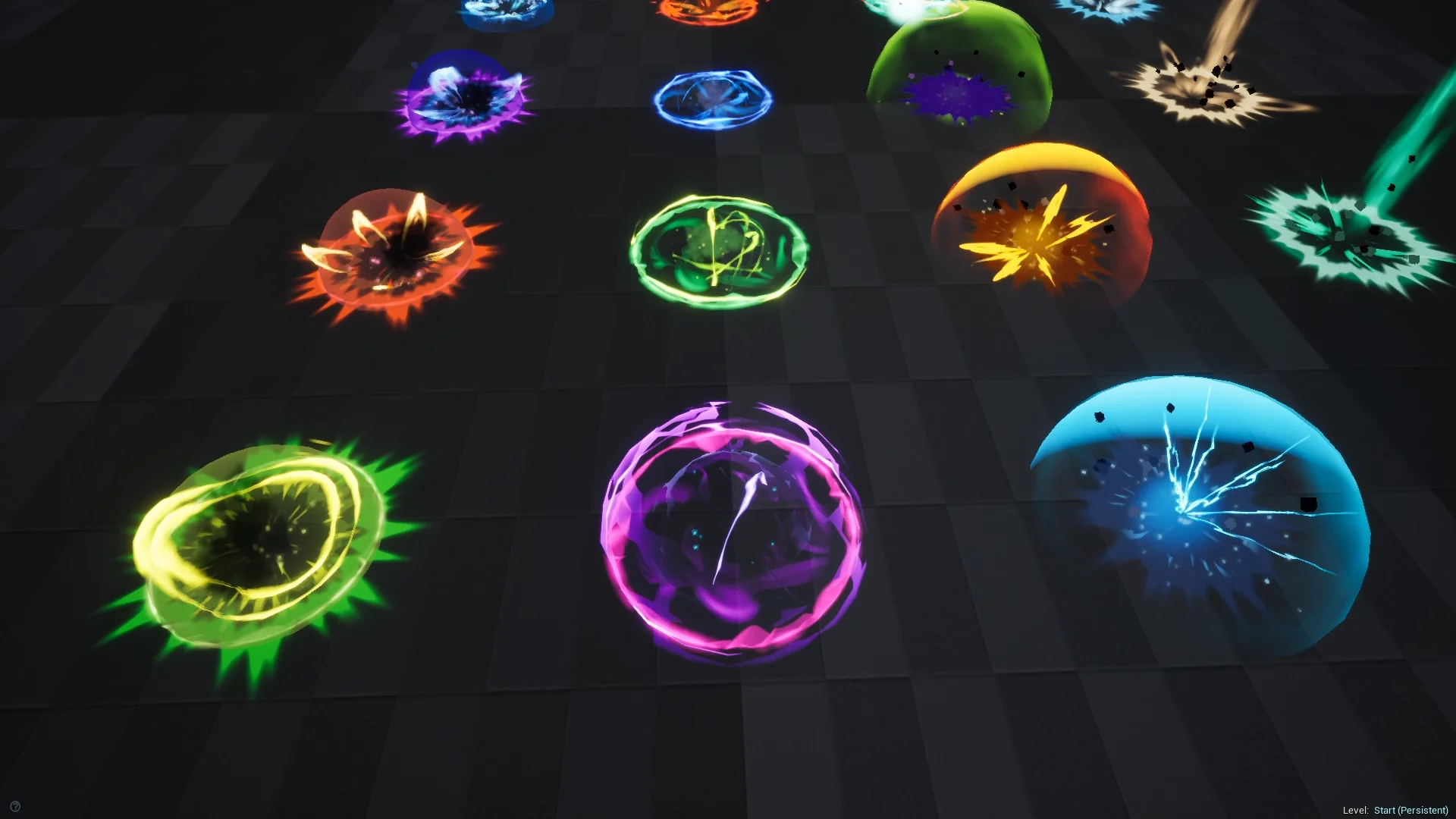
Stylized game environments rely on clean silhouettes, readable color language, and distinct motion profiles to convey action. When combat sequences, spellcasting, or environmental hazards call for a sudden release of energy, standard combustion visuals rarely fit the established aesthetic. Realistic fiery detonations often incorporate heavy smoke, irregular soot, and photorealistic noise that clash directly with stylized rendering pipelines. Magic Explosions fills this specific visual requirement by offering sixteen particle effects tailored directly for non-photorealistic worlds that require fantastical energy detonations.
In stylized action titles, magical blasts must communicate immediate visual feedback without muddying the screen. Every particle emitted during an explosion carries gameplay information, signaling to the player where the hazard originated, its current area of effect, and when the danger zone clears. By centering on magic-driven detonations, this asset set enables developers to represent unnatural, arcane, or supernatural forces erupting within the game world. The visual styling ensures that the blast radius remains legible against stylized terrain, stylized character models, and saturated environment palettes.
Time and Detonation Profiles Across Particle Effects
Time is an essential property of any visual detonation. An explosion cannot function as a static image; it is an animated sequence defined by its duration, acceleration, peak visual energy, and eventual falloff. Within the sixteen particle effects, temporal pacing defines how each burst feels during live gameplay. Fast, instantaneous eruptions deliver snappy, responsive visual confirmation for rapid-fire abilities, whereas slower, blossoming bursts suggest accumulated power, lingering danger, or high-tier spell impact.
Controlling the passage of time across an effect allows visual artists to tune how players read threats. A magical explosion typically moves through distinct temporal phases. The first instant involves an intense flash or energy focus at the point of origin, immediately drawing the player's attention. This is followed by rapid radial expansion where particles shoot outward, carrying the energy of the blast. The final phase involves dissipation, where residual magical flecks, sparks, or energetic wisps fade into the atmosphere over a set duration. Having access to multiple effect variations gives creators the ability to match specific detonation timing profiles to their mechanics, whether an attack needs a split-second pop or an expansive, lingering burst.
Bridging Real Explosive Force and Fantasy Magic
Effective stylized visual effects often borrow fundamental principles from real-world physics and recontextualize them through a fantasy lens. Real explosions involve violent displacement, pressure waves, rapid thermal expansion, and particle dispersal. When an effect ignores these physical instincts entirely, it risks feeling weightless or disconnected from the game world. Fantasy magic, on the other hand, breaks away from mundane chemistry by introducing vibrant colors, impossible motion curves, and ethereal behavior that real fire and fuel cannot produce.
By balancing real explosive behavior with fantasy magic, these sixteen particle effects provide visual punch that still obeys intuitive expectations of physical force. The radial velocity, directional shock, and central core burst mirror the impact dynamics of real detonations, ensuring that players register an authentic sense of shock and kinetic release. Simultaneously, the stylized fantasy treatment replaces standard soot and dull debris with luminous magical elements. This hybrid approach ensures the effects feel satisfyingly heavy and impactful while preserving the whimsical, arcane, or mythic tone required by fantasy gameplay.
Deploying 16 Particle Effects Across Gameplay Encounters
Having sixteen distinct particle effects gives developers enough range to build a clear visual hierarchy across an entire project. In combat-heavy stylized games, relying on a single explosion effect for every spell, trap, and enemy encounter rapidly creates visual repetition. Players lose the ability to differentiate between minor hazards and lethal attacks when every blast looks identical. With sixteen distinct configurations, a production team can map specific effects to varying tiers of power, distinct elemental affinities, or contrasting combat roles.
Smaller, tighter bursts can be assigned to basic player projectiles, quick counter-attacks, or breakable gameplay props that release magic upon destruction. Mid-sized detonations work naturally for area-of-effect spells, heavy melee impacts, or standard enemy charge-up attacks. The largest and most elaborate explosions in the set can be reserved for boss phase transitions, ultimate abilities, or climactic environmental events that require dominant visual presence on the screen. Because all sixteen effects share a coherent stylized fantasy direction, developers can distribute them across a game without breaking aesthetic consistency between different scenes and encounters.
Target Implementations for Magic Explosions
Productions that benefit most from this collection are stylized fantasy role-playing games, arena combat titles, arcade brawlers, and top-down action projects that prioritize readability and stylized flair over photorealism. Solo developers and small teams working within stylized art pipelines often struggle to produce a consistent library of explosive magic effects from scratch, as tuning particle lifetimes, expansion curves, and fantasy colors demands dedicated visual-effects iteration. Deploying a cohesive pack of sixteen stylized magical explosions provides an immediate solution for combat feedback, spellcraft systems, and ambient magical hazards across any stylized fantasy game world.
 Variety
 Variety
 Variety