"b00678cacce53329"{"id":"1002784","slug":"explosion-blueprints","title":"Explosion Blueprints","category":"Variety","engine":"4.15+,5.0+","assetVersion":"","engineVersion":"Engine Version: 4.15+,5.0+","tag":"Variety","accent":"blue","visual":"mech","summary":"Create scalable, physics-driven explosions using HDR flipbooks, modular particle emitters, and configurable Blueprints without external simulation tools.","platform":"Unreal Engine","indexPolicy":"index","publishedAt":"2026-11-20T07:07:26.441Z","updatedAt":"2026-11-20T07:07:26.441Z","sourceNotes":[],"fileContents":[],"compatibility":["Unreal Engine","Engine Version: 4.15+,5.0+"],"featuredImage":{"alt":"Explosion Blueprints","src":"/wp-content/uploads/published/2026/11/315e4b7979a2-5bdba137-7df8-460a-823e-bb2548ec514c-4f2df51f2c.webp"},"fileSizeBytes":1147617613,"hasDownloadLink":true,"downloads":0,"terms":[{"taxonomy":"category","slug":"variety-vfx","name":"Variety"}],"galleryImages":[{"src":"/wp-content/uploads/published/2026/11/a518441c94f2-d2fddc12-3c96-41e6-8df1-cf5a7f69a692-dfe8c10c1d.webp","alt":"Explosion Blueprints"},{"src":"/wp-content/uploads/published/2026/11/2e3138d90d18-4f6c49df-1434-4214-b60e-4b165bda4f49-97710f17b6.webp","alt":"Explosion Blueprints"},{"src":"/wp-content/uploads/published/2026/11/d61a10dfc6e8-c312615c-b725-4e05-a0cb-37ba9323712e-ded16fcd88.webp","alt":"Explosion Blueprints"},{"src":"/wp-content/uploads/published/2026/11/d07b50d28f89-0d767db5-d10b-4ef4-a0b2-f3c2b8971646-ae87ffabcd.webp","alt":"Explosion Blueprints"},{"src":"/wp-content/uploads/published/2026/11/4f6d4aeb5d1d-4421de0c-fa03-40d8-bedb-a76cbc042e43-4dba60db10.webp","alt":"Explosion Blueprints"},{"src":"/wp-content/uploads/published/2026/11/6c8e4160a9de-e0a6d3a5-fdd2-4c5e-ae80-652275d3d1d9-7b402127a6.webp","alt":"Explosion Blueprints"}],"accessPanel":{"kind":"resource","title":"Get this resource","safetyNote":"Resources are manually reviewed before listing to improve quality and reduce obvious risks.","fileName":"Content.7z","resourceType":"Resource archive","versions":[]},"contentHtml":"\u003ch2\u003eStaging Volumetric Detonations with Explosion Blueprints\u003c/h2\u003e\n\u003cp\u003eAction sequences, combat encounters, and industrial hazards depend heavily on how detonative events interact with the surrounding game environment. Placing raw particle systems by hand can result in disjointed behavior, where a fireball appears without the accompanying shockwave, physical displacement, or environmental scarring. Explosion Blueprints addresses this coordination problem by packaging complex blast events into modular actor blueprints that can be dropped directly into levels and calibrated for specific set pieces.\u003c/p\u003e\n\u003cp\u003eThe core advantage of using blueprint actors for explosive events lies in unified spatial control. Rather than manually tuning dozens of localized particle emitters, decal spawners, and force volumes whenever a bomb or gas tank explodes, the blueprint centralizes these elements into an integrated system. Level designers can drag an instance into a corridor, an open arena, or a vehicle bay, then configure the transformation values to properly scale the explosion footprint to fit the room. A small explosive charge can be adjusted down to a tight, focused burst, while an artillery shell or heavy ordnance blast can be scaled upward to fill wide outdoor clearings.\u003c/p\u003e\n\u003cp\u003eTesting these configurations before final map integration is facilitated by an included demo room setup. Navigating a dedicated test environment allows creators to observe how blast radii conform to scale adjustments, how lighting responds to sudden flashes, and how the underlying particle components align across varied distances. Evaluating detonations in an isolated space ensures that when the actors are deployed into actual gameplay levels, their visual impact and mechanical behavior remain consistent.\u003c/p\u003e \u003ch2\u003eConfiguring Physics Impulses and Decal Toggles\u003c/h2\u003e\n\u003cp\u003eAn explosion inside an interactive game world must do more than display an energetic visual effect; it must impact the entities around it. Explosion Blueprints builds gameplay feedback directly into each actor via toggleable behavioral parameters. Designers have granular on-and-off control over key physical and environmental responses, enabling precise optimization based on the context of the explosion.\u003c/p\u003e\n\u003cp\u003eOne primary feature is the radial impulse applied to physics actors. When enabled, the blueprint exerts an outward radial force from the epicenter at the moment of detonation. Nearby physics-simulated props—such as crates, barrels, scattered debris, or ragdoll characters—are abruptly pushed away, providing tangible weight to the blast. If an explosion occurs in a non-interactive narrative sequence or a background vista where physics calculations are unneeded, the radial impulse can be toggled off to preserve processing overhead.\u003c/p\u003e\n\u003cp\u003eEnvironmental traces and player perception are handled through dedicated decal and camera shake options. The system allows creators to enable or disable the placement of scorched surface decals, ensuring that blast marks appear on walls and floors when an explosion strikes solid geometry. For sensory impact, camera shake can be toggled on to jolt the player perspective when caught near the blast, emphasizing the sudden concussion of the boom. Furthermore, each blueprint includes an assignable sound cue parameter, allowing distinct audio assets to be mapped directly to individual visual presets so that sonic weight matches visual scale.\u003c/p\u003e \u003ch2\u003eVisual Fidelity via 2048x2048 HDR Flipbooks\u003c/h2\u003e\n\u003cp\u003eThe visual backbone of the blast sequences relies on high-resolution, high dynamic range (HDR) flipbook textures. Rendered at a resolution of 2048x2048, these texture sheets capture the intricate turbulence, core luminance, and billowing density of real-world combustion. Utilizing full 2048x2048 sheets ensures that even when an explosion is scaled up to monumental proportions, the fireballs, internal tendrils, and peripheral smoke clouds retain edge sharpness without breaking down into blurry artifacts.\u003c/p\u003e\n\u003cp\u003eHDR encoding plays a vital role in how the explosions integrate into engine lighting and post-processing pipelines. Standard dynamic range textures often clip hot white points or lose detail in deep, soot-laden smoke. HDR flipbooks store extended luminance ranges, allowing the initial fiery core to radiate extreme brightness that naturally triggers engine bloom, exposure adjustments, and dynamic light reflections. As the burst expands, the fire cools through realistic color gradients into dense, volumetric smoke plumes that scatter environmental light believably.\u003c/p\u003e \u003ch2\u003eCustom Emitter Combinations for Explosion Variations\u003c/h2\u003e\n\u003cp\u003eWhile the system offers pre-configured explosion setups ready for immediate deployment, it also functions as a visual effects toolkit. The package contains a comprehensive library of individual emitters designed to be disassembled, combined, and adapted into entirely new explosive profiles.\u003c/p\u003e\n\u003cp\u003eReal-world detonations consist of distinct visual phases: the initial flash, the high-velocity shockwave, the expanding core fireball, flying sparks or embers, and the lingering particulate dust. Because the library isolates these layers across separate emitters, developers can swap or layer different components to engineer unique blast behaviors. A clean, rapid propane blast can be assembled by emphasizing fast-clearing fire emitters with minimal smoke, whereas a dirty improvised bomb can combine dense black smoke emitters, widespread debris particles, and persistent embers.\u003c/p\u003e\n\u003cp\u003eThis emitter modularity extends the utility of the blueprints well beyond a single generic blast template. Creators building diverse combat rosters or complex environmental traps can define unique signatures for every hazard, ensuring that mortar strikes, landmines, vehicular explosions, and industrial failures look distinct while remaining grounded in the same underlying rendering quality.\u003c/p\u003e \u003ch2\u003eProduction Efficiency Without Complex Simulation Pipelines\u003c/h2\u003e\n\u003cp\u003eGenerating high-fidelity pyrotechnic effects from scratch is typically an arduous task requiring deep familiarity with dedicated volumetric simulation tools such as Houdini. Artists often spend hundreds of hours constructing fluid solvers, running computational passes, tweaking combustion chemistry, and baking out massive simulation caches before generating flipbook textures. For teams without specialized simulation artists or those facing tight development schedules, building custom assets through this pipeline can consume vast amounts of time.\u003c/p\u003e\n\u003cp\u003eBy incorporating pre-rendered, production-ready HDR simulations directly into an organized blueprint framework, Explosion Blueprints eliminates the need to learn complex offline simulation packages. The time-intensive labor of running fluid dynamics, tuning particle counts, and waiting on heavy render farms has already been carried out. Instead of managing complex voxel grids and cache exports, teams can focus entirely on level pacing, gameplay balance, and scene staging within the game engine itself.\u003c/p\u003e\n\n\u003ch2\u003eMore From The Same Workflow\u003c/h2\u003e\n\u003cul\u003e\n\u003cli\u003e\u003ca href=\"https://3dcghub.com/cartoony-impact-fx-second-edition/\" rel=\"noopener noreferrer\"\u003eCartoony Impact FX - Second Edition\u003c/a\u003e\u003c/li\u003e\n\u003cli\u003e\u003ca href=\"https://3dcghub.com/mixed-vfx-pack-4-niagara/\" rel=\"noopener noreferrer\"\u003eMixed Vfx Pack 4 (Niagara)\u003c/a\u003e\u003c/li\u003e\n\u003cli\u003e\u003ca href=\"https://3dcghub.com/100-explosion-pack-niagara/\" rel=\"noopener noreferrer\"\u003e100 Explosion Pack Niagara\u003c/a\u003e\u003c/li\u003e\n\u003cli\u003e\u003ca href=\"https://3dcghub.com/stylized-vfx-pack/\" rel=\"noopener noreferrer\"\u003eStylized VFX Pack\u003c/a\u003e\u003c/li\u003e\n\u003cli\u003e\u003ca href=\"https://3dcghub.com/2d-anime-vfx-pack/\" rel=\"noopener noreferrer\"\u003e2D Anime VFX Pack\u003c/a\u003e\u003c/li\u003e\n\u003c/ul\u003e","contentTextLength":7118,"navigation":{"current":96,"total":4797,"previous":{"id":"1002785","slug":"explosion-pack-1-nature-elements","title":"Explosion Pack #1 - Nature Elements","category":"Variety","platform":"Unreal Engine","updatedAt":"2026-11-20T07:08:23.380Z"},"next":{"id":"1002783","slug":"easy-dissolve-material","title":"Easy Dissolve Material","category":"Shaders","platform":"Unreal Engine","updatedAt":"2026-11-20T07:05:58.737Z"}},"relatedResources":[{"id":"1001724","slug":"cartoony-impact-fx-second-edition","title":"Cartoony Impact FX - Second Edition","category":"Variety","engine":"4.16+,5.0+","assetVersion":"","engineVersion":"Engine Version: 4.16+,5.0+","tag":"Variety","accent":"blue","visual":"mech","summary":"A breakdown of Cartoony Impact FX - Second Edition, focusing on its multi-layer modular explosion architecture, specialized stylized shaders, and Blueprint work","platform":"Unreal Engine","indexPolicy":"index","publishedAt":"2026-10-20T02:31:01.294Z","updatedAt":"2026-10-20T02:31:01.294Z","sourceNotes":[],"fileContents":[],"compatibility":["Unreal Engine","Engine Version: 4.16+,5.0+"],"featuredImage":{"alt":"Cartoony Impact FX - Second Edition","src":"/wp-content/uploads/published/2026/10/162fa84c565f-430f11b7-58a2-46fe-94f8-0db994923997-9610786aa4.webp"},"fileSizeBytes":57915212,"hasDownloadLink":true,"downloads":1},{"id":"1002327","slug":"mixed-vfx-pack-4-niagara","title":"Mixed Vfx Pack 4 (Niagara)","category":"Variety","engine":"4.26+,5.0+","assetVersion":"","engineVersion":"Engine Version: 4.26+,5.0+","tag":"Variety","accent":"blue","visual":"mech","summary":"Mixed Vfx Pack 4 (Niagara) contains 15 stylized effects: waterfall blueprints, anime thrusters, flame orbs, trails, portals, burnout, explosion, speed running.","platform":"Unreal Engine","indexPolicy":"index","publishedAt":"2026-11-06T06:32:51.943Z","updatedAt":"2026-11-06T06:32:51.943Z","sourceNotes":[],"fileContents":[],"compatibility":["Unreal Engine","Engine Version: 4.26+,5.0+"],"featuredImage":{"alt":"Mixed Vfx Pack 4 (Niagara)","src":"/wp-content/uploads/published/2026/11/1c3adb0e24ff-5063006f-5d69-4a6a-8a1a-c472dad6e22e-bf3701c3a0.webp"},"fileSizeBytes":137697824,"hasDownloadLink":true,"downloads":0},{"id":"1002856","slug":"vfx-series-pack-1","title":"VFX Series Pack 1","category":"Variety","engine":"4.15+,5.0+","assetVersion":"","engineVersion":"Engine Version: 4.15+,5.0+","tag":"Variety","accent":"blue","visual":"mech","summary":"VFX Series Pack 1 provides particle systems, a multi-purpose projectile blueprint, and prototyping tools for kinetic, tracking plasma, and beam effects.","platform":"Unreal Engine","indexPolicy":"index","publishedAt":"2026-11-20T12:37:19.700Z","updatedAt":"2026-11-20T12:37:19.700Z","sourceNotes":[],"fileContents":[],"compatibility":["Unreal Engine","Engine Version: 4.15+,5.0+"],"featuredImage":{"alt":"VFX Series Pack 1","src":"/wp-content/uploads/published/2026/11/ae2ffb17df50-0f2ca29c-7dfd-4b0a-9545-02d1a6161873-9478d63e76.webp"},"fileSizeBytes":125292350,"hasDownloadLink":true,"downloads":0}]}
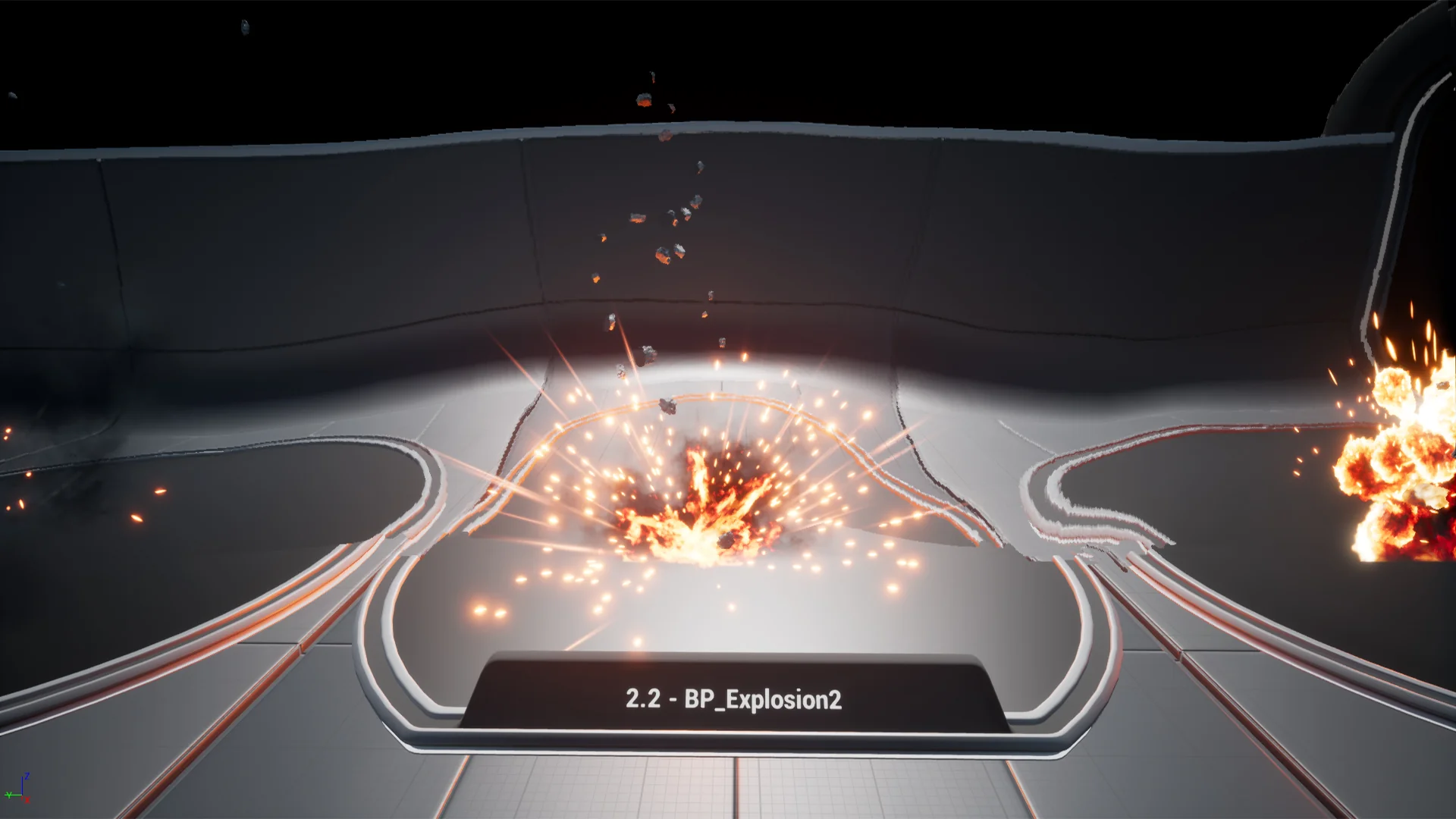
Resource screenshots
1 / 6
Join our channel
Follow 3DCGHUB on Telegram for new resource drops, migration updates, and community notices.
Staging Volumetric Detonations with Explosion Blueprints
Action sequences, combat encounters, and industrial hazards depend heavily on how detonative events interact with the surrounding game environment. Placing raw particle systems by hand can result in disjointed behavior, where a fireball appears without the accompanying shockwave, physical displacement, or environmental scarring. Explosion Blueprints addresses this coordination problem by packaging complex blast events into modular actor blueprints that can be dropped directly into levels and calibrated for specific set pieces.
The core advantage of using blueprint actors for explosive events lies in unified spatial control. Rather than manually tuning dozens of localized particle emitters, decal spawners, and force volumes whenever a bomb or gas tank explodes, the blueprint centralizes these elements into an integrated system. Level designers can drag an instance into a corridor, an open arena, or a vehicle bay, then configure the transformation values to properly scale the explosion footprint to fit the room. A small explosive charge can be adjusted down to a tight, focused burst, while an artillery shell or heavy ordnance blast can be scaled upward to fill wide outdoor clearings.
Testing these configurations before final map integration is facilitated by an included demo room setup. Navigating a dedicated test environment allows creators to observe how blast radii conform to scale adjustments, how lighting responds to sudden flashes, and how the underlying particle components align across varied distances. Evaluating detonations in an isolated space ensures that when the actors are deployed into actual gameplay levels, their visual impact and mechanical behavior remain consistent.
Configuring Physics Impulses and Decal Toggles
An explosion inside an interactive game world must do more than display an energetic visual effect; it must impact the entities around it. Explosion Blueprints builds gameplay feedback directly into each actor via toggleable behavioral parameters. Designers have granular on-and-off control over key physical and environmental responses, enabling precise optimization based on the context of the explosion.
One primary feature is the radial impulse applied to physics actors. When enabled, the blueprint exerts an outward radial force from the epicenter at the moment of detonation. Nearby physics-simulated props—such as crates, barrels, scattered debris, or ragdoll characters—are abruptly pushed away, providing tangible weight to the blast. If an explosion occurs in a non-interactive narrative sequence or a background vista where physics calculations are unneeded, the radial impulse can be toggled off to preserve processing overhead.
Environmental traces and player perception are handled through dedicated decal and camera shake options. The system allows creators to enable or disable the placement of scorched surface decals, ensuring that blast marks appear on walls and floors when an explosion strikes solid geometry. For sensory impact, camera shake can be toggled on to jolt the player perspective when caught near the blast, emphasizing the sudden concussion of the boom. Furthermore, each blueprint includes an assignable sound cue parameter, allowing distinct audio assets to be mapped directly to individual visual presets so that sonic weight matches visual scale.
Visual Fidelity via 2048x2048 HDR Flipbooks
The visual backbone of the blast sequences relies on high-resolution, high dynamic range (HDR) flipbook textures. Rendered at a resolution of 2048x2048, these texture sheets capture the intricate turbulence, core luminance, and billowing density of real-world combustion. Utilizing full 2048x2048 sheets ensures that even when an explosion is scaled up to monumental proportions, the fireballs, internal tendrils, and peripheral smoke clouds retain edge sharpness without breaking down into blurry artifacts.
HDR encoding plays a vital role in how the explosions integrate into engine lighting and post-processing pipelines. Standard dynamic range textures often clip hot white points or lose detail in deep, soot-laden smoke. HDR flipbooks store extended luminance ranges, allowing the initial fiery core to radiate extreme brightness that naturally triggers engine bloom, exposure adjustments, and dynamic light reflections. As the burst expands, the fire cools through realistic color gradients into dense, volumetric smoke plumes that scatter environmental light believably.
Custom Emitter Combinations for Explosion Variations
While the system offers pre-configured explosion setups ready for immediate deployment, it also functions as a visual effects toolkit. The package contains a comprehensive library of individual emitters designed to be disassembled, combined, and adapted into entirely new explosive profiles.
Real-world detonations consist of distinct visual phases: the initial flash, the high-velocity shockwave, the expanding core fireball, flying sparks or embers, and the lingering particulate dust. Because the library isolates these layers across separate emitters, developers can swap or layer different components to engineer unique blast behaviors. A clean, rapid propane blast can be assembled by emphasizing fast-clearing fire emitters with minimal smoke, whereas a dirty improvised bomb can combine dense black smoke emitters, widespread debris particles, and persistent embers.
This emitter modularity extends the utility of the blueprints well beyond a single generic blast template. Creators building diverse combat rosters or complex environmental traps can define unique signatures for every hazard, ensuring that mortar strikes, landmines, vehicular explosions, and industrial failures look distinct while remaining grounded in the same underlying rendering quality.
Production Efficiency Without Complex Simulation Pipelines
Generating high-fidelity pyrotechnic effects from scratch is typically an arduous task requiring deep familiarity with dedicated volumetric simulation tools such as Houdini. Artists often spend hundreds of hours constructing fluid solvers, running computational passes, tweaking combustion chemistry, and baking out massive simulation caches before generating flipbook textures. For teams without specialized simulation artists or those facing tight development schedules, building custom assets through this pipeline can consume vast amounts of time.
By incorporating pre-rendered, production-ready HDR simulations directly into an organized blueprint framework, Explosion Blueprints eliminates the need to learn complex offline simulation packages. The time-intensive labor of running fluid dynamics, tuning particle counts, and waiting on heavy render farms has already been carried out. Instead of managing complex voxel grids and cache exports, teams can focus entirely on level pacing, gameplay balance, and scene staging within the game engine itself.
 Variety
 Variety
 Variety