"a19e0535960bd083"{"id":"1002015","slug":"exland","title":"EXLAND","category":"Variety","engine":"4.26+,5.0+","assetVersion":"","engineVersion":"Engine Version: 4.26+,5.0+","tag":"Variety","accent":"blue","visual":"mech","summary":"Exland delivers an auto landscape material system with procedural and painted blending, Extile noise algorithms, RVT support, and multi-layered setups.","platform":"Unreal Engine","publishedAt":"2026-10-26T12:54:33.246Z","updatedAt":"2026-10-26T12:54:33.246Z","sourceNotes":[],"fileContents":[],"compatibility":["Unreal Engine","Engine Version: 4.26+,5.0+"],"featuredImage":{"alt":"EXLAND","src":"/wp-content/uploads/published/2026/10/ee5252dfa362-c544e796-d568-4b52-ace9-99ed32bb3a30-78d3c8d768.webp"},"hasDownloadLink":true,"downloads":0,"terms":[{"taxonomy":"category","slug":"variety","name":"Variety"}],"galleryImages":[{"src":"/wp-content/uploads/published/2026/10/4cf325d4668e-bbac9014-88c3-4750-9a32-fb6727638201-fc34dd7886.webp","alt":"EXLAND"},{"src":"/wp-content/uploads/published/2026/10/b5ccdebf34a5-017d6761-6cc8-40cb-b33f-75961b034ea8-fc2de33f2c.webp","alt":"EXLAND"},{"src":"/wp-content/uploads/published/2026/10/025ebaa777a5-1d94f09c-25a1-49cf-b042-b99c42e630af-31b55ccbd8.webp","alt":"EXLAND"},{"src":"/wp-content/uploads/published/2026/10/5ce36f3b0cae-d39d71c3-ce83-4b81-aa66-913af720abcb-b152ac7ca4.webp","alt":"EXLAND"},{"src":"/wp-content/uploads/published/2026/10/586eee47f850-354b17e2-1d11-49d9-a338-e4931b2b5224-820cba9ac2.webp","alt":"EXLAND"}],"accessPanel":{"kind":"resource","title":"Download this resource","eyebrow":"Free Download","message":"Log in or create a free account to start your download.","fileName":"Content.7z","safetyNote":"Resources are manually reviewed before listing to improve quality and reduce obvious risks.","actionLabel":"Download Free","resourceType":"Resource archive"},"contentHtml":"\u003cp\u003eExland is built as an auto landscape material system designed to combine procedural rule sets with manual artist control. Its core behavior allows terrain surfaces to blend textures automatically across heights, angles, and transitions while simultaneously accepting input from the standard landscape paint tool. By unifying procedural automation with direct brush control, artists can establish wide-scale terrain shading across expansive terrains without sacrificing the ability to paint bespoke transitions, pathways, or specific environmental boundaries manually.\u003c/p\u003e \u003ch2\u003eExland Layer Setups and the Wetness Layer System\u003c/h2\u003e\n\u003cp\u003eThe foundation of the asset rests on a versatile set of master materials configured across multiple layer counts. Exland provides dedicated master setups structured as 1X, 2X, 3X, and 4X layered systems. Each configuration accommodates different levels of environmental complexity, letting developers match their material structure to the performance targets and visual demands of a specific terrain. A single-layer setup allows for lean, lightweight ground treatments, while the expanded two-, three-, and four-layer setups accommodate rich surfaces featuring distinct soil variations, rock strata, detritus, and foliage bedding.\u003c/p\u003e \u003cp\u003eIncluded across these master configurations is a dedicated wetness and puddle layer. Instead of requiring external decal passes or secondary shader overlays, moisture response is built directly into the overarching material graph. This layer introduces surface darkening, gloss variation, and water accumulation across the terrain geometry, integrating puddling effects directly alongside the broader ground textures. Because the wetness logic functions within the master layer hierarchy, puddle behavior blends smoothly with both the automatic ground distribution rules and user-painted adjustments.\u003c/p\u003e \u003ch2\u003eSimultaneous Procedural Blending and Extile Noise Algorithms\u003c/h2\u003e\n\u003cp\u003eRepetition is one of the most persistent visual hurdles when painting and tiling landscape materials across vast environments. Exland resolves this by driving each texture through noise algorithms derived from Extile. These noise routines calculate non-repetitive tiling behaviors dynamically, suppressing visible grid patterns, seams, and recurring high-frequency details that typically appear when textures repeat across long viewing distances.\u003c/p\u003e \u003cp\u003eTextures run in world-aligned space, ensuring that projection scales remain consistent regardless of landscape actor scale, component stretching, or elevation shifts. At the same time, users have a broad array of parameter settings at their disposal to tune the frequency, contrast, and influence of the noise fields. To expand placement flexibility, the system includes a local coordinate option. This allows specific textures or elements to evaluate their positioning based on the local orientation and coordinates of the landscape itself rather than exclusively relying on absolute world-aligned projections.\u003c/p\u003e \u003cp\u003eCrucially, the automatic procedural blending does not lock out manual painting. In many terrain workflows, an auto-material either dictates the entire surface or requires destructive overrides. Exland keeps the landscape paint tool active in tandem with procedural rules. An artist can let the automatic system assign rocky cliffs and soil valleys by slope, then take the landscape brush to paint specific mud, grass, or gravel patches directly into the same surface without breaking the underlying noise-driven distribution.\u003c/p\u003e \u003ch2\u003eExland I, Exland II, and Exbomb Control Logic\u003c/h2\u003e\n\u003cp\u003eThe system encompasses two distinct core landscape material variations: Exland I and Exland II. Exland I serves as the established, refined baseline landscape material, providing dependable multi-layer blending, robust world-aligned texturing, and baseline parameter controls for standard open-world layouts. It continues to feature minor polish updates that maintain stability and blending response.\u003c/p\u003e \u003cp\u003eExland II introduces a companion material set alongside new instances. This second system is partly built on the Exbomb I and II architectures derived from Extile Plus and Exsite. Exland II supplies a divergent set of control parameters and extended options, giving artists an alternate mechanical approach to breaking up tiling patterns. By introducing the Exbomb variation into landscape spaces, the package offers different mathematical methods for scrambling texture repeats, providing varied aesthetic controls when dialing in non-repetitive ground covers across different biomes.\u003c/p\u003e \u003ch2\u003eGrass Nodes, Local Coordinates, and Layer Masking\u003c/h2\u003e\n\u003cp\u003eFoliage generation is deeply tied to terrain materials, and Exland handles this relationship through integrated Unreal Engine landscape grass nodes. Grass nodes are connected directly to the individual landscape layers, ensuring that foliage meshes populate dynamically wherever their corresponding material layers exist on the terrain.\u003c/p\u003e \u003cp\u003eTo give technical artists granular control over where foliage appears, Exland features the ability to add masks to these grass nodes. Rather than spawning static meshes across the entire breadth of a material layer indiscriminately, grass node masks allow users to filter foliage density, carve out barren clearings, or restrict growth based on custom texture masks or procedural criteria. When combined with the local coordinate option, developers can guide both the visual texturing and the associated grass node scattering to respect local terrain orientations, preventing unnatural growth on steep features or localized landscape deformations.\u003c/p\u003e \u003ch2\u003eRuntime Virtual Textures and Material Function Modularity\u003c/h2\u003e\n\u003cp\u003eTo meet the rendering demands of complex landscape shaders, Exland integrates native support for Runtime Virtual Textures (RVTs). Generating complex, non-repetitive multi-layer blending with real-time noise algorithms can place a heavy load on pixel processing across large landscape view distances. RVTs cache the compiled landscape material data into virtual textures at runtime, significantly reducing rendering overhead while ensuring sharp visual detail and seamless blending with interacting landscape meshes and props.\u003c/p\u003e \u003cp\u003eRather than packaging the landscape pipeline as a rigid, monolithic shader graph, the entire project is dissected into modular material functions. Each step—from the noise calculations and world-aligned sampling to coordinate conversions and layer blending—is compartmentalized. This modular layout allows technical artists to open the network, extract individual logic blocks, and assemble custom landscape iterations tailored to idiosyncratic project pipelines.\u003c/p\u003e \u003cp\u003eRegarding engine support, all materials and material functions in the package are compatible with Unreal Engine 5 early release configurations. The sole exception within that environment is displacement and tessellation, which are not supported in the UE5 early release pipeline. Across all standard shader operations, Exland delivers a comprehensive framework for creating non-repetitive, high-fidelity terrain surfaces that respond to both procedural parameters and artistic brushwork.\u003c/p\u003e\n\n\u003ch2\u003eExplore Similar Assets\u003c/h2\u003e\n\u003cul\u003e\n\u003cli\u003e\u003ca href=\"https://3dcghub.com/09-cloth-materials/\" title=\"09 Cloth Materials\"\u003e09 Cloth Materials\u003c/a\u003e\u003c/li\u003e\n\u003cli\u003e\u003ca href=\"https://3dcghub.com/1000-mega-decal-package-ai-sources/\" title=\"1000+ Mega Decal Package / AI SOURCES\"\u003e1000+ Mega Decal Package / AI SOURCES\u003c/a\u003e\u003c/li\u003e\n\u003cli\u003e\u003ca href=\"https://3dcghub.com/ground-vol-48-hand-painted-textures/\" title=\"Ground Vol.48 - Hand Painted Textures\"\u003eGround Vol.48 - Hand Painted Textures\u003c/a\u003e\u003c/li\u003e\n\u003cli\u003e\u003ca href=\"https://3dcghub.com/tiles-vol-54-hand-painted-textures/\" title=\"Tiles Vol.54 - Hand Painted Textures\"\u003eTiles Vol.54 - Hand Painted Textures\u003c/a\u003e\u003c/li\u003e\n\u003cli\u003e\u003ca href=\"https://3dcghub.com/customizable-grid/\" title=\"Customizable Grid\"\u003eCustomizable Grid\u003c/a\u003e\u003c/li\u003e\n\u003c/ul\u003e","contentTextLength":7271,"navigation":{"current":76,"total":4026,"previous":{"id":"1002016","slug":"fabric-material-pack-v4-20-pcs-4k-material","title":"Fabric Material Pack V4 - 20 Pcs 4k Material","category":"Fabric \u0026 Clothing","platform":"Unreal Engine","updatedAt":"2026-10-26T12:55:39.072Z"},"next":{"id":"1002014","slug":"event-icons","title":"Event Icons","category":"Variety","platform":"Unreal Engine","updatedAt":"2026-10-26T12:53:44.824Z"}},"relatedResources":[{"id":"1002044","slug":"ground-mix-vol-22-hand-painted-textures","title":"Ground Mix Vol.22 - Hand Painted Textures","category":"Variety","engine":"4.26+,5.0+","assetVersion":"","engineVersion":"Engine Version: 4.26+,5.0+","tag":"Variety","accent":"blue","visual":"luts","summary":"Five tileable hand-painted ground textures featuring snow, aquatic, and fantasy surfaces with full PBR map sets in 2048px TGA format.","platform":"Unreal Engine","publishedAt":"2026-10-26T14:36:30.033Z","updatedAt":"2026-10-26T14:36:30.033Z","sourceNotes":[],"fileContents":[],"compatibility":["Unreal Engine","Engine Version: 4.26+,5.0+"],"featuredImage":{"alt":"Ground Mix Vol.22 - Hand Painted Textures","src":"/wp-content/uploads/published/2026/10/4f63ad75fa84-897c2762-04a1-46bb-998c-d8783474c492-41535dadfe.webp"},"hasDownloadLink":true,"downloads":0},{"id":"1001854","slug":"09-cloth-materials","title":"09 Cloth Materials","category":"Variety","engine":"4.26+,5.0+","assetVersion":"","engineVersion":"Engine Version: 4.26+,5.0+","tag":"Variety","accent":"blue","visual":"luts","summary":"A focused pack of 09 ready-to-use cloth materials with instanced controls for diffuse color, roughness, specular, occlusion, UV tiling, and displacement.","platform":"Unreal Engine","publishedAt":"2026-10-22T10:34:49.927Z","updatedAt":"2026-10-22T10:34:49.927Z","sourceNotes":[],"fileContents":[],"compatibility":["Unreal Engine","Engine Version: 4.26+,5.0+"],"featuredImage":{"alt":"09 Cloth Materials","src":"/wp-content/uploads/published/2026/10/7b5e95f3f164-b93dcd3f-92ed-44e7-8b01-b34b2778087d-89c4520378.webp"},"hasDownloadLink":true,"downloads":0},{"id":"1000144","slug":"1000-mega-decal-package-ai-sources","title":"1000+ Mega Decal Package / AI SOURCES","category":"Variety","engine":"4.26+,5.0+","assetVersion":"","engineVersion":"Engine Version: 4.26+,5.0+","tag":"Variety","accent":"blue","visual":"mech","summary":"A high-quality customizable decal pack with texture-driven flexibility, combined or separate use, and access to main vector drawing files.","platform":"Unreal Engine","publishedAt":"2026-06-12T18:37:30.067Z","updatedAt":"2026-10-03T14:08:24.863Z","sourceNotes":[],"fileContents":[],"compatibility":["Unreal Engine","Engine Version: 4.26+,5.0+"],"featuredImage":{"alt":"1000+ Mega Decal Package / AI SOURCES","src":"/wp-content/uploads/published/2026/06/c65003b15164-8cfb9e15-1251-4bec-a5db-4031508b2f53-10a82d485f.webp"},"hasDownloadLink":true,"downloads":1}]}
Variety
EXLAND
Exland delivers an auto landscape material system with procedural and painted blending, Extile noise algorithms, RVT support, and multi-layered setups.
Category:Unreal Engine,VarietyPlatform: Unreal EngineEngine Version: 4.26+,5.0+Published: Oct 26, 2026
Variety
Resource overview
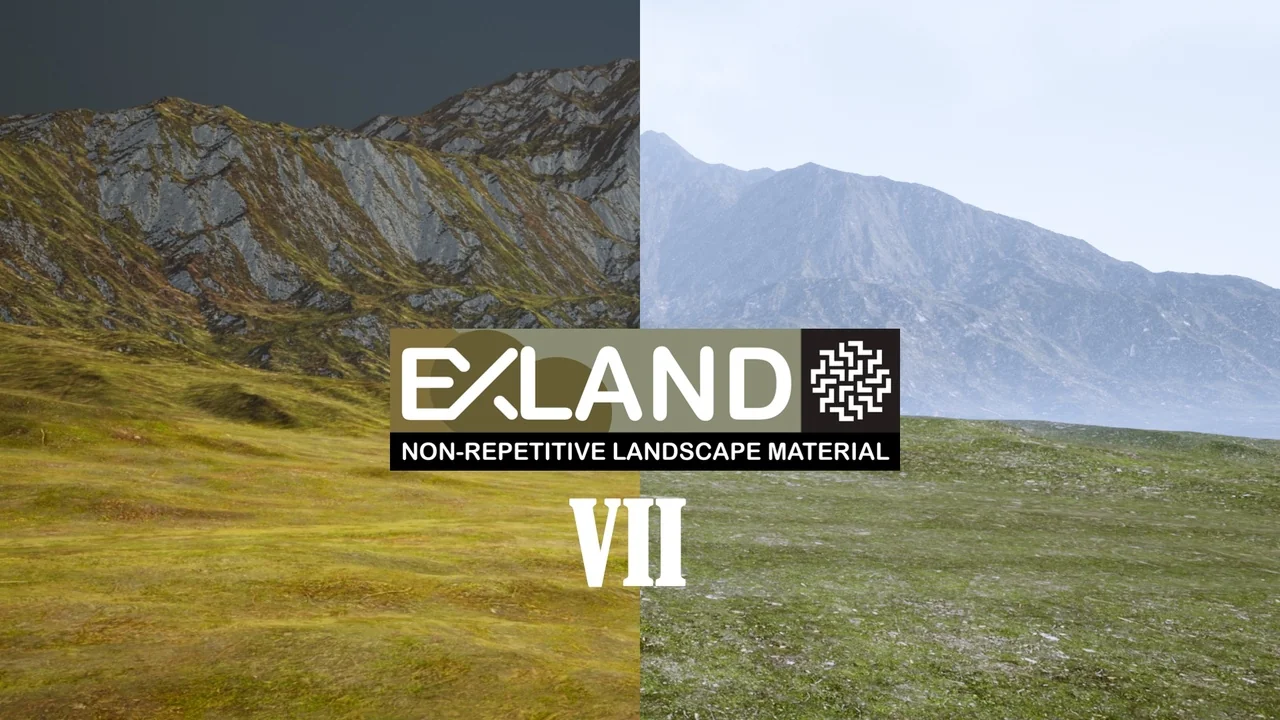
Exland is built as an auto landscape material system designed to combine procedural rule sets with manual artist control. Its core behavior allows terrain surfaces to blend textures automatically across heights, angles, and transitions while simultaneously accepting input from the standard landscape paint tool. By unifying procedural automation with direct brush control, artists can establish wide-scale terrain shading across expansive terrains without sacrificing the ability to paint bespoke transitions, pathways, or specific environmental boundaries manually.
Exland Layer Setups and the Wetness Layer System
The foundation of the asset rests on a versatile set of master materials configured across multiple layer counts. Exland provides dedicated master setups structured as 1X, 2X, 3X, and 4X layered systems. Each configuration accommodates different levels of environmental complexity, letting developers match their material structure to the performance targets and visual demands of a specific terrain. A single-layer setup allows for lean, lightweight ground treatments, while the expanded two-, three-, and four-layer setups accommodate rich surfaces featuring distinct soil variations, rock strata, detritus, and foliage bedding.
Included across these master configurations is a dedicated wetness and puddle layer. Instead of requiring external decal passes or secondary shader overlays, moisture response is built directly into the overarching material graph. This layer introduces surface darkening, gloss variation, and water accumulation across the terrain geometry, integrating puddling effects directly alongside the broader ground textures. Because the wetness logic functions within the master layer hierarchy, puddle behavior blends smoothly with both the automatic ground distribution rules and user-painted adjustments.
Simultaneous Procedural Blending and Extile Noise Algorithms
Repetition is one of the most persistent visual hurdles when painting and tiling landscape materials across vast environments. Exland resolves this by driving each texture through noise algorithms derived from Extile. These noise routines calculate non-repetitive tiling behaviors dynamically, suppressing visible grid patterns, seams, and recurring high-frequency details that typically appear when textures repeat across long viewing distances.
Textures run in world-aligned space, ensuring that projection scales remain consistent regardless of landscape actor scale, component stretching, or elevation shifts. At the same time, users have a broad array of parameter settings at their disposal to tune the frequency, contrast, and influence of the noise fields. To expand placement flexibility, the system includes a local coordinate option. This allows specific textures or elements to evaluate their positioning based on the local orientation and coordinates of the landscape itself rather than exclusively relying on absolute world-aligned projections.
Crucially, the automatic procedural blending does not lock out manual painting. In many terrain workflows, an auto-material either dictates the entire surface or requires destructive overrides. Exland keeps the landscape paint tool active in tandem with procedural rules. An artist can let the automatic system assign rocky cliffs and soil valleys by slope, then take the landscape brush to paint specific mud, grass, or gravel patches directly into the same surface without breaking the underlying noise-driven distribution.
Exland I, Exland II, and Exbomb Control Logic
The system encompasses two distinct core landscape material variations: Exland I and Exland II. Exland I serves as the established, refined baseline landscape material, providing dependable multi-layer blending, robust world-aligned texturing, and baseline parameter controls for standard open-world layouts. It continues to feature minor polish updates that maintain stability and blending response.
Exland II introduces a companion material set alongside new instances. This second system is partly built on the Exbomb I and II architectures derived from Extile Plus and Exsite. Exland II supplies a divergent set of control parameters and extended options, giving artists an alternate mechanical approach to breaking up tiling patterns. By introducing the Exbomb variation into landscape spaces, the package offers different mathematical methods for scrambling texture repeats, providing varied aesthetic controls when dialing in non-repetitive ground covers across different biomes.
Grass Nodes, Local Coordinates, and Layer Masking
Foliage generation is deeply tied to terrain materials, and Exland handles this relationship through integrated Unreal Engine landscape grass nodes. Grass nodes are connected directly to the individual landscape layers, ensuring that foliage meshes populate dynamically wherever their corresponding material layers exist on the terrain.
To give technical artists granular control over where foliage appears, Exland features the ability to add masks to these grass nodes. Rather than spawning static meshes across the entire breadth of a material layer indiscriminately, grass node masks allow users to filter foliage density, carve out barren clearings, or restrict growth based on custom texture masks or procedural criteria. When combined with the local coordinate option, developers can guide both the visual texturing and the associated grass node scattering to respect local terrain orientations, preventing unnatural growth on steep features or localized landscape deformations.
Runtime Virtual Textures and Material Function Modularity
To meet the rendering demands of complex landscape shaders, Exland integrates native support for Runtime Virtual Textures (RVTs). Generating complex, non-repetitive multi-layer blending with real-time noise algorithms can place a heavy load on pixel processing across large landscape view distances. RVTs cache the compiled landscape material data into virtual textures at runtime, significantly reducing rendering overhead while ensuring sharp visual detail and seamless blending with interacting landscape meshes and props.
Rather than packaging the landscape pipeline as a rigid, monolithic shader graph, the entire project is dissected into modular material functions. Each step—from the noise calculations and world-aligned sampling to coordinate conversions and layer blending—is compartmentalized. This modular layout allows technical artists to open the network, extract individual logic blocks, and assemble custom landscape iterations tailored to idiosyncratic project pipelines.
Regarding engine support, all materials and material functions in the package are compatible with Unreal Engine 5 early release configurations. The sole exception within that environment is displacement and tessellation, which are not supported in the UE5 early release pipeline. Across all standard shader operations, Exland delivers a comprehensive framework for creating non-repetitive, high-fidelity terrain surfaces that respond to both procedural parameters and artistic brushwork.
 Variety
 Variety
 Variety
 Variety