"a5ffaf404b9c2b7e"{"id":"1002628","slug":"dry-animal-bones-photoscan-vol-2","title":"Dry Animal Bones - Photoscan Vol 2.","category":"Nature \u0026 Plants","engine":"5.0+","assetVersion":"","engineVersion":"Engine Version: 5.0+","tag":"Nature \u0026 Plants","accent":"blue","visual":"mech","summary":"Examine Dry Animal Bones - Photoscan Vol 2, featuring 12 complete 4k bone meshes and 5 Australian desert ground materials optimized for games and cinematics.","platform":"Unreal Engine","indexPolicy":"index","publishedAt":"2026-11-15T06:07:04.009Z","updatedAt":"2026-11-15T06:07:04.009Z","sourceNotes":[],"fileContents":[],"compatibility":["Unreal Engine","Engine Version: 5.0+"],"featuredImage":{"alt":"Dry Animal Bones - Photoscan Vol 2.","src":"/wp-content/uploads/published/2026/11/0f13139086fc-301c9738-a161-404a-91af-46495867f383-a25d881d35.webp"},"hasDownloadLink":true,"downloads":0,"terms":[{"taxonomy":"category","slug":"nature-and-plants","name":"Nature \u0026 Plants"}],"galleryImages":[{"src":"/wp-content/uploads/published/2026/11/8f1c194d7a47-28e59e3a-6c35-4592-ad89-36cbfd64f978-3c0f07837a.webp","alt":"Dry Animal Bones - Photoscan Vol 2."},{"src":"/wp-content/uploads/published/2026/11/94dbd3a2e4fa-189165ff-f42e-489b-bc29-64441693d4ff-71b2174530.webp","alt":"Dry Animal Bones - Photoscan Vol 2."},{"src":"/wp-content/uploads/published/2026/11/d9ef8a383abc-cdc7056a-a38a-4783-aa6a-327972184d5f-7a7360801b.webp","alt":"Dry Animal Bones - Photoscan Vol 2."},{"src":"/wp-content/uploads/published/2026/11/1e72877df413-e69d3fc3-7dad-4b9a-a956-4b2fb90d9604-9811b52ca5.webp","alt":"Dry Animal Bones - Photoscan Vol 2."},{"src":"/wp-content/uploads/published/2026/11/9664ca69eb3b-6e8b2463-6fed-43e4-bd0d-44f74db91694-a2db342d2f.webp","alt":"Dry Animal Bones - Photoscan Vol 2."},{"src":"/wp-content/uploads/published/2026/11/3b409007235f-ce9d015f-e25d-4add-a37b-8b43570b3b55-cf7b0e1f93.webp","alt":"Dry Animal Bones - Photoscan Vol 2."},{"src":"/wp-content/uploads/published/2026/11/8e1a37270b93-0a313c95-a624-44b9-824d-bf45b6540468-c6937e7999.webp","alt":"Dry Animal Bones - Photoscan Vol 2."},{"src":"/wp-content/uploads/published/2026/11/62a2b4f229e2-addaee12-cb6c-4940-bd8a-b6ac591b3fcb-a180b4300d.webp","alt":"Dry Animal Bones - Photoscan Vol 2."},{"src":"/wp-content/uploads/published/2026/11/0ae31888cee6-7d6d24e4-ac44-4d6f-9697-b782894aecd4-0f2e2836a6.webp","alt":"Dry Animal Bones - Photoscan Vol 2."},{"src":"/wp-content/uploads/published/2026/11/fbf4e1c3129e-c22968c4-0462-48e5-96e3-951481c00985-4c1badfb83.webp","alt":"Dry Animal Bones - Photoscan Vol 2."}],"accessPanel":{"kind":"resource","title":"Get this resource","eyebrow":"Free resource","message":"Download this resource in your browser.","fileName":"Content.7z","safetyNote":"Resources are manually reviewed before listing to improve quality and reduce obvious risks.","actionLabel":"Get this resource","resourceType":"Resource archive","versions":[]},"contentHtml":"\u003ch2\u003eEnvironmental Storytelling with Photoscanned Animal Bones\u003c/h2\u003e\u003cp\u003eConstructing believable arid environments requires skeletal scatter that reflects authentic outdoor weathering rather than manual, synthetic approximations. Open rangelands, dried water channels, and windswept outback expanses frequently feature the remnants of livestock, such as cow and horse remains, which communicate long-term environmental hostility, drought, and the passage of time. Dry Animal Bones - Photoscan Vol 2 introduces twelve photogrammetry-derived skeletal assets captured directly from real-world Australian desert terrain. Because these models originate from direct environmental scans, they preserve authentic structural nuances, including natural sun bleaching, calcification patterns, fibrous organic fissures, and mineral staining characteristic of genuine sun-baked bones.\u003c/p\u003e\u003cp\u003eIntegrating organic scatter props of this nature prevents natural environments from appearing sterile. When building out dry river basins, sun-scorched valleys, or perimeter fencing across barren pastures, scattering identifiable animal remains grounds the scene in realistic regional ecology. The inclusion of cow and horse skeletal debris provides immediate scale references for approaching characters or interactive cameras, establishing an uncompromising environmental tone without relying on speculative or exaggerated fantasy stylization.\u003c/p\u003e\u003ch2\u003eGeometry Configuration and Whole Mesh Photoscan Assets\u003c/h2\u003e\u003cp\u003eA persistent technical hurdle encountered when using photogrammetric props in level design is the unmodeled contact boundary. Traditional scanning workflows frequently skip the underside where an object contacts the ground, leaving open cavities, missing polys, or flattened underside geometry. This defect forces artists to embed the asset rigidly into terrain planes to obscure the missing mesh surfaces. Dry Animal Bones - Photoscan Vol 2 resolves this operational limitation by supplying all twelve bone assets as complete, enclosed whole meshes.\u003c/p\u003e\u003cp\u003eBecause every bone is reconstructed across its entire physical volume, environment artists can position, orient, and pitch each mesh arbitrarily within a scene. A single leg bone, vertebrae, or cranial element can be balanced precariously on rocky outcrops, propped diagonally against embankments, dropped into dried gullies, or stacked into tangled scatter piles. Rolling or tumbling an asset down an incline exposes no inverted normals or untextured backfaces to the viewport. This omnidirectional structural integrity significantly increases the practical utility of the twelve meshes, as level dressers can rotate identical pieces along multiple axes and seat them at varying angles without revealing repetition or artificial contact boundaries.\u003c/p\u003e\u003ch2\u003eTexture Resolution, Channel Packing, and Displacement in Photoscan Models\u003c/h2\u003e\u003cp\u003eBalancing high-fidelity photogrammetry with interactive performance constraints requires structured texture workflows. Every skeletal subject in this collection underwent an 8k scanning capture process before being downscaled to 4k master textures. Downscaling from an 8k master preserves micro-porosity, delicate surface abrasions, and bone fibrous structures while effectively filtering out high-frequency sensor noise that can disrupt surface specular responses.\u003c/p\u003e\u003cp\u003eTo support real-time execution, the models are pre-configured and optimized directly for in-game use. Where appropriate, textures feature channel packing combining ambient occlusion and roughness maps within single file containers. This configuration reduces active texture sampler counts, curtails material memory footprints, and streamlines rendering throughput across dense scenes. Concurrently, the assets accommodate cinematic requirements: the base geometry supports tessellation, allowing rendering pipelines to apply displacement shaders that push the polygonal surface out to match the real-world micro-detail captured during scanning. Whether utilized as lightweight background scatter across expansive vistas or placed front and center as hero props in offline cinematic framing, the meshes preserve their physical silhouette and micro-textural fidelity.\u003c/p\u003e\u003ch2\u003eSurface Continuity with Bonus Dirt and Gravel Textures\u003c/h2\u003e\u003cp\u003eOrganic scatter assets frequently appear disconnected from game terrain when material properties, soil color, and grain sizes do not align between props and the ground underneath. To resolve this visual disconnect, the pack includes five bonus photoscanned surface materials captured in the identical Australian location where the animal bones were acquired: Dirt 01, Dirt Rocky 01, Dirt Rocky 02, Gravel 01, and Gravel 02.\u003c/p\u003e\u003cp\u003eSupplied at full 4k resolution, each of these five terrain textures features channel-packed ambient occlusion, roughness, and displacement maps. Environment artists can use these materials within landscape blending layers, virtual texture stacks, or decal workflows to ensure identical color palettes and mineral tones across both terrain planes and skeletal meshes. Painting Dirt Rocky or Gravel materials beneath a scatter cluster of horse or cow bones creates a natural bedding area where sediment and loose rock accumulate organically around the remains. The displacement maps included with the textures allow for physical depth variation in terrain materials, enabling bones to nestle into depressions, washouts, and stony clearings with accurate contact shadows and consistent light reflectivity.\u003c/p\u003e\u003ch2\u003eAssembling Arid Biomes with the Australian Desert Collection\u003c/h2\u003e\u003cp\u003eCohesive environmental design relies on modular assets that share consistent optical traits, lighting behavior, and climatic weathering. Dry Animal Bones - Photoscan Vol 2 functions as an integral piece of a broader regional asset ecosystem, harmonizing directly with related volumes such as Vol 1. Termite Mounds, Vol 3. Animal Dung, and Vol 4. Desert Embankments, which form the wider Australian Desert Collection.\u003c/p\u003e\u003cp\u003eDeploying these related packs together enables worldbuilders to construct complete ecological vignettes using assets derived from the same geographical region. Artists can establish dry washes by placing desert embankments to define the flow of historic water runoff, dressing the basin with loose gravel, and distributing weathered animal bones alongside termite mounds and dried dung scatter. Because each collection shares the same capture environment and photogrammetric baseline, surface reflectance, mineral tint, and level of degradation remain uniform. This consistency removes the need for extensive manual color-grading passes across individual assets, providing developers with a streamlined pipeline for assembling believable arid outback and desert landscapes.\u003c/p\u003e\n\n\u003ch2\u003eRelated Resources Worth Checking\u003c/h2\u003e\n\u003cul\u003e\n\u003cli\u003e\u003ca href=\"https://3dcghub.com/foliage-vol-26-dead-birch-trees-nanite-low-poly/\" rel=\"noopener noreferrer\"\u003eFoliage VOL.26 - Dead Birch Trees (Nanite + Low Poly)\u003c/a\u003e\u003c/li\u003e\n\u003cli\u003e\u003ca href=\"https://3dcghub.com/floors-and-walls-vol-1-photoscanned-textures/\" rel=\"noopener noreferrer\"\u003eFloors and Walls Vol.1 Photoscanned textures\u003c/a\u003e\u003c/li\u003e\n\u003cli\u003e\u003ca href=\"https://3dcghub.com/terrain-models-pack-vol-3/\" rel=\"noopener noreferrer\"\u003eTerrain Models Pack Vol. 3\u003c/a\u003e\u003c/li\u003e\n\u003cli\u003e\u003ca href=\"https://3dcghub.com/australian-desert-photoscan-collection/\" rel=\"noopener noreferrer\"\u003eAustralian Desert Photoscan Collection\u003c/a\u003e\u003c/li\u003e\n\u003cli\u003e\u003ca href=\"https://3dcghub.com/bones-vol-1-animal-bones-1-nanite-low-poly/\" rel=\"noopener noreferrer\"\u003eBones VOL.1 - Animal Bones 1 (Nanite + Low Poly)\u003c/a\u003e\u003c/li\u003e\n\u003c/ul\u003e","contentTextLength":6944,"navigation":{"current":20,"total":4570,"previous":{"id":"1002629","slug":"fantasy-characters-pack","title":"Fantasy Characters (Pack)","category":"Characters \u0026 Creatures","platform":"Unreal Engine","updatedAt":"2026-11-15T06:08:16.965Z"},"next":{"id":"1002627","slug":"corals","title":"Corals","category":"Plants","platform":"Unreal Engine","updatedAt":"2026-11-15T06:05:52.432Z"}},"relatedResources":[{"id":"1002645","slug":"termite-mounds-vol-1","title":"Termite Mounds - Vol 1","category":"Nature \u0026 Plants","engine":"5.0+","assetVersion":"","engineVersion":"Engine Version: 5.0+","tag":"Nature \u0026 Plants","accent":"blue","visual":"mech","summary":"A technical look at Termite Mounds - Vol 1, featuring 11 photoscanned Australian meshes, 4K channel-packed maps, pixel-depth offset, and bonus ground textures.","platform":"Unreal Engine","indexPolicy":"index","publishedAt":"2026-11-15T06:33:50.823Z","updatedAt":"2026-11-15T06:33:50.823Z","sourceNotes":[],"fileContents":[],"compatibility":["Unreal Engine","Engine Version: 5.0+"],"featuredImage":{"alt":"Termite Mounds - Vol 1","src":"/wp-content/uploads/published/2026/11/2c265563173d-535af1e6-ad9d-49c1-9a1f-ea29872a8c7b-6e649e40a6.webp"},"hasDownloadLink":true,"downloads":0},{"id":"1000607","slug":"foliage-vol-26-dead-birch-trees-nanite-low-poly","title":"Foliage VOL.26 - Dead Birch Trees (Nanite + Low Poly)","category":"Nature \u0026 Plants","engine":"5.1+","assetVersion":"","engineVersion":"Engine Version: 5.1+","tag":"Nature \u0026 Plants","accent":"blue","visual":"mech","summary":"Twenty-four dead birch tree meshes by Dekogon Studios, offered in Nanite and low poly variants with 4K channel-packed textures, Lumen support, and game-ready op","platform":"Unreal Engine","indexPolicy":"index","publishedAt":"2026-07-20T19:17:05.693Z","updatedAt":"2026-07-20T19:17:05.693Z","sourceNotes":[],"fileContents":[],"compatibility":["Unreal Engine","Engine Version: 5.1+"],"featuredImage":{"alt":"Foliage VOL.26 - Dead Birch Trees (Nanite + Low Poly)","src":"/wp-content/uploads/published/2026/07/41175b88c8ee-9e2e495c-76af-4f8f-8f26-c57a281f7239-cc2d364d8c.webp"},"hasDownloadLink":true,"downloads":0},{"id":"1002306","slug":"floors-and-walls-vol-1-photoscanned-textures","title":"Floors and Walls Vol.1 Photoscanned textures","category":"Nature \u0026 Plants","engine":"4.27+,5.0+","assetVersion":"","engineVersion":"Engine Version: 4.27+,5.0+","tag":"Nature \u0026 Plants","accent":"blue","visual":"luts","summary":"A practical look at Floors and Walls Vol.1 Photoscanned textures: 34 stone wall meshes, 20 tiled wall textures, 15 tiled floor textures, plus leaves and mud.","platform":"Unreal Engine","indexPolicy":"index","publishedAt":"2026-11-05T10:06:31.464Z","updatedAt":"2026-11-05T10:06:31.464Z","sourceNotes":[],"fileContents":[],"compatibility":["Unreal Engine","Engine Version: 4.27+,5.0+"],"featuredImage":{"alt":"Floors and Walls Vol.1 Photoscanned textures","src":"/wp-content/uploads/published/2026/11/4bb2d3ac47c6-c0fc7266-8901-4d7a-85c6-d9cd2f8ede9f-5fdf77fcf7.webp"},"hasDownloadLink":true,"downloads":0}]}
Nature & Plants
Dry Animal Bones - Photoscan Vol 2.
Examine Dry Animal Bones - Photoscan Vol 2, featuring 12 complete 4k bone meshes and 5 Australian desert ground materials optimized for games and cinematics.
Environmental Storytelling with Photoscanned Animal Bones
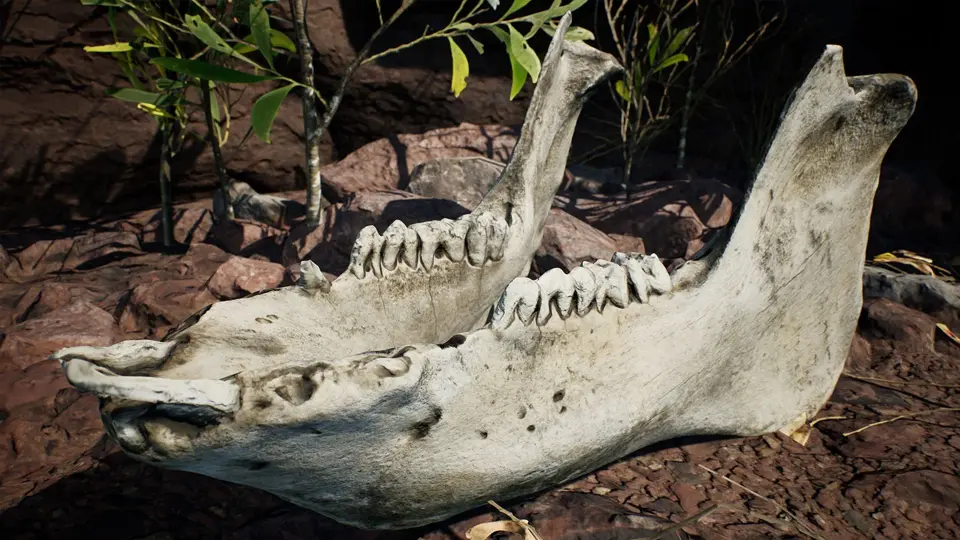
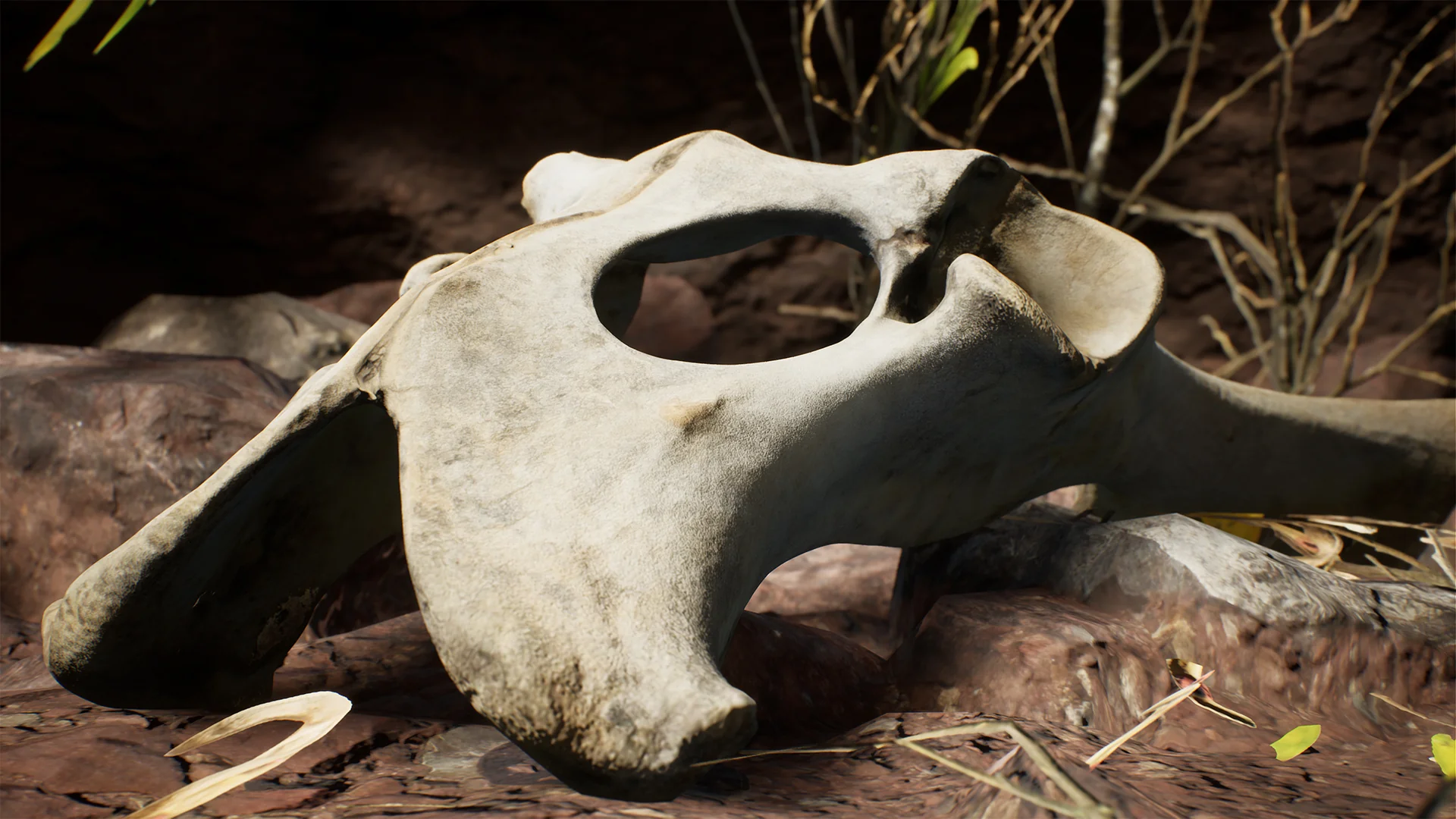
Constructing believable arid environments requires skeletal scatter that reflects authentic outdoor weathering rather than manual, synthetic approximations. Open rangelands, dried water channels, and windswept outback expanses frequently feature the remnants of livestock, such as cow and horse remains, which communicate long-term environmental hostility, drought, and the passage of time. Dry Animal Bones - Photoscan Vol 2 introduces twelve photogrammetry-derived skeletal assets captured directly from real-world Australian desert terrain. Because these models originate from direct environmental scans, they preserve authentic structural nuances, including natural sun bleaching, calcification patterns, fibrous organic fissures, and mineral staining characteristic of genuine sun-baked bones.
Integrating organic scatter props of this nature prevents natural environments from appearing sterile. When building out dry river basins, sun-scorched valleys, or perimeter fencing across barren pastures, scattering identifiable animal remains grounds the scene in realistic regional ecology. The inclusion of cow and horse skeletal debris provides immediate scale references for approaching characters or interactive cameras, establishing an uncompromising environmental tone without relying on speculative or exaggerated fantasy stylization.
Geometry Configuration and Whole Mesh Photoscan Assets
A persistent technical hurdle encountered when using photogrammetric props in level design is the unmodeled contact boundary. Traditional scanning workflows frequently skip the underside where an object contacts the ground, leaving open cavities, missing polys, or flattened underside geometry. This defect forces artists to embed the asset rigidly into terrain planes to obscure the missing mesh surfaces. Dry Animal Bones - Photoscan Vol 2 resolves this operational limitation by supplying all twelve bone assets as complete, enclosed whole meshes.
Because every bone is reconstructed across its entire physical volume, environment artists can position, orient, and pitch each mesh arbitrarily within a scene. A single leg bone, vertebrae, or cranial element can be balanced precariously on rocky outcrops, propped diagonally against embankments, dropped into dried gullies, or stacked into tangled scatter piles. Rolling or tumbling an asset down an incline exposes no inverted normals or untextured backfaces to the viewport. This omnidirectional structural integrity significantly increases the practical utility of the twelve meshes, as level dressers can rotate identical pieces along multiple axes and seat them at varying angles without revealing repetition or artificial contact boundaries.
Texture Resolution, Channel Packing, and Displacement in Photoscan Models
Balancing high-fidelity photogrammetry with interactive performance constraints requires structured texture workflows. Every skeletal subject in this collection underwent an 8k scanning capture process before being downscaled to 4k master textures. Downscaling from an 8k master preserves micro-porosity, delicate surface abrasions, and bone fibrous structures while effectively filtering out high-frequency sensor noise that can disrupt surface specular responses.
To support real-time execution, the models are pre-configured and optimized directly for in-game use. Where appropriate, textures feature channel packing combining ambient occlusion and roughness maps within single file containers. This configuration reduces active texture sampler counts, curtails material memory footprints, and streamlines rendering throughput across dense scenes. Concurrently, the assets accommodate cinematic requirements: the base geometry supports tessellation, allowing rendering pipelines to apply displacement shaders that push the polygonal surface out to match the real-world micro-detail captured during scanning. Whether utilized as lightweight background scatter across expansive vistas or placed front and center as hero props in offline cinematic framing, the meshes preserve their physical silhouette and micro-textural fidelity.
Surface Continuity with Bonus Dirt and Gravel Textures
Organic scatter assets frequently appear disconnected from game terrain when material properties, soil color, and grain sizes do not align between props and the ground underneath. To resolve this visual disconnect, the pack includes five bonus photoscanned surface materials captured in the identical Australian location where the animal bones were acquired: Dirt 01, Dirt Rocky 01, Dirt Rocky 02, Gravel 01, and Gravel 02.
Supplied at full 4k resolution, each of these five terrain textures features channel-packed ambient occlusion, roughness, and displacement maps. Environment artists can use these materials within landscape blending layers, virtual texture stacks, or decal workflows to ensure identical color palettes and mineral tones across both terrain planes and skeletal meshes. Painting Dirt Rocky or Gravel materials beneath a scatter cluster of horse or cow bones creates a natural bedding area where sediment and loose rock accumulate organically around the remains. The displacement maps included with the textures allow for physical depth variation in terrain materials, enabling bones to nestle into depressions, washouts, and stony clearings with accurate contact shadows and consistent light reflectivity.
Assembling Arid Biomes with the Australian Desert Collection
Cohesive environmental design relies on modular assets that share consistent optical traits, lighting behavior, and climatic weathering. Dry Animal Bones - Photoscan Vol 2 functions as an integral piece of a broader regional asset ecosystem, harmonizing directly with related volumes such as Vol 1. Termite Mounds, Vol 3. Animal Dung, and Vol 4. Desert Embankments, which form the wider Australian Desert Collection.
Deploying these related packs together enables worldbuilders to construct complete ecological vignettes using assets derived from the same geographical region. Artists can establish dry washes by placing desert embankments to define the flow of historic water runoff, dressing the basin with loose gravel, and distributing weathered animal bones alongside termite mounds and dried dung scatter. Because each collection shares the same capture environment and photogrammetric baseline, surface reflectance, mineral tint, and level of degradation remain uniform. This consistency removes the need for extensive manual color-grading passes across individual assets, providing developers with a streamlined pipeline for assembling believable arid outback and desert landscapes.
 Nature & Plants
 Nature & Plants
 Nature & Plants
 Nature & Plants