"a5ffaf404b9c2b7e"{"id":"1002629","slug":"fantasy-characters-pack","title":"Fantasy Characters (Pack)","category":"Characters \u0026 Creatures","engine":"5.0+","assetVersion":"","engineVersion":"Engine Version: 5.0+","tag":"Characters","accent":"blue","visual":"character","summary":"A technical look at the Fantasy Characters pack, detailing Epic Skeleton compatibility, modular lowpoly workflows, PBR materials, and character animations.","platform":"Unreal Engine","indexPolicy":"index","publishedAt":"2026-11-15T06:08:16.965Z","updatedAt":"2026-11-15T06:08:16.965Z","sourceNotes":[],"fileContents":[],"compatibility":["Unreal Engine","Engine Version: 5.0+"],"featuredImage":{"alt":"Fantasy Characters (Pack)","src":"/wp-content/uploads/published/2026/11/516243cb549c-959619ca-a30e-4a28-af28-bc8759b1e66e-2ae10ad1ac.webp"},"hasDownloadLink":true,"downloads":0,"terms":[{"taxonomy":"category","slug":"characters-and-creatures","name":"Characters \u0026 Creatures"}],"galleryImages":[{"src":"/wp-content/uploads/published/2026/11/177ce180969d-cd70c577-6fac-4b3b-bc09-04e3f1b41622-c7a9050425.webp","alt":"Fantasy Characters (Pack)"},{"src":"/wp-content/uploads/published/2026/11/237989b18630-a6e5b0c4-c86e-473d-994c-447265cdbee5-72d7853501.webp","alt":"Fantasy Characters (Pack)"},{"src":"/wp-content/uploads/published/2026/11/f824205f82c2-2af2a9d8-2935-4f03-807b-dd25a12d7d35-a538e26e1b.webp","alt":"Fantasy Characters (Pack)"},{"src":"/wp-content/uploads/published/2026/11/634846a67e94-bce95a20-b5e5-4a94-b01d-9c5b112fb9ea-3aafae1d43.webp","alt":"Fantasy Characters (Pack)"},{"src":"/wp-content/uploads/published/2026/11/927e8b562e7e-e2a364cc-9605-4228-bfa0-5c70650cbfe4-059b913948.webp","alt":"Fantasy Characters (Pack)"},{"src":"/wp-content/uploads/published/2026/11/902a2de28135-6f82c305-7de4-4ab4-a920-5795f89d4c52-371f545022.webp","alt":"Fantasy Characters (Pack)"},{"src":"/wp-content/uploads/published/2026/11/880ebacf77fb-e189cecf-08fc-46ed-b0ad-2a218fb383f5-8833f056e5.webp","alt":"Fantasy Characters (Pack)"},{"src":"/wp-content/uploads/published/2026/11/d20c3a66da50-895d6971-7fb5-4ee9-8546-6ee8d9159ad2-77be0c5e48.webp","alt":"Fantasy Characters (Pack)"},{"src":"/wp-content/uploads/published/2026/11/c94956c29a8e-54e77348-af5b-464a-b59f-8fa7d01ef7e9-fb5b9f183f.webp","alt":"Fantasy Characters (Pack)"},{"src":"/wp-content/uploads/published/2026/11/552ad9712943-86116aea-b9c1-467c-a116-88a283246d9f-dc4193f159.webp","alt":"Fantasy Characters (Pack)"}],"accessPanel":{"kind":"resource","title":"Get this resource","eyebrow":"Free resource","message":"Download this resource in your browser.","fileName":"Content.7z","safetyNote":"Resources are manually reviewed before listing to improve quality and reduce obvious risks.","actionLabel":"Get this resource","resourceType":"Resource archive","versions":[]},"contentHtml":"\u003cp\u003eIntegrating stylized combat units into a real-time project begins with skeletal binding and asset organization. Fantasy Characters (Pack) supplies an ensemble of fantasy and RPG combatants shaped by lowpoly geometry, modular customization, weapon integration, and physically based rendering (PBR) workflows. The assets are established figures within game engine ecosystems, carrying a legacy vintage while maintaining functional compatibility with standard modern development frameworks.\u003c/p\u003e\u003ch2\u003eIntegrating the Fantasy Characters with the Epic Skeleton\u003c/h2\u003e\u003cp\u003eRigging reliability dictates how quickly external models can adopt player input, locomotion blends, and combat state machines. A defining technical aspect of this collection is its alignment with the standard Epic Skeleton hierarchy. Multiple character types across the package undergo direct testing against this skeletal structure, enabling shared animation graphs and straightforward retargeting pipelines.\u003c/p\u003e\u003cp\u003eThe humanoid roster members evaluated under the Epic Skeleton include:\u003c/p\u003e\u003cul\u003e\u003cli\u003eBarbarian\u003c/li\u003e\u003cli\u003eBarbarian Fantasy\u003c/li\u003e\u003cli\u003eDwarf\u003c/li\u003e\u003cli\u003eRPG Knight\u003c/li\u003e\u003cli\u003eViking Ulf\u003c/li\u003e\u003cli\u003eWarrior\u003c/li\u003e\u003c/ul\u003e\u003cp\u003eBecause these figures correspond to standard joint conventions, assigning locomotion blends—such as walking, running, crouching, jumping, and strafing—requires minimal bone remapping. Standardizing across a uniform bone hierarchy prevents the need to build isolated animation blueprints for each separate fighter. The inclusion of diverse proportions, such as the stockier Dwarf alongside standard human builds like the Warrior and Viking Ulf, provides opportunities to verify bone stretching, retargeting offsets, and socket alignments across varying skeletal silhouettes.\u003c/p\u003e\u003cp\u003eNon-standard and non-human silhouettes also interface with this unified framework. The Werewolf and the Golem are both set up and tested against the Epic Skeleton, demonstrating how monstrous or heavily built creature types fit into existing player or enemy controller hierarchies. In practice, running non-standard fantasy physiques on a standard humanoid rig allows technical designers to reuse heavy attack logic, hit reactions, and death sequences across both monster encounters and human opponents without maintaining distinct skeletal data trees.\u003c/p\u003e\u003ch2\u003eModular Assembly and Weapon Slots for Fantasy Characters\u003c/h2\u003e\u003cp\u003eThe collection carries modular and weapon classification tags, pointing to flexible customization across project categories. In modular RPG architectures, separating character geometry into discrete meshes—such as headgear, chest pieces, gauntlets, and boots—enables real-time armor equipping, visual tier progression, and procedural enemy variation. Lowpoly construction keeps draw calls and vertex counts manageable across large encounters, whether populating a dungeon crawl, an open-world skirmish, or an isometric mob defense.\u003c/p\u003e\u003cp\u003eWeapons play an equally fundamental role in the functional pipeline. Meshes tailored for RPG combat depend on dedicated socket positioning at the hand joints. With the Barbarian, Barbarian Fantasy, RPG Knight, and Warrior, having modular mesh divisions alongside designated weapon attachments facilitates dynamic weapon unsheathing, dual-wielding, or switching between single-handed blades and shields. Because the base models follow lowpoly technical constraints, physics bodies and ragdoll simulations compute quickly, leaving greater processing budget for artificial intelligence routines, particle VFX, and environmental lighting.\u003c/p\u003e\u003ch2\u003eDedicated Motion Sets across the Characters Pack\u003c/h2\u003e\u003cp\u003eWhile standard locomotion runs through Epic Skeleton retargeting, distinct character entries feature dedicated animation assets tailored to their specific weight classes and combat behaviors. The package incorporates general Epic Animations alongside focused sequences created for specialized heavy archetypes.\u003c/p\u003e\u003cp\u003eThe Troll and the Orc Hammer stand out with dedicated animation coverage:\u003c/p\u003e\u003cul\u003e\u003cli\u003e\u003cstrong\u003eTroll Animations:\u003c/strong\u003e Motion profiles adapted to large, brutish postures where standard human locomotion curves would look too swift or unnatural. These sequences accommodate sweeping attacks, heavy footfalls, and lumbering idle states suited for elite boss encounters or heavy dungeon guardians.\u003c/li\u003e\u003cli\u003e\u003cstrong\u003eOrc Hammer Animations:\u003c/strong\u003e Combat motions focused on two-handed blunt weaponry. These sequences capture the windup, impact momentum, and recovery phases required for heavy weapon telegraphing, making them directly applicable to combat mechanics that emphasize deliberate timing and parry windows.\u003c/li\u003e\u003cli\u003e\u003cstrong\u003eEpic Animations:\u003c/strong\u003e Broad-spectrum animation data suitable for the standardized humanoid lineup, ensuring that standard sword strikes, baseline hit stuns, and directional movement feed cleanly into state machines.\u003c/li\u003e\u003c/ul\u003e\u003cp\u003eHaving dedicated animation data for the Troll and the Orc Hammer eliminates the awkwardness of forcing oversized, hulking character geometry through standard human animation loops, preserving visual weight and believable mass in game simulations.\u003c/p\u003e\u003ch2\u003ePBR Material Setup and Production Deployment\u003c/h2\u003e\u003cp\u003eVisual cohesion across the collection is governed by PBR surfacing, ensuring consistent response across dynamic lighting environments. Lowpoly meshes paired with PBR material pipelines rely on clean albedo maps, normal maps to bake in surface definition, and roughness-metallic channels to separate cloth, raw skin, polished steel, and rough stone. Characters like the Golem demand material separation that reads as solid mineral or carved rock, while the RPG Knight relies on metallic reflections across plate armor, contrasted against leather undergarments.\u003c/p\u003e\u003cp\u003eBecause the collection is characterized as an older generation of assets, developers should anticipate straightforward lowpoly topology rather than dense micro-poly meshes. This makes the lineup particularly suitable for:\u003c/p\u003e\u003cul\u003e\u003cli\u003ePrototypes and proof-of-concept RPG mechanical testing where quick character setup is vital.\u003c/li\u003e\u003cli\u003eTop-down, isometric, and mobile game engines requiring lightweight geometry and efficient texture throughput.\u003c/li\u003e\u003cli\u003eCrowd or horde enemy pools where dozens of Barbarians, Warriors, or Werewolves must render simultaneously without causing CPU or GPU bottlenecks.\u003c/li\u003e\u003c/ul\u003e\u003cp\u003eBy combining standardized Epic Skeleton validation across both human and monster forms, distinct animation sets for heavy units like the Troll and Orc Hammer, and a modular lowpoly design philosophy, the Fantasy Characters assets provide a functional structural base for fantasy game systems requiring rapid integration and predictable runtime performance.\u003c/p\u003e\n\n\u003ch2\u003eContinue Browsing Similar Packs\u003c/h2\u003e\n\u003cul\u003e\n\u003cli\u003e\u003ca href=\"https://3dcghub.com/armored-stone-golem-dark-fantasy-boss/\" rel=\"noopener noreferrer\"\u003eArmored Stone Golem - Dark Fantasy Boss\u003c/a\u003e\u003c/li\u003e\n\u003cli\u003e\u003ca href=\"https://3dcghub.com/modular-fantasy-knights/\" rel=\"noopener noreferrer\"\u003eModular Fantasy Knights\u003c/a\u003e\u003c/li\u003e\n\u003cli\u003e\u003ca href=\"https://3dcghub.com/heroic-fantasy-bosses-reaper/\" rel=\"noopener noreferrer\"\u003eHeroic Fantasy Bosses: Reaper\u003c/a\u003e\u003c/li\u003e\n\u003cli\u003e\u003ca href=\"https://3dcghub.com/fantasy-barbarian/\" rel=\"noopener noreferrer\"\u003eFantasy Barbarian\u003c/a\u003e\u003c/li\u003e\n\u003cli\u003e\u003ca href=\"https://3dcghub.com/fantasy-knight/\" rel=\"noopener noreferrer\"\u003eFantasy Knight\u003c/a\u003e\u003c/li\u003e\n\u003c/ul\u003e","contentTextLength":6611,"navigation":{"current":19,"total":4570,"previous":{"id":"1002630","slug":"fences-vol-2-farm-and-town-modular-nanite-and-low-poly","title":"Fences VOL.2 - Farm and Town Modular (Nanite and Low Poly)","category":"Railings \u0026 Fences","platform":"Unreal Engine","updatedAt":"2026-11-15T06:09:57.419Z"},"next":{"id":"1002628","slug":"dry-animal-bones-photoscan-vol-2","title":"Dry Animal Bones - Photoscan Vol 2.","category":"Nature \u0026 Plants","platform":"Unreal Engine","updatedAt":"2026-11-15T06:07:04.009Z"}},"relatedResources":[{"id":"1002578","slug":"armored-stone-golem-dark-fantasy-boss","title":"Armored Stone Golem - Dark Fantasy Boss","category":"Characters \u0026 Creatures","engine":"5.1+","assetVersion":"","engineVersion":"Engine Version: 5.1+","tag":"Characters","accent":"blue","visual":"character","summary":"Examine the Armored Stone Golem for dark fantasy action RPGs, featuring UE5 Epic Skeleton rigging, 25 animations, 4K PBR textures, and 4 color variants.","platform":"Unreal Engine","indexPolicy":"index","publishedAt":"2026-11-14T05:14:45.881Z","updatedAt":"2026-11-14T05:14:45.881Z","sourceNotes":[],"fileContents":[],"compatibility":["Unreal Engine","Engine Version: 5.1+"],"featuredImage":{"alt":"Armored Stone Golem - Dark Fantasy Boss","src":"/wp-content/uploads/published/2026/11/a23701a7778c-967708b1-552f-4ec6-85a2-4940374834ec-1d4d4d5052.webp"},"hasDownloadLink":true,"downloads":0},{"id":"1002499","slug":"modular-fantasy-knights","title":"Modular Fantasy Knights","category":"Characters \u0026 Creatures","engine":"4.26+,5.0+","assetVersion":"","engineVersion":"Engine Version: 4.26+,5.0+","tag":"Characters","accent":"blue","visual":"character","summary":"Explore Modular Fantasy Knights: 59 skeletal meshes, APEX cloth files, dynamic master materials, and UE4 Mannequin compatibility for RPG and MMO projects.","platform":"Unreal Engine","indexPolicy":"index","publishedAt":"2026-11-12T18:23:45.507Z","updatedAt":"2026-11-12T18:23:45.507Z","sourceNotes":[],"fileContents":[],"compatibility":["Unreal Engine","Engine Version: 4.26+,5.0+"],"featuredImage":{"alt":"Modular Fantasy Knights","src":"/wp-content/uploads/published/2026/11/b470911995c7-9135ea8a-8765-4abf-9a62-3c4f537ed1f5-a98c61938a.webp"},"hasDownloadLink":true,"downloads":0},{"id":"1002533","slug":"heroic-fantasy-bosses-reaper","title":"Heroic Fantasy Bosses: Reaper","category":"Characters \u0026 Creatures","engine":"4.26+,5.0+","assetVersion":"","engineVersion":"Engine Version: 4.26+,5.0+","tag":"Characters","accent":"blue","visual":"character","summary":"Examine Heroic Fantasy Bosses: Reaper, a 34.5 Ktris dark fantasy boss model featuring an 80-bone rig, 5 materials, specular PBR textures, and 15 animations.","platform":"Unreal Engine","indexPolicy":"index","publishedAt":"2026-11-13T09:35:58.663Z","updatedAt":"2026-11-13T09:35:58.663Z","sourceNotes":[],"fileContents":[],"compatibility":["Unreal Engine","Engine Version: 4.26+,5.0+"],"featuredImage":{"alt":"Heroic Fantasy Bosses: Reaper","src":"/wp-content/uploads/published/2026/11/3928d8596d26-d6e08623-66be-4cd8-97d0-b96cb6afebff-88afe8a010.webp"},"hasDownloadLink":true,"downloads":0}]}
Characters
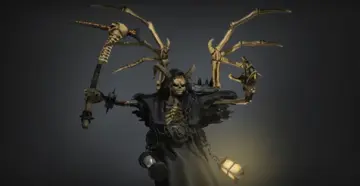
Fantasy Characters (Pack)
A technical look at the Fantasy Characters pack, detailing Epic Skeleton compatibility, modular lowpoly workflows, PBR materials, and character animations.
Integrating stylized combat units into a real-time project begins with skeletal binding and asset organization. Fantasy Characters (Pack) supplies an ensemble of fantasy and RPG combatants shaped by lowpoly geometry, modular customization, weapon integration, and physically based rendering (PBR) workflows. The assets are established figures within game engine ecosystems, carrying a legacy vintage while maintaining functional compatibility with standard modern development frameworks.
Integrating the Fantasy Characters with the Epic Skeleton
Rigging reliability dictates how quickly external models can adopt player input, locomotion blends, and combat state machines. A defining technical aspect of this collection is its alignment with the standard Epic Skeleton hierarchy. Multiple character types across the package undergo direct testing against this skeletal structure, enabling shared animation graphs and straightforward retargeting pipelines.
The humanoid roster members evaluated under the Epic Skeleton include:
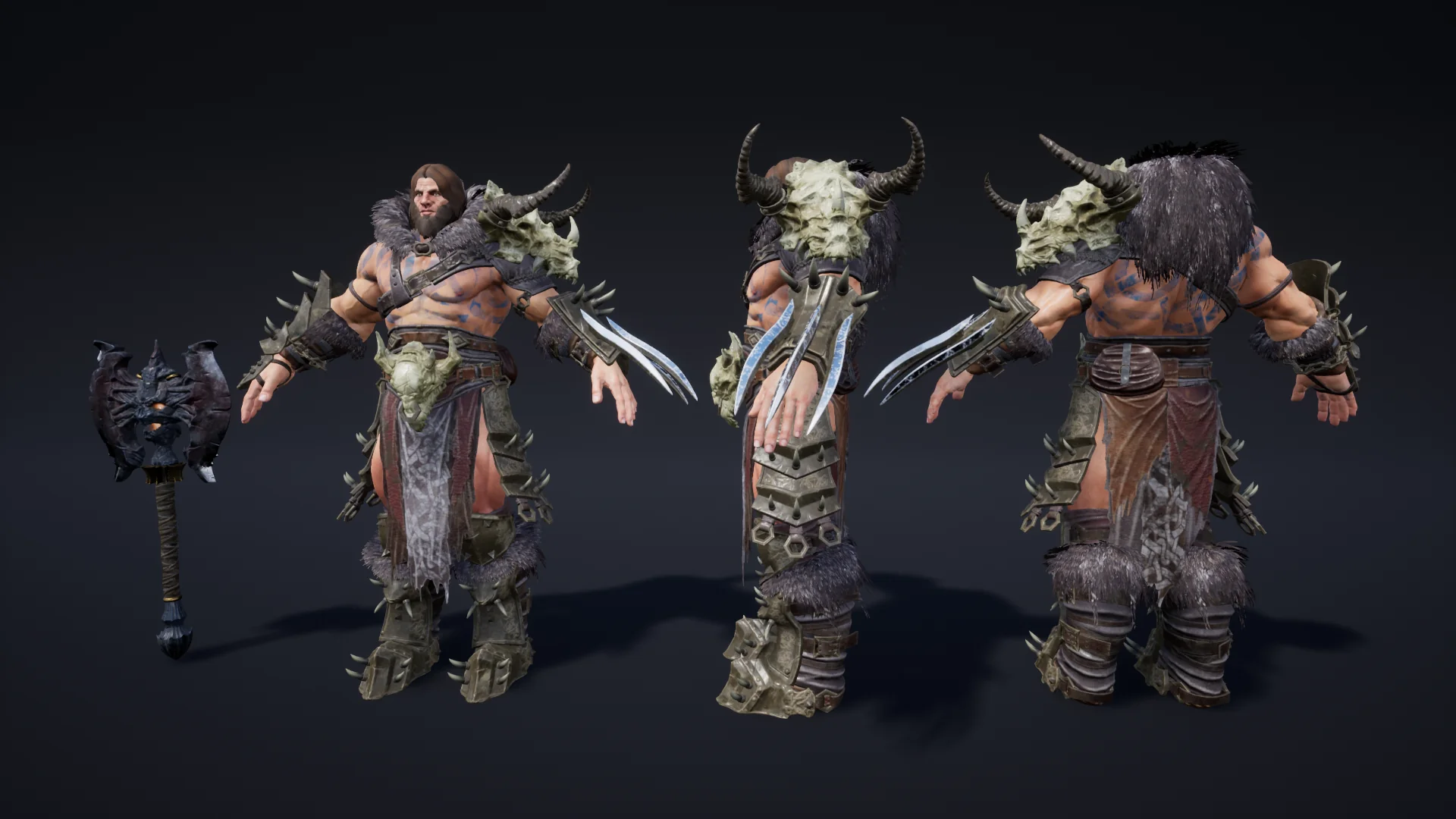
Barbarian
Barbarian Fantasy
Dwarf
RPG Knight
Viking Ulf
Warrior
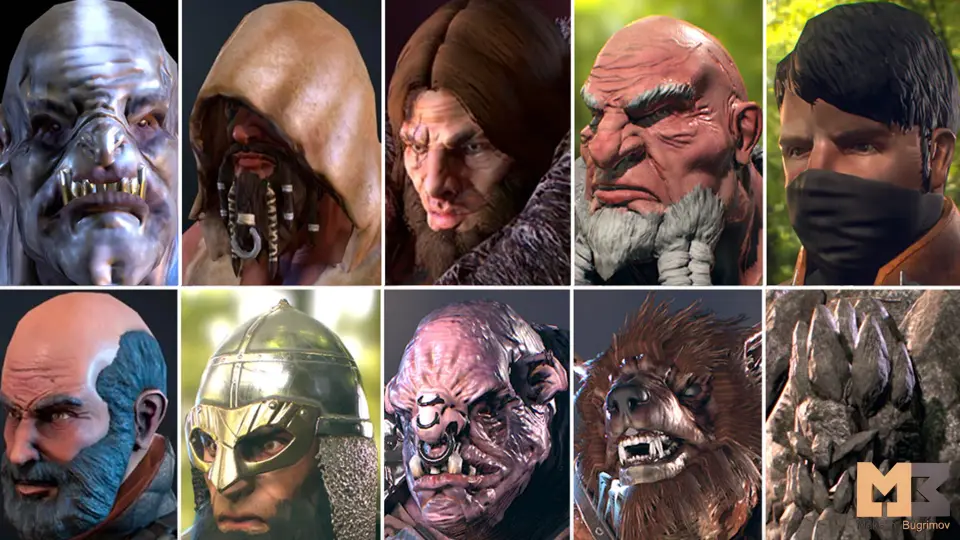
Because these figures correspond to standard joint conventions, assigning locomotion blends—such as walking, running, crouching, jumping, and strafing—requires minimal bone remapping. Standardizing across a uniform bone hierarchy prevents the need to build isolated animation blueprints for each separate fighter. The inclusion of diverse proportions, such as the stockier Dwarf alongside standard human builds like the Warrior and Viking Ulf, provides opportunities to verify bone stretching, retargeting offsets, and socket alignments across varying skeletal silhouettes.
Non-standard and non-human silhouettes also interface with this unified framework. The Werewolf and the Golem are both set up and tested against the Epic Skeleton, demonstrating how monstrous or heavily built creature types fit into existing player or enemy controller hierarchies. In practice, running non-standard fantasy physiques on a standard humanoid rig allows technical designers to reuse heavy attack logic, hit reactions, and death sequences across both monster encounters and human opponents without maintaining distinct skeletal data trees.
Modular Assembly and Weapon Slots for Fantasy Characters
The collection carries modular and weapon classification tags, pointing to flexible customization across project categories. In modular RPG architectures, separating character geometry into discrete meshes—such as headgear, chest pieces, gauntlets, and boots—enables real-time armor equipping, visual tier progression, and procedural enemy variation. Lowpoly construction keeps draw calls and vertex counts manageable across large encounters, whether populating a dungeon crawl, an open-world skirmish, or an isometric mob defense.
Weapons play an equally fundamental role in the functional pipeline. Meshes tailored for RPG combat depend on dedicated socket positioning at the hand joints. With the Barbarian, Barbarian Fantasy, RPG Knight, and Warrior, having modular mesh divisions alongside designated weapon attachments facilitates dynamic weapon unsheathing, dual-wielding, or switching between single-handed blades and shields. Because the base models follow lowpoly technical constraints, physics bodies and ragdoll simulations compute quickly, leaving greater processing budget for artificial intelligence routines, particle VFX, and environmental lighting.
Dedicated Motion Sets across the Characters Pack
While standard locomotion runs through Epic Skeleton retargeting, distinct character entries feature dedicated animation assets tailored to their specific weight classes and combat behaviors. The package incorporates general Epic Animations alongside focused sequences created for specialized heavy archetypes.
The Troll and the Orc Hammer stand out with dedicated animation coverage:
Troll Animations: Motion profiles adapted to large, brutish postures where standard human locomotion curves would look too swift or unnatural. These sequences accommodate sweeping attacks, heavy footfalls, and lumbering idle states suited for elite boss encounters or heavy dungeon guardians.
Orc Hammer Animations: Combat motions focused on two-handed blunt weaponry. These sequences capture the windup, impact momentum, and recovery phases required for heavy weapon telegraphing, making them directly applicable to combat mechanics that emphasize deliberate timing and parry windows.
Epic Animations: Broad-spectrum animation data suitable for the standardized humanoid lineup, ensuring that standard sword strikes, baseline hit stuns, and directional movement feed cleanly into state machines.
Having dedicated animation data for the Troll and the Orc Hammer eliminates the awkwardness of forcing oversized, hulking character geometry through standard human animation loops, preserving visual weight and believable mass in game simulations.
PBR Material Setup and Production Deployment
Visual cohesion across the collection is governed by PBR surfacing, ensuring consistent response across dynamic lighting environments. Lowpoly meshes paired with PBR material pipelines rely on clean albedo maps, normal maps to bake in surface definition, and roughness-metallic channels to separate cloth, raw skin, polished steel, and rough stone. Characters like the Golem demand material separation that reads as solid mineral or carved rock, while the RPG Knight relies on metallic reflections across plate armor, contrasted against leather undergarments.
Because the collection is characterized as an older generation of assets, developers should anticipate straightforward lowpoly topology rather than dense micro-poly meshes. This makes the lineup particularly suitable for:
Prototypes and proof-of-concept RPG mechanical testing where quick character setup is vital.
Top-down, isometric, and mobile game engines requiring lightweight geometry and efficient texture throughput.
Crowd or horde enemy pools where dozens of Barbarians, Warriors, or Werewolves must render simultaneously without causing CPU or GPU bottlenecks.
By combining standardized Epic Skeleton validation across both human and monster forms, distinct animation sets for heavy units like the Troll and Orc Hammer, and a modular lowpoly design philosophy, the Fantasy Characters assets provide a functional structural base for fantasy game systems requiring rapid integration and predictable runtime performance.
 Characters
 Characters
 Characters
 Characters