"7cee950366b2d3dd"{"id":"1002306","slug":"floors-and-walls-vol-1-photoscanned-textures","title":"Floors and Walls Vol.1 Photoscanned textures","category":"Nature \u0026 Plants","engine":"4.27+,5.0+","assetVersion":"","engineVersion":"Engine Version: 4.27+,5.0+","tag":"Nature \u0026 Plants","accent":"blue","visual":"luts","summary":"A practical look at Floors and Walls Vol.1 Photoscanned textures: 34 stone wall meshes, 20 tiled wall textures, 15 tiled floor textures, plus leaves and mud.","platform":"Unreal Engine","indexPolicy":"index","publishedAt":"2026-11-05T10:06:31.464Z","updatedAt":"2026-11-05T10:06:31.464Z","sourceNotes":[],"fileContents":[],"compatibility":["Unreal Engine","Engine Version: 4.27+,5.0+"],"featuredImage":{"alt":"Floors and Walls Vol.1 Photoscanned textures","src":"/wp-content/uploads/published/2026/11/4bb2d3ac47c6-c0fc7266-8901-4d7a-85c6-d9cd2f8ede9f-5fdf77fcf7.webp"},"hasDownloadLink":true,"downloads":0,"terms":[{"taxonomy":"category","slug":"nature-and-plants","name":"Nature \u0026 Plants"}],"galleryImages":[{"src":"/wp-content/uploads/published/2026/11/ac1418e44811-e265f776-e217-4aed-82ae-d70d4b3bbd64-62eb6c9443.webp","alt":"Floors and Walls Vol.1 Photoscanned textures"},{"src":"/wp-content/uploads/published/2026/11/753e25ce4fc8-f95c7ceb-3759-48af-adc1-09574c2805e9-35f8cc1fe5.webp","alt":"Floors and Walls Vol.1 Photoscanned textures"},{"src":"/wp-content/uploads/published/2026/11/e197e1ae9d2e-5b0c38a6-665c-423a-b848-bf32046548f2-71314a3945.webp","alt":"Floors and Walls Vol.1 Photoscanned textures"},{"src":"/wp-content/uploads/published/2026/11/4a99650e8b84-c8c4599f-fdf9-4661-b532-dcc0ee004d47-e504f44d95.webp","alt":"Floors and Walls Vol.1 Photoscanned textures"},{"src":"/wp-content/uploads/published/2026/11/8f9221b3823e-adef7b4b-459c-422b-b887-8df52db633ba-296e3bf9ec.webp","alt":"Floors and Walls Vol.1 Photoscanned textures"},{"src":"/wp-content/uploads/published/2026/11/32f316e688e0-7081d0fa-17e1-429d-9c90-6d830fde8a2a-9a6d0d12ae.webp","alt":"Floors and Walls Vol.1 Photoscanned textures"},{"src":"/wp-content/uploads/published/2026/11/f84f42e6c5c8-508727aa-013e-4bcd-a645-f7c4ea075655-545b783f99.webp","alt":"Floors and Walls Vol.1 Photoscanned textures"},{"src":"/wp-content/uploads/published/2026/11/5f6ff5d0c2a5-34d7598f-87fa-4917-bda9-6ca2198371e3-6bb567115a.webp","alt":"Floors and Walls Vol.1 Photoscanned textures"},{"src":"/wp-content/uploads/published/2026/11/fa6bf9096be7-ba0f7f8d-8c54-4040-8e06-86d17257cf44-1e9185c72e.webp","alt":"Floors and Walls Vol.1 Photoscanned textures"},{"src":"/wp-content/uploads/published/2026/11/809e1631bb4d-a3e16cce-e7ea-4c74-9949-62b5f945a067-2b193291d1.webp","alt":"Floors and Walls Vol.1 Photoscanned textures"}],"accessPanel":{"kind":"resource","title":"Get this resource","eyebrow":"Free resource","message":"3DCGHUB is a discovery service. EduQuill provides the file, account, quotas and delivery.","fileName":"Floors and Walls Vol.1 Photoscanned textures.7z","safetyNote":"Resources are manually reviewed before listing to improve quality and reduce obvious risks.","actionLabel":"Get from EduQuill","resourceType":"Resource archive","versions":[]},"contentHtml":"\u003cp\u003eStone surfaces are rarely a single problem. A camera moving past a wall needs geometry that holds up when the view gets close, while a corridor or courtyard needs texture coverage that can stretch across much more area than one mesh allows. Floors and Walls Vol.1 Photoscanned textures works both sides of that split: 34 stone wall meshes for built-out surfaces, alongside 20 tiled wall textures and 15 tiled floor textures. Photoscanned stone is the common thread across the meshes and the tiled surfaces.\u003c/p\u003e \u003ch2\u003eStone wall meshes for the surfaces the camera gets close to\u003c/h2\u003e\n\u003cp\u003eThe 34 stone wall meshes are the part of the set with actual wall form. Use them where a flat textured plane would reveal its limits: a tight corner, a low wall beside a path, a section of facade in the foreground, or a passage where the wall edge needs to read as stone rather than a painted surface. Because these are meshes, they can be placed as individual pieces and combined with the rest of the scene instead of being locked to one rectangular surface.\u003c/p\u003e\n\u003cp\u003ePhotoscanned stone brings variation that is difficult to fake across a whole wall. The mesh is also a practical way to break up a repeated tiled wall in the background: put a mesh section in the near field, then let tiled textures take over farther back. That transition is easier to manage when both parts of the set share the same stone character, which is the point of keeping meshes and tiled textures together in one volume.\u003c/p\u003e \u003ch2\u003eTiled wall textures for long walls and repeated architecture\u003c/h2\u003e\n\u003cp\u003eTwenty tiled wall textures handle the broad surfaces. A tiled texture can cover a wall longer or taller than the mesh piece, so it suits corridors, perimeter walls, stair wells, courtyard boundaries, and background buildings where the camera does not need to inspect every stone joint. The tiling is the feature to lean on: repeat the surface across a large plane, then use lighting and scene layout to keep the repeat from becoming the first thing a viewer notices.\u003c/p\u003e\n\u003cp\u003eThe wall textures are also useful for blockouts that need to become final-looking without a full mesh pass. If a wall is only seen from a distance or at an angle, a tiled stone texture may be enough. Save the 34 meshes for the places where the camera stops, turns, or moves in close. That division keeps the mesh work concentrated where it pays off and lets the tiled textures carry the bulk of the environment.\u003c/p\u003e \u003ch2\u003eFifteen tiled floor textures underfoot\u003c/h2\u003e\n\u003cp\u003eThe 15 tiled floor textures take the same practical approach to ground surfaces. Floors tend to cover more area than walls in an interior or courtyard, and they are often seen at a shallow angle, so tiling is a natural fit. Use them for stone paving, rough ground, or the base of an environment where the floor needs to continue past the edge of a single mesh or room. Because the floors are tiled, they can be laid out across open areas and repeated along paths without rebuilding the surface each time.\u003c/p\u003e\n\u003cp\u003ePairing floor and wall textures matters in stone environments because the two surfaces meet at the base of every wall. A floor texture can ground a wall section, and a wall texture can frame a floor plane. With 20 wall textures and 15 floor textures in the tiled group, there is enough variety to dress more than one room or exterior zone without every surface coming from the same image.\u003c/p\u003e \u003ch2\u003eLeaves and mud in the updated texture set\u003c/h2\u003e\n\u003cp\u003eAn update to the set added 25 textures of stone walls and floors, leaves, and mud. That addition changes the set from a clean stone library into something that can handle the surface layer that builds up around stone. Leaves and mud are the kind of detail that makes a floor read as an outdoor or weathered place rather than an untouched material sample. They can sit on floors, collect at wall bases, or appear in corners where stone meets soil and vegetation.\u003c/p\u003e\n\u003cp\u003eUse the leaf and mud textures as ground-level storytelling. A courtyard can move from swept stone to a drift of leaves near a wall. A passage can show mud where traffic would cross it. None of this requires changing the stone itself; the added textures supply the secondary surface detail while the wall meshes and tiled stone carry the architecture.\u003c/p\u003e \u003ch2\u003eBuilding a stone scene from meshes, tiled surfaces, and ground detail\u003c/h2\u003e\n\u003cp\u003eA workable order is to block the space with tiled wall and floor textures first, then replace the close or important sections with the 34 stone wall meshes. That keeps the scene covered early and puts the geometry where the camera will actually spend time. The 20 wall textures and 15 floor textures can stay on the surfaces that are farther away, while the meshes handle corners, foreground walls, and any place where a flat plane would look too thin.\u003c/p\u003e\n\u003cp\u003eAfter the main surfaces are in place, the 25 added textures of stone walls and floors, leaves, and mud can be used to break up the ground and the base of walls. The set is not organized as a single hero asset; it is a collection of stone surfaces at different levels of detail. That makes it useful for environments where the camera moves from wide establishing views into closer inspection.\u003c/p\u003e \u003ch2\u003eA fit for stone-heavy environments with mixed camera distance\u003c/h2\u003e\n\u003cp\u003eFloors and Walls Vol.1 Photoscanned textures is a fit when a project needs stone walls and floors at both mesh and tiled texture levels, plus leaves and mud for ground detail. The counts are straightforward: 34 meshes, 20 tiled wall textures, 15 tiled floor textures, and 25 added textures in the update. Use the meshes where the camera is close, the tiled textures where the surface runs long, and the leaf and mud textures where the stone meets the ground.\u003c/p\u003e\n\n\u003ch2\u003eRelated Resources Worth Checking\u003c/h2\u003e\n\u003cul\u003e\n\u003cli\u003e\u003ca href=\"https://3dcghub.com/meadow-environment-set/\" rel=\"noopener noreferrer\"\u003eMeadow - Environment Set\u003c/a\u003e\u003c/li\u003e\n\u003cli\u003e\u003ca href=\"https://3dcghub.com/realistic-grass-sv-02-master-grass/\" rel=\"noopener noreferrer\"\u003eRealistic Grass SV 02 Master Grass\u003c/a\u003e\u003c/li\u003e\n\u003cli\u003e\u003ca href=\"https://3dcghub.com/stylized-materials-vol-1/\" rel=\"noopener noreferrer\"\u003eStylized materials VOL.1\u003c/a\u003e\u003c/li\u003e\n\u003cli\u003e\u003ca href=\"https://3dcghub.com/nature-set/\" rel=\"noopener noreferrer\"\u003eNature Set\u003c/a\u003e\u003c/li\u003e\n\u003cli\u003e\u003ca href=\"https://3dcghub.com/realistic-pine-treesv3/\" rel=\"noopener noreferrer\"\u003eRealistic pine treesV3\u003c/a\u003e\u003c/li\u003e\n\u003c/ul\u003e","contentTextLength":5772,"navigation":{"current":2,"total":4230,"previous":{"id":"1002285","slug":"eduquill-for-unreal-engine","title":"EduQuill for Unreal Engine – Safe Imports and Project Health Toolkit (UE 5.8)","category":"Engine Tools","platform":"Unreal Engine","updatedAt":"2026-11-05T12:59:33.340Z"},"next":{"id":"1002305","slug":"floating-animations","title":"Floating Animations","category":"Variety","platform":"Unreal Engine","updatedAt":"2026-11-05T10:05:43.874Z"}},"relatedResources":[{"id":"1001893","slug":"meadow-environment-set","title":"Meadow - Environment Set","category":"Nature \u0026 Plants","engine":"4.26+,5.0+","assetVersion":"","engineVersion":"Engine Version: 4.26+,5.0+","tag":"Nature \u0026 Plants","accent":"blue","visual":"city","summary":"Explore the Meadow - Environment Set by Nature Manufacture, featuring photoscanned foliage, rocks with angle masking, ground textures, and fence systems.","platform":"Unreal Engine","indexPolicy":"index","publishedAt":"2026-10-22T11:33:14.167Z","updatedAt":"2026-10-22T11:33:14.167Z","sourceNotes":[],"fileContents":[],"compatibility":["Unreal Engine","Engine Version: 4.26+,5.0+"],"featuredImage":{"alt":"Meadow - Environment Set","src":"/wp-content/uploads/published/2026/10/e047d0852b2d-b99b7dc6-ebb5-403f-bb1a-454afc060c32-ed1d6072f4.webp"},"hasDownloadLink":true,"downloads":2},{"id":"1002166","slug":"realistic-grass-sv-02-master-grass","title":"Realistic Grass SV 02 Master Grass","category":"Nature \u0026 Plants","engine":"4.27+,5.0+","assetVersion":"","engineVersion":"Engine Version: 4.27+,5.0+","tag":"Nature \u0026 Plants","accent":"blue","visual":"mech","summary":"Realistic Grass SV 02 Master Grass provides optimized lowpoly ground cover, improved parallax textures, environmental props, and optional collision blueprints.","platform":"Unreal Engine","indexPolicy":"index","publishedAt":"2026-10-29T10:09:04.991Z","updatedAt":"2026-10-29T10:09:04.991Z","sourceNotes":[],"fileContents":[],"compatibility":["Unreal Engine","Engine Version: 4.27+,5.0+"],"featuredImage":{"alt":"Realistic Grass SV 02 Master Grass","src":"/wp-content/uploads/published/2026/10/37a3520511c1-ae532710-737c-4d8b-a9d7-d91779004a83-562df9e929.webp"},"hasDownloadLink":true,"downloads":0},{"id":"12972","slug":"stylized-materials-vol-1","title":"Stylized materials VOL.1","category":"Nature \u0026 Terrain","engine":"4.26+,5.0+","assetVersion":"Engine version: 4.26+,5.0+","engineVersion":"4.20","tag":"Nature \u0026 Terrain","accent":"blue","visual":"luts","summary":"Enhance your project with Stylized materials VOL.1, featuring a comprehensive 15-layer landscape material and a flexible 5-layer vertex painting tool for stylized environments.","platform":"Unreal Engine","indexPolicy":"index","publishedAt":"2026-03-09T18:07:56.000Z","updatedAt":"2026-04-19T15:46:34.000Z","sourceNotes":[],"fileContents":[],"compatibility":["Unreal Engine","Engine version: 4.26+,5.0+"],"featuredImage":{"alt":"Stylized materials VOL.1","src":"https://3dcghub.com/wp-content/uploads/2026/03/97eab7a6-3cc9-465b-85c9-a8de441575a1.webp"},"hasDownloadLink":true,"downloads":1}]}
Nature & Plants
Floors and Walls Vol.1 Photoscanned textures
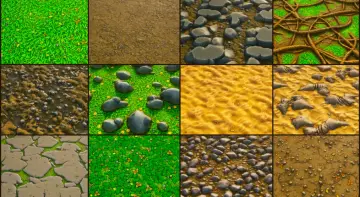
A practical look at Floors and Walls Vol.1 Photoscanned textures: 34 stone wall meshes, 20 tiled wall textures, 15 tiled floor textures, plus leaves and mud.
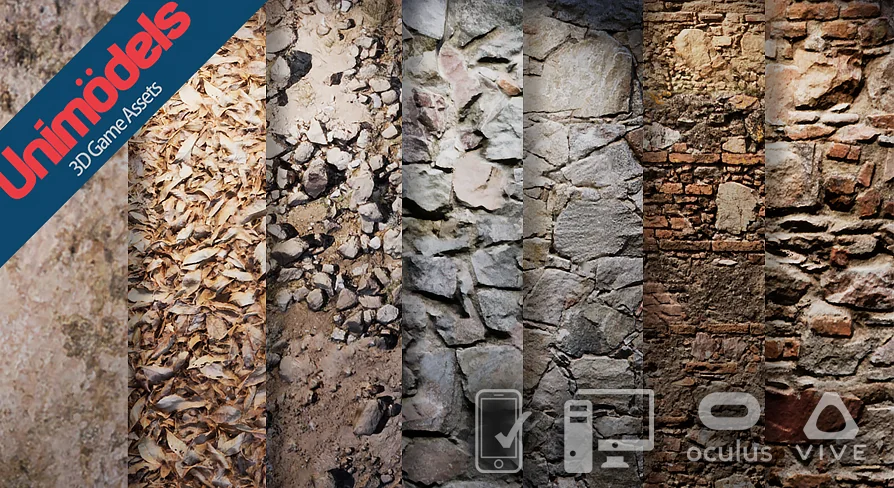
Stone surfaces are rarely a single problem. A camera moving past a wall needs geometry that holds up when the view gets close, while a corridor or courtyard needs texture coverage that can stretch across much more area than one mesh allows. Floors and Walls Vol.1 Photoscanned textures works both sides of that split: 34 stone wall meshes for built-out surfaces, alongside 20 tiled wall textures and 15 tiled floor textures. Photoscanned stone is the common thread across the meshes and the tiled surfaces.
Stone wall meshes for the surfaces the camera gets close to
The 34 stone wall meshes are the part of the set with actual wall form. Use them where a flat textured plane would reveal its limits: a tight corner, a low wall beside a path, a section of facade in the foreground, or a passage where the wall edge needs to read as stone rather than a painted surface. Because these are meshes, they can be placed as individual pieces and combined with the rest of the scene instead of being locked to one rectangular surface.
Photoscanned stone brings variation that is difficult to fake across a whole wall. The mesh is also a practical way to break up a repeated tiled wall in the background: put a mesh section in the near field, then let tiled textures take over farther back. That transition is easier to manage when both parts of the set share the same stone character, which is the point of keeping meshes and tiled textures together in one volume.
Tiled wall textures for long walls and repeated architecture
Twenty tiled wall textures handle the broad surfaces. A tiled texture can cover a wall longer or taller than the mesh piece, so it suits corridors, perimeter walls, stair wells, courtyard boundaries, and background buildings where the camera does not need to inspect every stone joint. The tiling is the feature to lean on: repeat the surface across a large plane, then use lighting and scene layout to keep the repeat from becoming the first thing a viewer notices.
The wall textures are also useful for blockouts that need to become final-looking without a full mesh pass. If a wall is only seen from a distance or at an angle, a tiled stone texture may be enough. Save the 34 meshes for the places where the camera stops, turns, or moves in close. That division keeps the mesh work concentrated where it pays off and lets the tiled textures carry the bulk of the environment.
Fifteen tiled floor textures underfoot
The 15 tiled floor textures take the same practical approach to ground surfaces. Floors tend to cover more area than walls in an interior or courtyard, and they are often seen at a shallow angle, so tiling is a natural fit. Use them for stone paving, rough ground, or the base of an environment where the floor needs to continue past the edge of a single mesh or room. Because the floors are tiled, they can be laid out across open areas and repeated along paths without rebuilding the surface each time.
Pairing floor and wall textures matters in stone environments because the two surfaces meet at the base of every wall. A floor texture can ground a wall section, and a wall texture can frame a floor plane. With 20 wall textures and 15 floor textures in the tiled group, there is enough variety to dress more than one room or exterior zone without every surface coming from the same image.
Leaves and mud in the updated texture set
An update to the set added 25 textures of stone walls and floors, leaves, and mud. That addition changes the set from a clean stone library into something that can handle the surface layer that builds up around stone. Leaves and mud are the kind of detail that makes a floor read as an outdoor or weathered place rather than an untouched material sample. They can sit on floors, collect at wall bases, or appear in corners where stone meets soil and vegetation.
Use the leaf and mud textures as ground-level storytelling. A courtyard can move from swept stone to a drift of leaves near a wall. A passage can show mud where traffic would cross it. None of this requires changing the stone itself; the added textures supply the secondary surface detail while the wall meshes and tiled stone carry the architecture.
Building a stone scene from meshes, tiled surfaces, and ground detail
A workable order is to block the space with tiled wall and floor textures first, then replace the close or important sections with the 34 stone wall meshes. That keeps the scene covered early and puts the geometry where the camera will actually spend time. The 20 wall textures and 15 floor textures can stay on the surfaces that are farther away, while the meshes handle corners, foreground walls, and any place where a flat plane would look too thin.
After the main surfaces are in place, the 25 added textures of stone walls and floors, leaves, and mud can be used to break up the ground and the base of walls. The set is not organized as a single hero asset; it is a collection of stone surfaces at different levels of detail. That makes it useful for environments where the camera moves from wide establishing views into closer inspection.
A fit for stone-heavy environments with mixed camera distance
Floors and Walls Vol.1 Photoscanned textures is a fit when a project needs stone walls and floors at both mesh and tiled texture levels, plus leaves and mud for ground detail. The counts are straightforward: 34 meshes, 20 tiled wall textures, 15 tiled floor textures, and 25 added textures in the update. Use the meshes where the camera is close, the tiled textures where the surface runs long, and the leaf and mud textures where the stone meets the ground.
 Nature & Plants
 Nature & Plants
 Nature & Plants
 Nature & Terrain