"a5ffaf404b9c2b7e"{"id":"1002627","slug":"corals","title":"Corals","category":"Plants","engine":"5.0+","assetVersion":"","engineVersion":"Engine Version: 5.0+","tag":"Plants","accent":"blue","visual":"mech","summary":"Explore the Corals 3D asset collection featuring 79 units, pregathered clusters, self illumination textures, and varied triangle counts for underwater scenes.","platform":"Unreal Engine","indexPolicy":"index","publishedAt":"2026-11-15T06:05:52.432Z","updatedAt":"2026-11-15T06:05:52.432Z","sourceNotes":[],"fileContents":[],"compatibility":["Unreal Engine","Engine Version: 5.0+"],"featuredImage":{"alt":"Corals","src":"/wp-content/uploads/published/2026/11/702e3f12c681-16951f65-a241-4bf2-b758-94fbb851b9ee-50507f9b56.webp"},"hasDownloadLink":true,"downloads":0,"terms":[{"taxonomy":"category","slug":"plants","name":"Plants"}],"galleryImages":[{"src":"/wp-content/uploads/published/2026/11/00dc5ab4298a-dfa90802-aedd-45c5-a80a-de46ecfbc446-4c465247ad.webp","alt":"Corals"},{"src":"/wp-content/uploads/published/2026/11/8288267a19d5-7be2d45a-57e3-4242-951a-632bbd15aab0-d10693c3d8.webp","alt":"Corals"},{"src":"/wp-content/uploads/published/2026/11/8c5e03cf045f-784e4072-3690-4c6d-9ac4-62e2973e99e6-33a47badb6.webp","alt":"Corals"},{"src":"/wp-content/uploads/published/2026/11/35a79698e616-54c3ab1b-37e6-4704-b7dd-b41ad22db2f1-4bc6db1054.webp","alt":"Corals"},{"src":"/wp-content/uploads/published/2026/11/476d1e417162-46805731-5a72-41e8-a115-31bd2815c75a-0330aa9657.webp","alt":"Corals"},{"src":"/wp-content/uploads/published/2026/11/418d290b1ff1-1ce27d80-cd70-4feb-80b8-abc63acd274f-5acc95dd0b.webp","alt":"Corals"},{"src":"/wp-content/uploads/published/2026/11/6523c0bbe253-2b2780cc-9c59-472c-809e-bbb98cb293b3-543d2e1214.webp","alt":"Corals"},{"src":"/wp-content/uploads/published/2026/11/c1151b2c778a-5099a194-0eeb-47eb-9563-4c61dda85ccf-81b9361774.webp","alt":"Corals"},{"src":"/wp-content/uploads/published/2026/11/44667a5bfad5-91f559e8-eecb-4d80-bacd-c010012a67d1-994a8cfd2f.webp","alt":"Corals"}],"accessPanel":{"kind":"resource","title":"Get this resource","eyebrow":"Free resource","message":"Download this resource in your browser.","fileName":"Content.7z","safetyNote":"Resources are manually reviewed before listing to improve quality and reduce obvious risks.","actionLabel":"Get this resource","resourceType":"Resource archive","versions":[]},"contentHtml":"\u003ch2\u003eConstructing Underwater Environments with Corals and Clustered Formations\u003c/h2\u003e\u003cp\u003eSubmerged environments present distinct spatial challenges, requiring dense, irregular layering to mimic organic marine growth across rocks, trenches, and sand beds. The Corals package provides around 79 units designed to address these underwater terrain requirements. Rather than forcing scene dressers to place every single marine organism by hand, the collection supplies pregathered groups of corals alongside individual models. These pre-assembled clusters allow rapid coverage of extensive seabed patches, establishing coherent natural groupings where multiple species seem to anchor and interlock across the ocean floor.\u003c/p\u003e\u003cp\u003eIndividual assets within the 79-unit collection permit fine placement around rocky outcrops, submerged cave entrances, and lake beds. By combining standalone variations with pregathered groups, a bed of sea flora avoids repetitive tiling artifacts while keeping scene layout rapid. The elements span realistic marine life as well as fantasy vegetation styles, adapting smoothly to open oceanic depths, shallow shore dives, or inland lake bottoms.\u003c/p\u003e\u003ch2\u003eGeometric Density and Mesh Breakdown Across Corals\u003c/h2\u003e\u003cp\u003eBalancing geometric silhouette against rendering overhead is essential in dense underwater environments where dozens of models cluster within a single camera frustum. The assets in this collection exhibit a wide spectrum of triangle counts, spanning intricate hero pieces down to extreme low-poly ground cover.\u003c/p\u003e\u003cp\u003eThe most complex models in the set provide detailed organic branch work and undulating structural mass:\u003c/p\u003e\u003cul\u003e\u003cli\u003eCoral 1_2: 3,300 tris\u003c/li\u003e\u003cli\u003eCoral 15_2: 3,100 tris\u003c/li\u003e\u003cli\u003eCoral 4_1: 3,050 tris\u003c/li\u003e\u003cli\u003eCoral 15_1: 2,700 tris\u003c/li\u003e\u003cli\u003eCoral 16_2: 2,300 tris\u003c/li\u003e\u003cli\u003eCoral 9_3: 2,150 tris\u003c/li\u003e\u003cli\u003eCoral 5_1: 2,100 tris\u003c/li\u003e\u003cli\u003eCoral 4_2: 1,800 tris\u003c/li\u003e\u003cli\u003eCoral 9_1: 1,750 tris\u003c/li\u003e\u003cli\u003eCoral 2_1: 1,700 tris\u003c/li\u003e\u003cli\u003eCoral 8_1: 1,560 tris\u003c/li\u003e\u003cli\u003eCoral 5_2: 1,450 tris\u003c/li\u003e\u003cli\u003eCoral 13_1: 1,400 tris\u003c/li\u003e\u003cli\u003eCoral 1_1: 1,300 tris\u003c/li\u003e\u003cli\u003eCoral 16_1: 1,300 tris\u003c/li\u003e\u003c/ul\u003e\u003cp\u003eThese higher-density meshes carry the main visual load in foreground compositions, player diving paths, or close-up underwater inspection points where branch curvature and tactile contours must hold up under close viewing.\u003c/p\u003e\u003cp\u003eA secondary group covers intermediate triangle budgets, ideal for midground filler or framing around larger formations:\u003c/p\u003e\u003cul\u003e\u003cli\u003eCoral 6_1: 900 tris\u003c/li\u003e\u003cli\u003eCoral 9_2: 900 tris\u003c/li\u003e\u003cli\u003eCoral 13_2: 860 tris\u003c/li\u003e\u003cli\u003eCoral 13_3: 670 tris\u003c/li\u003e\u003cli\u003eCoral 7_1: 650 tris\u003c/li\u003e\u003cli\u003eCoral 15_3: 650 tris\u003c/li\u003e\u003cli\u003eCoral 3_2: 460 tris\u003c/li\u003e\u003cli\u003eCoral 3_1: 370 tris\u003c/li\u003e\u003c/ul\u003e\u003cp\u003eThese mid-tier structures bridge the visual gap between complex foreground formations and basic floor accents, maintaining believable organic silhouettes without multiplying the scene's polygon weight unnecessarily.\u003c/p\u003e\u003cp\u003eFor massive scattering, distant expanses, and subtle bottom debris, the collection includes hyper-efficient, minimal-geometry meshes:\u003c/p\u003e\u003cul\u003e\u003cli\u003eSeaweed: 128 tris\u003c/li\u003e\u003cli\u003eCoral 17_1: 18 tris\u003c/li\u003e\u003cli\u003eCoral 17_2: 18 tris\u003c/li\u003e\u003cli\u003eCoral 14_1: 4 tris\u003c/li\u003e\u003cli\u003eCoral 14_2: 4 tris\u003c/li\u003e\u003cli\u003eCoral 14_3: 4 tris\u003c/li\u003e\u003cli\u003eCoral 14_4: 4 tris\u003c/li\u003e\u003c/ul\u003e\u003cp\u003eThe 4-triangle units, comprising four variations of Coral 14, provide extreme lightweight cross-quad or billboard options. These ultra-low assets can be scattered across vast aquatic plains to indicate sprawling micro-vegetation without degrading runtime performance. The pair of Coral 17 meshes, sitting at 18 triangles each, serve a similar purpose for compact bottom crusting. Seaweed, rated at 128 triangles, provides vertical motion and leafy contrast against the rigid, calcified profiles of the coral heads.\u003c/p\u003e\u003ch2\u003eNight Sea Bottom Lighting and Self Illumination\u003c/h2\u003e\u003cp\u003eLighting beneath the surface deteriorates rapidly with depth, and night sea environments present unique visual hurdles where directional light from above is completely absent. To solve visibility in pitch-black aquatic settings, the collection includes self illumination textures configured for night sea bottom scenes.\u003c/p\u003e\u003cp\u003eSelf-illuminating surface maps allow specific coral branches, ridges, and textures to emit their own luminance. In realistic dive simulations, this emulates natural bioluminescence common in abyssal marine species, highlighting ridges and tips against dark surrounding water. In fantasy environments, these self illumination textures transform ordinary reef formations into vibrant, glowing underwater forests. Emissive details also give level designers organic light sources to guide player navigation through underwater canyons, shipwrecks, and deep-water drop-offs without having to rely on artificial lamps or torches.\u003c/p\u003e\u003ch2\u003eVegetation Distribution Across Oceanic and Freshwater Biomes\u003c/h2\u003e\u003cp\u003eWhile coral structures are traditionally linked to warm marine shelves, the design versatility in this library extends into freshwater lakes, fantasy aquatic realms, and deep oceanic trenches. The combination of varied branching corals, compact crusts, and delicate 128-triangle seaweed makes it possible to depict several distinct ecological zones.\u003c/p\u003e\u003cp\u003eDense oceanic reefs benefit from stacking the 3,000-triangle specimens like Coral 1_2 and Coral 15_2 at prominent viewpoints, surrounded by the mid-range 600-to-1,400 triangle variants such as Coral 13_1 and Coral 7_1. Seaweed models introduce soft vegetative lines around the perimeter of these stony coral bases, breaking up sharp boundaries where the hard coral meets loose sand.\u003c/p\u003e\u003cp\u003eIn lake environments or low-visibility dive zones, using lower-density models such as Coral 3_1 alongside the 18-triangle and 4-triangle variants generates barren or sparse underwater scapes without exhausting the hardware budget. Because the pack spans both realistic nature aesthetics and fantasy underwater motifs, creators can tailor scene mood entirely through lighting and placement density.\u003c/p\u003e\u003ch2\u003ePractical Evaluation for Real-Time Environments\u003c/h2\u003e\u003cp\u003eManaging an underwater environment containing hundreds or thousands of scattered biological props requires clear understanding of asset scaling and mesh weight. The Corals package provides an explicit spectrum: high-impact pieces exceeding 3,000 triangles down to 4-triangle ground scatter, bundled with ready-to-place cluster arrangements and nighttime emissive textures.\u003c/p\u003e\u003cp\u003eFor teams building marine exploration titles, fantasy aquatic levels, or night diving sequences, these models provide the necessary geometric range to balance visual richness against tight rendering constraints across expansive underwater scenes.\u003c/p\u003e\n\n\u003ch2\u003eExplore Similar Assets\u003c/h2\u003e\n\u003cul\u003e\n\u003cli\u003e\u003ca href=\"https://3dcghub.com/corals-2/\" rel=\"noopener noreferrer\"\u003eCorals 2\u003c/a\u003e\u003c/li\u003e\n\u003cli\u003e\u003ca href=\"https://3dcghub.com/foliage-vol-23-ivy-low-poly/\" rel=\"noopener noreferrer\"\u003eFoliage VOL.23 - Ivy (Low Poly)\u003c/a\u003e\u003c/li\u003e\n\u003cli\u003e\u003ca href=\"https://3dcghub.com/suburbs-vol-12-interior-decor-nanite-and-low-poly/\" rel=\"noopener noreferrer\"\u003eSuburbs VOL.12 - Interior Decor (Nanite and Low Poly)\u003c/a\u003e\u003c/li\u003e\n\u003cli\u003e\u003ca href=\"https://3dcghub.com/underwater-coral-pack-01/\" rel=\"noopener noreferrer\"\u003eUnderwater Coral Pack 01\u003c/a\u003e\u003c/li\u003e\n\u003cli\u003e\u003ca href=\"https://3dcghub.com/foliage-vol-15-corn-field-nanite-and-low-poly/\" rel=\"noopener noreferrer\"\u003eFoliage VOL.15 - Corn Field (Nanite and Low Poly)\u003c/a\u003e\u003c/li\u003e\n\u003c/ul\u003e","contentTextLength":6498,"navigation":{"current":21,"total":4570,"previous":{"id":"1002628","slug":"dry-animal-bones-photoscan-vol-2","title":"Dry Animal Bones - Photoscan Vol 2.","category":"Nature \u0026 Plants","platform":"Unreal Engine","updatedAt":"2026-11-15T06:07:04.009Z"},"next":{"id":"1002626","slug":"clothing-and-shoe-stores","title":"CLOTHING AND SHOE STORES","category":"Commercial Buildings","platform":"Unreal Engine","updatedAt":"2026-11-15T06:04:17.667Z"}},"relatedResources":[{"id":"4140","slug":"corals-2","title":"Corals 2","category":"Plants","engine":"4.27,5.0+","assetVersion":"Engine version: 4.27,5.0+","engineVersion":"4.25","tag":"Plants","accent":"blue","visual":"character","summary":"Enhance your underwater environments with this high-quality 3D asset pack featuring realistic corals, shells, and animated seaweed for game development.","platform":"Unreal Engine","indexPolicy":"noindex","publishedAt":"2026-02-10T11:14:35.000Z","updatedAt":"2026-04-19T15:57:29.000Z","sourceNotes":[],"fileContents":[],"compatibility":["Unreal Engine","Engine version: 4.27,5.0+"],"featuredImage":{"alt":"Corals 2","src":"https://3dcghub.com/wp-content/uploads/2026/02/f6760cf3-4fba-413f-a755-bffa90591b5a.webp"},"hasDownloadLink":true,"downloads":0},{"id":"1001441","slug":"foliage-vol-23-ivy-low-poly","title":"Foliage VOL.23 - Ivy (Low Poly)","category":"Plants","engine":"5.1+","assetVersion":"","engineVersion":"Engine Version: 5.1+","tag":"Plants","accent":"blue","visual":"mech","summary":"Deploy and optimize Foliage VOL.23 - Ivy (Low Poly) in Unreal Engine with 49 meshes, Lumen support, modular branching, and vertex paint wall textures.","platform":"Unreal Engine","indexPolicy":"index","publishedAt":"2026-10-07T08:34:14.081Z","updatedAt":"2026-10-07T08:34:14.081Z","sourceNotes":[],"fileContents":[],"compatibility":["Unreal Engine","Engine Version: 5.1+"],"featuredImage":{"alt":"Foliage VOL.23 - Ivy (Low Poly)","src":"/wp-content/uploads/published/2026/10/ab74fe532ca8-53fce03b-c635-4bb2-ba66-1d26d6d4c521-0b026bd542.webp"},"hasDownloadLink":true,"downloads":2},{"id":"1001460","slug":"suburbs-vol-12-interior-decor-nanite-and-low-poly","title":"Suburbs VOL.12 - Interior Decor (Nanite and Low Poly)","category":"Plants","engine":"5.1+","assetVersion":"","engineVersion":"Engine Version: 5.1+","tag":"Plants","accent":"blue","visual":"mech","summary":"Examine Suburbs VOL.12 - Interior Decor, featuring 200 Nanite and low-poly meshes, 4K channel-packed textures, and Unreal Engine 5 Lumen support.","platform":"Unreal Engine","indexPolicy":"index","publishedAt":"2026-10-08T01:05:12.025Z","updatedAt":"2026-10-08T01:05:12.025Z","sourceNotes":[],"fileContents":[],"compatibility":["Unreal Engine","Engine Version: 5.1+"],"featuredImage":{"alt":"Suburbs VOL.12 - Interior Decor (Nanite and Low Poly)","src":"/wp-content/uploads/published/2026/10/498abc41b643-26d01b59-9156-4273-90eb-446ee8171d9c-366d9cfbce.webp"},"hasDownloadLink":true,"downloads":1}]}
Plants
Corals
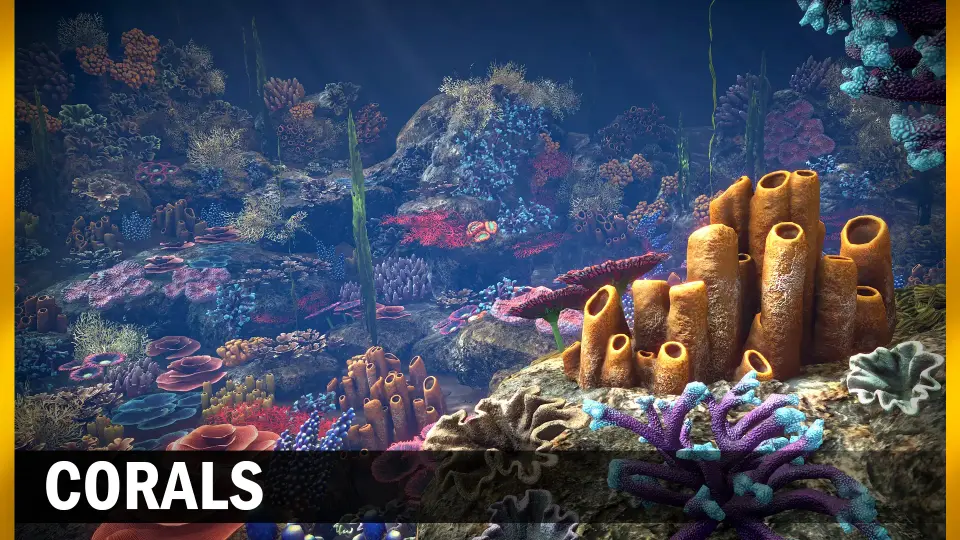
Explore the Corals 3D asset collection featuring 79 units, pregathered clusters, self illumination textures, and varied triangle counts for underwater scenes.
Category:Unreal Engine,PlantsPlatform: Unreal EngineEngine Version: 5.0+Published: Nov 15, 2026
Plants
Resource overview
Constructing Underwater Environments with Corals and Clustered Formations
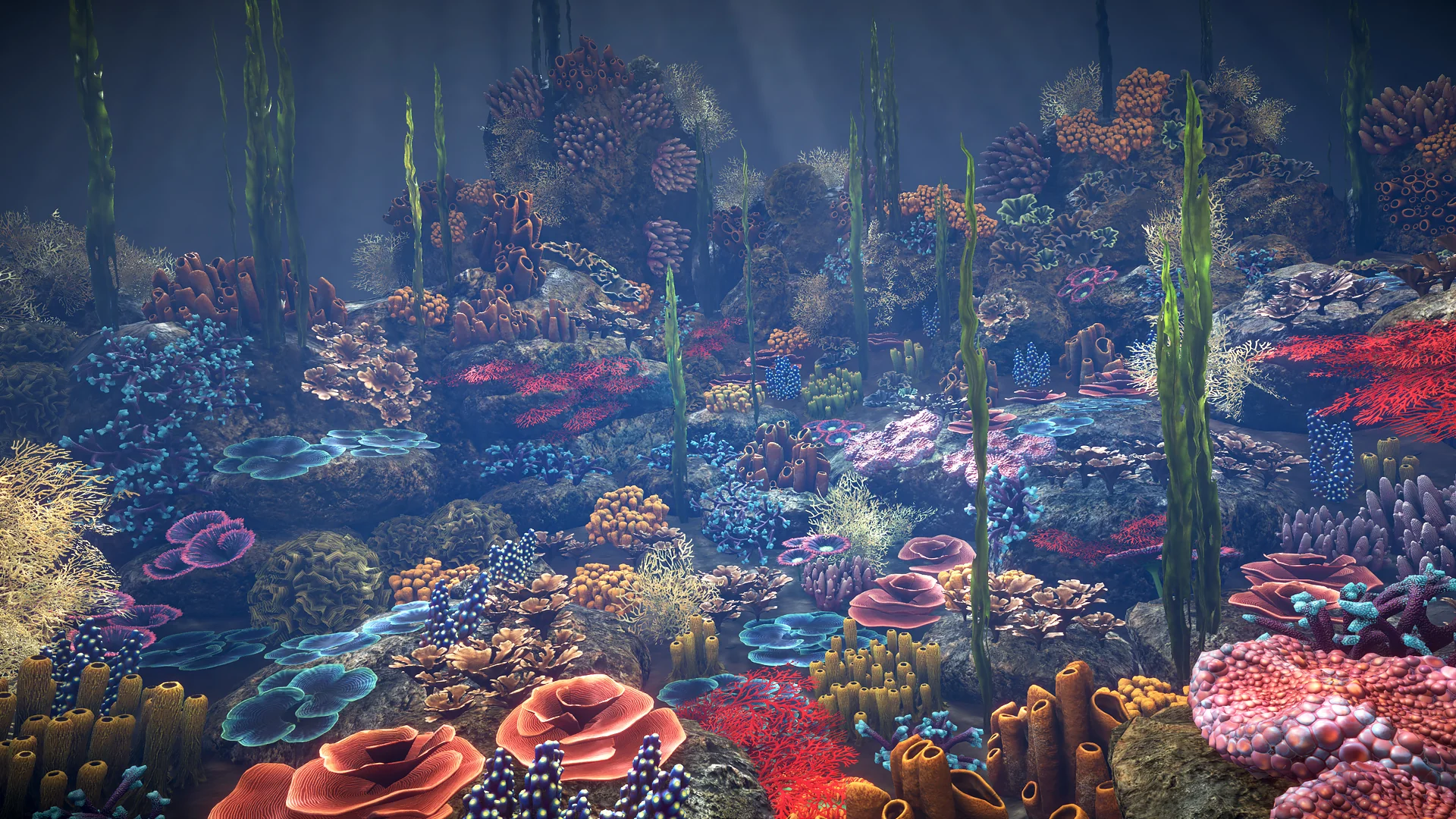
Submerged environments present distinct spatial challenges, requiring dense, irregular layering to mimic organic marine growth across rocks, trenches, and sand beds. The Corals package provides around 79 units designed to address these underwater terrain requirements. Rather than forcing scene dressers to place every single marine organism by hand, the collection supplies pregathered groups of corals alongside individual models. These pre-assembled clusters allow rapid coverage of extensive seabed patches, establishing coherent natural groupings where multiple species seem to anchor and interlock across the ocean floor.
Individual assets within the 79-unit collection permit fine placement around rocky outcrops, submerged cave entrances, and lake beds. By combining standalone variations with pregathered groups, a bed of sea flora avoids repetitive tiling artifacts while keeping scene layout rapid. The elements span realistic marine life as well as fantasy vegetation styles, adapting smoothly to open oceanic depths, shallow shore dives, or inland lake bottoms.
Geometric Density and Mesh Breakdown Across Corals
Balancing geometric silhouette against rendering overhead is essential in dense underwater environments where dozens of models cluster within a single camera frustum. The assets in this collection exhibit a wide spectrum of triangle counts, spanning intricate hero pieces down to extreme low-poly ground cover.
The most complex models in the set provide detailed organic branch work and undulating structural mass:
Coral 1_2: 3,300 tris
Coral 15_2: 3,100 tris
Coral 4_1: 3,050 tris
Coral 15_1: 2,700 tris
Coral 16_2: 2,300 tris
Coral 9_3: 2,150 tris
Coral 5_1: 2,100 tris
Coral 4_2: 1,800 tris
Coral 9_1: 1,750 tris
Coral 2_1: 1,700 tris
Coral 8_1: 1,560 tris
Coral 5_2: 1,450 tris
Coral 13_1: 1,400 tris
Coral 1_1: 1,300 tris
Coral 16_1: 1,300 tris
These higher-density meshes carry the main visual load in foreground compositions, player diving paths, or close-up underwater inspection points where branch curvature and tactile contours must hold up under close viewing.
A secondary group covers intermediate triangle budgets, ideal for midground filler or framing around larger formations:
Coral 6_1: 900 tris
Coral 9_2: 900 tris
Coral 13_2: 860 tris
Coral 13_3: 670 tris
Coral 7_1: 650 tris
Coral 15_3: 650 tris
Coral 3_2: 460 tris
Coral 3_1: 370 tris
These mid-tier structures bridge the visual gap between complex foreground formations and basic floor accents, maintaining believable organic silhouettes without multiplying the scene's polygon weight unnecessarily.
For massive scattering, distant expanses, and subtle bottom debris, the collection includes hyper-efficient, minimal-geometry meshes:
Seaweed: 128 tris
Coral 17_1: 18 tris
Coral 17_2: 18 tris
Coral 14_1: 4 tris
Coral 14_2: 4 tris
Coral 14_3: 4 tris
Coral 14_4: 4 tris
The 4-triangle units, comprising four variations of Coral 14, provide extreme lightweight cross-quad or billboard options. These ultra-low assets can be scattered across vast aquatic plains to indicate sprawling micro-vegetation without degrading runtime performance. The pair of Coral 17 meshes, sitting at 18 triangles each, serve a similar purpose for compact bottom crusting. Seaweed, rated at 128 triangles, provides vertical motion and leafy contrast against the rigid, calcified profiles of the coral heads.
Night Sea Bottom Lighting and Self Illumination
Lighting beneath the surface deteriorates rapidly with depth, and night sea environments present unique visual hurdles where directional light from above is completely absent. To solve visibility in pitch-black aquatic settings, the collection includes self illumination textures configured for night sea bottom scenes.
Self-illuminating surface maps allow specific coral branches, ridges, and textures to emit their own luminance. In realistic dive simulations, this emulates natural bioluminescence common in abyssal marine species, highlighting ridges and tips against dark surrounding water. In fantasy environments, these self illumination textures transform ordinary reef formations into vibrant, glowing underwater forests. Emissive details also give level designers organic light sources to guide player navigation through underwater canyons, shipwrecks, and deep-water drop-offs without having to rely on artificial lamps or torches.
Vegetation Distribution Across Oceanic and Freshwater Biomes
While coral structures are traditionally linked to warm marine shelves, the design versatility in this library extends into freshwater lakes, fantasy aquatic realms, and deep oceanic trenches. The combination of varied branching corals, compact crusts, and delicate 128-triangle seaweed makes it possible to depict several distinct ecological zones.
Dense oceanic reefs benefit from stacking the 3,000-triangle specimens like Coral 1_2 and Coral 15_2 at prominent viewpoints, surrounded by the mid-range 600-to-1,400 triangle variants such as Coral 13_1 and Coral 7_1. Seaweed models introduce soft vegetative lines around the perimeter of these stony coral bases, breaking up sharp boundaries where the hard coral meets loose sand.
In lake environments or low-visibility dive zones, using lower-density models such as Coral 3_1 alongside the 18-triangle and 4-triangle variants generates barren or sparse underwater scapes without exhausting the hardware budget. Because the pack spans both realistic nature aesthetics and fantasy underwater motifs, creators can tailor scene mood entirely through lighting and placement density.
Practical Evaluation for Real-Time Environments
Managing an underwater environment containing hundreds or thousands of scattered biological props requires clear understanding of asset scaling and mesh weight. The Corals package provides an explicit spectrum: high-impact pieces exceeding 3,000 triangles down to 4-triangle ground scatter, bundled with ready-to-place cluster arrangements and nighttime emissive textures.
For teams building marine exploration titles, fantasy aquatic levels, or night diving sequences, these models provide the necessary geometric range to balance visual richness against tight rendering constraints across expansive underwater scenes.
 Plants
 Plants
 Plants
 Plants