"a5ffaf404b9c2b7e"{"id":"1002645","slug":"termite-mounds-vol-1","title":"Termite Mounds - Vol 1","category":"Nature \u0026 Plants","engine":"5.0+","assetVersion":"","engineVersion":"Engine Version: 5.0+","tag":"Nature \u0026 Plants","accent":"blue","visual":"mech","summary":"A technical look at Termite Mounds - Vol 1, featuring 11 photoscanned Australian meshes, 4K channel-packed maps, pixel-depth offset, and bonus ground textures.","platform":"Unreal Engine","indexPolicy":"index","publishedAt":"2026-11-15T06:33:50.823Z","updatedAt":"2026-11-15T06:33:50.823Z","sourceNotes":[],"fileContents":[],"compatibility":["Unreal Engine","Engine Version: 5.0+"],"featuredImage":{"alt":"Termite Mounds - Vol 1","src":"/wp-content/uploads/published/2026/11/2c265563173d-535af1e6-ad9d-49c1-9a1f-ea29872a8c7b-6e649e40a6.webp"},"hasDownloadLink":true,"downloads":0,"terms":[{"taxonomy":"category","slug":"nature-and-plants","name":"Nature \u0026 Plants"}],"galleryImages":[{"src":"/wp-content/uploads/published/2026/11/39f1a571bd85-74548c26-38e3-4ecd-acd8-7e1c5c4866a8-f650b6d678.webp","alt":"Termite Mounds - Vol 1"},{"src":"/wp-content/uploads/published/2026/11/99afa5ed3ccb-7088de91-3e7c-4815-ad4f-21904e45d92d-c47e94db4f.webp","alt":"Termite Mounds - Vol 1"},{"src":"/wp-content/uploads/published/2026/11/637e671c852d-5593ce0a-df95-4aef-a29a-768f0051f679-0b935192a2.webp","alt":"Termite Mounds - Vol 1"},{"src":"/wp-content/uploads/published/2026/11/8401cae34a0d-aeb7740e-0c02-4001-8d06-87880e22f9bd-9345582b4f.webp","alt":"Termite Mounds - Vol 1"},{"src":"/wp-content/uploads/published/2026/11/46edb8d23a00-21e4db18-13f3-450f-bcdc-07087b3a8562-e5d148aac1.webp","alt":"Termite Mounds - Vol 1"},{"src":"/wp-content/uploads/published/2026/11/f088e6e0507e-9661ed01-250b-4bfc-a8f5-56fbbe6d24af-f93658f612.webp","alt":"Termite Mounds - Vol 1"},{"src":"/wp-content/uploads/published/2026/11/870cf6baf477-35c1f1f7-f193-4d68-9ff9-c101cbdd58fc-768aaa509d.webp","alt":"Termite Mounds - Vol 1"},{"src":"/wp-content/uploads/published/2026/11/fe8187191615-8efac796-f3ea-42b1-ad64-cfe464d4f429-5adc2ef2d0.webp","alt":"Termite Mounds - Vol 1"},{"src":"/wp-content/uploads/published/2026/11/ea748ad65e6e-cb8332dd-16f3-4cd9-bddf-064e0ea36c4f-3a87f481d5.webp","alt":"Termite Mounds - Vol 1"},{"src":"/wp-content/uploads/published/2026/11/116d4e88eb07-58931c27-b9f0-495b-acec-0e28c443a105-e38afb2f4b.webp","alt":"Termite Mounds - Vol 1"}],"accessPanel":{"kind":"resource","title":"Get this resource","eyebrow":"Free resource","message":"Download this resource in your browser.","fileName":"Content.7z","safetyNote":"Resources are manually reviewed before listing to improve quality and reduce obvious risks.","actionLabel":"Get this resource","resourceType":"Resource archive","versions":[]},"contentHtml":"\u003ch2\u003eDemo Scene Setup and Landscape Configuration\u003c/h2\u003e\u003cp\u003eDeploying the collection begins inside the included demo map, which pairs a foundational landscape with a preconfigured procedural foliage generator. Setting up the environment through this demo map establishes the baseline lighting and placement spacing used to showcase the assets. The included landscape provides a direct staging area to test object scale, terrain interaction, and ground coverage across different elevations.\u003c/p\u003e\u003cp\u003eBecause the procedural foliage generator comes pre-wired to handle the distribution, populating large areas does not require immediate manual scatter work. The generator places the varied mound meshes across the terrain to simulate realistic field clusters. When working within this initial level, developers will observe that the ground cover from the environment preview excludes the specific desert grass seen in demonstration videos, as that grass is sourced separately from Megascans. The layout relies entirely on the provided terrain, procedural rules, and bundled structural elements to form its arid foundation.\u003c/p\u003e\u003ch2\u003eTermite Mound Meshes and Base Lip Geometry\u003c/h2\u003e\u003cp\u003eThe structural core of the package delivers eleven static meshes, divided between six unique photogrammetric captures and five dedicated lip variations. Photographed and reconstructed from real-world formations in Queensland, Australia, these geological and biological structures feature authentic erosion, organic crevices, and earthen textures characteristic of native Australian insects. While naturally suited for sun-baked, dry, and arid desert landscapes, mounds of this variety also populate grassy paddocks, allowing them to bridge wild outback environments and rural agricultural fields.\u003c/p\u003e\u003cp\u003eWorld placement on uneven digital landscapes frequently leads to awkward contact angles or floating seams. To counteract this issue, five of the unique models include an alternate lip variation. These lip geometries extend slightly outward around the base, creating a broader, flatter skirt of earth. When sinking a model into an undulating terrain or pushing it against rough surface changes, the lip acts as a natural transition buffer. Level designers can seat the mesh into hillsides, gullies, or variable ground meshes without the sharp structural clipping that usually occurs when placing uniform vertical mounds onto angled surfaces.\u003c/p\u003e\u003ch2\u003eBlending Termite Mounds with Pixel-Depth Offset\u003c/h2\u003e\u003cp\u003eHard contact lines between static terrain geometry and imported environment props are an ongoing challenge in realistic scene assembly. To solve this, the master material provided in the pack integrates pixel-depth offset logic. Rather than rendering a crisp, distinct intersection edge where the base of the mound touches the landscape actor, the pixel-depth offset shader calculates the camera-space depth between the intersecting surfaces. The material shifts the depth values of the pixels at the contact point, softly feathering the intersection into the surrounding terrain heightmap.\u003c/p\u003e\u003cp\u003eThis depth-blending approach operates dynamically across the base of both the standard and lip-extended meshes. When the mound is planted into loose dirt or rocky soil, the contact plane blends into the surrounding landscape, simulating the natural accumulation of loose sediment around the base of the structure. Designers can adjust the placement depth knowing the material handles the seam reduction automatically, eliminating the need to hide intersections behind separate scatter rocks or foliage props.\u003c/p\u003e\u003ch2\u003eTexture Pipeline and Calibrated Ground Surfaces\u003c/h2\u003e\u003cp\u003eEvery photogrammetric asset in the collection originated from an 8K surface capture that was downscaled to 4K resolution. This downscaling workflow preserves fine surface pore details, crusting, and micro-cavities while keeping runtime texture memory predictable. The master material coordinates these surfaces using channel-packed textures, packaging Ambient Occlusion, Roughness, and Displacement into unified map channels where appropriate for each model. This channel-packing configuration optimizes memory overhead and draw call processing during runtime rendering passes.\u003c/p\u003e\u003cp\u003eTo support believable terrain composition around the static meshes, five bonus photoscanned ground surfaces are provided at 4K resolution, using matching channel-packed Ambient Occlusion, Roughness, and Displacement setups:\u003c/p\u003e\u003cul\u003e\u003cli\u003eDirt with rocks\u003c/li\u003e\u003cli\u003eDirt with weeds variation 1\u003c/li\u003e\u003cli\u003eDirt with weeds variation 2\u003c/li\u003e\u003cli\u003eAnt mounds\u003c/li\u003e\u003cli\u003eDirt with leaf litter\u003c/li\u003e\u003c/ul\u003e\u003cp\u003eThese bonus textures share an identical color grading and reflectance calibration with the termite mound photogrammetry. Applying the dirt surfaces to landscape layers ensures that the hue, roughness response, and mineral tones of the ground match the exterior shells of the mounds. The inclusion of ant mounds, weed variants, and leaf litter allows developers to build gradual ecological gradients, ranging from barren red dirt clearings to biologically active soil layers covered in debris.\u003c/p\u003e\u003ch2\u003eProcedural Scattering and Environment Integration\u003c/h2\u003e\u003cp\u003ePopulating extensive desert biomes requires balancing organic randomness with distinct geographical rules. The included procedural foliage spawner coordinates the distribution of the six unique mound shapes and their lip counterparts across the digital terrain. By leveraging procedural generation, large expanses of Australian scrubland, outback plains, or dry riverbeds can be dressed without manually hand-placing dozens of duplicate instances.\u003c/p\u003e\u003cp\u003eThe asset package fits within a broader suite of ecosystem components, linking visually with related collections including Vol 2 Dry Animal Bones, Vol 3 Animal Dung, and Vol 4 Desert Embankments, or the unified Australian Desert Collection. Used together or standalone, the assets supply the specific topological marks needed for arid scrub and paddock environments, backed by clean 4K maps, native shader blending, and authentic photogrammetric detail.\u003c/p\u003e\n\n\u003ch2\u003eRelated Resources Worth Checking\u003c/h2\u003e\n\u003cul\u003e\n\u003cli\u003e\u003ca href=\"https://3dcghub.com/dry-animal-bones-photoscan-vol-2/\" rel=\"noopener noreferrer\"\u003eDry Animal Bones - Photoscan Vol 2.\u003c/a\u003e\u003c/li\u003e\n\u003cli\u003e\u003ca href=\"https://3dcghub.com/foliage-vol-26-dead-birch-trees-nanite-low-poly/\" rel=\"noopener noreferrer\"\u003eFoliage VOL.26 - Dead Birch Trees (Nanite + Low Poly)\u003c/a\u003e\u003c/li\u003e\n\u003cli\u003e\u003ca href=\"https://3dcghub.com/floors-and-walls-vol-1-photoscanned-textures/\" rel=\"noopener noreferrer\"\u003eFloors and Walls Vol.1 Photoscanned textures\u003c/a\u003e\u003c/li\u003e\n\u003cli\u003e\u003ca href=\"https://3dcghub.com/terrain-models-pack-vol-3/\" rel=\"noopener noreferrer\"\u003eTerrain Models Pack Vol. 3\u003c/a\u003e\u003c/li\u003e\n\u003cli\u003e\u003ca href=\"https://3dcghub.com/underwater-coral-pack-01/\" rel=\"noopener noreferrer\"\u003eUnderwater Coral Pack 01\u003c/a\u003e\u003c/li\u003e\n\u003c/ul\u003e","contentTextLength":6144,"navigation":{"current":3,"total":4570,"previous":{"id":"1002646","slug":"undead-pack","title":"Undead Pack","category":"Characters \u0026 Creatures","platform":"Unreal Engine","updatedAt":"2026-11-15T06:34:55.365Z"},"next":{"id":"1002644","slug":"survival-npc-sarah-sal-jacobs","title":"Survival NPC - Sarah \"Sal\" Jacobs","category":"Characters \u0026 Creatures","platform":"Unreal Engine","updatedAt":"2026-11-15T06:32:47.086Z"}},"relatedResources":[{"id":"1002628","slug":"dry-animal-bones-photoscan-vol-2","title":"Dry Animal Bones - Photoscan Vol 2.","category":"Nature \u0026 Plants","engine":"5.0+","assetVersion":"","engineVersion":"Engine Version: 5.0+","tag":"Nature \u0026 Plants","accent":"blue","visual":"mech","summary":"Examine Dry Animal Bones - Photoscan Vol 2, featuring 12 complete 4k bone meshes and 5 Australian desert ground materials optimized for games and cinematics.","platform":"Unreal Engine","indexPolicy":"index","publishedAt":"2026-11-15T06:07:04.009Z","updatedAt":"2026-11-15T06:07:04.009Z","sourceNotes":[],"fileContents":[],"compatibility":["Unreal Engine","Engine Version: 5.0+"],"featuredImage":{"alt":"Dry Animal Bones - Photoscan Vol 2.","src":"/wp-content/uploads/published/2026/11/0f13139086fc-301c9738-a161-404a-91af-46495867f383-a25d881d35.webp"},"hasDownloadLink":true,"downloads":0},{"id":"1000607","slug":"foliage-vol-26-dead-birch-trees-nanite-low-poly","title":"Foliage VOL.26 - Dead Birch Trees (Nanite + Low Poly)","category":"Nature \u0026 Plants","engine":"5.1+","assetVersion":"","engineVersion":"Engine Version: 5.1+","tag":"Nature \u0026 Plants","accent":"blue","visual":"mech","summary":"Twenty-four dead birch tree meshes by Dekogon Studios, offered in Nanite and low poly variants with 4K channel-packed textures, Lumen support, and game-ready op","platform":"Unreal Engine","indexPolicy":"index","publishedAt":"2026-07-20T19:17:05.693Z","updatedAt":"2026-07-20T19:17:05.693Z","sourceNotes":[],"fileContents":[],"compatibility":["Unreal Engine","Engine Version: 5.1+"],"featuredImage":{"alt":"Foliage VOL.26 - Dead Birch Trees (Nanite + Low Poly)","src":"/wp-content/uploads/published/2026/07/41175b88c8ee-9e2e495c-76af-4f8f-8f26-c57a281f7239-cc2d364d8c.webp"},"hasDownloadLink":true,"downloads":0},{"id":"1002306","slug":"floors-and-walls-vol-1-photoscanned-textures","title":"Floors and Walls Vol.1 Photoscanned textures","category":"Nature \u0026 Plants","engine":"4.27+,5.0+","assetVersion":"","engineVersion":"Engine Version: 4.27+,5.0+","tag":"Nature \u0026 Plants","accent":"blue","visual":"luts","summary":"A practical look at Floors and Walls Vol.1 Photoscanned textures: 34 stone wall meshes, 20 tiled wall textures, 15 tiled floor textures, plus leaves and mud.","platform":"Unreal Engine","indexPolicy":"index","publishedAt":"2026-11-05T10:06:31.464Z","updatedAt":"2026-11-05T10:06:31.464Z","sourceNotes":[],"fileContents":[],"compatibility":["Unreal Engine","Engine Version: 4.27+,5.0+"],"featuredImage":{"alt":"Floors and Walls Vol.1 Photoscanned textures","src":"/wp-content/uploads/published/2026/11/4bb2d3ac47c6-c0fc7266-8901-4d7a-85c6-d9cd2f8ede9f-5fdf77fcf7.webp"},"hasDownloadLink":true,"downloads":0}]}
Nature & Plants
Termite Mounds - Vol 1
A technical look at Termite Mounds - Vol 1, featuring 11 photoscanned Australian meshes, 4K channel-packed maps, pixel-depth offset, and bonus ground textures.
Deploying the collection begins inside the included demo map, which pairs a foundational landscape with a preconfigured procedural foliage generator. Setting up the environment through this demo map establishes the baseline lighting and placement spacing used to showcase the assets. The included landscape provides a direct staging area to test object scale, terrain interaction, and ground coverage across different elevations.
Because the procedural foliage generator comes pre-wired to handle the distribution, populating large areas does not require immediate manual scatter work. The generator places the varied mound meshes across the terrain to simulate realistic field clusters. When working within this initial level, developers will observe that the ground cover from the environment preview excludes the specific desert grass seen in demonstration videos, as that grass is sourced separately from Megascans. The layout relies entirely on the provided terrain, procedural rules, and bundled structural elements to form its arid foundation.
Termite Mound Meshes and Base Lip Geometry
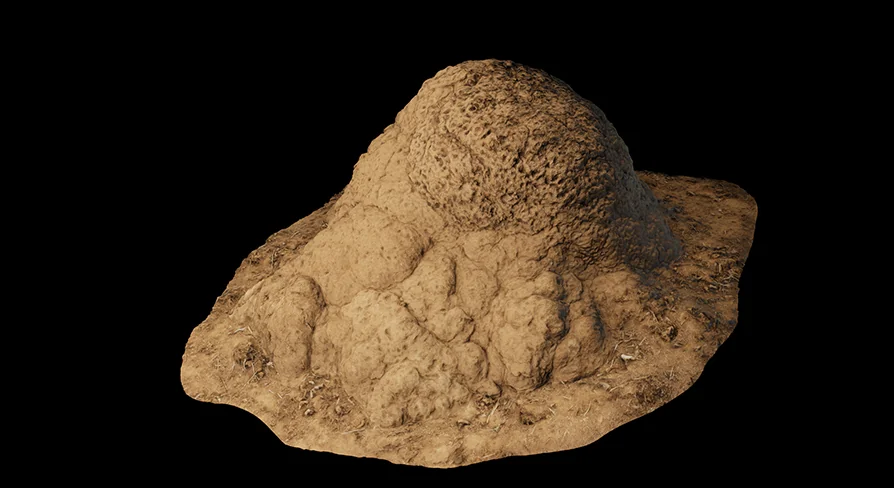
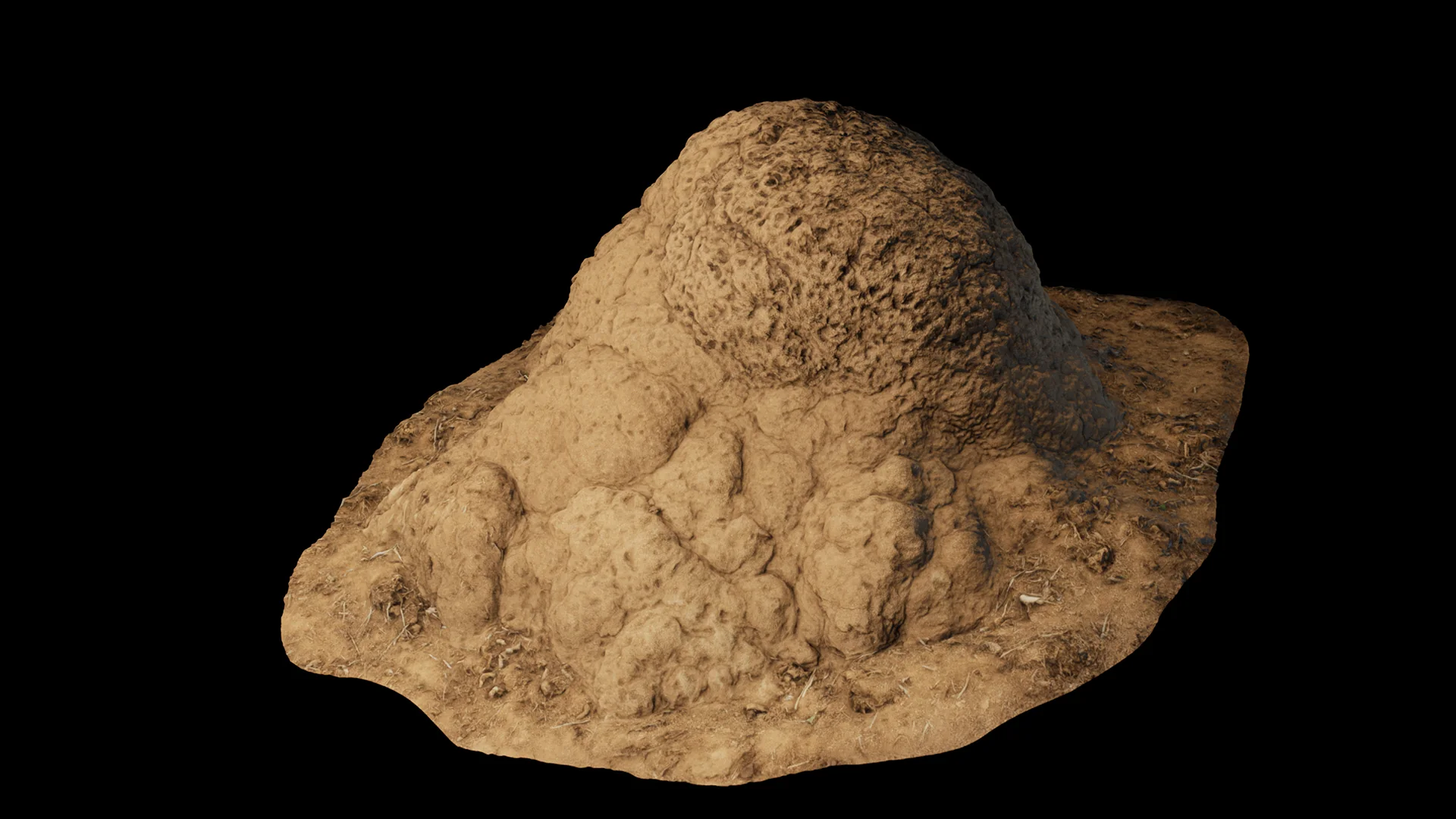
The structural core of the package delivers eleven static meshes, divided between six unique photogrammetric captures and five dedicated lip variations. Photographed and reconstructed from real-world formations in Queensland, Australia, these geological and biological structures feature authentic erosion, organic crevices, and earthen textures characteristic of native Australian insects. While naturally suited for sun-baked, dry, and arid desert landscapes, mounds of this variety also populate grassy paddocks, allowing them to bridge wild outback environments and rural agricultural fields.
World placement on uneven digital landscapes frequently leads to awkward contact angles or floating seams. To counteract this issue, five of the unique models include an alternate lip variation. These lip geometries extend slightly outward around the base, creating a broader, flatter skirt of earth. When sinking a model into an undulating terrain or pushing it against rough surface changes, the lip acts as a natural transition buffer. Level designers can seat the mesh into hillsides, gullies, or variable ground meshes without the sharp structural clipping that usually occurs when placing uniform vertical mounds onto angled surfaces.
Blending Termite Mounds with Pixel-Depth Offset
Hard contact lines between static terrain geometry and imported environment props are an ongoing challenge in realistic scene assembly. To solve this, the master material provided in the pack integrates pixel-depth offset logic. Rather than rendering a crisp, distinct intersection edge where the base of the mound touches the landscape actor, the pixel-depth offset shader calculates the camera-space depth between the intersecting surfaces. The material shifts the depth values of the pixels at the contact point, softly feathering the intersection into the surrounding terrain heightmap.
This depth-blending approach operates dynamically across the base of both the standard and lip-extended meshes. When the mound is planted into loose dirt or rocky soil, the contact plane blends into the surrounding landscape, simulating the natural accumulation of loose sediment around the base of the structure. Designers can adjust the placement depth knowing the material handles the seam reduction automatically, eliminating the need to hide intersections behind separate scatter rocks or foliage props.
Texture Pipeline and Calibrated Ground Surfaces
Every photogrammetric asset in the collection originated from an 8K surface capture that was downscaled to 4K resolution. This downscaling workflow preserves fine surface pore details, crusting, and micro-cavities while keeping runtime texture memory predictable. The master material coordinates these surfaces using channel-packed textures, packaging Ambient Occlusion, Roughness, and Displacement into unified map channels where appropriate for each model. This channel-packing configuration optimizes memory overhead and draw call processing during runtime rendering passes.
To support believable terrain composition around the static meshes, five bonus photoscanned ground surfaces are provided at 4K resolution, using matching channel-packed Ambient Occlusion, Roughness, and Displacement setups:
Dirt with rocks
Dirt with weeds variation 1
Dirt with weeds variation 2
Ant mounds
Dirt with leaf litter
These bonus textures share an identical color grading and reflectance calibration with the termite mound photogrammetry. Applying the dirt surfaces to landscape layers ensures that the hue, roughness response, and mineral tones of the ground match the exterior shells of the mounds. The inclusion of ant mounds, weed variants, and leaf litter allows developers to build gradual ecological gradients, ranging from barren red dirt clearings to biologically active soil layers covered in debris.
Procedural Scattering and Environment Integration
Populating extensive desert biomes requires balancing organic randomness with distinct geographical rules. The included procedural foliage spawner coordinates the distribution of the six unique mound shapes and their lip counterparts across the digital terrain. By leveraging procedural generation, large expanses of Australian scrubland, outback plains, or dry riverbeds can be dressed without manually hand-placing dozens of duplicate instances.
The asset package fits within a broader suite of ecosystem components, linking visually with related collections including Vol 2 Dry Animal Bones, Vol 3 Animal Dung, and Vol 4 Desert Embankments, or the unified Australian Desert Collection. Used together or standalone, the assets supply the specific topological marks needed for arid scrub and paddock environments, backed by clean 4K maps, native shader blending, and authentic photogrammetric detail.
 Nature & Plants
 Nature & Plants
 Nature & Plants
 Nature & Plants