"a5ffaf404b9c2b7e"{"id":"1002646","slug":"undead-pack","title":"Undead Pack","category":"Characters \u0026 Creatures","engine":"5.0+","assetVersion":"","engineVersion":"Engine Version: 5.0+","tag":"Characters","accent":"blue","visual":"character","summary":"Stylized character package featuring the Lich, Ghoul, Skeleton, Zombie, and Enemy Goblin with 4 LODs, full PBR maps, Control Rig, and Blueprints.","platform":"Unreal Engine","indexPolicy":"index","publishedAt":"2026-11-15T06:34:55.365Z","updatedAt":"2026-11-15T06:34:55.365Z","sourceNotes":[],"fileContents":[],"compatibility":["Unreal Engine","Engine Version: 5.0+"],"featuredImage":{"alt":"Undead Pack","src":"/wp-content/uploads/published/2026/11/f0022ddf4113-33d25ad7-6155-4ed7-b625-17888dddc37a-2e76e479cd.webp"},"hasDownloadLink":true,"downloads":0,"terms":[{"taxonomy":"category","slug":"characters-and-creatures","name":"Characters \u0026 Creatures"}],"galleryImages":[{"src":"/wp-content/uploads/published/2026/11/4605b13c9a55-7d899a9b-7bdd-4967-a1a8-4a5ee1faf11b-2cf3d77f66.webp","alt":"Undead Pack"},{"src":"/wp-content/uploads/published/2026/11/377b4b1eb4b4-4290cfb1-4aef-48b0-ba76-eb38092429ca-13f2b39851.webp","alt":"Undead Pack"},{"src":"/wp-content/uploads/published/2026/11/7428edbe7c45-89c9e103-64b8-4499-8111-35d8f7f430c6-3eae49b67e.webp","alt":"Undead Pack"},{"src":"/wp-content/uploads/published/2026/11/b1f4ecedb7ff-12ba8f86-9551-4c01-8e85-049fdc078a01-723b8cf401.webp","alt":"Undead Pack"},{"src":"/wp-content/uploads/published/2026/11/d56cf7d8f6f9-b2fc8932-b59d-4274-8af6-a4629f56c729-5b0ac98c00.webp","alt":"Undead Pack"},{"src":"/wp-content/uploads/published/2026/11/8c2ea339fb24-4f6caf09-b710-49a8-88b2-75bde2c7e43f-43dab504ad.webp","alt":"Undead Pack"},{"src":"/wp-content/uploads/published/2026/11/b7d37092dee2-4bdde8cd-5e95-4404-ad35-c6244b65df92-e8eb96a1b5.webp","alt":"Undead Pack"},{"src":"/wp-content/uploads/published/2026/11/87e81ff19929-1eb79d5e-434b-42f4-b7e0-2097afbdb7b8-d4250e2573.webp","alt":"Undead Pack"},{"src":"/wp-content/uploads/published/2026/11/ed2b91f28638-e01da909-e833-44c0-8cda-1d8ba029f901-951fe35778.webp","alt":"Undead Pack"},{"src":"/wp-content/uploads/published/2026/11/f7323fe119b5-55d417bb-d106-4092-9841-e56f7512c08e-d7d3c75c58.webp","alt":"Undead Pack"}],"accessPanel":{"kind":"resource","title":"Get this resource","eyebrow":"Free resource","message":"Download this resource in your browser.","fileName":"Content.7z","safetyNote":"Resources are manually reviewed before listing to improve quality and reduce obvious risks.","actionLabel":"Get this resource","resourceType":"Resource archive","versions":[]},"contentHtml":"\u003cp\u003eA fantasy enemy lineup requires distinct silhouettes, adaptable rendering setups, and functional rigging to populate hostile environments. Undead Pack supplies a core collective of stylized monster archetypes, bringing together the Lich, Ghoul, Skeleton, Zombie, and Enemy Goblin, alongside additional characters. Built with an expressive cartoon aesthetic that leans into stylized horror, the collection addresses encounter design across diverse combat and dungeon settings.\u003c/p\u003e \u003ch2\u003eCore Archetypes in the Undead Pack\u003c/h2\u003e\n\u003cp\u003ePopulating a combat encounter calls for varied unit behaviors, from frail horde units to imposing arcane casters. The characters provided in this collection cover distinct thematic roles, allowing developers to construct escalating waves of hostiles. The Zombie delivers a classic lumbering melee adversary, prioritizing physical threat and decayed anatomy. In contrast, the Ghoul introduces an agile, feral silhouette suited for ravenous ambush attacks, predatory leaping motions, or scavenger behaviors in underground corridors.\u003c/p\u003e \u003cp\u003eRanged and spellcasting duties center on the Lich, whose presence commands magical threat. Designed to serve as a commander or boss encounter, the Lich features elements compatible with emissive spell effects and hovering, deliberate motion patterns. To fill the mid-tier frontline, the Skeleton serves as an essential staple of dungeon scenarios, capable of wielding weaponry and clattering into battle in large groups. Diverging from pure necromancy, the Enemy Goblin expands the cast into traditional fantasy skirmishes, delivering an erratic, smaller combatant profile that can either fight alongside reanimated creatures or harass players independently.\u003c/p\u003e \u003ch2\u003eTexture Passes and LOD Stages in the Undead Pack\u003c/h2\u003e\n\u003cp\u003eReal-time performance hinges on material management and mesh scaling, particularly when scenes fill with dozens of attacking monsters. Each model in the collection is supplied with four discrete levels of detail (LOD 0 through LOD 3). These four LOD stages systematically reduce geometric density as the distance between the camera and the monster increases, preserving frame rates during massive horde encounters without sacrificing edge fidelity during tight close-ups.\u003c/p\u003e \u003cp\u003eMaterial definition relies on dedicated texture channels authored at both 2048x2048 and 4096x4096 resolutions. Providing both resolutions allows developers to tune texture memory budgets according to platform targets, using 4K sets for hero encounters or cinematic framing, and dropping to 2K maps for background cannon fodder. The texture suite includes dedicated passes for:\u003c/p\u003e\n\u003cul\u003e \u003cli\u003e\u003cstrong\u003eColor:\u003c/strong\u003e Establishes the stylized, cartoon-influenced albedo tone and surface pigmentation across garments, flesh, and bone.\u003c/li\u003e \u003cli\u003e\u003cstrong\u003eNormal:\u003c/strong\u003e Bakes sculptural details into low-poly surfaces, accentuating muscle cuts, fractured ribs, and weapon nicks.\u003c/li\u003e \u003cli\u003e\u003cstrong\u003eRoughness:\u003c/strong\u003e Dictates surface micro-finish, balancing dry bone, damp decaying hide, and dull metallic equipment.\u003c/li\u003e \u003cli\u003e\u003cstrong\u003eAmbient Occlusion (AO):\u003c/strong\u003e Enforces depth in cavities, eye sockets, ribs, and layered clothing folds under real-time lighting.\u003c/li\u003e \u003cli\u003e\u003cstrong\u003eEmissive:\u003c/strong\u003e Channels arcane light, glowing eyes, or magical glyphs, particularly critical for the Lich's necromantic spellwork.\u003c/li\u003e \u003cli\u003e\u003cstrong\u003eOpacity:\u003c/strong\u003e Governs transparency masks, enabling frayed cloth hems, tattered robes, and decaying anatomical borders.\u003c/li\u003e\n\u003c/ul\u003e \u003cp\u003eBy keeping material layers cleanly broken into separate PBR textures, technical artists can fine-tune surface properties directly inside master shaders, altering color shifts, boosting emissive values, or modulating roughness levels dynamically.\u003c/p\u003e \u003ch2\u003eAnimation Blueprints and Control Rig Functionality\u003c/h2\u003e\n\u003cp\u003eVisual fidelity remains ineffective if character skeletal systems resist movement adjustments. The package integrates dedicated Animation Blueprints, Blueprints, and Control Rig assets to support complex locomotion, blendspaces, and procedural animation updates. Having native Control Rig support simplifies keyframing and manual pose correction directly inside the game viewport or cinematic Sequencer, bypassing the constant round-trip export process to external digital content creation tools.\u003c/p\u003e \u003cp\u003eAnimation Blueprints manage the internal state logic governing transitions between idling, patrol loops, lunges, hit reactions, and death animations. These animation graphs integrate with standard gameplay scripts to interpret character speed, combat status, and hit velocity, ensuring that when an Enemy Goblin flinches or a Skeleton collapses, the procedural logic fires consistently. Because the assets are flagged as animated, the skeletal hierarchies conform to standardized animation playback while leaving room for custom motion capture or procedural secondary physics on swinging garments and dangling limbs.\u003c/p\u003e \u003ch2\u003eModular Weapon and Character Variations Across the Pack\u003c/h2\u003e\n\u003cp\u003eRepetition breaks immersion when players face repeated waves of identical enemies. The inclusion of modular characteristics and standalone weapon assets enables visual diversity among common troops. Skeletons and Goblins can be configured with or without their gear, creating variable difficulty markers where an unarmed enemy behaves as an expendable scout while an armed counterpart poses a lethal melee threat.\u003c/p\u003e \u003cp\u003eModularity also extends to the structural arrangement of the characters. By separating individual costume components, armor pieces, and equipment sockets, developers can script randomized spawning routines. A single blueprint class can spawn a barebones Skeleton, a helmeted warrior, or a club-wielding skirmisher on the fly, maximizing the utility of the mesh library across long campaigns without inflating asset storage footprints.\u003c/p\u003e \u003ch2\u003eIntegration Within Fantasy and Horror Production Workflows\u003c/h2\u003e\n\u003cp\u003eConstructing a cohesive hostile ecosystem requires assets that bridge multiple genre demands. With styling rooted in cartoon and stylized horror sensibilities, these models integrate cleanly into stylized action RPGs, top-down roguelikes, tower defense games, or survival titles. The exaggerated anatomy, pronounced silhouettes, and vibrant surface texturing ensure that the monsters remain readable from distant isometric camera angles or amidst dense particle chaos in third-person combat.\u003c/p\u003e \u003cp\u003eFrom rapid prototyping through final staging, the technical setup provides a direct deployment path. Blueprints handle basic logic, Control Rig simplifies procedural posing, 4 LOD levels maintain engine stability, and dual 2K/4K PBR textures balance visual punch with hardware constraints. The resulting character set equips a production with a dependable frontline of fantasy enemies ready for combat implementation.\u003c/p\u003e\n\n\u003ch2\u003eContinue Browsing Similar Packs\u003c/h2\u003e\n\u003cul\u003e\n\u003cli\u003e\u003ca href=\"https://3dcghub.com/superzombie8/\" rel=\"noopener noreferrer\"\u003eSuperZombie8\u003c/a\u003e\u003c/li\u003e\n\u003cli\u003e\u003ca href=\"https://3dcghub.com/urbanzombie3/\" rel=\"noopener noreferrer\"\u003eUrbanZombie3\u003c/a\u003e\u003c/li\u003e\n\u003cli\u003e\u003ca href=\"https://3dcghub.com/undead-horse-and-unholy-knight/\" rel=\"noopener noreferrer\"\u003eUndead Horse and Unholy Knight\u003c/a\u003e\u003c/li\u003e\n\u003cli\u003e\u003ca href=\"https://3dcghub.com/urban-zombie-pack/\" rel=\"noopener noreferrer\"\u003eUrban Zombie Pack\u003c/a\u003e\u003c/li\u003e\n\u003cli\u003e\u003ca href=\"https://3dcghub.com/ancient-undead-pack/\" rel=\"noopener noreferrer\"\u003eAncient Undead Pack\u003c/a\u003e\u003c/li\u003e\n\u003c/ul\u003e","contentTextLength":6725,"navigation":{"current":2,"total":4570,"previous":{"id":"1002647","slug":"wwii-weapon-pack-customizable","title":"WWII Weapon Pack (Customizable)","category":"Weapons \u0026 Combat","platform":"Unreal Engine","updatedAt":"2026-11-15T06:35:51.485Z"},"next":{"id":"1002645","slug":"termite-mounds-vol-1","title":"Termite Mounds - Vol 1","category":"Nature \u0026 Plants","platform":"Unreal Engine","updatedAt":"2026-11-15T06:33:50.823Z"}},"relatedResources":[{"id":"3632","slug":"superzombie8","title":"SuperZombie8","category":"Characters \u0026 Creatures","engine":"5.0+","assetVersion":"Engine version: 5.0+","engineVersion":"4.19","tag":"Characters","accent":"blue","visual":"character","summary":"Enhance your horror game with this detailed zombie character. Featuring 33 animations, 4K textures, and multiple skins for maximum variety in your project.","platform":"Unreal Engine","indexPolicy":"noindex","publishedAt":"2026-02-09T08:49:36.000Z","updatedAt":"2026-04-19T15:57:36.000Z","sourceNotes":[],"fileContents":[],"compatibility":["Unreal Engine","Engine version: 5.0+"],"featuredImage":{"alt":"SuperZombie8","src":"https://3dcghub.com/wp-content/uploads/2026/02/ec429f7f-aba2-4d8a-85a5-13620ef9827d.webp"},"hasDownloadLink":true,"downloads":1},{"id":"3773","slug":"urbanzombie3","title":"UrbanZombie3","category":"Characters \u0026 Creatures","engine":"5.0+","assetVersion":"Engine version: 5.0+","engineVersion":"4.18","tag":"Characters","accent":"blue","visual":"character","summary":"Enhance your horror game with UrbanZombie3. This high-quality, animated zombie character features 4K textures, 22 animations, and a detailed rig for Unreal Engi","platform":"Unreal Engine","indexPolicy":"noindex","publishedAt":"2026-02-09T09:30:54.000Z","updatedAt":"2026-04-19T15:57:34.000Z","sourceNotes":[],"fileContents":[],"compatibility":["Unreal Engine","Engine version: 5.0+"],"featuredImage":{"alt":"UrbanZombie3","src":"https://3dcghub.com/wp-content/uploads/2026/02/9501beeb-27b9-41b6-aa32-602890ee9eb1.webp"},"hasDownloadLink":true,"downloads":1},{"id":"3746","slug":"undead-horse-and-unholy-knight","title":"Undead Horse and Unholy Knight","category":"Characters \u0026 Creatures","engine":"5.0+","assetVersion":"Engine version: 5.0+","engineVersion":"5.2","tag":"Characters","accent":"blue","visual":"character","summary":"Enhance your dark fantasy game with the Undead Horse and Unholy Knight set. Featuring handpainted textures and full animation support for Unreal Engine.","platform":"Unreal Engine","indexPolicy":"index","publishedAt":"2026-02-09T09:23:01.000Z","updatedAt":"2026-04-19T15:57:34.000Z","sourceNotes":[],"fileContents":[],"compatibility":["Unreal Engine","Engine version: 5.0+"],"featuredImage":{"alt":"Undead Horse and Unholy Knight","src":"https://3dcghub.com/wp-content/uploads/2026/02/f23a4409-941f-44d4-8fe6-62f82648f339.webp"},"hasDownloadLink":true,"downloads":0}]}
Characters
Undead Pack
Stylized character package featuring the Lich, Ghoul, Skeleton, Zombie, and Enemy Goblin with 4 LODs, full PBR maps, Control Rig, and Blueprints.
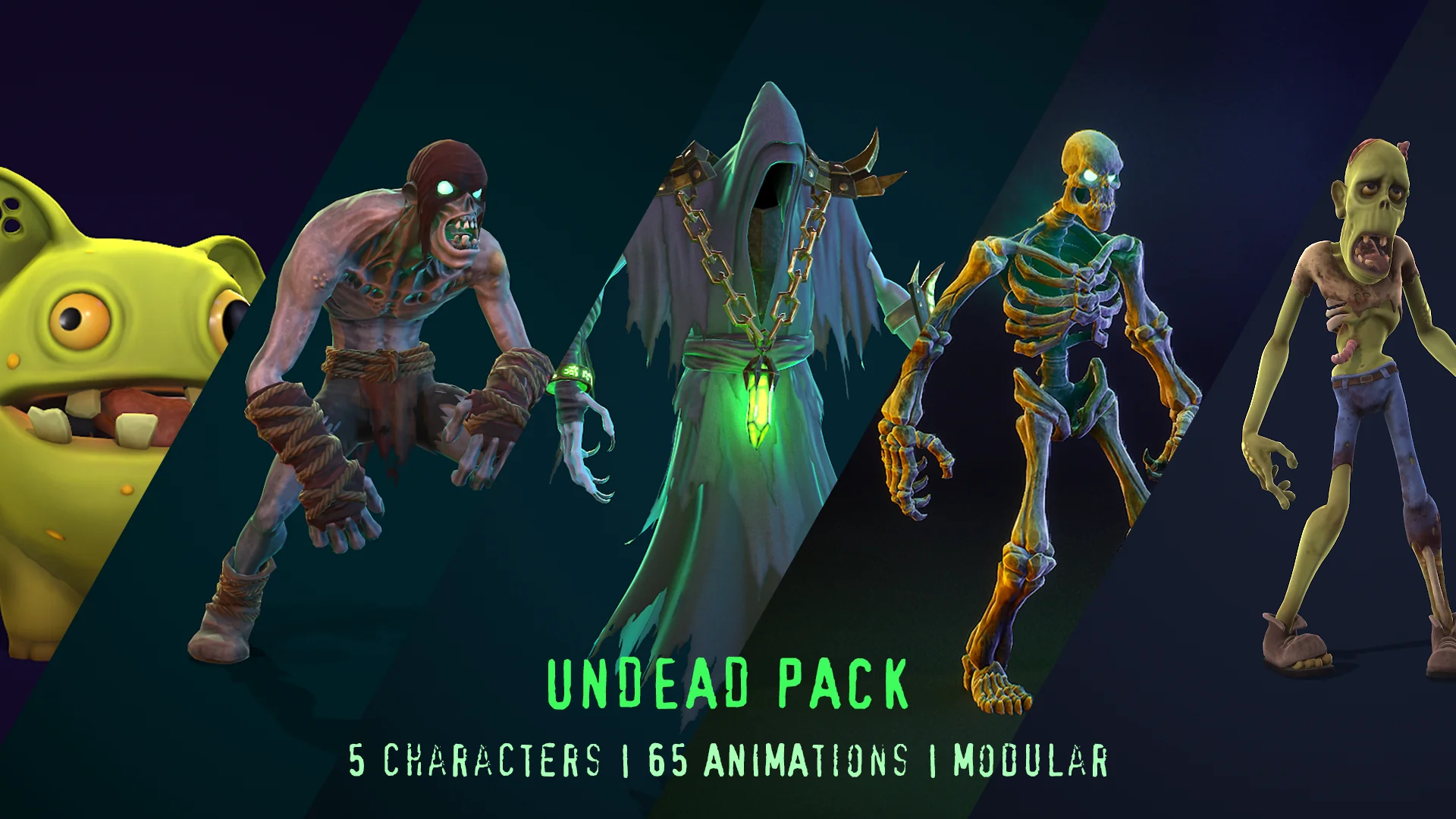
A fantasy enemy lineup requires distinct silhouettes, adaptable rendering setups, and functional rigging to populate hostile environments. Undead Pack supplies a core collective of stylized monster archetypes, bringing together the Lich, Ghoul, Skeleton, Zombie, and Enemy Goblin, alongside additional characters. Built with an expressive cartoon aesthetic that leans into stylized horror, the collection addresses encounter design across diverse combat and dungeon settings.
Core Archetypes in the Undead Pack
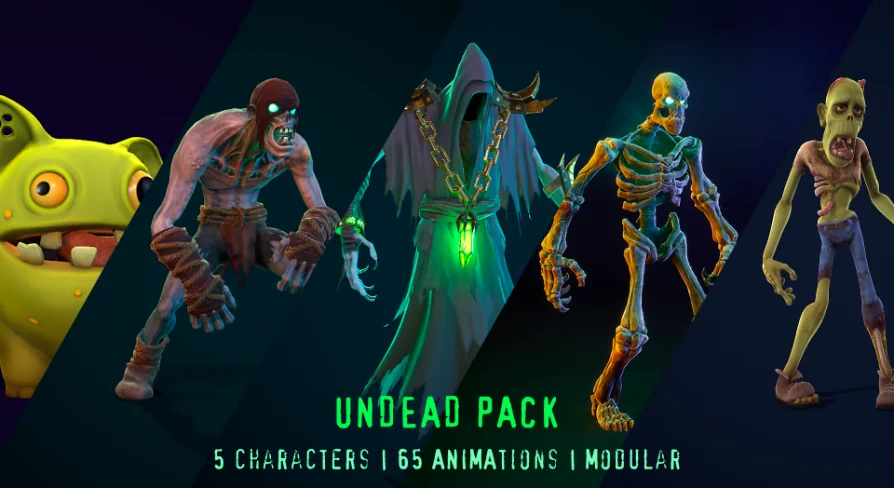
Populating a combat encounter calls for varied unit behaviors, from frail horde units to imposing arcane casters. The characters provided in this collection cover distinct thematic roles, allowing developers to construct escalating waves of hostiles. The Zombie delivers a classic lumbering melee adversary, prioritizing physical threat and decayed anatomy. In contrast, the Ghoul introduces an agile, feral silhouette suited for ravenous ambush attacks, predatory leaping motions, or scavenger behaviors in underground corridors.
Ranged and spellcasting duties center on the Lich, whose presence commands magical threat. Designed to serve as a commander or boss encounter, the Lich features elements compatible with emissive spell effects and hovering, deliberate motion patterns. To fill the mid-tier frontline, the Skeleton serves as an essential staple of dungeon scenarios, capable of wielding weaponry and clattering into battle in large groups. Diverging from pure necromancy, the Enemy Goblin expands the cast into traditional fantasy skirmishes, delivering an erratic, smaller combatant profile that can either fight alongside reanimated creatures or harass players independently.
Texture Passes and LOD Stages in the Undead Pack
Real-time performance hinges on material management and mesh scaling, particularly when scenes fill with dozens of attacking monsters. Each model in the collection is supplied with four discrete levels of detail (LOD 0 through LOD 3). These four LOD stages systematically reduce geometric density as the distance between the camera and the monster increases, preserving frame rates during massive horde encounters without sacrificing edge fidelity during tight close-ups.
Material definition relies on dedicated texture channels authored at both 2048x2048 and 4096x4096 resolutions. Providing both resolutions allows developers to tune texture memory budgets according to platform targets, using 4K sets for hero encounters or cinematic framing, and dropping to 2K maps for background cannon fodder. The texture suite includes dedicated passes for:
Color: Establishes the stylized, cartoon-influenced albedo tone and surface pigmentation across garments, flesh, and bone.
Normal: Bakes sculptural details into low-poly surfaces, accentuating muscle cuts, fractured ribs, and weapon nicks.
By keeping material layers cleanly broken into separate PBR textures, technical artists can fine-tune surface properties directly inside master shaders, altering color shifts, boosting emissive values, or modulating roughness levels dynamically.
Animation Blueprints and Control Rig Functionality
Visual fidelity remains ineffective if character skeletal systems resist movement adjustments. The package integrates dedicated Animation Blueprints, Blueprints, and Control Rig assets to support complex locomotion, blendspaces, and procedural animation updates. Having native Control Rig support simplifies keyframing and manual pose correction directly inside the game viewport or cinematic Sequencer, bypassing the constant round-trip export process to external digital content creation tools.
Animation Blueprints manage the internal state logic governing transitions between idling, patrol loops, lunges, hit reactions, and death animations. These animation graphs integrate with standard gameplay scripts to interpret character speed, combat status, and hit velocity, ensuring that when an Enemy Goblin flinches or a Skeleton collapses, the procedural logic fires consistently. Because the assets are flagged as animated, the skeletal hierarchies conform to standardized animation playback while leaving room for custom motion capture or procedural secondary physics on swinging garments and dangling limbs.
Modular Weapon and Character Variations Across the Pack
Repetition breaks immersion when players face repeated waves of identical enemies. The inclusion of modular characteristics and standalone weapon assets enables visual diversity among common troops. Skeletons and Goblins can be configured with or without their gear, creating variable difficulty markers where an unarmed enemy behaves as an expendable scout while an armed counterpart poses a lethal melee threat.
Modularity also extends to the structural arrangement of the characters. By separating individual costume components, armor pieces, and equipment sockets, developers can script randomized spawning routines. A single blueprint class can spawn a barebones Skeleton, a helmeted warrior, or a club-wielding skirmisher on the fly, maximizing the utility of the mesh library across long campaigns without inflating asset storage footprints.
Integration Within Fantasy and Horror Production Workflows
Constructing a cohesive hostile ecosystem requires assets that bridge multiple genre demands. With styling rooted in cartoon and stylized horror sensibilities, these models integrate cleanly into stylized action RPGs, top-down roguelikes, tower defense games, or survival titles. The exaggerated anatomy, pronounced silhouettes, and vibrant surface texturing ensure that the monsters remain readable from distant isometric camera angles or amidst dense particle chaos in third-person combat.
From rapid prototyping through final staging, the technical setup provides a direct deployment path. Blueprints handle basic logic, Control Rig simplifies procedural posing, 4 LOD levels maintain engine stability, and dual 2K/4K PBR textures balance visual punch with hardware constraints. The resulting character set equips a production with a dependable frontline of fantasy enemies ready for combat implementation.
 Characters
 Characters
 Characters
 Characters