"a5ffaf404b9c2b7e"{"id":"1002622","slug":"australian-desert-photoscan-collection","title":"Australian Desert Photoscan Collection","category":"Nature \u0026 Plants","engine":"5.0+","assetVersion":"","engineVersion":"Engine Version: 5.0+","tag":"Nature \u0026 Plants","accent":"blue","visual":"mech","summary":"Examine the Australian Desert Photoscan Collection, featuring 31 photogrammetry assets, terrain embankments, organic scatter, and matched Megascans texel densit","platform":"Unreal Engine","indexPolicy":"index","publishedAt":"2026-11-15T04:40:12.507Z","updatedAt":"2026-11-15T04:40:12.507Z","sourceNotes":[],"fileContents":[],"compatibility":["Unreal Engine","Engine Version: 5.0+"],"featuredImage":{"alt":"Australian Desert Photoscan Collection","src":"/wp-content/uploads/published/2026/11/1d22dfec0342-21088861-8417-43a9-adbd-a2c4c87e2549-f91a8adc6a.webp"},"hasDownloadLink":true,"downloads":0,"terms":[{"taxonomy":"category","slug":"nature-and-plants","name":"Nature \u0026 Plants"}],"galleryImages":[{"src":"/wp-content/uploads/published/2026/11/2bbb340b84e7-1a0284b5-7c9f-47b1-864c-86979275431b-ff8d400aed.webp","alt":"Australian Desert Photoscan Collection"},{"src":"/wp-content/uploads/published/2026/11/58fed5806d43-4435da42-2f9b-4437-a9af-98ec4751fe9c-6d2d8b932a.webp","alt":"Australian Desert Photoscan Collection"},{"src":"/wp-content/uploads/published/2026/11/49175f3d3f82-d2377249-6305-4a7d-aa61-3afcfe11c3ba-717667cbe4.webp","alt":"Australian Desert Photoscan Collection"},{"src":"/wp-content/uploads/published/2026/11/0633bd9fc5f5-ac678128-5c27-47c9-ba28-d016391a1cfe-a7341c721e.webp","alt":"Australian Desert Photoscan Collection"},{"src":"/wp-content/uploads/published/2026/11/22f3fa1d87cf-23552310-74b7-48cd-83da-9e67aacb3fd1-013dfcb9d1.webp","alt":"Australian Desert Photoscan Collection"},{"src":"/wp-content/uploads/published/2026/11/eeff394a020e-18cdf2c8-fc71-43d1-bd21-2a771d5b19bb-63d1f44951.webp","alt":"Australian Desert Photoscan Collection"},{"src":"/wp-content/uploads/published/2026/11/ef28724160dc-4cb88c08-d4c2-47d2-83f6-dd46db096caf-eae62118e2.webp","alt":"Australian Desert Photoscan Collection"},{"src":"/wp-content/uploads/published/2026/11/718a056d9066-6354cf5a-88fd-4494-a315-24e74fcf5764-62eee02dae.webp","alt":"Australian Desert Photoscan Collection"},{"src":"/wp-content/uploads/published/2026/11/ebdf8879cb9f-af8bec4e-4bf6-4f11-8559-7b972ef90059-812629d7b1.webp","alt":"Australian Desert Photoscan Collection"}],"accessPanel":{"kind":"resource","title":"Get this resource","eyebrow":"Free resource","message":"Download this resource in your browser.","fileName":"Content.7z","safetyNote":"Resources are manually reviewed before listing to improve quality and reduce obvious risks.","actionLabel":"Get this resource","resourceType":"Resource archive","versions":[]},"contentHtml":"\u003cp\u003eVast, sun-bleached landscapes require distinct geological and biological markers to convey genuine desolation. Parched earth, sun-baked clay, and weathered organic scatter form the visual backbone of dry inland regions. Captured directly in Queensland, the Australian Desert Photoscan Collection supplies a specialized library of real-world captures geared toward building believable arid wildernesses, scrublands, and open desert corridors without resorting to synthetic-looking ground features.\u003c/p\u003e \u003ch2\u003eQueensland Biome Captures in the Australian Desert Photoscan Collection\u003c/h2\u003e\n\u003cp\u003eBecause all primary assets originate from the same natural environment in Queensland, they share an inherent visual harmony. Biomes can look discordant when individual models are sourced from unrelated geographical locations with differing mineral compositions and weathering patterns. Here, the shared origin ensures that soil hues, erosion patterns, and structural wear align naturally across wide layouts.\u003c/p\u003e \u003cp\u003eWhile captured in Queensland, the scans support custom coloration to depict various continental territories. The native ground of central and northern Australia shifts from high-saturation iron-rich red dirt to pale yellow sands and dusty brown soil. Integrated tinting controls allow artists to adjust the surface hue across the meshes to fit these shifting regional soils without breaking the base photographic albedo detail.\u003c/p\u003e \u003ch2\u003eMacro Landforms and Desert Embankments\u003c/h2\u003e\n\u003cp\u003eTerrain variation in open desert scenes relies heavily on broken ridges, eroded gully edges, and washouts where water has cut through brittle earth. The collection supplies five distinct desert embankments to construct these natural transitions. Rather than relying purely on heightmaps that stretch at steep angles, placing photogrammetry-derived embankments creates sharp overhangs, cutaways, and tiered drops that mimic authentic soil slippage.\u003c/p\u003e \u003cp\u003eTo support seamless transitions between these steep edge meshes and the surrounding landscape, the pack includes fifteen bonus scanned ground textures. These surface maps provide the foundation for landscape materials, allowing embankments to sink into flat terrain cleanly. High-quality detail maps work alongside these captures, preserving close-up fidelity so large embankment meshes can be scaled up to form imposing geographic cuts without showing texture degradation or pixel stretching.\u003c/p\u003e \u003ch2\u003eBiological Detritus: Termite Mounds, Skeletal Remains, and Animal Dung\u003c/h2\u003e\n\u003cp\u003eConvincing environments need specific narrative scatter that reflects indigenous fauna and flora. Rather than relying purely on generic rock piles, this assembly emphasizes characteristic elements of the Australian outback across thirty-one distinct scanned models.\u003c/p\u003e \u003cp\u003eSix termite mounds introduce vertical spires unique to tropical and arid Australian plains. These structures feature intricate, fluted surface detail characteristic of insect architecture, serving as natural sightline anchors across flat terrain. Alongside these mounds, twelve animal bone assets supply skeletal fragments that evoke drought, predatory activity, and natural decay. These dry bones feature bleached, weathered surfaces that integrate into sanddrifts, gulches, or animal clearings.\u003c/p\u003e \u003cp\u003eGround-level scatter is rounded out by eight distinct animal dung types. Droppings represent an essential yet frequently overlooked element of wild terrain, grounding animal trails and grazing zones with organic believability. Because dung, bone, and soil assets were captured within the same ecosystem, their surface dust and soil retention match the general biome tone naturally.\u003c/p\u003e \u003ch2\u003eFoliage Decals and Rock Atlases Across the Collection\u003c/h2\u003e\n\u003cp\u003eBreaking up soil repetitive tiling requires controlled surface scatter. The pack provides eight atlas and foliage decals divided into four desert rock piles and four dry grass piles. Decal projection offers a lightweight method to scatter cluster debris around the base of the embankments, around termite colonies, or along vehicle pathways.\u003c/p\u003e \u003cp\u003eThe dry grass piles provide clusters of withered vegetation typical of rainfall-starved biomes, providing the sparse straw-like ground cover common across inland scrub. A dedicated foliage master material accompanies these decals. This shader includes exposed parameters designed to match texture atlas variations to the ambient lighting, moisture levels, and color profiles of the surrounding scene, preventing decal vegetation from looking foreign against the underlying terrain.\u003c/p\u003e \u003ch2\u003eMaster Material Architecture and Density Calibration\u003c/h2\u003e\n\u003cp\u003eTechnical integration relies on a robust core shader suited to geometric and surface fine-tuning. The main master material features support for pixel-depth offset, smoothing the harsh geometric seams where meshes intersect with landscape surfaces or with one another. Tessellation options are built directly into the shader framework, permitting dynamic surface displacement for platforms configured to use it.\u003c/p\u003e \u003cp\u003eSurface shading controls within the master material permit deep adjustments to scene cohesion:\u003c/p\u003e\n\u003cul\u003e\n\u003cli\u003eRoughness remapping to capture extremes from dusty, bone-dry matte surfaces to rain-slicked clay.\u003c/li\u003e\n\u003cli\u003eColor tinting controls tuned to push assets between red, yellow, and brown dirt environments.\u003c/li\u003e\n\u003cli\u003eDirect ambient occlusion multiplication into the albedo channel, accentuating deep crevasses and natural ambient shadows.\u003c/li\u003e\n\u003cli\u003eDetail mapping nodes allowing close-up scaling without sacrificing high-frequency surface noise.\u003c/li\u003e\n\u003c/ul\u003e \u003cp\u003eTo ease composition alongside widely used industry libraries, every asset was developed to closely match the triangle density and texel density found in Megascans assets. Because density and photographic fidelity correspond to these established benchmarks, the embankments, scatter models, and textures can sit directly beside Quixel assets without visual jarring or mismatched texture resolution.\u003c/p\u003e \u003ch2\u003ePractical Deployment in Dry Environments\u003c/h2\u003e\n\u003cp\u003eThe collection serves projects requiring dedicated outback, badland, or arid wilderness settings. While fully formed level environments are not included, every mesh, texture, and foliage decal displayed in the project showcases is supplied in the kit. The compilation merges four discrete thematic packs—termite mounds, dry animal bones, animal dung, and desert embankments—into a single modular ecosystem, with the pipeline continuing to expand in subsequent series entries.\u003c/p\u003e\n\n\u003ch2\u003eMore From The Same Workflow\u003c/h2\u003e\n\u003cul\u003e\n\u003cli\u003e\u003ca href=\"https://3dcghub.com/terrain-models-pack-vol-3/\" rel=\"noopener noreferrer\"\u003eTerrain Models Pack Vol. 3\u003c/a\u003e\u003c/li\u003e\n\u003cli\u003e\u003ca href=\"https://3dcghub.com/anime-skybox-v1/\" rel=\"noopener noreferrer\"\u003eANIME SKYBOX V1\u003c/a\u003e\u003c/li\u003e\n\u003cli\u003e\u003ca href=\"https://3dcghub.com/fantasy-plants-4/\" rel=\"noopener noreferrer\"\u003eFantasy plants 4\u003c/a\u003e\u003c/li\u003e\n\u003cli\u003e\u003ca href=\"https://3dcghub.com/cactus-plants-desert-garden/\" rel=\"noopener noreferrer\"\u003eCactus Plants: Desert Garden\u003c/a\u003e\u003c/li\u003e\n\u003cli\u003e\u003ca href=\"https://3dcghub.com/sourwood-trees-sourwood-trees-tree-nature-forest-vegetation-3d-prop-art/\" rel=\"noopener noreferrer\"\u003eSourwood Trees ( Sourwood Trees Tree Nature Forest Vegetation 3D Prop Art )\u003c/a\u003e\u003c/li\u003e\n\u003c/ul\u003e","contentTextLength":6558,"navigation":{"current":26,"total":4570,"previous":{"id":"1002623","slug":"buildings-vol-5-doors-nanite-and-low-poly","title":"Buildings VOL.5 - Doors (Nanite and Low Poly)","category":"Residential Buildings","platform":"Unreal Engine","updatedAt":"2026-11-15T04:41:52.692Z"},"next":{"id":"1002621","slug":"animal-dung-feces-horse-and-cow-photoscan-vol-3","title":"Animal Dung/Feces - Horse and Cow - Photoscan Vol 3.","category":"Animals","platform":"Unreal Engine","updatedAt":"2026-11-15T04:37:57.860Z"}},"relatedResources":[{"id":"1002628","slug":"dry-animal-bones-photoscan-vol-2","title":"Dry Animal Bones - Photoscan Vol 2.","category":"Nature \u0026 Plants","engine":"5.0+","assetVersion":"","engineVersion":"Engine Version: 5.0+","tag":"Nature \u0026 Plants","accent":"blue","visual":"mech","summary":"Examine Dry Animal Bones - Photoscan Vol 2, featuring 12 complete 4k bone meshes and 5 Australian desert ground materials optimized for games and cinematics.","platform":"Unreal Engine","indexPolicy":"index","publishedAt":"2026-11-15T06:07:04.009Z","updatedAt":"2026-11-15T06:07:04.009Z","sourceNotes":[],"fileContents":[],"compatibility":["Unreal Engine","Engine Version: 5.0+"],"featuredImage":{"alt":"Dry Animal Bones - Photoscan Vol 2.","src":"/wp-content/uploads/published/2026/11/0f13139086fc-301c9738-a161-404a-91af-46495867f383-a25d881d35.webp"},"hasDownloadLink":true,"downloads":0},{"id":"1002231","slug":"terrain-models-pack-vol-3","title":"Terrain Models Pack Vol. 3","category":"Nature \u0026 Plants","engine":"5.3+","assetVersion":"","engineVersion":"Engine Version: 5.3+","tag":"Nature \u0026 Plants","accent":"blue","visual":"mech","summary":"Explore Terrain Models Pack Vol. 3, featuring five high quality terrains including snow mountains, valleys, deserts, and alien planets with 4 to 5 models each.","platform":"Unreal Engine","indexPolicy":"index","publishedAt":"2026-10-29T15:34:00.934Z","updatedAt":"2026-10-29T15:34:00.934Z","sourceNotes":[],"fileContents":[],"compatibility":["Unreal Engine","Engine Version: 5.3+"],"featuredImage":{"alt":"Terrain Models Pack Vol. 3","src":"/wp-content/uploads/published/2026/10/02620cb20698-14b442c0-32c7-4581-9674-3a9bccf99c11-ae20ebcd30.webp"},"hasDownloadLink":true,"downloads":1},{"id":"1002645","slug":"termite-mounds-vol-1","title":"Termite Mounds - Vol 1","category":"Nature \u0026 Plants","engine":"5.0+","assetVersion":"","engineVersion":"Engine Version: 5.0+","tag":"Nature \u0026 Plants","accent":"blue","visual":"mech","summary":"A technical look at Termite Mounds - Vol 1, featuring 11 photoscanned Australian meshes, 4K channel-packed maps, pixel-depth offset, and bonus ground textures.","platform":"Unreal Engine","indexPolicy":"index","publishedAt":"2026-11-15T06:33:50.823Z","updatedAt":"2026-11-15T06:33:50.823Z","sourceNotes":[],"fileContents":[],"compatibility":["Unreal Engine","Engine Version: 5.0+"],"featuredImage":{"alt":"Termite Mounds - Vol 1","src":"/wp-content/uploads/published/2026/11/2c265563173d-535af1e6-ad9d-49c1-9a1f-ea29872a8c7b-6e649e40a6.webp"},"hasDownloadLink":true,"downloads":0}]}
Nature & Plants
Australian Desert Photoscan Collection
Examine the Australian Desert Photoscan Collection, featuring 31 photogrammetry assets, terrain embankments, organic scatter, and matched Megascans texel densit
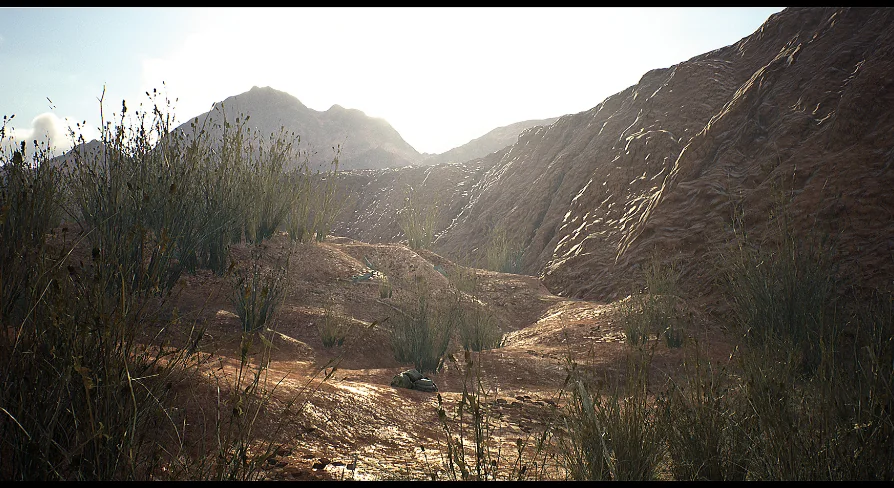
Vast, sun-bleached landscapes require distinct geological and biological markers to convey genuine desolation. Parched earth, sun-baked clay, and weathered organic scatter form the visual backbone of dry inland regions. Captured directly in Queensland, the Australian Desert Photoscan Collection supplies a specialized library of real-world captures geared toward building believable arid wildernesses, scrublands, and open desert corridors without resorting to synthetic-looking ground features.
Queensland Biome Captures in the Australian Desert Photoscan Collection
Because all primary assets originate from the same natural environment in Queensland, they share an inherent visual harmony. Biomes can look discordant when individual models are sourced from unrelated geographical locations with differing mineral compositions and weathering patterns. Here, the shared origin ensures that soil hues, erosion patterns, and structural wear align naturally across wide layouts.
While captured in Queensland, the scans support custom coloration to depict various continental territories. The native ground of central and northern Australia shifts from high-saturation iron-rich red dirt to pale yellow sands and dusty brown soil. Integrated tinting controls allow artists to adjust the surface hue across the meshes to fit these shifting regional soils without breaking the base photographic albedo detail.
Macro Landforms and Desert Embankments
Terrain variation in open desert scenes relies heavily on broken ridges, eroded gully edges, and washouts where water has cut through brittle earth. The collection supplies five distinct desert embankments to construct these natural transitions. Rather than relying purely on heightmaps that stretch at steep angles, placing photogrammetry-derived embankments creates sharp overhangs, cutaways, and tiered drops that mimic authentic soil slippage.
To support seamless transitions between these steep edge meshes and the surrounding landscape, the pack includes fifteen bonus scanned ground textures. These surface maps provide the foundation for landscape materials, allowing embankments to sink into flat terrain cleanly. High-quality detail maps work alongside these captures, preserving close-up fidelity so large embankment meshes can be scaled up to form imposing geographic cuts without showing texture degradation or pixel stretching.
Biological Detritus: Termite Mounds, Skeletal Remains, and Animal Dung
Convincing environments need specific narrative scatter that reflects indigenous fauna and flora. Rather than relying purely on generic rock piles, this assembly emphasizes characteristic elements of the Australian outback across thirty-one distinct scanned models.
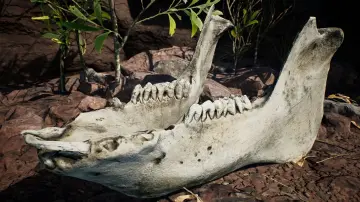
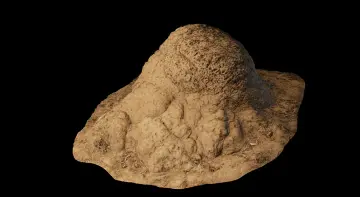
Six termite mounds introduce vertical spires unique to tropical and arid Australian plains. These structures feature intricate, fluted surface detail characteristic of insect architecture, serving as natural sightline anchors across flat terrain. Alongside these mounds, twelve animal bone assets supply skeletal fragments that evoke drought, predatory activity, and natural decay. These dry bones feature bleached, weathered surfaces that integrate into sanddrifts, gulches, or animal clearings.
Ground-level scatter is rounded out by eight distinct animal dung types. Droppings represent an essential yet frequently overlooked element of wild terrain, grounding animal trails and grazing zones with organic believability. Because dung, bone, and soil assets were captured within the same ecosystem, their surface dust and soil retention match the general biome tone naturally.
Foliage Decals and Rock Atlases Across the Collection
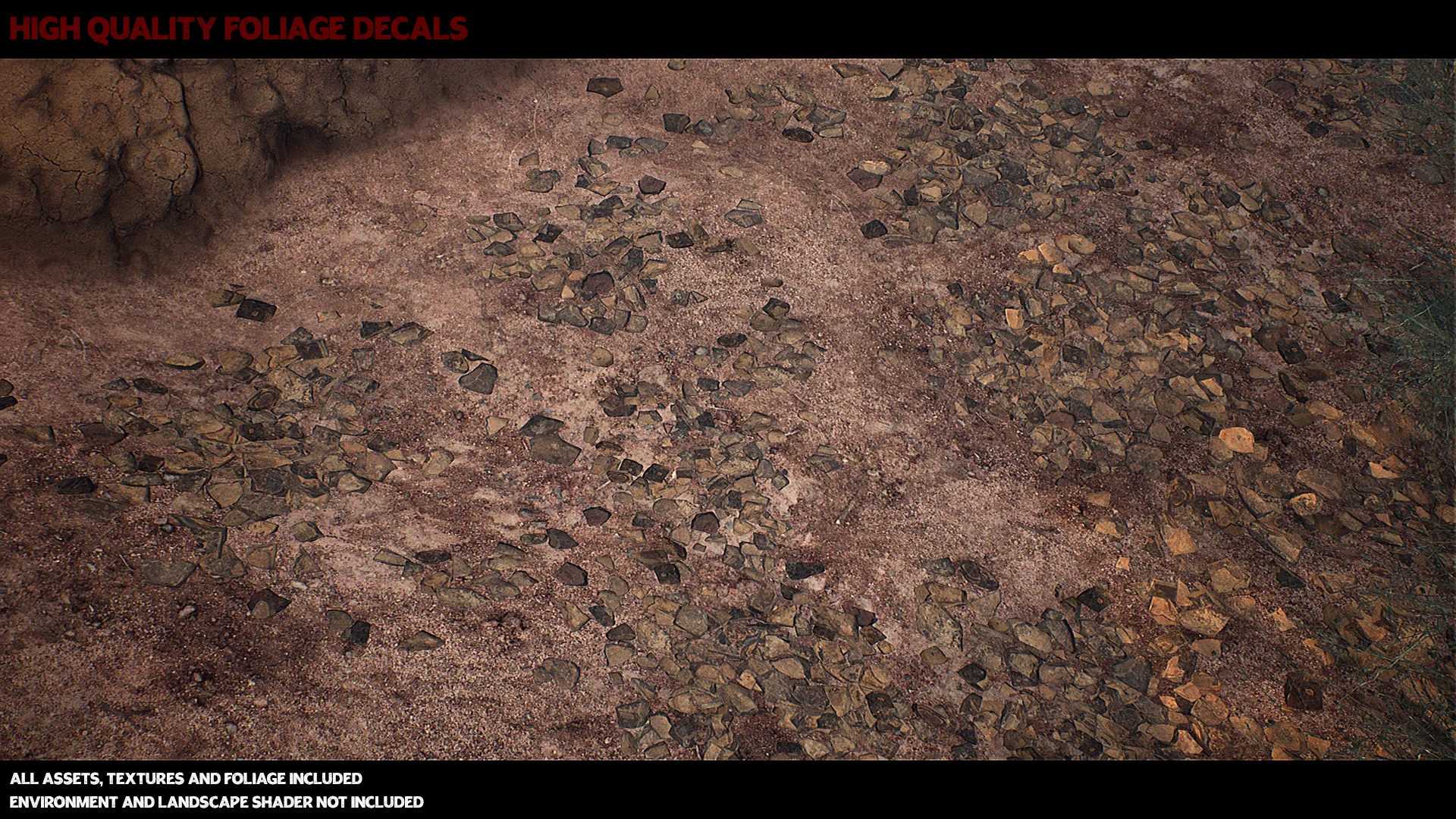
Breaking up soil repetitive tiling requires controlled surface scatter. The pack provides eight atlas and foliage decals divided into four desert rock piles and four dry grass piles. Decal projection offers a lightweight method to scatter cluster debris around the base of the embankments, around termite colonies, or along vehicle pathways.
The dry grass piles provide clusters of withered vegetation typical of rainfall-starved biomes, providing the sparse straw-like ground cover common across inland scrub. A dedicated foliage master material accompanies these decals. This shader includes exposed parameters designed to match texture atlas variations to the ambient lighting, moisture levels, and color profiles of the surrounding scene, preventing decal vegetation from looking foreign against the underlying terrain.
Master Material Architecture and Density Calibration
Technical integration relies on a robust core shader suited to geometric and surface fine-tuning. The main master material features support for pixel-depth offset, smoothing the harsh geometric seams where meshes intersect with landscape surfaces or with one another. Tessellation options are built directly into the shader framework, permitting dynamic surface displacement for platforms configured to use it.
Surface shading controls within the master material permit deep adjustments to scene cohesion:
Roughness remapping to capture extremes from dusty, bone-dry matte surfaces to rain-slicked clay.
Color tinting controls tuned to push assets between red, yellow, and brown dirt environments.
Direct ambient occlusion multiplication into the albedo channel, accentuating deep crevasses and natural ambient shadows.
To ease composition alongside widely used industry libraries, every asset was developed to closely match the triangle density and texel density found in Megascans assets. Because density and photographic fidelity correspond to these established benchmarks, the embankments, scatter models, and textures can sit directly beside Quixel assets without visual jarring or mismatched texture resolution.
Practical Deployment in Dry Environments
The collection serves projects requiring dedicated outback, badland, or arid wilderness settings. While fully formed level environments are not included, every mesh, texture, and foliage decal displayed in the project showcases is supplied in the kit. The compilation merges four discrete thematic packs—termite mounds, dry animal bones, animal dung, and desert embankments—into a single modular ecosystem, with the pipeline continuing to expand in subsequent series entries.
 Nature & Plants
 Nature & Plants
 Nature & Plants
 Nature & Plants