"a5ffaf404b9c2b7e"{"id":"1002621","slug":"animal-dung-feces-horse-and-cow-photoscan-vol-3","title":"Animal Dung/Feces - Horse and Cow - Photoscan Vol 3.","category":"Animals","engine":"5.0+","assetVersion":"","engineVersion":"Engine Version: 5.0+","tag":"Animals","accent":"blue","visual":"mech","summary":"Explore the implementation and technical setup of Animal Dung/Feces - Horse and Cow - Photoscan Vol 3, featuring 4K textures, master materials, and Megascans pa","platform":"Unreal Engine","indexPolicy":"index","publishedAt":"2026-11-15T04:37:57.860Z","updatedAt":"2026-11-15T04:37:57.860Z","sourceNotes":[],"fileContents":[],"compatibility":["Unreal Engine","Engine Version: 5.0+"],"featuredImage":{"alt":"Animal Dung/Feces - Horse and Cow - Photoscan Vol 3.","src":"/wp-content/uploads/published/2026/11/6b29d4f3b9e6-8b96e9a2-ce75-4c68-aa21-0090ee0151f2-385d0c325d.webp"},"hasDownloadLink":true,"downloads":0,"terms":[{"taxonomy":"category","slug":"animals","name":"Animals"}],"galleryImages":[{"src":"/wp-content/uploads/published/2026/11/154a05af2374-333584dd-5daf-4180-a290-f6cbc5ed4898-75476503a3.webp","alt":"Animal Dung/Feces - Horse and Cow - Photoscan Vol 3."},{"src":"/wp-content/uploads/published/2026/11/7899660aef22-bb413d46-691b-4b0d-ae84-5790166d803a-a5770fd716.webp","alt":"Animal Dung/Feces - Horse and Cow - Photoscan Vol 3."},{"src":"/wp-content/uploads/published/2026/11/e3fb9fe6d5fd-a02f333a-7e0b-43f9-8655-8d419edce4e4-e5849de8fe.webp","alt":"Animal Dung/Feces - Horse and Cow - Photoscan Vol 3."},{"src":"/wp-content/uploads/published/2026/11/2d078b0d0627-a8fc113f-2f2c-4df3-b526-c2c823c4f647-e9c324de16.webp","alt":"Animal Dung/Feces - Horse and Cow - Photoscan Vol 3."},{"src":"/wp-content/uploads/published/2026/11/fbadbb1a48fb-0d70f7c7-df7d-45dc-833e-5432984777a2-28a465f08d.webp","alt":"Animal Dung/Feces - Horse and Cow - Photoscan Vol 3."},{"src":"/wp-content/uploads/published/2026/11/9f745802f98e-136eacd5-634d-417e-ac85-0311ff3c6aee-54d92481a8.webp","alt":"Animal Dung/Feces - Horse and Cow - Photoscan Vol 3."},{"src":"/wp-content/uploads/published/2026/11/25061102279d-8dd59f7d-08d3-403d-ba82-6823ca33ba6d-ff7f790a54.webp","alt":"Animal Dung/Feces - Horse and Cow - Photoscan Vol 3."},{"src":"/wp-content/uploads/published/2026/11/b1c9269605dd-9d6a4178-feb4-48b0-99e5-bef696b52d6b-6c727b9e94.webp","alt":"Animal Dung/Feces - Horse and Cow - Photoscan Vol 3."},{"src":"/wp-content/uploads/published/2026/11/a87f15cd93b0-3fcbb37e-131f-4d06-bfdd-fe6aa8a1eceb-08204c7a93.webp","alt":"Animal Dung/Feces - Horse and Cow - Photoscan Vol 3."},{"src":"/wp-content/uploads/published/2026/11/b428324d7453-e914f49e-dc3d-4ae7-9ba4-dc13aefb1bd5-917ec67a02.webp","alt":"Animal Dung/Feces - Horse and Cow - Photoscan Vol 3."}],"accessPanel":{"kind":"resource","title":"Get this resource","eyebrow":"Free resource","message":"Download this resource in your browser.","fileName":"Content.7z","safetyNote":"Resources are manually reviewed before listing to improve quality and reduce obvious risks.","actionLabel":"Get this resource","resourceType":"Resource archive","versions":[]},"contentHtml":"\u003ch2\u003eImplementing Animal Dung Meshes in Interactive and Particle Systems\u003c/h2\u003e\u003cp\u003ePopulating rural paddocks, outback landscapes, and pasture terrain requires scatters that feel authentic to the wildlife and livestock inhabiting the space. The assets in this collection are built as whole, enclosed meshes rather than flat or single-sided decals. Because each geometry forms an entire object, level artists have full freedom over rotation, translation, and orientation across uneven ground.\u003c/p\u003e\u003cp\u003ePlacing these pieces does not restrict you to simple static placement along terrain heightmaps. Because they feature complete topology without hollow undersides, the meshes can be turned upside down, wedged into crevices, or stacked directly on top of one another to build larger, uneven accumulations. This full-mesh structure also makes them directly viable for dynamic physics and particle systems. Emitters can cast individual horse dung droppings across dirt tracks, toss debris during vehicle interactions, or disperse biological scatter over large agricultural fields without the visual breakdown associated with planar scatter meshes.\u003c/p\u003e\u003cp\u003eFor standard runtime deployment, the geometry is optimized for in-game performance, keeping overhead low during level streaming and general traversal. When higher geometric detail is required for offline sequences or tight cinematic camera passes, the underlying geometry supports tessellation, transforming the base assets into hero-quality surfaces with pronounced geometric displacement.\u003c/p\u003e\u003ch2\u003eHorse and Cow Photoscanned Variants and Texture Delivery\u003c/h2\u003e\u003cp\u003eThe collection provides eight discrete photogrammetry-derived variants divided evenly across two distinct types of livestock waste. Four variants represent cow-patty piles, capturing the broad, flattened, layered spread characteristic of bovine droppings across open ground. The remaining four variants focus on horse dung, delivering the fragmented, fibrous, and rounded formations typical of equine waste.\u003c/p\u003e\u003cp\u003eAll photogrammetric scans were captured at an initial 8k resolution to record the ultra-fine surface grain, dried fibrous edges, and irregular organic pitting. These source captures were subsequently downscaled to 4k texture maps, balancing resolution against real-time memory constraints while preserving micro-surface fidelity. For the individual scatter models, textures utilize channel packing where appropriate, storing ambient occlusion and roughness maps within combined texture channels. This packing structure reduces texture sampler counts and stream footprint without sacrificing surface definition or material response under dynamic lighting.\u003c/p\u003e\u003ch2\u003eMaster Material Pipeline: Tessellation, Shading, and Blending\u003c/h2\u003e\u003cp\u003eAchieving a seamless transition between standalone prop meshes and underlying terrain requires dedicated material controls. The pack includes a versatile master material configured to handle runtime material blending, lighting response, and surface displacement.\u003c/p\u003e\u003cp\u003eA critical technical component of the master material is pixel-depth offset. When intersecting scatter meshes with underlying ground planes or rocky terrain, hard intersection seams can break immersion. Pixel-depth offset softens the contact point between the dung meshes and the terrain geometry, allowing the biological scatter to sink naturally into dust, loose dirt, or gravel without exposing harsh geometric slicing. Alongside contact blending, the master material incorporates direct tessellation parameters, enabling dynamic displacement for close-up hero presentations.\u003c/p\u003e\u003cp\u003eSurface response can be tuned directly inside material instances through dedicated shading inputs:\u003c/p\u003e\u003cul\u003e\u003cli\u003e\u003cstrong\u003eRoughness Adjustments:\u003c/strong\u003e Artists can tweak dry, chalky surface characteristics or introduce localized sheen to represent fresher material.\u003c/li\u003e\u003cli\u003e\u003cstrong\u003eColor Tinting:\u003c/strong\u003e Flexible tint parameters allow the assets to match distinct soil hues, regional grass diets, or specific weathering stages.\u003c/li\u003e\u003cli\u003e\u003cstrong\u003eAmbient Occlusion Multiplication:\u003c/strong\u003e The channel-packed ambient occlusion map can be multiplied directly into the albedo channel, accentuating deep organic folds, crevices, and self-shadowing under diffuse lighting conditions.\u003c/li\u003e\u003cli\u003e\u003cstrong\u003eDetail Mapping:\u003c/strong\u003e Secondary micro-detail mapping can be blended over the base surface maps, maintaining visual density when the camera approaches ground level.\u003c/li\u003e\u003c/ul\u003e\u003ch2\u003eMatching Density Standards with Megascans Workflows\u003c/h2\u003e\u003cp\u003eIntegrating photogrammetry from different creators often introduces visual friction if texel scale and polygon distribution fail to align. To solve this common integration hurdle, deliberate calibration was carried out to align the triangle density and texel density of these models directly with Quixel Megascans standards.\u003c/p\u003e\u003cp\u003eBecause the geometric budgets and texture density mirror the parameters used across Megascans ground scatter and surface assets, these models drop into Megascans-heavy natural biomes without standing out as foreign data. The geometric wireframe density remains balanced against adjacent Megascans rocks, debris, and ground scatter, ensuring uniform level-of-detail transitions across the scene. Similarly, the 4k texture distribution aligns with the texel-per-meter ratios common to standard photogrammetry libraries, avoiding jarring shifts in clarity when players move between terrain surfaces and environmental props.\u003c/p\u003e\u003cp\u003eThis compatibility extends to the wider Australian Desert asset ecosystem, sitting alongside collections such as Termite Mounds, Dry Animal Bones, and Desert Embankments. When assembled together, these elements create a unified ecological setting shaped by the same environmental conditions, lighting characteristics, and weathering factors.\u003c/p\u003e\u003ch2\u003eBonus Soil Textures and Environmental Context\u003c/h2\u003e\u003cp\u003eGround scatter rarely works in isolation; it requires matching substrate textures to anchor it within a specific geographical context. To support complete ground dressing, five bonus photoscanned surface textures are included with the pack:\u003c/p\u003e\u003cul\u003e\u003cli\u003eArid Rocky Dirt 01\u003c/li\u003e\u003cli\u003ePacked Gravel 01\u003c/li\u003e\u003cli\u003ePacked Soil 01\u003c/li\u003e\u003cli\u003eSoil Tyre Marks 01\u003c/li\u003e\u003cli\u003eSoil Wavy 01\u003c/li\u003e\u003c/ul\u003e\u003cp\u003eThese surface textures originate from the exact same physical environment where the reference material for the dry animal bones was captured, guaranteeing visual consistency across the entire terrain layer. Each bonus material is supplied at 4k resolution and features channel-packed textures containing ambient occlusion, roughness, and full displacement maps. Using these matching surfaces ensures that soil coloration, gravel particle size, and tire imprint depth align directly with the organic dung scatter, yielding cohesive ground composition across arid stations, paddocks, and outback roads.\u003c/p\u003e\n\n\u003ch2\u003eContinue Browsing Similar Packs\u003c/h2\u003e\n\u003cul\u003e\n\u003cli\u003e\u003ca href=\"https://3dcghub.com/bones-vol-1-animal-bones-1-nanite-low-poly/\" rel=\"noopener noreferrer\"\u003eBones VOL.1 - Animal Bones 1 (Nanite + Low Poly)\u003c/a\u003e\u003c/li\u003e\n\u003cli\u003e\u003ca href=\"https://3dcghub.com/critters-vol-2-crows-and-seagulls-nanite-and-low-poly-w-particle/\" rel=\"noopener noreferrer\"\u003eCritters VOL.2 - Crows \u0026amp; Seagulls (Nanite and Low Poly w/Particle)\u003c/a\u003e\u003c/li\u003e\n\u003cli\u003e\u003ca href=\"https://3dcghub.com/suburbs-vol-5-around-the-house-retro-nanite-and-low-poly/\" rel=\"noopener noreferrer\"\u003eSuburbs VOL.5 - Around the House Retro (Nanite and Low Poly)\u003c/a\u003e\u003c/li\u003e\n\u003cli\u003e\u003ca href=\"https://3dcghub.com/spixs-macaw-ararinha-azul/\" rel=\"noopener noreferrer\"\u003eSpix\u0026#039;s Macaw - Ararinha Azul\u003c/a\u003e\u003c/li\u003e\n\u003cli\u003e\u003ca href=\"https://3dcghub.com/wild-boar-male/\" rel=\"noopener noreferrer\"\u003eWild Boar - Male\u003c/a\u003e\u003c/li\u003e\n\u003c/ul\u003e","contentTextLength":6865,"navigation":{"current":27,"total":4570,"previous":{"id":"1002622","slug":"australian-desert-photoscan-collection","title":"Australian Desert Photoscan Collection","category":"Nature \u0026 Plants","platform":"Unreal Engine","updatedAt":"2026-11-15T04:40:12.507Z"},"next":{"id":"12567","slug":"56-fabric-textile-materials-4k-pbr-collection","title":"56 Fabric \u0026 Textile Materials (4K PBR Collection)","category":"Fabric \u0026 Clothing","platform":"Unreal Engine","updatedAt":"2026-11-14T10:18:50.493Z"}},"relatedResources":[{"id":"1579","slug":"bones-vol-1-animal-bones-1-nanite-low-poly","title":"Bones VOL.1 - Animal Bones 1 (Nanite + Low Poly)","category":"Animals","engine":"5.0+","assetVersion":"Engine version: 5.0+","engineVersion":"5.0","tag":"Animals","accent":"blue","visual":"character","summary":"Enhance your game environments with 56 realistic animal bone meshes. Features Nanite support, 4K textures, and optimized low-poly versions for Unreal Engine.","platform":"Unreal Engine","indexPolicy":"noindex","publishedAt":"2026-02-06T19:51:21.000Z","updatedAt":"2026-11-14T10:15:59.424Z","sourceNotes":[],"fileContents":[],"compatibility":["Unreal Engine","Engine version: 5.0+"],"featuredImage":{"alt":"Bones VOL.1 - Animal Bones 1 (Nanite + Low Poly)","src":"https://3dcghub.com/wp-content/uploads/2026/02/6050220a-fd41-4d5f-8d79-4a7276034f1c.webp"},"hasDownloadLink":true,"downloads":1},{"id":"1000945","slug":"critters-vol-2-crows-and-seagulls-nanite-and-low-poly-w-particle","title":"Critters VOL.2 - Crows \u0026 Seagulls (Nanite and Low Poly w/Particle)","category":"Animals","engine":"5.2+","assetVersion":"","engineVersion":"Engine Version: 5.2+","tag":"Animals","accent":"blue","visual":"mech","summary":"Nanite and low poly crows \u0026 seagulls for Unreal Engine with 20 meshes, 4k textures, dead and posed versions, and Niagara particles for overhead flocks.","platform":"Unreal Engine","indexPolicy":"index","publishedAt":"2026-08-13T04:04:31.810Z","updatedAt":"2026-08-13T04:04:31.810Z","sourceNotes":[],"fileContents":[],"compatibility":["Unreal Engine","Engine Version: 5.2+"],"featuredImage":{"alt":"Critters VOL.2 - Crows \u0026 Seagulls (Nanite and Low Poly w/Particle)","src":"/wp-content/uploads/published/2026/08/a574ec954490-e13c35d6-fb8b-4abe-baef-294201d38aca-427538c056.webp"},"hasDownloadLink":true,"downloads":1},{"id":"1000484","slug":"suburbs-vol-5-around-the-house-retro-nanite-and-low-poly","title":"Suburbs VOL.5 - Around the House Retro (Nanite and Low Poly)","category":"Animals","engine":"5.1+","assetVersion":"","engineVersion":"Engine Version: 5.1+","tag":"Animals","accent":"blue","visual":"mech","summary":"A 124-mesh Unreal Engine asset pack by Dekogon Studios delivering Nanite and low-poly retro 1970s–1980s household props with 4K textures and Lumen support.","platform":"Unreal Engine","indexPolicy":"index","publishedAt":"2026-07-12T06:34:22.883Z","updatedAt":"2026-07-12T06:34:22.883Z","sourceNotes":[],"fileContents":[],"compatibility":["Unreal Engine","Engine Version: 5.1+"],"featuredImage":{"alt":"Suburbs VOL.5 - Around the House Retro (Nanite and Low Poly)","src":"/wp-content/uploads/published/2026/07/05ac67aa92ef-7d7a18cd-ee9b-4d9e-b10c-61a6c681ffd3-f57dda0968.webp"},"hasDownloadLink":true,"downloads":0}]}
Animals
Animal Dung/Feces - Horse and Cow - Photoscan Vol 3.
Explore the implementation and technical setup of Animal Dung/Feces - Horse and Cow - Photoscan Vol 3, featuring 4K textures, master materials, and Megascans pa
Category:Unreal Engine,AnimalsPlatform: Unreal EngineEngine Version: 5.0+Published: Nov 15, 2026
Animals
Resource overview
Implementing Animal Dung Meshes in Interactive and Particle Systems
Populating rural paddocks, outback landscapes, and pasture terrain requires scatters that feel authentic to the wildlife and livestock inhabiting the space. The assets in this collection are built as whole, enclosed meshes rather than flat or single-sided decals. Because each geometry forms an entire object, level artists have full freedom over rotation, translation, and orientation across uneven ground.
Placing these pieces does not restrict you to simple static placement along terrain heightmaps. Because they feature complete topology without hollow undersides, the meshes can be turned upside down, wedged into crevices, or stacked directly on top of one another to build larger, uneven accumulations. This full-mesh structure also makes them directly viable for dynamic physics and particle systems. Emitters can cast individual horse dung droppings across dirt tracks, toss debris during vehicle interactions, or disperse biological scatter over large agricultural fields without the visual breakdown associated with planar scatter meshes.
For standard runtime deployment, the geometry is optimized for in-game performance, keeping overhead low during level streaming and general traversal. When higher geometric detail is required for offline sequences or tight cinematic camera passes, the underlying geometry supports tessellation, transforming the base assets into hero-quality surfaces with pronounced geometric displacement.
Horse and Cow Photoscanned Variants and Texture Delivery
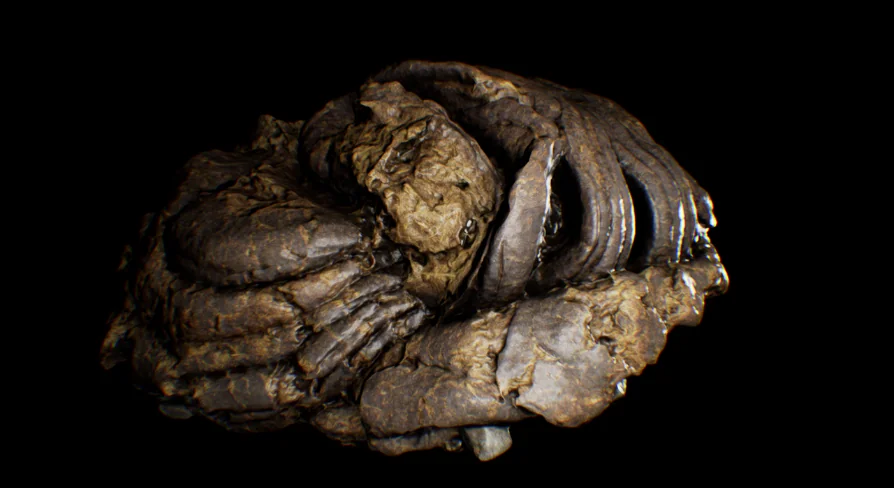
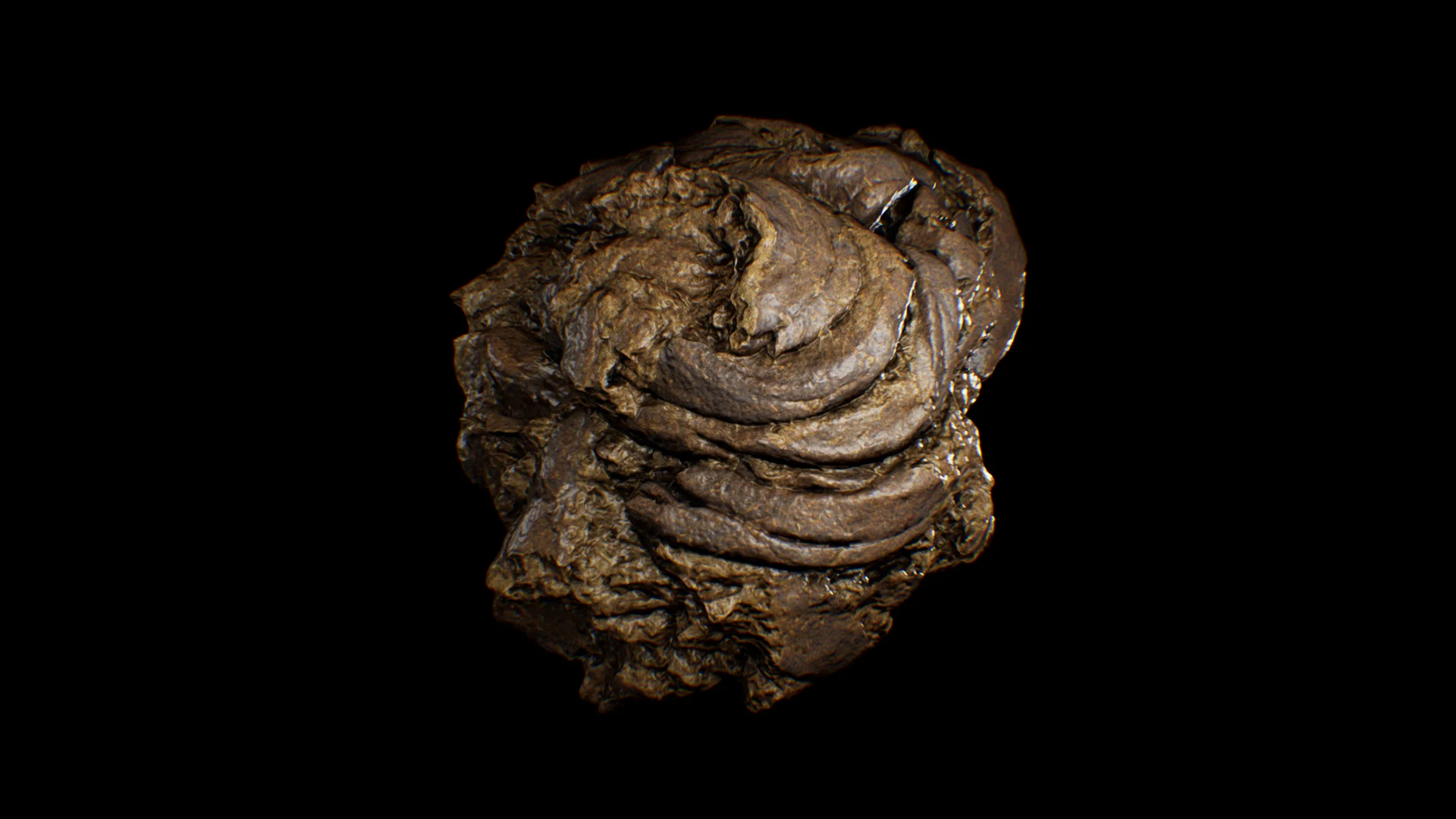
The collection provides eight discrete photogrammetry-derived variants divided evenly across two distinct types of livestock waste. Four variants represent cow-patty piles, capturing the broad, flattened, layered spread characteristic of bovine droppings across open ground. The remaining four variants focus on horse dung, delivering the fragmented, fibrous, and rounded formations typical of equine waste.
All photogrammetric scans were captured at an initial 8k resolution to record the ultra-fine surface grain, dried fibrous edges, and irregular organic pitting. These source captures were subsequently downscaled to 4k texture maps, balancing resolution against real-time memory constraints while preserving micro-surface fidelity. For the individual scatter models, textures utilize channel packing where appropriate, storing ambient occlusion and roughness maps within combined texture channels. This packing structure reduces texture sampler counts and stream footprint without sacrificing surface definition or material response under dynamic lighting.
Master Material Pipeline: Tessellation, Shading, and Blending
Achieving a seamless transition between standalone prop meshes and underlying terrain requires dedicated material controls. The pack includes a versatile master material configured to handle runtime material blending, lighting response, and surface displacement.
A critical technical component of the master material is pixel-depth offset. When intersecting scatter meshes with underlying ground planes or rocky terrain, hard intersection seams can break immersion. Pixel-depth offset softens the contact point between the dung meshes and the terrain geometry, allowing the biological scatter to sink naturally into dust, loose dirt, or gravel without exposing harsh geometric slicing. Alongside contact blending, the master material incorporates direct tessellation parameters, enabling dynamic displacement for close-up hero presentations.
Surface response can be tuned directly inside material instances through dedicated shading inputs:
Roughness Adjustments: Artists can tweak dry, chalky surface characteristics or introduce localized sheen to represent fresher material.
Color Tinting: Flexible tint parameters allow the assets to match distinct soil hues, regional grass diets, or specific weathering stages.
Ambient Occlusion Multiplication: The channel-packed ambient occlusion map can be multiplied directly into the albedo channel, accentuating deep organic folds, crevices, and self-shadowing under diffuse lighting conditions.
Detail Mapping: Secondary micro-detail mapping can be blended over the base surface maps, maintaining visual density when the camera approaches ground level.
Matching Density Standards with Megascans Workflows
Integrating photogrammetry from different creators often introduces visual friction if texel scale and polygon distribution fail to align. To solve this common integration hurdle, deliberate calibration was carried out to align the triangle density and texel density of these models directly with Quixel Megascans standards.
Because the geometric budgets and texture density mirror the parameters used across Megascans ground scatter and surface assets, these models drop into Megascans-heavy natural biomes without standing out as foreign data. The geometric wireframe density remains balanced against adjacent Megascans rocks, debris, and ground scatter, ensuring uniform level-of-detail transitions across the scene. Similarly, the 4k texture distribution aligns with the texel-per-meter ratios common to standard photogrammetry libraries, avoiding jarring shifts in clarity when players move between terrain surfaces and environmental props.
This compatibility extends to the wider Australian Desert asset ecosystem, sitting alongside collections such as Termite Mounds, Dry Animal Bones, and Desert Embankments. When assembled together, these elements create a unified ecological setting shaped by the same environmental conditions, lighting characteristics, and weathering factors.
Bonus Soil Textures and Environmental Context
Ground scatter rarely works in isolation; it requires matching substrate textures to anchor it within a specific geographical context. To support complete ground dressing, five bonus photoscanned surface textures are included with the pack:
Arid Rocky Dirt 01
Packed Gravel 01
Packed Soil 01
Soil Tyre Marks 01
Soil Wavy 01
These surface textures originate from the exact same physical environment where the reference material for the dry animal bones was captured, guaranteeing visual consistency across the entire terrain layer. Each bonus material is supplied at 4k resolution and features channel-packed textures containing ambient occlusion, roughness, and full displacement maps. Using these matching surfaces ensures that soil coloration, gravel particle size, and tire imprint depth align directly with the organic dung scatter, yielding cohesive ground composition across arid stations, paddocks, and outback roads.
 Animals
 Animals
 Animals
 Animals