"82ee98b2ee2793f1"{"id":"1002429","slug":"cuttlefish-camouflage","title":"Cuttlefish Camouflage","category":"Characters \u0026 Creatures","engine":"4.15+,5.0+","assetVersion":"","engineVersion":"Engine Version: 4.15+,5.0+","tag":"Characters","accent":"blue","visual":"character","summary":"An in-depth look at Cuttlefish Camouflage, featuring dynamic surface detection, procedural spline paths, vertex animation, and complete ocean post-processing.","platform":"Unreal Engine","indexPolicy":"index","publishedAt":"2026-11-10T18:22:12.836Z","updatedAt":"2026-11-10T18:22:12.836Z","sourceNotes":[],"fileContents":[],"compatibility":["Unreal Engine","Engine Version: 4.15+,5.0+"],"featuredImage":{"alt":"Cuttlefish Camouflage","src":"/wp-content/uploads/published/2026/11/10a1e89d9f5e-1388df39-d540-4f65-a762-dad75c32b6a5-acb3c1689a.webp"},"hasDownloadLink":true,"downloads":0,"terms":[{"taxonomy":"category","slug":"characters-and-creatures","name":"Characters \u0026 Creatures"}],"galleryImages":[{"src":"/wp-content/uploads/published/2026/11/0f9fda303f9c-c277b8db-18e3-46c2-8baa-31fd1ee1ac22-e044c2a219.webp","alt":"Cuttlefish Camouflage"},{"src":"/wp-content/uploads/published/2026/11/2b952e86e757-f400d89d-030e-43d6-9411-f2a62e59f11d-83a2c3c60b.webp","alt":"Cuttlefish Camouflage"},{"src":"/wp-content/uploads/published/2026/11/806b58f6804f-d6edda4e-951c-4995-ad23-9e26aa4d9537-92438d8b3b.webp","alt":"Cuttlefish Camouflage"},{"src":"/wp-content/uploads/published/2026/11/a09117ef977e-04996c11-45d2-4728-a30d-0f9f0b7c0941-03a33bcc65.webp","alt":"Cuttlefish Camouflage"},{"src":"/wp-content/uploads/published/2026/11/c489254256aa-8f515fb3-bd63-4100-9f29-4487ff8fd657-997a7db098.webp","alt":"Cuttlefish Camouflage"},{"src":"/wp-content/uploads/published/2026/11/d2a53ce51aca-8162e9da-ad51-4aad-b89c-b3cc137f5981-78a50bab72.webp","alt":"Cuttlefish Camouflage"},{"src":"/wp-content/uploads/published/2026/11/e8066b92be4a-d2a75c15-c49f-47c1-9bdd-8b9825f57b67-6b65b3ebaa.webp","alt":"Cuttlefish Camouflage"},{"src":"/wp-content/uploads/published/2026/11/91973d5d23b7-7ab011ce-c466-40eb-b511-2a985b20dfa3-3f4e315993.webp","alt":"Cuttlefish Camouflage"},{"src":"/wp-content/uploads/published/2026/11/c728743596af-03b9697a-2077-4242-b267-631f4f2caf3d-d517fb989a.webp","alt":"Cuttlefish Camouflage"},{"src":"/wp-content/uploads/published/2026/11/28ff02560486-dc98d0a2-639e-4480-b2b8-df2570f1e5c4-c73df8c574.webp","alt":"Cuttlefish Camouflage"}],"accessPanel":{"kind":"resource","title":"Get this resource","eyebrow":"Free resource","message":"Download this resource in your browser.","fileName":"Content.7z","safetyNote":"Resources are manually reviewed before listing to improve quality and reduce obvious risks.","actionLabel":"Get this resource","resourceType":"Resource archive","versions":[]},"contentHtml":"\u003cp\u003eDeep marine scenes, sunlit coastal shallows, and detailed underwater reefs demand lifeforms that react believably to their immediate surroundings. Unlike ordinary aquatic creatures that swim along predetermined routes without acknowledging the seafloor, cephalopods are defined by their reactive nature. Simulating this behavior requires an ecosystem where the animal reads the terrain underneath its body and changes its exterior appearance to blend with sand, rocks, and uneven seabed substrates.\u003c/p\u003e \u003ch2\u003eDynamic Cuttlefish Camouflage Driven by Physical Materials\u003c/h2\u003e\n\u003cp\u003eAt the center of this setup is a reactive skin transition system governed directly by physical materials assigned to scene geometry. Rather than relying on simple proximity checks or manual animation tracks, the cuttlefish blueprint actively reads the specific physics materials assigned to surfaces resting directly beneath the creature. This data is mapped directly to variables inside the blueprint, allowing the creature's epidermal appearance to morph smoothly as it glides from one environmental layer to the next.\u003c/p\u003e \u003cp\u003eFine-tuning this transition requires granular control over how and when the shifting begins. The blueprint gives developers control over several specific numerical thresholds:\u003c/p\u003e\n\u003cul\u003e\n\u003cli\u003e\u003cstrong\u003eDetection Distance:\u003c/strong\u003e Governs how far away a surface can be before the creature acknowledges the incoming terrain, ensuring shifts do not occur abruptly or prematurely.\u003c/li\u003e\n\u003cli\u003e\u003cstrong\u003eStarting Distance for Transformations:\u003c/strong\u003e Dictates the exact operational threshold where the skin transition begins blending between patterns.\u003c/li\u003e\n\u003cli\u003e\u003cstrong\u003eEvolution Speed:\u003c/strong\u003e Sets the rate at which the camouflage pattern transforms across the body, letting you simulate instantaneous adaptive shifts or slow, gradual fades.\u003c/li\u003e\n\u003cli\u003e\u003cstrong\u003ePhysical Material Linking:\u003c/strong\u003e Lets users redefine or remap which physical materials trigger particular skin profiles, integrating custom landscape layers or unique prop shaders.\u003c/li\u003e\n\u003cli\u003e\u003cstrong\u003eSwimming Animation Speed:\u003c/strong\u003e Permits timing tweaks to the propulsion cycles so fin undulations match the speed of movement across the seabed.\u003c/li\u003e\n\u003c/ul\u003e \u003cp\u003eTo match these programmatic controls, the package provides detailed Material Instances tailored to adjust three distinct camouflage types. This allows the creature to convincingly blend with bright sandy ground, darker rocky formations, and textured benthic layers without needing entirely separate mesh configurations.\u003c/p\u003e \u003ch2\u003eProcedural Camouflage Behavior Along Spline Pathways\u003c/h2\u003e\n\u003cp\u003eNavigating an organic underwater space requires movement paths that bypass rigid, linear tracks. The included procedural spline animation system directs the creature along fluid paths that reflect natural swimming dynamics. By adjusting spline curves through an environment, you define fluid patrol routes that send the creature skimming inches above jagged rocks or rising toward the open surface.\u003c/p\u003e \u003cp\u003eBecause the spline locomotion is tethered directly to the underlying detection routines, the animal can weave across varying surface types in a single continuous swimming loop. As the cuttlefish glides over a rock formation, its skin adapts to the assigned rock physical material. When the spline carries the creature across an expanse of sand, the transformation speed and starting distance parameters ensure that the coloration blends into a sand-appropriate pattern before the animal fully clears the transition zone. This continuous sampling eliminates visual popping and maintains continuity throughout extended camera shots.\u003c/p\u003e \u003ch2\u003eEvaluating Cuttlefish Mesh Variants and Performance Modes\u003c/h2\u003e\n\u003cp\u003eBalancing computational expense against interactive visual detail is a primary challenge in underwater simulations. To support diverse production requirements, the package supplies two distinct pipeline options for rendering and animating the animal.\u003c/p\u003e \u003cp\u003eThe first option is a standard skeletal mesh equipped with a swimming animation cycle and a dedicated Physics Asset. This setup is built for scenes requiring physical interaction, environmental collisions, or ragdoll effects upon impact. If a project demands that a cuttlefish react dynamically to environmental forces, external actors, or sudden momentum shifts, the skeletal and physics asset configuration delivers the necessary structural realism.\u003c/p\u003e \u003cp\u003eThe second option delivers a vertex-animated mesh paired with its own specialized Blueprint. This implementation trades complex skeletal bone evaluations for raw performance, making it practical when populating dense underwater scenes with multiple marine organisms. The vertex-animated asset is designed to be compatible with the Fish School System, allowing developers to integrate these creatures into broad flocking simulations without incurring the heavy CPU overhead typical of multiple active skeletal rigs. Both mesh configurations are built with three levels of detail (3 LODs), preserving visual fidelity during tight close-ups while aggressively reducing rendering strain as the creatures move into the distance.\u003c/p\u003e \u003ch2\u003eThe Accompanying Ocean Environment and Demonstration Setup\u003c/h2\u003e\n\u003cp\u003eUnderstanding how the material logic, spline paths, and visual systems interact is simplified by an included demonstration ocean environment. This scene contains practical examples of both standard skeletal and vertex-animated implementations moving along established paths.\u003c/p\u003e \u003cp\u003eThe staging area is constructed with dedicated Sand and Rock Materials paired with a modular Rock Static Mesh, illustrating how physics materials should be assigned to world props. In addition to geometry, the demo space features a complete underwater atmosphere consisting of:\u003c/p\u003e\n\u003cul\u003e\n\u003cli\u003eCaustic lighting that simulates sunlight refracting through moving surface water.\u003c/li\u003e\n\u003cli\u003eUnderwater post-process settings that calibrate light transmission and water clarity.\u003c/li\u003e\n\u003cli\u003eVolumetric and environmental fog configurations to establish proper underwater depth falloff.\u003c/li\u003e\n\u003cli\u003eDepth of field values tuned specifically for subaquatic vistas, softening distant terrain while keeping focal foreground elements sharp.\u003c/li\u003e\n\u003c/ul\u003e \u003cp\u003eThis contextual environment serves as a functional testbed where you can immediately observe how detection distance, surface physical materials, and caustic lighting interplay on the three camouflage material variants.\u003c/p\u003e \u003ch2\u003eSelecting the Right Integration for Production\u003c/h2\u003e\n\u003cp\u003eDeploying this creature pack successfully depends on matching the mesh type to your technical targets. For cinematic sequences, high-detail hero close-ups, or interactive encounters where physical collisions and ragdoll states are mandatory, the skeletal mesh with its dedicated Physics Asset is the appropriate route. It maximizes graphical feedback, maintains skeletal deformation fidelity, and reacts naturally to physics events.\u003c/p\u003e \u003cp\u003eWhen the priority shifts toward broad environmental dressing, background life, or schooling behaviors alongside other marine fauna like fish, sharks, squid, jellyfish, or whales, the vertex-animated mesh is the logical choice. It retains the reactive camouflage properties and 3 LOD structures while significantly minimizing animation evaluation overhead, fitting neatly into large-scale ocean simulations.\u003c/p\u003e\n\n\u003ch2\u003eMore From The Same Workflow\u003c/h2\u003e\n\u003cul\u003e\n\u003cli\u003e\u003ca href=\"https://3dcghub.com/german-soldier-wwii/\" rel=\"noopener noreferrer\"\u003eGerman Soldier WWII\u003c/a\u003e\u003c/li\u003e\n\u003cli\u003e\u003ca href=\"https://3dcghub.com/special-ops-modular-character-bundle/\" rel=\"noopener noreferrer\"\u003eSpecial Ops - Modular Character Bundle\u003c/a\u003e\u003c/li\u003e\n\u003cli\u003e\u003ca href=\"https://3dcghub.com/crocodile/\" rel=\"noopener noreferrer\"\u003eCROCODILE\u003c/a\u003e\u003c/li\u003e\n\u003cli\u003e\u003ca href=\"https://3dcghub.com/humpback-whale/\" rel=\"noopener noreferrer\"\u003eHumpback Whale\u003c/a\u003e\u003c/li\u003e\n\u003cli\u003e\u003ca href=\"https://3dcghub.com/animalia-rat/\" rel=\"noopener noreferrer\"\u003eAnimalia - Rat\u003c/a\u003e\u003c/li\u003e\n\u003c/ul\u003e","contentTextLength":7173,"navigation":{"current":21,"total":4372,"previous":{"id":"1002430","slug":"darkness-spider","title":"Darkness Spider","category":"Characters \u0026 Creatures","platform":"Unreal Engine","updatedAt":"2026-11-10T18:26:38.496Z"},"next":{"id":"1002428","slug":"cute-whale","title":"Cute Whale","category":"Animals","platform":"Unreal Engine","updatedAt":"2026-11-10T18:21:28.224Z"}},"relatedResources":[{"id":"1002040","slug":"german-soldier-wwii","title":"German Soldier WWII","category":"Characters \u0026 Creatures","engine":"4.26+,5.0+","assetVersion":"","engineVersion":"Engine Version: 4.26+,5.0+","tag":"Characters","accent":"blue","visual":"character","summary":"Explore the German Soldier WWII character asset, featuring standard UE mannequin rigging, customizable camouflage materials, and full PBR texture sets.","platform":"Unreal Engine","indexPolicy":"index","publishedAt":"2026-10-26T14:22:08.764Z","updatedAt":"2026-10-26T14:22:08.764Z","sourceNotes":[],"fileContents":[],"compatibility":["Unreal Engine","Engine Version: 4.26+,5.0+"],"featuredImage":{"alt":"German Soldier WWII","src":"/wp-content/uploads/published/2026/10/ef549c4de90c-7506682f-e445-427d-a90f-9300d7328716-5c6da2ebf9.webp"},"hasDownloadLink":true,"downloads":0},{"id":"24770","slug":"special-ops-modular-character-bundle","title":"Special Ops - Modular Character Bundle","category":"Characters \u0026 Creatures","engine":"5.5+","assetVersion":"Engine version: 5.5+","engineVersion":"5.5","tag":"Characters","accent":"blue","visual":"character","summary":"This bundle focuses on cinematic special-ops scenes that need fast character variation, pose control, and modular gear options. It combines photorealistic operatives, camouflage choices, and Unreal Engine-oriented Blueprint tools for tactical setups. It fit...","platform":"Unreal Engine","indexPolicy":"index","publishedAt":"2026-04-16T17:54:59.000Z","updatedAt":"2026-04-20T06:12:38.000Z","sourceNotes":[],"fileContents":[],"compatibility":["Unreal Engine","Engine version: 5.5+"],"featuredImage":{"alt":"Special Ops - Modular Character Bundle","src":"https://3dcghub.com/wp-content/uploads/2026/04/bbdf376a9114_c351e600-9483-4306-a061-27bdc851b013.webp"},"hasDownloadLink":true,"downloads":1},{"id":"1002434","slug":"giant-viper","title":"Giant Viper","category":"Characters \u0026 Creatures","engine":"4.15+,5.0+","assetVersion":"","engineVersion":"Engine Version: 4.15+,5.0+","tag":"Characters","accent":"blue","visual":"character","summary":"Low-poly Giant Viper creature model featuring 4.52 Ktris, 31 bones, 21 animations with root motion, single-material 2048x2048 textures, and 5 color variations.","platform":"Unreal Engine","indexPolicy":"index","publishedAt":"2026-11-10T18:30:25.159Z","updatedAt":"2026-11-10T18:30:25.159Z","sourceNotes":[],"fileContents":[],"compatibility":["Unreal Engine","Engine Version: 4.15+,5.0+"],"featuredImage":{"alt":"Giant Viper","src":"/wp-content/uploads/published/2026/11/653d1d24cc6d-6894143a-3e33-401f-a8b8-281b4d825fb0-7a645d247c.webp"},"hasDownloadLink":true,"downloads":0}]}
Characters
Cuttlefish Camouflage
An in-depth look at Cuttlefish Camouflage, featuring dynamic surface detection, procedural spline paths, vertex animation, and complete ocean post-processing.
Deep marine scenes, sunlit coastal shallows, and detailed underwater reefs demand lifeforms that react believably to their immediate surroundings. Unlike ordinary aquatic creatures that swim along predetermined routes without acknowledging the seafloor, cephalopods are defined by their reactive nature. Simulating this behavior requires an ecosystem where the animal reads the terrain underneath its body and changes its exterior appearance to blend with sand, rocks, and uneven seabed substrates.
Dynamic Cuttlefish Camouflage Driven by Physical Materials
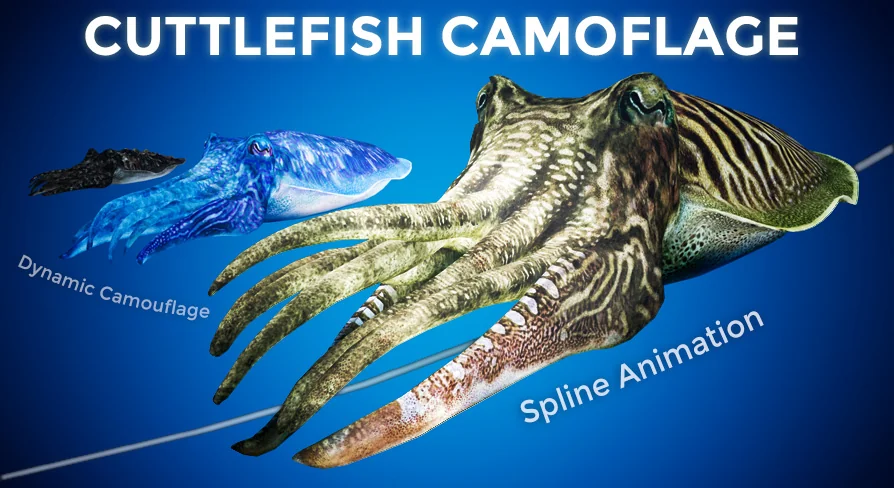
At the center of this setup is a reactive skin transition system governed directly by physical materials assigned to scene geometry. Rather than relying on simple proximity checks or manual animation tracks, the cuttlefish blueprint actively reads the specific physics materials assigned to surfaces resting directly beneath the creature. This data is mapped directly to variables inside the blueprint, allowing the creature's epidermal appearance to morph smoothly as it glides from one environmental layer to the next.
Fine-tuning this transition requires granular control over how and when the shifting begins. The blueprint gives developers control over several specific numerical thresholds:
Detection Distance: Governs how far away a surface can be before the creature acknowledges the incoming terrain, ensuring shifts do not occur abruptly or prematurely.
Starting Distance for Transformations: Dictates the exact operational threshold where the skin transition begins blending between patterns.
Evolution Speed: Sets the rate at which the camouflage pattern transforms across the body, letting you simulate instantaneous adaptive shifts or slow, gradual fades.
Physical Material Linking: Lets users redefine or remap which physical materials trigger particular skin profiles, integrating custom landscape layers or unique prop shaders.
Swimming Animation Speed: Permits timing tweaks to the propulsion cycles so fin undulations match the speed of movement across the seabed.
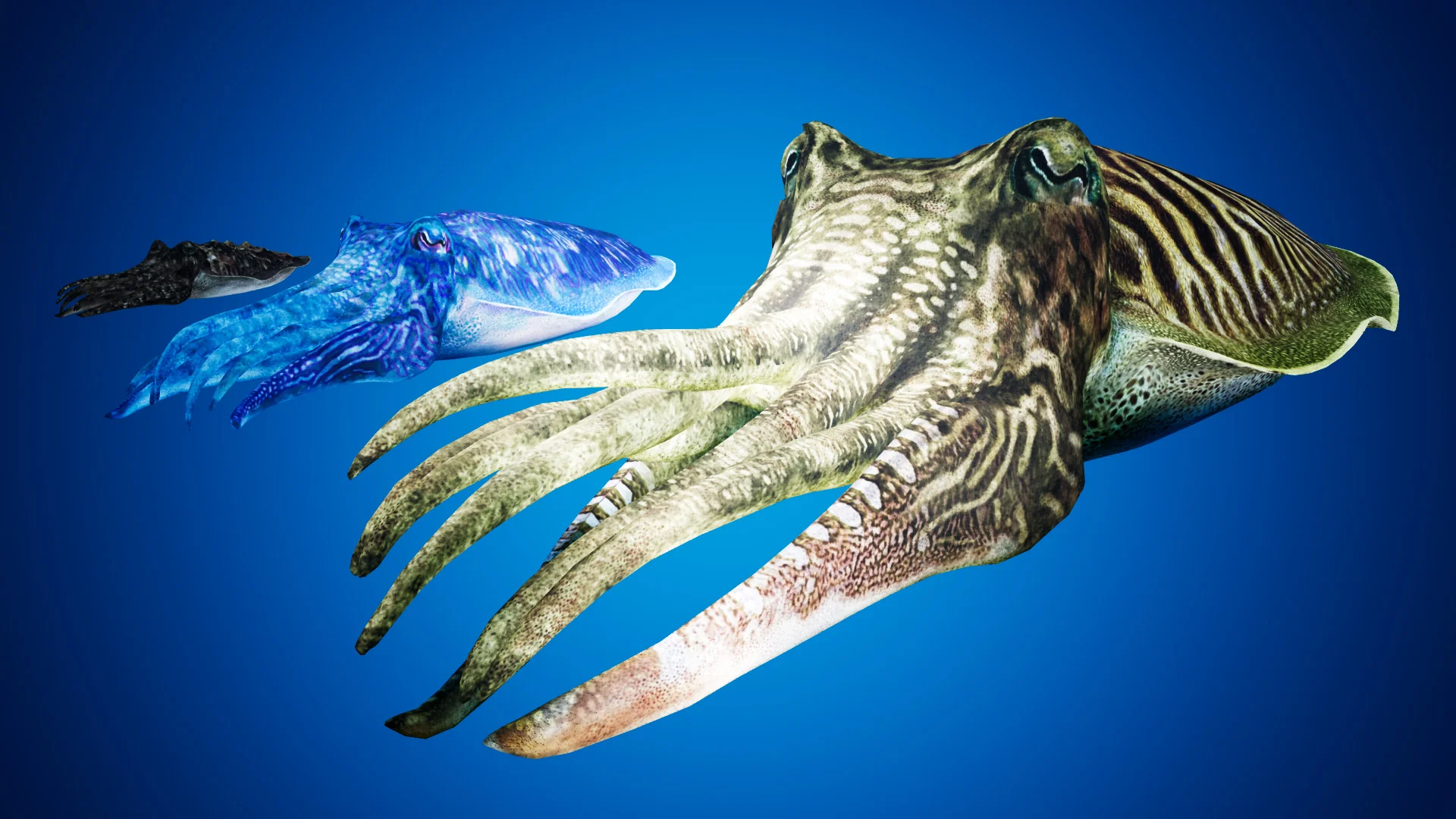
To match these programmatic controls, the package provides detailed Material Instances tailored to adjust three distinct camouflage types. This allows the creature to convincingly blend with bright sandy ground, darker rocky formations, and textured benthic layers without needing entirely separate mesh configurations.
Procedural Camouflage Behavior Along Spline Pathways
Navigating an organic underwater space requires movement paths that bypass rigid, linear tracks. The included procedural spline animation system directs the creature along fluid paths that reflect natural swimming dynamics. By adjusting spline curves through an environment, you define fluid patrol routes that send the creature skimming inches above jagged rocks or rising toward the open surface.
Because the spline locomotion is tethered directly to the underlying detection routines, the animal can weave across varying surface types in a single continuous swimming loop. As the cuttlefish glides over a rock formation, its skin adapts to the assigned rock physical material. When the spline carries the creature across an expanse of sand, the transformation speed and starting distance parameters ensure that the coloration blends into a sand-appropriate pattern before the animal fully clears the transition zone. This continuous sampling eliminates visual popping and maintains continuity throughout extended camera shots.
Evaluating Cuttlefish Mesh Variants and Performance Modes
Balancing computational expense against interactive visual detail is a primary challenge in underwater simulations. To support diverse production requirements, the package supplies two distinct pipeline options for rendering and animating the animal.
The first option is a standard skeletal mesh equipped with a swimming animation cycle and a dedicated Physics Asset. This setup is built for scenes requiring physical interaction, environmental collisions, or ragdoll effects upon impact. If a project demands that a cuttlefish react dynamically to environmental forces, external actors, or sudden momentum shifts, the skeletal and physics asset configuration delivers the necessary structural realism.
The second option delivers a vertex-animated mesh paired with its own specialized Blueprint. This implementation trades complex skeletal bone evaluations for raw performance, making it practical when populating dense underwater scenes with multiple marine organisms. The vertex-animated asset is designed to be compatible with the Fish School System, allowing developers to integrate these creatures into broad flocking simulations without incurring the heavy CPU overhead typical of multiple active skeletal rigs. Both mesh configurations are built with three levels of detail (3 LODs), preserving visual fidelity during tight close-ups while aggressively reducing rendering strain as the creatures move into the distance.
The Accompanying Ocean Environment and Demonstration Setup
Understanding how the material logic, spline paths, and visual systems interact is simplified by an included demonstration ocean environment. This scene contains practical examples of both standard skeletal and vertex-animated implementations moving along established paths.
The staging area is constructed with dedicated Sand and Rock Materials paired with a modular Rock Static Mesh, illustrating how physics materials should be assigned to world props. In addition to geometry, the demo space features a complete underwater atmosphere consisting of:
Caustic lighting that simulates sunlight refracting through moving surface water.
Underwater post-process settings that calibrate light transmission and water clarity.
Volumetric and environmental fog configurations to establish proper underwater depth falloff.
Depth of field values tuned specifically for subaquatic vistas, softening distant terrain while keeping focal foreground elements sharp.
This contextual environment serves as a functional testbed where you can immediately observe how detection distance, surface physical materials, and caustic lighting interplay on the three camouflage material variants.
Selecting the Right Integration for Production
Deploying this creature pack successfully depends on matching the mesh type to your technical targets. For cinematic sequences, high-detail hero close-ups, or interactive encounters where physical collisions and ragdoll states are mandatory, the skeletal mesh with its dedicated Physics Asset is the appropriate route. It maximizes graphical feedback, maintains skeletal deformation fidelity, and reacts naturally to physics events.
When the priority shifts toward broad environmental dressing, background life, or schooling behaviors alongside other marine fauna like fish, sharks, squid, jellyfish, or whales, the vertex-animated mesh is the logical choice. It retains the reactive camouflage properties and 3 LOD structures while significantly minimizing animation evaluation overhead, fitting neatly into large-scale ocean simulations.
 Characters
 Characters
 Characters
 Characters