"82ee98b2ee2793f1"{"id":"1002419","slug":"animalia-rat","title":"Animalia - Rat","category":"Characters \u0026 Creatures","engine":"4.12+,5.0+","assetVersion":"","engineVersion":"Engine Version: 4.12+,5.0+","tag":"Characters","accent":"blue","visual":"character","summary":"A close technical look at Animalia - Rat, featuring 60 fps animations, dual root-motion workflows, 2K textures, gFur support, and full DCC rigs.","platform":"Unreal Engine","indexPolicy":"index","publishedAt":"2026-11-10T18:09:48.713Z","updatedAt":"2026-11-10T18:09:48.713Z","sourceNotes":[],"fileContents":[],"compatibility":["Unreal Engine","Engine Version: 4.12+,5.0+"],"featuredImage":{"alt":"Animalia - Rat","src":"/wp-content/uploads/published/2026/11/29b9a6c97842-83907b08-259b-4708-b853-fe43dc26352b-0abcb383f7.webp"},"hasDownloadLink":true,"downloads":0,"terms":[{"taxonomy":"category","slug":"characters-and-creatures","name":"Characters \u0026 Creatures"}],"galleryImages":[{"src":"/wp-content/uploads/published/2026/11/4d3e99140e77-a6bf89ae-f0e6-49ce-bc06-59bf5d294e68-292200c811.webp","alt":"Animalia - Rat"},{"src":"/wp-content/uploads/published/2026/11/de75167d2914-27af332e-f911-4b7b-8fca-268f223d03d9-851c700c8d.webp","alt":"Animalia - Rat"},{"src":"/wp-content/uploads/published/2026/11/21d1c21ffa8c-86a11fda-861e-49c0-959a-dac3c07be469-cf401c3713.webp","alt":"Animalia - Rat"},{"src":"/wp-content/uploads/published/2026/11/96bc35e0f6e3-8bb38cc0-79d7-45ff-aca2-61d7d466502b-71d45252ca.webp","alt":"Animalia - Rat"},{"src":"/wp-content/uploads/published/2026/11/58491f0ba384-78aa9bfe-f97e-45ab-a937-f8ac31d8e90b-290275aba0.webp","alt":"Animalia - Rat"}],"accessPanel":{"kind":"resource","title":"Get this resource","eyebrow":"Free resource","message":"Download this resource in your browser.","fileName":"Content.7z","safetyNote":"Resources are manually reviewed before listing to improve quality and reduce obvious risks.","actionLabel":"Get this resource","resourceType":"Resource archive","versions":[]},"contentHtml":"\u003ch2\u003ePopulating Grimy Backdrops with Animalia Rat Behaviors\u003c/h2\u003e\u003cp\u003eSmall fauna often presents an annoying production hurdle in world-building. Grounding an urban gutter, a medieval larder, or a decaying subterranean tunnel requires believable ambient life, yet building tiny quadruped creatures from scratch consumes disproportionate amounts of rigging and animation time.\u003c/p\u003e\u003cp\u003eAnimalia - Rat addresses this gap by offering a dedicated realistic rat model tuned for real-time creature behavior. Built specifically as a quadruped animal asset, the package delivers ready-to-run motion sets and mesh setups that fit straight into level decoration, interactive AI encounters, or environmental background clutter. Because small quadrupeds exhibit rapid, distinct kinetic patterns, every animation in the package has been authored at 60 frames per second. This high capture rate preserves the brisk footfalls, rapid twitches, and micro-movements characteristic of rodents, avoiding the temporal stuttering or stepped interpolation that often occurs when downsampling fast-moving small limbs to lower frame rates.\u003c/p\u003e\u003ch2\u003eDual Motion Sets and 60 FPS Authoring on the Rat Rig\u003c/h2\u003e\u003cp\u003eLocomotion engineering usually forces artists to choose early between in-place motion graphs and full root-driven simulation.\u003c/p\u003e\u003cp\u003eAnimalia - Rat circumvents this dilemma by supplying all animations in two distinct configurations: with root motion and without root motion. When deploying rats as ambient non-player characters driven by an engine navigation mesh or dynamic pathfinding nodes, the in-place iterations allow movement speed, acceleration curves, and steering behaviors to remain strictly governed by code. Conversely, when cinematic sequences or tight platform-level interactions require absolute alignment between foot placement and velocity, the root motion versions track physical movement directly against world space. Refinements introduced in version 2.3.1 explicitly corrected the root motion implementation inside turn animations, guaranteeing smooth turning arcs without displacement snapping or unintended foot sliding during directional transitions.\u003c/p\u003e\u003cp\u003eIdle behaviors benefit from dedicated feeding actions introduced in revision 2.4.0, which incorporated three distinct eating animations. These additions allow level designers to scatter rats near food stores, garbage piles, or carcass props without relying solely on looping rest postures or erratic running cycles. The expanded motion repertoire ensures that clusters of rats can carry out realistic forage routines while idling inside game zones.\u003c/p\u003e\u003ch2\u003eShading, 2K Resolution, and gFur Layering\u003c/h2\u003e\u003cp\u003eVisual fidelity on small creatures depends heavily on how hair surfaces catch edge light, yet complex grooming pipelines frequently introduce engine overhead.\u003c/p\u003e\u003cp\u003eThe asset balances visual detail and texture memory by utilizing a dedicated 2K texture set. At 2048x2048 resolution, the surface maps preserve skin folds, ear translucency cues, claw details, and hair grain across close-up camera angles without demanding the memory footprints of oversized texture sets. This makes the rodent model light enough to instance across broad scenes while retaining surface sharpness when an in-game camera focuses directly on a feeding or moving subject.\u003c/p\u003e\u003cp\u003eFor projects requiring tangible fur volume, the package includes dedicated gFur support. While gFur can be obtained for free within Unreal Engine 5 to generate dense strand silhouettes and responsive fur meshes, the asset does not require the gFur plugin to function. Projects running conventional mesh pipelines can bypass external plugins entirely, rendering the underlying textured mesh without breaking dependencies or causing missing-shader errors. Level of Detail (LOD) steps are built into the model hierarchy, ensuring that distant rodents step down in geometric density to preserve rendering budgets during busy scenes.\u003c/p\u003e\u003ch2\u003eExternal Rigging Pipelines in Maya and 3ds Max\u003c/h2\u003e\u003cp\u003eProduction studios frequently need to modify base animations or author scripted cutscenes that cannot be assembled solely using standard engine blendspaces.\u003c/p\u003e\u003cp\u003eTo support full digital content creation pipelines outside the engine, Animalia - Rat provides native animation rigs for both Autodesk Maya and 3ds Max. Technical animators can open these source rigs directly within their primary DCC software to keyframe specialized interactions, adjust skin weights, or generate bespoke narrative performances. Having matched rigs in both standard industry tools eliminates the reverse-engineering process of importing raw skeleton meshes back from FBX files, allowing character animators to work with complete controller hierarchies, pole vectors, and constraint systems natively.\u003c/p\u003e\u003cp\u003eModernized through updates starting from Unreal Engine 4.24 and up, the underlying skeletal hierarchy matches current engine standards. This ensures that custom clips animated in Maya or 3ds Max can be re-exported cleanly into modern project iterations without axis orientation mismatches or scale distortions across the skeletal chain.\u003c/p\u003e\u003ch2\u003eSimulating Impacts and Animalia Prey Ecosystems\u003c/h2\u003e\u003cp\u003ePhysical interaction forms the second half of believable wildlife design, especially when rodents serve as reactive elements in combat zones or environmental hazards.\u003c/p\u003e\u003cp\u003eThe package includes a tailored ragdoll setup, enabling real-time physics bodies to take over instantaneously upon weapon impacts, trap triggers, or ledge falls. Rather than snapping into canned defeat sequences, the skeletal mesh transitions into dynamic physical collision, reacting naturally to slopes, environmental props, and terrain geometry. This physical responsiveness makes the rat an effective interactive asset for gameplay where vermin can be kicked, hunted, or startled by player movement.\u003c/p\u003e\u003cp\u003eFor broader natural ecosystem staging, the asset carries direct compatibility notes alongside Animalia - Bald and Golden Eagle. Because predatory avian behavior requires tangible prey meshes to target, track, and seize, the rat fits seamlessly as a grounded target within wildlife simulation scenes. Whether placed beneath an eagle's perch in a forested clearing or scattered across an industrial alleyway, Animalia - Rat operates as a robust quadruped asset that handles ambient feeding, procedural navmesh running, high-framerate motion, and dynamic physical collapses out of the box.\u003c/p\u003e\n\n\u003ch2\u003eRelated Resources Worth Checking\u003c/h2\u003e\n\u003cul\u003e\n\u003cli\u003e\u003ca href=\"https://3dcghub.com/animalia-brown-bear-male/\" rel=\"noopener noreferrer\"\u003eAnimalia - Brown Bear (male)\u003c/a\u003e\u003c/li\u003e\n\u003cli\u003e\u003ca href=\"https://3dcghub.com/animalia-ladybug/\" rel=\"noopener noreferrer\"\u003eAnimalia - Ladybug\u003c/a\u003e\u003c/li\u003e\n\u003cli\u003e\u003ca href=\"https://3dcghub.com/animalia-lion-male/\" rel=\"noopener noreferrer\"\u003eAnimalia - Lion (male)\u003c/a\u003e\u003c/li\u003e\n\u003cli\u003e\u003ca href=\"https://3dcghub.com/animalia-gray-wolf-young/\" rel=\"noopener noreferrer\"\u003eAnimalia - Gray Wolf (young)\u003c/a\u003e\u003c/li\u003e\n\u003cli\u003e\u003ca href=\"https://3dcghub.com/animalia-raccoon/\" rel=\"noopener noreferrer\"\u003eAnimalia - Raccoon\u003c/a\u003e\u003c/li\u003e\n\u003c/ul\u003e","contentTextLength":6491,"navigation":{"current":31,"total":4372,"previous":{"id":"1002420","slug":"animalia-wild-boar-young","title":"Animalia - Wild Boar (young)","category":"Characters \u0026 Creatures","platform":"Unreal Engine","updatedAt":"2026-11-10T18:10:25.416Z"},"next":{"id":"1002418","slug":"animalia-brown-bear-male","title":"Animalia - Brown Bear (male)","category":"Characters \u0026 Creatures","platform":"Unreal Engine","updatedAt":"2026-11-10T18:09:05.262Z"}},"relatedResources":[{"id":"1002436","slug":"mutant-rat-mouse","title":"Mutant Rat Mouse","category":"Characters \u0026 Creatures","engine":"4.20+,5.0+","assetVersion":"","engineVersion":"Engine Version: 4.20+,5.0+","tag":"Characters","accent":"blue","visual":"character","summary":"Explore the Mutant Rat Mouse asset package, featuring raw FBX meshes, 11 combat animations, a 4096x4096 diffuse texture, and multi-role gameplay flexibility.","platform":"Unreal Engine","indexPolicy":"index","publishedAt":"2026-11-10T18:31:52.675Z","updatedAt":"2026-11-10T18:31:52.675Z","sourceNotes":[],"fileContents":[],"compatibility":["Unreal Engine","Engine Version: 4.20+,5.0+"],"featuredImage":{"alt":"Mutant Rat Mouse","src":"/wp-content/uploads/published/2026/11/a4253623c018-dfa609bb-fc7a-4485-866a-25be88271a63-7251fa4fa1.webp"},"hasDownloadLink":true,"downloads":0},{"id":"1002420","slug":"animalia-wild-boar-young","title":"Animalia - Wild Boar (young)","category":"Characters \u0026 Creatures","engine":"4.20+,5.0+","assetVersion":"","engineVersion":"Engine Version: 4.20+,5.0+","tag":"Characters","accent":"blue","visual":"character","summary":"Realistic young wild boar asset featuring 60 fps animations, root motion options, Maya and 3ds Max CAT rigs, 4K textures, LODs, and ragdoll setups.","platform":"Unreal Engine","indexPolicy":"index","publishedAt":"2026-11-10T18:10:25.416Z","updatedAt":"2026-11-10T18:10:25.416Z","sourceNotes":[],"fileContents":[],"compatibility":["Unreal Engine","Engine Version: 4.20+,5.0+"],"featuredImage":{"alt":"Animalia - Wild Boar (young)","src":"/wp-content/uploads/published/2026/11/b285935029f6-6d4de84c-4135-462d-a680-40ea204955aa-72b2c6b0a5.webp"},"hasDownloadLink":true,"downloads":0},{"id":"1002418","slug":"animalia-brown-bear-male","title":"Animalia - Brown Bear (male)","category":"Characters \u0026 Creatures","engine":"4.12+,5.0+","assetVersion":"","engineVersion":"Engine Version: 4.12+,5.0+","tag":"Characters","accent":"blue","visual":"character","summary":"Detailed look at the Animalia male Brown Bear package featuring 60 fps animations, 4K textures, gFur support, Maya and 3ds Max rigs, and LODs.","platform":"Unreal Engine","indexPolicy":"index","publishedAt":"2026-11-10T18:09:05.262Z","updatedAt":"2026-11-10T18:09:05.262Z","sourceNotes":[],"fileContents":[],"compatibility":["Unreal Engine","Engine Version: 4.12+,5.0+"],"featuredImage":{"alt":"Animalia - Brown Bear (male)","src":"/wp-content/uploads/published/2026/11/d6b4a6e44202-82d7f659-7eaf-4bdf-aa24-2bad42a4a585-233ed26633.webp"},"hasDownloadLink":true,"downloads":0}]}
Characters
Animalia - Rat
A close technical look at Animalia - Rat, featuring 60 fps animations, dual root-motion workflows, 2K textures, gFur support, and full DCC rigs.
Populating Grimy Backdrops with Animalia Rat Behaviors
Small fauna often presents an annoying production hurdle in world-building. Grounding an urban gutter, a medieval larder, or a decaying subterranean tunnel requires believable ambient life, yet building tiny quadruped creatures from scratch consumes disproportionate amounts of rigging and animation time.
Animalia - Rat addresses this gap by offering a dedicated realistic rat model tuned for real-time creature behavior. Built specifically as a quadruped animal asset, the package delivers ready-to-run motion sets and mesh setups that fit straight into level decoration, interactive AI encounters, or environmental background clutter. Because small quadrupeds exhibit rapid, distinct kinetic patterns, every animation in the package has been authored at 60 frames per second. This high capture rate preserves the brisk footfalls, rapid twitches, and micro-movements characteristic of rodents, avoiding the temporal stuttering or stepped interpolation that often occurs when downsampling fast-moving small limbs to lower frame rates.
Dual Motion Sets and 60 FPS Authoring on the Rat Rig
Locomotion engineering usually forces artists to choose early between in-place motion graphs and full root-driven simulation.
Animalia - Rat circumvents this dilemma by supplying all animations in two distinct configurations: with root motion and without root motion. When deploying rats as ambient non-player characters driven by an engine navigation mesh or dynamic pathfinding nodes, the in-place iterations allow movement speed, acceleration curves, and steering behaviors to remain strictly governed by code. Conversely, when cinematic sequences or tight platform-level interactions require absolute alignment between foot placement and velocity, the root motion versions track physical movement directly against world space. Refinements introduced in version 2.3.1 explicitly corrected the root motion implementation inside turn animations, guaranteeing smooth turning arcs without displacement snapping or unintended foot sliding during directional transitions.
Idle behaviors benefit from dedicated feeding actions introduced in revision 2.4.0, which incorporated three distinct eating animations. These additions allow level designers to scatter rats near food stores, garbage piles, or carcass props without relying solely on looping rest postures or erratic running cycles. The expanded motion repertoire ensures that clusters of rats can carry out realistic forage routines while idling inside game zones.
Shading, 2K Resolution, and gFur Layering
Visual fidelity on small creatures depends heavily on how hair surfaces catch edge light, yet complex grooming pipelines frequently introduce engine overhead.
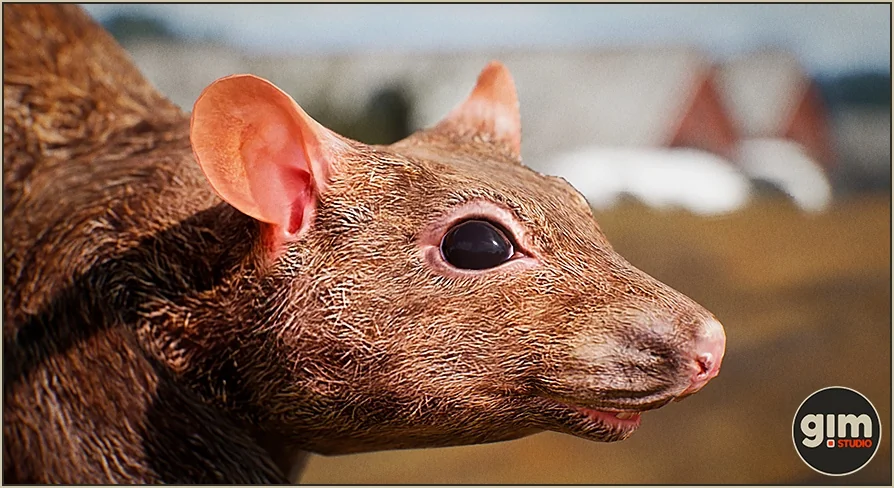
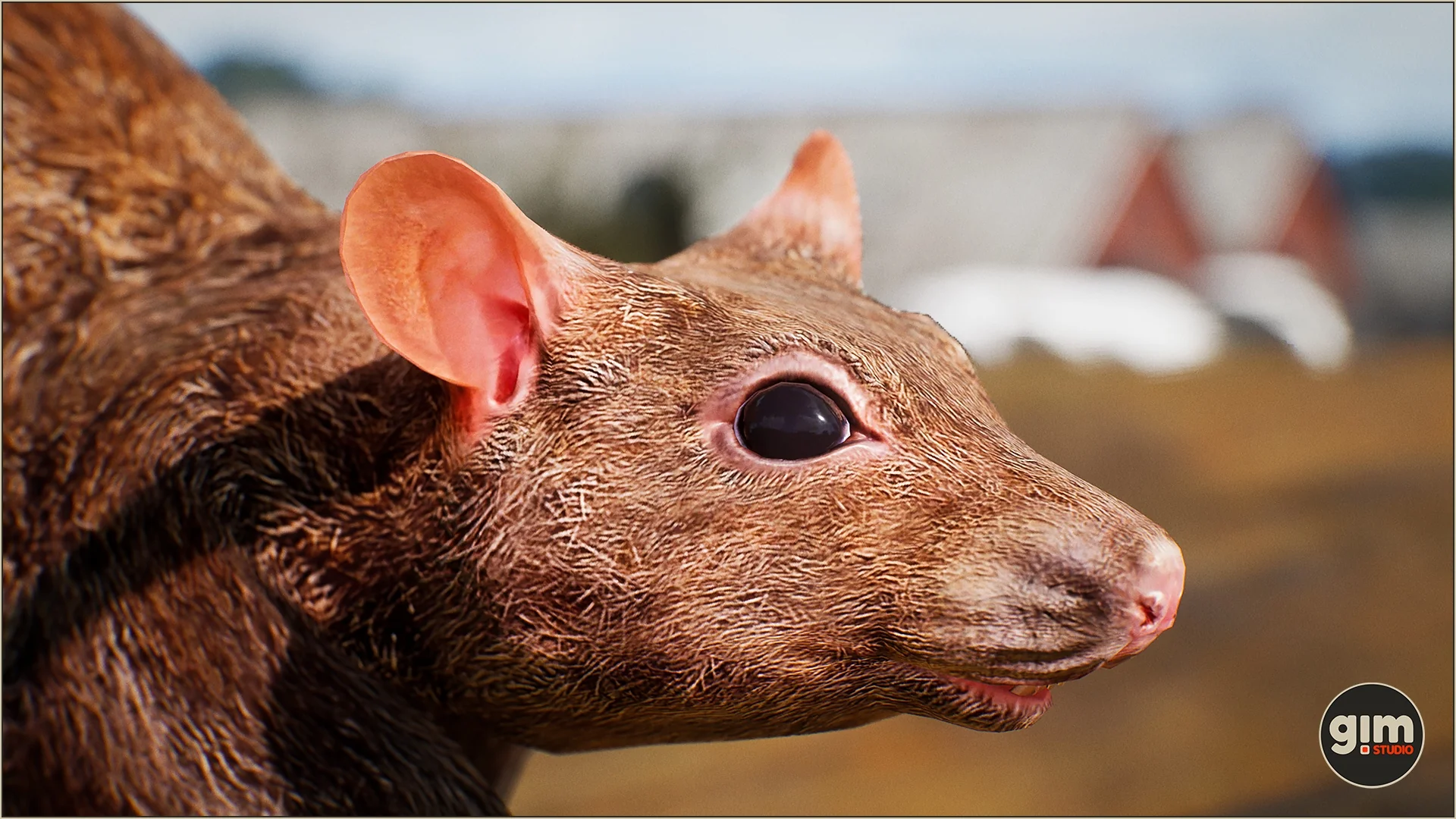
The asset balances visual detail and texture memory by utilizing a dedicated 2K texture set. At 2048x2048 resolution, the surface maps preserve skin folds, ear translucency cues, claw details, and hair grain across close-up camera angles without demanding the memory footprints of oversized texture sets. This makes the rodent model light enough to instance across broad scenes while retaining surface sharpness when an in-game camera focuses directly on a feeding or moving subject.
For projects requiring tangible fur volume, the package includes dedicated gFur support. While gFur can be obtained for free within Unreal Engine 5 to generate dense strand silhouettes and responsive fur meshes, the asset does not require the gFur plugin to function. Projects running conventional mesh pipelines can bypass external plugins entirely, rendering the underlying textured mesh without breaking dependencies or causing missing-shader errors. Level of Detail (LOD) steps are built into the model hierarchy, ensuring that distant rodents step down in geometric density to preserve rendering budgets during busy scenes.
External Rigging Pipelines in Maya and 3ds Max
Production studios frequently need to modify base animations or author scripted cutscenes that cannot be assembled solely using standard engine blendspaces.
To support full digital content creation pipelines outside the engine, Animalia - Rat provides native animation rigs for both Autodesk Maya and 3ds Max. Technical animators can open these source rigs directly within their primary DCC software to keyframe specialized interactions, adjust skin weights, or generate bespoke narrative performances. Having matched rigs in both standard industry tools eliminates the reverse-engineering process of importing raw skeleton meshes back from FBX files, allowing character animators to work with complete controller hierarchies, pole vectors, and constraint systems natively.
Modernized through updates starting from Unreal Engine 4.24 and up, the underlying skeletal hierarchy matches current engine standards. This ensures that custom clips animated in Maya or 3ds Max can be re-exported cleanly into modern project iterations without axis orientation mismatches or scale distortions across the skeletal chain.
Simulating Impacts and Animalia Prey Ecosystems
Physical interaction forms the second half of believable wildlife design, especially when rodents serve as reactive elements in combat zones or environmental hazards.
The package includes a tailored ragdoll setup, enabling real-time physics bodies to take over instantaneously upon weapon impacts, trap triggers, or ledge falls. Rather than snapping into canned defeat sequences, the skeletal mesh transitions into dynamic physical collision, reacting naturally to slopes, environmental props, and terrain geometry. This physical responsiveness makes the rat an effective interactive asset for gameplay where vermin can be kicked, hunted, or startled by player movement.
For broader natural ecosystem staging, the asset carries direct compatibility notes alongside Animalia - Bald and Golden Eagle. Because predatory avian behavior requires tangible prey meshes to target, track, and seize, the rat fits seamlessly as a grounded target within wildlife simulation scenes. Whether placed beneath an eagle's perch in a forested clearing or scattered across an industrial alleyway, Animalia - Rat operates as a robust quadruped asset that handles ambient feeding, procedural navmesh running, high-framerate motion, and dynamic physical collapses out of the box.
 Characters
 Characters
 Characters
 Characters