"7aa4acc705f0d80b"{"id":"1001986","slug":"concrete-hangar-v-1","title":"Concrete hangar v.1","category":"Buildings \u0026 Architecture","engine":"5.0+","assetVersion":"","engineVersion":"Engine Version: 5.0+","tag":"Buildings","accent":"blue","visual":"mech","summary":"Explore Concrete hangar v.1 for Unreal Engine 5.0+, featuring modular 20m geometry, Lumen, Nanite support, and three combinable damage variations.","platform":"Unreal Engine","publishedAt":"2026-10-24T14:32:18.069Z","updatedAt":"2026-10-24T14:32:18.069Z","sourceNotes":[],"fileContents":[],"compatibility":["Unreal Engine","Engine Version: 5.0+"],"featuredImage":{"alt":"Concrete hangar v.1","src":"/wp-content/uploads/published/2026/10/4ba8e7251ea7-fa877e0b-2176-41e6-98c3-6d1fcf0951db-1e3aad510e.webp"},"hasDownloadLink":true,"downloads":0,"terms":[{"taxonomy":"category","slug":"buildings-and-architecture","name":"Buildings \u0026 Architecture"}],"galleryImages":[{"src":"/wp-content/uploads/published/2026/10/9eb2468f67de-05f5e2cb-f090-4b33-a3bc-a0b2acd07838-3b51d1ca3a.webp","alt":"Concrete hangar v.1"},{"src":"/wp-content/uploads/published/2026/10/de880b0e3b1e-ea4fc569-99e4-42a6-9e98-e2a7d8bf6066-f006880a1c.webp","alt":"Concrete hangar v.1"},{"src":"/wp-content/uploads/published/2026/10/e15bd8faa166-ded0c988-e2cc-46d4-8ed9-7353d5e5855c-20c4fe61f0.webp","alt":"Concrete hangar v.1"},{"src":"/wp-content/uploads/published/2026/10/ec5e78e95b44-76018957-d9fa-4c4a-8874-b2ee11ab283a-db04ec19ed.webp","alt":"Concrete hangar v.1"},{"src":"/wp-content/uploads/published/2026/10/9f20e8d504c6-28ab1b99-737a-44d0-9c34-9b5d8067a1ef-9d42f957d0.webp","alt":"Concrete hangar v.1"},{"src":"/wp-content/uploads/published/2026/10/c3085cd94372-2485453a-4599-4725-a101-7bb7d577af42-c3adcdf293.webp","alt":"Concrete hangar v.1"},{"src":"/wp-content/uploads/published/2026/10/a66f6770ce48-7bae917d-452c-4d2f-b2a6-d09a419f0ebb-27d0368a64.webp","alt":"Concrete hangar v.1"},{"src":"/wp-content/uploads/published/2026/10/7bb2ddad6291-6420687f-aac3-4a62-8c19-103411fc3cb5-c37c2c37cf.webp","alt":"Concrete hangar v.1"},{"src":"/wp-content/uploads/published/2026/10/b248ba64e103-f5a31ed3-1b66-4d03-9a47-6b4c5722502e-02ebbca666.webp","alt":"Concrete hangar v.1"}],"accessPanel":{"kind":"resource","title":"Download this resource","eyebrow":"Free Download","message":"Log in or create a free account to start your download.","fileName":"Content.7z","safetyNote":"Resources are manually reviewed before listing to improve quality and reduce obvious risks.","actionLabel":"Download Free","resourceType":"Resource archive"},"contentHtml":"\u003ch2\u003eStaging Military and Industrial Shelters\u003c/h2\u003e\n\u003cp\u003eConstructing believable fortified installations, subterranean workshops, and aircraft shelters requires heavy structural forms that convey scale and physical weight. Enclosed concrete arches and protective bays frequently serve as the visual backbone for airbases, industrial transit zones, and fortified military compounds. Concrete hangar v.1 addresses these scene layouts by providing a modular structural shell shaped by a standardized 20-meter diameter curve. This measurement offers a defined internal clearance capable of accommodating large military equipment, maintenance rigs, or vehicle convoys while keeping the arched roofline structurally plausible.\u003c/p\u003e\n\u003cp\u003eBecause the structure is modular, level designers can repeat segments along an axis to build extended runways, segmented maintenance vaults, or isolated storage bays. The 20-meter diameter profile creates an immediate sense of structural volume, establishing an environment where light behaves realistically across curved vertical walls and arching ceiling spans.\u003c/p\u003e \u003ch2\u003eDamage States: Small Chips, Severe Erosion, and Fractures\u003c/h2\u003e\n\u003cp\u003ePoured concrete surfaces rarely age uniformly. In active zones, industrial wear, projectile impacts, weathering, and moisture seep into the material over different operational timelines. Concrete hangar v.1 supplies three specific physical variations to reflect these environmental shifts: small chips, severe erosion, and fractures.\u003c/p\u003e\n\u003cp\u003eThe small chips configuration reflects moderate surface distress, appropriate for facilities that remain structurally sound but exhibit signs of daily heavy operational use or early surface flaking along edge seams. Severe erosion models deeper surface decay, revealing coarse sub-layers, weathered textures, and rounded edges worn down by extended environmental exposure. The fractured variation introduces deeper structural ruptures, splitting sections of the concrete body to convey catastrophic impacts, structural failure, or prolonged seismic decay.\u003c/p\u003e\n\u003cp\u003eCrucially, these three damage profiles are combinable. Designers are not limited to presenting a structure that is entirely pristine or completely demolished. By combining modules that exhibit small chips with adjacent segments showing severe erosion or full structural fractures, an environment can tell a visual story of localized blast damage, weathering patterns concentrated near open exits, or structural fatigue focused along specific load-bearing segments.\u003c/p\u003e \u003ch2\u003eModular Assembly Across a 20-Meter Diameter Profile\u003c/h2\u003e\n\u003cp\u003eThe modular layout of the package simplifies the task of scaling military architecture across variable terrain. Centering the design on a fixed 20-meter diameter provides a uniform curvature that aligns cleanly across repeated sections. This predictable dimension enables level designers to block out deep underground transit tubes, airfield parking bays, or blast-resistant shelters without running into geometry mismatches between separate pieces.\u003c/p\u003e\n\u003cp\u003eSegmented installation allows for deliberate pacing within a level. A designer can assemble a long, continuous tunnel using sections with small chips to represent reinforced interior segments, then transition into fractured and heavily eroded arches near an exposed breach or entrance portal. Because the pieces assemble modularly, layouts can expand or contract to match the spatial requirements of specific gameplay zones, whether a project calls for a tight, self-contained bunker bay or a long aircraft service depot.\u003c/p\u003e \u003ch2\u003eTexture Customization Using Personal Libraries\u003c/h2\u003e\n\u003cp\u003eWhile the physical geometry provides the core silhouette and structural decay, surface identity often needs to match a project's wider visual direction. Textures on Concrete hangar v.1 can be replaced with any alternative sets from a personal library. This capability decouples the 3D meshes from a single static look, giving developers total control over final surface treatments.\u003c/p\u003e\n\u003cp\u003eSwapping materials allows the hangar structure to blend into radically different environmental biomes. Loading smooth, dry aggregate textures adapts the modules for arid desert outposts or modern proving grounds. Applying water-stained, moss-covered, or oil-slicked concrete materials shifts the same geometry into an abandoned Cold War facility or a damp subterranean silo. Teams working with proprietary concrete shaders can route their existing surface libraries directly onto these modules without breaking the underlying form.\u003c/p\u003e \u003ch2\u003eNanite and Lumen Illumination in Unreal Engine 5.0+\u003c/h2\u003e\n\u003cp\u003eThe package supports Nanite for Unreal Engine 5.0 and above, allowing the detailed geometry of small chips, rough erosion cavities, and sharp fracture borders to render directly without relying solely on normal maps to simulate depth. Nanite streams dense geometric detail on demand, maintaining crisp silhouettes along the edges of broken concrete segments whether the camera is inspecting a hairline fissure up close or viewing an entire 20-meter vaulted hangar from a distance.\u003c/p\u003e\n\u003cp\u003eReal-time global illumination and reflection workflows are facilitated by native Lumen support in Unreal Engine 5.0+. Large curved enclosures pose unique lighting conditions, where direct light entering from blast doors or fractured ceiling apertures must bounce smoothly across the concrete curve to illuminate recessed bays. Lumen calculates these indirect bounces against the hangar's curved profile, producing realistic soft shadows beneath structural ledges, inside deep erosion crevices, and across fractured cracks.\u003c/p\u003e \u003ch2\u003eCross-Asset Pipeline Alignment with Concrete Debris v.1\u003c/h2\u003e\n\u003cp\u003eCohesion across 3D environment art relies on uniform production standards. The assets in this line are built following a single unified pipeline, ensuring that surface scale, structural proportions, and modeling workflows align smoothly across multiple releases. This asset complements Concrete debris v.1, allowing fractured hangar segments to transition naturally into piles of collapsed, loose rubble on the floor.\u003c/p\u003e\n\u003cp\u003eWhen assembling a collapsed section of a concrete vault, placing the fractured hangar pieces alongside matching debris elements ensures that edge treatments, rock densities, and material scales remain identical. This shared workflow eliminates visual discrepancies between static architectural shells and scattered ground clutter.\u003c/p\u003e\n\u003cp\u003eLevel designers, technical artists, and environment creators building military airfields, defensive fortifications, or ruined industrial complexes benefit directly from this asset. The combination of flexible damage variants, modular 20-meter curved segments, texture swappability, and native Unreal Engine 5.0+ rendering features provides an adaptable foundation for high-fidelity architectural staging.\u003c/p\u003e\n\n\u003ch2\u003eMore From The Same Workflow\u003c/h2\u003e\n\u003cul\u003e\n\u003cli\u003e\u003ca href=\"https://3dcghub.com/apocalyptic-office-props-vol1/\" title=\"Apocalyptic Office Props Vol1\"\u003eApocalyptic Office Props Vol1\u003c/a\u003e\u003c/li\u003e\n\u003cli\u003e\u003ca href=\"https://3dcghub.com/suburbs-vol-11-rugs-nanite-and-low-poly/\" title=\"Suburbs VOL.11 - Rugs (Nanite and Low Poly)\"\u003eSuburbs VOL.11 - Rugs (Nanite and Low Poly)\u003c/a\u003e\u003c/li\u003e\n\u003cli\u003e\u003ca href=\"https://3dcghub.com/lost-temple-vol-1-ancient-ruins/\" title=\"Lost Temple VOL.1 - Ancient Ruins\"\u003eLost Temple VOL.1 - Ancient Ruins\u003c/a\u003e\u003c/li\u003e\n\u003cli\u003e\u003ca href=\"https://3dcghub.com/ucreate-fractal-toolkit/\" title=\"UCreate - Fractal Toolkit\"\u003eUCreate - Fractal Toolkit\u003c/a\u003e\u003c/li\u003e\n\u003cli\u003e\u003ca href=\"https://3dcghub.com/post-apocalyptic-office/\" title=\"Post Apocalyptic Office\"\u003ePost Apocalyptic Office\u003c/a\u003e\u003c/li\u003e\n\u003c/ul\u003e","contentTextLength":6918,"navigation":{"current":4,"total":3925,"previous":{"id":"1001987","slug":"construction-site-modular-kit","title":"Construction site modular kit","category":"Buildings \u0026 Architecture","platform":"Unreal Engine","updatedAt":"2026-10-24T14:36:17.153Z"},"next":{"id":"1001985","slug":"compact-login-system","title":"Compact Login System","category":"Engine Tools","platform":"Unreal Engine","updatedAt":"2026-10-24T14:30:09.819Z"}},"relatedResources":[{"id":"1001790","slug":"apocalyptic-office-props-vol1","title":"Apocalyptic Office Props Vol1","category":"Buildings \u0026 Architecture","engine":"5.3+","assetVersion":"","engineVersion":"Engine Version: 5.3+","tag":"Buildings","accent":"blue","visual":"mech","summary":"Apocalyptic Office Props Vol1 brings realistic hospital and office assets into Unreal Engine 5.4 for post-apocalyptic and abandoned interior environments.","platform":"Unreal Engine","publishedAt":"2026-10-21T07:42:48.211Z","updatedAt":"2026-10-21T07:42:48.211Z","sourceNotes":[],"fileContents":[],"compatibility":["Unreal Engine","Engine Version: 5.3+"],"featuredImage":{"alt":"Apocalyptic Office Props Vol1","src":"/wp-content/uploads/published/2026/10/9319306b06ba-7da03850-c648-4a18-b50f-ddfdaa2f7a9a-82644ff2d2.webp"},"hasDownloadLink":true,"downloads":1},{"id":"1001459","slug":"suburbs-vol-11-rugs-nanite-and-low-poly","title":"Suburbs VOL.11 - Rugs (Nanite and Low Poly)","category":"Buildings \u0026 Architecture","engine":"5.1+","assetVersion":"","engineVersion":"Engine Version: 5.1+","tag":"Buildings","accent":"blue","visual":"mech","summary":"Explore Suburbs VOL.11 - Rugs featuring 30 Nanite and low-poly meshes, 4K channel-packed textures, master materials, and Lumen support in Unreal Engine.","platform":"Unreal Engine","publishedAt":"2026-10-08T01:04:12.761Z","updatedAt":"2026-10-08T01:04:12.761Z","sourceNotes":[],"fileContents":[],"compatibility":["Unreal Engine","Engine Version: 5.1+"],"featuredImage":{"alt":"Suburbs VOL.11 - Rugs (Nanite and Low Poly)","src":"/wp-content/uploads/published/2026/10/0586d3855e14-a9bb8f28-4c7f-4dd4-916f-6d288e7880b4-2b15276468.webp"},"hasDownloadLink":true,"downloads":1},{"id":"1001166","slug":"lost-temple-vol-1-ancient-ruins","title":"Lost Temple VOL.1 - Ancient Ruins","category":"Buildings \u0026 Architecture","engine":"5.0+","assetVersion":"","engineVersion":"Engine Version: 5.0+","tag":"Buildings","accent":"blue","visual":"mech","summary":"An architectural library of 91 modular Balinese stone meshes and photogrammetry sculptures created by Rendertale Artists for Unreal Engine 5.4.","platform":"Unreal Engine","publishedAt":"2026-09-16T13:47:47.064Z","updatedAt":"2026-09-16T13:47:47.064Z","sourceNotes":[],"fileContents":[],"compatibility":["Unreal Engine","Engine Version: 5.0+"],"featuredImage":{"alt":"Lost Temple VOL.1 - Ancient Ruins","src":"/wp-content/uploads/published/2026/09/0808c34dfd67-d317756b-ea0b-4514-88e7-e39dac67cd02-ad0279ed47.webp"},"hasDownloadLink":true,"downloads":2}]}
Buildings
Concrete hangar v.1
Explore Concrete hangar v.1 for Unreal Engine 5.0+, featuring modular 20m geometry, Lumen, Nanite support, and three combinable damage variations.
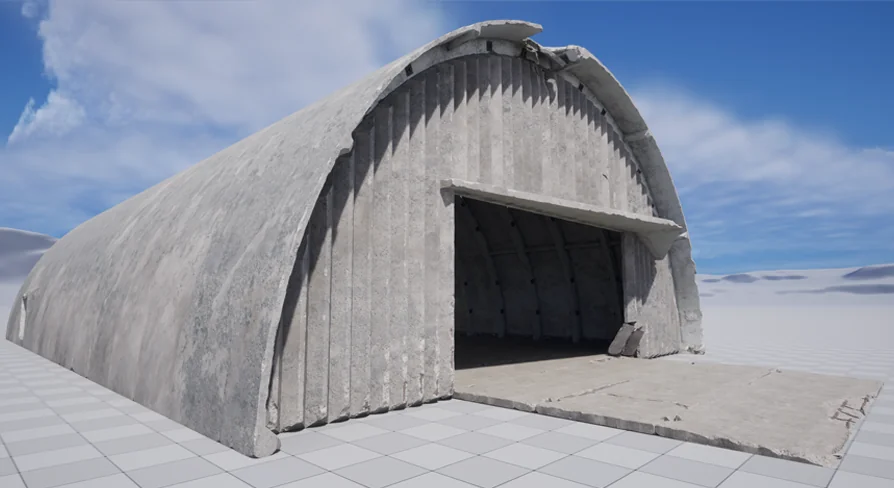
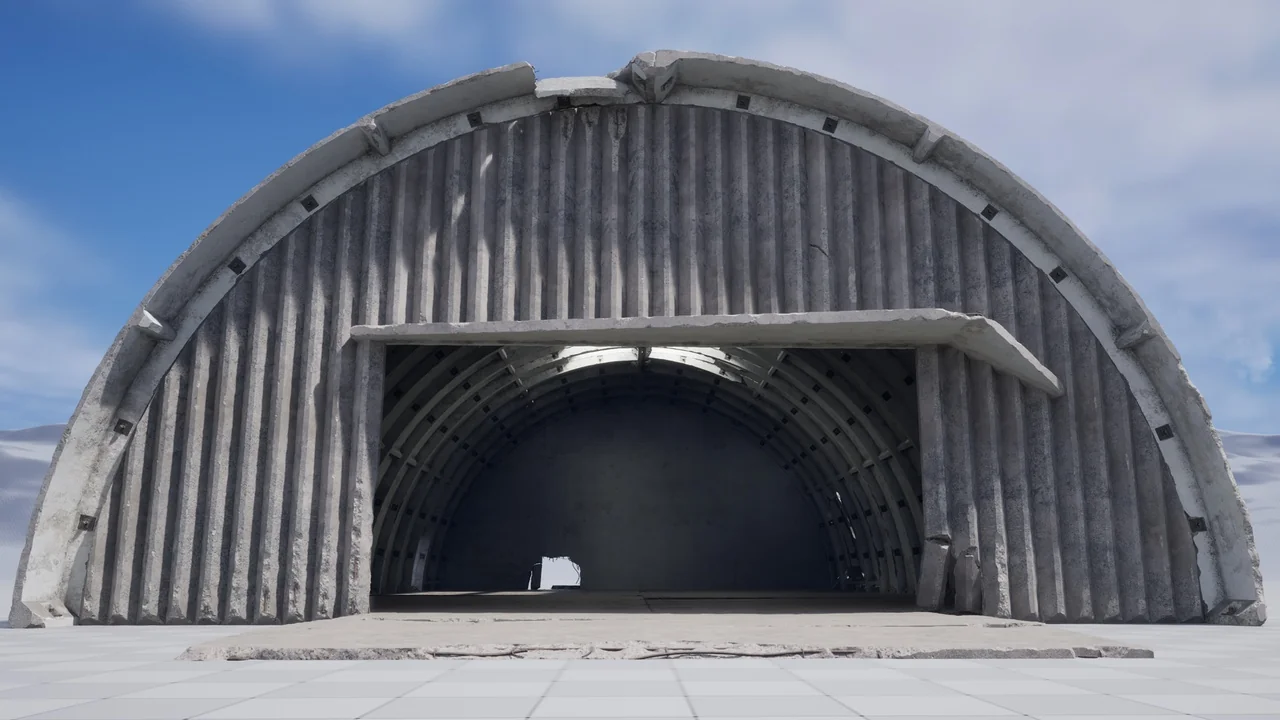
Constructing believable fortified installations, subterranean workshops, and aircraft shelters requires heavy structural forms that convey scale and physical weight. Enclosed concrete arches and protective bays frequently serve as the visual backbone for airbases, industrial transit zones, and fortified military compounds. Concrete hangar v.1 addresses these scene layouts by providing a modular structural shell shaped by a standardized 20-meter diameter curve. This measurement offers a defined internal clearance capable of accommodating large military equipment, maintenance rigs, or vehicle convoys while keeping the arched roofline structurally plausible.
Because the structure is modular, level designers can repeat segments along an axis to build extended runways, segmented maintenance vaults, or isolated storage bays. The 20-meter diameter profile creates an immediate sense of structural volume, establishing an environment where light behaves realistically across curved vertical walls and arching ceiling spans.
Damage States: Small Chips, Severe Erosion, and Fractures
Poured concrete surfaces rarely age uniformly. In active zones, industrial wear, projectile impacts, weathering, and moisture seep into the material over different operational timelines. Concrete hangar v.1 supplies three specific physical variations to reflect these environmental shifts: small chips, severe erosion, and fractures.
The small chips configuration reflects moderate surface distress, appropriate for facilities that remain structurally sound but exhibit signs of daily heavy operational use or early surface flaking along edge seams. Severe erosion models deeper surface decay, revealing coarse sub-layers, weathered textures, and rounded edges worn down by extended environmental exposure. The fractured variation introduces deeper structural ruptures, splitting sections of the concrete body to convey catastrophic impacts, structural failure, or prolonged seismic decay.
Crucially, these three damage profiles are combinable. Designers are not limited to presenting a structure that is entirely pristine or completely demolished. By combining modules that exhibit small chips with adjacent segments showing severe erosion or full structural fractures, an environment can tell a visual story of localized blast damage, weathering patterns concentrated near open exits, or structural fatigue focused along specific load-bearing segments.
Modular Assembly Across a 20-Meter Diameter Profile
The modular layout of the package simplifies the task of scaling military architecture across variable terrain. Centering the design on a fixed 20-meter diameter provides a uniform curvature that aligns cleanly across repeated sections. This predictable dimension enables level designers to block out deep underground transit tubes, airfield parking bays, or blast-resistant shelters without running into geometry mismatches between separate pieces.
Segmented installation allows for deliberate pacing within a level. A designer can assemble a long, continuous tunnel using sections with small chips to represent reinforced interior segments, then transition into fractured and heavily eroded arches near an exposed breach or entrance portal. Because the pieces assemble modularly, layouts can expand or contract to match the spatial requirements of specific gameplay zones, whether a project calls for a tight, self-contained bunker bay or a long aircraft service depot.
Texture Customization Using Personal Libraries
While the physical geometry provides the core silhouette and structural decay, surface identity often needs to match a project's wider visual direction. Textures on Concrete hangar v.1 can be replaced with any alternative sets from a personal library. This capability decouples the 3D meshes from a single static look, giving developers total control over final surface treatments.
Swapping materials allows the hangar structure to blend into radically different environmental biomes. Loading smooth, dry aggregate textures adapts the modules for arid desert outposts or modern proving grounds. Applying water-stained, moss-covered, or oil-slicked concrete materials shifts the same geometry into an abandoned Cold War facility or a damp subterranean silo. Teams working with proprietary concrete shaders can route their existing surface libraries directly onto these modules without breaking the underlying form.
Nanite and Lumen Illumination in Unreal Engine 5.0+
The package supports Nanite for Unreal Engine 5.0 and above, allowing the detailed geometry of small chips, rough erosion cavities, and sharp fracture borders to render directly without relying solely on normal maps to simulate depth. Nanite streams dense geometric detail on demand, maintaining crisp silhouettes along the edges of broken concrete segments whether the camera is inspecting a hairline fissure up close or viewing an entire 20-meter vaulted hangar from a distance.
Real-time global illumination and reflection workflows are facilitated by native Lumen support in Unreal Engine 5.0+. Large curved enclosures pose unique lighting conditions, where direct light entering from blast doors or fractured ceiling apertures must bounce smoothly across the concrete curve to illuminate recessed bays. Lumen calculates these indirect bounces against the hangar's curved profile, producing realistic soft shadows beneath structural ledges, inside deep erosion crevices, and across fractured cracks.
Cross-Asset Pipeline Alignment with Concrete Debris v.1
Cohesion across 3D environment art relies on uniform production standards. The assets in this line are built following a single unified pipeline, ensuring that surface scale, structural proportions, and modeling workflows align smoothly across multiple releases. This asset complements Concrete debris v.1, allowing fractured hangar segments to transition naturally into piles of collapsed, loose rubble on the floor.
When assembling a collapsed section of a concrete vault, placing the fractured hangar pieces alongside matching debris elements ensures that edge treatments, rock densities, and material scales remain identical. This shared workflow eliminates visual discrepancies between static architectural shells and scattered ground clutter.
Level designers, technical artists, and environment creators building military airfields, defensive fortifications, or ruined industrial complexes benefit directly from this asset. The combination of flexible damage variants, modular 20-meter curved segments, texture swappability, and native Unreal Engine 5.0+ rendering features provides an adaptable foundation for high-fidelity architectural staging.
 Buildings
 Buildings
 Buildings
 Buildings