"2596237520a17fbf"{"id":"1002904","slug":"cinematic-bike-rig-motorcycle-rigging-and-animation-blueprint","title":"Cinematic Bike Rig: Motorcycle Rigging \u0026 Animation Blueprint","category":"Procedural Systems","engine":"5.1+","assetVersion":"","engineVersion":"Engine Version: 5.1+","tag":"Procedural Systems","accent":"blue","visual":"animation","summary":"An in-depth look at the Cinematic Bike Rig Blueprint for Unreal Engine, delivering keyframe-driven motorcycle animation without physics simulation passes.","platform":"Unreal Engine","indexPolicy":"index","publishedAt":"2026-11-21T05:08:18.415Z","updatedAt":"2026-11-21T05:08:18.415Z","sourceNotes":[],"fileContents":[],"compatibility":["Unreal Engine","Engine Version: 5.1+"],"featuredImage":{"alt":"Cinematic Bike Rig: Motorcycle Rigging \u0026 Animation Blueprint","src":"/wp-content/uploads/published/2026/11/d830088f0b8b-8d03a49f-77ff-4d19-985d-8a70ad767bda-73bd2386f0.webp"},"fileSizeBytes":112086598,"hasDownloadLink":true,"downloads":0,"terms":[{"taxonomy":"category","slug":"procedural-systems","name":"Procedural Systems"}],"galleryImages":[{"src":"/wp-content/uploads/published/2026/11/04cbb9ac3585-38adfc5e-8df6-46c2-a0fb-03d5e5e43174-0e17fcc760.webp","alt":"Cinematic Bike Rig: Motorcycle Rigging \u0026 Animation Blueprint"},{"src":"/wp-content/uploads/published/2026/11/4a068c2d9c39-a4407487-5f6b-47a1-ac3c-f8173fd24ff8-76981ac177.webp","alt":"Cinematic Bike Rig: Motorcycle Rigging \u0026 Animation Blueprint"},{"src":"/wp-content/uploads/published/2026/11/8c056f58fd3f-402ed19c-1967-4b48-b23f-ec38e309e0d0-490a0da89e.webp","alt":"Cinematic Bike Rig: Motorcycle Rigging \u0026 Animation Blueprint"},{"src":"/wp-content/uploads/published/2026/11/e7f4e1702348-0c1cee44-e0d8-47ab-9db5-f5621bae57a1-e82b7be6bb.webp","alt":"Cinematic Bike Rig: Motorcycle Rigging \u0026 Animation Blueprint"},{"src":"/wp-content/uploads/published/2026/11/57c3537e4c21-93fd0ab3-9581-4af3-bf02-dd02b0d9a0ba-029f3e785f.webp","alt":"Cinematic Bike Rig: Motorcycle Rigging \u0026 Animation Blueprint"},{"src":"/wp-content/uploads/published/2026/11/e8bc81071450-8457b550-c4f0-4825-ae65-4447b6f5fe78-db3495ccdc.webp","alt":"Cinematic Bike Rig: Motorcycle Rigging \u0026 Animation Blueprint"},{"src":"/wp-content/uploads/published/2026/11/ca3d149c4eab-10881c74-40cb-44b8-8c13-996ee1d28b7d-00ee408075.webp","alt":"Cinematic Bike Rig: Motorcycle Rigging \u0026 Animation Blueprint"},{"src":"/wp-content/uploads/published/2026/11/80408620ec0f-c1a7cd6e-0468-47a8-a3d9-2c00b17305c1-989a3c516e.webp","alt":"Cinematic Bike Rig: Motorcycle Rigging \u0026 Animation Blueprint"}],"contentHtml":"\u003cp\u003eCinematic Bike Rig delivers a modular, physics-free motorcycle and motorbike rigging system constructed specifically for Unreal Engine. Instead of forcing artists to handle physics drivers, balance variables, or external simulation tools, the asset centers on direct keyframe manipulation inside Sequencer. The core package brings together custom static mesh swapping, dynamic procedural suspension springs, ground-tracing wheels with automatic spin, drift and lean controls, stunt posture keyframing, a dedicated spline path Blueprint, and a fully rigged off-road demo bike.\u003c/p\u003e \u003ch2\u003eCore Blueprint Modules and Custom Mesh Configuration\u003c/h2\u003e\n\u003cp\u003eAt the center of the setup is a modular architecture that breaks the motorcycle into distinct, configurable components. Rather than relying on a rigid, single-mesh hierarchy, the Blueprint lets artists slot in their own static meshes for individual bike elements. The main chassis body, front and rear wheels, suspension components, and steering forks exist as swappable pieces within the system. This allows projects to adapt the rig to various motorcycle types, ranging from urban sportbikes to rugged dirtbikes and custom motocross builds, without rebuilding skeletal structures from scratch.\u003c/p\u003e\n\u003cp\u003eTo demonstrate how these individual pieces assemble and behave, the package includes a fully rigged cross and off-road demo motorcycle. This demo vehicle illustrates how individual static meshes attach to the underlying transform logic, serving as a direct reference for replacing components with project-specific models. Because the framework is fully configurable, secondary decorative parts or specific mechanical linkages can be mounted to the main assemblies, ensuring the visual styling remains intact while retaining all underlying animation controls.\u003c/p\u003e \u003ch2\u003eGround-Adaptive Wheels and Physics-Free Suspension Mechanics\u003c/h2\u003e\n\u003cp\u003eMotorcycle wheels need to maintain reliable contact with uneven surfaces without collapsing under complex physics solvers. Cinematic Bike Rig achieves this through ground-adaptive wheel logic that uses continuous surface tracing. As the motorcycle navigates a scene, the system evaluates the terrain below each tire and conforms the wheel elevation directly to ground geometry. The wheels also calculate their own rotational rate automatically based on displacement, keeping tire spin synchronized with linear speed so animators do not need to manually dial in rolling speed curves.\u003c/p\u003e\n\u003cp\u003eSuspension movement operates through an internal spring system engineered to produce reactive shock absorption without running a physical simulation. Traditional vehicle tools like Chaos Vehicles rely on active physics worlds where unexpected terrain hitches can launch, flip, or jitter a two-wheeled vehicle. This spring setup acts dynamically and predictably, buffering elevation changes across rough ground surfaces while preserving complete scene stability. Surface interactions also incorporate collision detection with explicit object exclusion support, permitting animators to designate specific scene props or background meshes that the tracing passes should bypass during evaluation.\u003c/p\u003e \u003ch2\u003eKeyframing Stunts in Sequencer with the Cinematic Bike Rig\u003c/h2\u003e\n\u003cp\u003eCinematic workflows often conflict with real-time physics engines. In standard production passes, staging a motorcycle sequence frequently entails piloting a vehicle live, capturing erratic inputs through Take Recorder, and digging through playback takes to find usable motion. When vehicles drift out of control, animators often resort to artificial fixes like weighting down the center of gravity or hiding invisible stabilizer wheels. Cinematic Bike Rig eliminates that entire recording cycle by keeping every axis of motion accessible as a clean keyframe lane directly within Sequencer.\u003c/p\u003e\n\u003cp\u003eStunts and cornering behaviors that are notoriously difficult to stage in a live physics run become standard keyframed attributes. The rig exposes dedicated channels for pitch, roll, and drift angles, pairing manual drift offsets with automatic chassis leaning as turns occur. Wheelies and stoppies can be dialed in and held for exact frame counts, matching camera cuts and focal adjustments without risk of vehicle tipping. Because the rig requires no simulation run or physics bake, both the Unreal Engine viewport and the Sequencer timeline display real-time visual feedback instantly, showing the precise chassis attitude on any given frame.\u003c/p\u003e \u003ch2\u003eSpline Path Blueprint Traversal and Route Management\u003c/h2\u003e\n\u003cp\u003eFor choreographed traversal through environments, the package incorporates a specialized Spline Path Blueprint. Instead of hand-positioning the motorcycle across complex terrain frame by frame, animators can lay out a spline track through the level. The bike attaches to the path, utilizing automatic steering calculations that align the front forks and body orientation to the curve vectors of the spline. Forward progression is governed by keying the distance traveled along the track, giving exact control over pacing, acceleration, braking zones, and sudden stops.\u003c/p\u003e\n\u003cp\u003eBuilding track routes is accelerated by a tool that snaps individual spline points directly down onto underlying ground surfaces. If a sequence requires a turnaround or a vehicle moving against traffic, an instant direction reversal toggle shifts the travel trajectory without necessitating a spline rebuild. For closed tracks and racing circuits, the spline can be set to a closed loop. If the keyed travel distance exceeds the physical length of the spline, the system loops back to the start automatically, making it well-suited for repetitive background traffic loops or long circuit racing shots.\u003c/p\u003e \u003ch2\u003eEliminating External DCC Roundtrips in Movie and Animation Pipelines\u003c/h2\u003e\n\u003cp\u003eStaging intricate motorcycle stunts often pushes artists out of Unreal Engine and into external digital content creation software. Exporting camera plates, animating transforms elsewhere, and re-importing FBX or Alembic caches introduces friction and disrupts rapid shot iteration, especially when terrain revisions alter ground elevations. Operating completely inside Unreal Engine keeps the vehicle animation synchronized with live landscape edits, dynamic lighting passes, and active cinematic camera rigs.\u003c/p\u003e\n\u003cp\u003eWhether staging high-speed sportbike chases on asphalt, motocross hill climbs across jagged terrain, or stationary stunt maneuvers timed to narrative beats, the asset provides a clean pipeline for filmmakers and animators. By combining spline precision, keyable stunt parameters, and procedural ground tracing into a simulation-free Blueprint, Cinematic Bike Rig provides the tools necessary to execute predictable, shot-ready motorcycle cinematics on demand.\u003c/p\u003e\n\n\u003ch2\u003eExplore Similar Assets\u003c/h2\u003e\n\u003cul\u003e\n\u003cli\u003e\u003ca href=\"https://3dcghub.com/beefy-blackbirds-niagara-bird-system/\" rel=\"noopener noreferrer\"\u003eBeefy Blackbirds (Niagara Bird System)\u003c/a\u003e\u003c/li\u003e\n\u003cli\u003e\u003ca href=\"https://3dcghub.com/meta-foam/\" rel=\"noopener noreferrer\"\u003eMeta Foam\u003c/a\u003e\u003c/li\u003e\n\u003cli\u003e\u003ca href=\"https://3dcghub.com/cinematic-car-rig-ccr/\" rel=\"noopener noreferrer\"\u003eCinematic Car Rig (CCR)\u003c/a\u003e\u003c/li\u003e\n\u003cli\u003e\u003ca href=\"https://3dcghub.com/cinematic-fire/\" rel=\"noopener noreferrer\"\u003eCinematic Fire\u003c/a\u003e\u003c/li\u003e\n\u003cli\u003e\u003ca href=\"https://3dcghub.com/procedural-climbing-with-control-rig/\" rel=\"noopener noreferrer\"\u003eProcedural Climbing with Control Rig\u003c/a\u003e\u003c/li\u003e\n\u003c/ul\u003e","contentTextLength":6827,"navigation":{"current":20,"total":4839,"previous":{"id":"1002901","slug":"compact-email-service","title":"Compact Email Service [Email, Notification, Verification, Remote Config...]","category":"Engine Tools","platform":"Unreal Engine","updatedAt":"2026-11-21T05:22:33.129Z"},"next":{"id":"1002903","slug":"file-helper-plugin","title":"File Helper Plugin","category":"Engine Tools","platform":"Unreal Engine","updatedAt":"2026-11-21T04:50:02.963Z"}},"relatedResources":[{"id":"1001962","slug":"beefy-blackbirds-niagara-bird-system","title":"Beefy Blackbirds (Niagara Bird System)","category":"Procedural Systems","engine":"5.2+","assetVersion":"","engineVersion":"Engine Version: 5.2+","tag":"Procedural Systems","accent":"blue","visual":"mech","summary":"Configure stylized bird flocks in Unreal Engine 5.2 with Niagara particle simulation, WorldPositionOffset animation, and modular Blueprint behaviors.","platform":"Unreal Engine","indexPolicy":"index","publishedAt":"2026-10-24T11:38:57.939Z","updatedAt":"2026-10-24T11:38:57.939Z","sourceNotes":[],"fileContents":[],"compatibility":["Unreal Engine","Engine Version: 5.2+"],"featuredImage":{"alt":"Beefy Blackbirds (Niagara Bird System)","src":"/wp-content/uploads/published/2026/10/476c54916c49-5ea6c711-b7bb-42d8-a7ce-b262faede018-a232374bc2.webp"},"fileSizeBytes":7328648,"hasDownloadLink":true,"downloads":1},{"id":"1000646","slug":"meta-foam","title":"Meta Foam","category":"Procedural Systems","engine":"5.3+","assetVersion":"","engineVersion":"Engine Version: 5.3+","tag":"Procedural Systems","accent":"blue","visual":"mech","summary":"Meta Foam is a Blueprint-driven Unreal Engine system for realistic foam and bubble rendering using thin and thick modes, six presets, and a procedural Cinematic","platform":"Unreal Engine","indexPolicy":"index","publishedAt":"2026-07-21T17:47:33.872Z","updatedAt":"2026-07-21T17:47:33.872Z","sourceNotes":[],"fileContents":[],"compatibility":["Unreal Engine","Engine Version: 5.3+"],"featuredImage":{"alt":"Meta Foam","src":"/wp-content/uploads/published/2026/07/fd75f8ec081d-2c352051-58b7-4686-b860-9f0a68a13346-a27ba9c117.webp"},"fileSizeBytes":183717338,"hasDownloadLink":true,"downloads":1},{"id":"11305","slug":"cinematic-car-rig-ccr","title":"Cinematic Car Rig (CCR)","category":"Procedural Systems","engine":"5.1+","assetVersion":"Engine version: 5.1+","engineVersion":"Asset Version:2.1","tag":"Procedural Systems","accent":"blue","visual":"audio","summary":"The Cinematic Car Rig (CCR) offers a flexible and editable solution for automotive animation in Unreal Engine, moving beyond the limitations of physics-based simulations.","platform":"Unreal Engine","indexPolicy":"noindex","publishedAt":"2026-03-04T17:31:47.000Z","updatedAt":"2026-04-19T15:48:13.000Z","sourceNotes":[],"fileContents":[],"compatibility":["Unreal Engine","Engine version: 5.1+","Asset Version: 2.1"],"featuredImage":{"alt":"Cinematic Car Rig (CCR)","src":"https://3dcghub.com/wp-content/uploads/2026/03/952ef1e7-0b7d-46cc-a5da-45f69af1cdee-1.webp"},"fileSizeBytes":117993874,"hasDownloadLink":true,"downloads":2}]}
Resource screenshots
1 / 8
Join our channel
Follow 3DCGHUB on Telegram for new resource drops, migration updates, and community notices.
Cinematic Bike Rig: Motorcycle Rigging & Animation Blueprint
An in-depth look at the Cinematic Bike Rig Blueprint for Unreal Engine, delivering keyframe-driven motorcycle animation without physics simulation passes.
Cinematic Bike Rig delivers a modular, physics-free motorcycle and motorbike rigging system constructed specifically for Unreal Engine. Instead of forcing artists to handle physics drivers, balance variables, or external simulation tools, the asset centers on direct keyframe manipulation inside Sequencer. The core package brings together custom static mesh swapping, dynamic procedural suspension springs, ground-tracing wheels with automatic spin, drift and lean controls, stunt posture keyframing, a dedicated spline path Blueprint, and a fully rigged off-road demo bike.
Core Blueprint Modules and Custom Mesh Configuration
At the center of the setup is a modular architecture that breaks the motorcycle into distinct, configurable components. Rather than relying on a rigid, single-mesh hierarchy, the Blueprint lets artists slot in their own static meshes for individual bike elements. The main chassis body, front and rear wheels, suspension components, and steering forks exist as swappable pieces within the system. This allows projects to adapt the rig to various motorcycle types, ranging from urban sportbikes to rugged dirtbikes and custom motocross builds, without rebuilding skeletal structures from scratch.
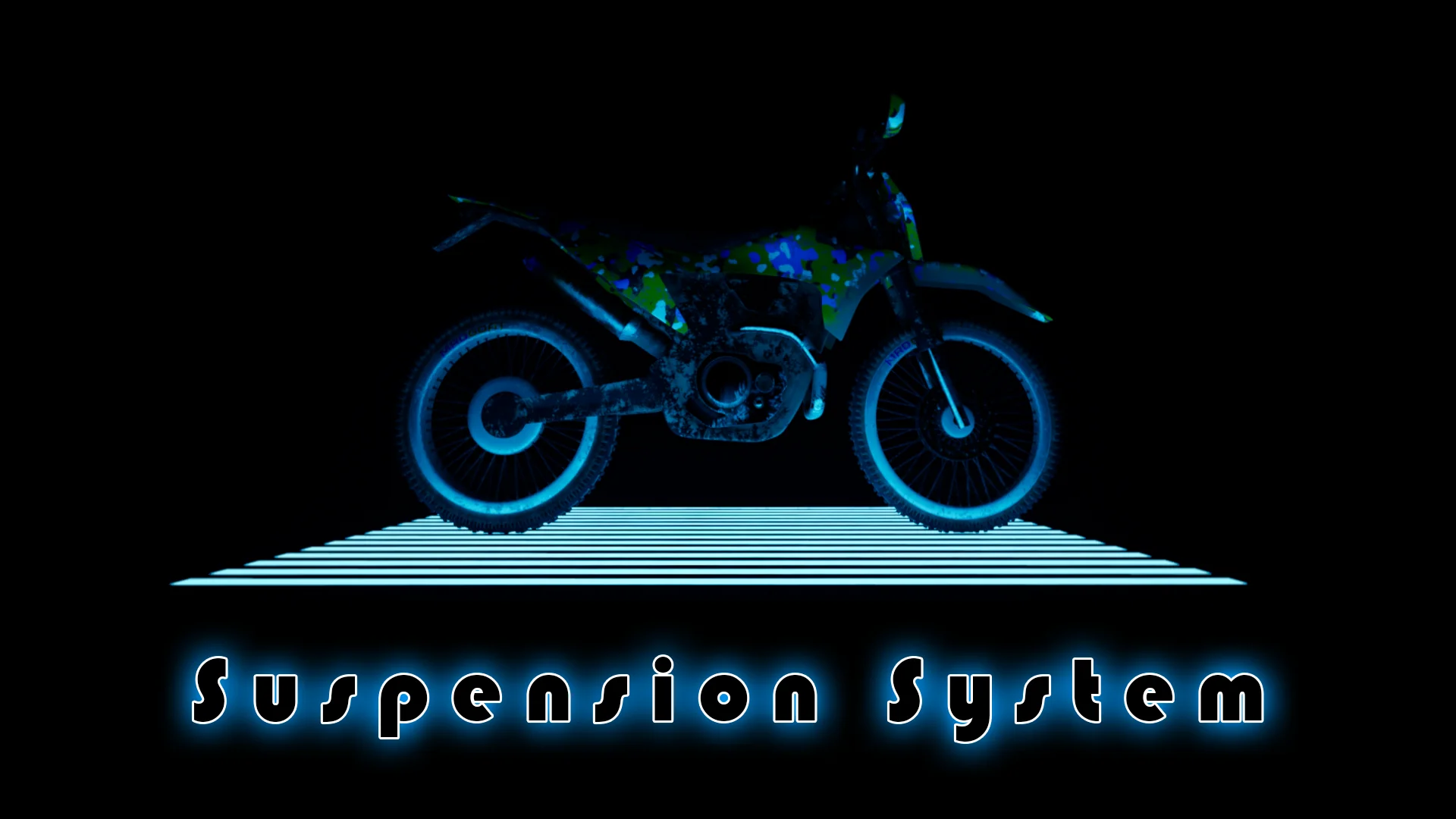
To demonstrate how these individual pieces assemble and behave, the package includes a fully rigged cross and off-road demo motorcycle. This demo vehicle illustrates how individual static meshes attach to the underlying transform logic, serving as a direct reference for replacing components with project-specific models. Because the framework is fully configurable, secondary decorative parts or specific mechanical linkages can be mounted to the main assemblies, ensuring the visual styling remains intact while retaining all underlying animation controls.
Ground-Adaptive Wheels and Physics-Free Suspension Mechanics
Motorcycle wheels need to maintain reliable contact with uneven surfaces without collapsing under complex physics solvers. Cinematic Bike Rig achieves this through ground-adaptive wheel logic that uses continuous surface tracing. As the motorcycle navigates a scene, the system evaluates the terrain below each tire and conforms the wheel elevation directly to ground geometry. The wheels also calculate their own rotational rate automatically based on displacement, keeping tire spin synchronized with linear speed so animators do not need to manually dial in rolling speed curves.
Suspension movement operates through an internal spring system engineered to produce reactive shock absorption without running a physical simulation. Traditional vehicle tools like Chaos Vehicles rely on active physics worlds where unexpected terrain hitches can launch, flip, or jitter a two-wheeled vehicle. This spring setup acts dynamically and predictably, buffering elevation changes across rough ground surfaces while preserving complete scene stability. Surface interactions also incorporate collision detection with explicit object exclusion support, permitting animators to designate specific scene props or background meshes that the tracing passes should bypass during evaluation.
Keyframing Stunts in Sequencer with the Cinematic Bike Rig
Cinematic workflows often conflict with real-time physics engines. In standard production passes, staging a motorcycle sequence frequently entails piloting a vehicle live, capturing erratic inputs through Take Recorder, and digging through playback takes to find usable motion. When vehicles drift out of control, animators often resort to artificial fixes like weighting down the center of gravity or hiding invisible stabilizer wheels. Cinematic Bike Rig eliminates that entire recording cycle by keeping every axis of motion accessible as a clean keyframe lane directly within Sequencer.
Stunts and cornering behaviors that are notoriously difficult to stage in a live physics run become standard keyframed attributes. The rig exposes dedicated channels for pitch, roll, and drift angles, pairing manual drift offsets with automatic chassis leaning as turns occur. Wheelies and stoppies can be dialed in and held for exact frame counts, matching camera cuts and focal adjustments without risk of vehicle tipping. Because the rig requires no simulation run or physics bake, both the Unreal Engine viewport and the Sequencer timeline display real-time visual feedback instantly, showing the precise chassis attitude on any given frame.
Spline Path Blueprint Traversal and Route Management
For choreographed traversal through environments, the package incorporates a specialized Spline Path Blueprint. Instead of hand-positioning the motorcycle across complex terrain frame by frame, animators can lay out a spline track through the level. The bike attaches to the path, utilizing automatic steering calculations that align the front forks and body orientation to the curve vectors of the spline. Forward progression is governed by keying the distance traveled along the track, giving exact control over pacing, acceleration, braking zones, and sudden stops.
Building track routes is accelerated by a tool that snaps individual spline points directly down onto underlying ground surfaces. If a sequence requires a turnaround or a vehicle moving against traffic, an instant direction reversal toggle shifts the travel trajectory without necessitating a spline rebuild. For closed tracks and racing circuits, the spline can be set to a closed loop. If the keyed travel distance exceeds the physical length of the spline, the system loops back to the start automatically, making it well-suited for repetitive background traffic loops or long circuit racing shots.
Eliminating External DCC Roundtrips in Movie and Animation Pipelines
Staging intricate motorcycle stunts often pushes artists out of Unreal Engine and into external digital content creation software. Exporting camera plates, animating transforms elsewhere, and re-importing FBX or Alembic caches introduces friction and disrupts rapid shot iteration, especially when terrain revisions alter ground elevations. Operating completely inside Unreal Engine keeps the vehicle animation synchronized with live landscape edits, dynamic lighting passes, and active cinematic camera rigs.
Whether staging high-speed sportbike chases on asphalt, motocross hill climbs across jagged terrain, or stationary stunt maneuvers timed to narrative beats, the asset provides a clean pipeline for filmmakers and animators. By combining spline precision, keyable stunt parameters, and procedural ground tracing into a simulation-free Blueprint, Cinematic Bike Rig provides the tools necessary to execute predictable, shot-ready motorcycle cinematics on demand.
 Procedural Systems
 Procedural Systems
 Procedural Systems