"7b46a695175d8694"{"id":"1001524","slug":"cinematic-fire","title":"Cinematic Fire","category":"Fire \u0026 Explosions","engine":"5.1+","assetVersion":"","engineVersion":"Engine Version: 5.1+","tag":"Fire \u0026 Explosions","accent":"blue","visual":"mech","summary":"Explore the systems inside Cinematic Fire for Unreal Engine 5, from portable flame Blueprints and flipbook shading to spline and mask scattering.","platform":"Unreal Engine","publishedAt":"2026-10-09T13:36:16.112Z","updatedAt":"2026-10-09T13:36:16.112Z","sourceNotes":[],"fileContents":[],"compatibility":["Unreal Engine","Engine Version: 5.1+"],"featuredImage":{"alt":"Cinematic Fire","src":"/wp-content/uploads/published/2026/10/937791fe4fd6-5365d593-6d5c-4e8e-ac09-97febf89af83-7edd6bc77d.webp"},"hasDownloadLink":true,"downloads":1,"terms":[{"taxonomy":"category","slug":"fire-and-explosions","name":"Fire \u0026 Explosions"}],"galleryImages":[{"src":"/wp-content/uploads/published/2026/10/a682c28d143e-4fb9465d-85a0-4205-b84d-9a0d7542f8c2-25ceb746c1.webp","alt":"Cinematic Fire"},{"src":"/wp-content/uploads/published/2026/10/e281fd439b7c-1f176f7f-0b38-40ff-b463-a65a82095542-ab9aa15d92.webp","alt":"Cinematic Fire"},{"src":"/wp-content/uploads/published/2026/10/90edb675b8e5-27c655aa-69d3-4eb4-90dc-4dcfb1403847-f794e0c0f2.webp","alt":"Cinematic Fire"},{"src":"/wp-content/uploads/published/2026/10/b60e284c7e12-01b75807-4b9b-45d2-aa09-b897de6d1be1-8f21df5e35.webp","alt":"Cinematic Fire"},{"src":"/wp-content/uploads/published/2026/10/2b7129945d19-c3f4e914-d9e3-452d-9ed8-ff4fafab5415-bad339499a.webp","alt":"Cinematic Fire"},{"src":"/wp-content/uploads/published/2026/10/438f47501004-e15fd4cd-cd04-4879-a15e-5fd3ed2654ea-54aeef00fb.webp","alt":"Cinematic Fire"},{"src":"/wp-content/uploads/published/2026/10/054a34383c59-b955b75a-2419-47cd-89c5-3aeeee30466a-af615090ee.webp","alt":"Cinematic Fire"},{"src":"/wp-content/uploads/published/2026/10/6e34cafb7318-3d8d7dad-4a48-4c81-a97a-a4814ccf44b4-2a948752ec.webp","alt":"Cinematic Fire"},{"src":"/wp-content/uploads/published/2026/10/edd88499b2ac-4f7f0984-f200-422d-834f-999eecd12274-9195a653b6.webp","alt":"Cinematic Fire"}],"accessPanel":{"kind":"resource","title":"Download this resource","eyebrow":"Free Download","message":"Log in or create a free account to start your download.","fileName":"Content.7z","safetyNote":"Resources are manually reviewed before listing to improve quality and reduce obvious risks.","actionLabel":"Download Free","resourceType":"Resource archive"},"contentHtml":"\u003cp\u003eHigh-resolution flipbook textures, specialized material graphs, dedicated Blueprint actors, and modular secondary Niagara emitters form the foundation of Cinematic Fire. Built specifically for Unreal Engine 5, the collection scales across production scenarios ranging from a single candle flame or moving torch to vehicle explosions, burning architecture, and widespread wildland blazes. The core architecture divides into isolated flame instances driven by portable control actors and procedural multi-point distribution handled by specialized scattering tools.\u003c/p\u003e \u003ch2\u003eDirect Flame Control with BP_Cinematic_Fire_Portable\u003c/h2\u003e\n\u003cp\u003eSingle flame placements rely on the \u003ccode\u003eBP_Cinematic_Fire_Portable\u003c/code\u003e Blueprint actor, which centralizes appearance, animation speed, and physical response parameters into a single interface. The actor indexes through 35 coordinated fire variants, selectable through numerical inputs from 0 to 35 or slider adjustments. Artists working on hero props can manipulate flame-core density, base-glow intensity, tip-glow falloff, and outer-flame feathering to tune the silhouette against varying backgrounds.\u003c/p\u003e \u003cp\u003eOrientation and spatial alignment controls allow the flame cards to function across diverse prop geometries. The Blueprint features automatic flame-anchor calibration alongside directional attachment offsets, preventing cards from separating from torch heads, vehicle panels, or wick geometry during actor movement. The system offers world-upright orientation locking, two-sided card rendering, and dynamic camera-facing behavior to ensure cards do not reveal flat profiles when viewed from acute camera angles.\u003c/p\u003e \u003cp\u003eOperational functions within the Blueprint include dedicated Fire Start and Fire Stop execution triggers, setup validation passes, material reapplication actions, and custom preset export and import tools. These procedural triggers can be tied directly to gameplay events or automated within Sequencer tracks without rebuilding underlying component hierarchies.\u003c/p\u003e \u003ch2\u003eColor grading, Flipbooks, and Surface Lighting\u003c/h2\u003e\n\u003cp\u003eThe visual foundation utilizes high-resolution flipbooks prepped as seamless looping sequences, supported by five distinct texture quality tiers: 512 px, 1K, 2K, 4K, and original cinematic resolution textures captured up to 16K. To avoid visual repetition and fit diverse artistic directions, the material pipeline incorporates four distinct color-source modes: unadjusted flipbook color, HDR color curves, curve atlases, and 2D color-ramp textures.\u003c/p\u003e \u003cp\u003eThe 2D color-ramp pipeline provides dedicated controls for chroma replacement, luminance remapping, saturation adjustments, ramp rotation, and procedural noise injection. Height influence and core influence sliders alter how color gradients map from the ignition root to the rising tips. Temperature-based coloring modes expose three editable gradient bands covering the base, middle, and upper dissipation regions, allowing hot blue or white combustion zones to bleed into amber, red, or dense soot.\u003c/p\u003e \u003cp\u003eIllumination data is not limited to static emissive multipliers. The materials feature normal-map detail blending, native translucent surface-lighting responses, and optional six-direction lighting textures. These six-point light captures allow fire cards to interact with dynamic scene illumination, simulating self-shadowing and volumetric depth when cameras navigate close to burning surfaces.\u003c/p\u003e \u003ch2\u003eEnvironmental Layouts via BP_Cinematic_Fire_Scatter\u003c/h2\u003e\n\u003cp\u003eBroad destruction scenes and continuous fire lines are handled by the \u003ccode\u003eBP_Cinematic_Fire_Scatter\u003c/code\u003e Actor. Rather than requiring manual hand-placement of dozens of individual flame actors, this system procedurally distributes instances using multiple spatial input methods:\u003c/p\u003e \u003cul\u003e \u003cli\u003eOpen splines for linear barriers, trenches, and fallen logs.\u003c/li\u003e \u003cli\u003eClosed spline loops for regional containment, burning rooms, or field patches.\u003c/li\u003e \u003cli\u003eVertex color channels painted directly onto static or skeletal mesh geometry.\u003c/li\u003e \u003cli\u003eMesh Paint Textures made for compatibility with Nanite geometry.\u003c/li\u003e \u003cli\u003eWorld-space texture masks with per-channel selection across Red, Green, Blue, Alpha, or Luminance data.\u003c/li\u003e\n\u003c/ul\u003e \u003cp\u003eDistribution across uneven terrain is governed by a collision projection pass. Developers can configure trace height, trace depth, slope angle filtering, surface offset distances, complex collision queries, and surface normal alignment. Deterministic random seed values ensure that layouts remain consistent between editor sessions, while controls for spacing, spacing jitter, lateral jitter, minimum clearance limits, scale variation, and randomized animation phase offsets eliminate uniform repetition across large surfaces.\u003c/p\u003e \u003cp\u003eTo keep massive layouts performant in gameplay and stable inside Sequencer, placement positions can be baked into portable transform caches using the \u003ccode\u003eUse Baked Placements\u003c/code\u003e Mode. This utilizes engine-native Geometry Scripting during editor operations, ensuring that runtime evaluation does not incur per-frame distribution overhead. Appearance properties, colors, and variant assignments can be adjusted on baked layouts without invalidating or recalculating the underlying physical positions.\u003c/p\u003e \u003ch2\u003eMotion Vectors, Wind Physics, and Secondary Effects\u003c/h2\u003e\n\u003cp\u003ePhysical dynamics adjust flames to scene forces and actor kinematics. The material and Blueprint logic include wind direction, gust intensity, fine turbulence, base stiffness, bend curves, maximum lean angles, and edge-feathering values. Torches held by moving characters, weapons swung during action sequences, and burning vehicles traveling through a level leverage motion-responsive bending, deflecting the flame card backward relative to directional velocity.\u003c/p\u003e \u003cp\u003eFor high-end cinematic captures and aggressive temporal anti-aliasing passes, the flipbooks integrate embedded motion vectors. These vectors supply real-time velocity buffers to Unreal Engine's temporal accumulators, preventing ghosting artifacts and delivering natural cinematic motion blur in high-speed or slow-motion sequences.\u003c/p\u003e \u003cp\u003eFourteen pre-configured presets provide immediate visual targets: Manual/Custom, Candle, Torch, Campfire, Vehicle Fire, Building Fire, Wildfire, Ground Fire, Hero Close Up, Cinematic Slow Motion, Game Background, and three distinct smoke varieties (White Smoke, Black Smoke, and Colored Smoke). Beyond the core fire cards, secondary elements can be toggled directly from the tools. Integrated Niagara emitters supply ambient ember sparks, floating dust, and rising smoke, while complementary burned wood meshes and ground decals add physical scorch marks underneath active blazes.\u003c/p\u003e \u003ch2\u003eProject Integration and Native Tooling\u003c/h2\u003e\n\u003cp\u003eThe package ships with four reusable fire-variant Data Asset libraries, specialized fire-card static meshes, materials, textures, example sequences, and reference levels demonstrating vertex painting, texture mask sampling, spline usage, wind response, and vehicle attachments. No external third-party runtime plugins are required; all editor baking and particle generation rely entirely on the engine-native Geometry Scripting and Niagara modules. Cinematic Fire functions as a self-contained visual effects framework capable of serving isolated environmental set dressing as well as large-scale, dynamic destruction sequences.\u003c/p\u003e\n\n\u003ch2\u003eMore From The Same Workflow\u003c/h2\u003e\n\u003cul\u003e\n\u003cli\u003e\u003ca href=\"https://3dcghub.com/cinematic-fire-3d-vdb-pack-loop/\" title=\"Cinematic Fire 3D VDB Pack loop\"\u003eCinematic Fire 3D VDB Pack loop\u003c/a\u003e\u003c/li\u003e\n\u003cli\u003e\u003ca href=\"https://3dcghub.com/volcano-environment-vfx/\" title=\"Volcano Environment VFX\"\u003eVolcano Environment VFX\u003c/a\u003e\u003c/li\u003e\n\u003cli\u003e\u003ca href=\"https://3dcghub.com/explosion-vfx-2/\" title=\"Explosion VFX 2\"\u003eExplosion VFX 2\u003c/a\u003e\u003c/li\u003e\n\u003cli\u003e\u003ca href=\"https://3dcghub.com/advanced-fireworks-system-vfx/\" title=\"Advanced Fireworks System VFX\"\u003eAdvanced Fireworks System VFX\u003c/a\u003e\u003c/li\u003e\n\u003cli\u003e\u003ca href=\"https://3dcghub.com/volcano-3d-vdb-pack/\" title=\"Volcano 3D VDB Pack\"\u003eVolcano 3D VDB Pack\u003c/a\u003e\u003c/li\u003e\n\u003c/ul\u003e","contentTextLength":7355,"navigation":{"current":21,"total":3481,"previous":{"id":"1001525","slug":"graveyard-cemetery-stylized-graveyard-stylized-cemetery-modular-graveyard","title":"Graveyard (Cemetery, Stylized Graveyard, Stylized Cemetery, Modular Graveyard)","category":"Horror","platform":"Unreal Engine","updatedAt":"2026-10-09T13:36:54.837Z"},"next":{"id":"1001523","slug":"cemetery-forgotten-churchyard","title":"Cemetery - Forgotten Churchyard","category":"Horror","platform":"Unreal Engine","updatedAt":"2026-10-09T13:35:28.174Z"}},"relatedResources":[{"id":"1000042","slug":"cinematic-fire-3d-vdb-pack-loop","title":"Cinematic Fire 3D VDB Pack loop","category":"Fire \u0026 Explosions","engine":"5.3+","assetVersion":"","engineVersion":"5.3+","tag":"Fire \u0026 Explosions","accent":"blue","visual":"mech","summary":"A closer look at a 10-loop cinematic fire VDB pack for Unreal Engine, including scene controls, path tracing setup, and where it fits in production.","platform":"Unreal Engine","publishedAt":"2026-05-22T08:25:52.982Z","updatedAt":"2026-05-22T08:25:52.982Z","sourceNotes":[],"fileContents":[],"compatibility":["Unreal Engine","Engine version: 5.3+"],"featuredImage":{"alt":"Cinematic Fire 3D VDB Pack loop","src":"/wp-content/uploads/published/2026/05/bc34be2adc82-0935183b-0505-48f7-9d7c-0f6a3ce4337f-c430de0bb6.webp"},"hasDownloadLink":true,"downloads":2},{"id":"1000777","slug":"volcano-environment-vfx","title":"Volcano Environment VFX","category":"Fire \u0026 Explosions","engine":"4.27,5.0+","assetVersion":"","engineVersion":"Engine Version: 4.27,5.0+","tag":"Fire \u0026 Explosions","accent":"blue","visual":"city","summary":"Six modular volcano environment and atmosphere VFX built for Niagara, optimized for games with drag-and-drop setup and customizable parameters for cinematic sce","platform":"Unreal Engine","publishedAt":"2026-07-28T18:19:24.127Z","updatedAt":"2026-07-28T18:19:24.127Z","sourceNotes":[],"fileContents":[],"compatibility":["Unreal Engine","Engine Version: 4.27,5.0+"],"featuredImage":{"alt":"Volcano Environment VFX","src":"/wp-content/uploads/published/2026/07/e24d5c319fff-909aa903-77c4-4aa3-a8ec-9a1cafca8cdf-5173a7858b.webp"},"hasDownloadLink":true,"downloads":0},{"id":"15576","slug":"explosion-vfx-2","title":"Explosion VFX 2","category":"Fire \u0026 Explosions","engine":"4.27,5.0+","assetVersion":"Engine version: 4.27,5.0+","engineVersion":"4.27","tag":"Fire \u0026 Explosions","accent":"blue","visual":"mech","summary":"Explosion VFX 2 is a collection of ten unique, ultra-realistic explosion effects designed for high-end games and animations. Each asset is UHD and utilizes optimized Sub UV technology for better performance.","platform":"Unreal Engine","publishedAt":"2026-03-12T12:10:13.000Z","updatedAt":"2026-04-19T15:44:44.000Z","sourceNotes":[],"fileContents":[],"compatibility":["Unreal Engine","Engine version: 4.27,5.0+"],"featuredImage":{"alt":"Explosion VFX 2","src":"https://3dcghub.com/wp-content/uploads/2026/03/0588e675-6dd6-4525-acc9-697baa028094.webp"},"hasDownloadLink":true,"downloads":1}]}
Fire & Explosions
Cinematic Fire
Explore the systems inside Cinematic Fire for Unreal Engine 5, from portable flame Blueprints and flipbook shading to spline and mask scattering.
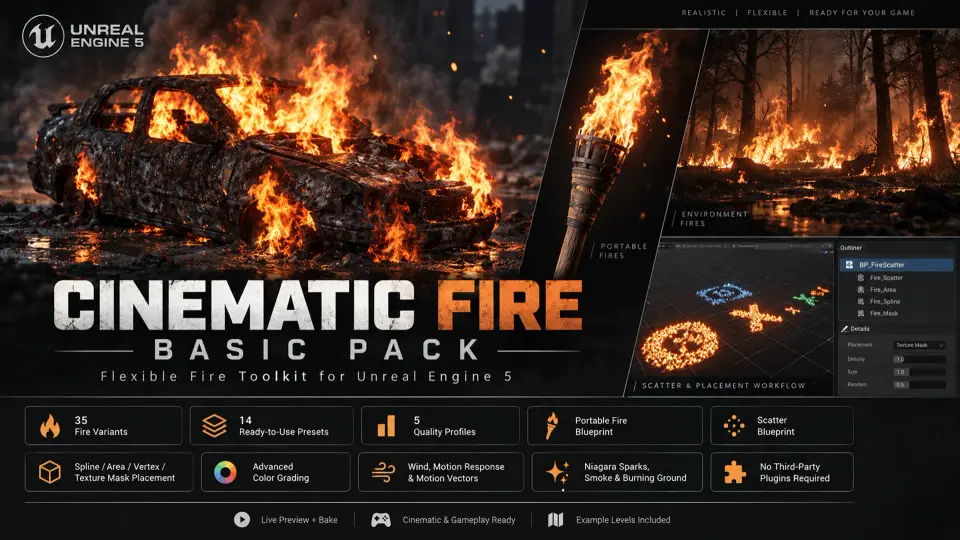
High-resolution flipbook textures, specialized material graphs, dedicated Blueprint actors, and modular secondary Niagara emitters form the foundation of Cinematic Fire. Built specifically for Unreal Engine 5, the collection scales across production scenarios ranging from a single candle flame or moving torch to vehicle explosions, burning architecture, and widespread wildland blazes. The core architecture divides into isolated flame instances driven by portable control actors and procedural multi-point distribution handled by specialized scattering tools.
Direct Flame Control with BP_Cinematic_Fire_Portable
Single flame placements rely on the BP_Cinematic_Fire_Portable Blueprint actor, which centralizes appearance, animation speed, and physical response parameters into a single interface. The actor indexes through 35 coordinated fire variants, selectable through numerical inputs from 0 to 35 or slider adjustments. Artists working on hero props can manipulate flame-core density, base-glow intensity, tip-glow falloff, and outer-flame feathering to tune the silhouette against varying backgrounds.
Orientation and spatial alignment controls allow the flame cards to function across diverse prop geometries. The Blueprint features automatic flame-anchor calibration alongside directional attachment offsets, preventing cards from separating from torch heads, vehicle panels, or wick geometry during actor movement. The system offers world-upright orientation locking, two-sided card rendering, and dynamic camera-facing behavior to ensure cards do not reveal flat profiles when viewed from acute camera angles.
Operational functions within the Blueprint include dedicated Fire Start and Fire Stop execution triggers, setup validation passes, material reapplication actions, and custom preset export and import tools. These procedural triggers can be tied directly to gameplay events or automated within Sequencer tracks without rebuilding underlying component hierarchies.
Color grading, Flipbooks, and Surface Lighting
The visual foundation utilizes high-resolution flipbooks prepped as seamless looping sequences, supported by five distinct texture quality tiers: 512 px, 1K, 2K, 4K, and original cinematic resolution textures captured up to 16K. To avoid visual repetition and fit diverse artistic directions, the material pipeline incorporates four distinct color-source modes: unadjusted flipbook color, HDR color curves, curve atlases, and 2D color-ramp textures.
The 2D color-ramp pipeline provides dedicated controls for chroma replacement, luminance remapping, saturation adjustments, ramp rotation, and procedural noise injection. Height influence and core influence sliders alter how color gradients map from the ignition root to the rising tips. Temperature-based coloring modes expose three editable gradient bands covering the base, middle, and upper dissipation regions, allowing hot blue or white combustion zones to bleed into amber, red, or dense soot.
Illumination data is not limited to static emissive multipliers. The materials feature normal-map detail blending, native translucent surface-lighting responses, and optional six-direction lighting textures. These six-point light captures allow fire cards to interact with dynamic scene illumination, simulating self-shadowing and volumetric depth when cameras navigate close to burning surfaces.
Environmental Layouts via BP_Cinematic_Fire_Scatter
Broad destruction scenes and continuous fire lines are handled by the BP_Cinematic_Fire_Scatter Actor. Rather than requiring manual hand-placement of dozens of individual flame actors, this system procedurally distributes instances using multiple spatial input methods:
Open splines for linear barriers, trenches, and fallen logs.
Closed spline loops for regional containment, burning rooms, or field patches.
Vertex color channels painted directly onto static or skeletal mesh geometry.
Mesh Paint Textures made for compatibility with Nanite geometry.
World-space texture masks with per-channel selection across Red, Green, Blue, Alpha, or Luminance data.
Distribution across uneven terrain is governed by a collision projection pass. Developers can configure trace height, trace depth, slope angle filtering, surface offset distances, complex collision queries, and surface normal alignment. Deterministic random seed values ensure that layouts remain consistent between editor sessions, while controls for spacing, spacing jitter, lateral jitter, minimum clearance limits, scale variation, and randomized animation phase offsets eliminate uniform repetition across large surfaces.
To keep massive layouts performant in gameplay and stable inside Sequencer, placement positions can be baked into portable transform caches using the Use Baked Placements Mode. This utilizes engine-native Geometry Scripting during editor operations, ensuring that runtime evaluation does not incur per-frame distribution overhead. Appearance properties, colors, and variant assignments can be adjusted on baked layouts without invalidating or recalculating the underlying physical positions.
Motion Vectors, Wind Physics, and Secondary Effects
Physical dynamics adjust flames to scene forces and actor kinematics. The material and Blueprint logic include wind direction, gust intensity, fine turbulence, base stiffness, bend curves, maximum lean angles, and edge-feathering values. Torches held by moving characters, weapons swung during action sequences, and burning vehicles traveling through a level leverage motion-responsive bending, deflecting the flame card backward relative to directional velocity.
For high-end cinematic captures and aggressive temporal anti-aliasing passes, the flipbooks integrate embedded motion vectors. These vectors supply real-time velocity buffers to Unreal Engine's temporal accumulators, preventing ghosting artifacts and delivering natural cinematic motion blur in high-speed or slow-motion sequences.
Fourteen pre-configured presets provide immediate visual targets: Manual/Custom, Candle, Torch, Campfire, Vehicle Fire, Building Fire, Wildfire, Ground Fire, Hero Close Up, Cinematic Slow Motion, Game Background, and three distinct smoke varieties (White Smoke, Black Smoke, and Colored Smoke). Beyond the core fire cards, secondary elements can be toggled directly from the tools. Integrated Niagara emitters supply ambient ember sparks, floating dust, and rising smoke, while complementary burned wood meshes and ground decals add physical scorch marks underneath active blazes.
Project Integration and Native Tooling
The package ships with four reusable fire-variant Data Asset libraries, specialized fire-card static meshes, materials, textures, example sequences, and reference levels demonstrating vertex painting, texture mask sampling, spline usage, wind response, and vehicle attachments. No external third-party runtime plugins are required; all editor baking and particle generation rely entirely on the engine-native Geometry Scripting and Niagara modules. Cinematic Fire functions as a self-contained visual effects framework capable of serving isolated environmental set dressing as well as large-scale, dynamic destruction sequences.
 Fire & Explosions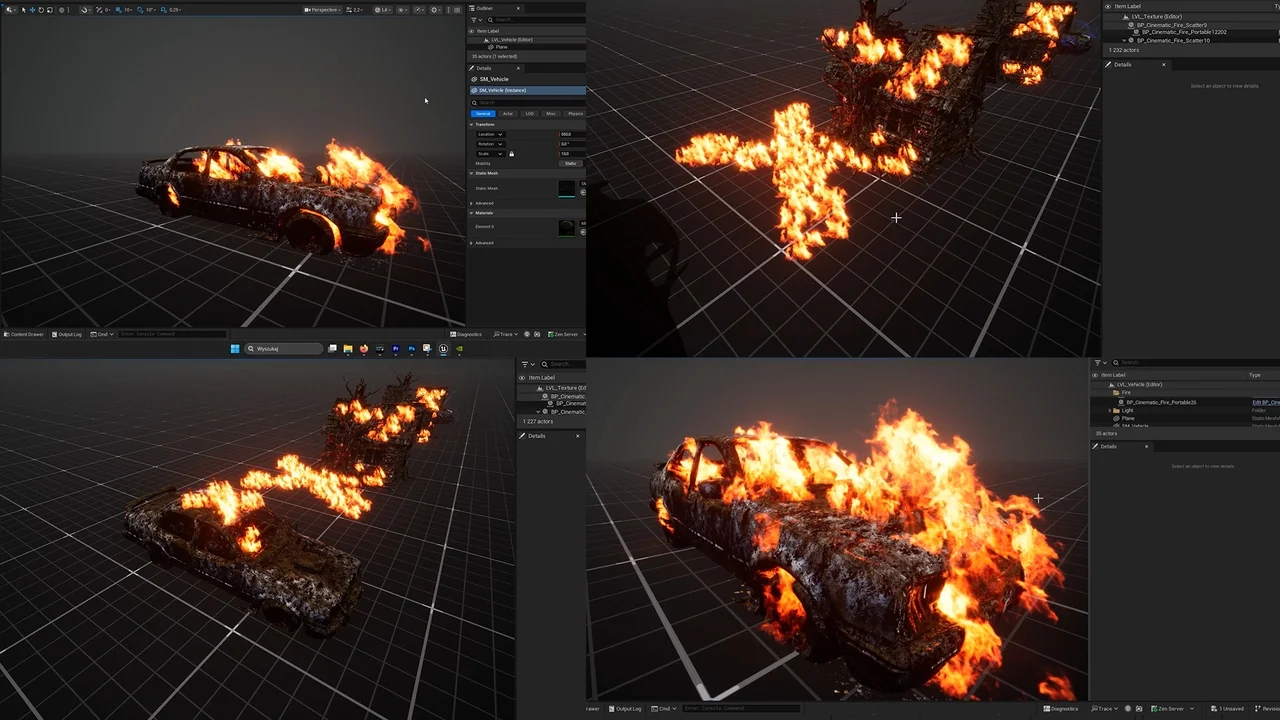
 Fire & Explosions
 Fire & Explosions
 Fire & Explosions