"6c6413bef81af556"{"id":"1000782","slug":"advanced-riding-locomotion-system-riding-system","title":"Advanced Riding Locomotion System (Riding System)","category":"Gameplay Features","engine":"5.1+","assetVersion":"Asset Version: 1.5.1","engineVersion":"Engine Version: 5.1+","tag":"Gameplay Features","accent":"blue","visual":"animation","summary":"A component-based riding framework for Unreal Engine handling ground and flight movement, mounting, and swim behavior through configurable blendspaces.","platform":"Unreal Engine","publishedAt":"2026-07-30T11:16:41.169Z","updatedAt":"2026-07-30T11:16:41.169Z","sourceNotes":[],"fileContents":[],"compatibility":["Unreal Engine","Asset Version: 1.5.1","Engine Version: 5.1+"],"featuredImage":{"alt":"Advanced Riding Locomotion System (Riding System)","src":"/wp-content/uploads/published/2026/07/07d9cf825a90-2f012bd6-b859-487a-95c5-a43988a83daa-7e44e48f0f.webp"},"hasDownloadLink":true,"downloads":0,"terms":[{"taxonomy":"category","slug":"gameplay-features","name":"Gameplay Features"}],"galleryImages":[{"src":"/wp-content/uploads/published/2026/07/f9bef214f0e3-ef083994-7c0e-42eb-8fbb-16c96851be48-e0ff511aac.webp","alt":"Advanced Riding Locomotion System (Riding System)"},{"src":"/wp-content/uploads/published/2026/07/4c62840ebb12-f9a005bd-fa86-4c38-b15d-a5e8ca953e28-04efc374ac.webp","alt":"Advanced Riding Locomotion System (Riding System)"},{"src":"/wp-content/uploads/published/2026/07/46e02b063101-f0d49b20-788c-4fc2-bfa4-163aab89eb1f-f8bdf197d9.webp","alt":"Advanced Riding Locomotion System (Riding System)"},{"src":"/wp-content/uploads/published/2026/07/d76247560385-dacc4ff5-6ea9-4d36-9b24-0767065f0e08-7afebad554.webp","alt":"Advanced Riding Locomotion System (Riding System)"},{"src":"/wp-content/uploads/published/2026/07/79e7c501fd3c-1eb38b40-9a67-40b3-b63a-52a800ad8cc9-e0891b24d4.webp","alt":"Advanced Riding Locomotion System (Riding System)"},{"src":"/wp-content/uploads/published/2026/07/e7bb65fdc812-f0bd4410-71bd-44dd-a085-a367f451e176-9de94b2983.webp","alt":"Advanced Riding Locomotion System (Riding System)"},{"src":"/wp-content/uploads/published/2026/07/37646b861f81-c6793be0-7db8-4125-a409-597317e51126-acb9803cf5.webp","alt":"Advanced Riding Locomotion System (Riding System)"},{"src":"/wp-content/uploads/published/2026/07/84db3e895d18-1628d53b-f854-43a6-af9d-0539b8c61071-3517069fc2.webp","alt":"Advanced Riding Locomotion System (Riding System)"},{"src":"/wp-content/uploads/published/2026/07/afa68e24b006-f0f4dbfd-a1fc-4f18-960c-1acac868a3b0-6027ffc5f9.webp","alt":"Advanced Riding Locomotion System (Riding System)"},{"src":"/wp-content/uploads/published/2026/07/6ae8bbf2e725-320d9da7-d8aa-482d-ac06-7f748ce5ef57-9b46711d94.webp","alt":"Advanced Riding Locomotion System (Riding System)"}],"accessPanel":{"kind":"resource","title":"Download this resource","eyebrow":"Free Download","message":"Log in or create a free account to start your download.","fileName":"Content.7z","safetyNote":"Resources are manually reviewed before listing to improve quality and reduce obvious risks.","actionLabel":"Download Free","resourceType":"Resource archive"},"contentHtml":"\u003cp\u003eA mounted character needs to switch from on-foot locomotion to creature-backed movement without interrupting the flow of gameplay. The \u003cem\u003eAdvanced Riding Locomotion System\u003c/em\u003e handles that handoff through generic components rather than packaged character art. It ships without models or animations, so teams bring their own creature rigs and motion sets into a framework already wired for ground traversal, flight, swimming, and possession transitions.\u003c/p\u003e\n\n\u003ch2\u003eGeneric Components Structured Through External Animation Sets\u003c/h2\u003e\n\u003cp\u003eThe asset is deliberately stripped of visual content. Every model and animation clip used in a project must come from a separate source. The core requirement listed is \u003cem\u003eHorse Animset\u003c/em\u003e, which supplies the motion data the system reads from. This separation lets the components stay flexible: a team can pair the riding logic with any compatible horse rig they already own or plan to acquire, then drive the playback through BlendSpaces the system reads.\u003c/p\u003e\n\n\u003cp\u003eFor wyvern-based flight scenarios, the required asset shifts to \u003cem\u003eIrval the Wyvern\u003c/em\u003e. The system itself demonstrates its range by supporting both grounded horse travel and aerial wyvern riding through the same component architecture, adjusting movement mode rather than swapping to a different technical approach for each creature type.\u003c/p\u003e\n\n\u003ch3\u003eAnimal Movement: Ground and Flight Through BlendSpaces\u003c/h3\u003e\n\u003cp\u003eThe \u003ccode\u003eAnimal Movement\u003c/code\u003e component reads a BlendSpace provided by the developer and plays different animations based on the creature's current speed. This means the visual selection of gaits—walk, trot, gallop, or flight strides—happens automatically once the BlendSpace is connected. Speed and rotation values are configurable, letting designers tune how sharply a horse turns at a canter or how quickly a wyvern banks during flight without touching the animation logic itself.\u003c/p\u003e\n\n\u003cp\u003eThe component supports both ground and fly movement modes. Switching between them lets a creature transition from running across terrain to taking to the air, a behavior demonstrated in the \u003cem\u003eIrval the Wyvern\u003c/em\u003e showcase. Version 1.5 added swimming support, broadening the movement states beyond solid ground and open sky to include water traversal.\u003c/p\u003e\n\n\u003ch3\u003eMount and Riding Component: Possession and Camera Transitions\u003c/h3\u003e\n\u003cp\u003eThe \u003ccode\u003eMount and Riding\u003c/code\u003e component governs the act of getting onto and controlling a creature. It handles the riding setup so that once a character is mounted, control shifts cleanly to the creature's movement model. A specific feature called out is smooth camera transition during possession. This is noted as useful within the \u003cem\u003eAdvanced Locomotion System\u003c/em\u003e (\u003cem\u003eALS\u003c/em\u003e), meaning the camera blend is designed to integrate with \u003cem\u003eALS\u003c/em\u003e rather than fighting its existing camera behavior.\u003c/p\u003e\n\n\u003cp\u003eVersion 1.5 introduced \u003ccode\u003eCmpt_Horse\u003c/code\u003e and \u003ccode\u003eCmpt_HorseRider\u003c/code\u003e components. These were added to ease integration, giving developers structured entry points for connecting a Horse Actor and a Rider Actor without building the linkage from scratch. The components encapsulate the setup so that the connection between mount and rider is defined through the component system rather than through ad-hoc Blueprint wiring.\u003c/p\u003e\n\n\u003ch2\u003eTutorial Coverage Across Project Types\u003c/h2\u003e\n\u003cp\u003eThe system is documented through a set of video tutorials that map to different project scales and starting points. A seed project tutorial covers UE4 and UE5. A UE5 skeleton tutorial addresses the newer engine version specifically. For teams building on the \u003cem\u003eAdvanced Locomotion System V4\u003c/em\u003e, a dedicated tutorial covers integration across both UE4 and UE5.\u003c/p\u003e\n\n\u003cp\u003eFor survival-oriented gameplay, the \u003cem\u003eEasySurvival RPG\u003c/em\u003e tutorials cover both standalone and multiplayer implementations in UE4 and UE5. This pairing matters because the riding system's component approach is meant to drop into existing character frameworks rather than replace them. The tutorials demonstrate how to connect the riding components to locomotion setups that already define the player's on-foot behavior.\u003c/p\u003e\n\n\u003ch3\u003eUE4 and UE5: Animation Blueprint Template Differences\u003c/h3\u003e\n\u003cp\u003eUnreal Engine 4 and Unreal Engine 5 handle certain animation linkage mechanics differently, and the riding system accounts for this. The difference stems from UE5's use of Animation Blueprint Templates. The project tutorials reference this distinction, and the documentation points to the official Unreal Engine 5 material on Animation Blueprint linking for the underlying technical context.\u003c/p\u003e\n\n\u003cp\u003eThe UE4 version of the system is distributed through the developer's Discord rather than the marketplace. Teams targeting UE4 specifically need to retrieve it through that channel. Version 1.5.1, released on December 18, 2022, fixed a bug that occurred when a client joined a session, addressing a networked multiplayer scenario relevant to the \u003cem\u003eEasySurvival RPG\u003c/em\u003e multiplayer tutorials.\u003c/p\u003e\n\n\u003ch2\u003ePegasus, Wyverns, and the Broader Creature Scope\u003c/h2\u003e\n\u003cp\u003eWhile the system is named around horse riding, its demonstrated use cases extend to winged creatures. The \u003cem\u003eHorse Riding and Pegasus\u003c/em\u003e showcase and the \u003cem\u003eIrval the Wyvern\u003c/em\u003e showcase both appear in the project materials. These demonstrations indicate that the \u003ccode\u003eMount and Riding\u003c/code\u003e component and the \u003ccode\u003eAnimal Movement\u003c/code\u003e component are not locked to quadruped ground movement. The flight support in the \u003ccode\u003eAnimal Movement\u003c/code\u003e component, combined with the BlendSpace-driven speed-based animation playback, lets a team apply the same mounting and riding logic to a flying creature provided the animation set supports the movement states the system expects.\u003c/p\u003e\n\n\u003cp\u003eThe older \u003cem\u003eHorse Riding System Example Project\u003c/em\u003e at version 1.4.3 is flagged as not recommended. Teams starting fresh are directed toward the newer version 1.5 track and its accompanying tutorials. The example project formally required \u003cem\u003eHorse Animset\u003c/em\u003e as well, reinforcing that the animation dependency is consistent across both the current and legacy offerings.\u003c/p\u003e\n\n\u003ch2\u003eCompatibility and Integration Points\u003c/h2\u003e\n\u003cp\u003eThe riding system is compatible with \u003cem\u003eAdvanced Locomotion Component v2.4\u003c/em\u003e. This alignment matters because the smooth camera transition during possession is specifically called out as a feature for use within \u003cem\u003eALS\u003c/em\u003e. Teams already running \u003cem\u003eALS\u003c/em\u003e for their player character movement can treat the riding system as an extension that activates when the player mounts a creature, then deactivates when they dismount.\u003c/p\u003e\n\n\u003cp\u003eThe tag set associated with the system—\u003cem\u003eMount\u003c/em\u003e, \u003cem\u003eComponent\u003c/em\u003e, \u003cem\u003eRider\u003c/em\u003e, \u003cem\u003eRide\u003c/em\u003e, \u003cem\u003eActor\u003c/em\u003e, \u003cem\u003eArchery\u003c/em\u003e, process, \u003cem\u003eDragon\u003c/em\u003e, \u003cem\u003eBlueprint\u003c/em\u003e, \u003cem\u003eHorse\u003c/em\u003e—reflects the intended scope. Archery suggests mounted combat scenarios where a rider needs to aim and fire from a moving creature. Dragon and Horse together signal that the framework is built to accommodate both fantastical flying mounts and realistic equine traversal under the same component roof.\u003c/p\u003e\n\n\u003cp\u003eFor teams evaluating this asset: it provides the mounting logic, movement state management, and BlendSpace-driven animation selection for rideable creatures, while requiring that teams supply the creatures and their animations themselves. The integration path runs through \u003cem\u003eALS\u003c/em\u003e-compatible components and a tutorial set covering seed projects, skeleton setups, and survival RPG multiplayer implementations.\u003c/p\u003e\n\n\u003ch2\u003eExplore Similar Assets\u003c/h2\u003e\n\u003cul\u003e\n\u003cli\u003e\u003ca href=\"https://3dcghub.com/complete-horse-riding-system-rideable-mount/\" title=\"Complete Horse Riding System: Rideable Mount\"\u003eComplete Horse Riding System: Rideable Mount\u003c/a\u003e\u003c/li\u003e\n\u003cli\u003e\u003ca href=\"https://3dcghub.com/enhanced-locomotion-system-replication/\" title=\"Enhanced Locomotion System (Replication)\"\u003eEnhanced Locomotion System (Replication)\u003c/a\u003e\u003c/li\u003e\n\u003cli\u003e\u003ca href=\"https://3dcghub.com/riding-system-in-blueprints-multiplayer/\" title=\"Riding System in Blueprints (Multiplayer)\"\u003eRiding System in Blueprints (Multiplayer)\u003c/a\u003e\u003c/li\u003e\n\u003cli\u003e\u003ca href=\"https://3dcghub.com/dynamic-flight-with-blueprints/\" title=\"Dynamic Flight with Blueprints\"\u003eDynamic Flight with Blueprints\u003c/a\u003e\u003c/li\u003e\n\u003cli\u003e\u003ca href=\"https://3dcghub.com/combat-drone/\" title=\"Combat Drone\"\u003eCombat Drone\u003c/a\u003e\u003c/li\u003e\n\u003c/ul\u003e","contentTextLength":7253,"navigation":{"current":442,"total":3140,"previous":{"id":"1000783","slug":"92-animations-for-warrior","title":"92 Animations For Warrior","category":"Combat","platform":"Unreal Engine","updatedAt":"2026-07-30T11:37:20.237Z"},"next":{"id":"13732","slug":"blend-file-importer","title":"Blend File Importer","category":"Engine Tools","platform":"Unreal Engine","updatedAt":"2026-07-30T10:55:24.261Z"}},"relatedResources":[{"id":"1001041","slug":"advanced-locomotion-component-v2-4","title":"Advanced Locomotion Component v2.4","category":"Gameplay Features","engine":"5.3+","assetVersion":"Asset Version: 2.4","engineVersion":"Engine Version: 5.3+","tag":"Gameplay Features","accent":"blue","visual":"animation","summary":"Advanced Locomotion Component v2.4 replaces complex ABP editing with DataTable-driven animation config, adds UE5 features like Distance Matching and Pose Warpin","platform":"Unreal Engine","publishedAt":"2026-08-27T10:43:05.017Z","updatedAt":"2026-08-27T10:43:05.017Z","sourceNotes":[],"fileContents":[],"compatibility":["Unreal Engine","Asset Version: 2.4","Engine Version: 5.3+"],"featuredImage":{"alt":"Advanced Locomotion Component v2.4","src":"/wp-content/uploads/published/2026/08/43450a572549-4a5891bf-a976-4a63-93e2-5f1d81294a8a-74689cbc73.webp"},"hasDownloadLink":true,"downloads":6},{"id":"1001117","slug":"open-world-locomotion-system","title":"Open World Locomotion System","category":"Gameplay Features","engine":"5.5+","assetVersion":"","engineVersion":"Engine Version: 5.5+","tag":"Gameplay Features","accent":"blue","visual":"animation","summary":"Unreal Engine asset providing a modular traversal system—dynamic climbing, ledge and ladder movement, vaulting, ground states, gliding, skydiving, and swimming.","platform":"Unreal Engine","publishedAt":"2026-09-07T12:46:04.945Z","updatedAt":"2026-09-07T12:46:04.945Z","sourceNotes":[],"fileContents":[],"compatibility":["Unreal Engine","Engine Version: 5.5+"],"featuredImage":{"alt":"Open World Locomotion System","src":"/wp-content/uploads/published/2026/09/07540a2a5f5f-0da0244c-d992-45ec-8019-81f190296c97-48c7de02be.webp"},"hasDownloadLink":true,"downloads":1},{"id":"1000980","slug":"basic-locomotion-system-replicated","title":"Basic Locomotion System (REPLICATED)","category":"Gameplay Features","engine":"5.0+","assetVersion":"","engineVersion":"Engine Version: 5.0+","tag":"Gameplay Features","accent":"blue","visual":"animation","summary":"A ground-up locomotion system for the UE5 Skeleton using Lyra animations, built as a simple third-person template with MetaHuman integration and multiplayer inv","platform":"Unreal Engine","publishedAt":"2026-08-18T05:57:51.717Z","updatedAt":"2026-08-18T05:57:51.717Z","sourceNotes":[],"fileContents":[],"compatibility":["Unreal Engine","Engine Version: 5.0+"],"featuredImage":{"alt":"Basic Locomotion System (REPLICATED)","src":"/wp-content/uploads/published/2026/08/497370037da8-24315aeb-c8a9-4077-aa37-d1119fdcf17d-0970e54182.webp"},"hasDownloadLink":true,"downloads":1}]}
Gameplay Features
Advanced Riding Locomotion System (Riding System)
A component-based riding framework for Unreal Engine handling ground and flight movement, mounting, and swim behavior through configurable blendspaces.
A mounted character needs to switch from on-foot locomotion to creature-backed movement without interrupting the flow of gameplay. The Advanced Riding Locomotion System handles that handoff through generic components rather than packaged character art. It ships without models or animations, so teams bring their own creature rigs and motion sets into a framework already wired for ground traversal, flight, swimming, and possession transitions.
Generic Components Structured Through External Animation Sets
The asset is deliberately stripped of visual content. Every model and animation clip used in a project must come from a separate source. The core requirement listed is Horse Animset, which supplies the motion data the system reads from. This separation lets the components stay flexible: a team can pair the riding logic with any compatible horse rig they already own or plan to acquire, then drive the playback through BlendSpaces the system reads.
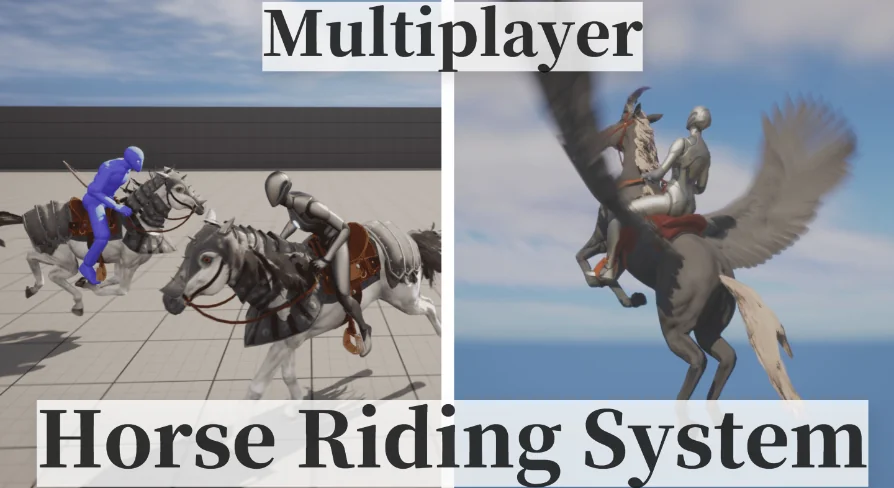
For wyvern-based flight scenarios, the required asset shifts to Irval the Wyvern. The system itself demonstrates its range by supporting both grounded horse travel and aerial wyvern riding through the same component architecture, adjusting movement mode rather than swapping to a different technical approach for each creature type.
Animal Movement: Ground and Flight Through BlendSpaces
The Animal Movement component reads a BlendSpace provided by the developer and plays different animations based on the creature's current speed. This means the visual selection of gaits—walk, trot, gallop, or flight strides—happens automatically once the BlendSpace is connected. Speed and rotation values are configurable, letting designers tune how sharply a horse turns at a canter or how quickly a wyvern banks during flight without touching the animation logic itself.
The component supports both ground and fly movement modes. Switching between them lets a creature transition from running across terrain to taking to the air, a behavior demonstrated in the Irval the Wyvern showcase. Version 1.5 added swimming support, broadening the movement states beyond solid ground and open sky to include water traversal.
Mount and Riding Component: Possession and Camera Transitions
The Mount and Riding component governs the act of getting onto and controlling a creature. It handles the riding setup so that once a character is mounted, control shifts cleanly to the creature's movement model. A specific feature called out is smooth camera transition during possession. This is noted as useful within the Advanced Locomotion System (ALS), meaning the camera blend is designed to integrate with ALS rather than fighting its existing camera behavior.
Version 1.5 introduced Cmpt_Horse and Cmpt_HorseRider components. These were added to ease integration, giving developers structured entry points for connecting a Horse Actor and a Rider Actor without building the linkage from scratch. The components encapsulate the setup so that the connection between mount and rider is defined through the component system rather than through ad-hoc Blueprint wiring.
Tutorial Coverage Across Project Types
The system is documented through a set of video tutorials that map to different project scales and starting points. A seed project tutorial covers UE4 and UE5. A UE5 skeleton tutorial addresses the newer engine version specifically. For teams building on the Advanced Locomotion System V4, a dedicated tutorial covers integration across both UE4 and UE5.
For survival-oriented gameplay, the EasySurvival RPG tutorials cover both standalone and multiplayer implementations in UE4 and UE5. This pairing matters because the riding system's component approach is meant to drop into existing character frameworks rather than replace them. The tutorials demonstrate how to connect the riding components to locomotion setups that already define the player's on-foot behavior.
UE4 and UE5: Animation Blueprint Template Differences
Unreal Engine 4 and Unreal Engine 5 handle certain animation linkage mechanics differently, and the riding system accounts for this. The difference stems from UE5's use of Animation Blueprint Templates. The project tutorials reference this distinction, and the documentation points to the official Unreal Engine 5 material on Animation Blueprint linking for the underlying technical context.
The UE4 version of the system is distributed through the developer's Discord rather than the marketplace. Teams targeting UE4 specifically need to retrieve it through that channel. Version 1.5.1, released on December 18, 2022, fixed a bug that occurred when a client joined a session, addressing a networked multiplayer scenario relevant to the EasySurvival RPG multiplayer tutorials.
Pegasus, Wyverns, and the Broader Creature Scope
While the system is named around horse riding, its demonstrated use cases extend to winged creatures. The Horse Riding and Pegasus showcase and the Irval the Wyvern showcase both appear in the project materials. These demonstrations indicate that the Mount and Riding component and the Animal Movement component are not locked to quadruped ground movement. The flight support in the Animal Movement component, combined with the BlendSpace-driven speed-based animation playback, lets a team apply the same mounting and riding logic to a flying creature provided the animation set supports the movement states the system expects.
The older Horse Riding System Example Project at version 1.4.3 is flagged as not recommended. Teams starting fresh are directed toward the newer version 1.5 track and its accompanying tutorials. The example project formally required Horse Animset as well, reinforcing that the animation dependency is consistent across both the current and legacy offerings.
Compatibility and Integration Points
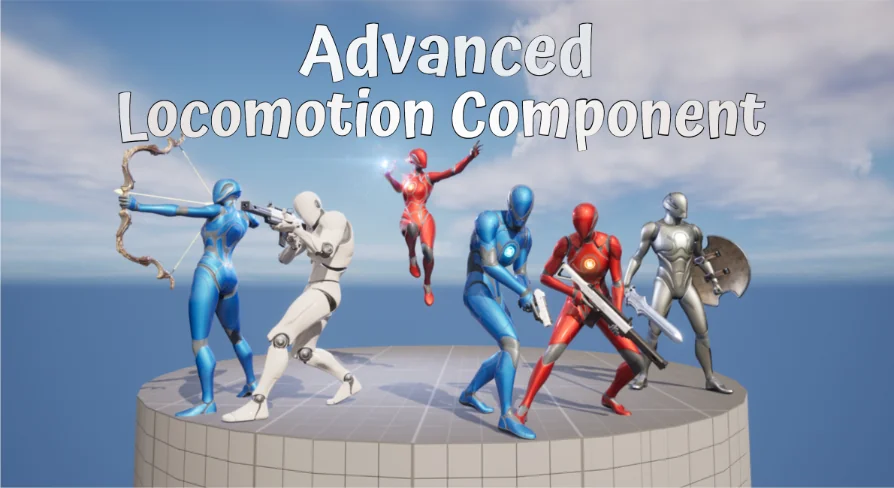
The riding system is compatible with Advanced Locomotion Component v2.4. This alignment matters because the smooth camera transition during possession is specifically called out as a feature for use within ALS. Teams already running ALS for their player character movement can treat the riding system as an extension that activates when the player mounts a creature, then deactivates when they dismount.
The tag set associated with the system—Mount, Component, Rider, Ride, Actor, Archery, process, Dragon, Blueprint, Horse—reflects the intended scope. Archery suggests mounted combat scenarios where a rider needs to aim and fire from a moving creature. Dragon and Horse together signal that the framework is built to accommodate both fantastical flying mounts and realistic equine traversal under the same component roof.
For teams evaluating this asset: it provides the mounting logic, movement state management, and BlendSpace-driven animation selection for rideable creatures, while requiring that teams supply the creatures and their animations themselves. The integration path runs through ALS-compatible components and a tutorial set covering seed projects, skeleton setups, and survival RPG multiplayer implementations.
 Gameplay Features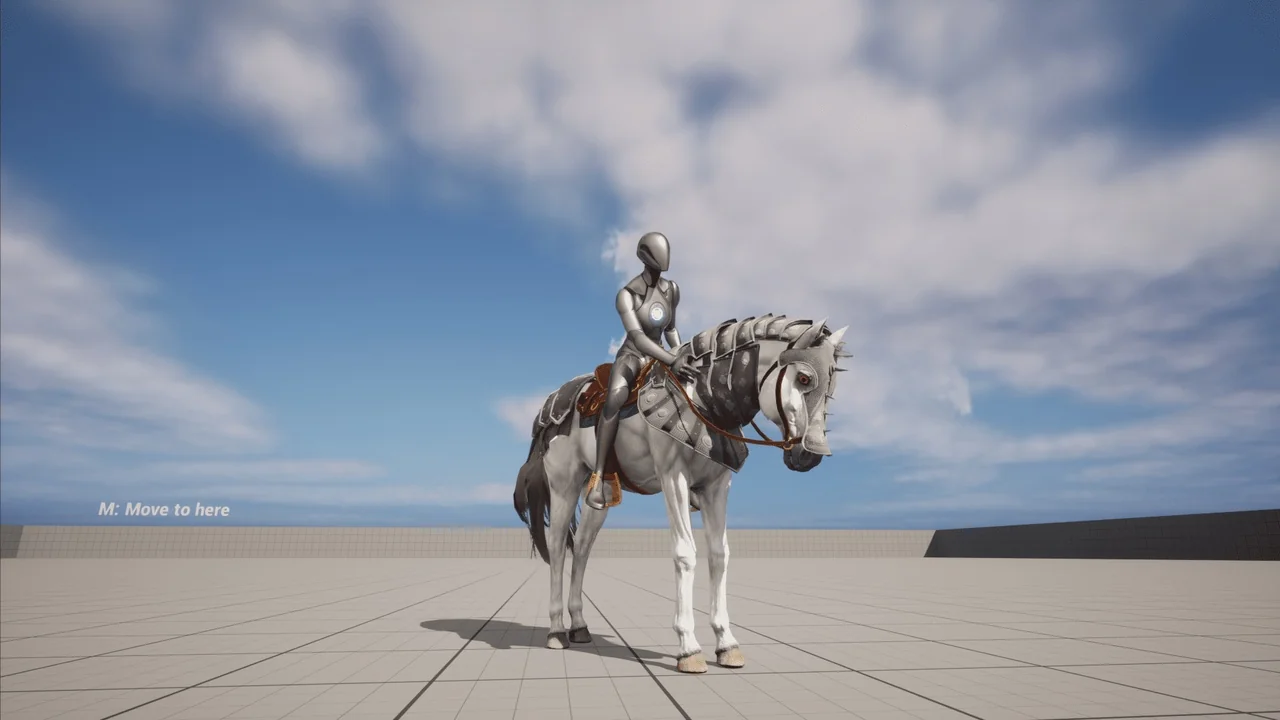
 Gameplay Features
 Gameplay Features
 Gameplay Features