"1a0e4ac4dc71d030"{"id":"1000155","slug":"advanced-modeling-techniques-for-aaa-assets-in-unreal-engine","title":"Advanced Modeling Techniques for AAA Assets in Unreal Engine","category":"Unreal Engine","engine":"File Content: video + English subtitles","assetVersion":"Video Language: English","engineVersion":"File Content: video + English subtitles","tag":"Unreal Engine","accent":"blue","visual":"mech","summary":"An intermediate Unreal Engine 5 course focused on AAA modeling for modular environment assets, UV mapping, art principles, and Nanite displacement.","platform":"Unreal Engine","publishedAt":"2026-06-18T21:55:27.675Z","updatedAt":"2026-06-18T21:55:27.675Z","sourceNotes":[],"fileContents":[],"compatibility":["Unreal Engine","Video Language: English","File Content: video + English subtitles"],"featuredImage":{"alt":"Advanced Modeling Techniques for AAA Assets in Unreal Engine","src":"/wp-content/uploads/published/2026/06/ab3fdf97eac6-6777151-209c-e4135fd71e.webp"},"hasDownloadLink":true,"downloads":0,"terms":[{"taxonomy":"category","slug":"tutoriallibrary-unrealengine","name":"Unreal Engine"}],"galleryImages":[],"accessPanel":{"kind":"video-resource","title":"Download this video resource","eyebrow":"Free Download","message":"Log in or create a free account to start your download.","fileName":"1 - Advanced Modeling Techniques for AAA Assets in Unreal Engine 5.7z","safetyNote":"Resources are manually reviewed before listing to improve quality and reduce obvious risks.","actionLabel":"Download Free","resourceType":"Video download"},"contentHtml":"\u003cp\u003eLarge game environments are rarely made from one-off props alone. They come together through repeatable pieces, careful detail decisions, and workflows that let artists push visual quality without losing control of the asset itself. \u003cstrong\u003eAdvanced Modeling Techniques for AAA Assets in Unreal Engine\u003c/strong\u003e Is aimed squarely at that kind of work, teaching professional techniques used in the game industry to create high quality environment assets.\u003c/p\u003e \u003cp\u003eThe course sits in the intermediate range and runs for 4 hours and 58 minutes. It is taught by Mao Mao and centers its curriculum on advanced modeling techniques for AAA assets in Unreal Engine 5. Rather than spreading itself across many unrelated subjects, it keeps a tight focus on environment production, especially the methods that support modular scene building and higher fidelity surface detail.\u003c/p\u003e \u003ch2\u003eAAA environment assets start with modular modeling\u003c/h2\u003e\n\u003cp\u003eOne of the clearest takeaways here is the emphasis on \u003cstrong\u003eAAA modeling techniques for modular environment pieces\u003c/strong\u003e. That focus matters because modular work is a practical foundation for building larger scenes. Environment artists often need pieces that can be reused, combined, and adjusted across a broader setting, and this course places that approach at the center instead of treating it as a side topic.\u003c/p\u003e \u003cp\u003eBy concentrating on modular environment pieces, the training is positioned around the kind of asset creation that supports consistent scene assembly. The attention stays on quality, which aligns with the course’s stated goal of helping artists create high quality environment assets. That makes the material especially relevant for scenes where structure, repetition, and cohesion matter as much as the individual model.\u003c/p\u003e \u003cp\u003eThere is also a clear difference between simply modeling an object and developing it with a production-minded standard. The AAA angle suggests a focus on methods that hold up in professional game art workflows. Within the limits of the published details, that means the course is less about casual experimentation and more about shaping environment pieces in a way that fits a higher-end visual target.\u003c/p\u003e \u003ch2\u003eArt principles for deciding where detail belongs\u003c/h2\u003e\n\u003cp\u003eModeling quality is not only about adding more geometry or surface complexity. This course also teaches \u003cstrong\u003eArt principles to decide how to add details to an asset\u003c/strong\u003e, which gives it a strong decision-making layer rather than treating detail as automatic decoration. That is an important distinction for environment art, where the placement and amount of detail can change how readable an asset feels inside a larger scene.\u003c/p\u003e \u003cp\u003eFor an aspiring environment artist, this part of the curriculum helps connect form and judgment. It is one thing to know how to make a model more complex; it is another to understand why certain areas deserve emphasis and others should stay restrained. The stated learning outcome points to that kind of visual reasoning. Instead of treating detail as a blanket pass applied evenly everywhere, the course addresses how to decide where those additions belong.\u003c/p\u003e \u003cp\u003eThis makes the material useful for artists who are trying to move beyond basic asset creation into work that feels more deliberate. High quality environment assets depend on choices, not just tools, and the course directly includes that principle-based side of the process. For production work, that can help when building modular pieces that need to look strong on their own while still fitting into a larger environment without becoming visually noisy.\u003c/p\u003e \u003ch2\u003eUV Mapping inside Unreal Engine 5\u003c/h2\u003e\n\u003cp\u003eAnother concrete part of the course is its inclusion of \u003cstrong\u003eUV Mapping inside Unreal Engine 5\u003c/strong\u003e. That detail gives the training a defined technical anchor within the Unreal Engine 5 workflow, rather than limiting itself to broader modeling discussion. The course name already points to Unreal Engine, and this specific topic confirms that Unreal Engine 5 is part of the hands-on learning path.\u003c/p\u003e \u003cp\u003eUV mapping is one of the supporting systems that can strongly affect how an asset behaves in production. Including it in an environment-focused modeling course keeps the material grounded in the practical requirements of asset preparation. For someone building modular environment pieces, that means the course is not only concerned with shape and visible detail, but also with an essential stage of preparing assets inside the engine context named in the curriculum.\u003c/p\u003e \u003cp\u003eThe wording is also specific: UV mapping \u003cem\u003eInside\u003c/em\u003e Unreal Engine 5. That suggests the course is attentive to doing this work within the engine environment itself, which can be especially useful for artists who want their modeling workflow to stay closely tied to the final runtime context. Since the stated curriculum remains focused on Unreal Engine 5, this topic helps connect advanced modeling techniques to engine-side asset handling rather than separating them into isolated steps.\u003c/p\u003e \u003ch2\u003eNanite Displacement tools and next gen model detail\u003c/h2\u003e\n\u003cp\u003eThe course also covers \u003cstrong\u003eNew Nanite Displacement tools\u003c/strong\u003e To quickly add next gen detail to models. This is one of the most distinct technical points in the course outline because it identifies not just a general feature area, but a named toolset and its intended benefit: adding detail quickly.\u003c/p\u003e \u003cp\u003eThat makes this part especially relevant for environment artists working toward richer surfaces and more advanced model presentation in Unreal Engine 5. The language around next gen detail ties the course to contemporary visual expectations, while the emphasis on speed suggests a workflow benefit rather than a purely theoretical explanation. Within the information provided, this is one of the clearest examples of the course focusing on methods that can increase visual complexity efficiently.\u003c/p\u003e \u003cp\u003ePlaced alongside the modular modeling and UV mapping topics, Nanite displacement broadens the course from structural asset creation into higher-detail finishing work. It rounds out a learning path where an artist begins with modular environment pieces, thinks carefully about where detail should be introduced, and then uses Unreal Engine 5 tools to push that detail further.\u003c/p\u003e \u003cp\u003eFor scene work, that combination is easy to understand. Modular pieces establish the environment. Art principles guide how much detail those pieces should carry. UV mapping supports the asset workflow in Unreal Engine 5. Nanite displacement becomes a way to introduce next generation detail more quickly. Even without adding claims beyond the stated curriculum, that sequence forms a coherent environment-art pipeline.\u003c/p\u003e \u003ch2\u003eWhere Advanced Modeling Techniques for AAA Assets in Unreal Engine fits best\u003c/h2\u003e\n\u003cp\u003eThis course is aimed at \u003cstrong\u003eAspiring Environment Artists who want to enter the AAA Game Industry\u003c/strong\u003e. That target audience is specific, and it helps define who will benefit most from the material. The course is not framed as an all-level introduction to 3D art in general. It is an intermediate course with a clear environment-art direction and a professional-quality goal.\u003c/p\u003e \u003cp\u003eBecause the training focuses on high quality environment assets, it is most useful for projects where the artist needs more than a basic prop workflow. It suits scene construction built from modular pieces, especially when the artist wants stronger control over detail choices and wants to work within Unreal Engine 5. The inclusion of Nanite displacement also makes it relevant for cases where added model detail is part of the visual target.\u003c/p\u003e \u003cp\u003eThe runtime of 4 hours and 58 minutes suggests a compact, focused course rather than a sprawling multi-topic program. That can be a good fit for artists who want a concentrated block of instruction around one production area: advanced environment asset modeling in Unreal Engine 5. With Mao Mao teaching and the curriculum staying locked on advanced modeling techniques for AAA assets, the course keeps its purpose narrow and easy to place within a larger learning path.\u003c/p\u003e \u003cp\u003eIf your work is moving toward modular environment creation, Unreal Engine 5 UV workflows, and faster methods for adding next gen model detail, this course is most closely aligned with that direction. It is best suited to aspiring environment artists who already have enough grounding to step into intermediate material and want their skills pointed toward AAA environment production.\u003c/p\u003e\n\n\u003ch2\u003eRelated Resources Worth Checking\u003c/h2\u003e\n\u003cul\u003e\n\u003cli\u003e\u003ca href=\"https://3dcghub.com/aaa-game-environment-creation-in-unreal-engine-5/\" title=\"AAA Game Environment Creation in Unreal Engine 5\"\u003eAAA Game Environment Creation in Unreal Engine 5\u003c/a\u003e\u003c/li\u003e\n\u003cli\u003e\u003ca href=\"https://3dcghub.com/3d-pool-in-ue5-c-aaa-quality-beginner-to-advance/\" title=\"3D pool in UE5 C++ AAA Quality (Beginner to Advance)\"\u003e3D pool in UE5 C++ AAA Quality (Beginner to Advance)\u003c/a\u003e\u003c/li\u003e\n\u003cli\u003e\u003ca href=\"https://3dcghub.com/unreal-engine-5-5-the-ultimate-cinematic-masterclass/\" title=\"Unreal Engine 5.5 - The Ultimate Cinematic Masterclass\"\u003eUnreal Engine 5.5 - The Ultimate Cinematic Masterclass\u003c/a\u003e\u003c/li\u003e\n\u003cli\u003e\u003ca href=\"https://3dcghub.com/the-ultimate-guide-to-unreal-engine-5-for-complete-beginners/\" title=\"The Ultimate Guide to Unreal Engine 5 For Complete Beginners\"\u003eThe Ultimate Guide to Unreal Engine 5 For Complete Beginners\u003c/a\u003e\u003c/li\u003e\n\u003cli\u003e\u003ca href=\"https://3dcghub.com/unreal-engine-5-c-advanced-action-rpg/\" title=\"Unreal Engine 5 C++: Advanced Action RPG\"\u003eUnreal Engine 5 C++: Advanced Action RPG\u003c/a\u003e\u003c/li\u003e\n\u003c/ul\u003e","contentTextLength":8542,"navigation":{"current":1148,"total":3200,"previous":{"id":"1000156","slug":"volumetric-glass","title":"Volumetric Glass","category":"Shaders","platform":"Unreal Engine","updatedAt":"2026-06-18T22:24:38.713Z"},"next":{"id":"1000154","slug":"eos-integration-kit","title":"EOS Integration Kit","category":"Network \u0026 Multiplayer","platform":"Unreal Engine","updatedAt":"2026-06-18T21:44:15.499Z"}},"relatedResources":[{"id":"1000556","slug":"master-unreal-engine-5-build-any-game-with-blueprint-and-c","title":"Master Unreal Engine 5: Build Any Game with Blueprint \u0026 C++","category":"Unreal Engine","engine":"File Content: video + English subtitles","assetVersion":"Video Language: English","engineVersion":"File Content: video + English subtitles","tag":"Unreal Engine","accent":"blue","visual":"mech","summary":"Build any game in Unreal Engine 5 using Blueprint and C++. Learn multiplayer networking, UMG UI, materials, modeling tools, and packaging across 13 hours.","platform":"Unreal Engine","publishedAt":"2026-07-15T16:49:38.751Z","updatedAt":"2026-07-15T16:49:38.751Z","sourceNotes":[],"fileContents":[],"compatibility":["Unreal Engine","Video Language: English","File Content: video + English subtitles"],"featuredImage":{"alt":"Master Unreal Engine 5: Build Any Game with Blueprint \u0026 C++","src":"/wp-content/uploads/published/2026/07/167dd95e84d7-6120743-8adb-4-ba02c71b99.webp"},"hasDownloadLink":true,"downloads":1},{"id":"1000748","slug":"unreal-engine-aaa-spellcasting-system","title":"Unreal Engine AAA Spellcasting System","category":"Unreal Engine","engine":"File Content: video + English subtitles","assetVersion":"Video Language: English","engineVersion":"File Content: video + English subtitles","tag":"Unreal Engine","accent":"blue","visual":"mech","summary":"A 100% Blueprint spellcasting course covering cooldown systems, cinematic hero intros, and signature abilities like Dragon Transformation for RPG and fantasy ga","platform":"Unreal Engine","publishedAt":"2026-07-27T13:24:24.308Z","updatedAt":"2026-07-27T13:24:24.308Z","sourceNotes":[],"fileContents":[],"compatibility":["Unreal Engine","Video Language: English","File Content: video + English subtitles"],"featuredImage":{"alt":"Unreal Engine AAA Spellcasting System","src":"/wp-content/uploads/published/2026/07/ebed083ff01f-6571001-a993-6-a5372b57cb.webp"},"hasDownloadLink":true,"downloads":0},{"id":"1000743","slug":"environment-design-in-unreal-engine-5-5-from-basics-to-pro","title":"Environment Design in Unreal Engine 5.5 – From Basics to Pro","category":"Unreal Engine","engine":"File Content: video + English subtitles","assetVersion":"Video Language: English","engineVersion":"File Content: video + English subtitles","tag":"Unreal Engine","accent":"blue","visual":"city","summary":"Build cinematic real-time 3D environments in Unreal Engine 5.5. Learn landscape sculpting, Megascans integration, lighting, and post-processing techniques.","platform":"Unreal Engine","publishedAt":"2026-07-27T12:02:43.552Z","updatedAt":"2026-07-27T12:02:43.552Z","sourceNotes":[],"fileContents":[],"compatibility":["Unreal Engine","Video Language: English","File Content: video + English subtitles"],"featuredImage":{"alt":"Environment Design in Unreal Engine 5.5 – From Basics to Pro","src":"/wp-content/uploads/published/2026/07/4ee3e4b4ccf2-6668023-deb3-50717e4e41.webp"},"hasDownloadLink":true,"downloads":0}]}
Unreal Engine
Advanced Modeling Techniques for AAA Assets in Unreal Engine
An intermediate Unreal Engine 5 course focused on AAA modeling for modular environment assets, UV mapping, art principles, and Nanite displacement.
Category:Unreal EnginePlatform: Unreal EngineVideo Language: EnglishFile Content: video + English subtitlesPublished: Jun 18, 2026
Unreal Engine
Resource overview
Large game environments are rarely made from one-off props alone. They come together through repeatable pieces, careful detail decisions, and workflows that let artists push visual quality without losing control of the asset itself. Advanced Modeling Techniques for AAA Assets in Unreal Engine Is aimed squarely at that kind of work, teaching professional techniques used in the game industry to create high quality environment assets.
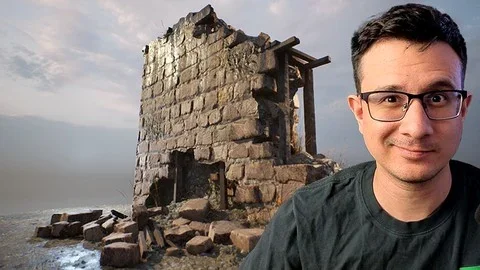
The course sits in the intermediate range and runs for 4 hours and 58 minutes. It is taught by Mao Mao and centers its curriculum on advanced modeling techniques for AAA assets in Unreal Engine 5. Rather than spreading itself across many unrelated subjects, it keeps a tight focus on environment production, especially the methods that support modular scene building and higher fidelity surface detail.
AAA environment assets start with modular modeling
One of the clearest takeaways here is the emphasis on AAA modeling techniques for modular environment pieces. That focus matters because modular work is a practical foundation for building larger scenes. Environment artists often need pieces that can be reused, combined, and adjusted across a broader setting, and this course places that approach at the center instead of treating it as a side topic.
By concentrating on modular environment pieces, the training is positioned around the kind of asset creation that supports consistent scene assembly. The attention stays on quality, which aligns with the course’s stated goal of helping artists create high quality environment assets. That makes the material especially relevant for scenes where structure, repetition, and cohesion matter as much as the individual model.
There is also a clear difference between simply modeling an object and developing it with a production-minded standard. The AAA angle suggests a focus on methods that hold up in professional game art workflows. Within the limits of the published details, that means the course is less about casual experimentation and more about shaping environment pieces in a way that fits a higher-end visual target.
Art principles for deciding where detail belongs
Modeling quality is not only about adding more geometry or surface complexity. This course also teaches Art principles to decide how to add details to an asset, which gives it a strong decision-making layer rather than treating detail as automatic decoration. That is an important distinction for environment art, where the placement and amount of detail can change how readable an asset feels inside a larger scene.
For an aspiring environment artist, this part of the curriculum helps connect form and judgment. It is one thing to know how to make a model more complex; it is another to understand why certain areas deserve emphasis and others should stay restrained. The stated learning outcome points to that kind of visual reasoning. Instead of treating detail as a blanket pass applied evenly everywhere, the course addresses how to decide where those additions belong.
This makes the material useful for artists who are trying to move beyond basic asset creation into work that feels more deliberate. High quality environment assets depend on choices, not just tools, and the course directly includes that principle-based side of the process. For production work, that can help when building modular pieces that need to look strong on their own while still fitting into a larger environment without becoming visually noisy.
UV Mapping inside Unreal Engine 5
Another concrete part of the course is its inclusion of UV Mapping inside Unreal Engine 5. That detail gives the training a defined technical anchor within the Unreal Engine 5 workflow, rather than limiting itself to broader modeling discussion. The course name already points to Unreal Engine, and this specific topic confirms that Unreal Engine 5 is part of the hands-on learning path.
UV mapping is one of the supporting systems that can strongly affect how an asset behaves in production. Including it in an environment-focused modeling course keeps the material grounded in the practical requirements of asset preparation. For someone building modular environment pieces, that means the course is not only concerned with shape and visible detail, but also with an essential stage of preparing assets inside the engine context named in the curriculum.
The wording is also specific: UV mapping Inside Unreal Engine 5. That suggests the course is attentive to doing this work within the engine environment itself, which can be especially useful for artists who want their modeling workflow to stay closely tied to the final runtime context. Since the stated curriculum remains focused on Unreal Engine 5, this topic helps connect advanced modeling techniques to engine-side asset handling rather than separating them into isolated steps.
Nanite Displacement tools and next gen model detail
The course also covers New Nanite Displacement tools To quickly add next gen detail to models. This is one of the most distinct technical points in the course outline because it identifies not just a general feature area, but a named toolset and its intended benefit: adding detail quickly.
That makes this part especially relevant for environment artists working toward richer surfaces and more advanced model presentation in Unreal Engine 5. The language around next gen detail ties the course to contemporary visual expectations, while the emphasis on speed suggests a workflow benefit rather than a purely theoretical explanation. Within the information provided, this is one of the clearest examples of the course focusing on methods that can increase visual complexity efficiently.
Placed alongside the modular modeling and UV mapping topics, Nanite displacement broadens the course from structural asset creation into higher-detail finishing work. It rounds out a learning path where an artist begins with modular environment pieces, thinks carefully about where detail should be introduced, and then uses Unreal Engine 5 tools to push that detail further.
For scene work, that combination is easy to understand. Modular pieces establish the environment. Art principles guide how much detail those pieces should carry. UV mapping supports the asset workflow in Unreal Engine 5. Nanite displacement becomes a way to introduce next generation detail more quickly. Even without adding claims beyond the stated curriculum, that sequence forms a coherent environment-art pipeline.
Where Advanced Modeling Techniques for AAA Assets in Unreal Engine fits best
This course is aimed at Aspiring Environment Artists who want to enter the AAA Game Industry. That target audience is specific, and it helps define who will benefit most from the material. The course is not framed as an all-level introduction to 3D art in general. It is an intermediate course with a clear environment-art direction and a professional-quality goal.
Because the training focuses on high quality environment assets, it is most useful for projects where the artist needs more than a basic prop workflow. It suits scene construction built from modular pieces, especially when the artist wants stronger control over detail choices and wants to work within Unreal Engine 5. The inclusion of Nanite displacement also makes it relevant for cases where added model detail is part of the visual target.
The runtime of 4 hours and 58 minutes suggests a compact, focused course rather than a sprawling multi-topic program. That can be a good fit for artists who want a concentrated block of instruction around one production area: advanced environment asset modeling in Unreal Engine 5. With Mao Mao teaching and the curriculum staying locked on advanced modeling techniques for AAA assets, the course keeps its purpose narrow and easy to place within a larger learning path.
If your work is moving toward modular environment creation, Unreal Engine 5 UV workflows, and faster methods for adding next gen model detail, this course is most closely aligned with that direction. It is best suited to aspiring environment artists who already have enough grounding to step into intermediate material and want their skills pointed toward AAA environment production.
 Unreal Engine
 Unreal Engine
 Unreal Engine
 Unreal Engine