"1a0e4ac4dc71d030"{"id":"1000156","slug":"volumetric-glass","title":"Volumetric Glass","category":"Shaders","engine":"4.26+,5.0+","assetVersion":"","engineVersion":"Engine Version: 4.26+,5.0+","tag":"Shaders","accent":"blue","visual":"mech","summary":"Volumetric Glass is a master material for underwater volume and shaped glass, optimized for VR, PC/Console, and mobile sci-fi scenes.","platform":"Unreal Engine","publishedAt":"2026-06-18T22:24:38.713Z","updatedAt":"2026-06-18T22:24:38.713Z","sourceNotes":[],"fileContents":[],"compatibility":["Unreal Engine","Engine Version: 4.26+,5.0+"],"featuredImage":{"alt":"Volumetric Glass","src":"/wp-content/uploads/published/2026/06/e17367fbe13f-98b3ac2f-dae2-4afb-af8c-205793d089f6-eb59282112.webp"},"hasDownloadLink":true,"downloads":0,"terms":[{"taxonomy":"category","slug":"shaders","name":"Shaders"}],"galleryImages":[{"src":"/wp-content/uploads/published/2026/06/a55e83ca12a9-8346dc6d-f4ba-40e1-92c1-d48c265e6c6d-73babe97ff.webp","alt":"Volumetric Glass"},{"src":"/wp-content/uploads/published/2026/06/b6468ebe605d-ddd02257-1485-41ba-892e-9e5a33097137-96ff5fd27f.webp","alt":"Volumetric Glass"},{"src":"/wp-content/uploads/published/2026/06/24da5f3125ec-c232daff-6973-4831-abe7-24f77318bf71-7bef5812ed.webp","alt":"Volumetric Glass"},{"src":"/wp-content/uploads/published/2026/06/a5456c0239db-7918cf99-03e9-4a4a-9e3b-ba5e05a96464-02b371a595.webp","alt":"Volumetric Glass"},{"src":"/wp-content/uploads/published/2026/06/fa7042e6d1f7-a83fb81d-269e-4b2d-bf33-d290d45f134a-4380bfeb35.webp","alt":"Volumetric Glass"},{"src":"/wp-content/uploads/published/2026/06/640a6e265b02-274515bf-db30-4dd0-a827-7b900735fe2f-92855fc9d9.webp","alt":"Volumetric Glass"},{"src":"/wp-content/uploads/published/2026/06/79852406de87-4316d57a-323c-4b87-bde5-42a608883355-688700acab.webp","alt":"Volumetric Glass"},{"src":"/wp-content/uploads/published/2026/06/f1f614726ed0-0fd12962-1e1c-4974-96c7-956641fbb137-d312569ac4.webp","alt":"Volumetric Glass"},{"src":"/wp-content/uploads/published/2026/06/5e723ed2656c-c7e4f3a8-f26d-404e-bd2c-dbcfe03adac0-cb77ce0a9a.webp","alt":"Volumetric Glass"},{"src":"/wp-content/uploads/published/2026/06/7382409f27fe-4c38dac8-93f3-4f71-8f60-72167d4a9ac1-f606147527.webp","alt":"Volumetric Glass"}],"accessPanel":{"kind":"resource","title":"Download this resource","eyebrow":"Free Download","message":"Log in or create a free account to start your download.","fileName":"Content.7z","safetyNote":"Resources are manually reviewed before listing to improve quality and reduce obvious risks.","actionLabel":"Download Free","resourceType":"Resource archive"},"contentHtml":"\u003cp\u003eWhen a scene needs more than a flat transparent surface, the usual glass workflow starts to break down. Water tanks, aquarium walls, underwater tunnels, and enclosed viewing windows all need a sense of depth inside the material itself, while still staying efficient enough for real-time use. Volumetric Glass targets that exact gap with an advanced master material built for rendering volumetric shapes and glass in a way that stays practical for production.\u003c/p\u003e\u003cp\u003eIts focus is firmly on sci-fi-style environments. The material is aimed at spaces such as water tanks, aquariums, underwater tunnels, and glass used in bathyscaphes, where the surface and the volume behind it need to work together instead of behaving like separate effects. The package is presented as balanced between quality and efficiency, with optimization specifically geared toward high-quality Virtual Reality and PC/Console games, while also remaining usable on mobile.\u003c/p\u003e\u003ch2\u003eHandling underwater volume and shaped glass in one setup\u003c/h2\u003e\u003cp\u003eVolumetric Glass includes two material types: underwater volume and shaped glass. That split makes its role in a workflow easy to place. One side covers the volumetric body of the effect, while the other supports the glass form that contains or frames it.\u003c/p\u003e\u003cp\u003eIn production terms, that means the package is not limited to a single look or a narrow hero prop. It can support enclosed underwater spaces and visible glass structures together, which is especially useful in scenes where players look through thick transparent forms into a fogged, light-filled interior. Instead of treating water, fog, and glass as disconnected layers, this setup gives environment work a more unified material approach.\u003c/p\u003e\u003ch2\u003eVolumetric Glass for tanks, aquariums, tunnels, and bathyscaphe windows\u003c/h2\u003e\u003cp\u003eThe scene examples attached to the package make its intended use very clear. It is tailored for sci-fi underwater spaces, including water tanks, aquariums, underwater tunnels, and glass in bathyscaphes.\u003c/p\u003e\u003cp\u003eThat range matters because each of those spaces asks for a slightly different kind of volume presentation. A tank may need controlled fog density and wet coloration. An aquarium wall may depend on reflections and scattering to sell thickness and enclosure. A tunnel needs volume that holds together across a long path, while a bathyscaphe window needs to work without precomputation so it can function as a practical viewing surface in an underwater setting. The package directly addresses those kinds of setups rather than treating volumetric glass as a purely decorative material.\u003c/p\u003e\u003cp\u003eAn example map reinforces this production angle by including both an underwater world and a sci-fi laboratory. Those two locations point to the asset’s place in environment development: it can serve large underwater spaces as well as more contained technical interiors where glass chambers, observation spaces, and experimental tanks are part of the visual language.\u003c/p\u003e\u003ch2\u003eShapes and spline tools that support real level-building\u003c/h2\u003e\u003cp\u003eVolumetric effects often become difficult to manage once a project moves from look development into actual layout work. This package answers that with support for multiple shapes: box, sphere, ellipse, cylinder, and mesh.\u003c/p\u003e\u003cp\u003eThat variety gives teams several ways to fit the material to scene geometry. A box can serve contained volumes and chambers. A sphere or ellipse can help with rounded tanks or stylized containers. A cylinder can fit tube-like structures. Mesh support opens the door to custom forms when standard primitives are not enough. The package then offers a material system that can follow the needs of the environment instead of forcing every space into one reusable shape.\u003c/p\u003e\u003cp\u003eThere is also a spline-based tunnel blueprint. For tunnel scenes, that is one of the most directly useful details in the package. Underwater passageways are rarely simple straight sections, and a spline workflow makes it easier to build continuous forms that read as navigable spaces rather than isolated assets. In a real project, that places Volumetric Glass not just in surface shading, but in actual level construction for underwater corridors and observation routes.\u003c/p\u003e\u003ch2\u003eControl over light shafts, fog density, scattering, and reflections\u003c/h2\u003e\u003cp\u003eThe package includes more than 70 parameters. That number alone suggests a material meant for active scene tuning rather than a one-click preset.\u003c/p\u003e\u003cp\u003eThe available controls cover light shafts, volumetrics, scattering, glass color, fog density, wet color, and reflections. Those are the visual levers that define whether a space feels sterile, murky, clinical, deep, or pressurized. In practice, this gives artists room to push the material toward different sci-fi moods without stepping outside the same core setup. A laboratory tank can lean on cleaner glass color and controlled reflections, while a tunnel or submerged habitat can use denser fog and stronger volumetric presence.\u003c/p\u003e\u003cp\u003eSeveral additional features support that same tuning process. The package includes high-quality fast scattering and fast box projected reflections, both of which speak to the material’s attempt to keep visual richness tied to efficiency. It also includes custom multi-channeled point lights, which adds another layer of lighting control for shaping how the volume reads in enclosed or stylized spaces.\u003c/p\u003e\u003cp\u003eAn animated clip plane surface extends the range further. Instead of leaving the volume static, that feature can help present changing surfaces and controlled animated transitions inside the effect. Vertex color-based texture masking adds more localized control, which is useful when artists need selective texture behavior on a model rather than a uniformly applied result.\u003c/p\u003e\u003ch2\u003eEfficiency targets for VR, PC/Console, and mobile\u003c/h2\u003e\u003cp\u003eVolumetric Glass puts unusual emphasis on performance for a material in this visual category. It is GPU-friendly and very efficient, using only 150 instructions.\u003c/p\u003e\u003cp\u003eThat matters most in the exact contexts the package targets: Virtual Reality, PC/Console games, and even mobile. Volumetric and transparent effects can become expensive quickly, especially in stereo rendering or scenes with multiple overlapping surfaces. By keeping the instruction count low and calling out mobile usability alongside VR, the package positions itself as something that can stay in a shipping workflow instead of remaining a showcase-only effect.\u003c/p\u003e\u003cp\u003eThe optimization focus also helps explain the package’s balance between quality and efficiency. This is not presented as a stripped-down substitute for visual depth. Its feature set still includes scattering, volumetrics, reflections, light shafts, and shape flexibility. The distinction is that those features are assembled with runtime use in mind, particularly for projects that need believable underwater glazing and enclosed volumes across interactive platforms.\u003c/p\u003e\u003ch2\u003eWhere Volumetric Glass fits beside other water surfaces\u003c/h2\u003e\u003cp\u003eNot every underwater scene is made from one material system alone. Volumetric Glass acknowledges that by being easy to integrate with other water surfaces such as Aquatic Surfaces.\u003c/p\u003e\u003cp\u003eThat makes it easier to place within a broader environment pipeline. Open water, surface layers, enclosed tanks, and viewing glass do not have to be forced into a single all-purpose shader. This package can handle the volumetric glass and contained underwater portions while still sitting next to external water solutions where needed. The absence of precomputation is another practical piece of that workflow, especially for an underwater bathyscaphe window where the material has to remain usable as a live viewing element rather than relying on a baked setup.\u003c/p\u003e\u003cp\u003eVolumetric Glass works best in productions that need controlled underwater volume inside real-time glass forms, especially when those scenes include tunnels, aquariums, tanks, laboratories, or submerged vehicles. It belongs in the stage where environment art, lighting, and performance concerns have to meet instead of being solved one at a time.\u003c/p\u003e\n\n\u003ch2\u003eContinue Browsing Similar Packs\u003c/h2\u003e\n\u003cul\u003e\n\u003cli\u003e\u003ca href=\"https://3dcghub.com/cyberpunk-fx-pack/\" title=\"Cyberpunk FX Pack\"\u003eCyberpunk FX Pack\u003c/a\u003e\u003c/li\u003e\n\u003cli\u003e\u003ca href=\"https://3dcghub.com/ultraglass-shader/\" title=\"ULTRAGlass Shader\"\u003eULTRAGlass Shader\u003c/a\u003e\u003c/li\u003e\n\u003cli\u003e\u003ca href=\"https://3dcghub.com/wall-fx-pack/\" title=\"Wall FX pack\"\u003eWall FX pack\u003c/a\u003e\u003c/li\u003e\n\u003cli\u003e\u003ca href=\"https://3dcghub.com/custom-motion-blur/\" title=\"Custom Motion Blur\"\u003eCustom Motion Blur\u003c/a\u003e\u003c/li\u003e\n\u003cli\u003e\u003ca href=\"https://3dcghub.com/slime-vfx/\" title=\"Slime VFX\"\u003eSlime VFX\u003c/a\u003e\u003c/li\u003e\n\u003c/ul\u003e","contentTextLength":8055,"navigation":{"current":1147,"total":3200,"previous":{"id":"1000157","slug":"soccer-ball-control-v0-41","title":"Soccer Ball Control v0.41","category":"Artificial Intelligence","platform":"Unreal Engine","updatedAt":"2026-06-18T22:27:28.132Z"},"next":{"id":"1000155","slug":"advanced-modeling-techniques-for-aaa-assets-in-unreal-engine","title":"Advanced Modeling Techniques for AAA Assets in Unreal Engine","category":"Unreal Engine","platform":"Unreal Engine","updatedAt":"2026-06-18T21:55:27.675Z"}},"relatedResources":[{"id":"1001185","slug":"advanced-glass-material-pack","title":"Advanced Glass Material Pack","category":"Shaders","engine":"5.0+","assetVersion":"","engineVersion":"Engine Version: 5.0+","tag":"Shaders","accent":"blue","visual":"luts","summary":"Examine the Advanced Glass Material Pack, featuring 5 glass types, over 35 material instances, vertex painting support, and 42 mask and normal textures.","platform":"Unreal Engine","publishedAt":"2026-09-17T06:34:49.942Z","updatedAt":"2026-09-17T06:34:49.942Z","sourceNotes":[],"fileContents":[],"compatibility":["Unreal Engine","Engine Version: 5.0+"],"featuredImage":{"alt":"Advanced Glass Material Pack","src":"/wp-content/uploads/published/2026/09/d991116315e2-090806c4-3f39-426d-8dfc-75300ddf461e-649af1b75b.webp"},"hasDownloadLink":true,"downloads":0},{"id":"1000894","slug":"stylized-volumetric-clouds-shader","title":"Stylized Volumetric Clouds Shader","category":"Shaders","engine":"5.0+","assetVersion":"","engineVersion":"Engine Version: 5.0+","tag":"Shaders","accent":"blue","visual":"mech","summary":"A stylized volumetric cloud shader with dynamic controls for color, density, movement, and lighting, built for games, cinematics, and immersive scenes.","platform":"Unreal Engine","publishedAt":"2026-08-06T04:43:20.840Z","updatedAt":"2026-08-06T04:43:20.840Z","sourceNotes":[],"fileContents":[],"compatibility":["Unreal Engine","Engine Version: 5.0+"],"featuredImage":{"alt":"Stylized Volumetric Clouds Shader","src":"/wp-content/uploads/published/2026/08/71d33757280e-2287f8a8-713f-42a2-951b-9f5332b68bb4-ac24eb472e.webp"},"hasDownloadLink":true,"downloads":0},{"id":"1000844","slug":"liquid-materials-vfx-pack","title":"LIQUID MATERIALS : VFX Pack","category":"Shaders","engine":"5.1+","assetVersion":"","engineVersion":"Engine Version: 5.1+","tag":"Shaders","accent":"blue","visual":"luts","summary":"LIQUID MATERIALS: VFX Pack provides 23 meshes, 13 glass materials, and 13 liquid materials with automatic Niagara-based real-time fluid animation for Unreal Eng","platform":"Unreal Engine","publishedAt":"2026-08-04T07:08:15.893Z","updatedAt":"2026-08-04T07:08:15.893Z","sourceNotes":[],"fileContents":[],"compatibility":["Unreal Engine","Engine Version: 5.1+"],"featuredImage":{"alt":"LIQUID MATERIALS : VFX Pack","src":"/wp-content/uploads/published/2026/08/031b6a53ab5b-856b12c0-66b3-4f90-9a63-103fd8b06400-4230560477.webp"},"hasDownloadLink":true,"downloads":2}]}
Shaders
Volumetric Glass
Volumetric Glass is a master material for underwater volume and shaped glass, optimized for VR, PC/Console, and mobile sci-fi scenes.
Category:Unreal Engine, ShadersPlatform: Unreal EngineEngine Version: 4.26+,5.0+Published: Jun 18, 2026
Shaders
Resource overview
When a scene needs more than a flat transparent surface, the usual glass workflow starts to break down. Water tanks, aquarium walls, underwater tunnels, and enclosed viewing windows all need a sense of depth inside the material itself, while still staying efficient enough for real-time use. Volumetric Glass targets that exact gap with an advanced master material built for rendering volumetric shapes and glass in a way that stays practical for production.
Its focus is firmly on sci-fi-style environments. The material is aimed at spaces such as water tanks, aquariums, underwater tunnels, and glass used in bathyscaphes, where the surface and the volume behind it need to work together instead of behaving like separate effects. The package is presented as balanced between quality and efficiency, with optimization specifically geared toward high-quality Virtual Reality and PC/Console games, while also remaining usable on mobile.
Handling underwater volume and shaped glass in one setup
Volumetric Glass includes two material types: underwater volume and shaped glass. That split makes its role in a workflow easy to place. One side covers the volumetric body of the effect, while the other supports the glass form that contains or frames it.
In production terms, that means the package is not limited to a single look or a narrow hero prop. It can support enclosed underwater spaces and visible glass structures together, which is especially useful in scenes where players look through thick transparent forms into a fogged, light-filled interior. Instead of treating water, fog, and glass as disconnected layers, this setup gives environment work a more unified material approach.
Volumetric Glass for tanks, aquariums, tunnels, and bathyscaphe windows
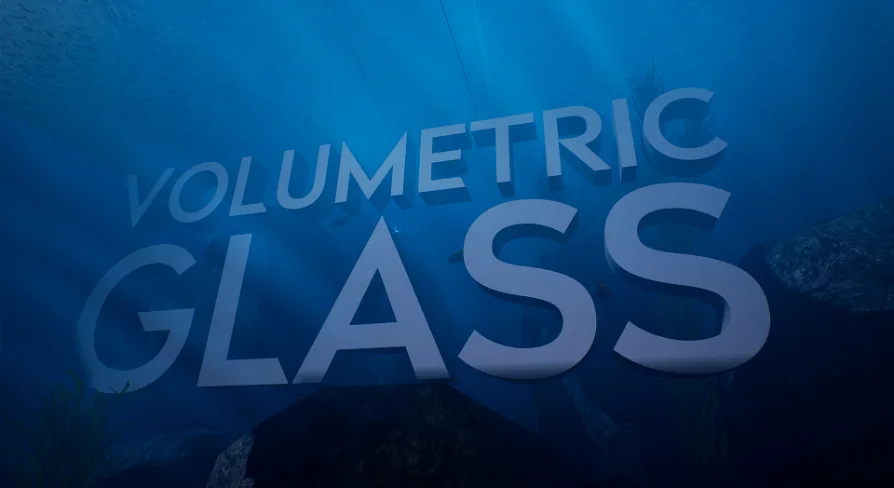
The scene examples attached to the package make its intended use very clear. It is tailored for sci-fi underwater spaces, including water tanks, aquariums, underwater tunnels, and glass in bathyscaphes.
That range matters because each of those spaces asks for a slightly different kind of volume presentation. A tank may need controlled fog density and wet coloration. An aquarium wall may depend on reflections and scattering to sell thickness and enclosure. A tunnel needs volume that holds together across a long path, while a bathyscaphe window needs to work without precomputation so it can function as a practical viewing surface in an underwater setting. The package directly addresses those kinds of setups rather than treating volumetric glass as a purely decorative material.
An example map reinforces this production angle by including both an underwater world and a sci-fi laboratory. Those two locations point to the asset’s place in environment development: it can serve large underwater spaces as well as more contained technical interiors where glass chambers, observation spaces, and experimental tanks are part of the visual language.
Shapes and spline tools that support real level-building
Volumetric effects often become difficult to manage once a project moves from look development into actual layout work. This package answers that with support for multiple shapes: box, sphere, ellipse, cylinder, and mesh.
That variety gives teams several ways to fit the material to scene geometry. A box can serve contained volumes and chambers. A sphere or ellipse can help with rounded tanks or stylized containers. A cylinder can fit tube-like structures. Mesh support opens the door to custom forms when standard primitives are not enough. The package then offers a material system that can follow the needs of the environment instead of forcing every space into one reusable shape.
There is also a spline-based tunnel blueprint. For tunnel scenes, that is one of the most directly useful details in the package. Underwater passageways are rarely simple straight sections, and a spline workflow makes it easier to build continuous forms that read as navigable spaces rather than isolated assets. In a real project, that places Volumetric Glass not just in surface shading, but in actual level construction for underwater corridors and observation routes.
Control over light shafts, fog density, scattering, and reflections
The package includes more than 70 parameters. That number alone suggests a material meant for active scene tuning rather than a one-click preset.
The available controls cover light shafts, volumetrics, scattering, glass color, fog density, wet color, and reflections. Those are the visual levers that define whether a space feels sterile, murky, clinical, deep, or pressurized. In practice, this gives artists room to push the material toward different sci-fi moods without stepping outside the same core setup. A laboratory tank can lean on cleaner glass color and controlled reflections, while a tunnel or submerged habitat can use denser fog and stronger volumetric presence.
Several additional features support that same tuning process. The package includes high-quality fast scattering and fast box projected reflections, both of which speak to the material’s attempt to keep visual richness tied to efficiency. It also includes custom multi-channeled point lights, which adds another layer of lighting control for shaping how the volume reads in enclosed or stylized spaces.
An animated clip plane surface extends the range further. Instead of leaving the volume static, that feature can help present changing surfaces and controlled animated transitions inside the effect. Vertex color-based texture masking adds more localized control, which is useful when artists need selective texture behavior on a model rather than a uniformly applied result.
Efficiency targets for VR, PC/Console, and mobile
Volumetric Glass puts unusual emphasis on performance for a material in this visual category. It is GPU-friendly and very efficient, using only 150 instructions.
That matters most in the exact contexts the package targets: Virtual Reality, PC/Console games, and even mobile. Volumetric and transparent effects can become expensive quickly, especially in stereo rendering or scenes with multiple overlapping surfaces. By keeping the instruction count low and calling out mobile usability alongside VR, the package positions itself as something that can stay in a shipping workflow instead of remaining a showcase-only effect.
The optimization focus also helps explain the package’s balance between quality and efficiency. This is not presented as a stripped-down substitute for visual depth. Its feature set still includes scattering, volumetrics, reflections, light shafts, and shape flexibility. The distinction is that those features are assembled with runtime use in mind, particularly for projects that need believable underwater glazing and enclosed volumes across interactive platforms.
Where Volumetric Glass fits beside other water surfaces
Not every underwater scene is made from one material system alone. Volumetric Glass acknowledges that by being easy to integrate with other water surfaces such as Aquatic Surfaces.
That makes it easier to place within a broader environment pipeline. Open water, surface layers, enclosed tanks, and viewing glass do not have to be forced into a single all-purpose shader. This package can handle the volumetric glass and contained underwater portions while still sitting next to external water solutions where needed. The absence of precomputation is another practical piece of that workflow, especially for an underwater bathyscaphe window where the material has to remain usable as a live viewing element rather than relying on a baked setup.
Volumetric Glass works best in productions that need controlled underwater volume inside real-time glass forms, especially when those scenes include tunnels, aquariums, tanks, laboratories, or submerged vehicles. It belongs in the stage where environment art, lighting, and performance concerns have to meet instead of being solved one at a time.
 Shaders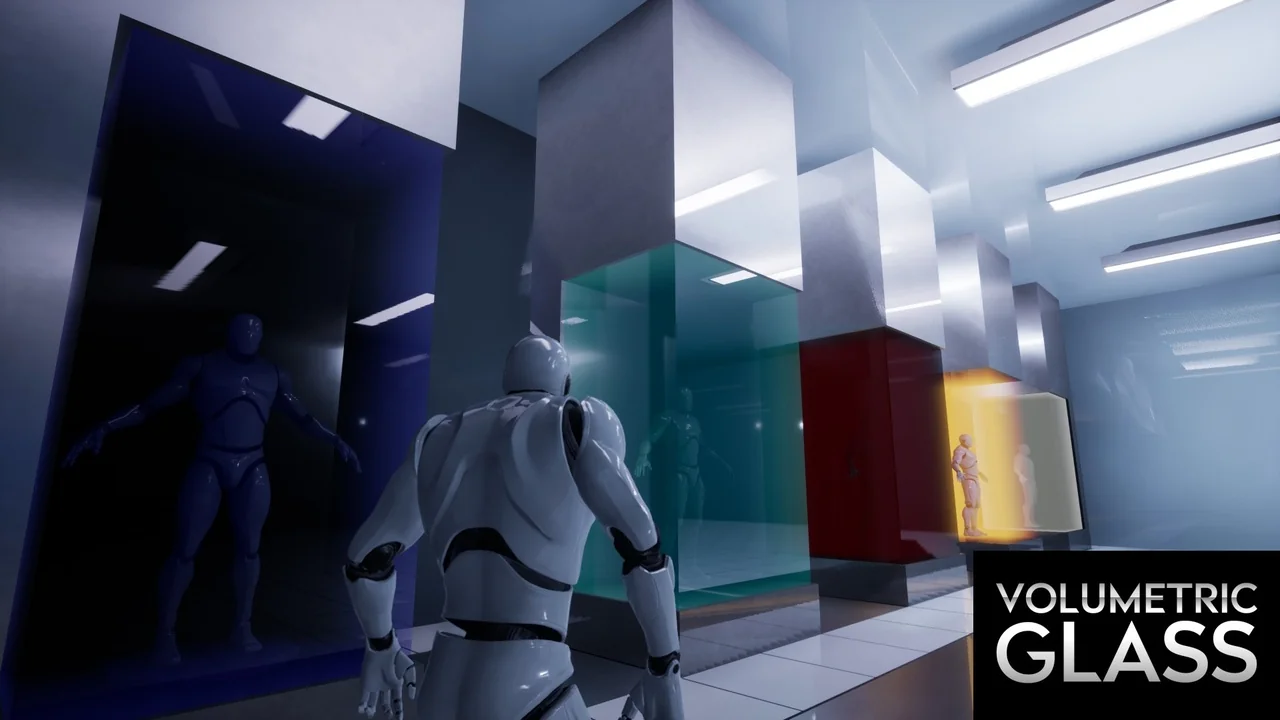
 Shaders
 Shaders
 Shaders