"177e4e4394b9ce1f"{"id":"1001574","slug":"advanced-landscape-material-ed-1","title":"Advanced Landscape Material Ed.1","category":"Nature \u0026 Terrain","engine":"5.5+","assetVersion":"","engineVersion":"Engine Version: 5.5+","tag":"Nature \u0026 Terrain","accent":"blue","visual":"luts","summary":"An advanced Unreal Engine multi-layer landscape material built with Substrate, Nanite Displacement, and per-layer subsurface scattering for snow and ice.","platform":"Unreal Engine","publishedAt":"2026-10-10T08:48:01.807Z","updatedAt":"2026-10-10T08:48:01.807Z","sourceNotes":[],"fileContents":[],"compatibility":["Unreal Engine","Engine Version: 5.5+"],"featuredImage":{"alt":"Advanced Landscape Material Ed.1","src":"/wp-content/uploads/published/2026/10/fff4ad2ebd1f-e96a267e-1f97-4716-8409-0ba58cbc9a4d-00c6217ed2.webp"},"hasDownloadLink":true,"downloads":0,"terms":[{"taxonomy":"category","slug":"nature-and-terrain","name":"Nature \u0026 Terrain"}],"galleryImages":[{"src":"/wp-content/uploads/published/2026/10/f7ff1e8e9a33-a182cbb1-df8f-47de-8411-ec25214ff11a-640454115d.webp","alt":"Advanced Landscape Material Ed.1"},{"src":"/wp-content/uploads/published/2026/10/faec7f0d7747-fd400734-4892-465f-9fa8-731b5287cd78-639fce3c77.webp","alt":"Advanced Landscape Material Ed.1"},{"src":"/wp-content/uploads/published/2026/10/6d6a8e653878-8ff0f373-6b06-4dcd-b899-93758e565243-9d53e5a1ed.webp","alt":"Advanced Landscape Material Ed.1"},{"src":"/wp-content/uploads/published/2026/10/712e8e7ef9ab-9b73490e-4122-4e86-862b-f66f51c647a3-9ae4370137.webp","alt":"Advanced Landscape Material Ed.1"}],"accessPanel":{"kind":"resource","title":"Download this resource","eyebrow":"Free Download","message":"Log in or create a free account to start your download.","fileName":"Advanced Landscape Material Ed.1.7z","safetyNote":"Resources are manually reviewed before listing to improve quality and reduce obvious risks.","actionLabel":"Download Free","resourceType":"Resource archive"},"contentHtml":"\u003ch2\u003eAchieving Physical Surface Depth on Unreal Engine Terrains\u003c/h2\u003e\u003cp\u003eBuilding believable natural ground surfaces frequently forces artists to navigate difficult trade-offs between rendering fidelity and workflow flexibility. Standard landscape shading setups often struggle to maintain believable physical presence when multiple distinct ground types intersect across an extensive terrain.\u003c/p\u003e\u003cp\u003eAdvanced Landscape Material Ed.1 resolves this operational tension by organizing modern Unreal Engine rendering features into a cohesive multi-layer landscape material. The material targets the specific demands of terrain creation, replacing flat approximations with rich structural definition and nuanced light response. By shifting away from standard monolithic material graphs, it provides environment artists with a reliable foundation for painting outdoor expanses where every layer preserves its intended material identity, whether representing hard earth, soft snow, or translucent ice sheets.\u003c/p\u003e\u003ch2\u003eSubstrate Architecture and Per-Layer Shader Profiles\u003c/h2\u003e\u003cp\u003eSubstrate replaces legacy shading assumptions with modular, physically aligned light transport behaviors.\u003c/p\u003e\u003cp\u003eIn Advanced Landscape Material Ed.1, the utilization of Substrate introduces per-layer shader profiles directly across the multi-layer framework. Standard engine materials traditionally require all painted landscape layers to share broad shading models, often resulting in compromised visual reads when disparate surfaces collide. Substrate allows individual terrain layers to calculate light according to their unique optical requirements. As artists paint distinct strata across hills, ravines, and plateaus, each layer processes incoming light through its own specialized shader profile, preserving crisp differentiation between completely different ground substances across a single unified terrain actor.\u003c/p\u003e\u003ch2\u003eNanite Displacement for Structural Landscape Detail\u003c/h2\u003e\u003cp\u003eTexture-based parallax and normal maps often fail to deliver convincing silhouettes when the camera approaches ground level.\u003c/p\u003e\u003cp\u003eBy integrating Nanite Displacement, this landscape material generates physical geometric depth directly out of the terrain surface. Displaced topology allows micro-peaks, ground crevices, and layered earth to protrude as true geometric volume, substantially increasing the physical depth and usability of the landscape during level design. Props, foliage, and character meshes rest against natural physical contours rather than floating above flat polygon planes masked by normal maps. This structural displacement operates in tandem with the multi-layer setup, letting individual painted layers manifest their own tactile surface volume across varied terrain forms.\u003c/p\u003e\u003ch2\u003eRendering Snow and Ice Layers with Subsurface Scattering\u003c/h2\u003e\u003cp\u003eCold biomes present serious shading hurdles because frozen matter does not interact with environmental lighting like dry soil or solid stone.\u003c/p\u003e\u003cp\u003eAdvanced Landscape Material Ed.1 directly incorporates subsurface scattering support, catering to snow, ice, and frozen terrain layers. Opaque ground surfaces reflect light directly at the surface boundary, whereas snow and ice require light to penetrate beneath the outer plane, diffuse internally, and exit at varying angles. Through dedicated subsurface properties embedded within its Substrate-driven structure, the material captures this internal illumination naturally. Snowdrifts gain their characteristic soft translucence rather than looking chalky, while ice patches maintain dense optical depth that responds convincingly to dynamic outdoor daylight.\u003c/p\u003e\u003ch2\u003eRapid Art Direction via Instanced Parameters and Volumetric Lighting\u003c/h2\u003e\u003cp\u003eFast iteration on world art requires immediate access to visual controls without the friction of compiling complex shader networks.\u003c/p\u003e\u003cp\u003eArtistic tuning is governed through an array of easy instanced parameters configured for quick and clear art direction. Environment teams can modify surface attributes, fine-tune layer behaviors, and balance visual contrasts directly inside lightweight material instances. The material also maintains compatibility with an Advanced Volumetric Light Function. This specific compatibility ensures that terrain surfaces interact cleanly with volumetric lighting setups, maintaining atmospheric harmony as fog, low-lying ground mist, and volumetric light shafts drift across the displaced landscape geometry.\u003c/p\u003e\u003ch2\u003eDeployment Across Modern Environment Pipelines\u003c/h2\u003e\u003cp\u003eDemanding natural environments require technical frameworks that actively leverage the engine's latest geometry and shading pipelines.\u003c/p\u003e\u003cp\u003eAdvanced Landscape Material Ed.1 serves as a practical, production-ready foundation for terrain construction in Unreal Engine projects. Combining Substrate shader profiles, Nanite Displacement, multi-layer functionality, and subsurface rendering for snow and ice, it removes the need to assemble complex next-generation ground shaders from scratch. Environment artists gain an integrated system that balances clear visual controls with modern rendering capabilities, accelerating the creation of detailed natural landscapes across diverse production settings.\u003c/p\u003e\n\n\u003ch2\u003eExplore Similar Assets\u003c/h2\u003e\n\u003cul\u003e\n\u003cli\u003e\u003ca href=\"https://3dcghub.com/grass-landscape-material-vol-i/\" title=\"Grass Landscape Material Vol. I\"\u003eGrass Landscape Material Vol. I\u003c/a\u003e\u003c/li\u003e\n\u003cli\u003e\u003ca href=\"https://3dcghub.com/forest-landscape-materials-vol-i/\" title=\"Forest Landscape Materials Vol.I\"\u003eForest Landscape Materials Vol.I\u003c/a\u003e\u003c/li\u003e\n\u003cli\u003e\u003ca href=\"https://3dcghub.com/forest-landscape-materials-vol-ii/\" title=\"Forest Landscape Materials Vol. II\"\u003eForest Landscape Materials Vol. II\u003c/a\u003e\u003c/li\u003e\n\u003cli\u003e\u003ca href=\"https://3dcghub.com/ground-material-texture-pack-advanced-materials-5-variations/\" title=\"Ground Material Texture Pack (Advanced Materials / 5 Variations)\"\u003eGround Material Texture Pack (Advanced Materials / 5 Variations)\u003c/a\u003e\u003c/li\u003e\n\u003cli\u003e\u003ca href=\"https://3dcghub.com/landscape-pro-2-0-auto-generated-material/\" title=\"Landscape Pro 2.0 Auto-Generated Material\"\u003eLandscape Pro 2.0 Auto-Generated Material\u003c/a\u003e\u003c/li\u003e\n\u003c/ul\u003e","contentTextLength":5332,"navigation":{"current":40,"total":3551,"previous":{"id":"1001575","slug":"cave-ruins-47-assets","title":"Cave Ruins / 47 Assets","category":"Environments","platform":"Unreal Engine","updatedAt":"2026-10-10T08:48:59.321Z"},"next":{"id":"1001573","slug":"ariana-character-p2","title":"Ariana Character P2","category":"Characters \u0026 Creatures","platform":"Unreal Engine","updatedAt":"2026-10-10T05:08:30.467Z"}},"relatedResources":[{"id":"1001211","slug":"grass-landscape-material-vol-i","title":"Grass Landscape Material Vol. I","category":"Nature \u0026 Terrain","engine":"5.0+","assetVersion":"","engineVersion":"Engine Version: 5.0+","tag":"Nature \u0026 Terrain","accent":"blue","visual":"luts","summary":"Examine Grass Landscape Material Vol. I, featuring photoscanned 3mx3m grass and mud surfaces with multiple displacement methods for realistic terrains.","platform":"Unreal Engine","publishedAt":"2026-09-19T08:44:44.049Z","updatedAt":"2026-09-19T08:44:44.049Z","sourceNotes":[],"fileContents":[],"compatibility":["Unreal Engine","Engine Version: 5.0+"],"featuredImage":{"alt":"Grass Landscape Material Vol. I","src":"/wp-content/uploads/published/2026/09/223a06048e45-13f8af89-33ba-43d2-bfbb-9135eb638f57-b26e938f50.webp"},"hasDownloadLink":true,"downloads":1},{"id":"1001210","slug":"forest-landscape-materials-vol-i","title":"Forest Landscape Materials Vol.I","category":"Nature \u0026 Terrain","engine":"5.0+","assetVersion":"","engineVersion":"Engine Version: 5.0+","tag":"Nature \u0026 Terrain","accent":"blue","visual":"luts","summary":"Examine Forest Landscape Materials Vol.I, featuring 3mx3m photo-scanned coniferous forest surfaces with multiple displacement methods.","platform":"Unreal Engine","publishedAt":"2026-09-19T08:43:08.399Z","updatedAt":"2026-09-19T08:43:08.399Z","sourceNotes":[],"fileContents":[],"compatibility":["Unreal Engine","Engine Version: 5.0+"],"featuredImage":{"alt":"Forest Landscape Materials Vol.I","src":"/wp-content/uploads/published/2026/09/b61bfba68fd5-e493231b-b7cb-4dda-a978-64109746a3b0-09225789f5.webp"},"hasDownloadLink":true,"downloads":0},{"id":"1001209","slug":"forest-landscape-materials-vol-ii","title":"Forest Landscape Materials Vol. II","category":"Nature \u0026 Terrain","engine":"5.0+","assetVersion":"","engineVersion":"Engine Version: 5.0+","tag":"Nature \u0026 Terrain","accent":"blue","visual":"luts","summary":"A detailed look at Forest Landscape Materials Vol. II, featuring 3mx3m photoscanned deciduous forest textures and multiple displacement methods.","platform":"Unreal Engine","publishedAt":"2026-09-19T08:41:22.784Z","updatedAt":"2026-09-19T08:41:22.784Z","sourceNotes":[],"fileContents":[],"compatibility":["Unreal Engine","Engine Version: 5.0+"],"featuredImage":{"alt":"Forest Landscape Materials Vol. II","src":"/wp-content/uploads/published/2026/09/87bf5469786d-c8f44977-9c23-4412-9186-783fc612d0d0-bae97017a8.webp"},"hasDownloadLink":true,"downloads":0}]}
Nature & Terrain
Advanced Landscape Material Ed.1
An advanced Unreal Engine multi-layer landscape material built with Substrate, Nanite Displacement, and per-layer subsurface scattering for snow and ice.
Achieving Physical Surface Depth on Unreal Engine Terrains
Building believable natural ground surfaces frequently forces artists to navigate difficult trade-offs between rendering fidelity and workflow flexibility. Standard landscape shading setups often struggle to maintain believable physical presence when multiple distinct ground types intersect across an extensive terrain.
Advanced Landscape Material Ed.1 resolves this operational tension by organizing modern Unreal Engine rendering features into a cohesive multi-layer landscape material. The material targets the specific demands of terrain creation, replacing flat approximations with rich structural definition and nuanced light response. By shifting away from standard monolithic material graphs, it provides environment artists with a reliable foundation for painting outdoor expanses where every layer preserves its intended material identity, whether representing hard earth, soft snow, or translucent ice sheets.
Substrate Architecture and Per-Layer Shader Profiles
Substrate replaces legacy shading assumptions with modular, physically aligned light transport behaviors.
In Advanced Landscape Material Ed.1, the utilization of Substrate introduces per-layer shader profiles directly across the multi-layer framework. Standard engine materials traditionally require all painted landscape layers to share broad shading models, often resulting in compromised visual reads when disparate surfaces collide. Substrate allows individual terrain layers to calculate light according to their unique optical requirements. As artists paint distinct strata across hills, ravines, and plateaus, each layer processes incoming light through its own specialized shader profile, preserving crisp differentiation between completely different ground substances across a single unified terrain actor.
Nanite Displacement for Structural Landscape Detail
Texture-based parallax and normal maps often fail to deliver convincing silhouettes when the camera approaches ground level.
By integrating Nanite Displacement, this landscape material generates physical geometric depth directly out of the terrain surface. Displaced topology allows micro-peaks, ground crevices, and layered earth to protrude as true geometric volume, substantially increasing the physical depth and usability of the landscape during level design. Props, foliage, and character meshes rest against natural physical contours rather than floating above flat polygon planes masked by normal maps. This structural displacement operates in tandem with the multi-layer setup, letting individual painted layers manifest their own tactile surface volume across varied terrain forms.
Rendering Snow and Ice Layers with Subsurface Scattering
Cold biomes present serious shading hurdles because frozen matter does not interact with environmental lighting like dry soil or solid stone.
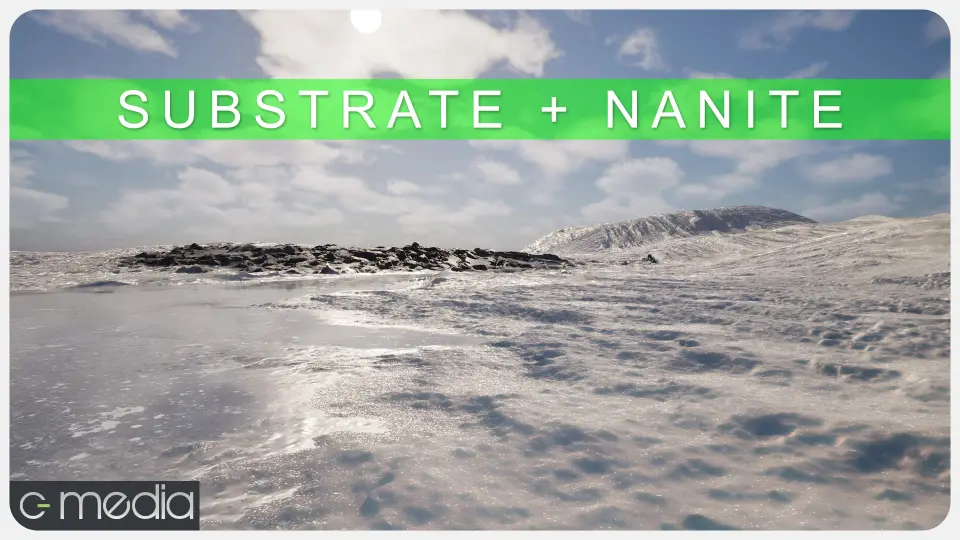
Advanced Landscape Material Ed.1 directly incorporates subsurface scattering support, catering to snow, ice, and frozen terrain layers. Opaque ground surfaces reflect light directly at the surface boundary, whereas snow and ice require light to penetrate beneath the outer plane, diffuse internally, and exit at varying angles. Through dedicated subsurface properties embedded within its Substrate-driven structure, the material captures this internal illumination naturally. Snowdrifts gain their characteristic soft translucence rather than looking chalky, while ice patches maintain dense optical depth that responds convincingly to dynamic outdoor daylight.
Rapid Art Direction via Instanced Parameters and Volumetric Lighting
Fast iteration on world art requires immediate access to visual controls without the friction of compiling complex shader networks.
Artistic tuning is governed through an array of easy instanced parameters configured for quick and clear art direction. Environment teams can modify surface attributes, fine-tune layer behaviors, and balance visual contrasts directly inside lightweight material instances. The material also maintains compatibility with an Advanced Volumetric Light Function. This specific compatibility ensures that terrain surfaces interact cleanly with volumetric lighting setups, maintaining atmospheric harmony as fog, low-lying ground mist, and volumetric light shafts drift across the displaced landscape geometry.
Deployment Across Modern Environment Pipelines
Demanding natural environments require technical frameworks that actively leverage the engine's latest geometry and shading pipelines.
Advanced Landscape Material Ed.1 serves as a practical, production-ready foundation for terrain construction in Unreal Engine projects. Combining Substrate shader profiles, Nanite Displacement, multi-layer functionality, and subsurface rendering for snow and ice, it removes the need to assemble complex next-generation ground shaders from scratch. Environment artists gain an integrated system that balances clear visual controls with modern rendering capabilities, accelerating the creation of detailed natural landscapes across diverse production settings.
 Nature & Terrain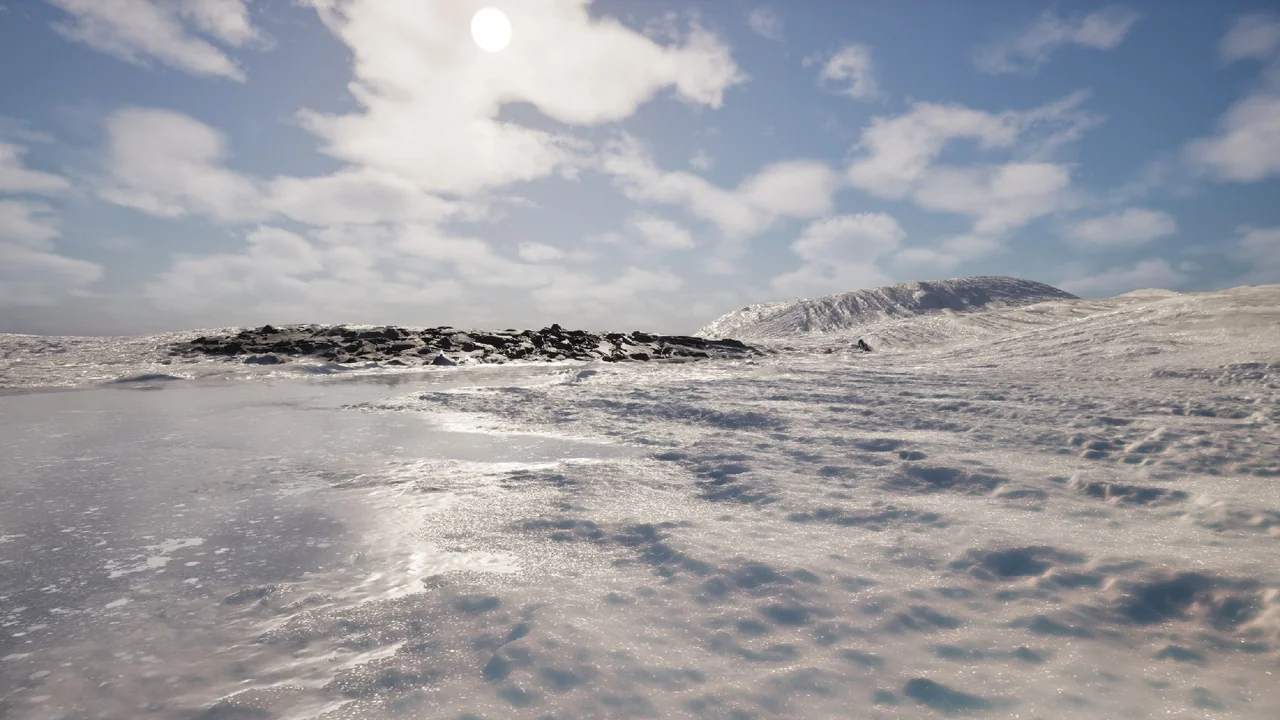
 Nature & Terrain
 Nature & Terrain
 Nature & Terrain