"177e4e4394b9ce1f"{"id":"1001575","slug":"cave-ruins-47-assets","title":"Cave Ruins / 47 Assets","category":"Environments","engine":"5.3+","assetVersion":"","engineVersion":"Engine Version: 5.3+","tag":"Environments","accent":"blue","visual":"city","summary":"Explore Cave Ruins / 47 Assets, a modular PBR environment pack featuring lowpoly medieval arches, columns, and Lumen-ready dungeon ruins.","platform":"Unreal Engine","publishedAt":"2026-10-10T08:48:59.321Z","updatedAt":"2026-10-10T08:48:59.321Z","sourceNotes":[],"fileContents":[],"compatibility":["Unreal Engine","Engine Version: 5.3+"],"featuredImage":{"alt":"Cave Ruins / 47 Assets","src":"/wp-content/uploads/published/2026/10/9b2d8b318eed-d1247a42-f0a5-4734-b2a6-11a8c8f39f5d-3dd719f3e7.webp"},"hasDownloadLink":true,"downloads":0,"terms":[{"taxonomy":"category","slug":"environments","name":"Environments"}],"galleryImages":[{"src":"/wp-content/uploads/published/2026/10/320e93214796-ca2eacc9-7609-449e-a866-1014b55e77e2-92a1dcde13.webp","alt":"Cave Ruins / 47 Assets"},{"src":"/wp-content/uploads/published/2026/10/3256f12de682-9f785e88-853a-4ad5-95d2-1d4ea2979dcc-4fceacde8f.webp","alt":"Cave Ruins / 47 Assets"},{"src":"/wp-content/uploads/published/2026/10/f526146f73f3-f453af2c-5339-4173-abaa-b04b3e45d016-77438d2485.webp","alt":"Cave Ruins / 47 Assets"},{"src":"/wp-content/uploads/published/2026/10/be493f15a65e-1c2ebfbe-bdb1-4a4c-8689-b1a08ba8bed9-ea27e3bd28.webp","alt":"Cave Ruins / 47 Assets"},{"src":"/wp-content/uploads/published/2026/10/7c8dbf9844a2-f6746074-7997-40d5-be82-6a75efb09bd6-76f8772960.webp","alt":"Cave Ruins / 47 Assets"},{"src":"/wp-content/uploads/published/2026/10/9a21a0f62d07-ad92cfe6-1065-48d4-a1c4-95219c267a31-79f2234476.webp","alt":"Cave Ruins / 47 Assets"},{"src":"/wp-content/uploads/published/2026/10/97880453c08b-525db73f-7d7b-43a6-8da9-5c91d376c64d-6b4e1f48b3.webp","alt":"Cave Ruins / 47 Assets"},{"src":"/wp-content/uploads/published/2026/10/67f315048876-597c6f76-a4f0-4c52-9305-afd59aa2981f-09441411fc.webp","alt":"Cave Ruins / 47 Assets"},{"src":"/wp-content/uploads/published/2026/10/bf9181563d99-f5c1f2fb-7d3d-488f-b301-ecbd13db6fa2-5f589aaa5f.webp","alt":"Cave Ruins / 47 Assets"}],"accessPanel":{"kind":"resource","title":"Download this resource","eyebrow":"Free Download","message":"Log in or create a free account to start your download.","fileName":"Content.7z","safetyNote":"Resources are manually reviewed before listing to improve quality and reduce obvious risks.","actionLabel":"Download Free","resourceType":"Resource archive"},"contentHtml":"\u003ch2\u003eStructuring Subterranean Environments with 47 Modular Assets\u003c/h2\u003e\u003cp\u003eAssembling underground spaces presents an immediate challenge in level creation: balancing heavy visual weight against runtime overhead. Cave Ruins / 47 Assets addresses this hurdle by supplying structural pieces that satisfy photorealistic targets while maintaining an optimized geometry profile.\u003c/p\u003e\u003cp\u003eUnderground ruin layouts require cohesive architecture that can convincingly merge natural cavern spaces with carved stone masonry. With 47 distinct assets spanning arches, columns, and collapsed structural components, the kit provides the building blocks needed to erect subterranean keeps, forgotten halls, and decayed passages. Level designers can snap modular elements together to form sprawling corridors or disperse fallen architectural remnants across uneven cave terrain, maintaining consistent structural logic across an entire dungeon map without needing to generate unique models for every room.\u003c/p\u003e\u003ch2\u003eModular Arch and Column Components in Medieval Ruin Design\u003c/h2\u003e\u003cp\u003eCrumbling architectural silhouettes define the mood of forgotten strongholds. The kit provides columns, arches, and fallen fragments to form the backbone of damaged medieval sanctuaries and ancient underground castles.\u003c/p\u003e\u003cp\u003eDungeon environments often require clear pathways broken up by catastrophic structural decay. By implementing modular ruined columns alongside upright architectural counterparts, level builders can establish areas that feel historically constructed before succumbing to cave-ins or age. Arches can frame transition corridors between rocky cave pockets and fortified rooms, while fallen debris assets litter stone floors to break up clean lines. This modularity allows level artists to assemble distinct, non-repetitive corridors, using varied placements of damaged and standing elements to communicate decay across ancient strongholds, dark dungeon chambers, and subterranean halls.\u003c/p\u003e\u003ch2\u003ePBR Pipeline Fidelity and Lumen Real-Time Lighting\u003c/h2\u003e\u003cp\u003eMaterial surfaces in deep subterranean scenes depend completely on accurate light interaction. The assets are constructed within a strict PBR pipeline, ensuring calibrated surface response under dynamic lighting conditions.\u003c/p\u003e\u003cp\u003eIn subterranean spaces where direct sunlight is completely absent or restricted to narrow ceiling fissures, lighting defines the player's perception of geometry. Lumen lighting support allows real-time indirect bounces off stone walls, carved columns, and damp cave floors, producing soft ambient occlusion in deep crevices without requiring pre-baked lightmaps. The photorealistic PBR material definitions respond accurately to torchlight, braziers, and dynamic player-carried lamps. Because surface roughness, metallic properties, and normal details are physically mapped, the stone retains its tactile, realistic definition under both sharp direct illumination and diffused ambient glow.\u003c/p\u003e\u003ch2\u003eLowpoly Optimization for AAA Quality and High-Performance Targets\u003c/h2\u003e\u003cp\u003eVisual fidelity in massive cavern scenes cannot come at the expense of rendering throughput. The collection is built with lowpoly efficiency in mind, offering an optimized profile capable of scaling across different performance budgets.\u003c/p\u003e\u003cp\u003eProduction teams often face difficulties when scaling dark, asset-heavy dungeons across varying hardware tiers. Because the geometry in this package emphasizes lowpoly optimization alongside photorealistic texturing, it services demanding AAA quality scenes while remaining viable for projects bound by strict performance thresholds. High polygon counts are not required to convey mass and age when the underlying geometry cleanly defines the silhouette and the PBR texture maps carry the fine micro-surface details. This dual approach allows developers to duplicate modular pieces across sprawling multi-tiered caverns without quickly exhausting draw call budgets or geometric limits.\u003c/p\u003e\u003ch2\u003eValidation Through Playable Demos and Runtime Evaluation\u003c/h2\u003e\u003cp\u003eAssessing an environment kit's practical usability before committing to integration saves crucial technical layout time. Verification is available directly through both an online playable demo and dedicated playable demo builds, alongside a comprehensive demo video.\u003c/p\u003e\u003cp\u003eStatic screenshots rarely convey how modular pieces align or how lighting travels through an assembled dungeon level. Testing through an online playable demo allows designers to interact directly with the environment, observing camera collisions, asset scaling, and the behavior of the modular pieces in an active runtime context. The demo video offers a curated look at the environmental assembly, highlighting how individual arches, columns, and cave surfaces coalesce into a finished scene. Reviewing these demonstrations gives technical artists clear insight into how the assets respond under player movement, perspective shifts, and real-time illumination.\u003c/p\u003e\u003ch2\u003eIntegrating Cave Ruins with Atlantis Ruins Assets in Production\u003c/h2\u003e\u003cp\u003eThe kit functions naturally alongside the complementary Atlantis Ruins / 37 Assets collection, expanding the available modular vocabulary for forgotten architectural complexes.\u003c/p\u003e\u003cp\u003eProductions rarely confine their ruined settings to a single room archetype. Pairing the 47 cave ruin components with the 37 assets from the Atlantis Ruins set extends the possibilities for environmental storytelling, allowing level artists to transition players from sunken remnants to deeply buried mountain vaults. The shared PBR pipeline and optimization standards across both packs maintain visual consistency throughout extended gameplay sequences. In an active production pipeline, this provides a cohesive foundation for dark fantasy RPGs, dungeon crawlers, and survival titles that demand modular ancient environments without sacrificing framerate stability.\u003c/p\u003e\n\n\u003ch2\u003eExplore Similar Assets\u003c/h2\u003e\n\u003cul\u003e\n\u003cli\u003e\u003ca href=\"https://3dcghub.com/modular-lost-ruins-kit/\" title=\"Modular Lost Ruins Kit\"\u003eModular Lost Ruins Kit\u003c/a\u003e\u003c/li\u003e\n\u003cli\u003e\u003ca href=\"https://3dcghub.com/fantasy-cave-ruins/\" title=\"Fantasy Cave Ruins\"\u003eFantasy Cave Ruins\u003c/a\u003e\u003c/li\u003e\n\u003cli\u003e\u003ca href=\"https://3dcghub.com/ancient-cave-ruins-ancient-temple-ruins-ancient-valley/\" title=\"Ancient Cave Ruins (Ancient Temple Ruins, Ancient Valley )\"\u003eAncient Cave Ruins (Ancient Temple Ruins, Ancient Valley )\u003c/a\u003e\u003c/li\u003e\n\u003cli\u003e\u003ca href=\"https://3dcghub.com/ancient-temple-ruins-mountains-environment/\" title=\"Ancient Temple Ruins - Mountains Environment\"\u003eAncient Temple Ruins - Mountains Environment\u003c/a\u003e\u003c/li\u003e\n\u003cli\u003e\u003ca href=\"https://3dcghub.com/viking-nordic-legendary-cave-modular-kit/\" title=\"Viking Nordic legendary Cave Modular Kit\"\u003eViking Nordic legendary Cave Modular Kit\u003c/a\u003e\u003c/li\u003e\n\u003c/ul\u003e","contentTextLength":5986,"navigation":{"current":39,"total":3551,"previous":{"id":"1001576","slug":"dwarf-fantasy-environment-set-1-1","title":"Dwarf Fantasy Environment Set 1.1","category":"Fantasy","platform":"Unreal Engine","updatedAt":"2026-10-10T08:50:06.263Z"},"next":{"id":"1001574","slug":"advanced-landscape-material-ed-1","title":"Advanced Landscape Material Ed.1","category":"Nature \u0026 Terrain","platform":"Unreal Engine","updatedAt":"2026-10-10T08:48:01.807Z"}},"relatedResources":[{"id":"1001536","slug":"modular-lost-ruins-kit","title":"Modular Lost Ruins Kit","category":"Environments","engine":"5.1+","assetVersion":"","engineVersion":"Engine Version: 5.1+","tag":"Environments","accent":"blue","visual":"city","summary":"Build overgrown stone temples and forgotten fantasy environments using the Modular Lost Ruins Kit, featuring Nanite, Lumen, and modular grid assets.","platform":"Unreal Engine","publishedAt":"2026-10-09T17:29:18.138Z","updatedAt":"2026-10-09T17:29:18.138Z","sourceNotes":[],"fileContents":[],"compatibility":["Unreal Engine","Engine Version: 5.1+"],"featuredImage":{"alt":"Modular Lost Ruins Kit","src":"/wp-content/uploads/published/2026/10/7af8a7b14e3e-f3f91042-90f8-406c-b1c8-c8e686a421ca-85d034c72a.webp"},"hasDownloadLink":true,"downloads":0},{"id":"7858","slug":"fantasy-cave-ruins","title":"Fantasy Cave Ruins","category":"Dungeon","engine":"5.0+","assetVersion":"Engine version: 5.0+","engineVersion":"5.0","tag":"Dungeon","accent":"blue","visual":"city","summary":"Build immersive underground worlds with the Fantasy Cave Ruins modular pack. Optimized for Unreal Engine 5, this set features Nanite and Lumen support for high-quality visuals.","platform":"Unreal Engine","publishedAt":"2026-02-21T18:05:48.000Z","updatedAt":"2026-04-19T15:55:54.000Z","sourceNotes":[],"fileContents":[],"compatibility":["Unreal Engine","Engine version: 5.0+"],"featuredImage":{"alt":"Fantasy Cave Ruins","src":"https://3dcghub.com/wp-content/uploads/2026/02/3aa21c79-ba2c-4f7c-a641-d59c5cf93587.webp"},"hasDownloadLink":true,"downloads":0},{"id":"27336","slug":"ancient-cave-ruins-ancient-temple-ruins-ancient-valley","title":"Ancient Cave Ruins (Ancient Temple Ruins, Ancient Valley )","category":"Dungeon","engine":"4.26+,5.0+","assetVersion":"Engine version: 4.26+,5.0+","engineVersion":"","tag":"Dungeon","accent":"blue","visual":"city","summary":"Ancient Cave Ruins focuses on stone-heavy cave and ruin pieces for fantasy spaces above or below ground. Its mix of cliffs, rocks, columns, slabs, Blueprint meshes, and landscape handling gives the scene a practical starting point.","platform":"Unreal Engine","publishedAt":"2026-04-24T06:21:26.000Z","updatedAt":"2026-04-24T06:21:28.000Z","sourceNotes":[],"fileContents":[],"compatibility":["Unreal Engine","Engine version: 4.26+,5.0+"],"featuredImage":{"alt":"Ancient Cave Ruins (Ancient Temple Ruins, Ancient Valley )","src":"https://3dcghub.com/wp-content/uploads/2026/04/df0c90184d5e_562c282a-fccc-4389-bd9c-084caf5e1f98.webp"},"hasDownloadLink":true,"downloads":0}]}
Environments
Cave Ruins / 47 Assets
Explore Cave Ruins / 47 Assets, a modular PBR environment pack featuring lowpoly medieval arches, columns, and Lumen-ready dungeon ruins.
Category:Unreal Engine,EnvironmentsPlatform: Unreal EngineEngine Version: 5.3+Published: Oct 10, 2026
Environments
Resource overview
Structuring Subterranean Environments with 47 Modular Assets
Assembling underground spaces presents an immediate challenge in level creation: balancing heavy visual weight against runtime overhead. Cave Ruins / 47 Assets addresses this hurdle by supplying structural pieces that satisfy photorealistic targets while maintaining an optimized geometry profile.
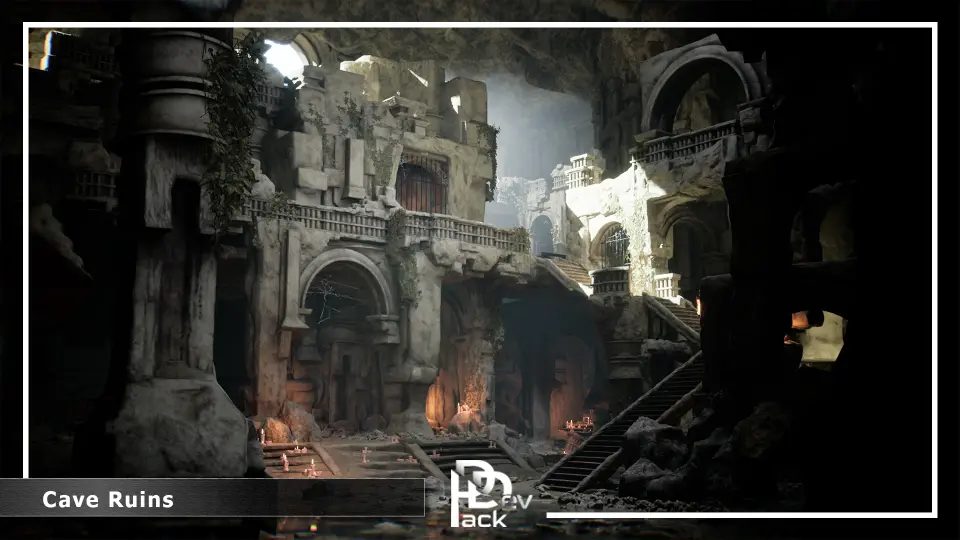
Underground ruin layouts require cohesive architecture that can convincingly merge natural cavern spaces with carved stone masonry. With 47 distinct assets spanning arches, columns, and collapsed structural components, the kit provides the building blocks needed to erect subterranean keeps, forgotten halls, and decayed passages. Level designers can snap modular elements together to form sprawling corridors or disperse fallen architectural remnants across uneven cave terrain, maintaining consistent structural logic across an entire dungeon map without needing to generate unique models for every room.
Modular Arch and Column Components in Medieval Ruin Design
Crumbling architectural silhouettes define the mood of forgotten strongholds. The kit provides columns, arches, and fallen fragments to form the backbone of damaged medieval sanctuaries and ancient underground castles.
Dungeon environments often require clear pathways broken up by catastrophic structural decay. By implementing modular ruined columns alongside upright architectural counterparts, level builders can establish areas that feel historically constructed before succumbing to cave-ins or age. Arches can frame transition corridors between rocky cave pockets and fortified rooms, while fallen debris assets litter stone floors to break up clean lines. This modularity allows level artists to assemble distinct, non-repetitive corridors, using varied placements of damaged and standing elements to communicate decay across ancient strongholds, dark dungeon chambers, and subterranean halls.
PBR Pipeline Fidelity and Lumen Real-Time Lighting
Material surfaces in deep subterranean scenes depend completely on accurate light interaction. The assets are constructed within a strict PBR pipeline, ensuring calibrated surface response under dynamic lighting conditions.
In subterranean spaces where direct sunlight is completely absent or restricted to narrow ceiling fissures, lighting defines the player's perception of geometry. Lumen lighting support allows real-time indirect bounces off stone walls, carved columns, and damp cave floors, producing soft ambient occlusion in deep crevices without requiring pre-baked lightmaps. The photorealistic PBR material definitions respond accurately to torchlight, braziers, and dynamic player-carried lamps. Because surface roughness, metallic properties, and normal details are physically mapped, the stone retains its tactile, realistic definition under both sharp direct illumination and diffused ambient glow.
Lowpoly Optimization for AAA Quality and High-Performance Targets
Visual fidelity in massive cavern scenes cannot come at the expense of rendering throughput. The collection is built with lowpoly efficiency in mind, offering an optimized profile capable of scaling across different performance budgets.
Production teams often face difficulties when scaling dark, asset-heavy dungeons across varying hardware tiers. Because the geometry in this package emphasizes lowpoly optimization alongside photorealistic texturing, it services demanding AAA quality scenes while remaining viable for projects bound by strict performance thresholds. High polygon counts are not required to convey mass and age when the underlying geometry cleanly defines the silhouette and the PBR texture maps carry the fine micro-surface details. This dual approach allows developers to duplicate modular pieces across sprawling multi-tiered caverns without quickly exhausting draw call budgets or geometric limits.
Validation Through Playable Demos and Runtime Evaluation
Assessing an environment kit's practical usability before committing to integration saves crucial technical layout time. Verification is available directly through both an online playable demo and dedicated playable demo builds, alongside a comprehensive demo video.
Static screenshots rarely convey how modular pieces align or how lighting travels through an assembled dungeon level. Testing through an online playable demo allows designers to interact directly with the environment, observing camera collisions, asset scaling, and the behavior of the modular pieces in an active runtime context. The demo video offers a curated look at the environmental assembly, highlighting how individual arches, columns, and cave surfaces coalesce into a finished scene. Reviewing these demonstrations gives technical artists clear insight into how the assets respond under player movement, perspective shifts, and real-time illumination.
Integrating Cave Ruins with Atlantis Ruins Assets in Production
The kit functions naturally alongside the complementary Atlantis Ruins / 37 Assets collection, expanding the available modular vocabulary for forgotten architectural complexes.
Productions rarely confine their ruined settings to a single room archetype. Pairing the 47 cave ruin components with the 37 assets from the Atlantis Ruins set extends the possibilities for environmental storytelling, allowing level artists to transition players from sunken remnants to deeply buried mountain vaults. The shared PBR pipeline and optimization standards across both packs maintain visual consistency throughout extended gameplay sequences. In an active production pipeline, this provides a cohesive foundation for dark fantasy RPGs, dungeon crawlers, and survival titles that demand modular ancient environments without sacrificing framerate stability.
 Environments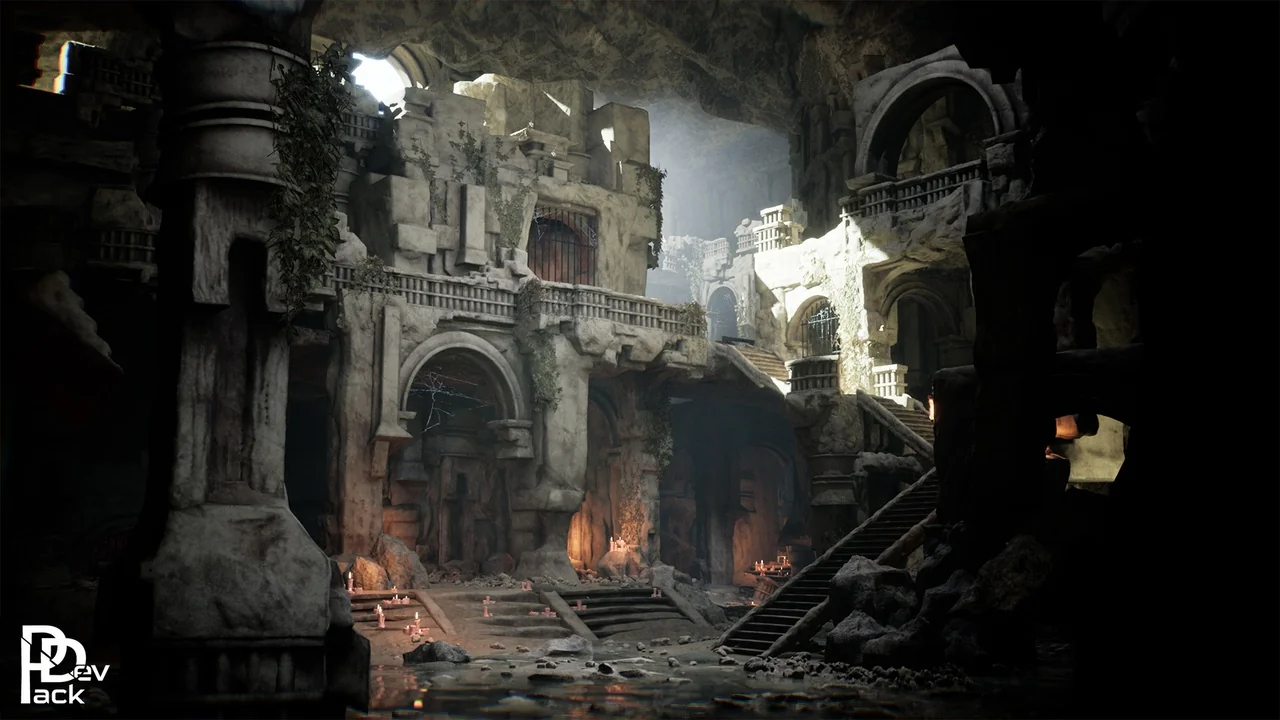
 Environments
 Dungeon
 Dungeon