"1062d43bc714d570"{"id":"1001423","slug":"advanced-beard-system","title":"Advanced Beard System","category":"Characters \u0026 Creatures","engine":"4.27+,5.0+","assetVersion":"","engineVersion":"Engine Version: 4.27+,5.0+","tag":"Characters","accent":"blue","visual":"character","summary":"A dynamic beard creator tool featuring physically simulated groom braids, 12 premade ornamental beard assets, and Blueprint animation support.","platform":"Unreal Engine","publishedAt":"2026-10-07T05:58:10.529Z","updatedAt":"2026-10-07T05:58:10.529Z","sourceNotes":[],"fileContents":[],"compatibility":["Unreal Engine","Engine Version: 4.27+,5.0+"],"featuredImage":{"alt":"Advanced Beard System","src":"/wp-content/uploads/published/2026/10/5bd93476b138-d696ffe6-19ba-4c29-a1c6-da65bafd2e4e-93a3927f64.webp"},"hasDownloadLink":true,"downloads":0,"terms":[{"taxonomy":"category","slug":"characters-and-creatures","name":"Characters \u0026 Creatures"}],"galleryImages":[{"src":"/wp-content/uploads/published/2026/10/f39d070abd6b-777b2d81-e49e-4afc-ae80-1f4546e19cf9-d17108d7fb.webp","alt":"Advanced Beard System"}],"accessPanel":{"kind":"resource","title":"Download this resource","eyebrow":"Free Download","message":"Log in or create a free account to start your download.","fileName":"Content.7z","safetyNote":"Resources are manually reviewed before listing to improve quality and reduce obvious risks.","actionLabel":"Download Free","resourceType":"Resource archive"},"contentHtml":"\u003ch2\u003eGroom-Based Physical Simulation in the Advanced Beard System\u003c/h2\u003e\u003cp\u003eThe Advanced Beard System functions as a dynamic beard creator tool built specifically to produce physically simulated ornamental facial hair. Rather than relying on rigid static geometry or simple card clusters, the system utilizes hair grooms to generate complex braided structures that respond dynamically to character movement. Braided hair has traditionally presented technical friction in real-time pipelines due to interpenetration, stiffness tuning, and collision calculation across intertwined strands. By using groom-based physical simulation, the system allows individual braid structures to shift, swing, and settle naturally alongside character kinematics.\u003c/p\u003e\u003cp\u003eA central focus of this toolset is eliminating visual defects that routinely occur during physical hair simulation. Creating intricate, multi-strand plait formations often introduces snapping, jittering, or separation artifacts when simulated geometry collides with underlying character surfaces. The Advanced Beard System is structured so that developers can build numerous variations of ornamental beards while keeping groom dynamics stable and free of common simulation artifacts.\u003c/p\u003e\u003ch2\u003eCrafting Viking, Elf, and Ornamental Beard Variations\u003c/h2\u003e\u003cp\u003eOrnamental facial styling demands unique shapes, binding points, and geometric densities that standard short-beard grooms rarely accommodate. The Advanced Beard System specifically addresses these aesthetic needs by supplying configurations suited for elaborate historical and fantasy character designs, including Viking beards, Elf beards, and heavily braided arrangements. These styles often feature long plaiting, central ties, bound sideburns, and accompanying mustache components that must maintain structural integrity while reacting to physical forces.\u003c/p\u003e\u003cp\u003eCharacter artists often face steep turnaround times when modeling braided facial hair from scratch. This tool provides 12 premade assets ready for direct integration into production rigs, offering immediate coverage for common character profiles. These ready-made styles showcase different braid densities, lengths, and layout options, functioning both as immediate production assets and as clean architectural baselines for building customized variations of ornamental and braided looks.\u003c/p\u003e\u003ch2\u003eProject Configuration and the Compute Skin Cache Setting\u003c/h2\u003e\u003cp\u003eAchieving stable strand-level groom simulation requires strict synchronization with the underlying skeletal mesh deformation. To ensure the Advanced Beard System functions as intended without mesh tracking errors or strand separation, projects must have the \"Support compute skin cache\" option enabled within project settings. This setting alters how the graphics pipeline evaluates vertex deformation across animated character geometry.\u003c/p\u003e\u003cp\u003eWhen compute skin cache is active, skeletal mesh skinning calculations execute via compute shaders, caching the resulting deformed positions in GPU memory. Groom simulation and strand attachment systems rely directly on this cached positional data to ground hair guide curves accurately against the deforming skin. Without compute skin cache enabled, character movement and facial expressions can cause grooming roots to drift away from vertex positions, resulting in clipping, stretching, or severe simulation errors. Adhering to this project-level requirement ensures that braided grooms remain properly anchored across active skeletal poses.\u003c/p\u003e\u003ch2\u003eBlueprint Structure and Animation Blueprint Behavior\u003c/h2\u003e\u003cp\u003eThe system pairs its groom components with scripting infrastructure organized through Blueprints and Animation Blueprints. Incorporating dynamic facial hair into a functional character rig requires a pipeline that links skeletal bone transforms, blend shapes, and secondary physics properties together seamlessly. Through its scripted Blueprint framework, the Advanced Beard System simplifies the process of attaching, toggling, and managing mustache and beard components on character models.\u003c/p\u003e\u003cp\u003eAnimation Blueprints handle the runtime interaction between character motion and groom movement. As a character accelerates, turns, or executes combat animations, the underlying logic balances skeletal animation influence against dynamic groom physics. This structural coordination prevents braids from behaving like detached appendages or rigid mesh props, ensuring they react dynamically to momentum while remaining aligned with facial movement.\u003c/p\u003e\u003ch2\u003eDeploying the 12 Premade Assets and Evaluating Real-Time Performance\u003c/h2\u003e\u003cp\u003eImplementing groom simulation inside interactive environments requires close monitoring of frame time budgets. The inclusion of 12 premade assets provides immediate opportunities to evaluate how groom-based braided facial hair behaves under real-time rendering conditions. Rather than forcing teams to build complex test assets manually, the system includes dedicated resources such as a playable demo, a trailer, real-time performance tests, and comprehensive documentation to assist with evaluation and implementation.\u003c/p\u003e\u003cp\u003eThese diagnostic and instructional materials allow developers to benchmark strand density and physics response across different camera angles and movement speeds. For workflows incorporating broader hair grooming configurations, the system shares design principles and compatibility with related components like the Advanced Braids Combo and the Hair Starter Pack. By supplying ready-to-use ornamental styles alongside explicit configuration guidelines, the package gives character pipelines a dependable path for deploying dynamic, braided grooms on animated digital humans.\u003c/p\u003e\n\n\u003ch2\u003eExplore Similar Assets\u003c/h2\u003e\n\u003cul\u003e\n\u003cli\u003e\u003ca href=\"https://3dcghub.com/western-npc-metahuman/\" title=\"Western NPC - Metahuman\"\u003eWestern NPC - Metahuman\u003c/a\u003e\u003c/li\u003e\n\u003cli\u003e\u003ca href=\"https://3dcghub.com/modular-soldier-opb-full/\" title=\"Modular Soldier OPB Full\"\u003eModular Soldier OPB Full\u003c/a\u003e\u003c/li\u003e\n\u003cli\u003e\u003ca href=\"https://3dcghub.com/infinite-characters-collection-over-230-characters-extra-stigma-studios/\" title=\"Infinite Characters Collection – Over 230 Characters + Extra | STIGMA STUDIOS\"\u003eInfinite Characters Collection – Over 230 Characters + Extra | STIGMA STUDIOS\u003c/a\u003e\u003c/li\u003e\n\u003cli\u003e\u003ca href=\"https://3dcghub.com/hair-starter-pack/\" title=\"Hair Starter Pack\"\u003eHair Starter Pack\u003c/a\u003e\u003c/li\u003e\n\u003cli\u003e\u003ca href=\"https://3dcghub.com/horse-herd/\" title=\"Horse Herd\"\u003eHorse Herd\u003c/a\u003e\u003c/li\u003e\n\u003c/ul\u003e","contentTextLength":5796,"navigation":{"current":21,"total":3379,"previous":{"id":"1001424","slug":"animated-skies","title":"Animated Skies","category":"Sky","platform":"Unreal Engine","updatedAt":"2026-10-07T05:59:24.301Z"},"next":{"id":"1001422","slug":"advance-weapon-pack","title":"Advance Weapon Pack","category":"3D","platform":"Unreal Engine","updatedAt":"2026-10-07T05:57:28.437Z"}},"relatedResources":[{"id":"1000715","slug":"western-npc-metahuman","title":"Western NPC - Metahuman","category":"Characters \u0026 Creatures","engine":"5.0+","assetVersion":"","engineVersion":"Engine Version: 5.0+","tag":"Characters","accent":"blue","visual":"character","summary":"Parametric MetaHuman clothing component for UE5 Mannequin. Modular Western NPC assembly with costume, legs, arms, head, hair, beard. Includes Victorian and cowb","platform":"Unreal Engine","publishedAt":"2026-07-24T11:47:34.725Z","updatedAt":"2026-07-24T11:47:34.725Z","sourceNotes":[],"fileContents":[],"compatibility":["Unreal Engine","Engine Version: 5.0+"],"featuredImage":{"alt":"Western NPC - Metahuman","src":"/wp-content/uploads/published/2026/07/568e5b20a5df-d4918928-d57d-4af1-aeaa-ed2675af2f1d-c0e2cbc7d9.webp"},"hasDownloadLink":true,"downloads":6},{"id":"1001167","slug":"modular-soldier-opb-full","title":"Modular Soldier OPB Full","category":"Characters \u0026 Creatures","engine":"4.27,5.0+","assetVersion":"","engineVersion":"Engine Version: 4.27,5.0+","tag":"Characters","accent":"blue","visual":"character","summary":"Examine the Modular Soldier OPB Full pack, featuring UE4 and MetaHuman skeletons, 17 skeletal meshes, 4K textures, Lyra support, and mobile LOD scaling.","platform":"Unreal Engine","publishedAt":"2026-09-16T15:17:15.509Z","updatedAt":"2026-09-16T15:17:15.509Z","sourceNotes":[],"fileContents":[],"compatibility":["Unreal Engine","Engine Version: 4.27,5.0+"],"featuredImage":{"alt":"Modular Soldier OPB Full","src":"/wp-content/uploads/published/2026/09/ea2ebd97c5f3-6fd23319-3d68-435c-a7cb-60a62bd850ca-000d21f799.webp"},"hasDownloadLink":true,"downloads":4},{"id":"1000184","slug":"infinite-characters-collection-over-230-characters-extra-stigma-studios","title":"Infinite Characters Collection – Over 230 Characters + Extra | STIGMA STUDIOS","category":"Characters \u0026 Creatures","engine":"4.27,5.0+","assetVersion":"","engineVersion":"Engine Version: 4.27,5.0+","tag":"Characters","accent":"blue","visual":"character","summary":"A massive Unreal Engine character collection with over 230 characters, armor, weapons, material variants, and ongoing future updates.","platform":"Unreal Engine","publishedAt":"2026-06-21T17:34:28.433Z","updatedAt":"2026-08-23T13:14:17.209Z","sourceNotes":[],"fileContents":[],"compatibility":["Unreal Engine","Engine Version: 4.27,5.0+"],"featuredImage":{"alt":"Infinite Characters Collection – Over 230 Characters + Extra | STIGMA STUDIOS","src":"/wp-content/uploads/published/2026/06/26476fb360bb-f2bcdade-6b80-4803-903a-68e84d350b6b-f00df84586.webp"},"hasDownloadLink":true,"downloads":15}]}
Characters
Advanced Beard System
A dynamic beard creator tool featuring physically simulated groom braids, 12 premade ornamental beard assets, and Blueprint animation support.
Groom-Based Physical Simulation in the Advanced Beard System
The Advanced Beard System functions as a dynamic beard creator tool built specifically to produce physically simulated ornamental facial hair. Rather than relying on rigid static geometry or simple card clusters, the system utilizes hair grooms to generate complex braided structures that respond dynamically to character movement. Braided hair has traditionally presented technical friction in real-time pipelines due to interpenetration, stiffness tuning, and collision calculation across intertwined strands. By using groom-based physical simulation, the system allows individual braid structures to shift, swing, and settle naturally alongside character kinematics.
A central focus of this toolset is eliminating visual defects that routinely occur during physical hair simulation. Creating intricate, multi-strand plait formations often introduces snapping, jittering, or separation artifacts when simulated geometry collides with underlying character surfaces. The Advanced Beard System is structured so that developers can build numerous variations of ornamental beards while keeping groom dynamics stable and free of common simulation artifacts.
Crafting Viking, Elf, and Ornamental Beard Variations
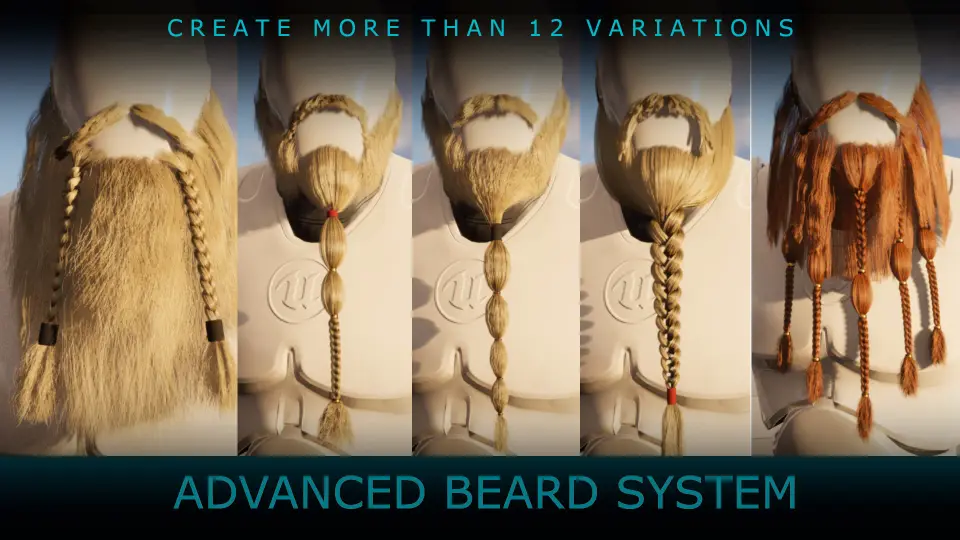
Ornamental facial styling demands unique shapes, binding points, and geometric densities that standard short-beard grooms rarely accommodate. The Advanced Beard System specifically addresses these aesthetic needs by supplying configurations suited for elaborate historical and fantasy character designs, including Viking beards, Elf beards, and heavily braided arrangements. These styles often feature long plaiting, central ties, bound sideburns, and accompanying mustache components that must maintain structural integrity while reacting to physical forces.
Character artists often face steep turnaround times when modeling braided facial hair from scratch. This tool provides 12 premade assets ready for direct integration into production rigs, offering immediate coverage for common character profiles. These ready-made styles showcase different braid densities, lengths, and layout options, functioning both as immediate production assets and as clean architectural baselines for building customized variations of ornamental and braided looks.
Project Configuration and the Compute Skin Cache Setting
Achieving stable strand-level groom simulation requires strict synchronization with the underlying skeletal mesh deformation. To ensure the Advanced Beard System functions as intended without mesh tracking errors or strand separation, projects must have the "Support compute skin cache" option enabled within project settings. This setting alters how the graphics pipeline evaluates vertex deformation across animated character geometry.
When compute skin cache is active, skeletal mesh skinning calculations execute via compute shaders, caching the resulting deformed positions in GPU memory. Groom simulation and strand attachment systems rely directly on this cached positional data to ground hair guide curves accurately against the deforming skin. Without compute skin cache enabled, character movement and facial expressions can cause grooming roots to drift away from vertex positions, resulting in clipping, stretching, or severe simulation errors. Adhering to this project-level requirement ensures that braided grooms remain properly anchored across active skeletal poses.
Blueprint Structure and Animation Blueprint Behavior
The system pairs its groom components with scripting infrastructure organized through Blueprints and Animation Blueprints. Incorporating dynamic facial hair into a functional character rig requires a pipeline that links skeletal bone transforms, blend shapes, and secondary physics properties together seamlessly. Through its scripted Blueprint framework, the Advanced Beard System simplifies the process of attaching, toggling, and managing mustache and beard components on character models.
Animation Blueprints handle the runtime interaction between character motion and groom movement. As a character accelerates, turns, or executes combat animations, the underlying logic balances skeletal animation influence against dynamic groom physics. This structural coordination prevents braids from behaving like detached appendages or rigid mesh props, ensuring they react dynamically to momentum while remaining aligned with facial movement.
Deploying the 12 Premade Assets and Evaluating Real-Time Performance
Implementing groom simulation inside interactive environments requires close monitoring of frame time budgets. The inclusion of 12 premade assets provides immediate opportunities to evaluate how groom-based braided facial hair behaves under real-time rendering conditions. Rather than forcing teams to build complex test assets manually, the system includes dedicated resources such as a playable demo, a trailer, real-time performance tests, and comprehensive documentation to assist with evaluation and implementation.
These diagnostic and instructional materials allow developers to benchmark strand density and physics response across different camera angles and movement speeds. For workflows incorporating broader hair grooming configurations, the system shares design principles and compatibility with related components like the Advanced Braids Combo and the Hair Starter Pack. By supplying ready-to-use ornamental styles alongside explicit configuration guidelines, the package gives character pipelines a dependable path for deploying dynamic, braided grooms on animated digital humans.
 Characters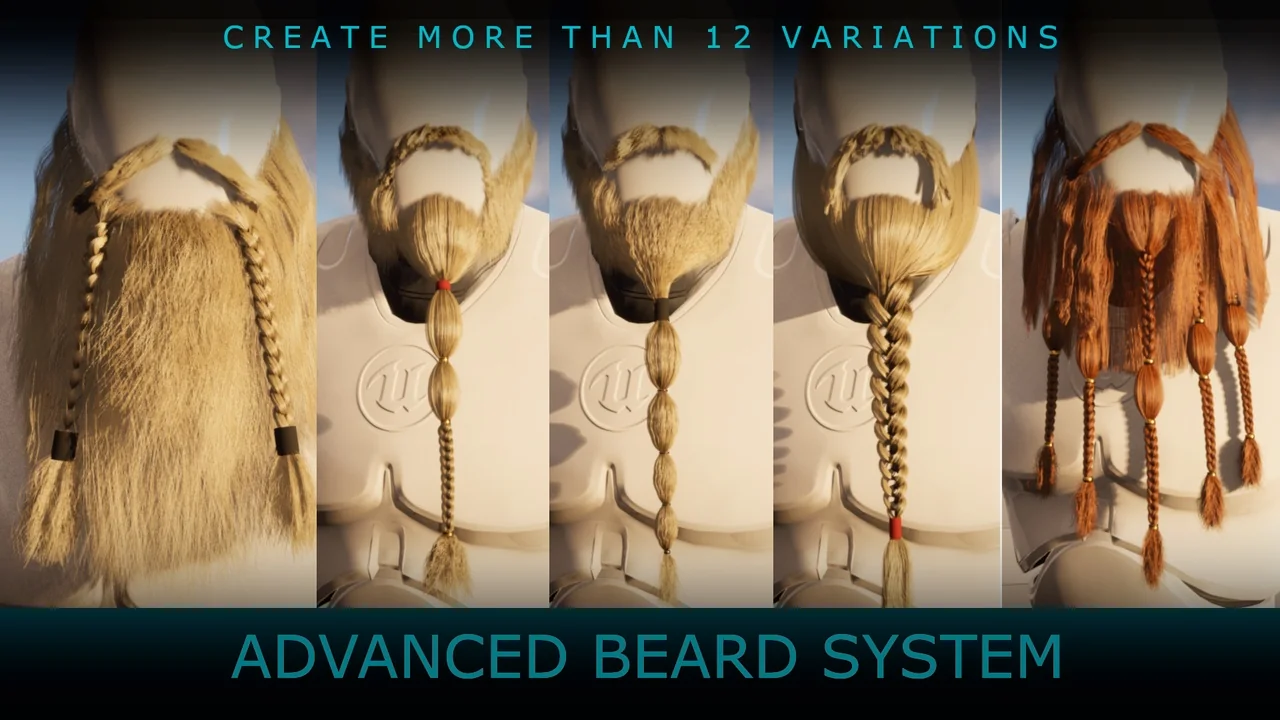
 Characters
 Characters
 Characters