"e9c335e082208b17"{"id":"1002896","slug":"horse-riding-system","title":"Horse Riding System","category":"Characters \u0026 Creatures","engine":"4.27+,5.0+","assetVersion":"","engineVersion":"Engine Version: 4.27+,5.0+","tag":"Characters","accent":"blue","visual":"character","summary":"Explore the Horse Riding System featuring inverse kinematics for slope adaptation, three directional mounting options, running dismounts, and whistle response.","platform":"Unreal Engine","indexPolicy":"index","publishedAt":"2026-11-21T02:38:36.684Z","updatedAt":"2026-11-21T02:38:36.684Z","sourceNotes":[],"fileContents":[],"compatibility":["Unreal Engine","Engine Version: 4.27+,5.0+"],"featuredImage":{"alt":"Horse Riding System","src":"/wp-content/uploads/published/2026/11/beb80215bc57-99fd68d1-5ba3-458f-821b-ffcc5da6516b-008defc199.webp"},"fileSizeBytes":607706390,"hasDownloadLink":true,"downloads":0,"terms":[{"taxonomy":"category","slug":"characters-and-creatures","name":"Characters \u0026 Creatures"}],"galleryImages":[{"src":"/wp-content/uploads/published/2026/11/54fab42a547d-dd88662a-b392-49aa-a905-2bbc096b92fd-524eb6b8b0.webp","alt":"Horse Riding System"},{"src":"/wp-content/uploads/published/2026/11/27f57c3fa405-01d52924-2768-47f0-b579-161ddaa66fd5-38e39f3590.webp","alt":"Horse Riding System"},{"src":"/wp-content/uploads/published/2026/11/cd9c346b2e8b-6a579c75-8792-49a0-9c88-ba55a5c77e98-e78ceeba08.webp","alt":"Horse Riding System"},{"src":"/wp-content/uploads/published/2026/11/e5da6fbade45-18457f9f-3dc1-4668-87ff-c338dc81e885-a30e797d62.webp","alt":"Horse Riding System"},{"src":"/wp-content/uploads/published/2026/11/f4b5d17e16da-b5480433-5214-4e3a-abfc-901ed1b0b443-1a89c88650.webp","alt":"Horse Riding System"},{"src":"/wp-content/uploads/published/2026/11/dce1b58363b5-4c45b703-2a4e-44c2-a57d-9b3d556bccb3-03092d5bd9.webp","alt":"Horse Riding System"},{"src":"/wp-content/uploads/published/2026/11/3def0b8756bf-d1bdad09-b3ee-4ced-b03e-282f3a0b3586-c646a69cab.webp","alt":"Horse Riding System"},{"src":"/wp-content/uploads/published/2026/11/49dfc7dcddb3-da2648ea-7027-4a67-a498-6abe6e404f0b-e026a9b40e.webp","alt":"Horse Riding System"},{"src":"/wp-content/uploads/published/2026/11/f6b62a573c35-326805b1-8ddb-4c87-8b2b-ec61f6a60b78-043d953bfe.webp","alt":"Horse Riding System"},{"src":"/wp-content/uploads/published/2026/11/2efd787da627-06ec9faa-1296-4756-92ae-0db6e529e5a9-b56fb2c761.webp","alt":"Horse Riding System"}],"contentHtml":"\u003cp\u003eMounting and commanding a horse in an interactive game environment requires tight coordination between creature locomotion, player control, and terrain negotiation. When mounts behave as simple wheeled vehicles wrapped in animal meshes, the visual illusion collapses immediately upon encountering uneven ground or sharp turns. The Horse Riding System approaches this gameplay challenge by pairing an inverse kinematics horse model with a responsive rider setup. Shaped by dedicated Blueprints and Animation Blueprints, the system integrates ground slope adaptation, neck rotation during steering, multi-directional mounting, high-speed running dismounts, and whistle signaling within an interactive framework.\u003c/p\u003e\u003ch2\u003eDynamic Slope Adaptation in the Horse Model\u003c/h2\u003e\u003cp\u003eTraversing irregular wilderness landscapes poses significant mechanical challenges for quadrupeds. Without reactive adjustments, rigid skeletal meshes either clip straight through steep inclines or hover unnaturally above descending slopes. Within the Horse Riding System, the horse directly addresses environmental variation by rotating its body, legs, and tail movements according to the slope of the ground. By continuously evaluating the terrain beneath each hoof, the system repositions and reorients the limbs so the animal stays grounded across dips, crests, and angled embankments.\u003c/p\u003e\u003cp\u003eThis continuous alignment extends beyond simple height offsets. The inverse kinematics framework actively recalculates the pitch and roll of the horse's main body to reflect surface contours. Because the tail movements also adapt dynamically relative to the slope, the entire length of the animal matches the physical geometry of the terrain. When navigating downward descents, the rear limbs extend and the body pitches back to balance the frame; when charging up hillsides, the front legs adjust upward while the spine mirrors the ascending angle. This comprehensive contact keeps stride cycles believable across irregular terrain.\u003c/p\u003e\u003cp\u003eIn addition to vertical and lateral slope adaptation, the horse rotates its neck as it turns around. Rather than keeping the spine locked in a uniform forward orientation during direction changes, the neck pivots into the turn. This behavioral rotation mirrors real equine movement, where the head and neck initiate directional shifts before the full mass of the body completes the arc. When guiding the mount through tight bends or broad circles, the turning neck provides immediate visual feedback that reinforces the weight and responsiveness of the steering mechanics.\u003c/p\u003e\u003ch2\u003eDirectional Riding Transitions and High-Speed Dismounts\u003c/h2\u003e\u003cp\u003eTransitioning between on-foot exploration and mounted travel can often feel clunky if player approach angles are constrained to a single interaction point. The Horse Riding System streamlines this workflow by enabling the rider to climb on to the horse from three different directions. Whether the player approaches the mount from the left flank, the right flank, or an alternate entry angle, the system initiates the appropriate boarding sequence. This multi-directional entry prevents the player character from having to circle the animal awkwardly just to locate a single active interaction trigger.\u003c/p\u003e\u003cp\u003eEqually critical to high-tempo gameplay is the ability to disengage cleanly under active travel conditions. In many game mechanics, mounts must come to a complete, stationary halt before the dismount animation is permitted to execute. Within this system, the rider is able to get down even when the horse is running. This running dismount capability allows seamless exits during sudden ambushes, rapid combat deployments, or high-speed navigation where slowing down would interrupt traversal momentum. The rider transitions smoothly off the saddle while the mount maintains its running stride, offering dynamic mechanical flexibility for fast-paced scenarios.\u003c/p\u003e\u003ch2\u003eWhistle Interaction and Blueprint Control System\u003c/h2\u003e\u003cp\u003eCalling an animal companion across distances forms a core pillar of open-world exploration. The Horse Riding System incorporates an integrated whistle mechanic where the horse responds directly to the whistle of the rider. When the player character signals, the horse acknowledges the prompt and reacts, establishing a dependable connection between character actions and mount behavior. This response eliminates the frustration of searching for a misplaced mount across expansive terrain.\u003c/p\u003e\u003cp\u003eBehind these mechanics operates a dedicated scripting and animation architecture. The project utilizes Blueprint scripts to manage player input, interaction states, whistle calls, and mode transitions, working in tandem with specialized Animation Blueprints for both characters. A key component of the package is the inclusion of complete animations for both the rider and the horse. Because animation assets are provided for both participants, the system maintains synchronization during boarding maneuvers, sustained gallops, sharp turns, running dismounts, and idle postures. The character scripts handle the handoff between standalone rider controls and mounted movement states cleanly, ensuring that inputs translate into coordinated motion across both skeletal hierarchies.\u003c/p\u003e\u003ch2\u003eArmor Configurations and Visual Skins for the Horse\u003c/h2\u003e\u003cp\u003eVisual presentation plays a central role in fitting an asset into specific aesthetic environments. The included horse asset is presented as a realistic looking IK horse model equipped with fitted body armor. The armor plating gives the mount a fortified, martial presence well suited for combat encounters, medieval settings, or fantasy deployments. The protective gear is fitted directly over the mesh, remaining fully functional through all running strides, turning rotations, and slope adjustments without breaking the underlying inverse kinematics logic.\u003c/p\u003e\u003cp\u003eTo provide visual variation across different scenes, herds, or factions, the asset includes six different skins. These variations allow creators to deploy multiple horses with distinct coat patterns and color tones while utilizing the exact same underlying skeletal structure and animation pipeline. Whether populating a royal stable, mounting an armored patrol, or offering different animal options across an open map, the six skins provide immediate visual diversity out of the box without requiring external texture work.\u003c/p\u003e\u003ch2\u003eTesting the Riding Mechanics in the Example DemoLevel\u003c/h2\u003e\u003cp\u003eImplementing a comprehensive locomotion and interaction asset requires a practical space to inspect how all modular elements function together. The package includes one Example DemoLevel designed as a fully configured testing ground. Inside this level, the complete framework is set up with the horse model, the rider character, the underlying Blueprint scripts, and the Animation Blueprints already active and configured.\u003c/p\u003e\u003cp\u003eWithin the Example DemoLevel, creators can directly evaluate how the horse senses ground contours, observe the body, leg, and tail slope rotations in real time, and verify how the neck responds during turns. The test space also provides an immediate arena for testing the whistle call mechanic, initiating climbing transitions from each of the three supported directions, and executing running dismounts while maintaining high movement speeds. The vendor's documentation covers the implementation structure, parameter adjustments, and blueprint connections, making it straightforward to analyze the pre-built logic and integrate the riding features into broader game projects.\u003c/p\u003e\n\n\u003ch2\u003eRelated Resources Worth Checking\u003c/h2\u003e\n\u003cul\u003e\n\u003cli\u003e\u003ca href=\"https://3dcghub.com/horse-herd/\" rel=\"noopener noreferrer\"\u003eHorse Herd\u003c/a\u003e\u003c/li\u003e\n\u003cli\u003e\u003ca href=\"https://3dcghub.com/horse-animset/\" rel=\"noopener noreferrer\"\u003eHorse Animset\u003c/a\u003e\u003c/li\u003e\n\u003cli\u003e\u003ca href=\"https://3dcghub.com/adam-horseman-archer/\" rel=\"noopener noreferrer\"\u003eAdam Horseman Archer\u003c/a\u003e\u003c/li\u003e\n\u003cli\u003e\u003ca href=\"https://3dcghub.com/realistic-horse-with-animations/\" rel=\"noopener noreferrer\"\u003eRealistic Horse with Animations\u003c/a\u003e\u003c/li\u003e\n\u003cli\u003e\u003ca href=\"https://3dcghub.com/undead-horse-and-unholy-knight/\" rel=\"noopener noreferrer\"\u003eUndead Horse and Unholy Knight\u003c/a\u003e\u003c/li\u003e\n\u003c/ul\u003e","contentTextLength":7619,"navigation":{"current":39,"total":4839,"previous":{"id":"1002295","slug":"auto-node-arranger","title":"Auto Node Arranger","category":"Automations","platform":"Unreal Engine","updatedAt":"2026-11-21T03:46:03.901Z"},"next":{"id":"1002895","slug":"root-motion-guide","title":"Root Motion Guide","category":"Engine Tools","platform":"Unreal Engine","updatedAt":"2026-11-21T02:08:26.554Z"}},"relatedResources":[{"id":"1000995","slug":"horse-herd","title":"Horse Herd","category":"Characters \u0026 Creatures","engine":"4.27,5.0+","assetVersion":"","engineVersion":"Engine Version: 4.27,5.0+","tag":"Characters","accent":"blue","visual":"character","summary":"Animated horse pack with 54 animations, a 136-bone skeleton, 4K PBR textures, and full tack. Updated with control rigs, sockets, and rider animations.","platform":"Unreal Engine","indexPolicy":"index","publishedAt":"2026-08-19T04:39:26.862Z","updatedAt":"2026-08-19T04:39:26.862Z","sourceNotes":[],"fileContents":[],"compatibility":["Unreal Engine","Engine Version: 4.27,5.0+"],"featuredImage":{"alt":"Horse Herd","src":"/wp-content/uploads/published/2026/08/3f72f99fd17c-395abe75-d784-4571-b041-e1333a632f41-5af8040525.webp"},"fileSizeBytes":519967225,"hasDownloadLink":true,"downloads":5},{"id":"2570","slug":"horse-animset","title":"Horse Animset","category":"Characters \u0026 Creatures","engine":"4.26+,5.0+","assetVersion":"Engine version: 4.26+,5.0+","engineVersion":"4.27","tag":"Characters","accent":"blue","visual":"character","summary":"Discover the Horse Animset featuring 200+ AAA animations for horses and riders. Includes Pegasus and Unicorn assets for high-quality game development.","platform":"Unreal Engine","indexPolicy":"noindex","publishedAt":"2026-02-07T10:24:43.000Z","updatedAt":"2026-04-19T15:58:00.000Z","sourceNotes":[],"fileContents":[],"compatibility":["Unreal Engine","Engine version: 4.26+,5.0+"],"featuredImage":{"alt":"Horse Animset","src":"https://3dcghub.com/wp-content/uploads/2026/02/23cfbf67-b4ce-41e8-826c-4fd66ad669ac.webp"},"fileSizeBytes":312712352,"hasDownloadLink":true,"downloads":6},{"id":"1469","slug":"adam-horseman-archer","title":"Adam Horseman Archer","category":"Characters \u0026 Creatures","engine":"4.26+5.0+","assetVersion":"Engine version: 4.26+5.0+","engineVersion":"4.12","tag":"Characters","accent":"blue","visual":"character","summary":"Enhance your game with this high-quality Medieval Archer and Horse Mount set. Featuring modular armor, weapons, and rigs for seamless integration.","platform":"Unreal Engine","indexPolicy":"noindex","publishedAt":"2026-02-06T18:34:13.000Z","updatedAt":"2026-04-19T15:58:10.000Z","sourceNotes":[],"fileContents":[],"compatibility":["Unreal Engine","Engine version: 4.26+5.0+"],"featuredImage":{"alt":"Adam Horseman Archer","src":"https://3dcghub.com/wp-content/uploads/2026/02/22324814-feda-45ca-8732-4043340279d4.webp"},"fileSizeBytes":999208140,"hasDownloadLink":true,"downloads":2}]}
Resource screenshots
1 / 10
Join our channel
Follow 3DCGHUB on Telegram for new resource drops, migration updates, and community notices.
Explore the Horse Riding System featuring inverse kinematics for slope adaptation, three directional mounting options, running dismounts, and whistle response.
Mounting and commanding a horse in an interactive game environment requires tight coordination between creature locomotion, player control, and terrain negotiation. When mounts behave as simple wheeled vehicles wrapped in animal meshes, the visual illusion collapses immediately upon encountering uneven ground or sharp turns. The Horse Riding System approaches this gameplay challenge by pairing an inverse kinematics horse model with a responsive rider setup. Shaped by dedicated Blueprints and Animation Blueprints, the system integrates ground slope adaptation, neck rotation during steering, multi-directional mounting, high-speed running dismounts, and whistle signaling within an interactive framework.
Dynamic Slope Adaptation in the Horse Model
Traversing irregular wilderness landscapes poses significant mechanical challenges for quadrupeds. Without reactive adjustments, rigid skeletal meshes either clip straight through steep inclines or hover unnaturally above descending slopes. Within the Horse Riding System, the horse directly addresses environmental variation by rotating its body, legs, and tail movements according to the slope of the ground. By continuously evaluating the terrain beneath each hoof, the system repositions and reorients the limbs so the animal stays grounded across dips, crests, and angled embankments.
This continuous alignment extends beyond simple height offsets. The inverse kinematics framework actively recalculates the pitch and roll of the horse's main body to reflect surface contours. Because the tail movements also adapt dynamically relative to the slope, the entire length of the animal matches the physical geometry of the terrain. When navigating downward descents, the rear limbs extend and the body pitches back to balance the frame; when charging up hillsides, the front legs adjust upward while the spine mirrors the ascending angle. This comprehensive contact keeps stride cycles believable across irregular terrain.
In addition to vertical and lateral slope adaptation, the horse rotates its neck as it turns around. Rather than keeping the spine locked in a uniform forward orientation during direction changes, the neck pivots into the turn. This behavioral rotation mirrors real equine movement, where the head and neck initiate directional shifts before the full mass of the body completes the arc. When guiding the mount through tight bends or broad circles, the turning neck provides immediate visual feedback that reinforces the weight and responsiveness of the steering mechanics.
Directional Riding Transitions and High-Speed Dismounts
Transitioning between on-foot exploration and mounted travel can often feel clunky if player approach angles are constrained to a single interaction point. The Horse Riding System streamlines this workflow by enabling the rider to climb on to the horse from three different directions. Whether the player approaches the mount from the left flank, the right flank, or an alternate entry angle, the system initiates the appropriate boarding sequence. This multi-directional entry prevents the player character from having to circle the animal awkwardly just to locate a single active interaction trigger.
Equally critical to high-tempo gameplay is the ability to disengage cleanly under active travel conditions. In many game mechanics, mounts must come to a complete, stationary halt before the dismount animation is permitted to execute. Within this system, the rider is able to get down even when the horse is running. This running dismount capability allows seamless exits during sudden ambushes, rapid combat deployments, or high-speed navigation where slowing down would interrupt traversal momentum. The rider transitions smoothly off the saddle while the mount maintains its running stride, offering dynamic mechanical flexibility for fast-paced scenarios.
Whistle Interaction and Blueprint Control System
Calling an animal companion across distances forms a core pillar of open-world exploration. The Horse Riding System incorporates an integrated whistle mechanic where the horse responds directly to the whistle of the rider. When the player character signals, the horse acknowledges the prompt and reacts, establishing a dependable connection between character actions and mount behavior. This response eliminates the frustration of searching for a misplaced mount across expansive terrain.
Behind these mechanics operates a dedicated scripting and animation architecture. The project utilizes Blueprint scripts to manage player input, interaction states, whistle calls, and mode transitions, working in tandem with specialized Animation Blueprints for both characters. A key component of the package is the inclusion of complete animations for both the rider and the horse. Because animation assets are provided for both participants, the system maintains synchronization during boarding maneuvers, sustained gallops, sharp turns, running dismounts, and idle postures. The character scripts handle the handoff between standalone rider controls and mounted movement states cleanly, ensuring that inputs translate into coordinated motion across both skeletal hierarchies.
Armor Configurations and Visual Skins for the Horse
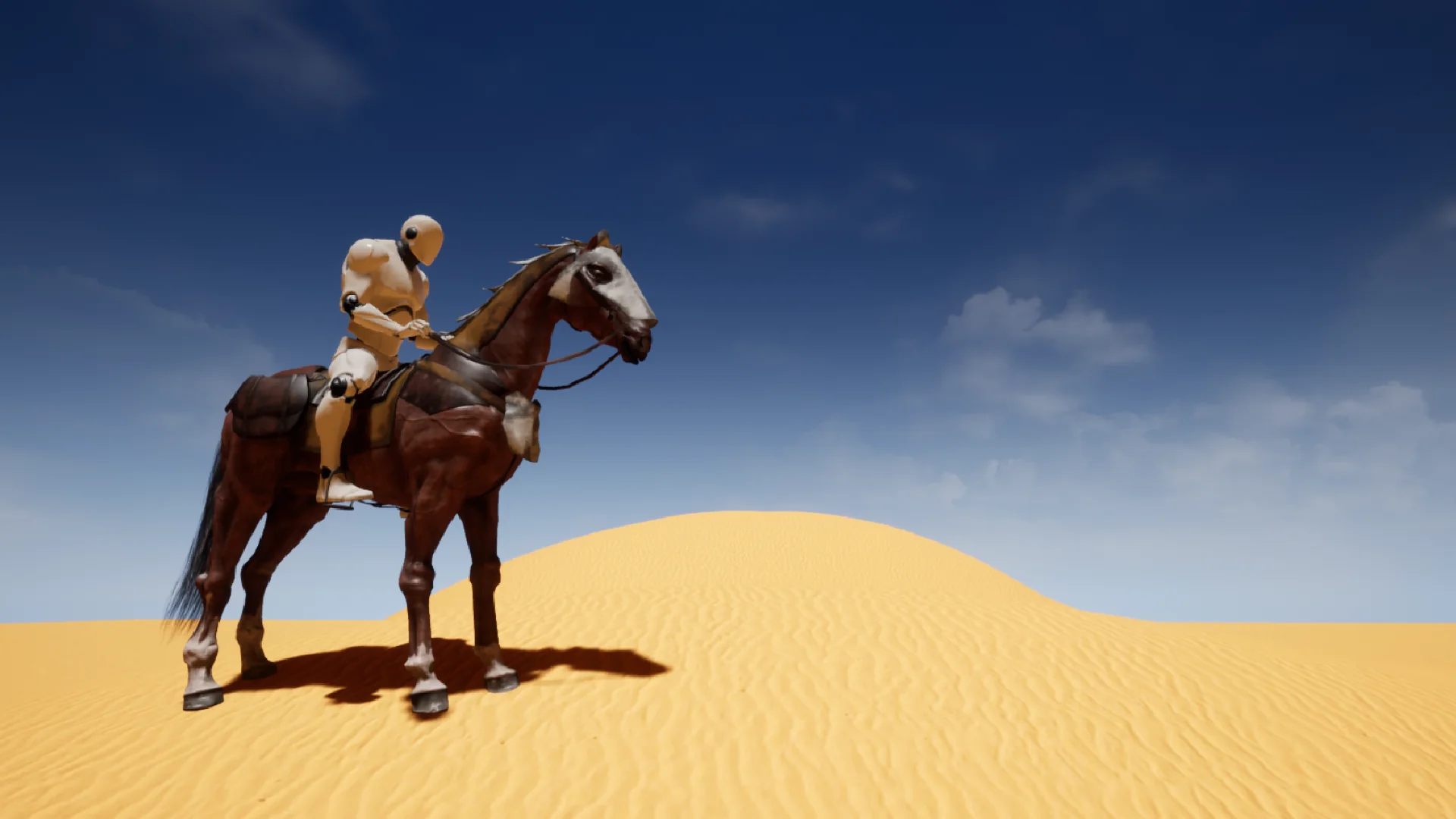
Visual presentation plays a central role in fitting an asset into specific aesthetic environments. The included horse asset is presented as a realistic looking IK horse model equipped with fitted body armor. The armor plating gives the mount a fortified, martial presence well suited for combat encounters, medieval settings, or fantasy deployments. The protective gear is fitted directly over the mesh, remaining fully functional through all running strides, turning rotations, and slope adjustments without breaking the underlying inverse kinematics logic.
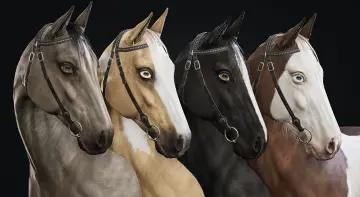
To provide visual variation across different scenes, herds, or factions, the asset includes six different skins. These variations allow creators to deploy multiple horses with distinct coat patterns and color tones while utilizing the exact same underlying skeletal structure and animation pipeline. Whether populating a royal stable, mounting an armored patrol, or offering different animal options across an open map, the six skins provide immediate visual diversity out of the box without requiring external texture work.
Testing the Riding Mechanics in the Example DemoLevel
Implementing a comprehensive locomotion and interaction asset requires a practical space to inspect how all modular elements function together. The package includes one Example DemoLevel designed as a fully configured testing ground. Inside this level, the complete framework is set up with the horse model, the rider character, the underlying Blueprint scripts, and the Animation Blueprints already active and configured.
Within the Example DemoLevel, creators can directly evaluate how the horse senses ground contours, observe the body, leg, and tail slope rotations in real time, and verify how the neck responds during turns. The test space also provides an immediate arena for testing the whistle call mechanic, initiating climbing transitions from each of the three supported directions, and executing running dismounts while maintaining high movement speeds. The vendor's documentation covers the implementation structure, parameter adjustments, and blueprint connections, making it straightforward to analyze the pre-built logic and integrate the riding features into broader game projects.
 Characters
 Characters
 Characters