"4481da9c895ef786"{"id":"1000995","slug":"horse-herd","title":"Horse Herd","category":"Characters \u0026 Creatures","engine":"4.27,5.0+","assetVersion":"","engineVersion":"Engine Version: 4.27,5.0+","tag":"Characters","accent":"blue","visual":"character","summary":"Animated horse pack with 54 animations, a 136-bone skeleton, 4K PBR textures, and full tack. Updated with control rigs, sockets, and rider animations.","platform":"Unreal Engine","publishedAt":"2026-08-19T04:39:26.862Z","updatedAt":"2026-08-19T04:39:26.862Z","sourceNotes":[],"fileContents":[],"compatibility":["Unreal Engine","Engine Version: 4.27,5.0+"],"featuredImage":{"alt":"Horse Herd","src":"/wp-content/uploads/published/2026/08/3f72f99fd17c-395abe75-d784-4571-b041-e1333a632f41-5af8040525.webp"},"hasDownloadLink":true,"downloads":4,"terms":[{"taxonomy":"category","slug":"characters-and-creatures","name":"Characters \u0026 Creatures"}],"galleryImages":[{"src":"/wp-content/uploads/published/2026/08/e69a978db96a-45c90814-f5fa-496b-b7db-9291c2545e71-119f24fa2e.webp","alt":"Horse Herd"},{"src":"/wp-content/uploads/published/2026/08/6327c5f0a43d-5ffb4620-1b57-48b9-81b0-784c554f351d-138ffd9c98.webp","alt":"Horse Herd"},{"src":"/wp-content/uploads/published/2026/08/c701fb86c23c-8be0ce7a-3c41-4e98-8ecd-e3d7605b1be8-168486bf73.webp","alt":"Horse Herd"},{"src":"/wp-content/uploads/published/2026/08/c117610a8332-0444420c-d6e7-43dd-9ce9-63a7aec77b38-14d32ceeae.webp","alt":"Horse Herd"},{"src":"/wp-content/uploads/published/2026/08/5882b283b50a-b300eddf-1aa5-4a8a-a7eb-a07309327242-6e57a31c6e.webp","alt":"Horse Herd"},{"src":"/wp-content/uploads/published/2026/08/692317b457c8-51e74ef5-4170-4e62-987d-c5f1aebe969b-cd3fb35816.webp","alt":"Horse Herd"},{"src":"/wp-content/uploads/published/2026/08/f19dcfdcf28e-820a9393-c37f-4b4b-a363-27b2e2cf5277-cfb8ae19d7.webp","alt":"Horse Herd"},{"src":"/wp-content/uploads/published/2026/08/88206145b289-50c49b34-22c9-4d98-b54d-3ef9f5a994ea-d20e30b3df.webp","alt":"Horse Herd"},{"src":"/wp-content/uploads/published/2026/08/9aa9ac168443-8d5e1bf2-6f9c-4ce5-be84-5abf1f1a8315-dc80bd969f.webp","alt":"Horse Herd"},{"src":"/wp-content/uploads/published/2026/08/badac2c5cd8c-3e1c908f-2f6a-499d-857f-ad2e43331751-245605ee20.webp","alt":"Horse Herd"}],"accessPanel":{"kind":"resource","title":"Download this resource","eyebrow":"Free Download","message":"Log in or create a free account to start your download.","fileName":"Content.7z","safetyNote":"Resources are manually reviewed before listing to improve quality and reduce obvious risks.","actionLabel":"Download Free","resourceType":"Resource archive"},"contentHtml":"\u003cp\u003eHorse Herd is a complete animated horse character structured through a single skeletal mesh and a full set of riding tack. The package includes the horse body with mane and tail, separate facial hair, saddle, headset, reins, and pad. Everything is rendered in Unreal Engine for the gallery previews, which gives a solid idea of how the materials, fur shading, and coat patterns behave in a real-time scene.\u003c/p\u003e\u003ch2\u003eModel and Tack Breakdown\u003c/h2\u003e\u003cp\u003eThe main horse model with mane and tail sits at 24,254 triangles and 17,149 vertices. Facial hair is kept separate at 380 triangles, allowing it to be swapped or hidden depending on the shot. The saddle is the largest tack piece with 6,685 triangles, followed by the headset at 3,600 triangles, the pad at 948 triangles, and the reins at 924 triangles. Each piece works as its own mesh, so a scene can present the horse bare or fully saddled without extra geometry.\u003c/p\u003e\u003cp\u003eThis split also simplifies material assignment. The tack pieces have distinct texture sets, and the horse body has its own set, so changing the saddle color doesn't touch the coat. For a project that needs a realistic horse with gear, these numbers keep things straightforward for physics or LOD work as well.\u003c/p\u003e\u003ch2\u003eTexture Sets, Coat Masks, and PBR Materials\u003c/h2\u003e\u003cp\u003eFive texture sets cover the body, hair, iris, saddle, and headset. All materials follow a metal/roughness PBR pipeline. The horse body gets 4K normal and roughness maps, eight base color albedo maps, and a directional map for fur anisotropy. That directional map helps the coat read as hair when light moves across it, which is often the key difference between a convincing horse and a flat one.\u003c/p\u003e\u003cp\u003eCoat variation comes from seven masks built for spot combinations: two body masks, four facial masks, and one leg mask. The shader uses these at 512x512 by default, but 4K versions are included for projects that need extra resolution. Hair materials are set up with 2K maps for normal, opacity, ID, root, and ambient occlusion, plus depth, directional, and flow maps for extra definition. The eyes provide five different 2K albedo colors, so a production can pick a look that fits its horse character.\u003c/p\u003e\u003cp\u003eFor the tack, saddle and pad share a 4K texture set with normal, roughness, metalness, three color albedo options, and a height map. The headset and reins follow the same pattern with two color albedo choices and a height map. That gives the gear a consistent visual quality with the horse itself.\u003c/p\u003e\u003ch2\u003eSkeleton, Reins, and Control Rigs\u003c/h2\u003e\u003cp\u003eThe horse skeleton contains 136 bones, 44 of which are facial bones. Those facial bones support expression-driven motion like blinking, ear movement, and nostril breathing. The reins are a separate prop with their own 32-bone skeleton, designed to attach to the horse head bone socket. This separation was introduced in version 2.0, along with an optimized skeleton and the shift of reins off the main skeletal mesh.\u003c/p\u003e\u003cp\u003eVersion 5.3 added control rigs for leg tracing and reins control, plus sockets for smoother integration into a riding system. For teams working with the Complete Horse Riding System, this makes it easier to line up the horse's legs with the ground and keep the reins behaving while the character rides. The pack itself does not include a riding system blueprint; it only supplies the meshes and horse animations. The intended workflow is to pair this asset with a separate riding system.\u003c/p\u003e\u003ch2\u003eAnimation Range: Locomotion, Steady States, and Additive Motions\u003c/h2\u003e\u003cp\u003eHorse Herd ships with 54 animations. Locomotion accounts for 29 of them, and each movement is provided in both in-place and root motion versions. A quick breakdown of the movement set:\u003c/p\u003e\u003cul\u003e\u003cli\u003eWalks: forward, turn left, turn right, backward, rotating backward left/right\u003c/li\u003e\u003cli\u003eTrots: forward, trot right, trot left\u003c/li\u003e\u003cli\u003eCanters: forward, turn left, turn right\u003c/li\u003e\u003cli\u003eGallops: forward, turn left, turn right\u003c/li\u003e\u003cli\u003eSwims: forward, left/right, backward, backward left/right\u003c/li\u003e\u003cli\u003eTurns in place: right and left\u003c/li\u003e\u003cli\u003eJump\u003c/li\u003e\u003cli\u003eFalls: starting from edge, falling high, falling low, landing\u003c/li\u003e\u003cli\u003eGrazing (eating)\u003c/li\u003e\u003c/ul\u003e\u003cp\u003eThe steady animation set covers 11 states. There are four idle variations (basic idle, look left, look right, head shake), a swim idle, three back-attack kicks (both legs, left leg, right leg), two death falls (right and left sides), and a rear. These are the poses that keep the horse feeling alive when the player is not driving it forward.\u003c/p\u003e\u003cp\u003eFourteen additive motions layer on top of those base states. The horse can blink, close either eye, pin either ear back, breathe through its nostrils, and open its mouth to neigh. Seven tail poses cover high lift, angled positions, and a neutral rest pose. For a horse, the tail is a strong visual cue for mood, so having these poses separate from the main animation slots makes it easier to react to gameplay events.\u003c/p\u003e\u003ch2\u003eUpdates and Compatibility Notes\u003c/h2\u003e\u003cp\u003eThe asset has been updated several times. Version 2.0 optimized the skeleton, added new animations, introduced the in-place/root motion splits, and separated the reins from the main skeletal mesh. That update also carried a warning: the new horse skeleton is not compatible with the previous one. Anyone swapping the old horse for the new version inside an existing project should check how their animations and rig references were built.\u003c/p\u003e\u003cp\u003eVersion 5.0 added rider animations, and that update is available for Unreal Engine 5 and higher. The older version remains unchanged. Version 5.3 added new animations, control rigs for leg tracing and reins control, and sockets for riding-system integration. The developer also noted that animation sequence names were changed in 5.3, so any project referencing the old names will need to remap them.\u003c/p\u003e\u003ch2\u003eWhere Horse Herd Fits Best\u003c/h2\u003e\u003cp\u003eBecause the pack includes a realistic horse, full tack set, 54 animations, and customizable coat patterns, it suits games and cinematics that need a believable horse character in a western, fantasy, or rural setting. The separate facial bones and additive tail poses give the horse a wider emotional range than a typical quadruped animation pack. The in-place and root motion variants make it usable both for scripted scenes and for character controllers that need root motion to drive movement.\u003c/p\u003e\u003cp\u003eThe main caveat is the absence of a riding system. The asset focuses on the horse itself, its animations, and the tack. The developer points to the Complete Horse Riding System for riding behavior, and the sockets and control rigs in 5.3 were added with that kind of integration in mind. As long as the project already has a riding system or is ready to use one, Horse Herd provides the animated horse side of the setup.\u003c/p\u003e\n\n\u003ch2\u003eMore From The Same Workflow\u003c/h2\u003e\n\u003cul\u003e\n\u003cli\u003e\u003ca href=\"https://3dcghub.com/realistic-horse-with-animations/\" title=\"Realistic Horse with Animations\"\u003eRealistic Horse with Animations\u003c/a\u003e\u003c/li\u003e\n\u003cli\u003e\u003ca href=\"https://3dcghub.com/undead-horse-and-unholy-knight/\" title=\"Undead Horse and Unholy Knight\"\u003eUndead Horse and Unholy Knight\u003c/a\u003e\u003c/li\u003e\n\u003cli\u003e\u003ca href=\"https://3dcghub.com/horse-animset/\" title=\"Horse Animset\"\u003eHorse Animset\u003c/a\u003e\u003c/li\u003e\n\u003cli\u003e\u003ca href=\"https://3dcghub.com/adam-horseman-archer/\" title=\"Adam Horseman Archer\"\u003eAdam Horseman Archer\u003c/a\u003e\u003c/li\u003e\n\u003cli\u003e\u003ca href=\"https://3dcghub.com/modular-private-military-contractor/\" title=\"Modular Private Military Contractor\"\u003eModular Private Military Contractor\u003c/a\u003e\u003c/li\u003e\n\u003c/ul\u003e","contentTextLength":6744,"navigation":{"current":387,"total":3269,"previous":{"id":"1000996","slug":"industrial-sawmill-modular-pack","title":"Industrial Sawmill Modular Pack","category":"Industrial","platform":"Unreal Engine","updatedAt":"2026-08-19T15:29:52.187Z"},"next":{"id":"1000994","slug":"havana-street-environment-havana-cuba-streets-3d-environment-exterior-havana","title":"Havana Street Environment ( Havana Cuba Streets 3d Environment Exterior Havana )","category":"Streets \u0026 Construction","platform":"Unreal Engine","updatedAt":"2026-08-19T03:47:02.608Z"}},"relatedResources":[{"id":"3284","slug":"realistic-horse-with-animations","title":"Realistic Horse with Animations","category":"Characters \u0026 Creatures","engine":"5.0+","assetVersion":"Engine version: 5.0+","engineVersion":"5.4","tag":"Characters","accent":"blue","visual":"animation","summary":"Enhance your game with this high-quality Realistic Horse asset. Featuring 20 animations, customizable shaders, and muscle shaking effects for maximum realism.","platform":"Unreal Engine","publishedAt":"2026-02-09T06:09:54.000Z","updatedAt":"2026-04-19T15:57:40.000Z","sourceNotes":[],"fileContents":[],"compatibility":["Unreal Engine","Engine version: 5.0+"],"featuredImage":{"alt":"Realistic Horse with Animations","src":"https://3dcghub.com/wp-content/uploads/2026/02/34363d28-a5d5-411a-84f6-36caa5d096af.webp"},"hasDownloadLink":true,"downloads":0},{"id":"3746","slug":"undead-horse-and-unholy-knight","title":"Undead Horse and Unholy Knight","category":"Characters \u0026 Creatures","engine":"5.0+","assetVersion":"Engine version: 5.0+","engineVersion":"5.2","tag":"Characters","accent":"blue","visual":"character","summary":"Enhance your dark fantasy game with the Undead Horse and Unholy Knight set. Featuring handpainted textures and full animation support for Unreal Engine.","platform":"Unreal Engine","publishedAt":"2026-02-09T09:23:01.000Z","updatedAt":"2026-04-19T15:57:34.000Z","sourceNotes":[],"fileContents":[],"compatibility":["Unreal Engine","Engine version: 5.0+"],"featuredImage":{"alt":"Undead Horse and Unholy Knight","src":"https://3dcghub.com/wp-content/uploads/2026/02/f23a4409-941f-44d4-8fe6-62f82648f339.webp"},"hasDownloadLink":true,"downloads":0},{"id":"2570","slug":"horse-animset","title":"Horse Animset","category":"Characters \u0026 Creatures","engine":"4.26+,5.0+","assetVersion":"Engine version: 4.26+,5.0+","engineVersion":"4.27","tag":"Characters","accent":"blue","visual":"character","summary":"Discover the Horse Animset featuring 200+ AAA animations for horses and riders. Includes Pegasus and Unicorn assets for high-quality game development.","platform":"Unreal Engine","publishedAt":"2026-02-07T10:24:43.000Z","updatedAt":"2026-04-19T15:58:00.000Z","sourceNotes":[],"fileContents":[],"compatibility":["Unreal Engine","Engine version: 4.26+,5.0+"],"featuredImage":{"alt":"Horse Animset","src":"https://3dcghub.com/wp-content/uploads/2026/02/23cfbf67-b4ce-41e8-826c-4fd66ad669ac.webp"},"hasDownloadLink":true,"downloads":6}]}
Characters
Horse Herd
Animated horse pack with 54 animations, a 136-bone skeleton, 4K PBR textures, and full tack. Updated with control rigs, sockets, and rider animations.
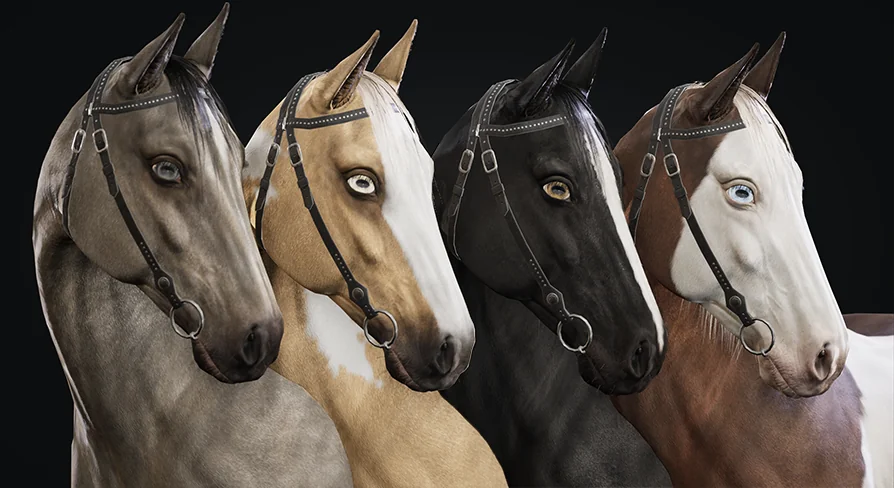
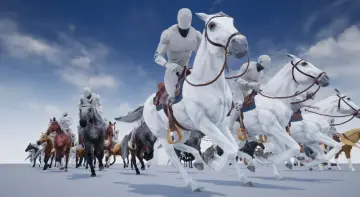
Horse Herd is a complete animated horse character structured through a single skeletal mesh and a full set of riding tack. The package includes the horse body with mane and tail, separate facial hair, saddle, headset, reins, and pad. Everything is rendered in Unreal Engine for the gallery previews, which gives a solid idea of how the materials, fur shading, and coat patterns behave in a real-time scene.
Model and Tack Breakdown
The main horse model with mane and tail sits at 24,254 triangles and 17,149 vertices. Facial hair is kept separate at 380 triangles, allowing it to be swapped or hidden depending on the shot. The saddle is the largest tack piece with 6,685 triangles, followed by the headset at 3,600 triangles, the pad at 948 triangles, and the reins at 924 triangles. Each piece works as its own mesh, so a scene can present the horse bare or fully saddled without extra geometry.
This split also simplifies material assignment. The tack pieces have distinct texture sets, and the horse body has its own set, so changing the saddle color doesn't touch the coat. For a project that needs a realistic horse with gear, these numbers keep things straightforward for physics or LOD work as well.
Texture Sets, Coat Masks, and PBR Materials
Five texture sets cover the body, hair, iris, saddle, and headset. All materials follow a metal/roughness PBR pipeline. The horse body gets 4K normal and roughness maps, eight base color albedo maps, and a directional map for fur anisotropy. That directional map helps the coat read as hair when light moves across it, which is often the key difference between a convincing horse and a flat one.
Coat variation comes from seven masks built for spot combinations: two body masks, four facial masks, and one leg mask. The shader uses these at 512x512 by default, but 4K versions are included for projects that need extra resolution. Hair materials are set up with 2K maps for normal, opacity, ID, root, and ambient occlusion, plus depth, directional, and flow maps for extra definition. The eyes provide five different 2K albedo colors, so a production can pick a look that fits its horse character.
For the tack, saddle and pad share a 4K texture set with normal, roughness, metalness, three color albedo options, and a height map. The headset and reins follow the same pattern with two color albedo choices and a height map. That gives the gear a consistent visual quality with the horse itself.
Skeleton, Reins, and Control Rigs
The horse skeleton contains 136 bones, 44 of which are facial bones. Those facial bones support expression-driven motion like blinking, ear movement, and nostril breathing. The reins are a separate prop with their own 32-bone skeleton, designed to attach to the horse head bone socket. This separation was introduced in version 2.0, along with an optimized skeleton and the shift of reins off the main skeletal mesh.
Version 5.3 added control rigs for leg tracing and reins control, plus sockets for smoother integration into a riding system. For teams working with the Complete Horse Riding System, this makes it easier to line up the horse's legs with the ground and keep the reins behaving while the character rides. The pack itself does not include a riding system blueprint; it only supplies the meshes and horse animations. The intended workflow is to pair this asset with a separate riding system.
Animation Range: Locomotion, Steady States, and Additive Motions
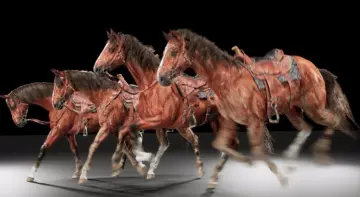
Horse Herd ships with 54 animations. Locomotion accounts for 29 of them, and each movement is provided in both in-place and root motion versions. A quick breakdown of the movement set:
Falls: starting from edge, falling high, falling low, landing
Grazing (eating)
The steady animation set covers 11 states. There are four idle variations (basic idle, look left, look right, head shake), a swim idle, three back-attack kicks (both legs, left leg, right leg), two death falls (right and left sides), and a rear. These are the poses that keep the horse feeling alive when the player is not driving it forward.
Fourteen additive motions layer on top of those base states. The horse can blink, close either eye, pin either ear back, breathe through its nostrils, and open its mouth to neigh. Seven tail poses cover high lift, angled positions, and a neutral rest pose. For a horse, the tail is a strong visual cue for mood, so having these poses separate from the main animation slots makes it easier to react to gameplay events.
Updates and Compatibility Notes
The asset has been updated several times. Version 2.0 optimized the skeleton, added new animations, introduced the in-place/root motion splits, and separated the reins from the main skeletal mesh. That update also carried a warning: the new horse skeleton is not compatible with the previous one. Anyone swapping the old horse for the new version inside an existing project should check how their animations and rig references were built.
Version 5.0 added rider animations, and that update is available for Unreal Engine 5 and higher. The older version remains unchanged. Version 5.3 added new animations, control rigs for leg tracing and reins control, and sockets for riding-system integration. The developer also noted that animation sequence names were changed in 5.3, so any project referencing the old names will need to remap them.
Where Horse Herd Fits Best
Because the pack includes a realistic horse, full tack set, 54 animations, and customizable coat patterns, it suits games and cinematics that need a believable horse character in a western, fantasy, or rural setting. The separate facial bones and additive tail poses give the horse a wider emotional range than a typical quadruped animation pack. The in-place and root motion variants make it usable both for scripted scenes and for character controllers that need root motion to drive movement.
The main caveat is the absence of a riding system. The asset focuses on the horse itself, its animations, and the tack. The developer points to the Complete Horse Riding System for riding behavior, and the sockets and control rigs in 5.3 were added with that kind of integration in mind. As long as the project already has a riding system or is ready to use one, Horse Herd provides the animated horse side of the setup.
 Characters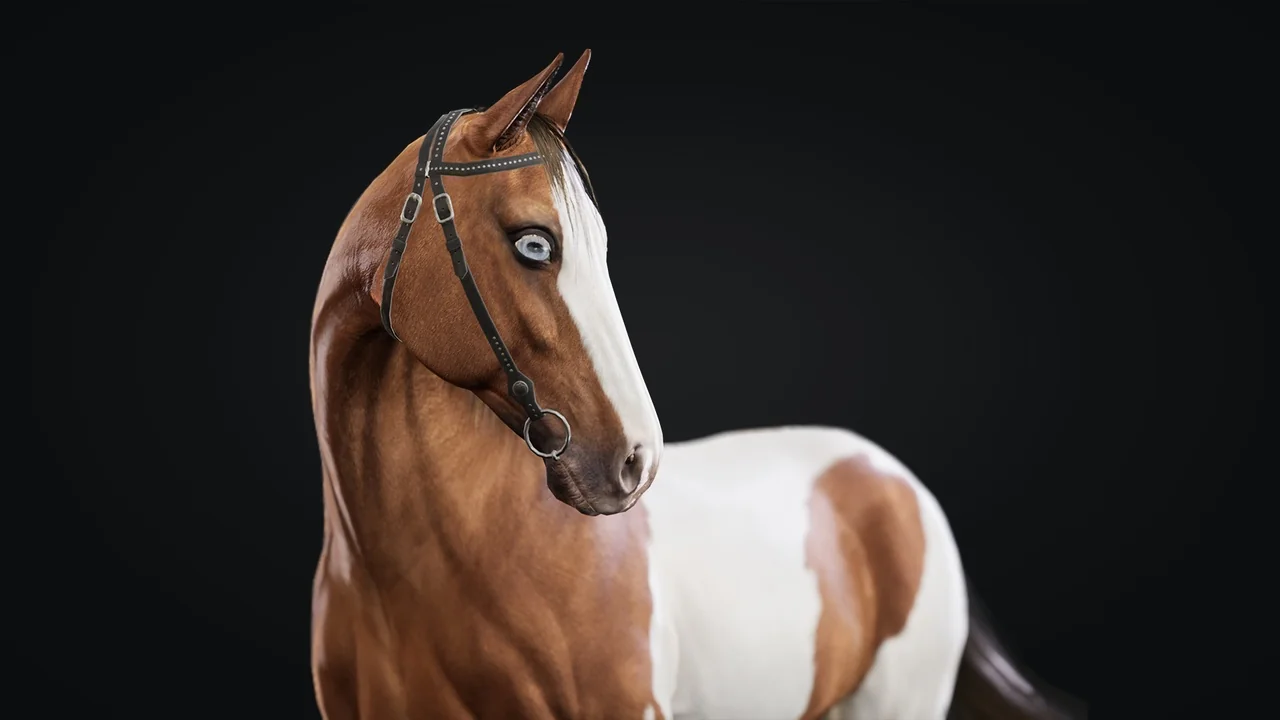
 Characters
 Characters
 Characters