"031373f479d9561a"{"id":"28447","slug":"abandoned-mansion-_-fully-modular-asset-pack","title":"Abandoned Mansion _ Fully Modular Asset Pack","category":"Abandoned","engine":"4.26+,5.0+","assetVersion":"Engine version: 4.26+,5.0+","engineVersion":"4.19","tag":"Abandoned","accent":"blue","visual":"city","summary":"Abandoned Mansion _ Fully Modular Asset Pack centers on a practical setup path: blocking out Victorian rooms quickly with a modular system that covers curved corners, ceilings, floors, doors, and windows. It also includes the original 3Ds Max, UE4, Substanc...","platform":"Unreal Engine","publishedAt":"2026-05-15T16:40:47.000Z","updatedAt":"2026-05-15T16:50:24.000Z","sourceNotes":[],"fileContents":[],"compatibility":["Unreal Engine","Engine version: 4.26+,5.0+"],"featuredImage":{"alt":"Abandoned Mansion _ Fully Modular Asset Pack","src":"https://3dcghub.com/wp-content/uploads/2026/05/4c3f8ee356d5_8270a8be-228d-43dc-b166-9978f2fe0a32.webp"},"hasDownloadLink":true,"downloads":0,"terms":[{"taxonomy":"category","slug":"abandoned","name":"Abandoned"},{"taxonomy":"post_tag","slug":"environment","name":"Environment"},{"taxonomy":"post_tag","slug":"game-systems","name":"Game Systems"},{"taxonomy":"post_tag","slug":"unreal-engine-5","name":"Unreal Engine 5"}],"galleryImages":[{"src":"https://3dcghub.com/wp-content/uploads/2026/05/e1e23ba11f29_8f86a893-9787-4f00-9bfe-e12d1c275385.webp","alt":"Abandoned Mansion _ Fully Modular Asset Pack"},{"src":"https://3dcghub.com/wp-content/uploads/2026/05/80b8d45c05d6_543bc5bf-dbca-4bb6-8acd-c0833097a3ba.webp","alt":"Abandoned Mansion _ Fully Modular Asset Pack"},{"src":"https://3dcghub.com/wp-content/uploads/2026/05/3884d1adf9ce_03b6268e-c959-4960-a041-77b2cb065c60.webp","alt":"Abandoned Mansion _ Fully Modular Asset Pack"},{"src":"https://3dcghub.com/wp-content/uploads/2026/05/7ffe9873a37d_ae642818-2f4d-4d53-8af6-0c6f06419d8b.webp","alt":"Abandoned Mansion _ Fully Modular Asset Pack"},{"src":"https://3dcghub.com/wp-content/uploads/2026/05/1d39a35b6346_a63d75b2-76c0-419c-9912-ef21a7404687.webp","alt":"Abandoned Mansion _ Fully Modular Asset Pack"},{"src":"https://3dcghub.com/wp-content/uploads/2026/05/79815b7c3c6a_b9d47a46-267d-4953-af8c-5e4eaea01844.webp","alt":"Abandoned Mansion _ Fully Modular Asset Pack"},{"src":"https://3dcghub.com/wp-content/uploads/2026/05/a298cc15b194_834d46cc-3516-427c-be15-0e06f811b11a.webp","alt":"Abandoned Mansion _ Fully Modular Asset Pack"},{"src":"https://3dcghub.com/wp-content/uploads/2026/05/e771eee2a577_cd8d34f7-78f4-484e-acec-a88b41f1d20a.webp","alt":"Abandoned Mansion _ Fully Modular Asset Pack"},{"src":"https://3dcghub.com/wp-content/uploads/2026/05/14f08b9d22dc_e6bcc080-4729-464e-9d95-eacb820c8dde.webp","alt":"Abandoned Mansion _ Fully Modular Asset Pack"},{"src":"https://3dcghub.com/wp-content/uploads/2026/05/fa7239b80642_36405972-5f25-4cb5-b740-190c6632161e.webp","alt":"Abandoned Mansion _ Fully Modular Asset Pack"}],"accessPanel":{"kind":"resource","title":"Access this resource","eyebrow":"Free Download","message":"Log in or create a free account to start your download.","fileName":"AbandonedMansion_FullyMod.7z","safetyNote":"All resources are 100% manually reviewed to eliminate all risks.","actionLabel":"Download Free","resourceType":"Resource archive"},"contentHtml":"\u003cp\u003eGetting a scene moving quickly is clearly part of the appeal here. Abandoned Mansion _ Fully Modular Asset Pack is structured around a fully modular system for realistic Victorian interiors, with instructions that show how to block out rooms using curved corners, ceilings, floors, doors, and windows. Rather than treating the mansion as a fixed environment, it approaches the space as a set of reusable parts that can be arranged into old, damaged, realistic interior layouts.\u003c/p\u003e\n\u003cp\u003eThat setup places it in a very practical spot in production. It can serve as a starting point for a horror house, an old mansion interior, or a broader Victorian level where room layout and mood matter as much as surface detail. The modular approach also makes it relevant for people who want to shape spaces quickly before spending time on lighting or scene dressing.\u003c/p\u003e \u003ch2\u003eBlocking out rooms in Abandoned Mansion\u003c/h2\u003e\n\u003cp\u003eThe most concrete part of the package is the room-building workflow. It includes instructions for quickly blocking out rooms, and that speed matters because the set is not limited to straight walls and simple square spaces. Curved corners are specifically part of the system, alongside ceilings, floors, doors, and windows. That gives the pack a stronger architectural identity than a loose collection of interior pieces.\u003c/p\u003e\n\u003cp\u003eFor environment work, this kind of structure changes how the asset pack fits into a project. It is not just about placing decorative objects into an empty shell. The shell itself is part of the modular system, so the resource sits very early in the scene-building process. A creator can establish the shape of an old Victorian house interior first, then continue with lighting practice or project-specific alterations afterward.\u003c/p\u003e\n\u003cp\u003eThe tags attached to the pack point in the same direction: modular, mansion, house, level, interior, realistic, old, damaged, horror, Victorian, and renaissance. Taken together, those terms frame the pack as a scene-construction resource beyond one hero environment. It supports interior level work where tone and age are important, especially when the goal is a worn or abandoned mansion atmosphere.\u003c/p\u003e \u003ch2\u003eVictorian setting, damaged interiors, and horror-friendly tone\u003c/h2\u003e\n\u003cp\u003eThe visual target is clearly a realistic Victorian setting. That immediately defines where the pack fits best. It is aimed at interiors with period character rather than contemporary architecture, and the old, damaged, mansion-oriented tags reinforce that direction. The package then offers a pack that speaks to projects needing a house with age, weight, and mood.\u003c/p\u003e\n\u003cp\u003eThere is also a strong overlap with horror production needs. Horror often depends on interior spaces that guide pacing through doors, corners, room transitions, and controlled sightlines. Since this system covers doors, windows, ceilings, floors, and curved corners, it has direct relevance for that kind of spatial design. The pack is equally useful when the goal is a realistic old mansion without an explicit horror angle, but the thematic fit for suspenseful interiors is easy to see.\u003c/p\u003e\n\u003cp\u003eThe “damaged” and “old” tags matter because they narrow the type of Victorian setting being represented. This is not framed as a clean or pristine historical interior. It belongs more naturally in abandoned, worn, or distressed spaces, where age and atmosphere are visible parts of the environment. That can influence everything from room composition to how lighting is approached inside the scene.\u003c/p\u003e \u003ch2\u003eOriginal 3Ds Max, UE4, and Substance files in a working pipeline\u003c/h2\u003e\n\u003cp\u003eOne of the most useful details is the inclusion of the original files. The pack contains 3Ds Max, UE4, Substance Painter, and Substance Designer files for easy alteration. That moves it beyond a closed asset set. It becomes a project that can be edited at multiple points in the workflow, whether the need is structural adjustment, material work, or direct Unreal Engine use.\u003c/p\u003e\n\u003cp\u003eIn practice, that makes the pack relevant to more than one kind of user. Someone building a game or interactive project can use it as environment content. Someone studying environment production can inspect how the creator set up the project and work backwards from there. Someone refining look development can use the included files to explore texture and material changes through the Substance tools.\u003c/p\u003e\n\u003cp\u003eThis is also where the resource has educational value without drifting away from production use. The pack is presented as an opportunity to look into the creator’s project setup. That means the included files are not only there for modification; they also offer a direct view into how the environment has been assembled across tools. For artists learning how a modular interior environment travels between modeling, texturing, and engine assembly, that kind of access can be just as important as the finished assets themselves.\u003c/p\u003e\n\u003cp\u003eThe fact that alteration is called out specifically suggests a workflow that expects user intervention rather than discouraging it. The pack can be opened, studied, and changed. For teams or individual creators working on a Victorian interior with very particular needs, that flexibility is often more useful than a locked package that only supports basic placement.\u003c/p\u003e \u003ch2\u003eLighting practice inside an old mansion environment\u003c/h2\u003e\n\u003cp\u003eAnother clear use case is lighting practice. The pack is described as a good opportunity to practice lighting skills, and that aligns naturally with the kind of environment it represents. A realistic Victorian mansion interior, especially one leaning into abandoned, old, or horror-friendly moods, gives lighting a central role. Windows, room depth, curved corners, and transitions between spaces all shape how light defines the scene.\u003c/p\u003e\n\u003cp\u003eBecause the pack supports room blockout and includes the project files, it can function as a lighting study environment rather than just a finished backdrop. A creator can examine the existing setup, change room arrangements, and test different interior moods within a space that already has an established architectural language. That is a practical fit for artists who want an environment to work in beyond one static result.\u003c/p\u003e\n\u003cp\u003eThere is a useful production connection here as well. Lighting tests are often more convincing when they happen inside spaces with believable structure. Curved corners, doors, windows, floors, and ceilings give those tests context. Instead of lighting a generic box room, the user is working within a Victorian mansion framework that can support more atmospheric and project-relevant results.\u003c/p\u003e \u003ch2\u003eProgram versions and the automatic LODs note\u003c/h2\u003e\n\u003cp\u003eThe supported program versions are stated directly: Unreal Engine 4.19.2, 3Ds Max 2019, Substance Painter 2018 2.3 or newer, and Substance Designer 2018 2.2 or newer. Those version details are important because the pack includes original working files across all four applications. Anyone planning to open and alter the content can assess that toolchain immediately.\u003c/p\u003e\n\u003cp\u003eThere is also a specific disclaimer attached to the pack: it only contains automatic LODs. That is a narrow but meaningful production note. It sets expectations clearly and helps define the technical state of the asset set without overstating it. For users evaluating how the pack fits into their project workflow, that detail belongs alongside the version information because both affect how directly the content can be picked up, examined, and adapted.\u003c/p\u003e\n\u003cp\u003ePut together, these details make the pack feel less like a single-purpose environment drop and more like a modular interior project that can be assembled, studied, altered, and lit inside a known set of tools. For a realistic Victorian mansion scene—especially one leaning into old, damaged, or horror-tinged interiors—that combination is the most practical reason to keep it in a working pipeline.\u003c/p\u003e\n\n\u003ch2\u003eContinue Browsing Similar Packs\u003c/h2\u003e\n\u003cul\u003e\n\u003cli\u003e\u003ca href=\"https://3dcghub.com/dreamscape-nature-meadows-stylized-open-world-environment/\" title=\"Dreamscape Nature : Meadows : Stylized Open World Environment\"\u003eDreamscape Nature : Meadows : Stylized Open World Environment\u003c/a\u003e\u003c/li\u003e\n\u003cli\u003e\u003ca href=\"https://3dcghub.com/environment-vfx-pack-high-quality/\" title=\"Environment VFX Pack – High Quality\"\u003eEnvironment VFX Pack – High Quality\u003c/a\u003e\u003c/li\u003e\n\u003cli\u003e\u003ca href=\"https://3dcghub.com/medieval-fantasy-ruins-dark-forest-environment/\" title=\"Medieval Fantasy Ruins – Dark Forest Environment\"\u003eMedieval Fantasy Ruins – Dark Forest Environment\u003c/a\u003e\u003c/li\u003e\n\u003cli\u003e\u003ca href=\"https://3dcghub.com/stylescape-stylized-environment-kit/\" title=\"Stylescape: Stylized Environment Kit\"\u003eStylescape: Stylized Environment Kit\u003c/a\u003e\u003c/li\u003e\n\u003c/ul\u003e","contentTextLength":8021,"navigation":{"current":1371,"total":3223,"previous":{"id":"28434","slug":"1900s-office-1900s-1900th-office-officed-workspace-workspace","title":"1900s Office ( 1900s 1900th Office Officed Workspace Workspace )","category":"Industrial","platform":"Unreal Engine","updatedAt":"2026-05-15T16:50:42.000Z"},"next":{"id":"28457","slug":"advanced-third-person-camera","title":"Advanced Third Person Camera","category":"Gameplay Features","platform":"Unreal Engine","updatedAt":"2026-05-15T16:49:52.000Z"}},"relatedResources":[{"id":"6759","slug":"old-minimarket-complete-environment","title":"Old minimarket complete environment","category":"Abandoned","engine":"5.0+","assetVersion":"Engine version: 5.0+","engineVersion":"5.0","tag":"Abandoned","accent":"blue","visual":"city","summary":"Build a gritty and realistic retail scene with this fully optimized asset pack. It includes a detailed market area, storage room, and bathroom with baked lighting for maximum performance.","platform":"Unreal Engine","publishedAt":"2026-02-20T15:19:38.000Z","updatedAt":"2026-04-19T15:56:07.000Z","sourceNotes":[],"fileContents":[],"compatibility":["Unreal Engine","Engine version: 5.0+"],"featuredImage":{"alt":"Old minimarket complete environment","src":"https://3dcghub.com/wp-content/uploads/2026/02/0480fc26-7f8b-4079-89c6-e8407765a5e0.webp"},"hasDownloadLink":true,"downloads":0},{"id":"27242","slug":"abandoned-russian-building","title":"Abandoned Russian Building","category":"Abandoned","engine":"4.26+,5.0+","assetVersion":"Engine version: 4.26+,5.0+","engineVersion":" ","tag":"Abandoned","accent":"blue","visual":"city","summary":"A decaying Soviet-era building gives horror scenes a bleak, enclosed place to unfold. The interior takes priority, while exterior pieces stay in the background, and the lighting setup is meant to stay baked if the scene is used in UE5.","platform":"Unreal Engine","publishedAt":"2026-04-23T04:12:10.000Z","updatedAt":"2026-04-23T04:12:13.000Z","sourceNotes":[],"fileContents":[],"compatibility":["Unreal Engine","Engine version: 4.26+,5.0+"],"featuredImage":{"alt":"Abandoned Russian Building","src":"https://3dcghub.com/wp-content/uploads/2026/04/134773e64463_c0be0b90-da6c-4324-9f0a-924af8ec2bc4.webp"},"hasDownloadLink":true,"downloads":6},{"id":"1001038","slug":"abandoned-factory-industrial-railway-zone-update-v-2","title":"ABANDONED FACTORY / Industrial railway zone (Update V.2)","category":"Abandoned","engine":"4.27,5.0+","assetVersion":"","engineVersion":"Engine Version: 4.27,5.0+","tag":"Abandoned","accent":"blue","visual":"mech","summary":"The V.2 update brings two pre-assembled levels, modular enterable factory buildings, vertex-painted ground materials, and a LOD-to-Nanite workflow.","platform":"Unreal Engine","publishedAt":"2026-08-27T10:13:05.620Z","updatedAt":"2026-08-27T10:13:05.620Z","sourceNotes":[],"fileContents":[],"compatibility":["Unreal Engine","Engine Version: 4.27,5.0+"],"featuredImage":{"alt":"ABANDONED FACTORY / Industrial railway zone (Update V.2)","src":"/wp-content/uploads/published/2026/08/4a5ab4769ce7-cb2ebff5-ca80-4b1b-bd0b-146d6ce653c8-80d800d987.webp"},"hasDownloadLink":true,"downloads":3}]}
Abandoned
Abandoned Mansion _ Fully Modular Asset Pack
Abandoned Mansion _ Fully Modular Asset Pack centers on a practical setup path: blocking out Victorian rooms quickly with a modular system that covers curved corners, ceilings, floors, doors, and windows. It also includes the original 3Ds Max, UE4, Substanc...
Category:Unreal Engine,AbandonedPlatform: Unreal EngineEngine version: 4.26+,5.0+Published: May 15, 2026
Abandoned
Resource overview
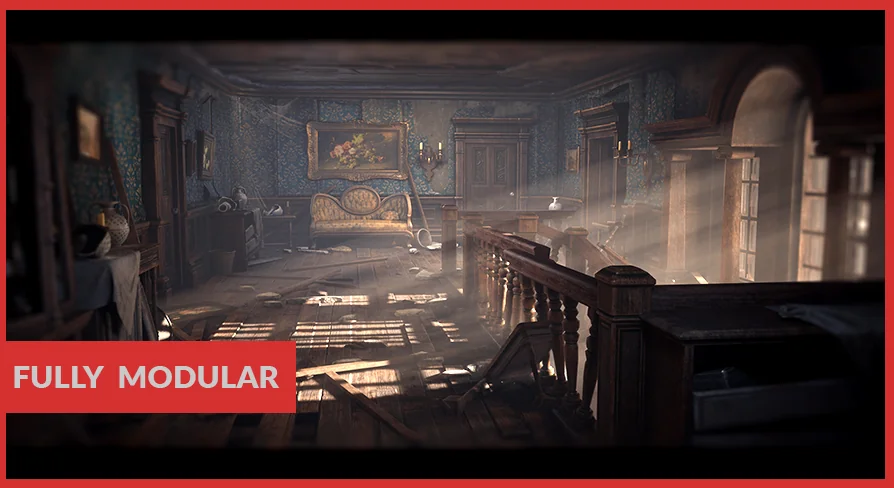
Getting a scene moving quickly is clearly part of the appeal here. Abandoned Mansion _ Fully Modular Asset Pack is structured around a fully modular system for realistic Victorian interiors, with instructions that show how to block out rooms using curved corners, ceilings, floors, doors, and windows. Rather than treating the mansion as a fixed environment, it approaches the space as a set of reusable parts that can be arranged into old, damaged, realistic interior layouts.
That setup places it in a very practical spot in production. It can serve as a starting point for a horror house, an old mansion interior, or a broader Victorian level where room layout and mood matter as much as surface detail. The modular approach also makes it relevant for people who want to shape spaces quickly before spending time on lighting or scene dressing.
Blocking out rooms in Abandoned Mansion
The most concrete part of the package is the room-building workflow. It includes instructions for quickly blocking out rooms, and that speed matters because the set is not limited to straight walls and simple square spaces. Curved corners are specifically part of the system, alongside ceilings, floors, doors, and windows. That gives the pack a stronger architectural identity than a loose collection of interior pieces.
For environment work, this kind of structure changes how the asset pack fits into a project. It is not just about placing decorative objects into an empty shell. The shell itself is part of the modular system, so the resource sits very early in the scene-building process. A creator can establish the shape of an old Victorian house interior first, then continue with lighting practice or project-specific alterations afterward.
The tags attached to the pack point in the same direction: modular, mansion, house, level, interior, realistic, old, damaged, horror, Victorian, and renaissance. Taken together, those terms frame the pack as a scene-construction resource beyond one hero environment. It supports interior level work where tone and age are important, especially when the goal is a worn or abandoned mansion atmosphere.
Victorian setting, damaged interiors, and horror-friendly tone
The visual target is clearly a realistic Victorian setting. That immediately defines where the pack fits best. It is aimed at interiors with period character rather than contemporary architecture, and the old, damaged, mansion-oriented tags reinforce that direction. The package then offers a pack that speaks to projects needing a house with age, weight, and mood.
There is also a strong overlap with horror production needs. Horror often depends on interior spaces that guide pacing through doors, corners, room transitions, and controlled sightlines. Since this system covers doors, windows, ceilings, floors, and curved corners, it has direct relevance for that kind of spatial design. The pack is equally useful when the goal is a realistic old mansion without an explicit horror angle, but the thematic fit for suspenseful interiors is easy to see.
The “damaged” and “old” tags matter because they narrow the type of Victorian setting being represented. This is not framed as a clean or pristine historical interior. It belongs more naturally in abandoned, worn, or distressed spaces, where age and atmosphere are visible parts of the environment. That can influence everything from room composition to how lighting is approached inside the scene.
Original 3Ds Max, UE4, and Substance files in a working pipeline
One of the most useful details is the inclusion of the original files. The pack contains 3Ds Max, UE4, Substance Painter, and Substance Designer files for easy alteration. That moves it beyond a closed asset set. It becomes a project that can be edited at multiple points in the workflow, whether the need is structural adjustment, material work, or direct Unreal Engine use.
In practice, that makes the pack relevant to more than one kind of user. Someone building a game or interactive project can use it as environment content. Someone studying environment production can inspect how the creator set up the project and work backwards from there. Someone refining look development can use the included files to explore texture and material changes through the Substance tools.
This is also where the resource has educational value without drifting away from production use. The pack is presented as an opportunity to look into the creator’s project setup. That means the included files are not only there for modification; they also offer a direct view into how the environment has been assembled across tools. For artists learning how a modular interior environment travels between modeling, texturing, and engine assembly, that kind of access can be just as important as the finished assets themselves.
The fact that alteration is called out specifically suggests a workflow that expects user intervention rather than discouraging it. The pack can be opened, studied, and changed. For teams or individual creators working on a Victorian interior with very particular needs, that flexibility is often more useful than a locked package that only supports basic placement.
Lighting practice inside an old mansion environment
Another clear use case is lighting practice. The pack is described as a good opportunity to practice lighting skills, and that aligns naturally with the kind of environment it represents. A realistic Victorian mansion interior, especially one leaning into abandoned, old, or horror-friendly moods, gives lighting a central role. Windows, room depth, curved corners, and transitions between spaces all shape how light defines the scene.
Because the pack supports room blockout and includes the project files, it can function as a lighting study environment rather than just a finished backdrop. A creator can examine the existing setup, change room arrangements, and test different interior moods within a space that already has an established architectural language. That is a practical fit for artists who want an environment to work in beyond one static result.
There is a useful production connection here as well. Lighting tests are often more convincing when they happen inside spaces with believable structure. Curved corners, doors, windows, floors, and ceilings give those tests context. Instead of lighting a generic box room, the user is working within a Victorian mansion framework that can support more atmospheric and project-relevant results.
Program versions and the automatic LODs note
The supported program versions are stated directly: Unreal Engine 4.19.2, 3Ds Max 2019, Substance Painter 2018 2.3 or newer, and Substance Designer 2018 2.2 or newer. Those version details are important because the pack includes original working files across all four applications. Anyone planning to open and alter the content can assess that toolchain immediately.
There is also a specific disclaimer attached to the pack: it only contains automatic LODs. That is a narrow but meaningful production note. It sets expectations clearly and helps define the technical state of the asset set without overstating it. For users evaluating how the pack fits into their project workflow, that detail belongs alongside the version information because both affect how directly the content can be picked up, examined, and adapted.
Put together, these details make the pack feel less like a single-purpose environment drop and more like a modular interior project that can be assembled, studied, altered, and lit inside a known set of tools. For a realistic Victorian mansion scene—especially one leaning into old, damaged, or horror-tinged interiors—that combination is the most practical reason to keep it in a working pipeline.
 Abandoned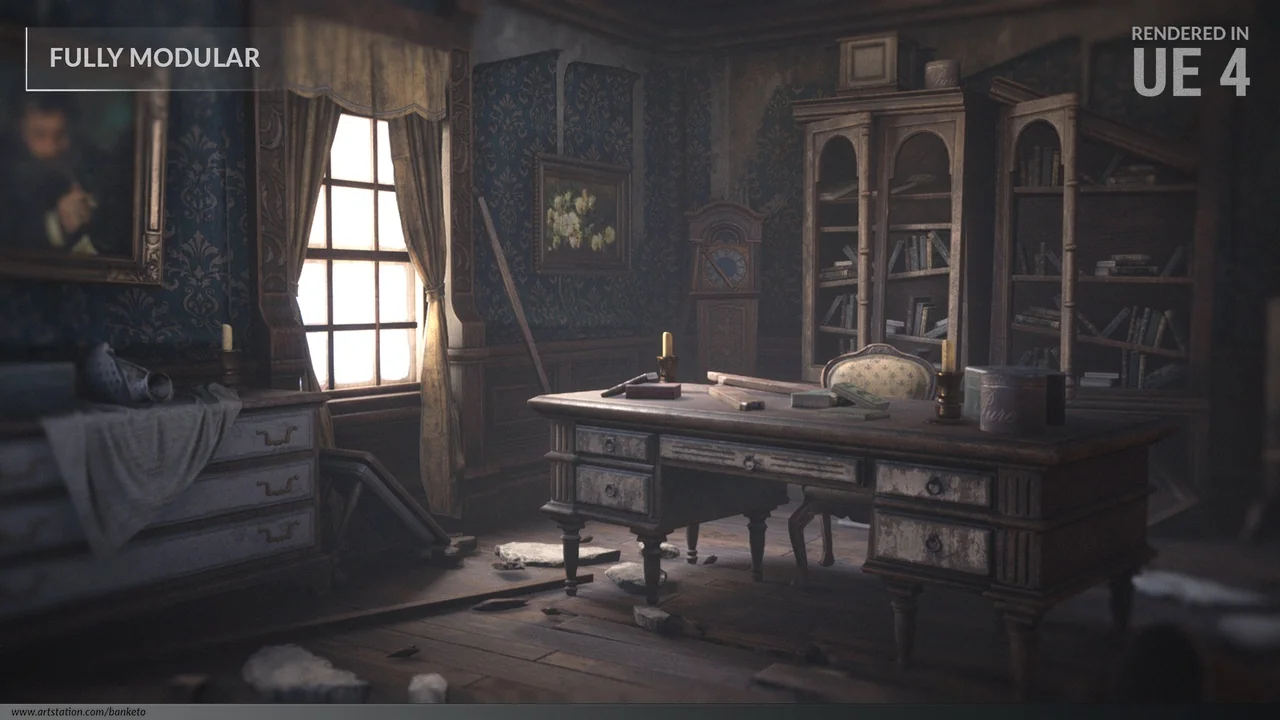
 Abandoned
 Abandoned
 Abandoned