"7066dd76da796369"{"id":"1001150","slug":"waterline-pro-6","title":"Waterline PRO 6","category":"Engine Tools","engine":"4.27+,5.4+","assetVersion":"","engineVersion":"Engine Version: 4.27+,5.4+","tag":"Engine Tools","accent":"blue","visual":"mech","summary":"Waterline PRO 6 delivers FFT spectra, baked ocean simulations, dynamic wakes, and multi-layered water surfaces across games, films, and virtual sets.","platform":"Unreal Engine","publishedAt":"2026-09-10T13:07:23.062Z","updatedAt":"2026-09-10T13:07:23.062Z","sourceNotes":[],"fileContents":[],"compatibility":["Unreal Engine","Engine Version: 4.27+,5.4+"],"featuredImage":{"alt":"Waterline PRO 6","src":"/wp-content/uploads/published/2026/09/8612287b2b8d-e62960e9-fc5c-4a85-851c-3bc204c2b07b-d5c59a5cbe.webp"},"hasDownloadLink":true,"downloads":3,"terms":[{"taxonomy":"category","slug":"engine-tools","name":"Engine Tools"}],"galleryImages":[{"src":"/wp-content/uploads/published/2026/09/705b54ffa6c1-cbf55a93-0e8c-4302-a6dc-e3f854175123-551b8a4fdc.webp","alt":"Waterline PRO 6"},{"src":"/wp-content/uploads/published/2026/09/edb722d0d9b6-623cec0b-648a-4a93-9c2f-c64313d88df0-c3719b116f.webp","alt":"Waterline PRO 6"},{"src":"/wp-content/uploads/published/2026/09/865abd10623b-8cc3ac93-5d0c-4267-9482-a23f9b270463-d852e31d9f.webp","alt":"Waterline PRO 6"},{"src":"/wp-content/uploads/published/2026/09/0c191fa9b1f6-f81becc5-0547-4d86-9541-0410d9cdcf96-6d4fdf6048.webp","alt":"Waterline PRO 6"},{"src":"/wp-content/uploads/published/2026/09/75b5e079893d-b18224eb-ac33-4187-b0c7-9647454ba26b-9f1e57c981.webp","alt":"Waterline PRO 6"},{"src":"/wp-content/uploads/published/2026/09/a805cb40a777-fd96cc16-c6fd-4894-a16b-6fa857178efc-885b8e6b89.webp","alt":"Waterline PRO 6"},{"src":"/wp-content/uploads/published/2026/09/214d0679789b-66d09c58-07c2-4f43-b25d-625733276cde-73ec5b3e0a.webp","alt":"Waterline PRO 6"},{"src":"/wp-content/uploads/published/2026/09/3349578a5ff1-c14b784b-5573-49bf-9693-58e09e067670-56a131acdc.webp","alt":"Waterline PRO 6"},{"src":"/wp-content/uploads/published/2026/09/2ed324656c37-66e263dc-a76d-494b-be2d-bf165f5a5dd9-2bc5c520de.webp","alt":"Waterline PRO 6"},{"src":"/wp-content/uploads/published/2026/09/04a1b71a12ac-f49391cf-fd78-4783-bac9-c4d85ad3b186-90c45ce911.webp","alt":"Waterline PRO 6"}],"accessPanel":{"kind":"resource","title":"Download this resource","eyebrow":"Free Download","message":"Log in or create a free account to start your download.","fileName":"Waterline PRO 6.7z","safetyNote":"Resources are manually reviewed before listing to improve quality and reduce obvious risks.","actionLabel":"Download Free","resourceType":"Resource archive"},"contentHtml":"\u003cp\u003eBalancing computational fidelity against runtime constraints remains a persistent challenge in real-time water simulation. Waterline PRO 6 targets this problem by unifying film-caliber water surfaces, physics-driven interactions, and performant game-ready deployment methods within a single modular framework. The package scales across environments ranging from high-end path-traced offline renderings and virtual production LED walls to cross-platform multiplayer games running on consoles and PCs.\u003c/p\u003e \u003cp\u003eRather than enforcing a single simulation method, the framework provides distinct ocean pipelines tailored to specific hardware profiles and project requirements. Projects can lean on fully computed real-time simulations, drop back to simplified mathematical wave models, or switch entirely to pre-baked displacement maps to match their performance targets without sacrificing visual complexity.\u003c/p\u003e \u003ch2\u003eChoosing Between FFT Spectra, Gerstner Math, and Baked Ocean Pipelines\u003c/h2\u003e \u003cp\u003eFour primary simulation styles form the technical foundation of the ocean tools. The centerpiece consists of GPU-based Fast Fourier Transform (FFT) simulations built without any custom HLSL code, keeping the pipeline deeply integrated with native engine rendering. Artists can pick from established oceanographic models including the movie-industry standard Phillips Spectrum, the JONSWAP Spectrum, and the Pierson-Moskowitz Spectrum. For specialized conditions or non-standard fluid surfaces, a Custom Spectrum mode allows artists to design and execute novel wave distributions.\u003c/p\u003e \u003cp\u003eProjects targeting older hardware or restricted execution budgets can utilize the Gerstner wave simulation mode. While Gerstner calculations use a simpler underlying mathematical profile, their low computational overhead unlocks compatibility across a wider bracket of consumer machines. When GPU overhead must be eliminated entirely, the baked ocean system comes into play. This pipeline bakes down a complete Phillips Spectrum into a highly optimized data format, freeing real-time GPU cycles while preserving post-simulation control over wind speed, wave amplitude, and overall directionality.\u003c/p\u003e \u003ch2\u003eConfiguring Multi-Layered Oceans and Sequencer Timelines for Cinematics\u003c/h2\u003e \u003cp\u003eCinematic artists working in Unreal Engine can route simulations directly through the native Path Tracer to achieve realistic reflections, refractions, and light transmission matching offline render suites.\u003c/p\u003e \u003cp\u003eSurface geometry is managed through screen-space ocean meshing, which maintains sub-centimeter geometric detail near the camera while spanning distances measured in kilometers. Individual simulation layers run at surface resolutions up to 2048x2048, matching production standards used in large-scale visual effects feature films. When an environment requires both immense physical scale and microscopic surface variation, Gen 4 Ocean Actors allow creators to run up to four distinct ocean simulation layers at the same time. A multi-layered setup can combine open ocean swells stretching hundreds of meters across with secondary 2K layers dedicated to fine centimeter-scale wavelets, topped off with a post-simulation detail pass for ultra-fine cresting.\u003c/p\u003e \u003cp\u003eEvery simulation system in the collection operates deterministically. Evaluating the same frame coordinates across repeated render passes yields completely identical wave heights, allowing precise shot matching during multi-pass compositing. Waves can also be keyed directly to a sequencer timeline, giving artists the ability to scrub back and forth through complex ocean states during shot setup. While default FFT simulations do not naturally loop over time, the Gerstner and baked ocean systems can be set to periodic looping modes when continuous, predictable wave cycles are needed for set dressing or backdrops.\u003c/p\u003e \u003ch2\u003eGameplay Networking, LWC Scaling, and Triple Buoyancy Models\u003c/h2\u003e \u003cp\u003eGameplay integration focuses on platform scalability and deterministic replication across large environments.\u003c/p\u003e \u003cp\u003eThe package operates within modern development workflows across Windows, Linux, and Mac systems configured for Shader Model 6. Shipped multiplayer titles utilize the framework on PC, PlayStation 5, and Xbox Series X/S hardware. For network replication, teams can choose between two fundamental network architectures:\u003c/p\u003e \u003cul\u003e \u003cli\u003e\u003cstrong\u003eClient-Authoritative Synchronization:\u003c/strong\u003e Driven by deterministic mathematics, all connected clients simulate visually and mechanically identical ocean surfaces using a synchronized constant time variable.\u003c/li\u003e \u003cli\u003e\u003cstrong\u003eServer-Authoritative Synchronization:\u003c/strong\u003e Headless dedicated servers running without active GPUs process baked ocean displacement data directly on the CPU, calculating authoritative positions before relaying coordinates to clients.\u003c/li\u003e\n\u003c/ul\u003e \u003cp\u003eTo prevent floating-point errors across massive terrains, all simulation routines support Large World Coordinates (LWC) alongside native World Partitioning, having undergone testing across maps spanning thousands of square kilometers. Flotation is governed by three distinct buoyancy models: rigid-body physical simulation for fully reactive vehicular physics, a deterministic non-physics CPU buoyancy model intended for stable networked actors, and a lightweight GPU material-based buoyancy mode for ambient decorative clutter.\u003c/p\u003e \u003ch2\u003eDynamic Object Interactions, Shoreline Waves, and Localized Water Bodies\u003c/h2\u003e \u003cp\u003eBeyond the horizon-to-horizon ocean actors, localized water features are addressed through dedicated Lake Actors and shoreline mechanics. Lakes support the full range of dynamic simulation systems while remaining bound to specific geographic depressions in the landscape. Along coastal boundaries, specialized shore systems introduce breaking and rolling wave profiles to simulate turbulent surf zones.\u003c/p\u003e \u003cp\u003eSubmerged perspectives are handled through modular underwater visual effects, offering a choice between an optimized post-process setup and a volumetric scattering pass. For inspection scenes or cutaway presentations, in-development ocean deformers give artists the tools to cut out and mask targeted sections of the water surface to expose cross-sectional slices of hulls or submerged terrain.\u003c/p\u003e \u003cp\u003eInteractive disturbances inject responsive foam, surface ripples, and trailing wakes wherever dynamic objects collide with the surface plane. The interactive engine scales fluid response based on the velocity, cross-sectional shape, and physical scale of the colliding actor, accurately handling both broad displacement wakes behind ocean-going cargo ships and slight surface tension ripples from wading characters. Production teams can customize interactive wave ranges, simulation resolutions, execution frame rates, and specific actor inclusion lists to strictly control processing costs.\u003c/p\u003e \u003ch2\u003eProduction Deployments from nDisplay Sets to Headless Dedicated Servers\u003c/h2\u003e \u003cp\u003eDeploying the asset into an active pipeline centers around pre-configured, drag-and-drop ocean actors that expose critical performance and aesthetic parameters in single inspector panels. Studios operating virtual production facilities can deploy the ocean surfaces straight to nDisplay clusters and live LED volumes, where deterministic frame evaluation guarantees sync across camera tracking systems and background display walls.\u003c/p\u003e \u003cp\u003eFor game development teams, the toolset acts as an end-to-end framework capable of sliding smoothly between lightweight baked displacement for performance-sensitive handheld or older target hardware, and layered multi-FFT execution for high-end cinematic titles. Its separation of simulation math, network replication modes, and dynamic interaction passes ensures that technical artists can budget GPU and CPU cycles specifically around their project's unique bottlenecks.\u003c/p\u003e\n\n\u003ch2\u003eRelated Resources Worth Checking\u003c/h2\u003e\n\u003cul\u003e\n\u003cli\u003e\u003ca href=\"https://3dcghub.com/easy-waterscape-realtime-ocean-and-water-system/\" title=\"Easy Waterscape - Realtime Ocean \u0026amp; Water System\"\u003eEasy Waterscape - Realtime Ocean \u0026amp; Water System\u003c/a\u003e\u003c/li\u003e\n\u003cli\u003e\u003ca href=\"https://3dcghub.com/offline-speech-recognition/\" title=\"Offline Speech Recognition\"\u003eOffline Speech Recognition\u003c/a\u003e\u003c/li\u003e\n\u003cli\u003e\u003ca href=\"https://3dcghub.com/uiws-unified-interactive-water-system/\" title=\"UIWS - Unified Interactive Water System\"\u003eUIWS - Unified Interactive Water System\u003c/a\u003e\u003c/li\u003e\n\u003cli\u003e\u003ca href=\"https://3dcghub.com/smart-measure-distance-and-length-measurement/\" title=\"Smart Measure – Distance \u0026amp; Length Measurement\"\u003eSmart Measure – Distance \u0026amp; Length Measurement\u003c/a\u003e\u003c/li\u003e\n\u003cli\u003e\u003ca href=\"https://3dcghub.com/ultimate-touch-components/\" title=\"Ultimate Touch Components\"\u003eUltimate Touch Components\u003c/a\u003e\u003c/li\u003e\n\u003c/ul\u003e","contentTextLength":7911,"navigation":{"current":989,"total":4016,"previous":{"id":"1001154","slug":"unreal-engine-5-lighting-fundamentals","title":"Unreal Engine 5 Lighting Fundamentals","category":"Unreal Engine","platform":"Unreal Engine","updatedAt":"2026-09-10T23:53:02.795Z"},"next":{"id":"1001149","slug":"survival-man","title":"Survival Man","category":"Humans","platform":"Unreal Engine","updatedAt":"2026-09-10T12:26:28.554Z"}},"relatedResources":[{"id":"1000768","slug":"easy-waterscape-realtime-ocean-and-water-system","title":"Easy Waterscape - Realtime Ocean \u0026 Water System","category":"Engine Tools","engine":"5.7+","assetVersion":"","engineVersion":"Engine Version: 5.7+","tag":"Engine Tools","accent":"blue","visual":"mech","summary":"Realtime FFT ocean simulation for Unreal Engine 5.7+. Drop-in Blueprint actor with Tessendorf waves, dynamic foam, buoyancy, and one-click coastlines.","platform":"Unreal Engine","publishedAt":"2026-07-28T17:20:25.391Z","updatedAt":"2026-07-28T17:23:14.846Z","sourceNotes":[],"fileContents":[],"compatibility":["Unreal Engine","Engine Version: 5.7+"],"featuredImage":{"alt":"Easy Waterscape - Realtime Ocean \u0026 Water System","src":"/wp-content/uploads/published/2026/07/d797b32e1cc0-1b72c960-d366-480e-89b3-2397a4e066bd-788359d934.webp"},"hasDownloadLink":true,"downloads":8},{"id":"1002028","slug":"flipbook-maker","title":"FlipBook Maker","category":"Engine Tools","engine":"4.27+,5.0+","assetVersion":"","engineVersion":"Engine Version: 4.27+,5.0+","tag":"Engine Tools","accent":"blue","visual":"mech","summary":"Convert Unreal Engine 5 skeletal mesh animations into flipbook textures and 2D flipbook animations for Paper setups, user widgets, and inventory systems.","platform":"Unreal Engine","publishedAt":"2026-10-26T13:04:08.987Z","updatedAt":"2026-10-26T13:04:08.987Z","sourceNotes":[],"fileContents":[],"compatibility":["Unreal Engine","Engine Version: 4.27+,5.0+"],"featuredImage":{"alt":"FlipBook Maker","src":"/wp-content/uploads/published/2026/10/2d970a54aab6-957f3222-3247-4585-87c5-b6e744ac4c9e-6781be6740.webp"},"hasDownloadLink":true,"downloads":0},{"id":"14318","slug":"offline-speech-recognition","title":"Offline Speech Recognition","category":"Engine Tools","engine":"4.26 - 4.27,5.0 - 5.4","assetVersion":"Engine version: 4.26 - 4.27,5.0 - 5.4","engineVersion":"Asset Version:1.1 - 2.0","tag":"Engine Tools","accent":"blue","visual":"mech","summary":"Implement advanced voice recognition in your Unreal Engine projects without relying on cloud services. This tool supports over 15 languages and allows for seamless streaming voice-to-text functionality.","platform":"Unreal Engine","publishedAt":"2026-03-11T17:34:09.000Z","updatedAt":"2026-04-19T15:45:49.000Z","sourceNotes":[],"fileContents":[],"compatibility":["Unreal Engine","Engine version: 4.26 - 4.27,5.0 - 5.4","Asset Version: 1.1 - 2.0"],"featuredImage":{"alt":"Offline Speech Recognition","src":"https://3dcghub.com/wp-content/uploads/2026/03/f9d5de4b-fd3a-4d69-b8ef-ced1b526f3d5.webp"},"hasDownloadLink":true,"downloads":0}]}
Engine Tools
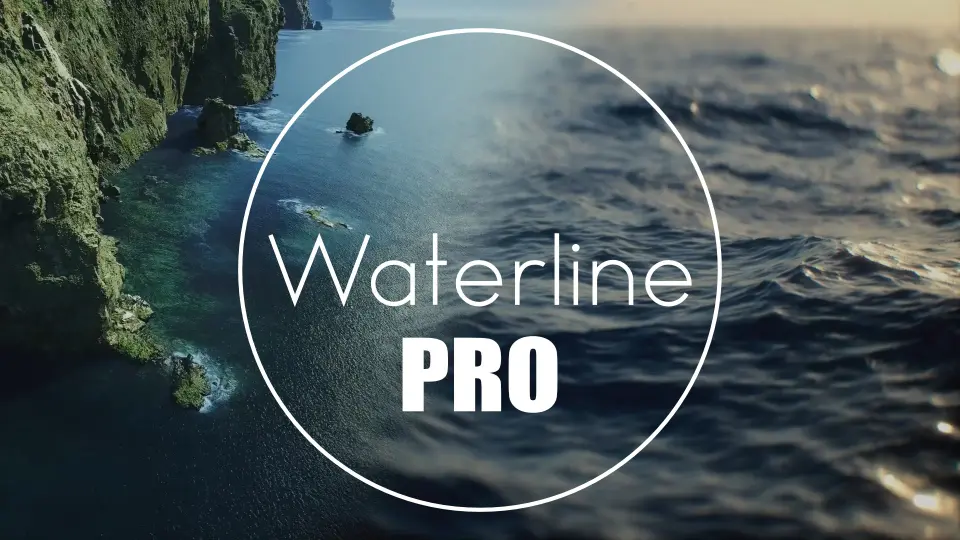
Waterline PRO 6
Waterline PRO 6 delivers FFT spectra, baked ocean simulations, dynamic wakes, and multi-layered water surfaces across games, films, and virtual sets.
Balancing computational fidelity against runtime constraints remains a persistent challenge in real-time water simulation. Waterline PRO 6 targets this problem by unifying film-caliber water surfaces, physics-driven interactions, and performant game-ready deployment methods within a single modular framework. The package scales across environments ranging from high-end path-traced offline renderings and virtual production LED walls to cross-platform multiplayer games running on consoles and PCs.
Rather than enforcing a single simulation method, the framework provides distinct ocean pipelines tailored to specific hardware profiles and project requirements. Projects can lean on fully computed real-time simulations, drop back to simplified mathematical wave models, or switch entirely to pre-baked displacement maps to match their performance targets without sacrificing visual complexity.
Choosing Between FFT Spectra, Gerstner Math, and Baked Ocean Pipelines
Four primary simulation styles form the technical foundation of the ocean tools. The centerpiece consists of GPU-based Fast Fourier Transform (FFT) simulations built without any custom HLSL code, keeping the pipeline deeply integrated with native engine rendering. Artists can pick from established oceanographic models including the movie-industry standard Phillips Spectrum, the JONSWAP Spectrum, and the Pierson-Moskowitz Spectrum. For specialized conditions or non-standard fluid surfaces, a Custom Spectrum mode allows artists to design and execute novel wave distributions.
Projects targeting older hardware or restricted execution budgets can utilize the Gerstner wave simulation mode. While Gerstner calculations use a simpler underlying mathematical profile, their low computational overhead unlocks compatibility across a wider bracket of consumer machines. When GPU overhead must be eliminated entirely, the baked ocean system comes into play. This pipeline bakes down a complete Phillips Spectrum into a highly optimized data format, freeing real-time GPU cycles while preserving post-simulation control over wind speed, wave amplitude, and overall directionality.
Configuring Multi-Layered Oceans and Sequencer Timelines for Cinematics
Cinematic artists working in Unreal Engine can route simulations directly through the native Path Tracer to achieve realistic reflections, refractions, and light transmission matching offline render suites.
Surface geometry is managed through screen-space ocean meshing, which maintains sub-centimeter geometric detail near the camera while spanning distances measured in kilometers. Individual simulation layers run at surface resolutions up to 2048x2048, matching production standards used in large-scale visual effects feature films. When an environment requires both immense physical scale and microscopic surface variation, Gen 4 Ocean Actors allow creators to run up to four distinct ocean simulation layers at the same time. A multi-layered setup can combine open ocean swells stretching hundreds of meters across with secondary 2K layers dedicated to fine centimeter-scale wavelets, topped off with a post-simulation detail pass for ultra-fine cresting.
Every simulation system in the collection operates deterministically. Evaluating the same frame coordinates across repeated render passes yields completely identical wave heights, allowing precise shot matching during multi-pass compositing. Waves can also be keyed directly to a sequencer timeline, giving artists the ability to scrub back and forth through complex ocean states during shot setup. While default FFT simulations do not naturally loop over time, the Gerstner and baked ocean systems can be set to periodic looping modes when continuous, predictable wave cycles are needed for set dressing or backdrops.
Gameplay Networking, LWC Scaling, and Triple Buoyancy Models
Gameplay integration focuses on platform scalability and deterministic replication across large environments.
The package operates within modern development workflows across Windows, Linux, and Mac systems configured for Shader Model 6. Shipped multiplayer titles utilize the framework on PC, PlayStation 5, and Xbox Series X/S hardware. For network replication, teams can choose between two fundamental network architectures:
Client-Authoritative Synchronization: Driven by deterministic mathematics, all connected clients simulate visually and mechanically identical ocean surfaces using a synchronized constant time variable.
Server-Authoritative Synchronization: Headless dedicated servers running without active GPUs process baked ocean displacement data directly on the CPU, calculating authoritative positions before relaying coordinates to clients.
To prevent floating-point errors across massive terrains, all simulation routines support Large World Coordinates (LWC) alongside native World Partitioning, having undergone testing across maps spanning thousands of square kilometers. Flotation is governed by three distinct buoyancy models: rigid-body physical simulation for fully reactive vehicular physics, a deterministic non-physics CPU buoyancy model intended for stable networked actors, and a lightweight GPU material-based buoyancy mode for ambient decorative clutter.
Dynamic Object Interactions, Shoreline Waves, and Localized Water Bodies
Beyond the horizon-to-horizon ocean actors, localized water features are addressed through dedicated Lake Actors and shoreline mechanics. Lakes support the full range of dynamic simulation systems while remaining bound to specific geographic depressions in the landscape. Along coastal boundaries, specialized shore systems introduce breaking and rolling wave profiles to simulate turbulent surf zones.
Submerged perspectives are handled through modular underwater visual effects, offering a choice between an optimized post-process setup and a volumetric scattering pass. For inspection scenes or cutaway presentations, in-development ocean deformers give artists the tools to cut out and mask targeted sections of the water surface to expose cross-sectional slices of hulls or submerged terrain.
Interactive disturbances inject responsive foam, surface ripples, and trailing wakes wherever dynamic objects collide with the surface plane. The interactive engine scales fluid response based on the velocity, cross-sectional shape, and physical scale of the colliding actor, accurately handling both broad displacement wakes behind ocean-going cargo ships and slight surface tension ripples from wading characters. Production teams can customize interactive wave ranges, simulation resolutions, execution frame rates, and specific actor inclusion lists to strictly control processing costs.
Production Deployments from nDisplay Sets to Headless Dedicated Servers
Deploying the asset into an active pipeline centers around pre-configured, drag-and-drop ocean actors that expose critical performance and aesthetic parameters in single inspector panels. Studios operating virtual production facilities can deploy the ocean surfaces straight to nDisplay clusters and live LED volumes, where deterministic frame evaluation guarantees sync across camera tracking systems and background display walls.
For game development teams, the toolset acts as an end-to-end framework capable of sliding smoothly between lightweight baked displacement for performance-sensitive handheld or older target hardware, and layered multi-FFT execution for high-end cinematic titles. Its separation of simulation math, network replication modes, and dynamic interaction passes ensures that technical artists can budget GPU and CPU cycles specifically around their project's unique bottlenecks.
 Engine Tools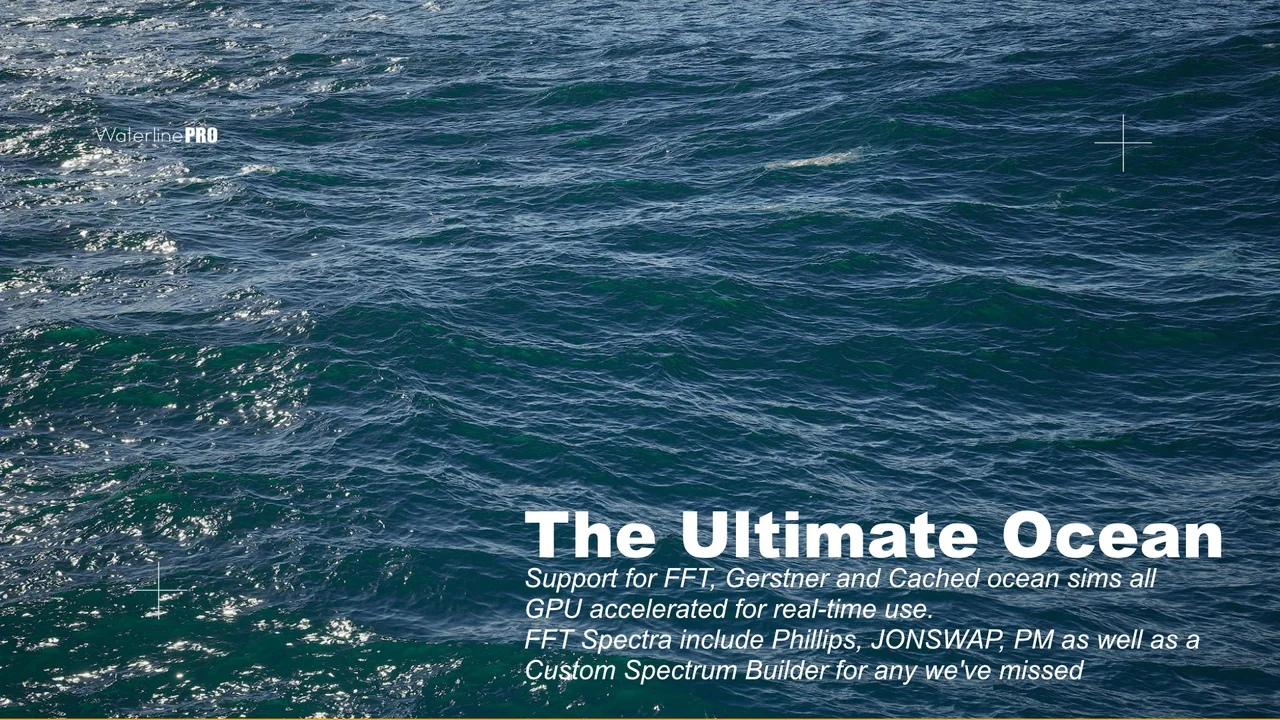
 Engine Tools
 Engine Tools
 Engine Tools