"b00678cacce53329"{"id":"1002858","slug":"vfx-weather-pack","title":"VFX Weather Pack","category":"Variety","engine":"4.26+,5.0+","assetVersion":"","engineVersion":"Engine Version: 4.26+,5.0+","tag":"Variety","accent":"blue","visual":"mech","summary":"Examine the VFX Weather Pack, featuring snow, rain, lightning, leaves, fog, and dust built with instanced materials and editable particle parameters.","platform":"Unreal Engine","indexPolicy":"index","publishedAt":"2026-11-20T12:38:46.484Z","updatedAt":"2026-11-20T12:38:46.484Z","sourceNotes":[],"fileContents":[],"compatibility":["Unreal Engine","Engine Version: 4.26+,5.0+"],"featuredImage":{"alt":"VFX Weather Pack","src":"/wp-content/uploads/published/2026/11/9f4a438f3ecf-cd11dfe8-b8ea-4a56-b897-2bc78d4160d2-cf34e4d81b.webp"},"fileSizeBytes":6533770,"hasDownloadLink":true,"downloads":0,"terms":[{"taxonomy":"category","slug":"variety-vfx","name":"Variety"}],"galleryImages":[{"src":"/wp-content/uploads/published/2026/11/fe4403a3f5a7-364d349e-fc56-4a2a-be94-9fb8c9c1c409-0b76591971.webp","alt":"VFX Weather Pack"},{"src":"/wp-content/uploads/published/2026/11/baa5a3d1fd4f-b94d618e-f691-48b7-a7fa-2aed283bae93-43925c5a0b.webp","alt":"VFX Weather Pack"},{"src":"/wp-content/uploads/published/2026/11/74393d51b060-13e7496c-d57d-409b-ad69-cb51f8b11867-f9f311a58b.webp","alt":"VFX Weather Pack"},{"src":"/wp-content/uploads/published/2026/11/7eaedd1c98a7-5d6b1f1a-369a-4cd4-a4d2-d48757e164d2-15b3185a71.webp","alt":"VFX Weather Pack"}],"accessPanel":{"kind":"resource","title":"Get this resource","safetyNote":"Resources are manually reviewed before listing to improve quality and reduce obvious risks.","fileName":"Content.7z","resourceType":"Resource archive","versions":[]},"contentHtml":"\u003cp\u003eA barren exterior setting instantly shifts tone when atmospheric particles are introduced. Whether building a dilapidated interior where motes drift through window slats or rendering an open highland swept by mountain storms, ambient particle systems provide the sensory cues that make a digital location feel reactive. The VFX Weather Pack addresses these scene demands by grouping foundational meteorological and environmental phenomena into a unified set of modular particle elements.\u003c/p\u003e \u003cp\u003eRather than attempting to simulate every conceivable climate permutation, the collection gathers six specific environmental conditions: snow, rain, lightning, leaves, fog, and dust. Each effect targets a specific layer of environmental storytelling, ranging from wide-area precipitation to fine suspended particles that establish scene scale and depth.\u003c/p\u003e \u003ch2\u003eAtmospheric Foundations in the VFX Weather Pack\u003c/h2\u003e \u003cp\u003eSpatial depth in digital environments relies heavily on air quality. Without particulate matter suspended in the atmosphere, distant geometry appears unnaturally sharp, exposing the artificial edges of background assets and terrain boundaries. Fog and dust serve as the baseline visual tools for correcting this flatness.\u003c/p\u003e \u003cp\u003eDust elements inside the package supply low-velocity particulate drift. In practical scene assembly, dust particles serve two distinct environmental duties: indoor settling and outdoor arid suspension. Placed inside enclosed structures, barns, or underground corridors, small motes catch directional lights to trace volumetric shafts. In dry outdoor environments, a wider dust scatter communicates wind scouring across unpaved earth or desert floors. Because the particles drift slowly, they add passive motion to scenes that might otherwise appear completely stationary.\u003c/p\u003e \u003cp\u003eFog provides the macro-level atmospheric companion to dust. Instead of pinpoint motes, fog systems create soft density falloff across large viewing distances. Ground fog banks pool in terrain depressions, valleys, and riverbeds, while general mist softens harsh daylight or scatters horizon lighting during dawn and dusk scenes. By breaking clean lines of sight, the fog effect gives level layouts a tangible sense of humidity and vastness.\u003c/p\u003e \u003ch2\u003ePrecipitation Systems and Sudden Storm Visuals\u003c/h2\u003e \u003cp\u003ePrecipitation dramatically alters how a player or viewer reads an exterior environment. Wet, stormy settings convey tension and hostility, whereas gentle snowfall creates quiet, insulated isolation. The package includes three complementary effects suited to active storm conditions: rain, snow, and lightning.\u003c/p\u003e \u003cp\u003eRain relies on directional speed and visual density. Streaking droplets communicate downward velocity and wind orientation across the camera view. When rain particle systems are deployed, they change the perceptual temperature of a scene, especially when paired with low ambient light or stormy skyboxes. Depending on how the density is dialed, the effect can scale from a persistent autumn drizzle to a heavy downpour.\u003c/p\u003e \u003cp\u003eSnow functions on contrasting physical principles. Falling flakes exhibit lower terminal velocity and drift with turbulence rather than slicing directly downward. By introducing rotational sway and slow descent, the snow effect transforms forest roads, tundra outposts, and mountain passes into cold, slow-moving landscapes. The visual weight of snow particles forces scenes into a deliberate, muffled tempo.\u003c/p\u003e \u003cp\u003eLightning introduces high-contrast, instantaneous illumination into severe weather scenarios. Unlike continuous precipitation, lightning operates as an episodic event. Within the collection, lightning delivers the visual discharge needed to punctuated torrential rain or turbulent overcast horizons. It serves as an atmospheric spike, instantly outlining landscape silhouettes and accentuating the severity of storm-driven environments.\u003c/p\u003e \u003ch2\u003eOrganic Motion with Airborne Foliage Elements\u003c/h2\u003e \u003cp\u003eWeather is rarely composed purely of water and air; mechanical forces like wind reveal themselves through what they pick up from the ground. The inclusion of leaves provides an organic bridge between weather systems and vegetation.\u003c/p\u003e \u003cp\u003eTumbling leaf particles simulate the aerodynamic tumbling of deciduous foliage caught in an updraft or seasonal gale. Dropping fallen leaves into a forest path, a park walkway, or an abandoned town square immediately communicates the season and local wind strength. Combined with rain or dust, drifting foliage breaks the regularity of purely geometric level design, scattering irregular organic shapes across the active gameplay or render space.\u003c/p\u003e \u003ch2\u003eConfiguring Parameters Across the Weather Systems\u003c/h2\u003e \u003cp\u003eA static visual effect quickly becomes useless if its color, density, or velocity cannot adapt to individual project palettes. The technical infrastructure of the VFX Weather Pack relies on instanced materials alongside exposed particle parameters to maintain flexibility without requiring low-level system rebuilds.\u003c/p\u003e \u003cp\u003eInstanced materials decouple visual appearance from base shader code. Instead of editing master materials and waiting for shader recompilations, artists can open a material instance to alter key parameters in real time. This means tinting dust to match desert sand, adjusting the softness and opacity of fog cards, or altering the reflectivity and transparency of rain streaks happens instantaneously within the editing interface.\u003c/p\u003e \u003cp\u003eExposing critical variables directly as particle parameters handles system-level behaviors. Spawn rates, particle lifespan, initial velocity, scale distribution, and emitter bounds can be modified per instance. If a scene requires a sparse dusting of snow rather than a blinding blizzard, adjusting the spawn rate and velocity parameters scales the density without needing a separate asset. This parameter-driven workflow allows a single base system to cover gentle breezes, dense squalls, localized indoor dust, or sweeping landscape mists.\u003c/p\u003e \u003ch2\u003eTargeted Use Cases and Technical Beneficiaries\u003c/h2\u003e \u003cp\u003eThis collection directly targets environment artists, technical artists, and independent developers who need ready-to-deploy atmospheric systems without building emitters and master materials from scratch. Constructing realistic weather behaviors from blank templates consumes substantial development time, particularly when balancing material translucency and emitter performance.\u003c/p\u003e \u003cp\u003eLevel designers working on narrative walk-throughs, action sequences, or open-world zones gain immediate visual grounding for their scenes. The inclusion of core physical types—liquids, crystalline flakes, electrical discharge, foliage debris, and vaporous density—covers the majority of exterior meteorological demands. Creators prioritizing rapid iteration will benefit most from the combination of instanced material controls and editable emitter parameters, allowing rapid visual tuning to match specific project aesthetics directly inside the viewport.\u003c/p\u003e\n\n\u003ch2\u003eRelated Resources Worth Checking\u003c/h2\u003e\n\u003cul\u003e\n\u003cli\u003e\u003ca href=\"https://3dcghub.com/vfx-bundle-2/\" rel=\"noopener noreferrer\"\u003eVFX Bundle 2\u003c/a\u003e\u003c/li\u003e\n\u003cli\u003e\u003ca href=\"https://3dcghub.com/big-niagara-bundle/\" rel=\"noopener noreferrer\"\u003eBig Niagara Bundle\u003c/a\u003e\u003c/li\u003e\n\u003cli\u003e\u003ca href=\"https://3dcghub.com/niagara-ribbon-examples/\" rel=\"noopener noreferrer\"\u003eNiagara Ribbon examples\u003c/a\u003e\u003c/li\u003e\n\u003cli\u003e\u003ca href=\"https://3dcghub.com/lazy-godray/\" rel=\"noopener noreferrer\"\u003eLazy Godray\u003c/a\u003e\u003c/li\u003e\n\u003cli\u003e\u003ca href=\"https://3dcghub.com/good-fx-rain/\" rel=\"noopener noreferrer\"\u003eGood FX : Rain\u003c/a\u003e\u003c/li\u003e\n\u003c/ul\u003e","contentTextLength":7014,"navigation":{"current":22,"total":4797,"previous":{"id":"1002859","slug":"weapon-impact-fx","title":"Weapon Impact FX","category":"Variety","platform":"Unreal Engine","updatedAt":"2026-11-20T12:39:48.939Z"},"next":{"id":"1002857","slug":"vfx-spark-pack","title":"VFX Spark Pack","category":"Variety","platform":"Unreal Engine","updatedAt":"2026-11-20T12:38:12.653Z"}},"relatedResources":[{"id":"1001196","slug":"vfx-bundle-2","title":"VFX Bundle 2","category":"Variety","engine":"5.2+","assetVersion":"","engineVersion":"Engine Version: 5.2+","tag":"Variety","accent":"blue","visual":"mech","summary":"A technical breakdown of VFX Bundle 2, featuring 121 particle systems, 46 materials, and 18 dynamic weather and surface blueprints.","platform":"Unreal Engine","indexPolicy":"index","publishedAt":"2026-09-17T07:45:20.255Z","updatedAt":"2026-09-17T07:45:20.255Z","sourceNotes":[],"fileContents":[],"compatibility":["Unreal Engine","Engine Version: 5.2+"],"featuredImage":{"alt":"VFX Bundle 2","src":"/wp-content/uploads/published/2026/09/cb57fa104c87-9a1273ec-eeb8-4e2e-a3fb-ecf563281a9e-df81056cc7.webp"},"fileSizeBytes":143643617,"hasDownloadLink":true,"downloads":2},{"id":"1001192","slug":"big-niagara-bundle","title":"Big Niagara Bundle","category":"Variety","engine":"5.0+","assetVersion":"","engineVersion":"Engine Version: 5.0+","tag":"Variety","accent":"blue","visual":"mech","summary":"A collection of 453 Niagara effects across 13 packs, featuring weather, holograms, abstract space visual systems, blueprints, and meshes.","platform":"Unreal Engine","indexPolicy":"index","publishedAt":"2026-09-17T07:36:32.355Z","updatedAt":"2026-09-17T07:36:32.355Z","sourceNotes":[],"fileContents":[],"compatibility":["Unreal Engine","Engine Version: 5.0+"],"featuredImage":{"alt":"Big Niagara Bundle","src":"/wp-content/uploads/published/2026/09/6fe3d65ea8f9-aae557ef-41e9-40c5-bffc-ac14b60707ec-02490edbb6.webp"},"fileSizeBytes":230410995,"hasDownloadLink":true,"downloads":0},{"id":"1002823","slug":"niagara-ribbon-examples","title":"Niagara Ribbon examples","category":"Weather","engine":"4.26+,5.0+","assetVersion":"","engineVersion":"Engine Version: 4.26+,5.0+","tag":"Weather","accent":"blue","visual":"mech","summary":"Explore Niagara Ribbon examples featuring lightning, procedural tree structures, and conceptual systems for real-time visual effects.","platform":"Unreal Engine","indexPolicy":"index","publishedAt":"2026-11-20T07:58:36.251Z","updatedAt":"2026-11-20T07:58:36.251Z","sourceNotes":[],"fileContents":[],"compatibility":["Unreal Engine","Engine Version: 4.26+,5.0+"],"featuredImage":{"alt":"Niagara Ribbon examples","src":"/wp-content/uploads/published/2026/11/2d56e9a2782a-7cb66038-81bf-4e32-af4a-5aaf65747410-f9a90f0f60.webp"},"fileSizeBytes":440933117,"hasDownloadLink":true,"downloads":0}]}
Resource screenshots
1 / 4
Join our channel
Follow 3DCGHUB on Telegram for new resource drops, migration updates, and community notices.
A barren exterior setting instantly shifts tone when atmospheric particles are introduced. Whether building a dilapidated interior where motes drift through window slats or rendering an open highland swept by mountain storms, ambient particle systems provide the sensory cues that make a digital location feel reactive. The VFX Weather Pack addresses these scene demands by grouping foundational meteorological and environmental phenomena into a unified set of modular particle elements.
Rather than attempting to simulate every conceivable climate permutation, the collection gathers six specific environmental conditions: snow, rain, lightning, leaves, fog, and dust. Each effect targets a specific layer of environmental storytelling, ranging from wide-area precipitation to fine suspended particles that establish scene scale and depth.
Atmospheric Foundations in the VFX Weather Pack
Spatial depth in digital environments relies heavily on air quality. Without particulate matter suspended in the atmosphere, distant geometry appears unnaturally sharp, exposing the artificial edges of background assets and terrain boundaries. Fog and dust serve as the baseline visual tools for correcting this flatness.
Dust elements inside the package supply low-velocity particulate drift. In practical scene assembly, dust particles serve two distinct environmental duties: indoor settling and outdoor arid suspension. Placed inside enclosed structures, barns, or underground corridors, small motes catch directional lights to trace volumetric shafts. In dry outdoor environments, a wider dust scatter communicates wind scouring across unpaved earth or desert floors. Because the particles drift slowly, they add passive motion to scenes that might otherwise appear completely stationary.
Fog provides the macro-level atmospheric companion to dust. Instead of pinpoint motes, fog systems create soft density falloff across large viewing distances. Ground fog banks pool in terrain depressions, valleys, and riverbeds, while general mist softens harsh daylight or scatters horizon lighting during dawn and dusk scenes. By breaking clean lines of sight, the fog effect gives level layouts a tangible sense of humidity and vastness.
Precipitation Systems and Sudden Storm Visuals
Precipitation dramatically alters how a player or viewer reads an exterior environment. Wet, stormy settings convey tension and hostility, whereas gentle snowfall creates quiet, insulated isolation. The package includes three complementary effects suited to active storm conditions: rain, snow, and lightning.
Rain relies on directional speed and visual density. Streaking droplets communicate downward velocity and wind orientation across the camera view. When rain particle systems are deployed, they change the perceptual temperature of a scene, especially when paired with low ambient light or stormy skyboxes. Depending on how the density is dialed, the effect can scale from a persistent autumn drizzle to a heavy downpour.
Snow functions on contrasting physical principles. Falling flakes exhibit lower terminal velocity and drift with turbulence rather than slicing directly downward. By introducing rotational sway and slow descent, the snow effect transforms forest roads, tundra outposts, and mountain passes into cold, slow-moving landscapes. The visual weight of snow particles forces scenes into a deliberate, muffled tempo.
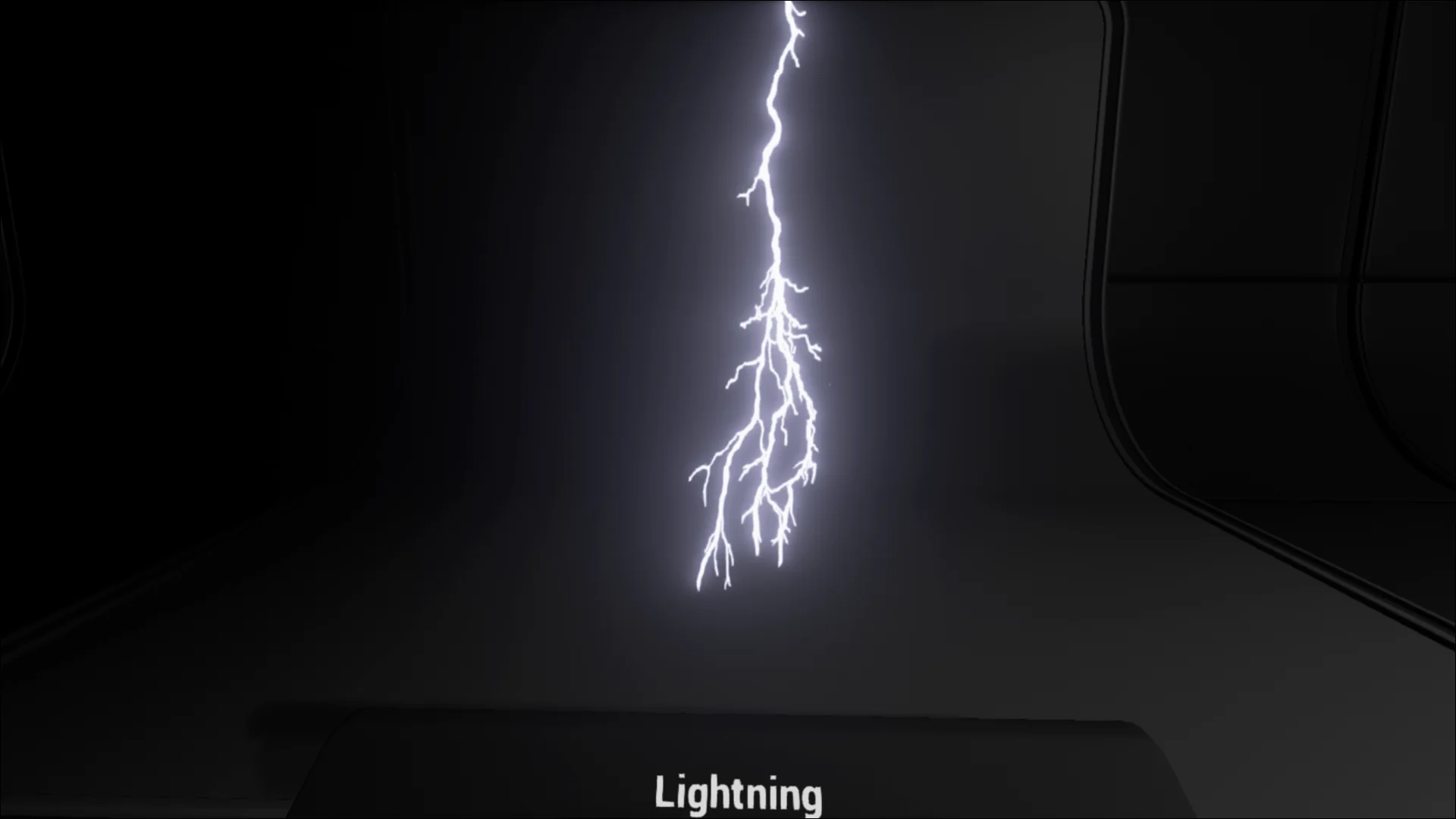
Lightning introduces high-contrast, instantaneous illumination into severe weather scenarios. Unlike continuous precipitation, lightning operates as an episodic event. Within the collection, lightning delivers the visual discharge needed to punctuated torrential rain or turbulent overcast horizons. It serves as an atmospheric spike, instantly outlining landscape silhouettes and accentuating the severity of storm-driven environments.
Organic Motion with Airborne Foliage Elements
Weather is rarely composed purely of water and air; mechanical forces like wind reveal themselves through what they pick up from the ground. The inclusion of leaves provides an organic bridge between weather systems and vegetation.
Tumbling leaf particles simulate the aerodynamic tumbling of deciduous foliage caught in an updraft or seasonal gale. Dropping fallen leaves into a forest path, a park walkway, or an abandoned town square immediately communicates the season and local wind strength. Combined with rain or dust, drifting foliage breaks the regularity of purely geometric level design, scattering irregular organic shapes across the active gameplay or render space.
Configuring Parameters Across the Weather Systems
A static visual effect quickly becomes useless if its color, density, or velocity cannot adapt to individual project palettes. The technical infrastructure of the VFX Weather Pack relies on instanced materials alongside exposed particle parameters to maintain flexibility without requiring low-level system rebuilds.
Instanced materials decouple visual appearance from base shader code. Instead of editing master materials and waiting for shader recompilations, artists can open a material instance to alter key parameters in real time. This means tinting dust to match desert sand, adjusting the softness and opacity of fog cards, or altering the reflectivity and transparency of rain streaks happens instantaneously within the editing interface.
Exposing critical variables directly as particle parameters handles system-level behaviors. Spawn rates, particle lifespan, initial velocity, scale distribution, and emitter bounds can be modified per instance. If a scene requires a sparse dusting of snow rather than a blinding blizzard, adjusting the spawn rate and velocity parameters scales the density without needing a separate asset. This parameter-driven workflow allows a single base system to cover gentle breezes, dense squalls, localized indoor dust, or sweeping landscape mists.
Targeted Use Cases and Technical Beneficiaries
This collection directly targets environment artists, technical artists, and independent developers who need ready-to-deploy atmospheric systems without building emitters and master materials from scratch. Constructing realistic weather behaviors from blank templates consumes substantial development time, particularly when balancing material translucency and emitter performance.
Level designers working on narrative walk-throughs, action sequences, or open-world zones gain immediate visual grounding for their scenes. The inclusion of core physical types—liquids, crystalline flakes, electrical discharge, foliage debris, and vaporous density—covers the majority of exterior meteorological demands. Creators prioritizing rapid iteration will benefit most from the combination of instanced material controls and editable emitter parameters, allowing rapid visual tuning to match specific project aesthetics directly inside the viewport.
 Variety
 Variety
 Weather