"07a32e720bd988c8"{"id":"1002498","slug":"us-paratrooper","title":"US Paratrooper","category":"Characters \u0026 Creatures","engine":"4.18+,5.0+","assetVersion":"","engineVersion":"Engine Version: 4.18+,5.0+","tag":"Characters","accent":"blue","visual":"character","summary":"Examine the US Paratrooper character model, featuring standard UE mannequin rigging, customizable PBR materials, and flexible combat camera roles.","platform":"Unreal Engine","indexPolicy":"index","publishedAt":"2026-11-12T05:16:00.911Z","updatedAt":"2026-11-12T05:16:00.911Z","sourceNotes":[],"fileContents":[],"compatibility":["Unreal Engine","Engine Version: 4.18+,5.0+"],"featuredImage":{"alt":"US Paratrooper","src":"/wp-content/uploads/published/2026/11/d9a2d53e7fad-d8656ec0-541f-42cf-aadc-26b04dcba7b5-150c3a03ae.webp"},"hasDownloadLink":true,"downloads":0,"terms":[{"taxonomy":"category","slug":"characters-and-creatures","name":"Characters \u0026 Creatures"}],"galleryImages":[{"src":"/wp-content/uploads/published/2026/11/1924c8c8f510-ea7e8fa8-1c52-475d-bd5b-32ccbd7dfe8c-64a8e8d226.webp","alt":"US Paratrooper"},{"src":"/wp-content/uploads/published/2026/11/2c507bf138ac-b57d0312-96e7-4e7c-b7d3-913c7015ef55-3de63c7e87.webp","alt":"US Paratrooper"},{"src":"/wp-content/uploads/published/2026/11/9b2c3f3468b8-a6259e8b-d35b-47b5-9c09-1a8628a4502f-5beb22e266.webp","alt":"US Paratrooper"},{"src":"/wp-content/uploads/published/2026/11/5a33345b55e2-9f89e628-bf78-4298-bcad-9e9ec1a003e8-646d269a4c.webp","alt":"US Paratrooper"},{"src":"/wp-content/uploads/published/2026/11/0116ae86d51a-6ba8ceef-83af-42d1-9297-79ad4370fab8-13fe06be5c.webp","alt":"US Paratrooper"},{"src":"/wp-content/uploads/published/2026/11/dde0a7b60742-7023d26b-c540-451b-8727-514cfa275e7d-8f1d297171.webp","alt":"US Paratrooper"},{"src":"/wp-content/uploads/published/2026/11/8b41428e1209-29e12815-1004-4bfe-995e-205cdc7f3a2f-b75f876455.webp","alt":"US Paratrooper"},{"src":"/wp-content/uploads/published/2026/11/b1c8c596507b-78f31a0b-49ca-4234-ab7d-8a8a117dc100-65d91e25c1.webp","alt":"US Paratrooper"},{"src":"/wp-content/uploads/published/2026/11/981b49a66f55-e961c67d-e510-4b9e-8517-d9789680eb01-97759c226b.webp","alt":"US Paratrooper"},{"src":"/wp-content/uploads/published/2026/11/c440a2679a49-3a6a7eba-91ac-4fce-a889-7e1045449c2b-09f5fe3866.webp","alt":"US Paratrooper"}],"accessPanel":{"kind":"resource","title":"Get this resource","eyebrow":"Free resource","message":"Download this resource in your browser.","fileName":"Content.7z","safetyNote":"Resources are manually reviewed before listing to improve quality and reduce obvious risks.","actionLabel":"Get this resource","resourceType":"Resource archive","versions":[]},"contentHtml":"\u003ch2\u003eDeploying the US Paratrooper Across Historic and Speculative Theaters\u003c/h2\u003e\u003cp\u003eThe airborne infantry uniform remains one of the most recognizable silhouettes of twentieth-century warfare. Designed to withstand demanding drops behind hostile lines, the gear reflects the practical demands placed on paratroopers throughout key World War II operations. In interactive environments, this aesthetic identity allows developers to anchor campaigns directly into iconic historical backdrops, whether staging airborne insertions into the bocage of Normandy for D-Day, fighting across the arid, mountainous drop zones of the Battle for Sicily, engaging in island warfare throughout the Pacific theater, or navigating late-war urban ruins on the approaches to Berlin.\u003c/p\u003e\u003cp\u003eBeyond strict historical recreation, the uniform structure readily translates into speculative projects. Because the kit contains functional foundational garments, webbing, and airborne field gear, it adapts cleanly into alternative history scenarios. Modifying specific emblems or blending the attire with non-standard hardware allows technical artists to create unique timeline variations while retaining the disciplined, combat-ready appearance of mid-century airborne forces.\u003c/p\u003e\u003ch2\u003eSurface Customization and Unit Differentiation\u003c/h2\u003e\u003cp\u003eA core element of the character asset is an advanced material system configured for rapid visual adaptation. Rather than locking the soldier into a single static look, the setup lets creators swap out surface elements and integrate new patterns directly. Custom camouflage textures can be applied across the uniform surfaces, enabling quick adaptations to specific environmental biomes such as dense European woodlands, dusty Mediterranean scrub, or damp Pacific foliage.\u003c/p\u003e\u003cp\u003eIdentification markings and insignia represent another practical vector for variation. Shoulder logos can be introduced or modified to represent distinct divisions, regiments, or fictional factions without requiring external asset rebuilds. The material framework also supports element-level color adjustment. This capability serves gameplay clarity directly, allowing teams to establish clear multiplayer faction differentiation or unit role distinctions by tinting specific components of the uniform while preserving the realistic base values of the fabrics and gear.\u003c/p\u003e\u003ch2\u003eUS Paratrooper Mesh Construction and Perspective Flexibility\u003c/h2\u003e\u003cp\u003eCharacter models intended for action titles must strike a reliable balance between detail retention and performance stability. The geometry of this soldier is balanced across multiple viewing ranges, providing the necessary edge density for close-up inspection while retaining clean silhouettes during mid- and long-distance rendering. This polygon distribution avoids harsh visual degradation when the character moves away from the active viewpoint.\u003c/p\u003e\u003cp\u003eThis mesh balance dictates how the character can be deployed within camera hierarchies:\u003c/p\u003e\u003cul\u003e\u003cli\u003e\u003cstrong\u003eThird-Person Player Character:\u003c/strong\u003e The mesh topology and gear placement hold up under persistent scrutiny when viewed directly from behind, displaying clear fabric folds, equipment hang points, and holster profiles during dynamic motion.\u003c/li\u003e\u003cli\u003e\u003cstrong\u003eFirst-Person Enemy and NPC Combatants:\u003c/strong\u003e When encountered as adversaries or AI squad members in first-person setups, the geometry provides crisp visual cues, precise silhouettes, and responsive hit zones during fast-paced close-quarters engagements.\u003c/li\u003e\u003cli\u003e\u003cstrong\u003eThird-Person AI Units:\u003c/strong\u003e The balanced mid-range profile ensures squads of airborne soldiers can populate open battlefield environments without incurring severe computational overhead.\u003c/li\u003e\u003c/ul\u003e\u003ch2\u003eTexturing Structure and PBR Implementation\u003c/h2\u003e\u003cp\u003eMaterial responses are grounded in a physically based rendering pipeline, ensuring that every piece of airborne equipment reacts accurately under dynamic light sources, harsh sun angles, and dim interior conditions. Highly detailed texture sets are organized across standard texture channels to ensure correct surface interactions:\u003c/p\u003e\u003cul\u003e\u003cli\u003e\u003cstrong\u003eDiffuse / Albedo:\u003c/strong\u003e Captures the true color values of heavy-duty field canvas, treated leather straps, painted metal buckles, and fabric weave without baked-in directional lighting or artificial shadows.\u003c/li\u003e\u003cli\u003e\u003cstrong\u003eRoughness:\u003c/strong\u003e Dictates the varied light scatter across disparate surfaces, separating the matte, light-absorbing qualities of rough military cloth from the slick sheen of polished leather holsters and oil-treated hardware.\u003c/li\u003e\u003cli\u003e\u003cstrong\u003eMetalness:\u003c/strong\u003e Defines conductive responses on structural metal clips, snap buttons, zippers, weapon attachment loops, and uniform clasps, preventing unnatural reflections on non-metallic fabrics.\u003c/li\u003e\u003cli\u003e\u003cstrong\u003eNormal:\u003c/strong\u003e Projects fine micro-details, including heavy-gauge seam stitching, cloth tension creases, structural folds in field pouches, and subtle surface grain across gear straps.\u003c/li\u003e\u003c/ul\u003e\u003ch2\u003eAnimation Blueprint Setup and Skeleton Architecture\u003c/h2\u003e\u003cp\u003eAnimation setup relies on standard Unreal Engine mannequin compatibility. By adhering directly to this common skeletal structure, the paratrooper circumvents the time-consuming process of unique skeletal retargeting. Locomotion sets, tactical combat animations, weapon handling systems, and cover transitions developed for the default mannequin can be assigned to the character without extensive bone remapping.\u003c/p\u003e\u003cp\u003eThis shared hierarchy provides immediate access to the wide spectrum of existing marketplace animation assets, along with Epic's free Animation Starter Pack. Developers can plug the character directly into existing Animation Blueprints and scripting systems, mapping weapon-holding offsets, crouch transitions, airborne deployment poses, and sprint cycles seamlessly. Rig compatibility also extends alongside assets designed within similar functional parameters, including setups like the Gothic Knight, reinforcing clean asset modularity across technical combat prototypes.\u003c/p\u003e\u003ch2\u003eProject Implementations and Production Scope\u003c/h2\u003e\u003cp\u003eThe US Paratrooper asset delivers practical value to teams building single-player narrative shooters, tactical squad simulators, or multiplayer battlefields that require historically grounded combatants. Because the model balances detailed PBR texturing with an adaptable material workflow and standard mannequin rigging, it can be dropped straight into active gameplay logic without custom rigging passes. Whether fulfilling the role of a lead player character during airborne drops or populating entire fireteams across varied historic operations, the model offers a flexible, production-ready combat foundation.\u003c/p\u003e\n\n\u003ch2\u003eContinue Browsing Similar Packs\u003c/h2\u003e\n\u003cul\u003e\n\u003cli\u003e\u003ca href=\"https://3dcghub.com/heavy-g-soldier/\" rel=\"noopener noreferrer\"\u003eHeavy G Soldier\u003c/a\u003e\u003c/li\u003e\n\u003cli\u003e\u003ca href=\"https://3dcghub.com/german-soldier-wwii/\" rel=\"noopener noreferrer\"\u003eGerman Soldier WWII\u003c/a\u003e\u003c/li\u003e\n\u003cli\u003e\u003ca href=\"https://3dcghub.com/sci-fi-space-soldier/\" rel=\"noopener noreferrer\"\u003eSci Fi Space Soldier\u003c/a\u003e\u003c/li\u003e\n\u003cli\u003e\u003ca href=\"https://3dcghub.com/native-american/\" rel=\"noopener noreferrer\"\u003eNative American\u003c/a\u003e\u003c/li\u003e\n\u003cli\u003e\u003ca href=\"https://3dcghub.com/biotech-hornet/\" rel=\"noopener noreferrer\"\u003eBiotech - Hornet\u003c/a\u003e\u003c/li\u003e\n\u003c/ul\u003e","contentTextLength":6570,"navigation":{"current":1,"total":4421,"next":{"id":"1002497","slug":"the-leader-of-the-bandits","title":"The leader of the bandits","category":"Characters \u0026 Creatures","platform":"Unreal Engine","updatedAt":"2026-11-12T04:08:31.277Z"}},"relatedResources":[{"id":"1002481","slug":"heavy-g-soldier","title":"Heavy G Soldier","category":"Characters \u0026 Creatures","engine":"4.18+,5.0+","assetVersion":"","engineVersion":"Engine Version: 4.18+,5.0+","tag":"Characters","accent":"blue","visual":"character","summary":"Explore the Heavy G Soldier asset, featuring modular tactical armor, PBR texture maps, custom camouflage materials, and standard UE mannequin rigging.","platform":"Unreal Engine","indexPolicy":"index","publishedAt":"2026-11-12T03:42:25.782Z","updatedAt":"2026-11-12T03:42:25.782Z","sourceNotes":[],"fileContents":[],"compatibility":["Unreal Engine","Engine Version: 4.18+,5.0+"],"featuredImage":{"alt":"Heavy G Soldier","src":"/wp-content/uploads/published/2026/11/d96c9d3cedf9-2576b439-12f6-4d63-a576-0e862b7dd59f-2140e6b36f.webp"},"hasDownloadLink":true,"downloads":0},{"id":"1002040","slug":"german-soldier-wwii","title":"German Soldier WWII","category":"Characters \u0026 Creatures","engine":"4.26+,5.0+","assetVersion":"","engineVersion":"Engine Version: 4.26+,5.0+","tag":"Characters","accent":"blue","visual":"character","summary":"Explore the German Soldier WWII character asset, featuring standard UE mannequin rigging, customizable camouflage materials, and full PBR texture sets.","platform":"Unreal Engine","indexPolicy":"index","publishedAt":"2026-10-26T14:22:08.764Z","updatedAt":"2026-10-26T14:22:08.764Z","sourceNotes":[],"fileContents":[],"compatibility":["Unreal Engine","Engine Version: 4.26+,5.0+"],"featuredImage":{"alt":"German Soldier WWII","src":"/wp-content/uploads/published/2026/10/ef549c4de90c-7506682f-e445-427d-a90f-9300d7328716-5c6da2ebf9.webp"},"hasDownloadLink":true,"downloads":0},{"id":"1002495","slug":"sci-fi-space-soldier","title":"Sci Fi Space Soldier","category":"Characters \u0026 Creatures","engine":"4.18+,5.0+","assetVersion":"","engineVersion":"Engine Version: 4.18+,5.0+","tag":"Characters","accent":"blue","visual":"character","summary":"An in-depth look at the Sci Fi Space Soldier character asset, featuring Epic skeleton rigging, custom material masks, retarget poses, and animation testing.","platform":"Unreal Engine","indexPolicy":"index","publishedAt":"2026-11-12T04:03:25.497Z","updatedAt":"2026-11-12T04:03:25.497Z","sourceNotes":[],"fileContents":[],"compatibility":["Unreal Engine","Engine Version: 4.18+,5.0+"],"featuredImage":{"alt":"Sci Fi Space Soldier","src":"/wp-content/uploads/published/2026/11/3d796a9a0908-bf151e50-e203-4f75-a5f9-6c6f632572f0-00db45fe88.webp"},"hasDownloadLink":true,"downloads":0}]}
Characters
US Paratrooper
Examine the US Paratrooper character model, featuring standard UE mannequin rigging, customizable PBR materials, and flexible combat camera roles.
Deploying the US Paratrooper Across Historic and Speculative Theaters
The airborne infantry uniform remains one of the most recognizable silhouettes of twentieth-century warfare. Designed to withstand demanding drops behind hostile lines, the gear reflects the practical demands placed on paratroopers throughout key World War II operations. In interactive environments, this aesthetic identity allows developers to anchor campaigns directly into iconic historical backdrops, whether staging airborne insertions into the bocage of Normandy for D-Day, fighting across the arid, mountainous drop zones of the Battle for Sicily, engaging in island warfare throughout the Pacific theater, or navigating late-war urban ruins on the approaches to Berlin.
Beyond strict historical recreation, the uniform structure readily translates into speculative projects. Because the kit contains functional foundational garments, webbing, and airborne field gear, it adapts cleanly into alternative history scenarios. Modifying specific emblems or blending the attire with non-standard hardware allows technical artists to create unique timeline variations while retaining the disciplined, combat-ready appearance of mid-century airborne forces.
Surface Customization and Unit Differentiation
A core element of the character asset is an advanced material system configured for rapid visual adaptation. Rather than locking the soldier into a single static look, the setup lets creators swap out surface elements and integrate new patterns directly. Custom camouflage textures can be applied across the uniform surfaces, enabling quick adaptations to specific environmental biomes such as dense European woodlands, dusty Mediterranean scrub, or damp Pacific foliage.
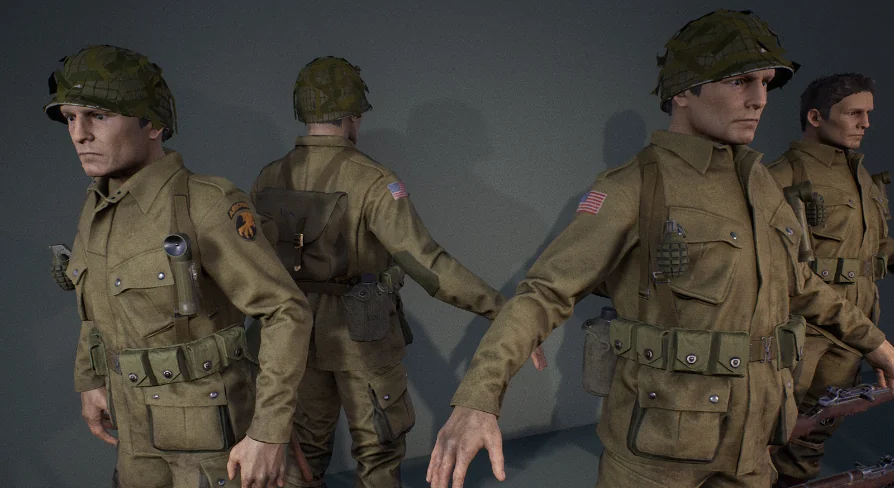
Identification markings and insignia represent another practical vector for variation. Shoulder logos can be introduced or modified to represent distinct divisions, regiments, or fictional factions without requiring external asset rebuilds. The material framework also supports element-level color adjustment. This capability serves gameplay clarity directly, allowing teams to establish clear multiplayer faction differentiation or unit role distinctions by tinting specific components of the uniform while preserving the realistic base values of the fabrics and gear.
US Paratrooper Mesh Construction and Perspective Flexibility
Character models intended for action titles must strike a reliable balance between detail retention and performance stability. The geometry of this soldier is balanced across multiple viewing ranges, providing the necessary edge density for close-up inspection while retaining clean silhouettes during mid- and long-distance rendering. This polygon distribution avoids harsh visual degradation when the character moves away from the active viewpoint.
This mesh balance dictates how the character can be deployed within camera hierarchies:
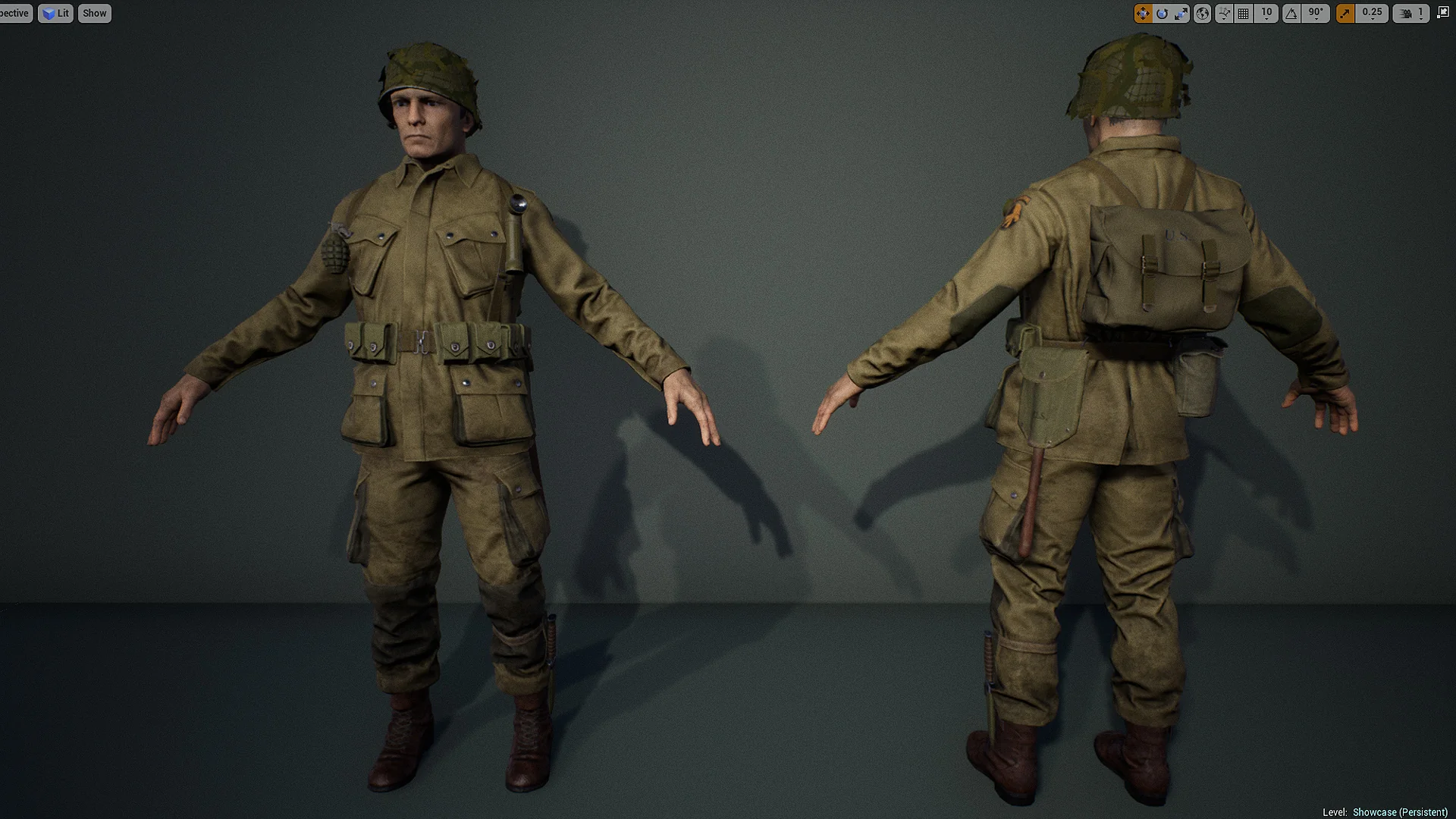
Third-Person Player Character: The mesh topology and gear placement hold up under persistent scrutiny when viewed directly from behind, displaying clear fabric folds, equipment hang points, and holster profiles during dynamic motion.
First-Person Enemy and NPC Combatants: When encountered as adversaries or AI squad members in first-person setups, the geometry provides crisp visual cues, precise silhouettes, and responsive hit zones during fast-paced close-quarters engagements.
Third-Person AI Units: The balanced mid-range profile ensures squads of airborne soldiers can populate open battlefield environments without incurring severe computational overhead.
Texturing Structure and PBR Implementation
Material responses are grounded in a physically based rendering pipeline, ensuring that every piece of airborne equipment reacts accurately under dynamic light sources, harsh sun angles, and dim interior conditions. Highly detailed texture sets are organized across standard texture channels to ensure correct surface interactions:
Diffuse / Albedo: Captures the true color values of heavy-duty field canvas, treated leather straps, painted metal buckles, and fabric weave without baked-in directional lighting or artificial shadows.
Roughness: Dictates the varied light scatter across disparate surfaces, separating the matte, light-absorbing qualities of rough military cloth from the slick sheen of polished leather holsters and oil-treated hardware.
Metalness: Defines conductive responses on structural metal clips, snap buttons, zippers, weapon attachment loops, and uniform clasps, preventing unnatural reflections on non-metallic fabrics.
Normal: Projects fine micro-details, including heavy-gauge seam stitching, cloth tension creases, structural folds in field pouches, and subtle surface grain across gear straps.
Animation Blueprint Setup and Skeleton Architecture
Animation setup relies on standard Unreal Engine mannequin compatibility. By adhering directly to this common skeletal structure, the paratrooper circumvents the time-consuming process of unique skeletal retargeting. Locomotion sets, tactical combat animations, weapon handling systems, and cover transitions developed for the default mannequin can be assigned to the character without extensive bone remapping.
This shared hierarchy provides immediate access to the wide spectrum of existing marketplace animation assets, along with Epic's free Animation Starter Pack. Developers can plug the character directly into existing Animation Blueprints and scripting systems, mapping weapon-holding offsets, crouch transitions, airborne deployment poses, and sprint cycles seamlessly. Rig compatibility also extends alongside assets designed within similar functional parameters, including setups like the Gothic Knight, reinforcing clean asset modularity across technical combat prototypes.
Project Implementations and Production Scope
The US Paratrooper asset delivers practical value to teams building single-player narrative shooters, tactical squad simulators, or multiplayer battlefields that require historically grounded combatants. Because the model balances detailed PBR texturing with an adaptable material workflow and standard mannequin rigging, it can be dropped straight into active gameplay logic without custom rigging passes. Whether fulfilling the role of a lead player character during airborne drops or populating entire fireteams across varied historic operations, the model offers a flexible, production-ready combat foundation.
 Characters
 Characters
 Characters
 Characters