"07a32e720bd988c8"{"id":"1002481","slug":"heavy-g-soldier","title":"Heavy G Soldier","category":"Characters \u0026 Creatures","engine":"4.18+,5.0+","assetVersion":"","engineVersion":"Engine Version: 4.18+,5.0+","tag":"Characters","accent":"blue","visual":"character","summary":"Explore the Heavy G Soldier asset, featuring modular tactical armor, PBR texture maps, custom camouflage materials, and standard UE mannequin rigging.","platform":"Unreal Engine","indexPolicy":"index","publishedAt":"2026-11-12T03:42:25.782Z","updatedAt":"2026-11-12T03:42:25.782Z","sourceNotes":[],"fileContents":[],"compatibility":["Unreal Engine","Engine Version: 4.18+,5.0+"],"featuredImage":{"alt":"Heavy G Soldier","src":"/wp-content/uploads/published/2026/11/d96c9d3cedf9-2576b439-12f6-4d63-a576-0e862b7dd59f-2140e6b36f.webp"},"hasDownloadLink":true,"downloads":0,"terms":[{"taxonomy":"category","slug":"characters-and-creatures","name":"Characters \u0026 Creatures"}],"galleryImages":[{"src":"/wp-content/uploads/published/2026/11/9bdec492bf8a-09ce9508-86d2-4adc-bbe5-f9fe7439beed-bdb128724c.webp","alt":"Heavy G Soldier"},{"src":"/wp-content/uploads/published/2026/11/3a2304236613-f2c485c0-0768-4d55-af03-4adb27c18990-9981d9d23b.webp","alt":"Heavy G Soldier"},{"src":"/wp-content/uploads/published/2026/11/b59abcc4b1c6-a0c7e870-566d-4218-980f-d25d611b4ea5-797135eafa.webp","alt":"Heavy G Soldier"},{"src":"/wp-content/uploads/published/2026/11/361bbc3c0365-4c5a9aef-b279-4646-96a4-564af63458f1-691bd2642d.webp","alt":"Heavy G Soldier"},{"src":"/wp-content/uploads/published/2026/11/bbf6cdb32b07-d589f747-ee83-4577-aca3-c3a36218515d-65a5304fe8.webp","alt":"Heavy G Soldier"},{"src":"/wp-content/uploads/published/2026/11/52538a9f0d50-f7800e71-f3a8-49d1-b432-c2655f4f5e50-8b45fc3e74.webp","alt":"Heavy G Soldier"},{"src":"/wp-content/uploads/published/2026/11/70ca1f8f7deb-19705410-1ae4-43c1-b8b4-821bbcf7ec16-6e5e614cbe.webp","alt":"Heavy G Soldier"},{"src":"/wp-content/uploads/published/2026/11/7eea85a3a552-c76ad7b0-a87e-4fdf-9cc0-4c46ce3d6494-b8bf9c0990.webp","alt":"Heavy G Soldier"}],"accessPanel":{"kind":"resource","title":"Get this resource","eyebrow":"Free resource","message":"Download this resource in your browser.","fileName":"Content.7z","safetyNote":"Resources are manually reviewed before listing to improve quality and reduce obvious risks.","actionLabel":"Get this resource","resourceType":"Resource archive","versions":[]},"contentHtml":"\u003ch2\u003eSetting Up the Heavy G Soldier for Tactical and Sci-Fi Scenarios\u003c/h2\u003e\u003cp\u003eDense urban warfare zones, sterile sci-fi corridors, and rugged outpost environments demand character designs that visually convey ballistic protection and field readiness. The Heavy G Soldier addresses these production needs by providing a heavily armored combatant capable of bridging both grounded modern-day tactical aesthetics and near-future defense forces. The model is shaped by heavy protective gear, tactical plating, and utilitarian kit arrangements that immediately read as hardened frontline infantry.\u003c/p\u003e\u003cp\u003eBecause the character is constructed to accommodate realistic and sci-fi styles, scene staging can shift drastically based on the surrounding context. Placed within a bleak industrial facility, the reinforced body panels and bulky profile create an imposing security presence. When integrated into an orbital outpost or high-tech defensive line, those same armored forms suggest mechanized support infantry. Achieving this balance depends heavily on how the character is deployed, whether as an individual elite operative or as coordinated ranks of standardized tactical troops.\u003c/p\u003e\u003ch2\u003eSingle-Mesh Simplicity Versus Modular Kit Assembly\u003c/h2\u003e\u003cp\u003eProduction workflows often face competing demands between rendering efficiency and visual variety. To navigate this balance, the package offers two distinct structural approaches: a simple combined setup and an advanced modular kit.\u003c/p\u003e\u003cp\u003eThe simple version binds all elements into one continuous mesh. This unified model is ideal for background infantry, mass tactical formations, or performance-sensitive gameplay sequences where individual equipment swapping is unnecessary. Running a single mesh minimizes the overhead of managing multiple sub-components, making it straightforward to drop into levels without configuring multiple attachment points.\u003c/p\u003e\u003cp\u003eThe advanced configuration separates the operative into distinct modular pieces, granting full freedom to assemble or omit specific components. In this mode, the body, vest, and head are handled as independent items. Beyond altering the fundamental silhouette, this separation lets developers strip away primary protective elements or isolate specific clothing layers to represent different operational stages, varying ranks, or specialized tactical loadouts across a squad.\u003c/p\u003e\u003ch2\u003eArmoring the Heavy Soldier with Dedicated Gear and Pouches\u003c/h2\u003e\u003cp\u003eTactical characters require utility-focused accessories to sell the illusion of combat readiness. The modular inventory accompanying the Heavy G Soldier includes an extensive collection of individual bags, ammunition carriers, and sidearm apparatus designed to mount directly over the base armor.\u003c/p\u003e\u003cp\u003eA core element of this layer is the equipment group, provided as a single mesh pre-skinned to the skeleton. This approach prevents manual attachment drift during intense character locomotion, ensuring that foundational support gear moves fluidly with torso and limb deformations. For granular adjustments, specific accessories are provided separately:\u003c/p\u003e\u003cul\u003e\u003cli\u003eSmall bag for minor utility supplies\u003c/li\u003e\u003cli\u003eMedium bag for general patrol gear\u003c/li\u003e\u003cli\u003eBig bag for extended mission supplies\u003c/li\u003e\u003cli\u003eTwo assault rifle size ammo bags for primary weapon magazines\u003c/li\u003e\u003cli\u003ePistol size ammo bag for secondary sidearm reloads\u003c/li\u003e\u003cli\u003eTactical knife and dedicated knife holster\u003c/li\u003e\u003cli\u003ePistol holster for quick-draw secondary weapon staging\u003c/li\u003e\u003c/ul\u003e\u003cp\u003eThese pieces allow developers to configure asymmetric loadouts. A frontline point-man can carry twin assault rifle magazine carriers alongside the heavy knife and sidearm holsters, while a support role might prioritize the big bag and multi-tier utility pouches. Because each bag and container exists as a separate element, item availability can also reflect active gameplay states, such as discarding empty carriers or showing equipped utilities dynamically.\u003c/p\u003e\u003ch2\u003eMaterial Pipeline, Camouflage Configurations, and PBR Texture Sets\u003c/h2\u003e\u003cp\u003eVisual diversity across military or sci-fi forces frequently hinges on material treatment rather than distinct mesh modeling. The asset incorporates an advanced material system built to deliver completely unique character variations in just a few clicks. This setup handles color alterations directly across the model, allowing instant changes to suit faction assignments, unit ranks, or distinct biome palettes.\u003c/p\u003e\u003cp\u003eCamouflage handling forms a central pillar of this customization system. Creators can select directly from provided camouflage patterns to fit woodland, desert, or covert operations, or introduce custom patterns into the material structure. The logic automatically blends the pattern across the corresponding gear pieces, keeping uniform and equipment sets cohesive without requiring external texture authoring programs.\u003c/p\u003e\u003cp\u003eUnderpinning this flexibility is a comprehensive physically based rendering (PBR) texture pipeline. Each map set contains dedicated Diffuse (Albedo), Roughness, Metalness, and Normal maps, ensuring realistic light reflection, surface depth, and material response under dynamic lighting engines. The texture resolutions are assigned strategically according to surface area and visual priority:\u003c/p\u003e\u003cul\u003e\u003cli\u003eJacket: 2048x2048\u003c/li\u003e\u003cli\u003ePants: 2048x2048\u003c/li\u003e\u003cli\u003eVest: 2048x2048\u003c/li\u003e\u003cli\u003eHelmet: 2048x2048\u003c/li\u003e\u003cli\u003eEquipment: 1024x1024\u003c/li\u003e\u003c/ul\u003e\u003cp\u003eBy allocating discrete 2048x2048 maps to major clothing and protection zones—the jacket, pants, vest, and helmet—fine fabric weaves, ballistic plate micro-detail, and surface wear retain crisp definition during tight cinematic close-ups and third-person over-the-shoulder perspectives. The supporting equipment items utilize a compact 1024x1024 layout, optimizing memory usage while maintaining the sharp edges of hard-surface buckles, straps, and pouch seams.\u003c/p\u003e\u003ch2\u003eStandard Skeleton Integration and Blueprint Considerations\u003c/h2\u003e\u003cp\u003eA high-detail combat model is only as practical as its implementation speed inside an active game engine. The Heavy G Soldier shares its skeleton directly with the standard Unreal Engine mannequin. This shared skeletal hierarchy bypasses the need for custom retargeting chains or complex bone remapping routines for existing animation libraries built for the standard mannequin.\u003c/p\u003e\u003cp\u003eStandard mannequin compatibility ensures that standard combat locomotion, aiming offsets, crouch walks, and jump cycles translate cleanly to the mesh without distorted joint rotations. The rigging handles the bulky silhouette of the armor plates naturally, preserving volume around the shoulders, knees, and torso during extreme animation poses. Furthermore, the underlying setup supports character interaction sequences, letting the model transition into interactive contextual maneuvers—such as handling sidearms, operating machinery, or vaulting obstacles—using established scripting structures.\u003c/p\u003e\u003cp\u003eTechnical setups can also draw upon Animation Blueprint structures to govern state transitions, blend spaces, and dynamic gear offsets. For productions managing historical or fantasy-adjacent systems, compatibility with Gothic Knight structures provides an alternative bridge for projects blending heavy plate kinematics with modern combat movement. Whether deployed as a baseline enemy unit, an elite playable operative, or a modular sci-fi trooper, the Heavy G Soldier offers a comprehensive, production-ready framework that pairs immediate skeletal utility with deep visual customization.\u003c/p\u003e\n\n\u003ch2\u003eRelated Resources Worth Checking\u003c/h2\u003e\n\u003cul\u003e\n\u003cli\u003e\u003ca href=\"https://3dcghub.com/modular-russian-soldier/\" rel=\"noopener noreferrer\"\u003emodular russian soldier\u003c/a\u003e\u003c/li\u003e\n\u003cli\u003e\u003ca href=\"https://3dcghub.com/sci-fi-alien-soldier/\" rel=\"noopener noreferrer\"\u003eSci Fi Alien Soldier\u003c/a\u003e\u003c/li\u003e\n\u003cli\u003e\u003ca href=\"https://3dcghub.com/sci-fi-space-soldier-female/\" rel=\"noopener noreferrer\"\u003eSci Fi Space Soldier Female\u003c/a\u003e\u003c/li\u003e\n\u003cli\u003e\u003ca href=\"https://3dcghub.com/modular-soldier-opb-full/\" rel=\"noopener noreferrer\"\u003eModular Soldier OPB Full\u003c/a\u003e\u003c/li\u003e\n\u003cli\u003e\u003ca href=\"https://3dcghub.com/sci-fi-soldier-02/\" rel=\"noopener noreferrer\"\u003eSci-Fi Soldier 02\u003c/a\u003e\u003c/li\u003e\n\u003c/ul\u003e","contentTextLength":7444,"navigation":{"current":18,"total":4421,"previous":{"id":"1002482","slug":"human-base-male","title":"Human Base Male","category":"Characters \u0026 Creatures","platform":"Unreal Engine","updatedAt":"2026-11-12T03:45:27.330Z"},"next":{"id":"1002480","slug":"goth-girl","title":"Goth girl","category":"Humans","platform":"Unreal Engine","updatedAt":"2026-11-12T03:38:12.469Z"}},"relatedResources":[{"id":"1002114","slug":"modular-russian-soldier","title":"modular russian soldier","category":"Characters \u0026 Creatures","engine":"4.27+,5.0+","assetVersion":"","engineVersion":"Engine Version: 4.27+,5.0+","tag":"Characters","accent":"blue","visual":"character","summary":"Explore the modular russian soldier asset featuring realistic tactical armor, groom hair settings, material customization, and CORPSE compatibility.","platform":"Unreal Engine","indexPolicy":"index","publishedAt":"2026-10-29T08:57:07.985Z","updatedAt":"2026-10-29T08:57:07.985Z","sourceNotes":[],"fileContents":[],"compatibility":["Unreal Engine","Engine Version: 4.27+,5.0+"],"featuredImage":{"alt":"modular russian soldier","src":"/wp-content/uploads/published/2026/10/e4444c1f147e-90addc23-97a4-4406-b204-db1ac87d0390-63948fc1dc.webp"},"hasDownloadLink":true,"downloads":1},{"id":"1002495","slug":"sci-fi-space-soldier","title":"Sci Fi Space Soldier","category":"Characters \u0026 Creatures","engine":"4.18+,5.0+","assetVersion":"","engineVersion":"Engine Version: 4.18+,5.0+","tag":"Characters","accent":"blue","visual":"character","summary":"An in-depth look at the Sci Fi Space Soldier character asset, featuring Epic skeleton rigging, custom material masks, retarget poses, and animation testing.","platform":"Unreal Engine","indexPolicy":"index","publishedAt":"2026-11-12T04:03:25.497Z","updatedAt":"2026-11-12T04:03:25.497Z","sourceNotes":[],"fileContents":[],"compatibility":["Unreal Engine","Engine Version: 4.18+,5.0+"],"featuredImage":{"alt":"Sci Fi Space Soldier","src":"/wp-content/uploads/published/2026/11/3d796a9a0908-bf151e50-e203-4f75-a5f9-6c6f632572f0-00db45fe88.webp"},"hasDownloadLink":true,"downloads":0},{"id":"1002461","slug":"sci-fi-alien-soldier","title":"Sci Fi Alien Soldier","category":"Characters \u0026 Creatures","engine":"4.16+,5.0+","assetVersion":"","engineVersion":"Engine Version: 4.16+,5.0+","tag":"Characters","accent":"blue","visual":"character","summary":"Examine the Sci Fi Alien Soldier, featuring Epic skeleton rigging, tested animation support, customizable color materials, and emissive masking.","platform":"Unreal Engine","indexPolicy":"index","publishedAt":"2026-11-11T08:48:30.204Z","updatedAt":"2026-11-11T08:48:30.204Z","sourceNotes":[],"fileContents":[],"compatibility":["Unreal Engine","Engine Version: 4.16+,5.0+"],"featuredImage":{"alt":"Sci Fi Alien Soldier","src":"/wp-content/uploads/published/2026/11/068918ee3039-06b44861-59c1-4c05-a6b6-6a97ae440ac4-9510f961ec.webp"},"hasDownloadLink":true,"downloads":0}]}
Characters
Heavy G Soldier
Explore the Heavy G Soldier asset, featuring modular tactical armor, PBR texture maps, custom camouflage materials, and standard UE mannequin rigging.
Setting Up the Heavy G Soldier for Tactical and Sci-Fi Scenarios
Dense urban warfare zones, sterile sci-fi corridors, and rugged outpost environments demand character designs that visually convey ballistic protection and field readiness. The Heavy G Soldier addresses these production needs by providing a heavily armored combatant capable of bridging both grounded modern-day tactical aesthetics and near-future defense forces. The model is shaped by heavy protective gear, tactical plating, and utilitarian kit arrangements that immediately read as hardened frontline infantry.
Because the character is constructed to accommodate realistic and sci-fi styles, scene staging can shift drastically based on the surrounding context. Placed within a bleak industrial facility, the reinforced body panels and bulky profile create an imposing security presence. When integrated into an orbital outpost or high-tech defensive line, those same armored forms suggest mechanized support infantry. Achieving this balance depends heavily on how the character is deployed, whether as an individual elite operative or as coordinated ranks of standardized tactical troops.
Single-Mesh Simplicity Versus Modular Kit Assembly
Production workflows often face competing demands between rendering efficiency and visual variety. To navigate this balance, the package offers two distinct structural approaches: a simple combined setup and an advanced modular kit.
The simple version binds all elements into one continuous mesh. This unified model is ideal for background infantry, mass tactical formations, or performance-sensitive gameplay sequences where individual equipment swapping is unnecessary. Running a single mesh minimizes the overhead of managing multiple sub-components, making it straightforward to drop into levels without configuring multiple attachment points.
The advanced configuration separates the operative into distinct modular pieces, granting full freedom to assemble or omit specific components. In this mode, the body, vest, and head are handled as independent items. Beyond altering the fundamental silhouette, this separation lets developers strip away primary protective elements or isolate specific clothing layers to represent different operational stages, varying ranks, or specialized tactical loadouts across a squad.
Armoring the Heavy Soldier with Dedicated Gear and Pouches
Tactical characters require utility-focused accessories to sell the illusion of combat readiness. The modular inventory accompanying the Heavy G Soldier includes an extensive collection of individual bags, ammunition carriers, and sidearm apparatus designed to mount directly over the base armor.
A core element of this layer is the equipment group, provided as a single mesh pre-skinned to the skeleton. This approach prevents manual attachment drift during intense character locomotion, ensuring that foundational support gear moves fluidly with torso and limb deformations. For granular adjustments, specific accessories are provided separately:
Small bag for minor utility supplies
Medium bag for general patrol gear
Big bag for extended mission supplies
Two assault rifle size ammo bags for primary weapon magazines
Pistol size ammo bag for secondary sidearm reloads
Tactical knife and dedicated knife holster
Pistol holster for quick-draw secondary weapon staging
These pieces allow developers to configure asymmetric loadouts. A frontline point-man can carry twin assault rifle magazine carriers alongside the heavy knife and sidearm holsters, while a support role might prioritize the big bag and multi-tier utility pouches. Because each bag and container exists as a separate element, item availability can also reflect active gameplay states, such as discarding empty carriers or showing equipped utilities dynamically.
Material Pipeline, Camouflage Configurations, and PBR Texture Sets
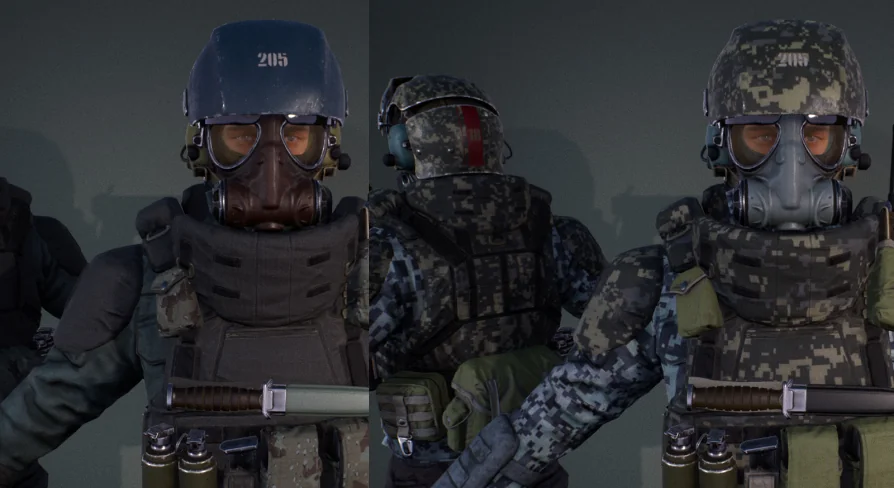
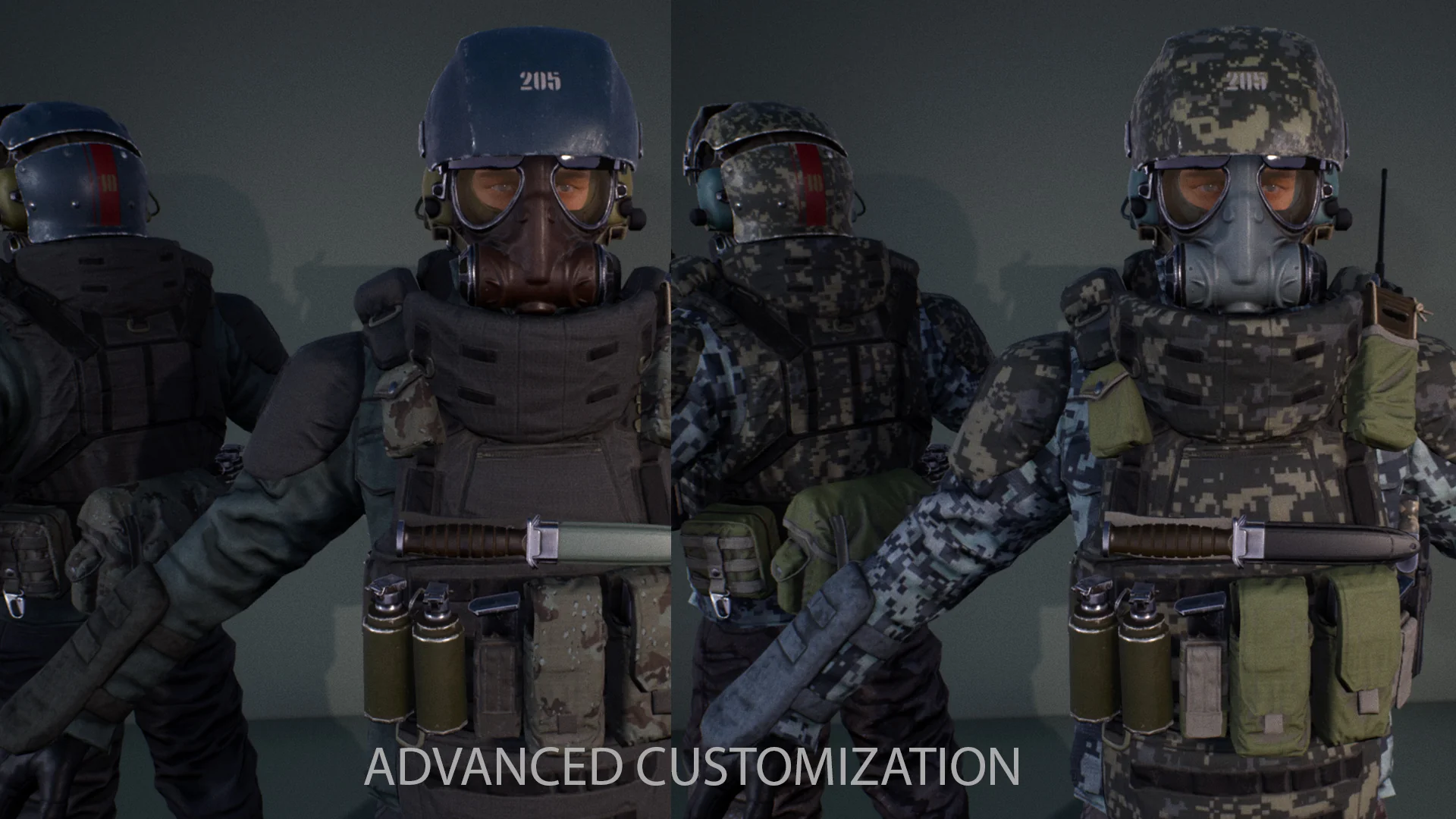
Visual diversity across military or sci-fi forces frequently hinges on material treatment rather than distinct mesh modeling. The asset incorporates an advanced material system built to deliver completely unique character variations in just a few clicks. This setup handles color alterations directly across the model, allowing instant changes to suit faction assignments, unit ranks, or distinct biome palettes.
Camouflage handling forms a central pillar of this customization system. Creators can select directly from provided camouflage patterns to fit woodland, desert, or covert operations, or introduce custom patterns into the material structure. The logic automatically blends the pattern across the corresponding gear pieces, keeping uniform and equipment sets cohesive without requiring external texture authoring programs.
Underpinning this flexibility is a comprehensive physically based rendering (PBR) texture pipeline. Each map set contains dedicated Diffuse (Albedo), Roughness, Metalness, and Normal maps, ensuring realistic light reflection, surface depth, and material response under dynamic lighting engines. The texture resolutions are assigned strategically according to surface area and visual priority:
Jacket: 2048x2048
Pants: 2048x2048
Vest: 2048x2048
Helmet: 2048x2048
Equipment: 1024x1024
By allocating discrete 2048x2048 maps to major clothing and protection zones—the jacket, pants, vest, and helmet—fine fabric weaves, ballistic plate micro-detail, and surface wear retain crisp definition during tight cinematic close-ups and third-person over-the-shoulder perspectives. The supporting equipment items utilize a compact 1024x1024 layout, optimizing memory usage while maintaining the sharp edges of hard-surface buckles, straps, and pouch seams.
Standard Skeleton Integration and Blueprint Considerations
A high-detail combat model is only as practical as its implementation speed inside an active game engine. The Heavy G Soldier shares its skeleton directly with the standard Unreal Engine mannequin. This shared skeletal hierarchy bypasses the need for custom retargeting chains or complex bone remapping routines for existing animation libraries built for the standard mannequin.
Standard mannequin compatibility ensures that standard combat locomotion, aiming offsets, crouch walks, and jump cycles translate cleanly to the mesh without distorted joint rotations. The rigging handles the bulky silhouette of the armor plates naturally, preserving volume around the shoulders, knees, and torso during extreme animation poses. Furthermore, the underlying setup supports character interaction sequences, letting the model transition into interactive contextual maneuvers—such as handling sidearms, operating machinery, or vaulting obstacles—using established scripting structures.
Technical setups can also draw upon Animation Blueprint structures to govern state transitions, blend spaces, and dynamic gear offsets. For productions managing historical or fantasy-adjacent systems, compatibility with Gothic Knight structures provides an alternative bridge for projects blending heavy plate kinematics with modern combat movement. Whether deployed as a baseline enemy unit, an elite playable operative, or a modular sci-fi trooper, the Heavy G Soldier offers a comprehensive, production-ready framework that pairs immediate skeletal utility with deep visual customization.
 Characters
 Characters
 Characters
 Characters