"efaa631e936fd3ee"{"id":"1002251","slug":"unified-procedural-animation","title":"Unified Procedural Animation","category":"Gameplay Features","engine":"4.27,5.0+","assetVersion":"","engineVersion":"Engine Version: 4.27,5.0+","tag":"Gameplay Features","accent":"blue","visual":"animation","summary":"Explore the Unified Procedural Animation framework for Unreal Engine, featuring modular legs, terrain-driven body rotation, and disjoint nav mesh traversal.","platform":"Unreal Engine","publishedAt":"2026-10-29T16:11:23.823Z","updatedAt":"2026-10-29T16:11:23.823Z","sourceNotes":[],"fileContents":[],"compatibility":["Unreal Engine","Engine Version: 4.27,5.0+"],"featuredImage":{"alt":"Unified Procedural Animation","src":"/wp-content/uploads/published/2026/10/588f2e75e5d7-d8afe828-a0ec-4bae-bedc-9adcc14b2bfc-496604c5ad.webp"},"hasDownloadLink":true,"downloads":0,"terms":[{"taxonomy":"category","slug":"gameplay-features","name":"Gameplay Features"}],"galleryImages":[{"src":"/wp-content/uploads/published/2026/10/1b6c7c4cabe4-7fb28048-23eb-49a7-b4bc-44ff8c08bf8b-1d08b695d2.webp","alt":"Unified Procedural Animation"},{"src":"/wp-content/uploads/published/2026/10/69bd5c33b5e0-137717ef-30c0-4887-89c0-0d93b1826a10-5548232e23.webp","alt":"Unified Procedural Animation"},{"src":"/wp-content/uploads/published/2026/10/2442f8b4ca4f-32010027-d2d6-4d47-8da3-27c56459c42a-f59670c09b.webp","alt":"Unified Procedural Animation"},{"src":"/wp-content/uploads/published/2026/10/f99c42746f84-354d8c6f-278b-4d3e-9f3a-d22ff2621669-91236e95a7.webp","alt":"Unified Procedural Animation"},{"src":"/wp-content/uploads/published/2026/10/c8176246a7fe-8fd142cb-cb6b-46db-a336-b29d1f2cbf6a-0b178ecfb1.webp","alt":"Unified Procedural Animation"},{"src":"/wp-content/uploads/published/2026/10/7cda7b32d410-caaa7930-17fd-4958-aace-552c149736dd-2fcaaf5faa.webp","alt":"Unified Procedural Animation"},{"src":"/wp-content/uploads/published/2026/10/90a6eeb5d144-469b3d18-9516-4866-856d-9ac54125e8f0-fe36f82aaf.webp","alt":"Unified Procedural Animation"},{"src":"/wp-content/uploads/published/2026/10/4c41ae951270-b794519e-a4f1-4ec5-b7db-0a454a40a9d9-08f24b6e2f.webp","alt":"Unified Procedural Animation"},{"src":"/wp-content/uploads/published/2026/10/06468a360ed4-12e8a80f-b34e-41af-b027-fde0edf1a171-fcbfdff37d.webp","alt":"Unified Procedural Animation"}],"accessPanel":{"kind":"resource","title":"Download this resource","eyebrow":"Free Download","message":"Log in or create a free account to start your download.","fileName":"Unified Procedural Animation.7z","safetyNote":"Resources are manually reviewed before listing to improve quality and reduce obvious risks.","actionLabel":"Download Free","resourceType":"Resource archive"},"contentHtml":"\u003ch2\u003eNavigating Broken Geometry and Disjoint Nav Meshes\u003c/h2\u003e\u003cp\u003eUneven game worlds present immediate challenges for traditional skeletal movement. When characters encounter steep inclines, broken pathways, or disconnected ledges, standard animation clips frequently fail, resulting in feet hovering over empty space or bodies intersecting directly with the geometry. Unified Procedural Animation addresses these traversal scenarios by replacing pre-baked gait cycles with real-time procedural calculations.\u003c/p\u003e\u003cp\u003eThe system is specifically engineered to handle complex route conditions, including disjoint nav meshes and floating platforms. Rather than restricting character navigation to contiguous flat zones, the logic calculates viable steps across gaps, permitting dynamic climbing and descending behaviors. In settings such as rugged survival environments or multi-tiered platforming maps, this setup allows characters to step onto irregular elevations naturally without requiring specialized transitional animations for every height deviation.\u003c/p\u003e\u003ch2\u003eThe Mechanics of Unified Procedural Legs\u003c/h2\u003e\u003cp\u003eAt the center of the package is Unified Procedural Legs, a modular architecture implemented entirely in Blueprint. The framework separates character anatomy into modular base units, allowing developers to mate any rigged leg mesh to any target body. Once attached, the framework generates walking motion automatically, eliminating the need to build individual walk, run, and turning states from scratch.\u003c/p\u003e\u003cp\u003eBuilding custom IK setups, contact point detection, and gait synchronizers typically demands weeks of iterative testing. By providing a prebuilt kinematic loop, the system saves an estimated 100 or more hours of foundational coding and debugging. Because it functions completely within Blueprints, designers and programmers can inspect the execution paths directly, modifying math nodes or integrating custom game logic without dealing with external compilation steps.\u003c/p\u003e\u003ch2\u003eSurface Foot Alignment and Blueprint Debug Traces\u003c/h2\u003e\u003cp\u003eDynamic movement across non-flat terrain requires continuous environmental sampling. Unified Procedural Animation actively calculates both horizontal foot placement and vertical foot alignment to conform directly to underlying surfaces. As feet step onto rocky outcroppings or sloping ground, each limb adjusts its target rotation and offset to match the surface normal.\u003c/p\u003e\u003cp\u003eSimultaneously, the framework recalculates body motion and body rotation based on terrain positioning. Rather than remaining static or rigidly upright, the main torso leans, twists, and compensates to maintain realistic equilibrium relative to the ground plane below. Fine-tuning these behaviors is handled through an extensive parameter set:\u003c/p\u003e\u003cul\u003e\u003cli\u003eOver 50 base variables exposed in Blueprint to adjust step height, cadence, body sway, response speeds, and rotation limits.\u003c/li\u003e\u003cli\u003eReal-time visual debug traces showing the origin, trajectory, and impact points of every terrain interaction raycast.\u003c/li\u003e\u003cli\u003eImmediate dynamic feedback on how individual limbs calculate valid resting points versus moving steps.\u003c/li\u003e\u003c/ul\u003e\u003cp\u003eThese debug traces take the guesswork out of setup. Developers can see precisely where traces strike collision geometry, identifying whether a failed step is caused by trace lengths, collision channel mismatches, or steep surface angle thresholds.\u003c/p\u003e\u003ch2\u003ePrototyping Traversal Across the Included Obstacle Maps\u003c/h2\u003e\u003cp\u003eEvaluating procedural animation requires diverse environments that challenge kinematics under extreme angles and irregular gaps. The package includes three specialized obstacle maps engineered specifically to test character movement limits. These levels contain sudden elevation changes, variable surface angles, stepped terrain, and suspended platforms that force the procedural solver to recalculate paths continuously.\u003c/p\u003e\u003cp\u003eTo accelerate initial testing, the package supplies a starter kit containing over 40 models and legs. These assets serve as ready-to-use testing baselines, allowing teams to construct multi-legged creatures, arachnid-style units, mechs, or alien organisms right out of the box. Prototyping a functioning character requires simply selecting a body, mounting the desired leg configuration, and deploying the actor into one of the obstacle maps to inspect its traversal behavior.\u003c/p\u003e\u003ch2\u003eTarget Implementations and Spline Movement Compatibility\u003c/h2\u003e\u003cp\u003eProjects revolving around survival mechanics, mechanical drones, or non-humanoid fauna benefit most from this framework. Multi-legged designs such as spiders are notoriously labor-intensive to animate by hand due to the complex coordination required across six, eight, or more independent limbs. Unified Procedural Animation handles these coordinated gait sequences mathematically, keeping all limbs synchronized regardless of movement velocity or surface topology.\u003c/p\u003e\u003cp\u003eThe system also offers verified compatibility with Unified Spline Movement. Combining the procedural leg solver with spline-based navigation makes it possible to route complex creatures along walls, ceilings, curved rails, or predetermined environmental tracks while retaining procedural foot placement throughout the motion path.\u003c/p\u003e\u003cp\u003eDevelopers seeking to implement multi-legged traversal, dynamic surface clinging, or modular robotic characters will find this system particularly valuable. By handling terrain evaluation, body tilting, and foot alignment out of the box, it removes the heavy technical burden of procedural locomotion and lets teams focus immediately on character design and gameplay mechanics.\u003c/p\u003e\n\n\u003ch2\u003eExplore Similar Assets\u003c/h2\u003e\n\u003cul\u003e\n\u003cli\u003e\u003ca href=\"https://3dcghub.com/advanced-light-pack/\" title=\"Advanced Light Pack\"\u003eAdvanced Light Pack\u003c/a\u003e\u003c/li\u003e\n\u003cli\u003e\u003ca href=\"https://3dcghub.com/procedural-climbing-with-control-rig/\" title=\"Procedural Climbing with Control Rig\"\u003eProcedural Climbing with Control Rig\u003c/a\u003e\u003c/li\u003e\n\u003cli\u003e\u003ca href=\"https://3dcghub.com/multiplayer-fps-procedural-animation-toolkit/\" title=\"Multiplayer FPS Procedural Animation Toolkit\"\u003eMultiplayer FPS Procedural Animation Toolkit\u003c/a\u003e\u003c/li\u003e\n\u003cli\u003e\u003ca href=\"https://3dcghub.com/procedural-turn-in-place-system/\" title=\"Procedural Turn in Place System\"\u003eProcedural Turn in Place System\u003c/a\u003e\u003c/li\u003e\n\u003cli\u003e\u003ca href=\"https://3dcghub.com/bodycam-fps-kit/\" title=\"BODYCAM FPS KIT\"\u003eBODYCAM FPS KIT\u003c/a\u003e\u003c/li\u003e\n\u003c/ul\u003e","contentTextLength":5663,"navigation":{"current":34,"total":4209,"previous":{"id":"1002252","slug":"useful-rts-camera","title":"Useful RTS Camera","category":"Gameplay Features","platform":"Unreal Engine","updatedAt":"2026-10-29T16:12:08.826Z"},"next":{"id":"1002250","slug":"underground-tunnels","title":"Underground Tunnels","category":"Industrial","platform":"Unreal Engine","updatedAt":"2026-10-29T16:10:29.226Z"}},"relatedResources":[{"id":"10535","slug":"advanced-light-pack","title":"Advanced Light Pack","category":"Gameplay Features","engine":"4.27,5.0+","assetVersion":"Engine version: 4.27,5.0+","engineVersion":"4.20","tag":"Gameplay Features","accent":"blue","visual":"city","summary":"Enhance your 3D environments with the Advanced Light Pack, featuring 67 customizable blueprints and procedural tools. This resource includes studio setups, modular lights, and integrated animation systems.","platform":"Unreal Engine","publishedAt":"2026-03-03T15:35:18.000Z","updatedAt":"2026-04-19T15:50:00.000Z","sourceNotes":[],"fileContents":[],"compatibility":["Unreal Engine","Engine version: 4.27,5.0+"],"featuredImage":{"alt":"Advanced Light Pack","src":"https://3dcghub.com/wp-content/uploads/2026/03/cc80f405-effc-4ca9-bced-0f2aa8be97b4.webp"},"hasDownloadLink":true,"downloads":0},{"id":"1001751","slug":"procedural-climbing-with-control-rig","title":"Procedural Climbing with Control Rig","category":"Gameplay Features","engine":"5.4+","assetVersion":"","engineVersion":"Engine Version: 5.4+","tag":"Gameplay Features","accent":"blue","visual":"mech","summary":"Explore Procedural Climbing with Control Rig, an animation-free climbing system built entirely in Blueprints using Full Body IK in Unreal Engine.","platform":"Unreal Engine","publishedAt":"2026-10-20T02:56:44.210Z","updatedAt":"2026-10-20T02:56:44.210Z","sourceNotes":[],"fileContents":[],"compatibility":["Unreal Engine","Engine Version: 5.4+"],"featuredImage":{"alt":"Procedural Climbing with Control Rig","src":"/wp-content/uploads/published/2026/10/cd95fe573438-221256f7-22ff-4c02-8995-df4bcf97c4c0-e2111d1953.webp"},"hasDownloadLink":true,"downloads":0},{"id":"1002124","slug":"multiplayer-fps-procedural-animation-toolkit","title":"Multiplayer FPS Procedural Animation Toolkit","category":"Network \u0026 Multiplayer","engine":"5.0","assetVersion":"Asset Version: 1.0","engineVersion":"Engine Version: 5.0","tag":"Network","accent":"blue","visual":"animation","summary":"Examine the Multiplayer FPS Procedural Animation Toolkit, covering C++ procedural recoil, socket-based aiming, character component setup, and multiplayer replic","platform":"Unreal Engine","publishedAt":"2026-10-29T09:04:51.154Z","updatedAt":"2026-10-29T09:04:51.154Z","sourceNotes":[],"fileContents":[],"compatibility":["Unreal Engine","Asset Version: 1.0","Engine Version: 5.0"],"featuredImage":{"alt":"Multiplayer FPS Procedural Animation Toolkit","src":"/wp-content/uploads/published/2026/10/2fcdafd7f87f-817ca7b9-9cb8-4982-9a44-338089bb88d1-a98b77170d.webp"},"hasDownloadLink":true,"downloads":0}]}
Gameplay Features
Unified Procedural Animation
Explore the Unified Procedural Animation framework for Unreal Engine, featuring modular legs, terrain-driven body rotation, and disjoint nav mesh traversal.
Navigating Broken Geometry and Disjoint Nav Meshes
Uneven game worlds present immediate challenges for traditional skeletal movement. When characters encounter steep inclines, broken pathways, or disconnected ledges, standard animation clips frequently fail, resulting in feet hovering over empty space or bodies intersecting directly with the geometry. Unified Procedural Animation addresses these traversal scenarios by replacing pre-baked gait cycles with real-time procedural calculations.
The system is specifically engineered to handle complex route conditions, including disjoint nav meshes and floating platforms. Rather than restricting character navigation to contiguous flat zones, the logic calculates viable steps across gaps, permitting dynamic climbing and descending behaviors. In settings such as rugged survival environments or multi-tiered platforming maps, this setup allows characters to step onto irregular elevations naturally without requiring specialized transitional animations for every height deviation.
The Mechanics of Unified Procedural Legs
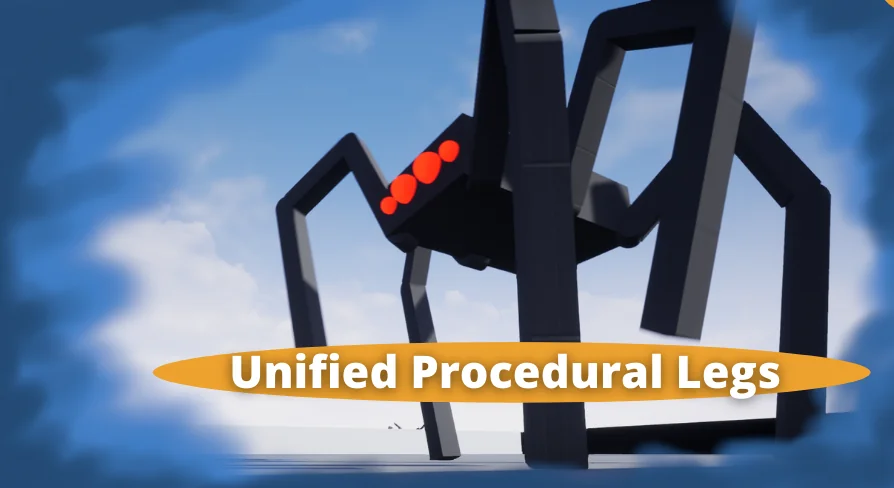
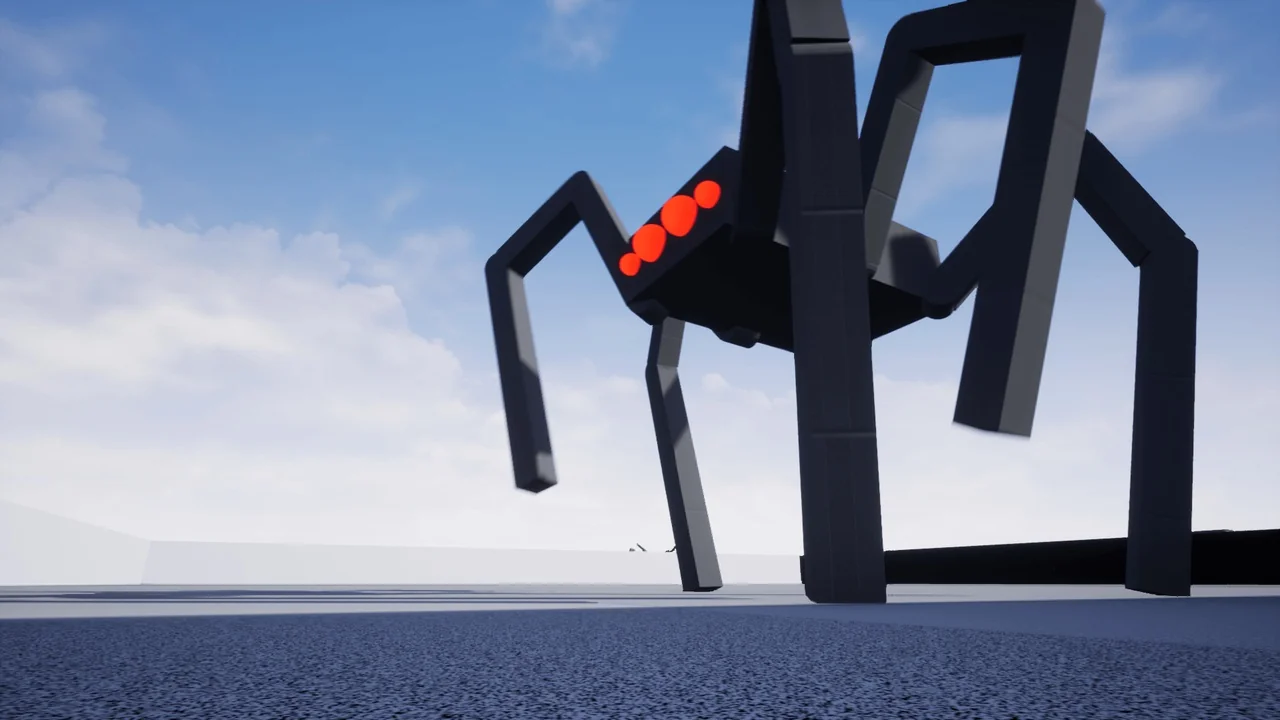
At the center of the package is Unified Procedural Legs, a modular architecture implemented entirely in Blueprint. The framework separates character anatomy into modular base units, allowing developers to mate any rigged leg mesh to any target body. Once attached, the framework generates walking motion automatically, eliminating the need to build individual walk, run, and turning states from scratch.
Building custom IK setups, contact point detection, and gait synchronizers typically demands weeks of iterative testing. By providing a prebuilt kinematic loop, the system saves an estimated 100 or more hours of foundational coding and debugging. Because it functions completely within Blueprints, designers and programmers can inspect the execution paths directly, modifying math nodes or integrating custom game logic without dealing with external compilation steps.
Surface Foot Alignment and Blueprint Debug Traces
Dynamic movement across non-flat terrain requires continuous environmental sampling. Unified Procedural Animation actively calculates both horizontal foot placement and vertical foot alignment to conform directly to underlying surfaces. As feet step onto rocky outcroppings or sloping ground, each limb adjusts its target rotation and offset to match the surface normal.
Simultaneously, the framework recalculates body motion and body rotation based on terrain positioning. Rather than remaining static or rigidly upright, the main torso leans, twists, and compensates to maintain realistic equilibrium relative to the ground plane below. Fine-tuning these behaviors is handled through an extensive parameter set:
Over 50 base variables exposed in Blueprint to adjust step height, cadence, body sway, response speeds, and rotation limits.
Real-time visual debug traces showing the origin, trajectory, and impact points of every terrain interaction raycast.
Immediate dynamic feedback on how individual limbs calculate valid resting points versus moving steps.
These debug traces take the guesswork out of setup. Developers can see precisely where traces strike collision geometry, identifying whether a failed step is caused by trace lengths, collision channel mismatches, or steep surface angle thresholds.
Prototyping Traversal Across the Included Obstacle Maps
Evaluating procedural animation requires diverse environments that challenge kinematics under extreme angles and irregular gaps. The package includes three specialized obstacle maps engineered specifically to test character movement limits. These levels contain sudden elevation changes, variable surface angles, stepped terrain, and suspended platforms that force the procedural solver to recalculate paths continuously.
To accelerate initial testing, the package supplies a starter kit containing over 40 models and legs. These assets serve as ready-to-use testing baselines, allowing teams to construct multi-legged creatures, arachnid-style units, mechs, or alien organisms right out of the box. Prototyping a functioning character requires simply selecting a body, mounting the desired leg configuration, and deploying the actor into one of the obstacle maps to inspect its traversal behavior.
Target Implementations and Spline Movement Compatibility
Projects revolving around survival mechanics, mechanical drones, or non-humanoid fauna benefit most from this framework. Multi-legged designs such as spiders are notoriously labor-intensive to animate by hand due to the complex coordination required across six, eight, or more independent limbs. Unified Procedural Animation handles these coordinated gait sequences mathematically, keeping all limbs synchronized regardless of movement velocity or surface topology.
The system also offers verified compatibility with Unified Spline Movement. Combining the procedural leg solver with spline-based navigation makes it possible to route complex creatures along walls, ceilings, curved rails, or predetermined environmental tracks while retaining procedural foot placement throughout the motion path.
Developers seeking to implement multi-legged traversal, dynamic surface clinging, or modular robotic characters will find this system particularly valuable. By handling terrain evaluation, body tilting, and foot alignment out of the box, it removes the heavy technical burden of procedural locomotion and lets teams focus immediately on character design and gameplay mechanics.
 Gameplay Features
 Gameplay Features
 Gameplay Features
 Network