"b00678cacce53329"{"id":"1002873","slug":"tycoon-template","title":"Tycoon Template","category":"City Builder","engine":"5.6+","assetVersion":"Asset Version: 1.5","engineVersion":"Engine Version: 5.6+","tag":"City Builder","accent":"blue","visual":"city","summary":"Examine the Tycoon Template for Unreal Engine, covering blueprint architectures, park finances, visitor queue logic, staff simulation, and placement systems.","platform":"Unreal Engine","indexPolicy":"index","publishedAt":"2026-11-20T18:07:20.448Z","updatedAt":"2026-11-20T18:07:20.448Z","sourceNotes":[],"fileContents":[],"compatibility":["Unreal Engine","Asset Version: 1.5","Engine Version: 5.6+"],"featuredImage":{"alt":"Tycoon Template","src":"/wp-content/uploads/published/2026/11/7ee3d173b20d-de35be2f-b3b2-4e8f-8365-cb2483169d44-439d291d03.webp"},"fileSizeBytes":895283236,"hasDownloadLink":true,"downloads":0,"terms":[{"taxonomy":"category","slug":"city-builder","name":"City Builder"}],"galleryImages":[{"src":"/wp-content/uploads/published/2026/11/f01130e9c093-6798aba5-3ff8-417d-99d0-5254a96a8f03-a0a17df068.webp","alt":"Tycoon Template"},{"src":"/wp-content/uploads/published/2026/11/f1c5633c3f44-ba9743cb-b3ac-46ea-b74f-d9a92c8d8335-d2534449ec.webp","alt":"Tycoon Template"},{"src":"/wp-content/uploads/published/2026/11/edf47f65cf13-32f2f16a-b9fa-407c-82cd-202dacae2706-a85bbeebad.webp","alt":"Tycoon Template"},{"src":"/wp-content/uploads/published/2026/11/bd3bc39afdfa-15ea3fcc-b3e9-444f-a049-4a31a241daa1-6f6dd0ef15.webp","alt":"Tycoon Template"},{"src":"/wp-content/uploads/published/2026/11/d7f87de0e76c-789f2278-c1da-46cf-a36f-c86255cf8f25-c6ebd6e4d2.webp","alt":"Tycoon Template"},{"src":"/wp-content/uploads/published/2026/11/faa5a06f1aa1-0fba8a95-712b-429a-8370-f02f34ff6b58-e2499ee771.webp","alt":"Tycoon Template"},{"src":"/wp-content/uploads/published/2026/11/bf0eec993e49-e36f0ffa-a7cd-4c69-a17b-f6df00734fd5-1e95be5c91.webp","alt":"Tycoon Template"},{"src":"/wp-content/uploads/published/2026/11/ee004cc83c99-0d34ddb4-ea1c-4a80-9225-b7187c1788ee-0e2ab8b306.webp","alt":"Tycoon Template"},{"src":"/wp-content/uploads/published/2026/11/ef02939314d0-2f1b22f1-f7ce-4438-99ff-f828bdeae327-5d578cfdaf.webp","alt":"Tycoon Template"},{"src":"/wp-content/uploads/published/2026/11/7dbf48fa4cac-31f1d6af-af00-449a-b62a-26135a26f22e-c95559261f.webp","alt":"Tycoon Template"}],"accessPanel":{"kind":"resource","title":"Get this resource","safetyNote":"Resources are manually reviewed before listing to improve quality and reduce obvious risks.","fileName":"Tycoon Template.7z","resourceType":"Resource archive","versions":[]},"contentHtml":"\u003cp\u003eVast management projects such as theme parks, animal sanctuaries, circus grounds, and industrial simulation games require interconnected loops of visitor flow, operating expenses, park infrastructure, and real-time revenue collection. Building these structures from a blank project typically demands months of foundational development before any specific simulation flavor can be established. Tycoon Template sets down these underlying management pipelines in Unreal Engine, establishing the mechanical links between attraction placement, customer psychology, staff maintenance, and persistent financial accounting.\u003c/p\u003e\u003ch2\u003eConstructing Parks with the Tycoon Template Architecture\u003c/h2\u003e\u003cp\u003eThe core structural design of this framework relies heavily on data tables, enums, and child blueprints stemming from a master building actor. This modular foundation allows developers to create and insert new structures, concessions, and park attractions within minutes rather than reconstructing logic from scratch. Custom building data tables are specifically configured to safeguard user additions against unintentional overwrite when core template systems receive updates.\u003c/p\u003e\u003cp\u003eBlueprints across the system arrive fully commented, containing targeted guidance within the graph logic for adjusting parameters or swapping functional nodes quickly. Although the default configuration is pre-tuned for zoological and theme park environments, the reliance on generic data tables and child building classes makes it adaptable to alternate management niches—such as production campuses, resort facilities, or fairgrounds—with minimal system adjustment.\u003c/p\u003e\u003ch2\u003eVisitor Psychology, Queuing, and Sanitation Mechanics\u003c/h2\u003e\u003cp\u003ePark patrons in the framework are governed by dynamic state machines tracking individual perception, spending thresholds, and physiological needs. Visitors calculate pricing thresholds before making purchases at concessions or rides. While regular guests adhere to strict markup limits, specific rich visitor archetypes carry wider spending allowances, opening opportunities for layered pricing models. When prices at attractions exceed perceived value, visitor satisfaction metrics drop significantly.\u003c/p\u003e\u003cp\u003eGuest navigation incorporates an active pathing framework where visitors are naturally funneled down designated trails, yet retain individual autonomy to cut across open terrain if they choose. Visitors grow weary and seek recovery spots, sitting down on placed benches or resting inside full-service restaurants. Guest comfort is also tied directly to environmental cleanliness. Visitors who purchase items at kiosks and canteens discard waste once finished, whereas food consumed inside sit-down restaurants produces no surface refuse. When garbage cans are absent or reach an overflowing state, visitors dump trash directly onto the ground, sparking negative guest thoughts that depress overall park ratings.\u003c/p\u003e\u003cp\u003eQueue networks govern how guests access high-traffic infrastructure. The system utilizes manually placed queuing lines with individual standing markers:\u003c/p\u003e\u003cul\u003e\u003cli\u003eGuests line up at the tail of the queue and move forward node by node as transactions occur.\u003c/li\u003e\u003cli\u003eTransactions are locked until a guest reaches the exact front node of the line.\u003c/li\u003e\u003cli\u003eQueued visitors maintain their precise sequence order through the save and load cycle without resetting line progress.\u003c/li\u003e\u003cli\u003eVendor training levels directly scale the speed at which queues advance, accelerating transaction completion times.\u003c/li\u003e\u003c/ul\u003e\u003ch2\u003eCommercial Facilities and Operational Data in Tycoon Template\u003c/h2\u003e\u003cp\u003eCommercial structures within the simulation are divided across distinct operational tiers, encompassing canteens, standalone kiosks, sit-down restaurants, and gift shops. Every facility records and exposes active operational data within specialized building interface tabs. Players can inspect top-selling products, identify the highest- and lowest-earning inventory items, and review all recurring operational overhead tied to that specific structure. Structures clearly display overhead visual icons whenever they lose electrical power or are manually toggled to a closed state.\u003c/p\u003e\u003cp\u003eParkwide navigation and organization are handled through centralized administrative hubs. The Visitor Center interface populates an exhaustive directory of every constructed facility in the park, allowing instant camera selection and status monitoring. Furthermore, players have the ability to rename individual buildings to customize regional zones or thematic sectors. The system also tracks all active commercial goods through an itemized structure of sold assets, preserving physical inventories as items exchange hands.\u003c/p\u003e\u003ch2\u003eStaff Management, Workforce Stress, and Service Roles\u003c/h2\u003e\u003cp\u003eOperations depend on a functioning labor force that must be recruited, assigned, and managed financially. Employee payroll is tied directly into the park's monthly balance sheet, balancing labor costs against concession profits. The staff framework includes multiple specialized roles, including janitors who clean litter across paths and deposit collected waste at dedicated garbage sheds, entertainers who project an influence radius that elevates the excitement and happiness of nearby patrons, and retail vendors who man service counters.\u003c/p\u003e\u003cp\u003eEmployee retention and productivity hinge on stress management and career progression:\u003c/p\u003e\u003cul\u003e\u003cli\u003eEmployees periodically take breaks based on accumulated stress and individual training levels to recover baseline happiness.\u003c/li\u003e\u003cli\u003eJanitors, vendors, and entertainers will resign from the park if neglected and left in an unhappy state for prolonged periods.\u003c/li\u003e\u003cli\u003eIssuing raises elevates the allowable stress tolerance of staff members, helping preserve high retention rates across demanding operational periods.\u003c/li\u003e\u003cli\u003eInvesting in staff training increases individual work efficiency, boosts default happiness, and raises the overall stress ceiling an employee can endure.\u003c/li\u003e\u003cli\u003eVendors can be assigned directly to specific building posts or set to auto-detect vacant workstations independently.\u003c/li\u003e\u003cli\u003eThe Staff House tracking hub details critical workforce metrics, including identification of the park's highest-paid employee and single-click location targeting for every worker.\u003c/li\u003e\u003c/ul\u003e\u003ch2\u003eNavigation, Placement Systems, and Integration Scope\u003c/h2\u003e\u003cp\u003eThe builder framework operates under an updated input setup leveraging Unreal Engine's Input Mapping Context and Enhanced Input systems. Navigation across the site features edge-screen scrolling for standard top-down management control, alongside a dedicated third-person character controller that permits direct, ground-level traversal of the park while building. Structure deployment supports either precise freeform object translation or strict snapping to a defined grid. Placement tracing relies on dynamic landscape surface detection, letting builders snap actors accurately across uneven terrain.\u003c/p\u003e\u003cp\u003eData preservation uses an expansive multi-save, load, and delete system that tracks active queue lines, financial ledgers, staff attributes, and building statistics without loss of fidelity. The template includes over 160 starter icons generated with artificial intelligence alongside several pre-built building assets to assist project assembly. However, developers planning a zoo project must note that animal behavioral AI and animal skeletal assets are not supplied within the package. Utilizing the framework requires baseline familiarity with Unreal Engine blueprints; a comprehensive 50-page technical manual guides implementation across the blueprint architecture.\u003c/p\u003e\n\n\u003ch2\u003eContinue Browsing Similar Packs\u003c/h2\u003e\n\u003cul\u003e\n\u003cli\u003e\u003ca href=\"https://3dcghub.com/vectorfield-builder/\" rel=\"noopener noreferrer\"\u003eVectorField Builder\u003c/a\u003e\u003c/li\u003e\n\u003cli\u003e\u003ca href=\"https://3dcghub.com/fire-builder/\" rel=\"noopener noreferrer\"\u003eFire Builder\u003c/a\u003e\u003c/li\u003e\n\u003cli\u003e\u003ca href=\"https://3dcghub.com/spline-grind-rail-builder-v2-grinding-and-zipline-movement-system/\" rel=\"noopener noreferrer\"\u003eSpline Grind Rail Builder v2 - Grinding \u0026amp; Zipline Movement System\u003c/a\u003e\u003c/li\u003e\n\u003cli\u003e\u003ca href=\"https://3dcghub.com/scifi-kitbash-level-builder-vol-2/\" rel=\"noopener noreferrer\"\u003eSciFi Kitbash Level Builder Vol.2\u003c/a\u003e\u003c/li\u003e\n\u003cli\u003e\u003ca href=\"https://3dcghub.com/paris-fontaine-saint-michel/\" rel=\"noopener noreferrer\"\u003eParis - Fontaine Saint-Michel\u003c/a\u003e\u003c/li\u003e\n\u003c/ul\u003e","contentTextLength":7681,"navigation":{"current":6,"total":4797,"previous":{"id":"1002874","slug":"ynnk-voice-lipsync","title":"Ynnk Voice Lipsync","category":"Animations","platform":"Unreal Engine","updatedAt":"2026-11-20T18:07:59.515Z"},"next":{"id":"1001503","slug":"audio-analyzer","title":"Audio Analyzer","category":"Engine Tools","platform":"Unreal Engine","updatedAt":"2026-11-20T17:30:29.499Z"}},"relatedResources":[{"id":"1002852","slug":"vectorfield-builder","title":"VectorField Builder","category":"Variety","engine":"4.16+,5.0+","assetVersion":"","engineVersion":"Engine Version: 4.16+,5.0+","tag":"Variety","accent":"blue","visual":"mech","summary":"VectorField Builder delivers over 88 vector fields and pre-built emitters for crafting GPU particle motion, swirls, tornadoes, and explosive nova visuals.","platform":"Unreal Engine","indexPolicy":"index","publishedAt":"2026-11-20T12:34:10.218Z","updatedAt":"2026-11-20T12:34:10.218Z","sourceNotes":[],"fileContents":[],"compatibility":["Unreal Engine","Engine Version: 4.16+,5.0+"],"featuredImage":{"alt":"VectorField Builder","src":"/wp-content/uploads/published/2026/11/d885dd995d0b-8fc2f9e6-2032-47bb-8c75-5af81c1e43bd-5fbdc11476.webp"},"fileSizeBytes":179555950,"hasDownloadLink":true,"downloads":0},{"id":"1002790","slug":"fire-builder","title":"Fire Builder","category":"Variety","engine":"4.16+,5.0+","assetVersion":"","engineVersion":"Engine Version: 4.16+,5.0+","tag":"Variety","accent":"blue","visual":"mech","summary":"A deep dive into Fire Builder, covering its modular 2048x2048 HDR effects, flame customization, training resources, and real-time visual implementation.","platform":"Unreal Engine","indexPolicy":"index","publishedAt":"2026-11-20T07:13:10.323Z","updatedAt":"2026-11-20T07:13:10.323Z","sourceNotes":[],"fileContents":[],"compatibility":["Unreal Engine","Engine Version: 4.16+,5.0+"],"featuredImage":{"alt":"Fire Builder","src":"/wp-content/uploads/published/2026/11/8b351af02a6e-2548e8a9-e8fd-46ec-bef8-fcdaadb35f4b-0cc178c77a.webp"},"fileSizeBytes":416207830,"hasDownloadLink":true,"downloads":0},{"id":"1002208","slug":"spline-grind-rail-builder-v2-grinding-and-zipline-movement-system","title":"Spline Grind Rail Builder v2 - Grinding \u0026 Zipline Movement System","category":"Game Mechanics","engine":"4.27,5.0+","assetVersion":"","engineVersion":"Engine Version: 4.27,5.0+","tag":"Game Mechanics","accent":"blue","visual":"mech","summary":"Configure spline grind rails, loop rails, and zipline movement systems in Unreal Engine with automated height adaptation and Blueprint character logic.","platform":"Unreal Engine","indexPolicy":"index","publishedAt":"2026-10-29T14:51:31.163Z","updatedAt":"2026-10-29T14:51:31.163Z","sourceNotes":[],"fileContents":[],"compatibility":["Unreal Engine","Engine Version: 4.27,5.0+"],"featuredImage":{"alt":"Spline Grind Rail Builder v2 - Grinding \u0026 Zipline Movement System","src":"/wp-content/uploads/published/2026/10/63e2a634bb2c-59302988-8dc9-4827-bcbc-64f027a7f562-0c0dcc7b82.webp"},"fileSizeBytes":43147331,"hasDownloadLink":true,"downloads":0}]}
Resource screenshots
1 / 10
Join our channel
Follow 3DCGHUB on Telegram for new resource drops, migration updates, and community notices.
Resources are manually reviewed before listing to improve quality and reduce obvious risks.
No account required
City Builder
Tycoon Template
Examine the Tycoon Template for Unreal Engine, covering blueprint architectures, park finances, visitor queue logic, staff simulation, and placement systems.
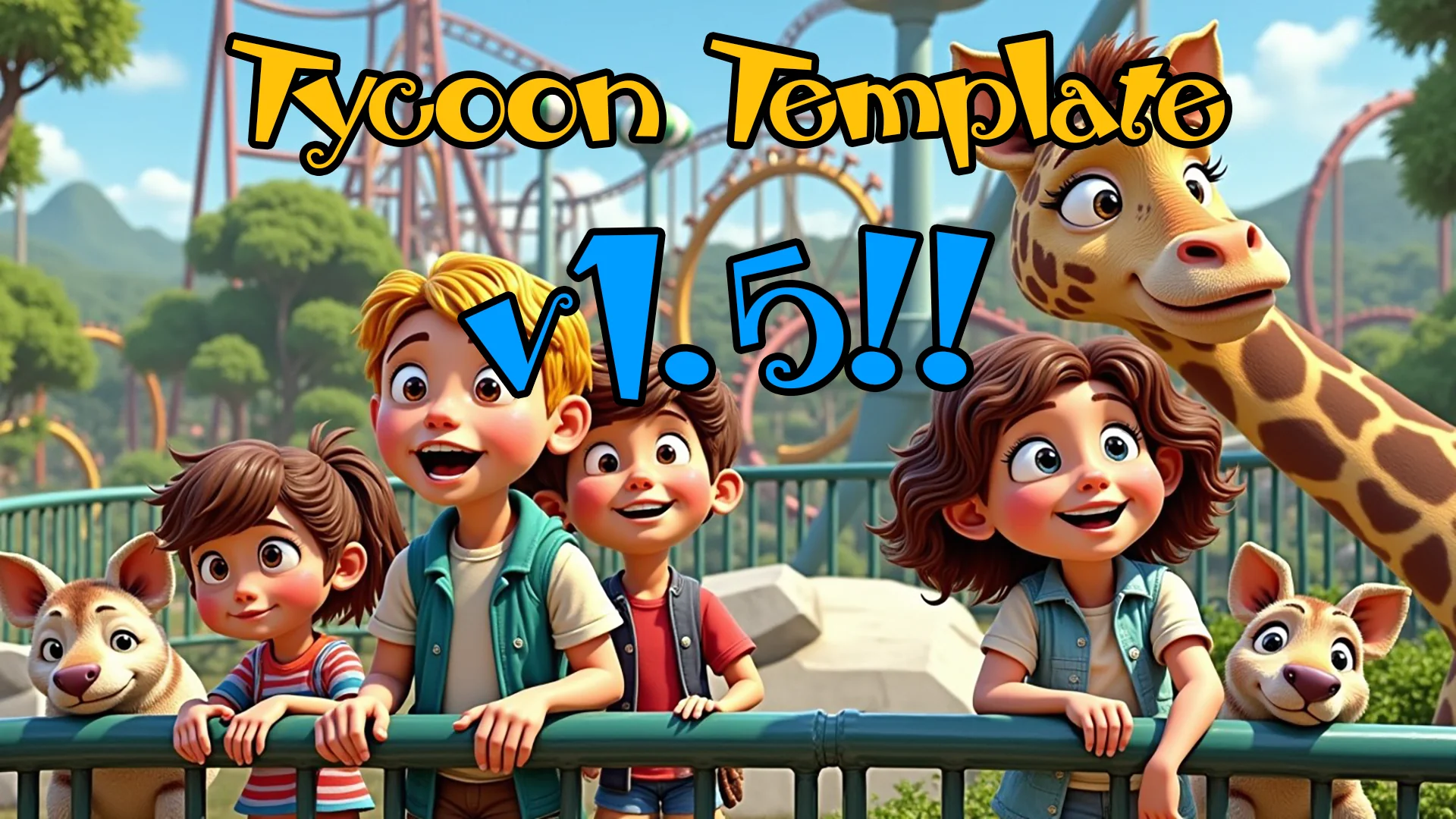
Vast management projects such as theme parks, animal sanctuaries, circus grounds, and industrial simulation games require interconnected loops of visitor flow, operating expenses, park infrastructure, and real-time revenue collection. Building these structures from a blank project typically demands months of foundational development before any specific simulation flavor can be established. Tycoon Template sets down these underlying management pipelines in Unreal Engine, establishing the mechanical links between attraction placement, customer psychology, staff maintenance, and persistent financial accounting.
Constructing Parks with the Tycoon Template Architecture
The core structural design of this framework relies heavily on data tables, enums, and child blueprints stemming from a master building actor. This modular foundation allows developers to create and insert new structures, concessions, and park attractions within minutes rather than reconstructing logic from scratch. Custom building data tables are specifically configured to safeguard user additions against unintentional overwrite when core template systems receive updates.
Blueprints across the system arrive fully commented, containing targeted guidance within the graph logic for adjusting parameters or swapping functional nodes quickly. Although the default configuration is pre-tuned for zoological and theme park environments, the reliance on generic data tables and child building classes makes it adaptable to alternate management niches—such as production campuses, resort facilities, or fairgrounds—with minimal system adjustment.
Visitor Psychology, Queuing, and Sanitation Mechanics
Park patrons in the framework are governed by dynamic state machines tracking individual perception, spending thresholds, and physiological needs. Visitors calculate pricing thresholds before making purchases at concessions or rides. While regular guests adhere to strict markup limits, specific rich visitor archetypes carry wider spending allowances, opening opportunities for layered pricing models. When prices at attractions exceed perceived value, visitor satisfaction metrics drop significantly.
Guest navigation incorporates an active pathing framework where visitors are naturally funneled down designated trails, yet retain individual autonomy to cut across open terrain if they choose. Visitors grow weary and seek recovery spots, sitting down on placed benches or resting inside full-service restaurants. Guest comfort is also tied directly to environmental cleanliness. Visitors who purchase items at kiosks and canteens discard waste once finished, whereas food consumed inside sit-down restaurants produces no surface refuse. When garbage cans are absent or reach an overflowing state, visitors dump trash directly onto the ground, sparking negative guest thoughts that depress overall park ratings.
Queue networks govern how guests access high-traffic infrastructure. The system utilizes manually placed queuing lines with individual standing markers:
Guests line up at the tail of the queue and move forward node by node as transactions occur.
Transactions are locked until a guest reaches the exact front node of the line.
Queued visitors maintain their precise sequence order through the save and load cycle without resetting line progress.
Vendor training levels directly scale the speed at which queues advance, accelerating transaction completion times.
Commercial Facilities and Operational Data in Tycoon Template
Commercial structures within the simulation are divided across distinct operational tiers, encompassing canteens, standalone kiosks, sit-down restaurants, and gift shops. Every facility records and exposes active operational data within specialized building interface tabs. Players can inspect top-selling products, identify the highest- and lowest-earning inventory items, and review all recurring operational overhead tied to that specific structure. Structures clearly display overhead visual icons whenever they lose electrical power or are manually toggled to a closed state.
Parkwide navigation and organization are handled through centralized administrative hubs. The Visitor Center interface populates an exhaustive directory of every constructed facility in the park, allowing instant camera selection and status monitoring. Furthermore, players have the ability to rename individual buildings to customize regional zones or thematic sectors. The system also tracks all active commercial goods through an itemized structure of sold assets, preserving physical inventories as items exchange hands.
Staff Management, Workforce Stress, and Service Roles
Operations depend on a functioning labor force that must be recruited, assigned, and managed financially. Employee payroll is tied directly into the park's monthly balance sheet, balancing labor costs against concession profits. The staff framework includes multiple specialized roles, including janitors who clean litter across paths and deposit collected waste at dedicated garbage sheds, entertainers who project an influence radius that elevates the excitement and happiness of nearby patrons, and retail vendors who man service counters.
Employee retention and productivity hinge on stress management and career progression:
Employees periodically take breaks based on accumulated stress and individual training levels to recover baseline happiness.
Janitors, vendors, and entertainers will resign from the park if neglected and left in an unhappy state for prolonged periods.
Issuing raises elevates the allowable stress tolerance of staff members, helping preserve high retention rates across demanding operational periods.
Investing in staff training increases individual work efficiency, boosts default happiness, and raises the overall stress ceiling an employee can endure.
Vendors can be assigned directly to specific building posts or set to auto-detect vacant workstations independently.
The Staff House tracking hub details critical workforce metrics, including identification of the park's highest-paid employee and single-click location targeting for every worker.
Navigation, Placement Systems, and Integration Scope
The builder framework operates under an updated input setup leveraging Unreal Engine's Input Mapping Context and Enhanced Input systems. Navigation across the site features edge-screen scrolling for standard top-down management control, alongside a dedicated third-person character controller that permits direct, ground-level traversal of the park while building. Structure deployment supports either precise freeform object translation or strict snapping to a defined grid. Placement tracing relies on dynamic landscape surface detection, letting builders snap actors accurately across uneven terrain.
Data preservation uses an expansive multi-save, load, and delete system that tracks active queue lines, financial ledgers, staff attributes, and building statistics without loss of fidelity. The template includes over 160 starter icons generated with artificial intelligence alongside several pre-built building assets to assist project assembly. However, developers planning a zoo project must note that animal behavioral AI and animal skeletal assets are not supplied within the package. Utilizing the framework requires baseline familiarity with Unreal Engine blueprints; a comprehensive 50-page technical manual guides implementation across the blueprint architecture.
 Variety
 Variety
 Game Mechanics