"b00678cacce53329"{"id":"1002852","slug":"vectorfield-builder","title":"VectorField Builder","category":"Variety","engine":"4.16+,5.0+","assetVersion":"","engineVersion":"Engine Version: 4.16+,5.0+","tag":"Variety","accent":"blue","visual":"mech","summary":"VectorField Builder delivers over 88 vector fields and pre-built emitters for crafting GPU particle motion, swirls, tornadoes, and explosive nova visuals.","platform":"Unreal Engine","indexPolicy":"index","publishedAt":"2026-11-20T12:34:10.218Z","updatedAt":"2026-11-20T12:34:10.218Z","sourceNotes":[],"fileContents":[],"compatibility":["Unreal Engine","Engine Version: 4.16+,5.0+"],"featuredImage":{"alt":"VectorField Builder","src":"/wp-content/uploads/published/2026/11/d885dd995d0b-8fc2f9e6-2032-47bb-8c75-5af81c1e43bd-5fbdc11476.webp"},"fileSizeBytes":179555950,"hasDownloadLink":true,"downloads":0,"terms":[{"taxonomy":"category","slug":"variety-vfx","name":"Variety"}],"galleryImages":[{"src":"/wp-content/uploads/published/2026/11/982c79ba7861-a47ff7f5-413d-48d7-b2ec-3c2da16e64aa-385bca3663.webp","alt":"VectorField Builder"},{"src":"/wp-content/uploads/published/2026/11/71e6f2139c6f-e7afc4ce-5ed1-4cc5-9f5f-3a5cb1418e51-992fa29e96.webp","alt":"VectorField Builder"},{"src":"/wp-content/uploads/published/2026/11/d563f60fd196-cf8a9f13-8198-4975-afe1-75f4267beff1-d20948a1a4.webp","alt":"VectorField Builder"},{"src":"/wp-content/uploads/published/2026/11/25dc96953973-1568c9ff-c07b-4b5f-aa11-ec46f23694a7-1dc10f928f.webp","alt":"VectorField Builder"},{"src":"/wp-content/uploads/published/2026/11/2639a65b0f96-4b94a1ff-2c34-4b0a-80f6-fbc3e6a4f6e1-7e71f8411d.webp","alt":"VectorField Builder"},{"src":"/wp-content/uploads/published/2026/11/898700122894-c0a952fa-c2a8-47b7-8c75-bee960c3a0bb-87afb99b76.webp","alt":"VectorField Builder"},{"src":"/wp-content/uploads/published/2026/11/f304d656ed93-d621862b-70d1-44e9-8972-1ad4fa4194fd-2990a1770f.webp","alt":"VectorField Builder"}],"accessPanel":{"kind":"resource","title":"Get this resource","safetyNote":"Resources are manually reviewed before listing to improve quality and reduce obvious risks.","fileName":"Content.7z","resourceType":"Resource archive","versions":[]},"contentHtml":"\u003ch2\u003eDirecting Dynamic Motion with VectorField Assets\u003c/h2\u003e\u003cp\u003eReal-time visual effects authoring frequently requires balancing computationally intensive spatial motion against strict per-frame hardware limitations. While direct analytical calculations or basic uniform directional forces can push particles along straight lines, organic natural phenomena and stylized visual displays depend on multi-directional, volume-aware current patterns. Simulating complex vortex fluid interactions or non-linear particle drift entirely on runtime physics components can quickly exhaust frame budgets, particularly when particle counts climb into the tens of thousands.\u003c/p\u003e\u003cp\u003eVectorField Builder resolves this runtime tension by supplying over 88 new vector fields designed specifically to drive high-density GPU particle effects. A vector field stores discrete, three-dimensional directional vectors across a grid volume, allowing real-time rendering pipelines to look up spatial velocity instructions instantly rather than calculating dynamic forces at each simulation tick. By offloading these calculations into static spatial velocity arrays evaluated by the graphics processor, the simulation easily steers vast quantities of concurrent particles through intricate geometric trajectories, maintaining fluid aesthetic performance across complex scenes.\u003c/p\u003e\u003ch2\u003eVelocity Volume Architecture Inside VectorField Builder\u003c/h2\u003e\u003cp\u003eThe mathematical foundation of a vector field is rooted in its volumetric coordinate grid, where each point in space holds a three-component velocity vector indicating both directional orientation and relative force. In VectorField Builder, these spatial volumes are curated to bypass the sterile, predictable motion typical of default mathematical noise functions. Rather than relying on simple noise offsets that oscillate uniformly, the library supplies over 88 distinct directional fields that manipulate visual elements through clear morphological patterns.\u003c/p\u003e\u003cp\u003eBecause GPU particle engines sample vector values based on the particle's three-dimensional position inside the bounding box of the volume, the fields in this package can gently guide particles into subtle ambient currents or aggressively whip them along dense velocity channels. This sampling process enables complex layered motion: as individual sparks, dust motes, or magical motes enter differing sub-regions of the volume, they automatically shift direction and speed according to the local vectors. The package then offers a simulation that feels physically grounded and coherent, exhibiting natural compression, dispersion, and shear across the entire volume of the effect.\u003c/p\u003e\u003ch2\u003eSimulating Swirls and Tornadoes with Vector Currents\u003c/h2\u003e\u003cp\u003eRotational fluid movement represents one of the most technical challenges in visual effects production. Creating a convincing cyclonic motion requires velocities to increase toward a central vortex while simultaneously lifting particles along a vertical axis and scattering perimeter elements outward into decaying turbulence. Constructing this balance manually using basic engine-native radial and point forces often produces rigid, circular orbits that lack depth and authentic volumetric turbulence.\u003c/p\u003e\u003cp\u003eThe motion profiles in VectorField Builder heavily feature intricate swirls and full-scale tornadoes built to resolve these exact rotational dynamics. Within these cyclonic fields, particles are drawn into spinning velocity cores that mimic the updrafts, suction, and lateral centrifugal dispersal of physical funnels. Beyond standard cyclonic forces, the collection integrates wavy patterns and unconventional, weird shapes that break away from strictly circular rotational paths. These wavy and irregular vectors force particles along undulating tracks, introducing visual ripples, serpentine contours, and unpredictable eddies. For stylized combat strikes, ambient environmental drafts, or supernatural phenomena, these weird shapes offer distinctive physical silhouettes that traditional rotational forces cannot achieve.\u003c/p\u003e\u003ch2\u003eExplosive Nova Bursts and High-Energy Particle Systems\u003c/h2\u003e\u003cp\u003eBeyond continuous vortices and atmospheric drifts, real-time particle designers routinely require immediate, violent bursts of energy for explosive nova effects and detonations. An explosion driven strictly by radial velocity vectors tends to result in an unnatural, hollow spherical shell expanding outward evenly, quickly breaking the illusion of combustion, shockwaves, or volatile magical releases.\u003c/p\u003e\u003cp\u003eVectorField Builder accommodates these high-energy visual scenarios by pairing rapid dispersal forces with internal directional agitation. When powering explosive nova effects, the fields impart initial outward momentum while simultaneously twisting debris, glowing embers, and fiery sparks through localized directional currents. As the nova blast blooms outward from its detonation point, the velocity data continues to churn the expanding front, preventing the cloud from thinning into a generic sphere. The turbulent vector fields maintain particle clump density along primary velocity streams while scattering trailing elements into curling wakes, producing sharp, readable explosion silhouettes that remain visually compelling throughout their entire dissipation cycle.\u003c/p\u003e\u003ch2\u003eUtilizing the Pre-Made Emitter Library in Production\u003c/h2\u003e\u003cp\u003eWorking directly with raw spatial vector data can introduce iterative friction if artists must manually construct emitter parameters, boundary dimensions, force scales, and particle lifespans for each individual test. Even subtle mismatches between initial particle velocity and field magnitude can cause particles to shoot past the vector volume without registering the field's internal currents, or stall entirely inside zero-velocity dead zones.\u003c/p\u003e\u003cp\u003eTo streamline production implementation, VectorField Builder includes a pre-made emitter library that packages the vector fields into operational visual presets. Visual effects artists can immediately drag pre-configured emitters into a level or stage to observe how specific velocity volumes interact with particle spawn rates, lifespans, initial speeds, and color ramps. Rather than spending valuable development time wiring logic bounds from scratch, artists can use the pre-built library to quickly audition swirls, tornadoes, wavy paths, and explosive nova shapes in context. These ready-to-use emitters also illustrate practical baseline relationships between field dimensions and particle velocities, establishing clear reference setups that can be rapidly modified or migrated into wider scene particle networks.\u003c/p\u003e\u003ch2\u003eWorkflow Integration and Guidance from Training Videos\u003c/h2\u003e\u003cp\u003eAdopting new simulation volumes into an established project pipeline requires understanding how spatial scale, vector density, and GPU sampling parameters interact with existing project settings. VectorField Builder is accompanied by training videos that document the direct mechanics of handling and configuring the assets. These instructional materials clarify how to align vector field boundaries with emitter spawn locations, adjust global and local force multipliers, and tune particle lifetimes to match the physical scale of a target scene.\u003c/p\u003e\u003cp\u003eIn addition to instructional videos, developer-supported avenues such as a dedicated Discord chat and the W3 Studios newsletter offer continued touchpoints for technical context and workflow developments. Whether generating persistent tornadic funnel clouds for open-world weather systems, directing undulating magical spells with wavy current vectors, or crafting impact detonations using explosive nova profiles, VectorField Builder functions as both a rapid testing ground and a comprehensive library of directional forces designed to expand the expressive potential of real-time GPU particle pipelines.\u003c/p\u003e\n\n\u003ch2\u003eMore From The Same Workflow\u003c/h2\u003e\n\u003cul\u003e\n\u003cli\u003e\u003ca href=\"https://3dcghub.com/fire-builder/\" rel=\"noopener noreferrer\"\u003eFire Builder\u003c/a\u003e\u003c/li\u003e\n\u003cli\u003e\u003ca href=\"https://3dcghub.com/retro-shooter-fx-pack/\" rel=\"noopener noreferrer\"\u003eRetro Shooter FX Pack\u003c/a\u003e\u003c/li\u003e\n\u003cli\u003e\u003ca href=\"https://3dcghub.com/realistic-starter-vfx-pack/\" rel=\"noopener noreferrer\"\u003eRealistic Starter VFX Pack\u003c/a\u003e\u003c/li\u003e\n\u003cli\u003e\u003ca href=\"https://3dcghub.com/splash-damage-blood/\" rel=\"noopener noreferrer\"\u003eSplash Damage Blood\u003c/a\u003e\u003c/li\u003e\n\u003cli\u003e\u003ca href=\"https://3dcghub.com/explosion-pack-1-nature-elements/\" rel=\"noopener noreferrer\"\u003eExplosion Pack #1 - Nature Elements\u003c/a\u003e\u003c/li\u003e\n\u003c/ul\u003e","contentTextLength":7922,"navigation":{"current":28,"total":4797,"previous":{"id":"1002853","slug":"vfx-fire-pack","title":"VFX Fire Pack","category":"Fire \u0026 Explosions","platform":"Unreal Engine","updatedAt":"2026-11-20T12:34:58.772Z"},"next":{"id":"1002851","slug":"toon-projectiles-vol-1","title":"Toon Projectiles Vol. 1","category":"Spells \u0026 Combat","platform":"Unreal Engine","updatedAt":"2026-11-20T12:33:25.424Z"}},"relatedResources":[{"id":"1002790","slug":"fire-builder","title":"Fire Builder","category":"Variety","engine":"4.16+,5.0+","assetVersion":"","engineVersion":"Engine Version: 4.16+,5.0+","tag":"Variety","accent":"blue","visual":"mech","summary":"A deep dive into Fire Builder, covering its modular 2048x2048 HDR effects, flame customization, training resources, and real-time visual implementation.","platform":"Unreal Engine","indexPolicy":"index","publishedAt":"2026-11-20T07:13:10.323Z","updatedAt":"2026-11-20T07:13:10.323Z","sourceNotes":[],"fileContents":[],"compatibility":["Unreal Engine","Engine Version: 4.16+,5.0+"],"featuredImage":{"alt":"Fire Builder","src":"/wp-content/uploads/published/2026/11/8b351af02a6e-2548e8a9-e8fd-46ec-bef8-fcdaadb35f4b-0cc178c77a.webp"},"fileSizeBytes":416207830,"hasDownloadLink":true,"downloads":0},{"id":"1002866","slug":"stylized-fx-6","title":"Stylized FX 6","category":"Variety","engine":"4.16+,5.0+","assetVersion":"","engineVersion":"Engine Version: 4.16+,5.0+","tag":"Variety","accent":"blue","visual":"mech","summary":"Stylized FX 6 delivers focused real-time visual effects for non-photorealistic game projects, emphasizing silhouette clarity, timing, and bold artistic style.","platform":"Unreal Engine","indexPolicy":"index","publishedAt":"2026-11-20T12:53:23.890Z","updatedAt":"2026-11-20T12:53:23.890Z","sourceNotes":[],"fileContents":[],"compatibility":["Unreal Engine","Engine Version: 4.16+,5.0+"],"featuredImage":{"alt":"Stylized FX 6","src":"/wp-content/uploads/published/2026/11/0a2e8bbe656b-1ef4dc10-f2ff-47d4-bdc0-f8fa091c8df2-228260cee1.webp"},"fileSizeBytes":73365834,"hasDownloadLink":true,"downloads":0},{"id":"1002830","slug":"retro-shooter-fx-pack","title":"Retro Shooter FX Pack","category":"Variety","engine":"4.16+,5.0+","assetVersion":"","engineVersion":"Engine Version: 4.16+,5.0+","tag":"Variety","accent":"blue","visual":"mech","summary":"Examine the Retro Shooter FX Pack, featuring top-down visual FX, modular shaders, Blueprint AI turrets, spacecraft models, and a playable trench demo.","platform":"Unreal Engine","indexPolicy":"index","publishedAt":"2026-11-20T12:00:08.209Z","updatedAt":"2026-11-20T12:00:08.209Z","sourceNotes":[],"fileContents":[],"compatibility":["Unreal Engine","Engine Version: 4.16+,5.0+"],"featuredImage":{"alt":"Retro Shooter FX Pack","src":"/wp-content/uploads/published/2026/11/1c19cf5532b7-c292d4e3-3774-4b77-a810-6583380269dc-6c6beebcc0.webp"},"fileSizeBytes":191384509,"hasDownloadLink":true,"downloads":0}]}
Resource screenshots
1 / 7
Join our channel
Follow 3DCGHUB on Telegram for new resource drops, migration updates, and community notices.
Resources are manually reviewed before listing to improve quality and reduce obvious risks.
No account required
Variety
VectorField Builder
VectorField Builder delivers over 88 vector fields and pre-built emitters for crafting GPU particle motion, swirls, tornadoes, and explosive nova visuals.
Real-time visual effects authoring frequently requires balancing computationally intensive spatial motion against strict per-frame hardware limitations. While direct analytical calculations or basic uniform directional forces can push particles along straight lines, organic natural phenomena and stylized visual displays depend on multi-directional, volume-aware current patterns. Simulating complex vortex fluid interactions or non-linear particle drift entirely on runtime physics components can quickly exhaust frame budgets, particularly when particle counts climb into the tens of thousands.
VectorField Builder resolves this runtime tension by supplying over 88 new vector fields designed specifically to drive high-density GPU particle effects. A vector field stores discrete, three-dimensional directional vectors across a grid volume, allowing real-time rendering pipelines to look up spatial velocity instructions instantly rather than calculating dynamic forces at each simulation tick. By offloading these calculations into static spatial velocity arrays evaluated by the graphics processor, the simulation easily steers vast quantities of concurrent particles through intricate geometric trajectories, maintaining fluid aesthetic performance across complex scenes.
The mathematical foundation of a vector field is rooted in its volumetric coordinate grid, where each point in space holds a three-component velocity vector indicating both directional orientation and relative force. In VectorField Builder, these spatial volumes are curated to bypass the sterile, predictable motion typical of default mathematical noise functions. Rather than relying on simple noise offsets that oscillate uniformly, the library supplies over 88 distinct directional fields that manipulate visual elements through clear morphological patterns.
Because GPU particle engines sample vector values based on the particle's three-dimensional position inside the bounding box of the volume, the fields in this package can gently guide particles into subtle ambient currents or aggressively whip them along dense velocity channels. This sampling process enables complex layered motion: as individual sparks, dust motes, or magical motes enter differing sub-regions of the volume, they automatically shift direction and speed according to the local vectors. The package then offers a simulation that feels physically grounded and coherent, exhibiting natural compression, dispersion, and shear across the entire volume of the effect.
Simulating Swirls and Tornadoes with Vector Currents
Rotational fluid movement represents one of the most technical challenges in visual effects production. Creating a convincing cyclonic motion requires velocities to increase toward a central vortex while simultaneously lifting particles along a vertical axis and scattering perimeter elements outward into decaying turbulence. Constructing this balance manually using basic engine-native radial and point forces often produces rigid, circular orbits that lack depth and authentic volumetric turbulence.
The motion profiles in VectorField Builder heavily feature intricate swirls and full-scale tornadoes built to resolve these exact rotational dynamics. Within these cyclonic fields, particles are drawn into spinning velocity cores that mimic the updrafts, suction, and lateral centrifugal dispersal of physical funnels. Beyond standard cyclonic forces, the collection integrates wavy patterns and unconventional, weird shapes that break away from strictly circular rotational paths. These wavy and irregular vectors force particles along undulating tracks, introducing visual ripples, serpentine contours, and unpredictable eddies. For stylized combat strikes, ambient environmental drafts, or supernatural phenomena, these weird shapes offer distinctive physical silhouettes that traditional rotational forces cannot achieve.
Explosive Nova Bursts and High-Energy Particle Systems
Beyond continuous vortices and atmospheric drifts, real-time particle designers routinely require immediate, violent bursts of energy for explosive nova effects and detonations. An explosion driven strictly by radial velocity vectors tends to result in an unnatural, hollow spherical shell expanding outward evenly, quickly breaking the illusion of combustion, shockwaves, or volatile magical releases.
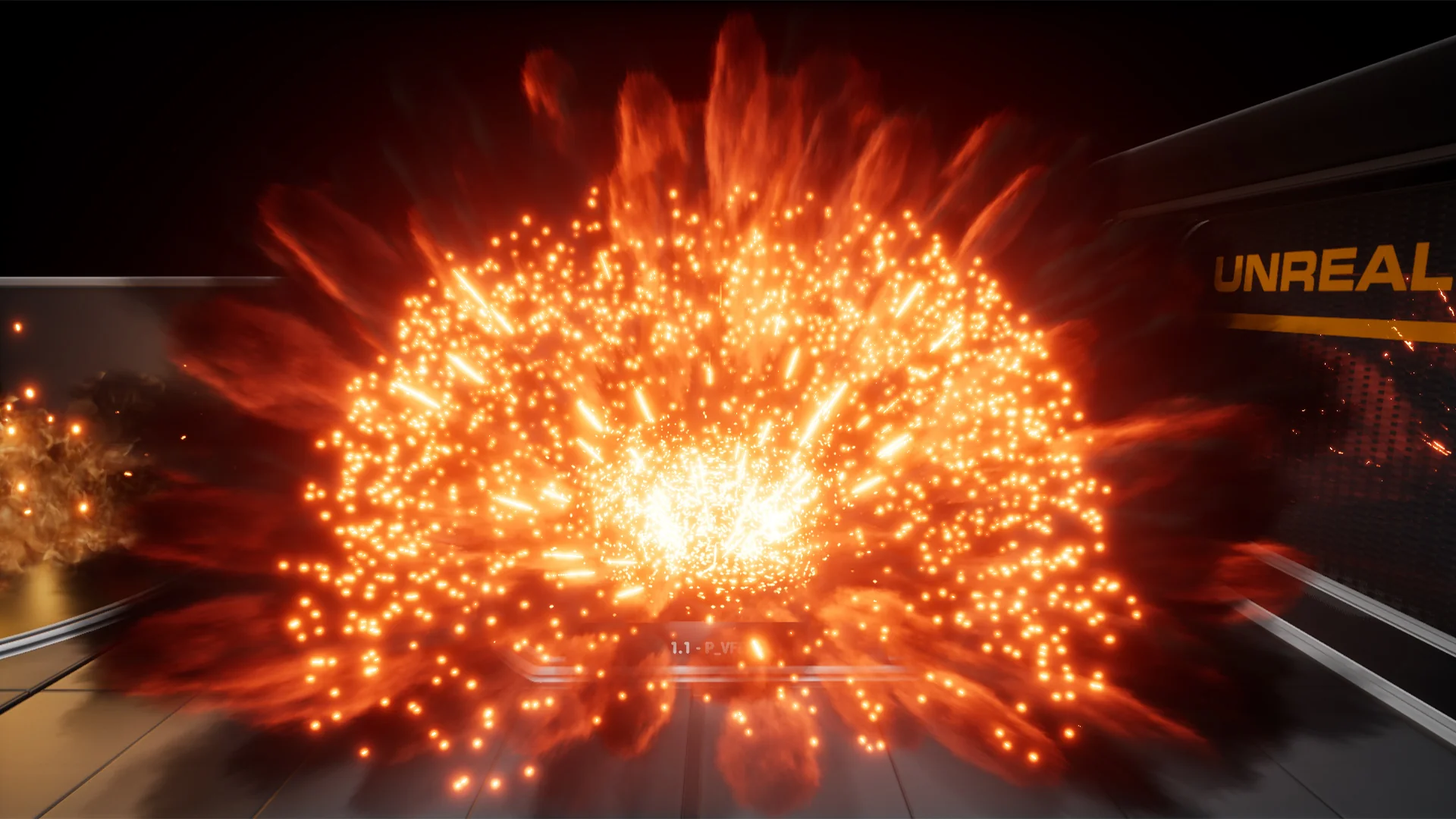
VectorField Builder accommodates these high-energy visual scenarios by pairing rapid dispersal forces with internal directional agitation. When powering explosive nova effects, the fields impart initial outward momentum while simultaneously twisting debris, glowing embers, and fiery sparks through localized directional currents. As the nova blast blooms outward from its detonation point, the velocity data continues to churn the expanding front, preventing the cloud from thinning into a generic sphere. The turbulent vector fields maintain particle clump density along primary velocity streams while scattering trailing elements into curling wakes, producing sharp, readable explosion silhouettes that remain visually compelling throughout their entire dissipation cycle.
Utilizing the Pre-Made Emitter Library in Production
Working directly with raw spatial vector data can introduce iterative friction if artists must manually construct emitter parameters, boundary dimensions, force scales, and particle lifespans for each individual test. Even subtle mismatches between initial particle velocity and field magnitude can cause particles to shoot past the vector volume without registering the field's internal currents, or stall entirely inside zero-velocity dead zones.
To streamline production implementation, VectorField Builder includes a pre-made emitter library that packages the vector fields into operational visual presets. Visual effects artists can immediately drag pre-configured emitters into a level or stage to observe how specific velocity volumes interact with particle spawn rates, lifespans, initial speeds, and color ramps. Rather than spending valuable development time wiring logic bounds from scratch, artists can use the pre-built library to quickly audition swirls, tornadoes, wavy paths, and explosive nova shapes in context. These ready-to-use emitters also illustrate practical baseline relationships between field dimensions and particle velocities, establishing clear reference setups that can be rapidly modified or migrated into wider scene particle networks.
Workflow Integration and Guidance from Training Videos
Adopting new simulation volumes into an established project pipeline requires understanding how spatial scale, vector density, and GPU sampling parameters interact with existing project settings. VectorField Builder is accompanied by training videos that document the direct mechanics of handling and configuring the assets. These instructional materials clarify how to align vector field boundaries with emitter spawn locations, adjust global and local force multipliers, and tune particle lifetimes to match the physical scale of a target scene.
In addition to instructional videos, developer-supported avenues such as a dedicated Discord chat and the W3 Studios newsletter offer continued touchpoints for technical context and workflow developments. Whether generating persistent tornadic funnel clouds for open-world weather systems, directing undulating magical spells with wavy current vectors, or crafting impact detonations using explosive nova profiles, VectorField Builder functions as both a rapid testing ground and a comprehensive library of directional forces designed to expand the expressive potential of real-time GPU particle pipelines.
 Variety
 Variety
 Variety