"7e6fc58c410f2894"{"id":"1000486","slug":"suburbs-vol-14-furniture-nanite-and-low-poly","title":"Suburbs VOL.14 - Furniture (Nanite and Low Poly)","category":"Tables","engine":"5.2+","assetVersion":"","engineVersion":"Engine Version: 5.2+","tag":"Tables","accent":"blue","visual":"mech","summary":"110 furniture meshes from Dekogon Studios with Nanite and low-poly versions, 4K textures, channel-packed maps, tintable materials, and Lumen support for Unreal","platform":"Unreal Engine","publishedAt":"2026-07-12T08:04:35.766Z","updatedAt":"2026-07-12T08:04:35.766Z","sourceNotes":[],"fileContents":[],"compatibility":["Unreal Engine","Engine Version: 5.2+"],"featuredImage":{"alt":"Suburbs VOL.14 - Furniture (Nanite and Low Poly)","src":"/wp-content/uploads/published/2026/07/f4a77c59f560-cc857324-37df-4873-b39d-7c7dfbd504ff-33a78a6529.webp"},"hasDownloadLink":true,"downloads":1,"terms":[{"taxonomy":"category","slug":"tables","name":"Tables"}],"galleryImages":[{"src":"/wp-content/uploads/published/2026/07/0ee9f73b5c3e-c143ea44-febe-4907-ae37-7f85b6cfa3a3-d3b4167bbe.webp","alt":"Suburbs VOL.14 - Furniture (Nanite and Low Poly)"},{"src":"/wp-content/uploads/published/2026/07/d4ff5635b5c2-06ea4674-b0e9-48e9-bea6-4d0a19adb4a5-ad0fda80c3.webp","alt":"Suburbs VOL.14 - Furniture (Nanite and Low Poly)"},{"src":"/wp-content/uploads/published/2026/07/f980223834e4-4e75cafb-c6cf-4ab3-9a0f-62db69722bb0-834c34eaa5.webp","alt":"Suburbs VOL.14 - Furniture (Nanite and Low Poly)"},{"src":"/wp-content/uploads/published/2026/07/955e4bfc6af5-4ceb3963-433b-47f3-b429-0d2350d713ad-fa21dd1d39.webp","alt":"Suburbs VOL.14 - Furniture (Nanite and Low Poly)"},{"src":"/wp-content/uploads/published/2026/07/96ae959341d8-2810c25f-cc8a-417b-bed9-b5aa14293f3a-cc6a399fed.webp","alt":"Suburbs VOL.14 - Furniture (Nanite and Low Poly)"},{"src":"/wp-content/uploads/published/2026/07/800ce80b171a-a10bd5cb-3db6-4cbe-8737-8d32c1a7ea30-214114a94d.webp","alt":"Suburbs VOL.14 - Furniture (Nanite and Low Poly)"},{"src":"/wp-content/uploads/published/2026/07/4d3d47d1bb3a-5e09cefa-82b1-4b17-a5c3-0d93e31928bd-24999036cd.webp","alt":"Suburbs VOL.14 - Furniture (Nanite and Low Poly)"},{"src":"/wp-content/uploads/published/2026/07/d5e43a79ed46-3247b179-0ed0-4840-a8aa-8c08917e1e77-ecf88e12fd.webp","alt":"Suburbs VOL.14 - Furniture (Nanite and Low Poly)"},{"src":"/wp-content/uploads/published/2026/07/c9e0dae4a45b-c4f7590b-3ff6-4e12-a410-1872aa7da460-31f5d0c6f0.webp","alt":"Suburbs VOL.14 - Furniture (Nanite and Low Poly)"},{"src":"/wp-content/uploads/published/2026/07/df8350ba0e33-23582bab-b073-4ba5-8ac7-4689abe25d11-6c36ff9c58.webp","alt":"Suburbs VOL.14 - Furniture (Nanite and Low Poly)"}],"accessPanel":{"kind":"resource","title":"Download this resource","eyebrow":"Free Download","message":"Log in or create a free account to start your download.","fileName":"Content.7z","safetyNote":"Resources are manually reviewed before listing to improve quality and reduce obvious risks.","actionLabel":"Download Free","resourceType":"Resource archive"},"contentHtml":"\u003cp\u003eFurniture props in this pack behave across two distinct fidelity tiers. Each mesh ships in a Nanite version engineered for high-polycount visual detail and a low-poly version suited to performance-sensitive game contexts. That dual construction runs through all 110 meshes included, giving scene builders the option to place the same chair, bench, or shelving unit in a cinematic high-detail shot or a populated gameplay space without switching to a different asset library. Both versions share the same visual identity, so swapping between fidelity modes does not break the look of a room.\u003c/p\u003e\n\u003cp\u003eThe props target realistic AAA-quality visuals. Dekogon Studios built every model to hold up under close scrutiny, with full geometric detail on all sides rather than relying on flat backing or unfinished geometry where the camera is unlikely to look. That matters for interior environments where viewers can walk around furniture, open cabinets, or inspect shelves from multiple angles. The tag list points toward the kind of objects filling these rooms: chairs, benches, tables, cabinets, shelving units, cubes, and soldier-related props. The style leans retro, and the horror tag sits alongside interior and wood descriptors, suggesting rooms that read as lived-in, aged, or atmospherically heavy.\u003c/p\u003e\n\u003ch2\u003eDual Nanite and Low-Poly Mesh Coverage Across 110 Props\u003c/h2\u003e\n\u003cp\u003eThe 110-mesh count splits evenly between Nanite and low-poly variants of each prop. That structure means 55 base objects carry two geometry representations. Nanite in Unreal Engine 5 allows these high-fidelity versions to render at dense polycounts without the traditional performance penalty associated with detailed static meshes, making them viable for foreground hero props or scenes where the camera moves close enough to read fine surface geometry. The low-poly counterparts exist for situations where draw-call pressure or memory footprint matters more than per-object micro-detail, such as distant props in a large interior or furniture scattered across a wide level layout.\u003c/p\u003e\n\u003cp\u003eBecause both versions share the same textures and master material setup, teams can standardize a room’s appearance and then tune geometry density per platform or per scene section without touching the look-development side of the pipeline.\u003c/p\u003e\n\u003ch2\u003eMaterial Architecture: Master Setup, Channel Packing, and Tintable Painted Props\u003c/h2\u003e\n\u003cp\u003eA master material controls the majority of props and models in the set. Rather than each mesh carrying its own isolated shader graph, the pack routes most surfaces through a shared material framework with exposed parameters for roughness, albedo, normals, and additional surface controls. This approach keeps material instances consistent across the collection and reduces the maintenance cost when art direction needs to shift. If lighting in a scene reads too glossy or too matte, an artist can adjust roughness through the instance rather than authoring new textures.\u003c/p\u003e\n\u003cp\u003eTexture sets run at 4K resolution, and the pack uses channel packing for Roughness, Metalness, and Ambient Occlusion. Packed maps reduce the number of individual texture fetches and keep the material footprint tighter, which is practical when an interior scene stacks dozens of furniture props within view. The channel-packed workflow also means each surface carries the full set of standard PBR response data needed for realistic shading under varied lighting conditions.\u003c/p\u003e\n\u003cp\u003ePainted assets are tintable through material instances. A painted chair or cabinet surface, for example, can be recolored without producing a new texture file. The tinting operates through the instance interface, so teams can populate a room with the same furniture model in different colors and maintain visual variety from a single mesh-and-texture pair. This flexibility is particularly useful for furniture-heavy interiors where repetition would otherwise be visible.\u003c/p\u003e\n\u003ch3\u003ePost-Processing and Look Development\u003c/h3\u003e\n\u003cp\u003eThe pack includes a realistic post-process setup and a Look Up Table (LUT). These tools contribute to the intended visual tone out of the box—the asset collection is designed to look a certain way once placed, lit, and rendered, and the included post-process configuration provides a baseline for that look. Teams building horror or retro interiors can use the provided setup as a starting point and then tune color grading to their scene’s mood. The LUT and post-process combination matters most for projects that want to match the pack’s intended aesthetic quickly rather than reconstructing the look from scratch.\u003c/p\u003e\n\u003ch2\u003eBranding, Labels, and Legal Clarity\u003c/h2\u003e\n\u003cp\u003eEvery brand and label visible on the props is custom-made by the studio. The pack is free of legal issues related to third-party branding, which means props can appear in shipped projects without concern over trademarked logos or copyrighted packaging designs. For furniture especially, this extends to printed materials, signage, and any surface detail that could otherwise read as a real-world brand. Studios publishing commercial projects can place these props in visible scenes without a secondary audit pass for trademark exposure.\u003c/p\u003e\n\u003ch2\u003eEngine Compatibility and Lumen Support\u003c/h2\u003e\n\u003cp\u003eThe pack supports Lumen and is built for Unreal Engine 5.0 and forward. Editor notes place compatibility in the 5.2–5.8 range, covering the current engine generation. Lumen support means the furniture responds correctly to dynamic global illumination—surfaces bounce light into nearby geometry, colored materials reflect spill onto adjacent floors, and shadowing softens based on proximity. For interior furniture scenes where most geometry sits within enclosed rooms, Lumen integration is central to why the props will read as grounded rather than statically lit.\u003c/p\u003e\n\u003cp\u003eSince the materials are built with standard PBR channel-packed maps—Roughness, Metalness, Ambient Occlusion—and the master material exposes roughness, albedo, and normal controls, Lumen has the surface data it needs to produce convincing indirect lighting across the furniture. A glossy wooden cabinet surface will catch and reflect light differently than a matte painted bench, and the material parameters allow further tuning without breaking the lighting response.\u003c/p\u003e\n\u003ch2\u003eScene Types and Practical Fit\u003c/h2\u003e\n\u003cp\u003eThe tag set—retro, furniture, shelving, bench, chair, cube, table, cabinet, shelf, horror, interior, soldier—points to specific scene categories. Retro interiors benefit from the prop selection and the tintable painted surfaces, which allow color palettes appropriate to period styling. Horror environments gain from the realistic post-process baseline, the aged-surface material controls, and the objects themselves: shelving, cabinets, and benches read as set dressing for interiors where atmosphere is the dominant visual goal. Soldier-related props expand the collection beyond pure furniture, which can support narrative scenes or themed interiors tied to military or survival subject matter.\u003c/p\u003e\n\u003cp\u003eThe wood tag appears consistently, and the material setup is described as covering wood surfaces among others, which aligns the collection with interiors where furniture is wood-dominant. Tables, cabinets, shelves, and benches in a wood-heavy material palette suit residential, institutional, or abandoned-interior environments equally.\u003c/p\u003e\n\u003ch2\u003eTeams Getting the Most Out of This Pack\u003c/h2\u003e\n\u003cp\u003eStudios and solo developers building Unreal Engine 5.2+ interiors will get immediate value from the dual-version mesh structure. Designers who want Nanite fidelity in close-range shots and low-poly efficiency in broader scenes can source both from one collection. The master material and material-instance tinting reduce per-prop art tasks, and the 4K channel-packed textures provide the surface detail needed for realistic PBR rendering under Lumen. The custom branding removes a category of legal overhead before a project ships. For teams working in retro, horror, or detailed-interior genres, the pack covers a core furniture scope with the geometry, materials, and engine integration to place props into lit, shipped scenes without additional asset preparation.\u003c/p\u003e\n\n\u003ch2\u003eContinue Browsing Similar Packs\u003c/h2\u003e\n\u003cul\u003e\n\u003cli\u003e\u003ca href=\"https://3dcghub.com/suburbs-vol-3-retro-furniture-nanite-and-low-poly/\" title=\"Suburbs VOL.3 - Retro Furniture (Nanite and Low Poly)\"\u003eSuburbs VOL.3 - Retro Furniture (Nanite and Low Poly)\u003c/a\u003e\u003c/li\u003e\n\u003cli\u003e\u003ca href=\"https://3dcghub.com/roadside-vol-3-rural-props-nanite-and-low-poly-versions/\" title=\"Roadside VOL.3 - Rural Props (Nanite and Low Poly Versions)\"\u003eRoadside VOL.3 - Rural Props (Nanite and Low Poly Versions)\u003c/a\u003e\u003c/li\u003e\n\u003cli\u003e\u003ca href=\"https://3dcghub.com/foliage-vol-22-wild-grass-low-poly/\" title=\"Foliage VOL.22 - Wild Grass (Low Poly)\"\u003eFoliage VOL.22 - Wild Grass (Low Poly)\u003c/a\u003e\u003c/li\u003e\n\u003cli\u003e\u003ca href=\"https://3dcghub.com/suburbs-vol-2-couches-and-sofas-nanite-and-low-poly/\" title=\"Suburbs VOL.2 - Couches and Sofas (Nanite and Low Poly)\"\u003eSuburbs VOL.2 - Couches and Sofas (Nanite and Low Poly)\u003c/a\u003e\u003c/li\u003e\n\u003cli\u003e\u003ca href=\"https://3dcghub.com/foliage-vol-24-farming-plants-low-poly/\" title=\"Foliage VOL.24 - Farming Plants (Low Poly)\"\u003eFoliage VOL.24 - Farming Plants (Low Poly)\u003c/a\u003e\u003c/li\u003e\n\u003c/ul\u003e","contentTextLength":8322,"navigation":{"current":1273,"total":3618,"previous":{"id":"1000487","slug":"best-ue5-beginners-course-create-your-first-project","title":"Best UE5 Beginners Course: Create Your First Project","category":"Unreal Engine","platform":"Unreal Engine","updatedAt":"2026-07-13T02:22:27.407Z"},"next":{"id":"1000485","slug":"suburbs-vol-13-roof-antennas-nanite-and-low-poly","title":"Suburbs VOL.13 - Roof Antennas (Nanite and Low Poly)","category":"Cities","platform":"Unreal Engine","updatedAt":"2026-07-12T06:42:31.146Z"}},"relatedResources":[{"id":"1000030","slug":"suburbs-vol-3-retro-furniture-nanite-and-low-poly","title":"Suburbs VOL.3 - Retro Furniture (Nanite and Low Poly)","category":"Tables","engine":"5.1+","assetVersion":"","engineVersion":"5.1+","tag":"Tables","accent":"blue","visual":"mech","summary":"A retro furniture collection for Unreal Engine with 97 meshes, 4K textures, Nanite and low poly versions, Lumen support, and flexible material controls.","platform":"Unreal Engine","publishedAt":"2026-05-21T08:29:38.749Z","updatedAt":"2026-05-21T08:29:38.749Z","sourceNotes":[],"fileContents":[],"compatibility":["Unreal Engine","Engine version: 5.1+"],"featuredImage":{"alt":"Suburbs VOL.3 - Retro Furniture (Nanite and Low Poly)","src":"/wp-content/uploads/published/2026/05/b4d0d8ed8c82-246527c0-50fc-443c-aed3-f574fb46554e-f1b321d350.webp"},"hasDownloadLink":true,"downloads":1},{"id":"1001441","slug":"foliage-vol-23-ivy-low-poly","title":"Foliage VOL.23 - Ivy (Low Poly)","category":"Plants","engine":"5.1+","assetVersion":"","engineVersion":"Engine Version: 5.1+","tag":"Plants","accent":"blue","visual":"mech","summary":"Deploy and optimize Foliage VOL.23 - Ivy (Low Poly) in Unreal Engine with 49 meshes, Lumen support, modular branching, and vertex paint wall textures.","platform":"Unreal Engine","publishedAt":"2026-10-07T08:34:14.081Z","updatedAt":"2026-10-07T08:34:14.081Z","sourceNotes":[],"fileContents":[],"compatibility":["Unreal Engine","Engine Version: 5.1+"],"featuredImage":{"alt":"Foliage VOL.23 - Ivy (Low Poly)","src":"/wp-content/uploads/published/2026/10/ab74fe532ca8-53fce03b-c635-4bb2-ba66-1d26d6d4c521-0b026bd542.webp"},"hasDownloadLink":true,"downloads":2},{"id":"1001494","slug":"suburbs-vol-9-kitchen-appliances-nanite-and-low-poly","title":"Suburbs VOL.9 - Kitchen Appliances (Nanite and Low Poly)","category":"Tools, Objects \u0026 Decor","engine":"5.1+","assetVersion":"","engineVersion":"Engine Version: 5.1+","tag":"Tools","accent":"blue","visual":"mech","summary":"Explore Suburbs VOL.9 - Kitchen Appliances featuring 100 Nanite and low-poly meshes, 4K channel-packed textures, master materials, and Lumen support in UE5.","platform":"Unreal Engine","publishedAt":"2026-10-08T12:59:10.109Z","updatedAt":"2026-10-08T12:59:10.109Z","sourceNotes":[],"fileContents":[],"compatibility":["Unreal Engine","Engine Version: 5.1+"],"featuredImage":{"alt":"Suburbs VOL.9 - Kitchen Appliances (Nanite and Low Poly)","src":"/wp-content/uploads/published/2026/10/3979285da268-cfab6cc0-906e-4d64-b5c0-261f887167a6-7b5e04d362.webp"},"hasDownloadLink":true,"downloads":1}]}
Tables
Suburbs VOL.14 - Furniture (Nanite and Low Poly)
110 furniture meshes from Dekogon Studios with Nanite and low-poly versions, 4K textures, channel-packed maps, tintable materials, and Lumen support for Unreal
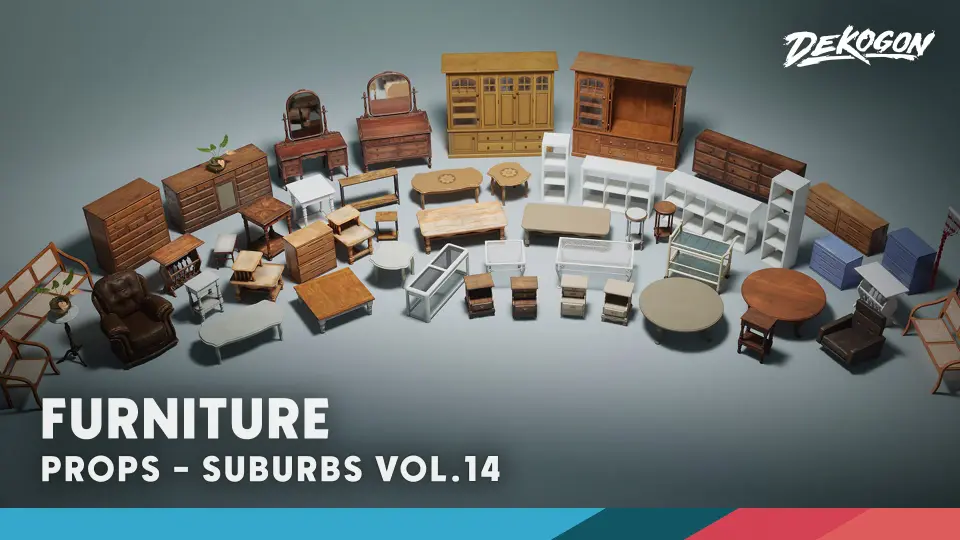
Furniture props in this pack behave across two distinct fidelity tiers. Each mesh ships in a Nanite version engineered for high-polycount visual detail and a low-poly version suited to performance-sensitive game contexts. That dual construction runs through all 110 meshes included, giving scene builders the option to place the same chair, bench, or shelving unit in a cinematic high-detail shot or a populated gameplay space without switching to a different asset library. Both versions share the same visual identity, so swapping between fidelity modes does not break the look of a room.
The props target realistic AAA-quality visuals. Dekogon Studios built every model to hold up under close scrutiny, with full geometric detail on all sides rather than relying on flat backing or unfinished geometry where the camera is unlikely to look. That matters for interior environments where viewers can walk around furniture, open cabinets, or inspect shelves from multiple angles. The tag list points toward the kind of objects filling these rooms: chairs, benches, tables, cabinets, shelving units, cubes, and soldier-related props. The style leans retro, and the horror tag sits alongside interior and wood descriptors, suggesting rooms that read as lived-in, aged, or atmospherically heavy.
Dual Nanite and Low-Poly Mesh Coverage Across 110 Props
The 110-mesh count splits evenly between Nanite and low-poly variants of each prop. That structure means 55 base objects carry two geometry representations. Nanite in Unreal Engine 5 allows these high-fidelity versions to render at dense polycounts without the traditional performance penalty associated with detailed static meshes, making them viable for foreground hero props or scenes where the camera moves close enough to read fine surface geometry. The low-poly counterparts exist for situations where draw-call pressure or memory footprint matters more than per-object micro-detail, such as distant props in a large interior or furniture scattered across a wide level layout.
Because both versions share the same textures and master material setup, teams can standardize a room’s appearance and then tune geometry density per platform or per scene section without touching the look-development side of the pipeline.
Material Architecture: Master Setup, Channel Packing, and Tintable Painted Props
A master material controls the majority of props and models in the set. Rather than each mesh carrying its own isolated shader graph, the pack routes most surfaces through a shared material framework with exposed parameters for roughness, albedo, normals, and additional surface controls. This approach keeps material instances consistent across the collection and reduces the maintenance cost when art direction needs to shift. If lighting in a scene reads too glossy or too matte, an artist can adjust roughness through the instance rather than authoring new textures.
Texture sets run at 4K resolution, and the pack uses channel packing for Roughness, Metalness, and Ambient Occlusion. Packed maps reduce the number of individual texture fetches and keep the material footprint tighter, which is practical when an interior scene stacks dozens of furniture props within view. The channel-packed workflow also means each surface carries the full set of standard PBR response data needed for realistic shading under varied lighting conditions.
Painted assets are tintable through material instances. A painted chair or cabinet surface, for example, can be recolored without producing a new texture file. The tinting operates through the instance interface, so teams can populate a room with the same furniture model in different colors and maintain visual variety from a single mesh-and-texture pair. This flexibility is particularly useful for furniture-heavy interiors where repetition would otherwise be visible.
Post-Processing and Look Development
The pack includes a realistic post-process setup and a Look Up Table (LUT). These tools contribute to the intended visual tone out of the box—the asset collection is designed to look a certain way once placed, lit, and rendered, and the included post-process configuration provides a baseline for that look. Teams building horror or retro interiors can use the provided setup as a starting point and then tune color grading to their scene’s mood. The LUT and post-process combination matters most for projects that want to match the pack’s intended aesthetic quickly rather than reconstructing the look from scratch.
Branding, Labels, and Legal Clarity
Every brand and label visible on the props is custom-made by the studio. The pack is free of legal issues related to third-party branding, which means props can appear in shipped projects without concern over trademarked logos or copyrighted packaging designs. For furniture especially, this extends to printed materials, signage, and any surface detail that could otherwise read as a real-world brand. Studios publishing commercial projects can place these props in visible scenes without a secondary audit pass for trademark exposure.
Engine Compatibility and Lumen Support
The pack supports Lumen and is built for Unreal Engine 5.0 and forward. Editor notes place compatibility in the 5.2–5.8 range, covering the current engine generation. Lumen support means the furniture responds correctly to dynamic global illumination—surfaces bounce light into nearby geometry, colored materials reflect spill onto adjacent floors, and shadowing softens based on proximity. For interior furniture scenes where most geometry sits within enclosed rooms, Lumen integration is central to why the props will read as grounded rather than statically lit.
Since the materials are built with standard PBR channel-packed maps—Roughness, Metalness, Ambient Occlusion—and the master material exposes roughness, albedo, and normal controls, Lumen has the surface data it needs to produce convincing indirect lighting across the furniture. A glossy wooden cabinet surface will catch and reflect light differently than a matte painted bench, and the material parameters allow further tuning without breaking the lighting response.
Scene Types and Practical Fit
The tag set—retro, furniture, shelving, bench, chair, cube, table, cabinet, shelf, horror, interior, soldier—points to specific scene categories. Retro interiors benefit from the prop selection and the tintable painted surfaces, which allow color palettes appropriate to period styling. Horror environments gain from the realistic post-process baseline, the aged-surface material controls, and the objects themselves: shelving, cabinets, and benches read as set dressing for interiors where atmosphere is the dominant visual goal. Soldier-related props expand the collection beyond pure furniture, which can support narrative scenes or themed interiors tied to military or survival subject matter.
The wood tag appears consistently, and the material setup is described as covering wood surfaces among others, which aligns the collection with interiors where furniture is wood-dominant. Tables, cabinets, shelves, and benches in a wood-heavy material palette suit residential, institutional, or abandoned-interior environments equally.
Teams Getting the Most Out of This Pack
Studios and solo developers building Unreal Engine 5.2+ interiors will get immediate value from the dual-version mesh structure. Designers who want Nanite fidelity in close-range shots and low-poly efficiency in broader scenes can source both from one collection. The master material and material-instance tinting reduce per-prop art tasks, and the 4K channel-packed textures provide the surface detail needed for realistic PBR rendering under Lumen. The custom branding removes a category of legal overhead before a project ships. For teams working in retro, horror, or detailed-interior genres, the pack covers a core furniture scope with the geometry, materials, and engine integration to place props into lit, shipped scenes without additional asset preparation.
 Tables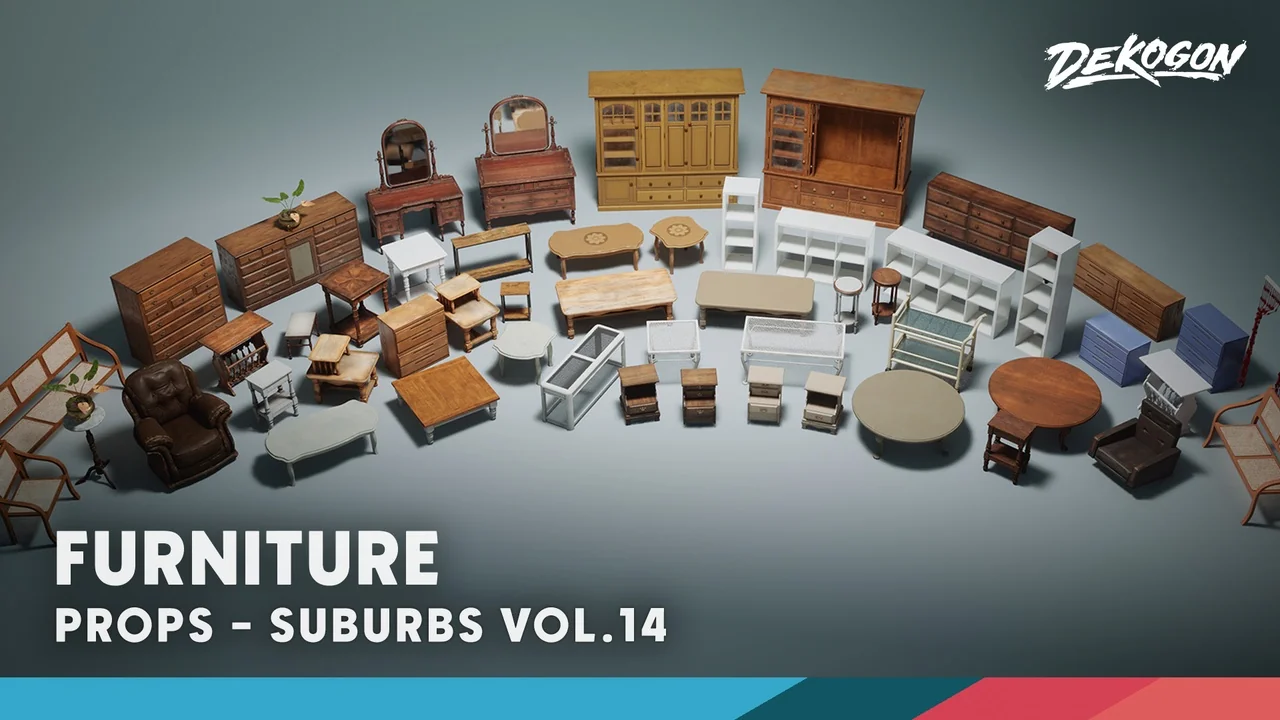
 Tables
 Plants
 Tools
Tools