"7e6fc58c410f2894"{"id":"1000489","slug":"suburbs-vol-19-retro-office-nanite-and-low-poly","title":"Suburbs VOL.19 - Retro Office (Nanite and Low Poly)","category":"Seating","engine":"5.1+","assetVersion":"","engineVersion":"Engine Version: 5.1+","tag":"Seating","accent":"blue","visual":"mech","summary":"Retro office environment asset pack for Unreal Engine with 350 Nanite and low poly meshes, 4K textures, master material controls, and Lumen support.","platform":"Unreal Engine","publishedAt":"2026-07-13T02:42:02.972Z","updatedAt":"2026-07-13T02:42:02.972Z","sourceNotes":[],"fileContents":[],"compatibility":["Unreal Engine","Engine Version: 5.1+"],"featuredImage":{"alt":"Suburbs VOL.19 - Retro Office (Nanite and Low Poly)","src":"/wp-content/uploads/published/2026/07/6894ddc8fa53-d0ea6e33-981c-4569-af3f-dbffd1f2e28e-f495b0f805.webp"},"hasDownloadLink":true,"downloads":0,"terms":[{"taxonomy":"category","slug":"seating","name":"Seating"}],"galleryImages":[{"src":"/wp-content/uploads/published/2026/07/f47fbb7b8780-f43d3886-e424-4d81-b30d-d9a379a60acb-0d83905f18.webp","alt":"Suburbs VOL.19 - Retro Office (Nanite and Low Poly)"},{"src":"/wp-content/uploads/published/2026/07/d7b687d31f59-190b4a96-c0ef-4b0c-83cb-8caee03b71b0-acb68176ba.webp","alt":"Suburbs VOL.19 - Retro Office (Nanite and Low Poly)"},{"src":"/wp-content/uploads/published/2026/07/2af47fea2277-e027d3db-2d54-4e5c-a850-86d2d9e7cfb2-3793b93be4.webp","alt":"Suburbs VOL.19 - Retro Office (Nanite and Low Poly)"},{"src":"/wp-content/uploads/published/2026/07/cffc15e59387-4b66b039-d657-4b63-81ce-96aa0387d12a-fa8a02e2ad.webp","alt":"Suburbs VOL.19 - Retro Office (Nanite and Low Poly)"},{"src":"/wp-content/uploads/published/2026/07/f011ece256e4-fd2755b3-0ffc-4617-a97b-0f26d3cf3d1b-7478f2273c.webp","alt":"Suburbs VOL.19 - Retro Office (Nanite and Low Poly)"},{"src":"/wp-content/uploads/published/2026/07/9fc7f93c0102-20da9af9-19eb-4075-9757-a789274ea4e6-184d59e273.webp","alt":"Suburbs VOL.19 - Retro Office (Nanite and Low Poly)"},{"src":"/wp-content/uploads/published/2026/07/1a9b1f3d83e1-dd8f1a7a-5dd5-48fd-8a28-00b092974ade-382724e8e7.webp","alt":"Suburbs VOL.19 - Retro Office (Nanite and Low Poly)"},{"src":"/wp-content/uploads/published/2026/07/3e8d44a03135-80064fa8-64cc-4681-9f07-3f7875c270e7-eb0c505c81.webp","alt":"Suburbs VOL.19 - Retro Office (Nanite and Low Poly)"},{"src":"/wp-content/uploads/published/2026/07/697d2c5622e8-5e628611-de9b-4ce3-bccb-b994640b5505-d9a37fb54d.webp","alt":"Suburbs VOL.19 - Retro Office (Nanite and Low Poly)"},{"src":"/wp-content/uploads/published/2026/07/5b3b9d661c37-0722f2fb-9677-4855-b0a6-a799cf48cbfe-f479020cc7.webp","alt":"Suburbs VOL.19 - Retro Office (Nanite and Low Poly)"}],"accessPanel":{"kind":"resource","title":"Download this resource","eyebrow":"Free Download","message":"Log in or create a free account to start your download.","fileName":"Content.7z","safetyNote":"Resources are manually reviewed before listing to improve quality and reduce obvious risks.","actionLabel":"Download Free","resourceType":"Resource archive"},"contentHtml":"\u003cp\u003eSuburbs VOL.19 - Retro Office (Nanite and Low Poly) enters a Unreal Engine project with both rendering paths already accounted for. Every mesh in the pack is constructed once for Nanite high-fidelity polygon counts and once as a low poly version, giving developers the choice of pushing dense geometry through UE5's virtualized geometry system or falling back to traditional rendering for platforms where Nanite is disabled. The 350 meshes included are split evenly across these two representations, so nothing in the package is locked to a single pipeline.\u003c/p\u003e \u003ch2\u003eSetting Up the Retro Office in Unreal Engine\u003c/h2\u003e \u003cp\u003eInstallation is straightforward because the entire collection was authored inside Unreal Engine from the start. All assets, maps, and materials originate in the engine rather than being ported from an external DCC format, which reduces the friction of integrating the pack into an existing UE project. The content is grouped by a retro office theme, with the tag list naming folders, furniture, paper, pegs, chairs, trashcans, boards, stationary, and desks among the available props. Work and interior scenes are the central focus, pulling together the everyday objects you would expect to find in a vintage workspace.\u003c/p\u003e \u003cp\u003eEach asset is built for what the creator describes as realistic AAA quality visuals, style, and budget. The “budget” angle is addressed directly by the dual mesh strategy: a Nanite mesh can carry high-quality fidelity without the traditional performance penalty of dense geometry, while the low poly counterpart gives a lighter option when draw-call or memory limits are tighter. Because every mesh ships in both forms, developers can mix and match within the same scene rather than committing the entire level to one approach.\u003c/p\u003e \u003ch2\u003eMaterial Controls and Channel-Packed Masks\u003c/h2\u003e \u003cp\u003eA master material setup governs the majority of the props and models, consolidating shader logic so that individual assets do not each carry an isolated material graph. Within that master material, instance parameters expose controls for roughness, albedo, normals, and other surface properties. This lets artists adjust the look of props directly through material instances rather than baking changes into texture maps.\u003c/p\u003e \u003cp\u003eTexture detail is provided through 4K texture sets, preserving surface information for close-up shots and larger-scale props. The texture workflow uses channel packing to combine Roughness, Metalness, and Ambient Occlusion into a single map, which keeps texture memory lean and simplifies the material sampling logic.\u003c/p\u003e \u003cp\u003ePainted assets in the collection are tintable via the material instance. In practice this means any painted surface can be recolored without opening a texture editor or generating a new mask. A developer can duplicate the material instance, pick a new tint, and apply it across multiple meshes while still keeping the underlying roughness and metalness data intact through the channel-packed texture.\u003c/p\u003e \u003ch3\u003eLook Development Through Post Process and LUT\u003c/h3\u003e \u003cp\u003eThe pack ships with a realistic post-process setup and a Look Up Table, handling part of the visual identity at the rendering level rather than relying solely on textures and geometry. This is useful for retro interior scenes where color grading defines the period atmosphere and mood. Applying the included LUT through Unreal's post-process volume unifies the color response across both Nanite and low poly meshes, so the two representations stay visually consistent within the same frame.\u003c/p\u003e \u003ch2\u003eCompatibility Across Unreal Engine Versions\u003c/h2\u003e \u003cp\u003eCompatibility spans Unreal Engine 5.1 through 5.8, covering projects on recent UE5 releases and those tracking the latest engine updates. The pack also explicitly supports Lumen for Unreal Engine 5.0 and above. Lumen's dynamic global illumination pairs naturally with a Nanite-heavy workflow because dense geometry can interact with bounce lighting at a level of detail that traditional proxy meshes cannot match. For scenes running on the low poly variants, the master material and texture setup remain consistent so the visual style does not break when Nanite is not in use.\u003c/p\u003e \u003cp\u003eBecause everything was created in Unreal Engine rather than imported from a third-party pipeline, the materials, textures, and mesh setups operate within native UE conventions. The master material, channel-packed textures, and instance parameters require no additional plugins or custom shader code to function.\u003c/p\u003e \u003ch2\u003eAsset Coverage and Legal Considerations\u003c/h2\u003e \u003cp\u003eThe 350-mesh count covers the full range of retro office furnishings and accessories. The named tags provide a concrete picture of what is available: desks for workstations, chairs, folders and paper props, pegs, trashcans, boards, and stationary items. Each of these is provided as a fully detailed model from all sides, meaning there are no incomplete backfaces or hidden gaps if a prop is picked up, rotated, or placed away from a wall.\u003c/p\u003e \u003cp\u003eAll branding and labels within the pack are custom-made by the studio. This removes a common legal friction point for environment art: any packaging, paperwork, or signage textures can be used in commercial projects without clearing third-party trademarks or logos. The studio states the pack is free of all legal issues tied to branding and labels.\u003c/p\u003e \u003ch2\u003eProduction-Readiness for Game and Interior Scenes\u003c/h2\u003e \u003cp\u003eThe collection is optimized for games, which in this context means the dual Nanite and low poly options are the primary performance management tool. A developer building a detailed first-person office environment can lean on Nanite meshes for hero props and desk clutter, while background furniture or distant room contents can use the low poly variants to keep frame costs manageable. For isometric or third-person interior scenes, the low poly versions can serve as the base representation, with Nanite swapped in only for close-range interactive props.\u003c/p\u003e \u003cp\u003eReal-time sectors aside, the retro office tag set and tintable material parameters make this pack viable for archviz styling workflows where a period-accurate workspace needs to be blocked out quickly. The tintable painted assets allow color studies on furniture, boards, and stationary without retexturing each variant. The 4K texture resolution retains detail in still renders, while the post-process and LUT unify the final look regardless of which mesh version is used.\u003c/p\u003e \u003cp\u003eFor teams already committed to a UE5 Lumen and Nanite pipeline, the pack is essentially plug-and-play. For those still working with traditional rendering on UE 5.1 or later, the low poly meshes and master material instances provide a workable surface without requiring a Nanite fallback strategy. The combination of dual mesh formats, channel-packed textures, tintable instances, and filtered legal branding covers the main requirements for a production-ready retro office environment.\u003c/p\u003e\n\n\u003ch2\u003eRelated Resources Worth Checking\u003c/h2\u003e\n\u003cul\u003e\n\u003cli\u003e\u003ca href=\"https://3dcghub.com/suburbs-vol-2-couches-and-sofas-nanite-and-low-poly/\" title=\"Suburbs VOL.2 - Couches and Sofas (Nanite and Low Poly)\"\u003eSuburbs VOL.2 - Couches and Sofas (Nanite and Low Poly)\u003c/a\u003e\u003c/li\u003e\n\u003cli\u003e\u003ca href=\"https://3dcghub.com/roadside-vol-3-rural-props-nanite-and-low-poly-versions/\" title=\"Roadside VOL.3 - Rural Props (Nanite and Low Poly Versions)\"\u003eRoadside VOL.3 - Rural Props (Nanite and Low Poly Versions)\u003c/a\u003e\u003c/li\u003e\n\u003cli\u003e\u003ca href=\"https://3dcghub.com/foliage-vol-22-wild-grass-low-poly/\" title=\"Foliage VOL.22 - Wild Grass (Low Poly)\"\u003eFoliage VOL.22 - Wild Grass (Low Poly)\u003c/a\u003e\u003c/li\u003e\n\u003cli\u003e\u003ca href=\"https://3dcghub.com/foliage-vol-24-farming-plants-low-poly/\" title=\"Foliage VOL.24 - Farming Plants (Low Poly)\"\u003eFoliage VOL.24 - Farming Plants (Low Poly)\u003c/a\u003e\u003c/li\u003e\n\u003cli\u003e\u003ca href=\"https://3dcghub.com/seaside-docks-vol-2-boats-nanite-low-poly/\" title=\"Seaside Docks VOL.2 - Boats (Nanite + Low Poly)\"\u003eSeaside Docks VOL.2 - Boats (Nanite + Low Poly)\u003c/a\u003e\u003c/li\u003e\n\u003c/ul\u003e","contentTextLength":7077,"navigation":{"current":1270,"total":3618,"previous":{"id":"1000490","slug":"suburbs-vol-20-vending-and-service-nanite-and-low-poly","title":"Suburbs VOL.20 - Vending and Service (Nanite and Low Poly)","category":"Tools, Objects \u0026 Decor","platform":"Unreal Engine","updatedAt":"2026-07-13T02:53:38.784Z"},"next":{"id":"1000488","slug":"suburbs-vol-16-bedroom-nanite-and-low-poly","title":"Suburbs VOL.16 - Bedroom (Nanite and Low Poly)","category":"Home","platform":"Unreal Engine","updatedAt":"2026-07-13T02:35:19.852Z"}},"relatedResources":[{"id":"1000029","slug":"suburbs-vol-2-couches-and-sofas-nanite-and-low-poly","title":"Suburbs VOL.2 - Couches and Sofas (Nanite and Low Poly)","category":"Seating","engine":"5.1+","assetVersion":"","engineVersion":"5.1+","tag":"Seating","accent":"blue","visual":"mech","summary":"A close look at an Unreal Engine furniture set with 48 couch and sofa meshes, Nanite and low poly variants, 4K textures, Lumen support, and tintable materials.","platform":"Unreal Engine","publishedAt":"2026-05-20T17:18:05.305Z","updatedAt":"2026-05-20T17:18:05.305Z","sourceNotes":[],"fileContents":[],"compatibility":["Unreal Engine","Engine version: 5.1+"],"featuredImage":{"alt":"Suburbs VOL.2 - Couches and Sofas (Nanite and Low Poly)","src":"/wp-content/uploads/published/2026/05/de34d98c9e00-eb65d217-73ce-4f69-8b5d-dde42d2c8dba-a8f14b442b.webp"},"hasDownloadLink":true,"downloads":3},{"id":"1001441","slug":"foliage-vol-23-ivy-low-poly","title":"Foliage VOL.23 - Ivy (Low Poly)","category":"Plants","engine":"5.1+","assetVersion":"","engineVersion":"Engine Version: 5.1+","tag":"Plants","accent":"blue","visual":"mech","summary":"Deploy and optimize Foliage VOL.23 - Ivy (Low Poly) in Unreal Engine with 49 meshes, Lumen support, modular branching, and vertex paint wall textures.","platform":"Unreal Engine","publishedAt":"2026-10-07T08:34:14.081Z","updatedAt":"2026-10-07T08:34:14.081Z","sourceNotes":[],"fileContents":[],"compatibility":["Unreal Engine","Engine Version: 5.1+"],"featuredImage":{"alt":"Foliage VOL.23 - Ivy (Low Poly)","src":"/wp-content/uploads/published/2026/10/ab74fe532ca8-53fce03b-c635-4bb2-ba66-1d26d6d4c521-0b026bd542.webp"},"hasDownloadLink":true,"downloads":2},{"id":"1001494","slug":"suburbs-vol-9-kitchen-appliances-nanite-and-low-poly","title":"Suburbs VOL.9 - Kitchen Appliances (Nanite and Low Poly)","category":"Tools, Objects \u0026 Decor","engine":"5.1+","assetVersion":"","engineVersion":"Engine Version: 5.1+","tag":"Tools","accent":"blue","visual":"mech","summary":"Explore Suburbs VOL.9 - Kitchen Appliances featuring 100 Nanite and low-poly meshes, 4K channel-packed textures, master materials, and Lumen support in UE5.","platform":"Unreal Engine","publishedAt":"2026-10-08T12:59:10.109Z","updatedAt":"2026-10-08T12:59:10.109Z","sourceNotes":[],"fileContents":[],"compatibility":["Unreal Engine","Engine Version: 5.1+"],"featuredImage":{"alt":"Suburbs VOL.9 - Kitchen Appliances (Nanite and Low Poly)","src":"/wp-content/uploads/published/2026/10/3979285da268-cfab6cc0-906e-4d64-b5c0-261f887167a6-7b5e04d362.webp"},"hasDownloadLink":true,"downloads":1}]}
Seating
Suburbs VOL.19 - Retro Office (Nanite and Low Poly)
Retro office environment asset pack for Unreal Engine with 350 Nanite and low poly meshes, 4K textures, master material controls, and Lumen support.
Suburbs VOL.19 - Retro Office (Nanite and Low Poly) enters a Unreal Engine project with both rendering paths already accounted for. Every mesh in the pack is constructed once for Nanite high-fidelity polygon counts and once as a low poly version, giving developers the choice of pushing dense geometry through UE5's virtualized geometry system or falling back to traditional rendering for platforms where Nanite is disabled. The 350 meshes included are split evenly across these two representations, so nothing in the package is locked to a single pipeline.
Setting Up the Retro Office in Unreal Engine
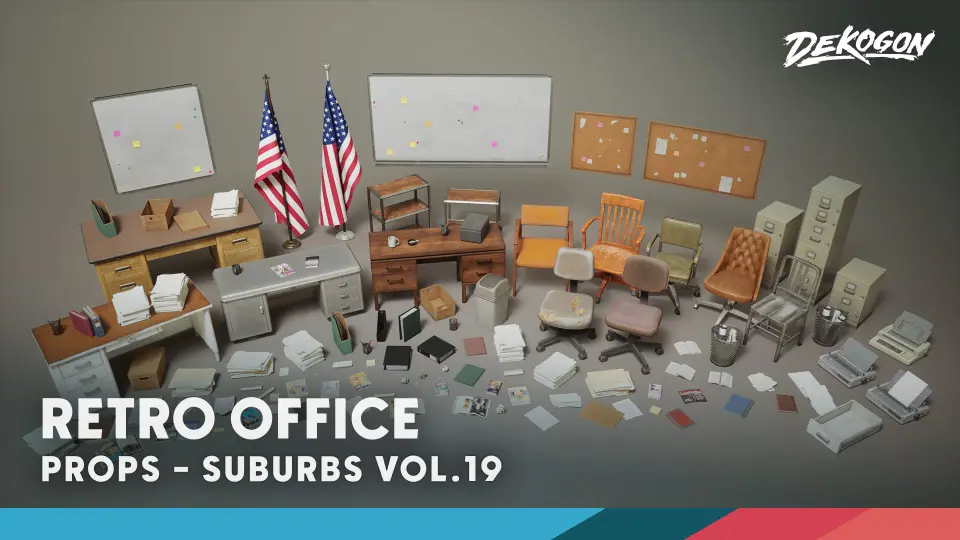
Installation is straightforward because the entire collection was authored inside Unreal Engine from the start. All assets, maps, and materials originate in the engine rather than being ported from an external DCC format, which reduces the friction of integrating the pack into an existing UE project. The content is grouped by a retro office theme, with the tag list naming folders, furniture, paper, pegs, chairs, trashcans, boards, stationary, and desks among the available props. Work and interior scenes are the central focus, pulling together the everyday objects you would expect to find in a vintage workspace.
Each asset is built for what the creator describes as realistic AAA quality visuals, style, and budget. The “budget” angle is addressed directly by the dual mesh strategy: a Nanite mesh can carry high-quality fidelity without the traditional performance penalty of dense geometry, while the low poly counterpart gives a lighter option when draw-call or memory limits are tighter. Because every mesh ships in both forms, developers can mix and match within the same scene rather than committing the entire level to one approach.
Material Controls and Channel-Packed Masks
A master material setup governs the majority of the props and models, consolidating shader logic so that individual assets do not each carry an isolated material graph. Within that master material, instance parameters expose controls for roughness, albedo, normals, and other surface properties. This lets artists adjust the look of props directly through material instances rather than baking changes into texture maps.
Texture detail is provided through 4K texture sets, preserving surface information for close-up shots and larger-scale props. The texture workflow uses channel packing to combine Roughness, Metalness, and Ambient Occlusion into a single map, which keeps texture memory lean and simplifies the material sampling logic.
Painted assets in the collection are tintable via the material instance. In practice this means any painted surface can be recolored without opening a texture editor or generating a new mask. A developer can duplicate the material instance, pick a new tint, and apply it across multiple meshes while still keeping the underlying roughness and metalness data intact through the channel-packed texture.
Look Development Through Post Process and LUT
The pack ships with a realistic post-process setup and a Look Up Table, handling part of the visual identity at the rendering level rather than relying solely on textures and geometry. This is useful for retro interior scenes where color grading defines the period atmosphere and mood. Applying the included LUT through Unreal's post-process volume unifies the color response across both Nanite and low poly meshes, so the two representations stay visually consistent within the same frame.
Compatibility Across Unreal Engine Versions
Compatibility spans Unreal Engine 5.1 through 5.8, covering projects on recent UE5 releases and those tracking the latest engine updates. The pack also explicitly supports Lumen for Unreal Engine 5.0 and above. Lumen's dynamic global illumination pairs naturally with a Nanite-heavy workflow because dense geometry can interact with bounce lighting at a level of detail that traditional proxy meshes cannot match. For scenes running on the low poly variants, the master material and texture setup remain consistent so the visual style does not break when Nanite is not in use.
Because everything was created in Unreal Engine rather than imported from a third-party pipeline, the materials, textures, and mesh setups operate within native UE conventions. The master material, channel-packed textures, and instance parameters require no additional plugins or custom shader code to function.
Asset Coverage and Legal Considerations
The 350-mesh count covers the full range of retro office furnishings and accessories. The named tags provide a concrete picture of what is available: desks for workstations, chairs, folders and paper props, pegs, trashcans, boards, and stationary items. Each of these is provided as a fully detailed model from all sides, meaning there are no incomplete backfaces or hidden gaps if a prop is picked up, rotated, or placed away from a wall.
All branding and labels within the pack are custom-made by the studio. This removes a common legal friction point for environment art: any packaging, paperwork, or signage textures can be used in commercial projects without clearing third-party trademarks or logos. The studio states the pack is free of all legal issues tied to branding and labels.
Production-Readiness for Game and Interior Scenes
The collection is optimized for games, which in this context means the dual Nanite and low poly options are the primary performance management tool. A developer building a detailed first-person office environment can lean on Nanite meshes for hero props and desk clutter, while background furniture or distant room contents can use the low poly variants to keep frame costs manageable. For isometric or third-person interior scenes, the low poly versions can serve as the base representation, with Nanite swapped in only for close-range interactive props.
Real-time sectors aside, the retro office tag set and tintable material parameters make this pack viable for archviz styling workflows where a period-accurate workspace needs to be blocked out quickly. The tintable painted assets allow color studies on furniture, boards, and stationary without retexturing each variant. The 4K texture resolution retains detail in still renders, while the post-process and LUT unify the final look regardless of which mesh version is used.
For teams already committed to a UE5 Lumen and Nanite pipeline, the pack is essentially plug-and-play. For those still working with traditional rendering on UE 5.1 or later, the low poly meshes and master material instances provide a workable surface without requiring a Nanite fallback strategy. The combination of dual mesh formats, channel-packed textures, tintable instances, and filtered legal branding covers the main requirements for a production-ready retro office environment.
 Seating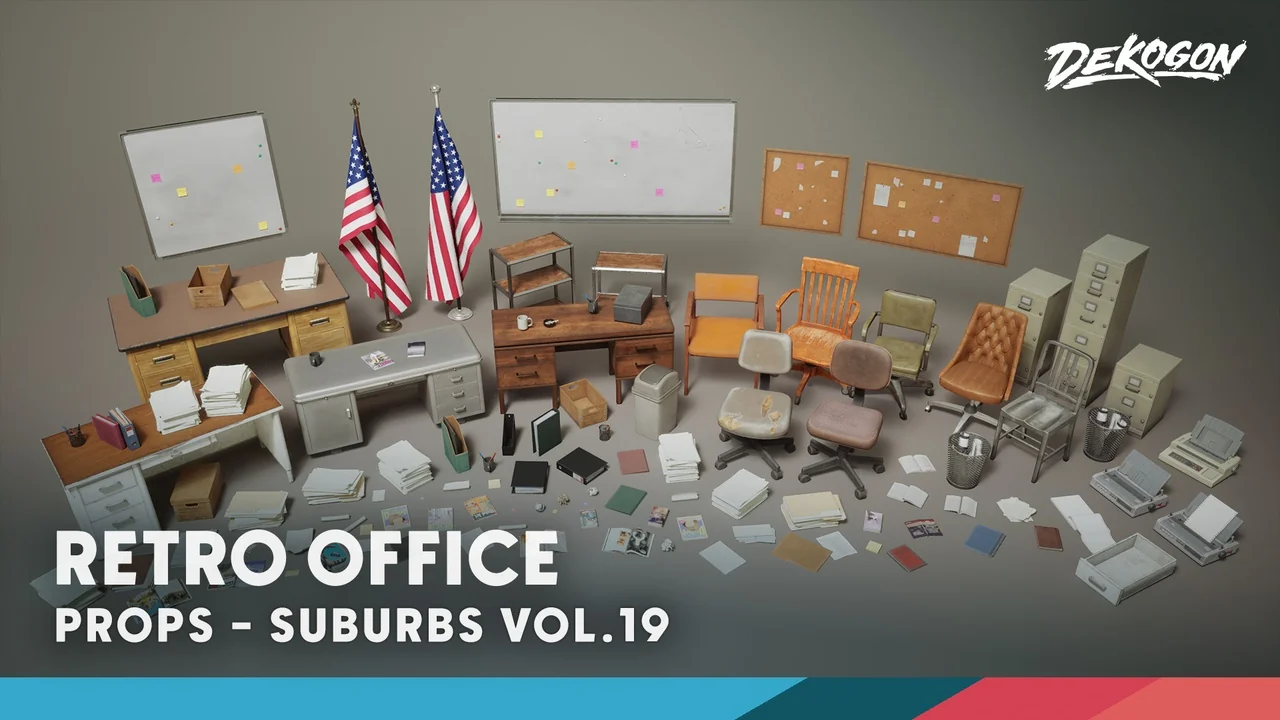
 Seating
 Plants
 Tools
Tools