"7977b3847c3127c7"{"id":"1000030","slug":"suburbs-vol-3-retro-furniture-nanite-and-low-poly","title":"Suburbs VOL.3 - Retro Furniture (Nanite and Low Poly)","category":"Tables","engine":"5.1+","assetVersion":"","engineVersion":"5.1+","tag":"Tables","accent":"blue","visual":"mech","summary":"A retro furniture collection for Unreal Engine with 97 meshes, 4K textures, Nanite and low poly versions, Lumen support, and flexible material controls.","platform":"Unreal Engine","publishedAt":"2026-05-21T08:29:38.749Z","updatedAt":"2026-05-21T08:29:38.749Z","sourceNotes":[],"fileContents":[],"compatibility":["Unreal Engine","Engine version: 5.1+"],"featuredImage":{"alt":"Suburbs VOL.3 - Retro Furniture (Nanite and Low Poly)","src":"/wp-content/uploads/published/2026/05/b4d0d8ed8c82-246527c0-50fc-443c-aed3-f574fb46554e-f1b321d350.webp"},"hasDownloadLink":true,"downloads":1,"terms":[{"taxonomy":"category","slug":"tables","name":"Tables"}],"galleryImages":[{"src":"/wp-content/uploads/published/2026/05/e7ddcc0d6ebd-a96a45fb-f21d-494e-99d1-3342533854fc-004e5f5880.webp","alt":"Suburbs VOL.3 - Retro Furniture (Nanite and Low Poly)"},{"src":"/wp-content/uploads/published/2026/05/bf44d3ef7550-cc734653-9afb-495e-a1a0-738755d70986-2b2f991ce6.webp","alt":"Suburbs VOL.3 - Retro Furniture (Nanite and Low Poly)"},{"src":"/wp-content/uploads/published/2026/05/3779454f2aae-dddcc558-7fd6-4ace-9ddc-11fd42212430-e7048f3a15.webp","alt":"Suburbs VOL.3 - Retro Furniture (Nanite and Low Poly)"},{"src":"/wp-content/uploads/published/2026/05/493c45da3e0f-7f5e8152-5ba9-43a1-bb96-5be08d0c7697-a387b385f0.webp","alt":"Suburbs VOL.3 - Retro Furniture (Nanite and Low Poly)"},{"src":"/wp-content/uploads/published/2026/05/45cb9c078d3b-99014bbb-a3d5-4fb0-9367-0f4928e5bd9a-bb3b670f7f.webp","alt":"Suburbs VOL.3 - Retro Furniture (Nanite and Low Poly)"},{"src":"/wp-content/uploads/published/2026/05/0f883882a3d9-72d45351-7dad-4600-8b18-a134473ecd8c-9d6601f363.webp","alt":"Suburbs VOL.3 - Retro Furniture (Nanite and Low Poly)"},{"src":"/wp-content/uploads/published/2026/05/b1b9dd1f31ec-7c1d2e16-d64d-4922-af79-cd2734ebe0c4-068afddc64.webp","alt":"Suburbs VOL.3 - Retro Furniture (Nanite and Low Poly)"},{"src":"/wp-content/uploads/published/2026/05/a0de946b9a73-423f400a-c171-4698-907b-35cb880553c2-681a0af55a.webp","alt":"Suburbs VOL.3 - Retro Furniture (Nanite and Low Poly)"},{"src":"/wp-content/uploads/published/2026/05/cc7f724b745c-ccb54ec6-2a9f-4dbf-ae40-98a7e37fa0c7-49c58c37e6.webp","alt":"Suburbs VOL.3 - Retro Furniture (Nanite and Low Poly)"},{"src":"/wp-content/uploads/published/2026/05/85798239f5d2-3615aeda-d870-42ab-911b-af4abcf4e5d1-12979f29a6.webp","alt":"Suburbs VOL.3 - Retro Furniture (Nanite and Low Poly)"}],"accessPanel":{"kind":"resource","title":"Access this resource","eyebrow":"Free Download","message":"Log in or create a free account to start your download.","fileName":"Content.7z","safetyNote":"Resources are manually reviewed before listing to improve quality and reduce obvious risks.","actionLabel":"Download Free","resourceType":"Resource archive"},"contentHtml":"\u003cp\u003eRooms shaped by retro furniture tend to do a lot of storytelling before a character ever enters the frame. Dining areas, lived-in interiors, partitioned spaces, and furniture-heavy rooms all gain their character from silhouette, finish, and the relationship between larger pieces and smaller accent props. \u003cstrong\u003eSuburbs VOL.3 - Retro Furniture (Nanite and Low Poly)\u003c/strong\u003e Is focused on that kind of scene-building, with a collection that supports retro-inspired interiors tied to the visual language of the 1970s and 1980s.\u003c/p\u003e\n\u003cp\u003eThe project includes everything pictured, with all assets, maps, and materials created in Unreal Engine. The stated goal for the assets is realistic AAA quality across visuals, style, and budget, which places the pack in a space where presentation matters just as much as practicality. It is not only a group of furniture objects placed side by side, but a set intended to help build coherent rooms with a consistent visual standard.\u003c/p\u003e \u003ch2\u003eRetro furniture for 1970s and 1980s interiors\u003c/h2\u003e\n\u003cp\u003eThe strongest identity here comes from the theme itself. The tags point directly toward retro design, furniture, dining, interior, and room work, with pieces associated with chairs, tables, partitions, cabinets, armchairs, dressers, and clocks. That mix gives the collection a broad enough footprint to support rooms that feel assembled rather than sparse. A scene can lean more domestic, more decorative, or more layout-driven depending on how those categories are combined.\u003c/p\u003e\n\u003cp\u003eThat matters when building spaces where furniture has to carry the period tone. A chair or armchair can establish seating zones, a table can anchor dining or shared areas, partitions can break up open interiors, and cabinets or dressers can push a room toward a lived-in residential feel. Clocks and similar details can help complete the read from all angles, which aligns with the note that the models are fully detailed on every side. For artists staging interiors, that full-sided treatment is especially useful in camera moves or playable spaces where furniture may be approached, circled, or seen from unexpected vantage points.\u003c/p\u003e\n\u003cp\u003eThe retro angle is not handled as a single object type repeated many times. It spans room-defining furniture and supporting pieces, which makes the collection more adaptable for layered interior work. Instead of treating furniture as background filler, this pack supports rooms where the furnishings themselves are central to the environment identity.\u003c/p\u003e \u003ch2\u003e97 meshes with Nanite and low poly versions\u003c/h2\u003e\n\u003cp\u003eThe pack contains \u003cstrong\u003e97 meshes\u003c/strong\u003e, split between Nanite and low poly versions of each mesh. That dual approach is one of the most practical parts of the set because it gives artists and developers more than one route for using the same furniture family. The Nanite construction is there for high-fidelity polycounts, while low poly versions are also included.\u003c/p\u003e\n\u003cp\u003eIn production terms, that opens up different ways to stage the same environment. A hero interior can lean on the higher-fidelity side where furniture is meant to be closely observed. The low poly counterparts make it easier to think about broader gameplay use, alternate scene density, or different optimization needs while still staying inside the same visual set. The pack is explicitly optimized for games, so this is not a case where high-detail furniture is isolated from performance-minded use. Both sides of the workflow are part of the same package.\u003c/p\u003e\n\u003cp\u003eThere is also a consistency benefit. When a collection includes both Nanite and low poly versions of each mesh, scene planning becomes less about replacing entire styles and more about choosing the right representation for a given task. That helps preserve a unified look across rooms even when production needs vary from one environment to another.\u003c/p\u003e \u003ch2\u003eMaterial control across props, painted surfaces, and texture response\u003c/h2\u003e\n\u003cp\u003eTexture and material support play a major role in how reusable retro furniture becomes, and this collection puts notable emphasis on that side. The texture sets are described as high quality and high fidelity, with \u003cstrong\u003e4K textures\u003c/strong\u003e. A master material setup controls the majority of the props and models, which is a meaningful advantage in interior work where many objects need to sit together without drifting apart in finish or response.\u003c/p\u003e\n\u003cp\u003eThere are also additional controls for roughness, albedo, normals, and more. Those controls matter because retro furniture often relies on surface character as much as overall form. Slight shifts in roughness can change how a piece reads under interior lighting. Albedo control can help align objects within a room palette. Normal response contributes to how material detail holds up when furniture is viewed up close or hit with directional light.\u003c/p\u003e\n\u003cp\u003eThe pack also uses channel-packed \u003cstrong\u003eRoughness | Metalness | Ambient Occlusion\u003c/strong\u003e, which points to a workflow that keeps the material side organized for production use. The collection is not limited to static, locked-down finishes either. Painted assets are tintable through the material instance, giving artists room to adjust color direction while staying within the existing material framework. For interior scenes, that kind of tint control is especially useful when a room needs to shift warmer, cooler, more muted, or more saturated without abandoning the established furniture shapes.\u003c/p\u003e\n\u003cp\u003eBecause the master material controls the majority of the set, those adjustments can support consistency rather than one-off edits. That makes the collection more flexible for teams or solo artists who want to iterate on room mood through surface treatment and color variation.\u003c/p\u003e \u003ch2\u003eLumen, post process, and the Unreal Engine look\u003c/h2\u003e\n\u003cp\u003eThe Unreal Engine focus is present throughout the pack. All assets, maps, and materials were created in the engine, and the product supports \u003cstrong\u003eLumen for Unreal Engine 5.0+\u003c/strong\u003e. Combined with the included realistic post process and Look Up Table, that support gives the set a clear rendering context. The furniture is not only modeled for use in Unreal; it is accompanied by tools that shape how the final scene reads onscreen.\u003c/p\u003e\n\u003cp\u003eFor artists building interiors, this combination can make a visible difference. Furniture-heavy spaces depend on lighting response, surface contrast, and the balance between direct illumination and ambient mood. Lumen support helps place the collection within a modern Unreal lighting workflow, while the post process and LUT help define the intended visual finish. In a retro room, that can affect whether the environment feels flat, clinical, soft, moody, or richly styled.\u003c/p\u003e\n\u003cp\u003eSince the assets aim for realistic AAA quality visuals, the rendering side is not incidental. It is part of the way the collection presents itself. That leaves a pack that can support polished interior presentation, whether the goal is a detailed room showcase or a playable environment where visual cohesion still matters.\u003c/p\u003e \u003ch2\u003eCustom branding, full-sided detail, and fit for room-based scene work\u003c/h2\u003e\n\u003cp\u003eTwo smaller details strengthen the pack’s usefulness in practical production. First, all branding and labels are custom made by the studio, and the collection is noted as free of legal issues on that basis. For environment work that includes readable labels or branded-looking surfaces, this removes a common point of concern and keeps the furniture easier to place into finished scenes.\u003c/p\u003e\n\u003cp\u003eSecond, the models are fully detailed from all sides. That is especially relevant for room layouts with open circulation, partitions, central furniture placement, or cameras that are not locked to one hero angle. Furniture can sit in the middle of a room, divide space, or be approached from multiple directions without relying on a hidden back side. In interiors, that kind of coverage makes placement much less restrictive.\u003c/p\u003e\n\u003cp\u003eAs a project fit, this collection makes the most sense when a retro room needs more than a few decorative pieces. It is strongest for artists and developers who want to assemble interiors with a recognizable 1970s or 1980s character, while still working inside an Unreal-focused pipeline that includes Nanite, low poly alternatives, shared materials, tintable painted assets, 4K textures, and Lumen support. For scenes where furniture is expected to carry atmosphere as well as function, that combination is the central reason to use it.\u003c/p\u003e\n\n\u003ch2\u003eRelated Resources Worth Checking\u003c/h2\u003e\n\u003cul\u003e\n\u003cli\u003e\u003ca href=\"https://3dcghub.com/suburbs-vol-2-couches-and-sofas-nanite-and-low-poly/\" title=\"Suburbs VOL.2 - Couches and Sofas (Nanite and Low Poly)\"\u003eSuburbs VOL.2 - Couches and Sofas (Nanite and Low Poly)\u003c/a\u003e\u003c/li\u003e\n\u003cli\u003e\u003ca href=\"https://3dcghub.com/foliage-vol-13-southern-oak-trees-nanite-and-low-poly/\" title=\"Foliage VOL.13 - Southern Oak Trees (Nanite and Low Poly)\"\u003eFoliage VOL.13 - Southern Oak Trees (Nanite and Low Poly)\u003c/a\u003e\u003c/li\u003e\n\u003cli\u003e\u003ca href=\"https://3dcghub.com/foliage-vol-6-broom-bushes-nanite-and-low-poly/\" title=\"Foliage VOL.6 - Broom Bushes (Nanite and Low Poly)\"\u003eFoliage VOL.6 - Broom Bushes (Nanite and Low Poly)\u003c/a\u003e\u003c/li\u003e\n\u003cli\u003e\u003ca href=\"https://3dcghub.com/signage-vol-2-town-and-city-nanite-and-low-poly/\" title=\"Signage VOL.2 - Town and City (Nanite and Low Poly)\"\u003eSignage VOL.2 - Town and City (Nanite and Low Poly)\u003c/a\u003e\u003c/li\u003e\n\u003cli\u003e\u003ca href=\"https://3dcghub.com/signage-vol-1-town-and-city-nanite-and-low-poly/\" title=\"Signage VOL.1 - Town and City (Nanite and Low Poly)\"\u003eSignage VOL.1 - Town and City (Nanite and Low Poly)\u003c/a\u003e\u003c/li\u003e\n\u003c/ul\u003e","contentTextLength":8572,"navigation":{"current":1623,"total":3510,"previous":{"id":"1000031","slug":"ultimate-fishing-megapack","title":"Ultimate Fishing Megapack","category":"Vehicles \u0026 Transportation","platform":"Unreal Engine","updatedAt":"2026-05-21T08:50:01.340Z"},"next":{"id":"1000029","slug":"suburbs-vol-2-couches-and-sofas-nanite-and-low-poly","title":"Suburbs VOL.2 - Couches and Sofas (Nanite and Low Poly)","category":"Seating","platform":"Unreal Engine","updatedAt":"2026-05-20T17:18:05.305Z"}},"relatedResources":[{"id":"1000486","slug":"suburbs-vol-14-furniture-nanite-and-low-poly","title":"Suburbs VOL.14 - Furniture (Nanite and Low Poly)","category":"Tables","engine":"5.2+","assetVersion":"","engineVersion":"Engine Version: 5.2+","tag":"Tables","accent":"blue","visual":"mech","summary":"110 furniture meshes from Dekogon Studios with Nanite and low-poly versions, 4K textures, channel-packed maps, tintable materials, and Lumen support for Unreal","platform":"Unreal Engine","publishedAt":"2026-07-12T08:04:35.766Z","updatedAt":"2026-07-12T08:04:35.766Z","sourceNotes":[],"fileContents":[],"compatibility":["Unreal Engine","Engine Version: 5.2+"],"featuredImage":{"alt":"Suburbs VOL.14 - Furniture (Nanite and Low Poly)","src":"/wp-content/uploads/published/2026/07/f4a77c59f560-cc857324-37df-4873-b39d-7c7dfbd504ff-33a78a6529.webp"},"hasDownloadLink":true,"downloads":1},{"id":"1001441","slug":"foliage-vol-23-ivy-low-poly","title":"Foliage VOL.23 - Ivy (Low Poly)","category":"Plants","engine":"5.1+","assetVersion":"","engineVersion":"Engine Version: 5.1+","tag":"Plants","accent":"blue","visual":"mech","summary":"Deploy and optimize Foliage VOL.23 - Ivy (Low Poly) in Unreal Engine with 49 meshes, Lumen support, modular branching, and vertex paint wall textures.","platform":"Unreal Engine","publishedAt":"2026-10-07T08:34:14.081Z","updatedAt":"2026-10-07T08:34:14.081Z","sourceNotes":[],"fileContents":[],"compatibility":["Unreal Engine","Engine Version: 5.1+"],"featuredImage":{"alt":"Foliage VOL.23 - Ivy (Low Poly)","src":"/wp-content/uploads/published/2026/10/ab74fe532ca8-53fce03b-c635-4bb2-ba66-1d26d6d4c521-0b026bd542.webp"},"hasDownloadLink":true,"downloads":2},{"id":"1001494","slug":"suburbs-vol-9-kitchen-appliances-nanite-and-low-poly","title":"Suburbs VOL.9 - Kitchen Appliances (Nanite and Low Poly)","category":"Tools, Objects \u0026 Decor","engine":"5.1+","assetVersion":"","engineVersion":"Engine Version: 5.1+","tag":"Tools","accent":"blue","visual":"mech","summary":"Explore Suburbs VOL.9 - Kitchen Appliances featuring 100 Nanite and low-poly meshes, 4K channel-packed textures, master materials, and Lumen support in UE5.","platform":"Unreal Engine","publishedAt":"2026-10-08T12:59:10.109Z","updatedAt":"2026-10-08T12:59:10.109Z","sourceNotes":[],"fileContents":[],"compatibility":["Unreal Engine","Engine Version: 5.1+"],"featuredImage":{"alt":"Suburbs VOL.9 - Kitchen Appliances (Nanite and Low Poly)","src":"/wp-content/uploads/published/2026/10/3979285da268-cfab6cc0-906e-4d64-b5c0-261f887167a6-7b5e04d362.webp"},"hasDownloadLink":true,"downloads":1}]}
Tables
Suburbs VOL.3 - Retro Furniture (Nanite and Low Poly)
A retro furniture collection for Unreal Engine with 97 meshes, 4K textures, Nanite and low poly versions, Lumen support, and flexible material controls.
Category:Unreal Engine,TablesPlatform: Unreal EngineEngine version: 5.1+Published: May 21, 2026
Tables
Resource overview
Rooms shaped by retro furniture tend to do a lot of storytelling before a character ever enters the frame. Dining areas, lived-in interiors, partitioned spaces, and furniture-heavy rooms all gain their character from silhouette, finish, and the relationship between larger pieces and smaller accent props. Suburbs VOL.3 - Retro Furniture (Nanite and Low Poly) Is focused on that kind of scene-building, with a collection that supports retro-inspired interiors tied to the visual language of the 1970s and 1980s.
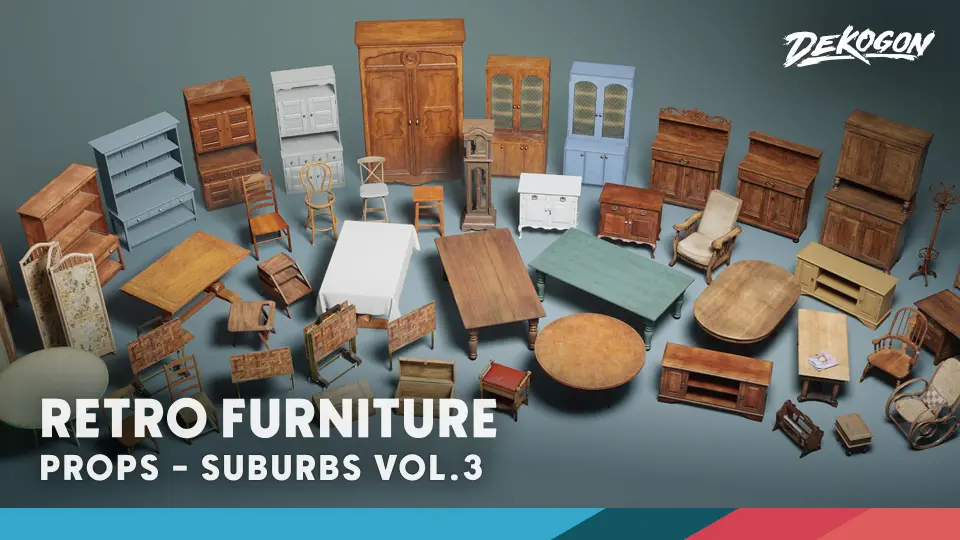
The project includes everything pictured, with all assets, maps, and materials created in Unreal Engine. The stated goal for the assets is realistic AAA quality across visuals, style, and budget, which places the pack in a space where presentation matters just as much as practicality. It is not only a group of furniture objects placed side by side, but a set intended to help build coherent rooms with a consistent visual standard.
Retro furniture for 1970s and 1980s interiors
The strongest identity here comes from the theme itself. The tags point directly toward retro design, furniture, dining, interior, and room work, with pieces associated with chairs, tables, partitions, cabinets, armchairs, dressers, and clocks. That mix gives the collection a broad enough footprint to support rooms that feel assembled rather than sparse. A scene can lean more domestic, more decorative, or more layout-driven depending on how those categories are combined.
That matters when building spaces where furniture has to carry the period tone. A chair or armchair can establish seating zones, a table can anchor dining or shared areas, partitions can break up open interiors, and cabinets or dressers can push a room toward a lived-in residential feel. Clocks and similar details can help complete the read from all angles, which aligns with the note that the models are fully detailed on every side. For artists staging interiors, that full-sided treatment is especially useful in camera moves or playable spaces where furniture may be approached, circled, or seen from unexpected vantage points.
The retro angle is not handled as a single object type repeated many times. It spans room-defining furniture and supporting pieces, which makes the collection more adaptable for layered interior work. Instead of treating furniture as background filler, this pack supports rooms where the furnishings themselves are central to the environment identity.
97 meshes with Nanite and low poly versions
The pack contains 97 meshes, split between Nanite and low poly versions of each mesh. That dual approach is one of the most practical parts of the set because it gives artists and developers more than one route for using the same furniture family. The Nanite construction is there for high-fidelity polycounts, while low poly versions are also included.
In production terms, that opens up different ways to stage the same environment. A hero interior can lean on the higher-fidelity side where furniture is meant to be closely observed. The low poly counterparts make it easier to think about broader gameplay use, alternate scene density, or different optimization needs while still staying inside the same visual set. The pack is explicitly optimized for games, so this is not a case where high-detail furniture is isolated from performance-minded use. Both sides of the workflow are part of the same package.
There is also a consistency benefit. When a collection includes both Nanite and low poly versions of each mesh, scene planning becomes less about replacing entire styles and more about choosing the right representation for a given task. That helps preserve a unified look across rooms even when production needs vary from one environment to another.
Material control across props, painted surfaces, and texture response
Texture and material support play a major role in how reusable retro furniture becomes, and this collection puts notable emphasis on that side. The texture sets are described as high quality and high fidelity, with 4K textures. A master material setup controls the majority of the props and models, which is a meaningful advantage in interior work where many objects need to sit together without drifting apart in finish or response.
There are also additional controls for roughness, albedo, normals, and more. Those controls matter because retro furniture often relies on surface character as much as overall form. Slight shifts in roughness can change how a piece reads under interior lighting. Albedo control can help align objects within a room palette. Normal response contributes to how material detail holds up when furniture is viewed up close or hit with directional light.
The pack also uses channel-packed Roughness | Metalness | Ambient Occlusion, which points to a workflow that keeps the material side organized for production use. The collection is not limited to static, locked-down finishes either. Painted assets are tintable through the material instance, giving artists room to adjust color direction while staying within the existing material framework. For interior scenes, that kind of tint control is especially useful when a room needs to shift warmer, cooler, more muted, or more saturated without abandoning the established furniture shapes.
Because the master material controls the majority of the set, those adjustments can support consistency rather than one-off edits. That makes the collection more flexible for teams or solo artists who want to iterate on room mood through surface treatment and color variation.
Lumen, post process, and the Unreal Engine look
The Unreal Engine focus is present throughout the pack. All assets, maps, and materials were created in the engine, and the product supports Lumen for Unreal Engine 5.0+. Combined with the included realistic post process and Look Up Table, that support gives the set a clear rendering context. The furniture is not only modeled for use in Unreal; it is accompanied by tools that shape how the final scene reads onscreen.
For artists building interiors, this combination can make a visible difference. Furniture-heavy spaces depend on lighting response, surface contrast, and the balance between direct illumination and ambient mood. Lumen support helps place the collection within a modern Unreal lighting workflow, while the post process and LUT help define the intended visual finish. In a retro room, that can affect whether the environment feels flat, clinical, soft, moody, or richly styled.
Since the assets aim for realistic AAA quality visuals, the rendering side is not incidental. It is part of the way the collection presents itself. That leaves a pack that can support polished interior presentation, whether the goal is a detailed room showcase or a playable environment where visual cohesion still matters.
Custom branding, full-sided detail, and fit for room-based scene work
Two smaller details strengthen the pack’s usefulness in practical production. First, all branding and labels are custom made by the studio, and the collection is noted as free of legal issues on that basis. For environment work that includes readable labels or branded-looking surfaces, this removes a common point of concern and keeps the furniture easier to place into finished scenes.
Second, the models are fully detailed from all sides. That is especially relevant for room layouts with open circulation, partitions, central furniture placement, or cameras that are not locked to one hero angle. Furniture can sit in the middle of a room, divide space, or be approached from multiple directions without relying on a hidden back side. In interiors, that kind of coverage makes placement much less restrictive.
As a project fit, this collection makes the most sense when a retro room needs more than a few decorative pieces. It is strongest for artists and developers who want to assemble interiors with a recognizable 1970s or 1980s character, while still working inside an Unreal-focused pipeline that includes Nanite, low poly alternatives, shared materials, tintable painted assets, 4K textures, and Lumen support. For scenes where furniture is expected to carry atmosphere as well as function, that combination is the central reason to use it.
 Tables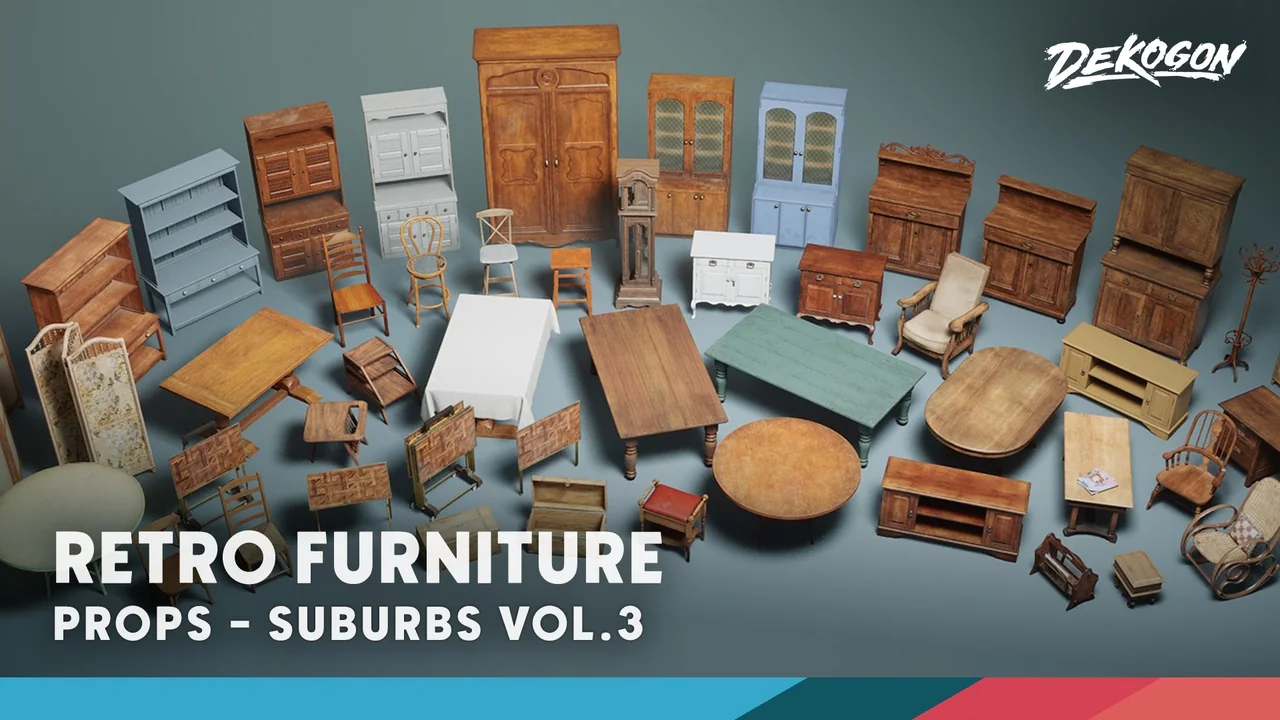
 Tables
 Plants
 Tools
Tools