"f0d304d7232d0332"{"id":"1002729","slug":"stone-pine-forest","title":"Stone Pine Forest","category":"Forest \u0026 Jungle","engine":"5.0+","assetVersion":"","engineVersion":"Engine Version: 5.0+","tag":"Forest \u0026 Jungle","accent":"blue","visual":"mech","summary":"Stone Pine Forest delivers 4 maps, procedural foliage systems with 11 tree variations, automatic slope materials, and customizable signage.","platform":"Unreal Engine","indexPolicy":"index","publishedAt":"2026-11-17T19:05:52.158Z","updatedAt":"2026-11-17T19:05:52.158Z","sourceNotes":[],"fileContents":[],"compatibility":["Unreal Engine","Engine Version: 5.0+"],"featuredImage":{"alt":"Stone Pine Forest","src":"/wp-content/uploads/published/2026/11/8bb12428cf04-027ebc3b-73f7-4c1b-946c-018d80ad3958-f302a6c1b7.webp"},"fileSizeBytes":3049406227,"hasDownloadLink":true,"downloads":0,"terms":[{"taxonomy":"category","slug":"forest-and-jungle","name":"Forest \u0026 Jungle"}],"galleryImages":[{"src":"/wp-content/uploads/published/2026/11/610a66b650a8-7cd807c8-8189-4934-ac85-17656ea5dfec-fa2d1fffdf.webp","alt":"Stone Pine Forest"},{"src":"/wp-content/uploads/published/2026/11/936fc893f051-075eab53-2129-4f4f-8293-57151c0c5443-ca781f3db1.webp","alt":"Stone Pine Forest"},{"src":"/wp-content/uploads/published/2026/11/eef385ad80b2-3f261b8b-f2a4-452f-bb20-1046da28535d-20efec2502.webp","alt":"Stone Pine Forest"},{"src":"/wp-content/uploads/published/2026/11/c60056b57efd-f20de06a-bcb5-48e8-902a-4df02e06dd73-9a2e185aeb.webp","alt":"Stone Pine Forest"},{"src":"/wp-content/uploads/published/2026/11/eecc383035d7-3bdd41c3-af02-4118-b8a9-fb7edd69d589-d3b1f6252e.webp","alt":"Stone Pine Forest"},{"src":"/wp-content/uploads/published/2026/11/d78e27b53bcb-32a8a269-2094-4662-baf0-c4da49e05973-c697824ca3.webp","alt":"Stone Pine Forest"},{"src":"/wp-content/uploads/published/2026/11/ebc93aede410-ebd6bf0d-54ee-4a3d-9bf8-5db614ca77da-0fa1bab16d.webp","alt":"Stone Pine Forest"},{"src":"/wp-content/uploads/published/2026/11/a936e62e2cdb-96ac3c80-ec84-49c5-8b9d-aedd50950ddb-d3ca306ca8.webp","alt":"Stone Pine Forest"},{"src":"/wp-content/uploads/published/2026/11/751172884938-1f9ed0a0-7212-4e04-9e9b-be8f3a400b99-b5a890335c.webp","alt":"Stone Pine Forest"},{"src":"/wp-content/uploads/published/2026/11/973090d53408-ca63732a-d517-4377-93e1-a4c82c9186a4-fa776c3f3f.webp","alt":"Stone Pine Forest"}],"accessPanel":{"kind":"resource","title":"Get this resource","safetyNote":"Resources are manually reviewed before listing to improve quality and reduce obvious risks.","fileName":"Content.7z","resourceType":"Resource archive","versions":[]},"contentHtml":"\u003ch2\u003eDeploying Pre-Made Layouts in the Stone Pine Forest\u003c/h2\u003e\u003cp\u003eIntegrating large-scale outdoor spaces into an active production pipeline often requires immediate playable territory for whiteboxing or rapid level design testing. Stone Pine Forest resolves this need by supplying ready-to-use maps that support early-stage development while functioning as fully realized environments. Developers can drop immediately into pre-assembled rural terrains or use the underlying generation mechanics to transform an existing blank heightmap into an organic, rugged landscape.\u003c/p\u003e\u003cp\u003eThe package contains four distinct maps suited for different workflow phases. A dedicated showcase and overview map serves as an inspection ground for lighting calibration, foliage densities, and individual mesh assets. Beyond this testing area, two unique uninhabited rural maps offer massive 2x2 square kilometer expanses, establishing sprawling natural topographies devoid of human structures. A fourth map integrates settled civilization, featuring paved infrastructure, modern roads, directional signs, and a concentrated rural village. Because the project spans empty wilderness and organized human habitation, it can be dropped directly into prototyping phases without requiring immediate asset population.\u003c/p\u003e\u003ch2\u003eDesigning Navigation Across the GooseLand and Mountains Levels\u003c/h2\u003e\u003cp\u003eThe primary world space, divided into Mountains and Mountains_LevelDesign, provides two alternate design philosophies across identical geographic topology. The untouched natural forest configuration presents pure wilderness, where untamed vegetation and rolling terrain define every sightline. This baseline serves wilderness exploration, nature simulations, or untamed game settings where artificial interventions would break visual continuity.\u003c/p\u003e\u003cp\u003eThe settled alternate, Mountains_LevelDesign, overlays human infrastructure onto the mountain base. Equipped with modern asphalt or dirt roads, signage, and village clusters, this version introduces multi-purpose level design accommodating multiple gameplay genres. High-speed racing titles can take advantage of the winding mountain road networks, while war games focused on vehicular combat benefit from unobstructed transit lanes intersecting natural choke points. Deathmatch and open-world survival projects can deploy the rural village as a contested zone, using structural cover against open fields.\u003c/p\u003e\u003cp\u003eIn contrast to the broader sightlines of the mountain territories, the second pre-made environment, titled GooseLand, focuses on spatial disorientation. Although built upon a 2x2 square kilometer footprint, GooseLand relies on tight hills, winding natural pathways, and dense vegetation to form a maze-like forest layout. The deliberate placement of terrain barriers systematically confounds the player's sense of scale and direction. Traversing the map from one cardinal direction offers an entirely different navigational experience than entering from another, making a single continuous terrain feel like multiple unrelated locations depending on the starting spawn point.\u003c/p\u003e\u003ch2\u003eProcedural Foliage System and Pine Tree Variations\u003c/h2\u003e\u003cp\u003ePopulating extensive forest environments by hand is impractical across multiple square kilometers. Stone Pine Forest relies on an automated procedural foliage system configured to distribute natural scatter across varied elevations. The arboreal library focuses on two primary species: Stone Pine and Pecan trees, providing a distinct Mediterranean and temperate rural character.\u003c/p\u003e\u003cp\u003eAcross these species, the package features 11 tree variations in total. Having varied physical silhouettes prevents noticeable patterning across the canopy when generating dense forest expanses. The collection also includes three traditional Stone Pines added in an update, expanding the diversity of mature, characteristic tree forms. When distributed alongside the landscape grass assets, the procedural rules populate clearings, steep inclines, and dense thickets with distinct ground cover densities, maintaining plausible ecological boundaries between tree canopies and open meadows.\u003c/p\u003e\u003ch2\u003eMaterial Instances, Slope Coordinates, and Background Meshes\u003c/h2\u003e\u003cp\u003eTerrain coloration and cliff definition are managed through an automated slope variation and texture coordinate system. Instead of requiring manual paint passes along sheer rock faces, the master terrain shader evaluates landscape pitch automatically. Flat plateaus retain grass, soil, and ground cover, while surfaces that exceed defined angles transition into exposed stone and cliff textures.\u003c/p\u003e\u003cp\u003eThe landscape shading pipeline relies on smart master materials paired with easily adjustable material instances. Artists can refine tiling parameters, modify blending thresholds, and balance surface albedo across vast stretches without altering the core shader network. This setup ensures that distant ground matches nearby playable paths under changing environmental lighting.\u003c/p\u003e\u003cp\u003eTo solve performance challenges associated with rendering endless terrain geometry, the pack includes specialized background meshes. These distant landforms encircle the playable 2x2 kilometer borders, creating an illusion of vast geographic depth without incurring the severe performance hit of active landscape components. Game cameras maintain unbroken horizons, framing mountain ridges and distant peaks behind the active procedural foliage boundaries.\u003c/p\u003e\u003ch2\u003eInfrastructure Placement and Customizable Sign Blueprints\u003c/h2\u003e\u003cp\u003eBridging the gap between wild forests and interactive level mechanics, the populated rural spaces include a customizable sign blueprint system. This modular utility allows designers to modify road postings, directional indicators, and warnings throughout the settled village map without authoring bespoke meshes for each intersection. The blueprint adapts to systemic pathfinding markers or contextual game waypoints, establishing immediate visual logic along vehicle routes.\u003c/p\u003e\u003cp\u003eThe mixture of untouched nature, intricate maze-like hills in GooseLand, high-speed road paths, and modular blueprints makes Stone Pine Forest a comprehensive toolkit. Whether serving as a rapid blockout stage for vehicular mechanics or providing the final background vista for survival encounters, the system operates across every tier of environmental world construction.\u003c/p\u003e\n\n\u003ch2\u003eExplore Similar Assets\u003c/h2\u003e\n\u003cul\u003e\n\u003cli\u003e\u003ca href=\"https://3dcghub.com/forest-environment-riverside-forest-with-pine-and-tropical-trees/\" rel=\"noopener noreferrer\"\u003eForest Environment ( Riverside Forest with Pine and Tropical Trees )\u003c/a\u003e\u003c/li\u003e\n\u003cli\u003e\u003ca href=\"https://3dcghub.com/pine-forest-photogrammetry-based-high-poly-biome/\" rel=\"noopener noreferrer\"\u003ePine forest - Photogrammetry based High poly Biome\u003c/a\u003e\u003c/li\u003e\n\u003cli\u003e\u003ca href=\"https://3dcghub.com/red-pine-biome/\" rel=\"noopener noreferrer\"\u003eRed Pine Biome\u003c/a\u003e\u003c/li\u003e\n\u003cli\u003e\u003ca href=\"https://3dcghub.com/wildlands-stylized-nature-pine-forest-trees-foliage-nature-forest-biome/\" rel=\"noopener noreferrer\"\u003eWildlands: Stylized Nature (Pine Forest, Trees, Foliage, Nature, Forest, Biome)\u003c/a\u003e\u003c/li\u003e\n\u003cli\u003e\u003ca href=\"https://3dcghub.com/scrubby-flatwoods-habitat-brush/\" rel=\"noopener noreferrer\"\u003eScrubby Flatwoods Habitat Brush\u003c/a\u003e\u003c/li\u003e\n\u003c/ul\u003e","contentTextLength":6552,"navigation":{"current":11,"total":4660,"previous":{"id":"1002730","slug":"storage-house-set","title":"Storage House Set","category":"Industrial","platform":"Unreal Engine","updatedAt":"2026-11-17T19:06:43.185Z"},"next":{"id":"1002728","slug":"simpoly-town","title":"SimPoly Town","category":"Cities","platform":"Unreal Engine","updatedAt":"2026-11-17T19:04:53.217Z"}},"relatedResources":[{"id":"1001848","slug":"forest-environment-riverside-forest-with-pine-and-tropical-trees","title":"Forest Environment ( Riverside Forest with Pine and Tropical Trees )","category":"Forest \u0026 Jungle","engine":"5.0+","assetVersion":"","engineVersion":"Engine Version: 5.0+","tag":"Forest \u0026 Jungle","accent":"blue","visual":"city","summary":"Explore the Forest Environment pack featuring pine and tropical trees, procedural rock and tree generation, auto landscape materials, and pivot painter wind.","platform":"Unreal Engine","indexPolicy":"index","publishedAt":"2026-10-21T08:39:46.495Z","updatedAt":"2026-10-21T08:39:46.495Z","sourceNotes":[],"fileContents":[],"compatibility":["Unreal Engine","Engine Version: 5.0+"],"featuredImage":{"alt":"Forest Environment ( Riverside Forest with Pine and Tropical Trees )","src":"/wp-content/uploads/published/2026/10/2f78926ae744-e7f77afd-d678-4a31-ad5f-9c463e3aca9d-1fc817319c.webp"},"fileSizeBytes":2696456965,"hasDownloadLink":true,"downloads":1},{"id":"1001544","slug":"pine-forest-photogrammetry-based-high-poly-biome","title":"Pine forest - Photogrammetry based High poly Biome","category":"Forest \u0026 Jungle","engine":"5.1+","assetVersion":"","engineVersion":"Engine Version: 5.1+","tag":"Forest \u0026 Jungle","accent":"blue","visual":"mech","summary":"Explore the Pine forest photogrammetry biome, featuring 95 procedural assets, 8K terrain support, RHA texture maps, and high-fidelity wind animation.","platform":"Unreal Engine","indexPolicy":"index","publishedAt":"2026-10-10T03:08:19.926Z","updatedAt":"2026-10-10T03:08:19.926Z","sourceNotes":[],"fileContents":[],"compatibility":["Unreal Engine","Engine Version: 5.1+"],"featuredImage":{"alt":"Pine forest - Photogrammetry based High poly Biome","src":"/wp-content/uploads/published/2026/10/82885d3ff947-ab7d61f5-70cf-4902-a8eb-c017c5314e67-95b32130bb.webp"},"fileSizeBytes":5519186945,"hasDownloadLink":true,"downloads":0},{"id":"1000663","slug":"red-pine-biome","title":"Red Pine Biome","category":"Forest \u0026 Jungle","engine":"5.4+","assetVersion":"","engineVersion":"Engine Version: 5.4+","tag":"Forest \u0026 Jungle","accent":"blue","visual":"mech","summary":"Red Pine Biome delivers Mediterranean red pine trees, endemic vegetation, cliffs, and scatter with landscape material, procedural foliage, and wind interaction.","platform":"Unreal Engine","indexPolicy":"index","publishedAt":"2026-07-22T06:41:11.442Z","updatedAt":"2026-07-22T06:41:11.442Z","sourceNotes":[],"fileContents":[],"compatibility":["Unreal Engine","Engine Version: 5.4+"],"featuredImage":{"alt":"Red Pine Biome","src":"/wp-content/uploads/published/2026/07/b774421f9718-c6d49ccf-c1a0-425a-bc09-3d64bdd79653-d7a4531c7f.webp"},"fileSizeBytes":1903831292,"hasDownloadLink":true,"downloads":1}]}
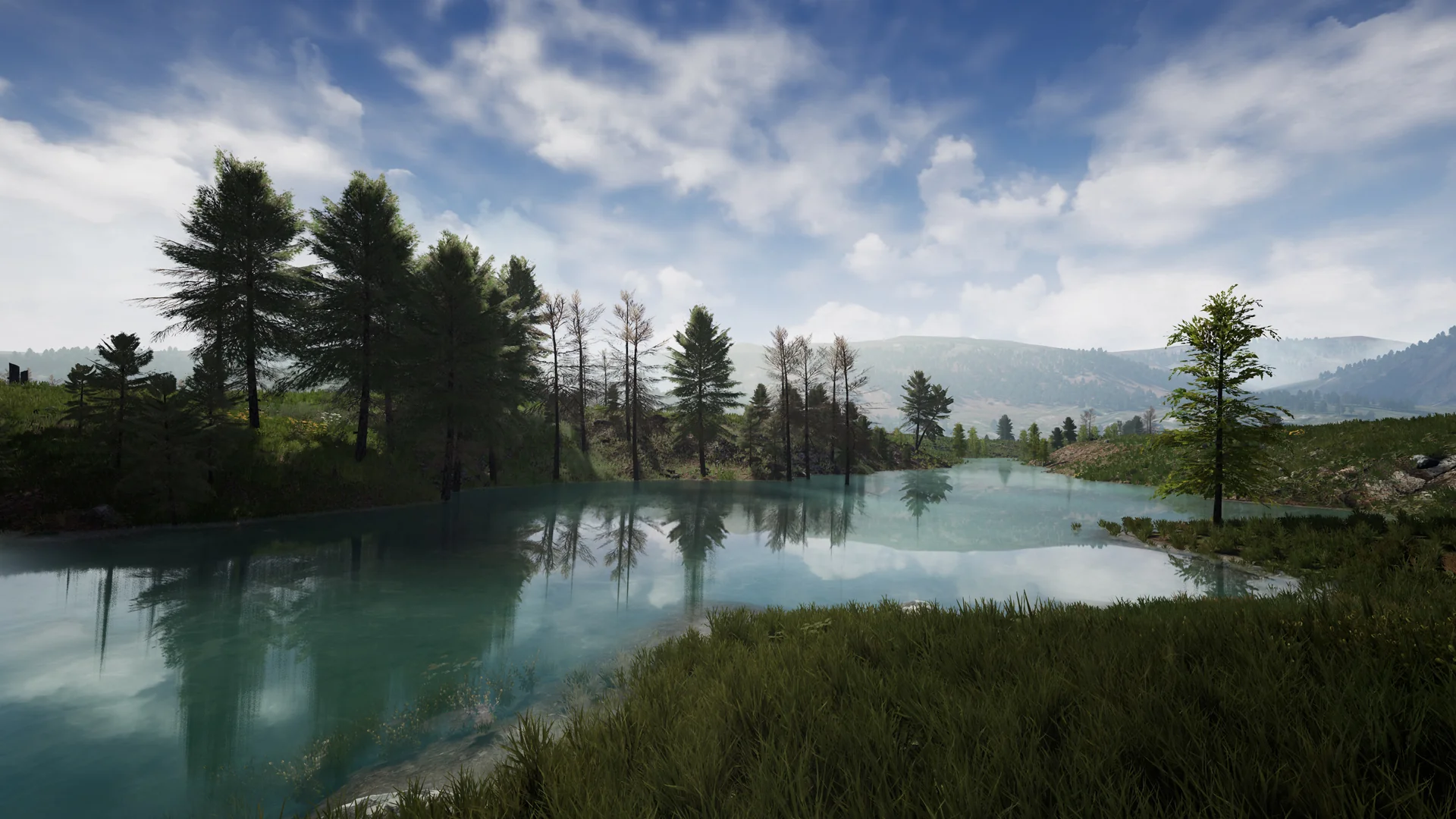
Resource screenshots
1 / 10
Join our channel
Follow 3DCGHUB on Telegram for new resource drops, migration updates, and community notices.
Deploying Pre-Made Layouts in the Stone Pine Forest
Integrating large-scale outdoor spaces into an active production pipeline often requires immediate playable territory for whiteboxing or rapid level design testing. Stone Pine Forest resolves this need by supplying ready-to-use maps that support early-stage development while functioning as fully realized environments. Developers can drop immediately into pre-assembled rural terrains or use the underlying generation mechanics to transform an existing blank heightmap into an organic, rugged landscape.
The package contains four distinct maps suited for different workflow phases. A dedicated showcase and overview map serves as an inspection ground for lighting calibration, foliage densities, and individual mesh assets. Beyond this testing area, two unique uninhabited rural maps offer massive 2x2 square kilometer expanses, establishing sprawling natural topographies devoid of human structures. A fourth map integrates settled civilization, featuring paved infrastructure, modern roads, directional signs, and a concentrated rural village. Because the project spans empty wilderness and organized human habitation, it can be dropped directly into prototyping phases without requiring immediate asset population.
Designing Navigation Across the GooseLand and Mountains Levels
The primary world space, divided into Mountains and Mountains_LevelDesign, provides two alternate design philosophies across identical geographic topology. The untouched natural forest configuration presents pure wilderness, where untamed vegetation and rolling terrain define every sightline. This baseline serves wilderness exploration, nature simulations, or untamed game settings where artificial interventions would break visual continuity.
The settled alternate, Mountains_LevelDesign, overlays human infrastructure onto the mountain base. Equipped with modern asphalt or dirt roads, signage, and village clusters, this version introduces multi-purpose level design accommodating multiple gameplay genres. High-speed racing titles can take advantage of the winding mountain road networks, while war games focused on vehicular combat benefit from unobstructed transit lanes intersecting natural choke points. Deathmatch and open-world survival projects can deploy the rural village as a contested zone, using structural cover against open fields.
In contrast to the broader sightlines of the mountain territories, the second pre-made environment, titled GooseLand, focuses on spatial disorientation. Although built upon a 2x2 square kilometer footprint, GooseLand relies on tight hills, winding natural pathways, and dense vegetation to form a maze-like forest layout. The deliberate placement of terrain barriers systematically confounds the player's sense of scale and direction. Traversing the map from one cardinal direction offers an entirely different navigational experience than entering from another, making a single continuous terrain feel like multiple unrelated locations depending on the starting spawn point.
Procedural Foliage System and Pine Tree Variations
Populating extensive forest environments by hand is impractical across multiple square kilometers. Stone Pine Forest relies on an automated procedural foliage system configured to distribute natural scatter across varied elevations. The arboreal library focuses on two primary species: Stone Pine and Pecan trees, providing a distinct Mediterranean and temperate rural character.
Across these species, the package features 11 tree variations in total. Having varied physical silhouettes prevents noticeable patterning across the canopy when generating dense forest expanses. The collection also includes three traditional Stone Pines added in an update, expanding the diversity of mature, characteristic tree forms. When distributed alongside the landscape grass assets, the procedural rules populate clearings, steep inclines, and dense thickets with distinct ground cover densities, maintaining plausible ecological boundaries between tree canopies and open meadows.
Material Instances, Slope Coordinates, and Background Meshes
Terrain coloration and cliff definition are managed through an automated slope variation and texture coordinate system. Instead of requiring manual paint passes along sheer rock faces, the master terrain shader evaluates landscape pitch automatically. Flat plateaus retain grass, soil, and ground cover, while surfaces that exceed defined angles transition into exposed stone and cliff textures.
The landscape shading pipeline relies on smart master materials paired with easily adjustable material instances. Artists can refine tiling parameters, modify blending thresholds, and balance surface albedo across vast stretches without altering the core shader network. This setup ensures that distant ground matches nearby playable paths under changing environmental lighting.
To solve performance challenges associated with rendering endless terrain geometry, the pack includes specialized background meshes. These distant landforms encircle the playable 2x2 kilometer borders, creating an illusion of vast geographic depth without incurring the severe performance hit of active landscape components. Game cameras maintain unbroken horizons, framing mountain ridges and distant peaks behind the active procedural foliage boundaries.
Infrastructure Placement and Customizable Sign Blueprints
Bridging the gap between wild forests and interactive level mechanics, the populated rural spaces include a customizable sign blueprint system. This modular utility allows designers to modify road postings, directional indicators, and warnings throughout the settled village map without authoring bespoke meshes for each intersection. The blueprint adapts to systemic pathfinding markers or contextual game waypoints, establishing immediate visual logic along vehicle routes.
The mixture of untouched nature, intricate maze-like hills in GooseLand, high-speed road paths, and modular blueprints makes Stone Pine Forest a comprehensive toolkit. Whether serving as a rapid blockout stage for vehicular mechanics or providing the final background vista for survival encounters, the system operates across every tier of environmental world construction.
 Forest & Jungle
 Forest & Jungle
 Forest & Jungle