"f0d304d7232d0332"{"id":"1002728","slug":"simpoly-town","title":"SimPoly Town","category":"Cities","engine":"5.0+","assetVersion":"","engineVersion":"Engine Version: 5.0+","tag":"Cities","accent":"blue","visual":"mech","summary":"Build exterior game environments with SimPoly Town, featuring over 150 modular models, animated elements, demo maps, and varied material palettes.","platform":"Unreal Engine","indexPolicy":"index","publishedAt":"2026-11-17T19:04:53.217Z","updatedAt":"2026-11-17T19:04:53.217Z","sourceNotes":[],"fileContents":[],"compatibility":["Unreal Engine","Engine Version: 5.0+"],"featuredImage":{"alt":"SimPoly Town","src":"/wp-content/uploads/published/2026/11/e7e1aca3052c-a4a7ed78-7d5c-4396-827d-69a833fcb022-7a150f01d5.webp"},"fileSizeBytes":127998831,"hasDownloadLink":true,"downloads":0,"terms":[{"taxonomy":"category","slug":"cities","name":"Cities"}],"galleryImages":[{"src":"/wp-content/uploads/published/2026/11/e24ba2716d86-7c78b0b2-f75c-4791-a9d8-ffed02073efe-f89636bb7d.webp","alt":"SimPoly Town"},{"src":"/wp-content/uploads/published/2026/11/de4d316c9a03-0bd30aae-4be2-4a62-8439-4937629fbe9e-201bec702e.webp","alt":"SimPoly Town"},{"src":"/wp-content/uploads/published/2026/11/654a2c555823-3aa0249e-fefa-4ba2-9655-e60534fce153-213e483807.webp","alt":"SimPoly Town"},{"src":"/wp-content/uploads/published/2026/11/df4b1eaa14b9-67048126-5f37-45ea-8bc3-b25b02b6b8f6-870efa6eff.webp","alt":"SimPoly Town"},{"src":"/wp-content/uploads/published/2026/11/2dfc9ff02bad-1e62b7a5-2e6b-43d8-bdf6-dfbcfb803caa-0cb4f75f0b.webp","alt":"SimPoly Town"},{"src":"/wp-content/uploads/published/2026/11/4bed7145ce60-99556f6f-f9a6-44cc-ac7a-298ca822059a-99c09b3998.webp","alt":"SimPoly Town"},{"src":"/wp-content/uploads/published/2026/11/66776eb13185-ccf88c7b-8c2d-4862-8989-dde7b9630731-15aabe456b.webp","alt":"SimPoly Town"},{"src":"/wp-content/uploads/published/2026/11/3ba784c36476-3cac4254-994e-444a-a15e-ab493bc88246-e625dd5ebf.webp","alt":"SimPoly Town"},{"src":"/wp-content/uploads/published/2026/11/921d28ddd427-a0b718a0-7556-4e01-959d-b29286603a3b-1695809e7a.webp","alt":"SimPoly Town"},{"src":"/wp-content/uploads/published/2026/11/da26f0f4fbb2-5de3ef17-6fc7-4ddc-922d-3b51f8e74c97-b69bd51c45.webp","alt":"SimPoly Town"}],"accessPanel":{"kind":"resource","title":"Get this resource","safetyNote":"Resources are manually reviewed before listing to improve quality and reduce obvious risks.","fileName":"Content.7z","resourceType":"Resource archive","versions":[]},"contentHtml":"\u003cp\u003eExterior level construction requires clean modularity, cohesive assets, and atmospheric cohesion to turn empty terrain into a recognizable settlement. SimPoly Town is assembled specifically around exterior workflows, providing the building blocks needed to assemble small settlements, suburban roads, or sprawling urban perimeters. Developed as part of the SimPoly Series, it employs a clean, simple art style characterized by readable silhouettes and crisp geometric definition. This aesthetic differs distinctly from standalone low-poly or stylized companion releases, offering a clear visual treatment suited for mobile projects, top-down tactical titles, and stylized cartoon worlds.\u003c/p\u003e \u003ch2\u003eArchitectural and Exterior Staging in SimPoly Town\u003c/h2\u003e\n\u003cp\u003ePopulating a believable town space starts with the core structural geometry. SimPoly Town incorporates more than 150 distinct models, covering everything from core residential structures to small perimeter boundaries. The architectural assets feature house units and countryhouse options that can be combined to form varied neighborhood blocks. Rather than forcing uniform street layouts, builders can frame lots and courtyards using the modular wall sections and fences provided in the package.\u003c/p\u003e \u003cp\u003eExterior detailing relies heavily on intermediate props that bridge the gap between large buildings and open roads. The asset library supplies items such as barrels, lamps, and streetlights to establish functional streetscapes and active alleyways. Placing streetlights along transit corridors helps define the walking paths of pedestrians, while fence variations and perimeter walls allow developers to delineate private plots from public gathering zones. Because the geometry focuses on clear, simplified forms, structures remain easily readable even when viewed from elevated camera angles or on compact mobile screens.\u003c/p\u003e \u003ch2\u003eRoadways, Traffic Layouts, and Environmental Dressing\u003c/h2\u003e\n\u003cp\u003eTown environments depend on connected transit routes to guide player movement and frame visual sightlines. SimPoly Town provides modular road segments designed to assemble highway corridors, downtown avenues, and residential paths. These road pieces align to build complex intersections, long stretches of pavement, and parking turnouts tailored to the flow of traffic.\u003c/p\u003e \u003cp\u003eOnce roads are plotted, the package supplies vehicles and cars to populate the asphalt. Developers can arrange parked vehicles outside houses or position them around gas-station-style utility nodes to imply everyday transit. Beyond man-made infrastructure, the package addresses the organic ground beneath the town. Landscape ground and grass textures allow designers to paint natural transitions between paved streets, backyards, and roadside ditches. Placing trees across these grassy zones softens the rigid lines of the buildings, introducing organic foliage that integrates highway routes into broader nature backdrops.\u003c/p\u003e \u003ch2\u003eDynamic FX, Lighting Variations, and Town Scene Dynamics\u003c/h2\u003e\n\u003cp\u003eStatic props risk making an exterior environment feel completely dormant if there is no motion in the air. SimPoly Town addresses ambient motion by including built-in animated elements and environmental particle effects. A dedicated wind particle system introduces drifting air currents through streets, rooftop gaps, and open squares, providing immediate environmental context to outdoor spaces.\u003c/p\u003e \u003cp\u003eAbove the buildings, a dedicated birds flying animation populates the skybox. Having airborne movement visible above rooftops instantly breaks the stillness of static geometry, creating an impression of scale and ongoing life without requiring custom character logic. Lighting setup is similarly accounted for through two massive demo maps: one configured for daytime illumination and another set up for nighttime conditions. The night map demonstrates how localized illumination from lamps, streetlights, and house fixtures interacts with the simplified geometry, giving level designers a direct template for ambient nocturnal contrast.\u003c/p\u003e \u003ch2\u003eModular Palette Management and Material Color Variations\u003c/h2\u003e\n\u003cp\u003eVisual fatigue is a frequent challenge in modular town design when the same structural assets appear repeatedly across a single map. SimPoly Town counters asset repetition through integrated material color variations and flexible texture setups. By applying alternative color treatments across house exteriors, fences, walls, and vehicles, multiple distinct districts can be generated from the same underlying geometry.\u003c/p\u003e \u003cp\u003eA neighborhood can shift from a colorful downtown commercial strip to a muted residential cul-de-sac simply by swapping material color assignments. The included textures maintain the smooth, uncluttered surface finish intrinsic to the simple art style, avoiding noisy micro-detail that might clash with the geometry. This focus on controlled color variation makes the kit versatile across multiple game styles, supporting fantasy settlements, cartoon cities, or minimalist polyart scenarios while preserving artistic consistency across every prop.\u003c/p\u003e \u003ch2\u003eLayout Construction Using the SimPoly Demonstration Maps\u003c/h2\u003e\n\u003cp\u003eEvaluating an extensive library of more than 150 models is made straightforward through the inclusion of an overview map alongside the full gameplay levels. The overview map arranges every prop, vehicle, tree, and architectural piece in an organized grid, functioning as an interactive asset catalog. Level builders can inspect mesh scale, pivot alignment, and color variations side by side before dragging pieces into production scenes.\u003c/p\u003e \u003cp\u003eThe massive demo maps supply pre-assembled town layouts ready for exploration or direct level adaptation. These environments demonstrate how modular roads, wall systems, countryhouses, and street dressing connect into fully formed neighborhoods. Developers can dissect the placement of traffic assets, study how ground textures blend against modular road curbs, or use the demo map as an immediate testing ground for player controllers, camera perspectives, and mobile rendering performance.\u003c/p\u003e\n\n\u003ch2\u003eMore From The Same Workflow\u003c/h2\u003e\n\u003cul\u003e\n\u003cli\u003e\u003ca href=\"https://3dcghub.com/a-futuristic-city-lake-town/\" rel=\"noopener noreferrer\"\u003eA Futuristic City - LAKE TOWN\u003c/a\u003e\u003c/li\u003e\n\u003cli\u003e\u003ca href=\"https://3dcghub.com/signage-vol-2-town-and-city-nanite-and-low-poly/\" rel=\"noopener noreferrer\"\u003eSignage VOL.2 - Town and City (Nanite and Low Poly)\u003c/a\u003e\u003c/li\u003e\n\u003cli\u003e\u003ca href=\"https://3dcghub.com/modular-seaside-town/\" rel=\"noopener noreferrer\"\u003eModular Seaside Town\u003c/a\u003e\u003c/li\u003e\n\u003cli\u003e\u003ca href=\"https://3dcghub.com/ancient-towns/\" rel=\"noopener noreferrer\"\u003eAncient Towns\u003c/a\u003e\u003c/li\u003e\n\u003cli\u003e\u003ca href=\"https://3dcghub.com/low-poly-town/\" rel=\"noopener noreferrer\"\u003eLow Poly Town\u003c/a\u003e\u003c/li\u003e\n\u003c/ul\u003e","contentTextLength":6169,"navigation":{"current":12,"total":4660,"previous":{"id":"1002729","slug":"stone-pine-forest","title":"Stone Pine Forest","category":"Forest \u0026 Jungle","platform":"Unreal Engine","updatedAt":"2026-11-17T19:05:52.158Z"},"next":{"id":"1002727","slug":"sicka-dynasty","title":"SICKA DYNASTY","category":"Fantasy","platform":"Unreal Engine","updatedAt":"2026-11-17T19:03:36.248Z"}},"relatedResources":[{"id":"7001","slug":"a-futuristic-city-lake-town","title":"A Futuristic City - LAKE TOWN","category":"Cities","engine":"5.3+","assetVersion":"Engine version: 5.3+","engineVersion":"5.1","tag":"Cities","accent":"blue","visual":"city","summary":"Transform your project with A Futuristic City - LAKE TOWN, a comprehensive urban environment featuring realistic PBR textures and animated structures.","platform":"Unreal Engine","indexPolicy":"noindex","publishedAt":"2026-02-20T16:35:07.000Z","updatedAt":"2026-04-19T15:56:04.000Z","sourceNotes":[],"fileContents":[],"compatibility":["Unreal Engine","Engine version: 5.3+"],"featuredImage":{"alt":"A Futuristic City - LAKE TOWN","src":"https://3dcghub.com/wp-content/uploads/2026/02/17422937-7f0e-4494-991b-e97abafc44b2.webp"},"fileSizeBytes":3529406305,"hasDownloadLink":true,"downloads":1},{"id":"1000024","slug":"signage-vol-2-town-and-city-nanite-and-low-poly","title":"Signage VOL.2 - Town and City (Nanite and Low Poly)","category":"Cities","engine":"5.1+","assetVersion":"","engineVersion":"5.1+","tag":"Cities","accent":"blue","visual":"city","summary":"A city signage collection for Unreal Engine with 230 meshes, Nanite and low poly versions, 4K textures, tint controls, and Lumen support.","platform":"Unreal Engine","indexPolicy":"index","publishedAt":"2026-05-20T12:08:20.801Z","updatedAt":"2026-05-20T12:08:20.801Z","sourceNotes":[],"fileContents":[],"compatibility":["Unreal Engine","Engine version: 5.1+"],"featuredImage":{"alt":"Signage VOL.2 - Town and City (Nanite and Low Poly)","src":"/wp-content/uploads/published/2026/05/5dae48205fe5-4cfef502-1be5-4a89-bab8-b50cc0a5fc66-d5fee08561.webp"},"fileSizeBytes":3249121763,"hasDownloadLink":true,"downloads":0},{"id":"1000384","slug":"modular-seaside-town","title":"Modular Seaside Town","category":"Cities","engine":"4.26+,5.0+","assetVersion":"","engineVersion":"Engine Version: 4.26+,5.0+","tag":"Cities","accent":"blue","visual":"mech","summary":"A collection of stylized, modular brick and wood structures featuring customizable shaders, vertex paintable weathering, and translucent water surfaces.","platform":"Unreal Engine","indexPolicy":"index","publishedAt":"2026-07-07T08:43:02.678Z","updatedAt":"2026-07-07T08:43:02.678Z","sourceNotes":[],"fileContents":[],"compatibility":["Unreal Engine","Engine Version: 4.26+,5.0+"],"featuredImage":{"alt":"Modular Seaside Town","src":"/wp-content/uploads/published/2026/07/ed61494c2ca9-32de6340-6873-44a1-87fe-144005c12c63-97f014c81f.webp"},"fileSizeBytes":1874074272,"hasDownloadLink":true,"downloads":0}]}
Resource screenshots
1 / 10
Join our channel
Follow 3DCGHUB on Telegram for new resource drops, migration updates, and community notices.
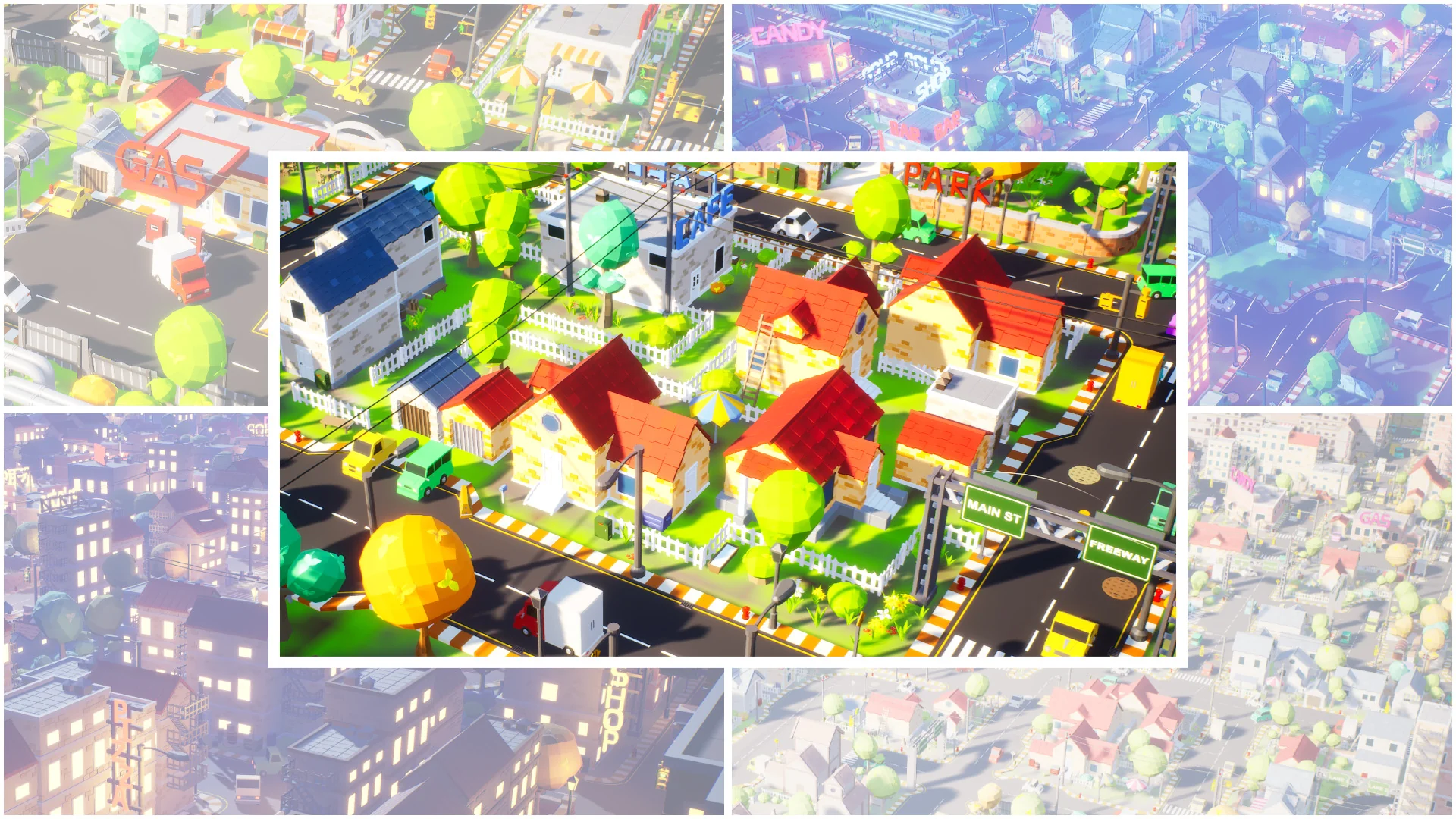
Exterior level construction requires clean modularity, cohesive assets, and atmospheric cohesion to turn empty terrain into a recognizable settlement. SimPoly Town is assembled specifically around exterior workflows, providing the building blocks needed to assemble small settlements, suburban roads, or sprawling urban perimeters. Developed as part of the SimPoly Series, it employs a clean, simple art style characterized by readable silhouettes and crisp geometric definition. This aesthetic differs distinctly from standalone low-poly or stylized companion releases, offering a clear visual treatment suited for mobile projects, top-down tactical titles, and stylized cartoon worlds.
Architectural and Exterior Staging in SimPoly Town
Populating a believable town space starts with the core structural geometry. SimPoly Town incorporates more than 150 distinct models, covering everything from core residential structures to small perimeter boundaries. The architectural assets feature house units and countryhouse options that can be combined to form varied neighborhood blocks. Rather than forcing uniform street layouts, builders can frame lots and courtyards using the modular wall sections and fences provided in the package.
Exterior detailing relies heavily on intermediate props that bridge the gap between large buildings and open roads. The asset library supplies items such as barrels, lamps, and streetlights to establish functional streetscapes and active alleyways. Placing streetlights along transit corridors helps define the walking paths of pedestrians, while fence variations and perimeter walls allow developers to delineate private plots from public gathering zones. Because the geometry focuses on clear, simplified forms, structures remain easily readable even when viewed from elevated camera angles or on compact mobile screens.
Roadways, Traffic Layouts, and Environmental Dressing
Town environments depend on connected transit routes to guide player movement and frame visual sightlines. SimPoly Town provides modular road segments designed to assemble highway corridors, downtown avenues, and residential paths. These road pieces align to build complex intersections, long stretches of pavement, and parking turnouts tailored to the flow of traffic.
Once roads are plotted, the package supplies vehicles and cars to populate the asphalt. Developers can arrange parked vehicles outside houses or position them around gas-station-style utility nodes to imply everyday transit. Beyond man-made infrastructure, the package addresses the organic ground beneath the town. Landscape ground and grass textures allow designers to paint natural transitions between paved streets, backyards, and roadside ditches. Placing trees across these grassy zones softens the rigid lines of the buildings, introducing organic foliage that integrates highway routes into broader nature backdrops.
Dynamic FX, Lighting Variations, and Town Scene Dynamics
Static props risk making an exterior environment feel completely dormant if there is no motion in the air. SimPoly Town addresses ambient motion by including built-in animated elements and environmental particle effects. A dedicated wind particle system introduces drifting air currents through streets, rooftop gaps, and open squares, providing immediate environmental context to outdoor spaces.
Above the buildings, a dedicated birds flying animation populates the skybox. Having airborne movement visible above rooftops instantly breaks the stillness of static geometry, creating an impression of scale and ongoing life without requiring custom character logic. Lighting setup is similarly accounted for through two massive demo maps: one configured for daytime illumination and another set up for nighttime conditions. The night map demonstrates how localized illumination from lamps, streetlights, and house fixtures interacts with the simplified geometry, giving level designers a direct template for ambient nocturnal contrast.
Modular Palette Management and Material Color Variations
Visual fatigue is a frequent challenge in modular town design when the same structural assets appear repeatedly across a single map. SimPoly Town counters asset repetition through integrated material color variations and flexible texture setups. By applying alternative color treatments across house exteriors, fences, walls, and vehicles, multiple distinct districts can be generated from the same underlying geometry.
A neighborhood can shift from a colorful downtown commercial strip to a muted residential cul-de-sac simply by swapping material color assignments. The included textures maintain the smooth, uncluttered surface finish intrinsic to the simple art style, avoiding noisy micro-detail that might clash with the geometry. This focus on controlled color variation makes the kit versatile across multiple game styles, supporting fantasy settlements, cartoon cities, or minimalist polyart scenarios while preserving artistic consistency across every prop.
Layout Construction Using the SimPoly Demonstration Maps
Evaluating an extensive library of more than 150 models is made straightforward through the inclusion of an overview map alongside the full gameplay levels. The overview map arranges every prop, vehicle, tree, and architectural piece in an organized grid, functioning as an interactive asset catalog. Level builders can inspect mesh scale, pivot alignment, and color variations side by side before dragging pieces into production scenes.
The massive demo maps supply pre-assembled town layouts ready for exploration or direct level adaptation. These environments demonstrate how modular roads, wall systems, countryhouses, and street dressing connect into fully formed neighborhoods. Developers can dissect the placement of traffic assets, study how ground textures blend against modular road curbs, or use the demo map as an immediate testing ground for player controllers, camera perspectives, and mobile rendering performance.
 Cities
 Cities
 Cities