"efaa631e936fd3ee"{"id":"1002210","slug":"starry-sky","title":"Starry Sky","category":"Sky \u0026 Space","engine":"4.26+,5.0+","assetVersion":"","engineVersion":"Engine Version: 4.26+,5.0+","tag":"Sky \u0026 Space","accent":"blue","visual":"mech","summary":"Dynamic celestial sky system featuring 16K NASA starfield cubemaps, real-equation solar tracking, volumetric fog transitions, and Sequencer support.","platform":"Unreal Engine","publishedAt":"2026-10-29T14:54:09.713Z","updatedAt":"2026-10-29T14:54:09.713Z","sourceNotes":[],"fileContents":[],"compatibility":["Unreal Engine","Engine Version: 4.26+,5.0+"],"featuredImage":{"alt":"Starry Sky","src":"/wp-content/uploads/published/2026/10/090ec04e05d4-e593081a-06d7-449c-b337-d684aaa1bf84-afe1f99c16.webp"},"hasDownloadLink":true,"downloads":0,"terms":[{"taxonomy":"category","slug":"sky-and-space","name":"Sky \u0026 Space"}],"galleryImages":[{"src":"/wp-content/uploads/published/2026/10/d38d9b9a83ae-ebf02315-e3e8-4652-9dda-cb5b07d8028d-0b1b614a6e.webp","alt":"Starry Sky"},{"src":"/wp-content/uploads/published/2026/10/a2986f1dd651-e00bce41-d405-40ae-8e3a-ce9fcb36d9a5-fdab525267.webp","alt":"Starry Sky"},{"src":"/wp-content/uploads/published/2026/10/97c0070c009c-1a2aa33f-d298-4184-b6e8-d5d5bc19a3e1-24d13a934a.webp","alt":"Starry Sky"},{"src":"/wp-content/uploads/published/2026/10/91d3132814b2-133c56f3-cab6-4c40-9d11-f287b09e3a6e-a9aab44322.webp","alt":"Starry Sky"},{"src":"/wp-content/uploads/published/2026/10/c4bea4a1ba40-6ae46ae2-1b1e-43e2-896b-f278c820d72d-b4f390d418.webp","alt":"Starry Sky"},{"src":"/wp-content/uploads/published/2026/10/cf7180a79bcd-0a1e3518-b8e0-47d5-aea8-0fc9a55925d7-467e07aebd.webp","alt":"Starry Sky"},{"src":"/wp-content/uploads/published/2026/10/d1902f60e73b-9798bab0-f717-4e5c-9d2c-a9c09ccf2089-09eaa7bdf3.webp","alt":"Starry Sky"},{"src":"/wp-content/uploads/published/2026/10/277c14ce6b92-7ebe9d42-3aa5-403f-ae43-7826d99b0538-526f36f113.webp","alt":"Starry Sky"},{"src":"/wp-content/uploads/published/2026/10/56508144d33c-65cf4210-c684-4bab-b08c-7b1ed4f16ca4-1231a619e2.webp","alt":"Starry Sky"},{"src":"/wp-content/uploads/published/2026/10/9f42b2a65800-62e71fbf-0a24-487d-9f85-348986042331-6440b2805c.webp","alt":"Starry Sky"}],"accessPanel":{"kind":"resource","title":"Download this resource","eyebrow":"Free Download","message":"Log in or create a free account to start your download.","fileName":"Content.7z","safetyNote":"Resources are manually reviewed before listing to improve quality and reduce obvious risks.","actionLabel":"Download Free","resourceType":"Resource archive"},"contentHtml":"\u003cp\u003eStarry Sky brings real astronomical mechanics, deep-space visual captures, and real-time atmospheric systems together into a single environment framework. Driven by a central Blueprint controller, the system handles solar tracking, lunar phases, real-time lighting, volumetric fog, and high-resolution celestial backgrounds to create accurate day, twilight, and night scenes.\u003c/p\u003e \u003ch2\u003eCelestial Data from NASA and ESO Panoramas\u003c/h2\u003e\n\u003cp\u003eThe visual foundation of the night sky relies on high-resolution astronomical observation data rather than synthetic star textures. Deep space backgrounds incorporate 16K starfield and Milky Way cubemaps sourced directly from NASA Deep Star Maps 2020. These cubemaps place celestial bodies, star clusters, and deep-sky features in positions true to modern astronomical catalogs.\u003c/p\u003e \u003cp\u003eTo deliver high fidelity when looking directly overhead at the galactic plane, the package also incorporates an 8K panorama from the European Southern Observatory (ESO), upscaled to 16K resolution. This preserves the delicate dust lanes, interstellar gas clouds, and galactic core details of the Milky Way across large display fields. Lunar rendering follows the same data-driven methodology, adopting data from NASA's 2018 Moon Phase and Libration survey. The moon accurately portrays surface features, lighting angles, and phase variations rather than relying on a static billboard texture.\u003c/p\u003e \u003ch2\u003eSolar Positioning Through Coordinates, Date, and Time Equations\u003c/h2\u003e\n\u003cp\u003eSun movement across the sky is governed by real mathematical equations rather than fixed, manual rotation paths. The system determines the exact solar position in the sky based on four user-defined inputs: latitude, longitude, calendar date, and the specific time of day. This astronomical positioning system calculates the precise elevation and azimuth angles of the sun relative to the horizon.\u003c/p\u003e \u003cp\u003eInputting actual geographic coordinates lets the virtual sun mimic real-world lighting behavior at any point on Earth. High-latitude coordinates produce shallow solar arcs with elongated shadows, while equatorial inputs drive steep midday paths directly overhead. As time advances through the calendar date, seasonal variations shift the solar trajectory naturally. The system accurately traverses dawn, twilight, sunset, and full night cycles without requiring manually animated light angles.\u003c/p\u003e \u003ch2\u003eAtmospheric Transitions: Seamless Cloud Cover and Volumetric Fog\u003c/h2\u003e\n\u003cp\u003eScene lighting remains completely dynamic, updating in real time as the sun and moon move through their respective arcs. Directional light vectors, ambient colors, and sky tints adjust continuously to mirror the angle of incoming light through the atmosphere. This real-time illumination prevents lighting seams when transitioning between daytime brightness and deep starlit environments.\u003c/p\u003e \u003cp\u003eAtmospheric density adjusts simultaneously alongside celestial shifts. The volume of clouds and the density of volumetric fog change seamlessly over time rather than popping between distinct presets. Volumetric fog scatters directional light from the sun or moon, catching low-angle sunset rays and lunar silhouettes as it moves through the environment. Cloud layers can build up or clear away gradually, allowing for clear starry vistas, partial overcast conditions, or heavy atmospheric haze without visual disruption.\u003c/p\u003e \u003ch2\u003eBlueprint Control, Clock Widgets, and Sequencer Timelapses\u003c/h2\u003e\n\u003cp\u003eManaging the sky does not require jumping between disconnected scene elements. The primary system parameters are unified within a single Blueprint, allowing artists and developers to modify geographic position, temporal progression, cloud values, and visual scales from one control interface. This consolidation keeps scene management clean, whether setting up a static sunset or a dynamic day-night cycle.\u003c/p\u003e \u003cp\u003eFor cinematic production, the framework is built to operate directly with Sequencer. Animators can expose and keyframe time parameters to create smooth cinematic timelapses. Scrubbing the timeline or playing back a sequence accelerates the solar trajectory, advances lunar phases, rotates the 16K starfield, and drives evolving fog banks in a unified pass. Real-time illumination updates frame by frame to keep shadows and sky colors coherent throughout high-speed time transitions.\u003c/p\u003e \u003cp\u003eInteractive projects benefit from included compass and clock widgets. These user-interface elements read live values from the sky system, providing players with on-screen visual feedback for temporal progression and spatial orientation. Networked gameplay is also accounted for, as the architecture includes multiplayer support to keep celestial positions, dynamic time, and atmospheric transitions synchronized across all connected clients.\u003c/p\u003e \u003ch2\u003eReal Space Skybox Implementation\u003c/h2\u003e\n\u003cp\u003eConfigured for real space skybox applications, the asset offers an accurate baseline for projects that demand authentic astronomical visuals. By pairing real-world coordinate equations with verified NASA and ESO imaging, the package provides a solid foundation for realistic outdoor environments, scientific visualizations, and cinematic timelapses.\u003c/p\u003e\n\n\u003ch2\u003eContinue Browsing Similar Packs\u003c/h2\u003e\n\u003cul\u003e\n\u003cli\u003e\u003ca href=\"https://3dcghub.com/moon-landscape/\" title=\"Moon Landscape\"\u003eMoon Landscape\u003c/a\u003e\u003c/li\u003e\n\u003cli\u003e\u003ca href=\"https://3dcghub.com/asteroids-planet/\" title=\"Asteroids Planet\"\u003eAsteroids Planet\u003c/a\u003e\u003c/li\u003e\n\u003cli\u003e\u003ca href=\"https://3dcghub.com/volumetric-space-nebula-procedural-generator/\" title=\"Volumetric Space Nebula Procedural Generator\"\u003eVolumetric Space Nebula Procedural Generator\u003c/a\u003e\u003c/li\u003e\n\u003cli\u003e\u003ca href=\"https://3dcghub.com/brushify-mars-pack/\" title=\"Brushify - Mars Pack\"\u003eBrushify - Mars Pack\u003c/a\u003e\u003c/li\u003e\n\u003cli\u003e\u003ca href=\"https://3dcghub.com/sci-fi-observation-station-kit/\" title=\"Sci Fi Observation Station Kit\"\u003eSci Fi Observation Station Kit\u003c/a\u003e\u003c/li\u003e\n\u003c/ul\u003e","contentTextLength":5255,"navigation":{"current":75,"total":4209,"previous":{"id":"1002211","slug":"stealth-finishers-knife-and-hand","title":"Stealth Finishers - knife and hand","category":"Combat","platform":"Unreal Engine","updatedAt":"2026-10-29T14:55:11.500Z"},"next":{"id":"1002209","slug":"spray-painting-animations","title":"Spray Painting Animations","category":"Combat","platform":"Unreal Engine","updatedAt":"2026-10-29T14:52:43.545Z"}},"relatedResources":[{"id":"9747","slug":"moon-landscape","title":"Moon Landscape","category":"Sky \u0026 Space","engine":"4.26+,5.0+","assetVersion":"Engine version: 4.26+,5.0+","engineVersion":"5.0","tag":"Sky \u0026 Space","accent":"blue","visual":"city","summary":"Enhance your cosmic scenes with this detailed Moon Landscape. It features a massive 8129x8129 surface, unique material layers, and realistic background assets like planet Earth and a starry sky.","platform":"Unreal Engine","publishedAt":"2026-03-01T17:43:23.000Z","updatedAt":"2026-04-19T15:51:01.000Z","sourceNotes":[],"fileContents":[],"compatibility":["Unreal Engine","Engine version: 4.26+,5.0+"],"featuredImage":{"alt":"Moon Landscape","src":"https://3dcghub.com/wp-content/uploads/2026/03/0c3bb51b-8fd3-4b08-93a2-b69c5d7ee79a.webp"},"hasDownloadLink":true,"downloads":1},{"id":"1001719","slug":"asteroids-planet","title":"Asteroids Planet","category":"Sky \u0026 Space","engine":"4.26+,5.0+","assetVersion":"","engineVersion":"Engine Version: 4.26+,5.0+","tag":"Sky \u0026 Space","accent":"blue","visual":"mech","summary":"Build realistic space levels with Asteroids Planet, featuring 10 asteroid models, 12 planet materials, 10 space skydomes, a sky blueprint, and demo maps.","platform":"Unreal Engine","publishedAt":"2026-10-19T15:51:58.447Z","updatedAt":"2026-10-19T15:51:58.447Z","sourceNotes":[],"fileContents":[],"compatibility":["Unreal Engine","Engine Version: 4.26+,5.0+"],"featuredImage":{"alt":"Asteroids Planet","src":"/wp-content/uploads/published/2026/10/ff7f46fe3020-495a5e6b-259c-4e33-939e-4d0300a39135-6fce006d05.webp"},"hasDownloadLink":true,"downloads":0},{"id":"1001676","slug":"volumetric-space-nebula-procedural-generator","title":"Volumetric Space Nebula Procedural Generator","category":"Sky \u0026 Space","engine":"4.26+,5.0+","assetVersion":"","engineVersion":"Engine Version: 4.26+,5.0+","tag":"Sky \u0026 Space","accent":"blue","visual":"mech","summary":"Generate real-time volumetric space nebulae with procedural Blueprints. Explore performance benchmarks, DLSS scaling, and cosmic environment workflows.","platform":"Unreal Engine","publishedAt":"2026-10-13T15:27:12.561Z","updatedAt":"2026-10-13T15:27:12.561Z","sourceNotes":[],"fileContents":[],"compatibility":["Unreal Engine","Engine Version: 4.26+,5.0+"],"featuredImage":{"alt":"Volumetric Space Nebula Procedural Generator","src":"/wp-content/uploads/published/2026/10/ed5e294cddf7-bf156143-df14-42a9-a30d-15701732ea7b-4d3a24d0eb.webp"},"hasDownloadLink":true,"downloads":0}]}
Sky & Space
Starry Sky
Dynamic celestial sky system featuring 16K NASA starfield cubemaps, real-equation solar tracking, volumetric fog transitions, and Sequencer support.
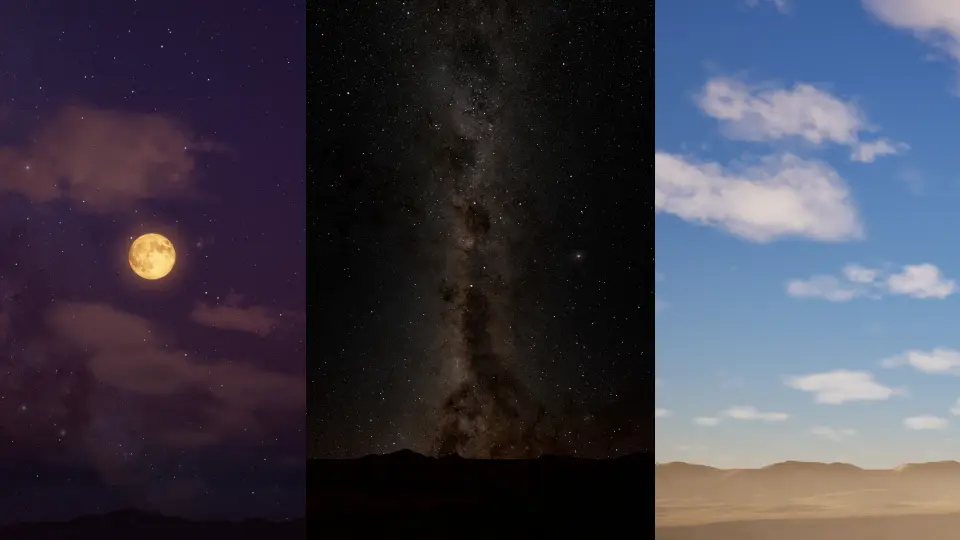
Starry Sky brings real astronomical mechanics, deep-space visual captures, and real-time atmospheric systems together into a single environment framework. Driven by a central Blueprint controller, the system handles solar tracking, lunar phases, real-time lighting, volumetric fog, and high-resolution celestial backgrounds to create accurate day, twilight, and night scenes.
Celestial Data from NASA and ESO Panoramas
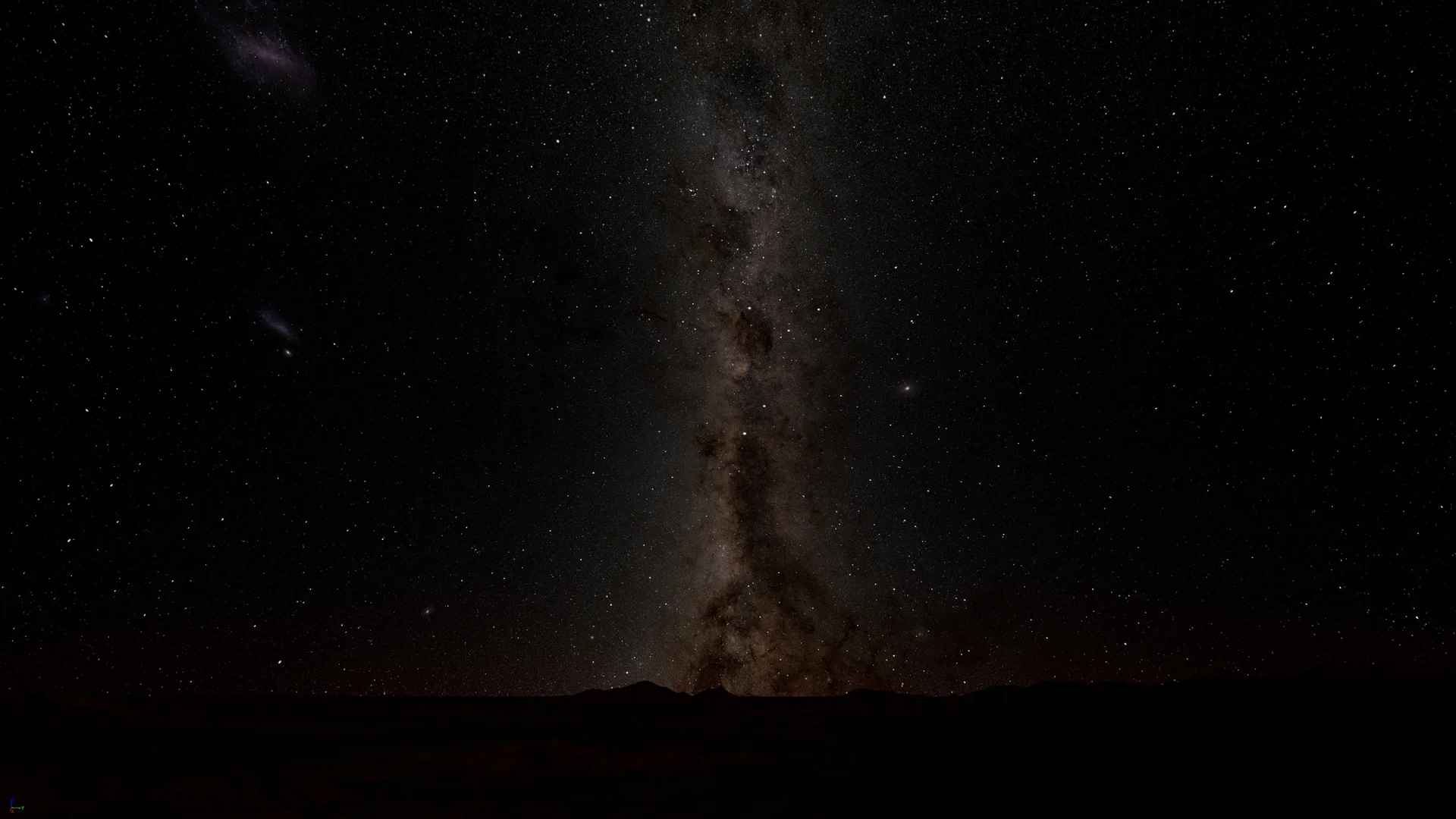
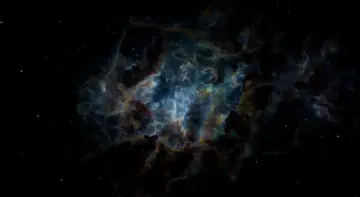
The visual foundation of the night sky relies on high-resolution astronomical observation data rather than synthetic star textures. Deep space backgrounds incorporate 16K starfield and Milky Way cubemaps sourced directly from NASA Deep Star Maps 2020. These cubemaps place celestial bodies, star clusters, and deep-sky features in positions true to modern astronomical catalogs.
To deliver high fidelity when looking directly overhead at the galactic plane, the package also incorporates an 8K panorama from the European Southern Observatory (ESO), upscaled to 16K resolution. This preserves the delicate dust lanes, interstellar gas clouds, and galactic core details of the Milky Way across large display fields. Lunar rendering follows the same data-driven methodology, adopting data from NASA's 2018 Moon Phase and Libration survey. The moon accurately portrays surface features, lighting angles, and phase variations rather than relying on a static billboard texture.
Solar Positioning Through Coordinates, Date, and Time Equations
Sun movement across the sky is governed by real mathematical equations rather than fixed, manual rotation paths. The system determines the exact solar position in the sky based on four user-defined inputs: latitude, longitude, calendar date, and the specific time of day. This astronomical positioning system calculates the precise elevation and azimuth angles of the sun relative to the horizon.
Inputting actual geographic coordinates lets the virtual sun mimic real-world lighting behavior at any point on Earth. High-latitude coordinates produce shallow solar arcs with elongated shadows, while equatorial inputs drive steep midday paths directly overhead. As time advances through the calendar date, seasonal variations shift the solar trajectory naturally. The system accurately traverses dawn, twilight, sunset, and full night cycles without requiring manually animated light angles.
Atmospheric Transitions: Seamless Cloud Cover and Volumetric Fog
Scene lighting remains completely dynamic, updating in real time as the sun and moon move through their respective arcs. Directional light vectors, ambient colors, and sky tints adjust continuously to mirror the angle of incoming light through the atmosphere. This real-time illumination prevents lighting seams when transitioning between daytime brightness and deep starlit environments.
Atmospheric density adjusts simultaneously alongside celestial shifts. The volume of clouds and the density of volumetric fog change seamlessly over time rather than popping between distinct presets. Volumetric fog scatters directional light from the sun or moon, catching low-angle sunset rays and lunar silhouettes as it moves through the environment. Cloud layers can build up or clear away gradually, allowing for clear starry vistas, partial overcast conditions, or heavy atmospheric haze without visual disruption.
Blueprint Control, Clock Widgets, and Sequencer Timelapses
Managing the sky does not require jumping between disconnected scene elements. The primary system parameters are unified within a single Blueprint, allowing artists and developers to modify geographic position, temporal progression, cloud values, and visual scales from one control interface. This consolidation keeps scene management clean, whether setting up a static sunset or a dynamic day-night cycle.
For cinematic production, the framework is built to operate directly with Sequencer. Animators can expose and keyframe time parameters to create smooth cinematic timelapses. Scrubbing the timeline or playing back a sequence accelerates the solar trajectory, advances lunar phases, rotates the 16K starfield, and drives evolving fog banks in a unified pass. Real-time illumination updates frame by frame to keep shadows and sky colors coherent throughout high-speed time transitions.
Interactive projects benefit from included compass and clock widgets. These user-interface elements read live values from the sky system, providing players with on-screen visual feedback for temporal progression and spatial orientation. Networked gameplay is also accounted for, as the architecture includes multiplayer support to keep celestial positions, dynamic time, and atmospheric transitions synchronized across all connected clients.
Real Space Skybox Implementation
Configured for real space skybox applications, the asset offers an accurate baseline for projects that demand authentic astronomical visuals. By pairing real-world coordinate equations with verified NASA and ESO imaging, the package provides a solid foundation for realistic outdoor environments, scientific visualizations, and cinematic timelapses.
 Sky & Space
 Sky & Space
 Sky & Space
 Sky & Space