"ee989f9ed9d4794c"{"id":"1001719","slug":"asteroids-planet","title":"Asteroids Planet","category":"Sky \u0026 Space","engine":"4.26+,5.0+","assetVersion":"","engineVersion":"Engine Version: 4.26+,5.0+","tag":"Sky \u0026 Space","accent":"blue","visual":"mech","summary":"Build realistic space levels with Asteroids Planet, featuring 10 asteroid models, 12 planet materials, 10 space skydomes, a sky blueprint, and demo maps.","platform":"Unreal Engine","publishedAt":"2026-10-19T15:51:58.447Z","updatedAt":"2026-10-19T15:51:58.447Z","sourceNotes":[],"fileContents":[],"compatibility":["Unreal Engine","Engine Version: 4.26+,5.0+"],"featuredImage":{"alt":"Asteroids Planet","src":"/wp-content/uploads/published/2026/10/ff7f46fe3020-495a5e6b-259c-4e33-939e-4d0300a39135-6fce006d05.webp"},"hasDownloadLink":true,"downloads":0,"terms":[{"taxonomy":"category","slug":"sky-and-space","name":"Sky \u0026 Space"}],"galleryImages":[{"src":"/wp-content/uploads/published/2026/10/bc4c87b476f9-e66183af-a954-4b7c-8a87-d33de842ff5c-02a0c48218.webp","alt":"Asteroids Planet"},{"src":"/wp-content/uploads/published/2026/10/3119279779c3-c84a8118-753d-4724-b1e7-5b738b9ed09d-ee51151598.webp","alt":"Asteroids Planet"},{"src":"/wp-content/uploads/published/2026/10/8778be88ef0f-3c07e125-e003-4def-bf69-aecfdc2d9c54-cad8087bcf.webp","alt":"Asteroids Planet"},{"src":"/wp-content/uploads/published/2026/10/d031010813de-6f9ec655-b077-4796-b4c1-b9884f05563d-2e6652c3a5.webp","alt":"Asteroids Planet"},{"src":"/wp-content/uploads/published/2026/10/597957110b87-0a02ac26-65a4-46cc-93ea-7769ae5920fa-087c8a1ea4.webp","alt":"Asteroids Planet"},{"src":"/wp-content/uploads/published/2026/10/ae833acfc216-3bdfc467-9d69-4d93-b555-0ee4a3994ce7-ea61c55be8.webp","alt":"Asteroids Planet"},{"src":"/wp-content/uploads/published/2026/10/6d0fa8ca9f06-761349ef-bf61-4aa1-9006-4a25e081de09-a27d4a04e5.webp","alt":"Asteroids Planet"},{"src":"/wp-content/uploads/published/2026/10/08dee7544f18-c44ad83e-434f-40fc-843e-5000cea70804-915caa9d01.webp","alt":"Asteroids Planet"},{"src":"/wp-content/uploads/published/2026/10/33b14a0b8563-95dd6f74-5188-463e-95fa-43a90a441ffc-0af947b586.webp","alt":"Asteroids Planet"},{"src":"/wp-content/uploads/published/2026/10/4dbe6ec13230-19503e85-0b50-427c-9c96-3d804c7da827-c4ac8c18b2.webp","alt":"Asteroids Planet"}],"accessPanel":{"kind":"resource","title":"Download this resource","eyebrow":"Free Download","message":"Log in or create a free account to start your download.","fileName":"Content.7z","safetyNote":"Resources are manually reviewed before listing to improve quality and reduce obvious risks.","actionLabel":"Download Free","resourceType":"Resource archive"},"contentHtml":"\u003ch2\u003eConstructing Deep Space Levels with Asteroids Planet\u003c/h2\u003e\n\u003cp\u003eStaging believable exterior space environments requires balancing massive macro structures against minute, foreground details. In a typical orbital or deep-space scene, background scale is established by massive planetary bodies and distant celestial vistas, while immediate depth and player collision rely on fields of rocky debris. Asteroids Planet addresses this entire visual hierarchy by packaging both ends of the scale spectrum into a unified assembly. The package brings together sky backdrops, planetary surface shaders, unique rock meshes, and specialized object materials designed to produce realistic space scenes.\u003c/p\u003e\n\u003cp\u003eSpace scenes present distinct challenges regarding empty space and scale reference. Without atmospheric haze or terrestrial horizon lines, depth perception depends entirely on how light strikes solid surfaces against the void. By combining celestial spheres, volumetric sky domes, high-resolution texture maps, and distinct rocky bodies, artists can assemble convincing space vistas. Whether orchestrating an intense orbital dogfight, a slow-paced mining sequence, or a cinematic vista, having an integrated collection of assets ensures consistent lighting behavior and visual continuity across the entire environment.\u003c/p\u003e \u003ch2\u003eAtmospheric and Deep Space Framing via Space SkyDome and Sky Blueprint\u003c/h2\u003e\n\u003cp\u003eThe foundation of any exterior space level is its backdrop. Asteroids Planet includes 10 Space SkyDome assets, each providing a distinct ambient setting for celestial stages. These sky domes define the panoramic boundaries of the scene, wrapping the playable volume in varied cosmic environments that dictate the global color palette, nebula patterns, and distant star density. Selecting a specific sky dome instantly establishes the lighting conditions of the scene, whether the environment demands cold, high-contrast black voids or colorful regions illuminated by nearby stellar phenomena.\u003c/p\u003e\n\u003cp\u003eTo control and integrate these expansive environments, the package incorporates a Sky Blueprint. Managing celestial spheres and sky materials through a blueprint setup allows for organized environment control within the project workflow. Instead of manually aligning multiple sphere meshes or wrestling with complex coordinate transforms in standard viewports, the Sky Blueprint serves as the central operational hub for backdrop positioning and visual balancing. This setup ensures that the background environment correctly responds to directional sunlight and camera movements without exposing unwanted edge seams or texture stretching at the perimeter of the level.\u003c/p\u003e \u003ch2\u003eSurface Variation Across 12 Materials of Planets\u003c/h2\u003e\n\u003cp\u003ePlanetary bodies dominate deep-space vistas, serving as primary visual anchors that orient the player in the void. Asteroids Planet features 12 Materials of Planets, providing diverse surface treatments for distant or mid-ground spheres. In a realistic level design pipeline, these planet materials allow developers to populate orbital spaces with a wide variety of planetary types—ranging from barren, crater-swept terrestrial worlds and frozen rock spheres to complex atmospheric gas giants and volcanic surfaces.\u003c/p\u003e\n\u003cp\u003eBecause the collection offers twelve distinct planet materials, environmental artists can establish narrative context across multiple stages or zones without reusing the exact same planetary shader. A stage set in low orbit around a volatile, cracked world can easily be repurposed into an icy moon system or an arid planetary fringe simply by swapping the applied planet material. These shaders rely on a substantial portion of the pack's 91 textures, generating realistic surface relief, specular variation, and limb darkening that holds up under dynamic space lighting.\u003c/p\u003e \u003ch2\u003eAsteroid Meshes, Asteroid Materials, and Materials of Loot\u003c/h2\u003e\n\u003cp\u003eWhile planets and sky domes establish the distant vista, navigable fields require distinct physical geometry. The package provides 10 Models of Asteroids, featuring irregular silhouettes, varied impact craters, and jagged geometric profiles characteristic of realistic cosmic debris. These models supply the structural foundation for everything from solitary landmark rocks to dense, navigable minefields.\u003c/p\u003e\n\u003cp\u003eSurface diversity across these ten meshes is driven by 11 Materials of Asteroids. Rather than locking each 3D model to a single static texture set, the availability of eleven dedicated rock materials enables cross-application. Applying different asteroid materials across the ten asteroid models yields over a hundred potential combinations. A single asteroid mesh can appear as porous, weathered silicate in one cluster, and metallic or dark carbonaceous stone in another, preventing visual repetition across large asteroid belts.\u003c/p\u003e\n\u003cp\u003eBeyond natural rock formations, the collection incorporates dedicated Materials of Loot. In interactive gameplay scenarios, distinguishing between inert environmental obstacles and harvestable or objective-focused objects is critical. The materials of loot provide targeted surface treatments to denote resource-rich deposits, valuable mineral veins, or interactable debris embedded directly within the asteroid fields. This allows developers to integrate game mechanics directly into the realistic rock formations without breaking the visual cohesion of the environment.\u003c/p\u003e \u003ch2\u003eScene Layout and Architecture in the 10 Demonstration Maps\u003c/h2\u003e\n\u003cp\u003eUnderstanding how disparate models, sky domes, and materials integrate into a cohesive scene is made straightforward through 10 Demonstration Maps. These pre-built maps illustrate functional compositions of the pack's assets, showing how the Sky Blueprint, 10 Space SkyDome variants, and 12 planet materials interact under realistic lighting setups.\u003c/p\u003e\n\u003cp\u003eStudying these demonstration maps offers direct insight into level staging:\u003c/p\u003e\n\u003cul\u003e \u003cli\u003e\u003cstrong\u003eFocal Composition:\u003c/strong\u003e Examining the placement and scaling of planet bodies relative to the playable volume.\u003c/li\u003e \u003cli\u003e\u003cstrong\u003eCluster Density:\u003c/strong\u003e Observing how the 10 asteroid models are layered and rotated to generate dense fields without obvious repetition.\u003c/li\u003e \u003cli\u003e\u003cstrong\u003eLighting Integration:\u003c/strong\u003e Reviewing how directional lighting works in tandem with the sky domes to bring out the normal and roughness detail from the 91 textures.\u003c/li\u003e\n\u003c/ul\u003e\n\u003cp\u003eRather than starting from a blank scene, these demonstration maps can be used as functional testing grounds, direct references for lighting balance, or structural jumping-off points for complete production levels.\u003c/p\u003e \u003ch2\u003eTexture Budget and Practical Implementation\u003c/h2\u003e\n\u003cp\u003eThe visual fidelity of the pack is backed by a library of 91 textures distributed across the meshes, sky domes, and material shaders. These textures deliver the realistic surface data needed for crisp asteroid fissures, fine planetary atmospheric banding, and crisp celestial sky maps. Because the textures are shared across multiple material archetypes—spanning planets, asteroid rocks, loot, and sky domes—memory footprint remains structured while visual variety is maximized.\u003c/p\u003e\n\u003cp\u003eAsteroids Planet is built for developers and technical artists building space-flight combat games, orbital simulators, space exploration environments, and cinematic sci-fi scenes. The modular separation between geometry, sky blueprints, planetary shaders, and interactive loot materials provides a versatile toolkit. Teams needing rapid, realistic space level staging can leverage the demonstration maps immediately, while those constructing custom procedural belts can utilize the asteroid models and material combinations to populate wide-scale cosmic sandboxes with consistent visual fidelity.\u003c/p\u003e\n\n\u003ch2\u003eMore From The Same Workflow\u003c/h2\u003e\n\u003cul\u003e\n\u003cli\u003e\u003ca href=\"https://3dcghub.com/space-creator-pro/\" title=\"Space Creator Pro\"\u003eSpace Creator Pro\u003c/a\u003e\u003c/li\u003e\n\u003cli\u003e\u003ca href=\"https://3dcghub.com/space-creator/\" title=\"Space Creator\"\u003eSpace Creator\u003c/a\u003e\u003c/li\u003e\n\u003cli\u003e\u003ca href=\"https://3dcghub.com/moon-landscape/\" title=\"Moon Landscape\"\u003eMoon Landscape\u003c/a\u003e\u003c/li\u003e\n\u003cli\u003e\u003ca href=\"https://3dcghub.com/incredible-earth-80k-photorealistic-planet/\" title=\"Incredible Earth 80K - Photorealistic Planet\"\u003eIncredible Earth 80K - Photorealistic Planet\u003c/a\u003e\u003c/li\u003e\n\u003cli\u003e\u003ca href=\"https://3dcghub.com/brushify-mars-pack/\" title=\"Brushify - Mars Pack\"\u003eBrushify - Mars Pack\u003c/a\u003e\u003c/li\u003e\n\u003c/ul\u003e","contentTextLength":7693,"navigation":{"current":6,"total":3660,"previous":{"id":"1001720","slug":"bike-shop-environment-stores-bike-shop","title":"Bike Shop Environment ( Stores Bike Shop )","category":"Interior","platform":"Unreal Engine","updatedAt":"2026-10-19T15:54:09.701Z"},"next":{"id":"1001718","slug":"alien-planet-fantasy-environment-grassland-plants","title":"Alien Planet Fantasy Environment - Grassland Plants","category":"Forest \u0026 Jungle","platform":"Unreal Engine","updatedAt":"2026-10-19T15:50:53.489Z"}},"relatedResources":[{"id":"1001572","slug":"space-creator-pro","title":"Space Creator Pro","category":"Sky \u0026 Space","engine":"5.0+","assetVersion":"","engineVersion":"Engine Version: 5.0+","tag":"Sky \u0026 Space","accent":"blue","visual":"mech","summary":"Build film-quality celestial scenes using Space Creator Pro, featuring 16K skyboxes, parametric planets, star systems, black holes, and asteroid fields.","platform":"Unreal Engine","publishedAt":"2026-10-10T04:06:11.432Z","updatedAt":"2026-10-10T04:06:11.432Z","sourceNotes":[],"fileContents":[],"compatibility":["Unreal Engine","Engine Version: 5.0+"],"featuredImage":{"alt":"Space Creator Pro","src":"/wp-content/uploads/published/2026/10/c621ed20932e-311b762b-9e14-46b4-ad3c-fda4b077a28e-d09556b24c.webp"},"hasDownloadLink":true,"downloads":2},{"id":"9775","slug":"space-creator","title":"Space Creator","category":"Sky \u0026 Space","engine":"4.26+,5.0+","assetVersion":"","engineVersion":"Engine version: 4.26+,5.0+","tag":"Sky \u0026 Space","accent":"blue","visual":"city","summary":"Space Creator offers a powerful set of Blueprints and Materials for building cinematic space environments. It allows developers to customize planets and stars directly within the scene using an intuitive interface.","platform":"Unreal Engine","publishedAt":"2026-03-01T17:48:55.000Z","updatedAt":"2026-08-30T15:40:37.415Z","sourceNotes":[],"fileContents":[],"compatibility":["Unreal Engine","Engine version: 4.26+,5.0+"],"featuredImage":{"alt":"Space Creator","src":"https://3dcghub.com/wp-content/uploads/2026/03/850660b1-cb44-434f-8806-94576d61159c.webp"},"hasDownloadLink":true,"downloads":1},{"id":"9747","slug":"moon-landscape","title":"Moon Landscape","category":"Sky \u0026 Space","engine":"4.26+,5.0+","assetVersion":"Engine version: 4.26+,5.0+","engineVersion":"5.0","tag":"Sky \u0026 Space","accent":"blue","visual":"city","summary":"Enhance your cosmic scenes with this detailed Moon Landscape. It features a massive 8129x8129 surface, unique material layers, and realistic background assets like planet Earth and a starry sky.","platform":"Unreal Engine","publishedAt":"2026-03-01T17:43:23.000Z","updatedAt":"2026-04-19T15:51:01.000Z","sourceNotes":[],"fileContents":[],"compatibility":["Unreal Engine","Engine version: 4.26+,5.0+"],"featuredImage":{"alt":"Moon Landscape","src":"https://3dcghub.com/wp-content/uploads/2026/03/0c3bb51b-8fd3-4b08-93a2-b69c5d7ee79a.webp"},"hasDownloadLink":true,"downloads":1}]}
Sky & Space
Asteroids Planet
Build realistic space levels with Asteroids Planet, featuring 10 asteroid models, 12 planet materials, 10 space skydomes, a sky blueprint, and demo maps.
Constructing Deep Space Levels with Asteroids Planet
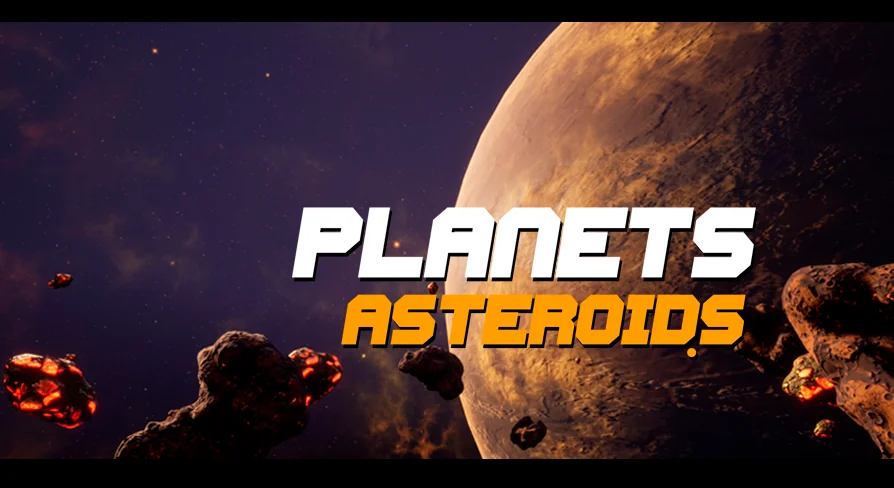
Staging believable exterior space environments requires balancing massive macro structures against minute, foreground details. In a typical orbital or deep-space scene, background scale is established by massive planetary bodies and distant celestial vistas, while immediate depth and player collision rely on fields of rocky debris. Asteroids Planet addresses this entire visual hierarchy by packaging both ends of the scale spectrum into a unified assembly. The package brings together sky backdrops, planetary surface shaders, unique rock meshes, and specialized object materials designed to produce realistic space scenes.
Space scenes present distinct challenges regarding empty space and scale reference. Without atmospheric haze or terrestrial horizon lines, depth perception depends entirely on how light strikes solid surfaces against the void. By combining celestial spheres, volumetric sky domes, high-resolution texture maps, and distinct rocky bodies, artists can assemble convincing space vistas. Whether orchestrating an intense orbital dogfight, a slow-paced mining sequence, or a cinematic vista, having an integrated collection of assets ensures consistent lighting behavior and visual continuity across the entire environment.
Atmospheric and Deep Space Framing via Space SkyDome and Sky Blueprint
The foundation of any exterior space level is its backdrop. Asteroids Planet includes 10 Space SkyDome assets, each providing a distinct ambient setting for celestial stages. These sky domes define the panoramic boundaries of the scene, wrapping the playable volume in varied cosmic environments that dictate the global color palette, nebula patterns, and distant star density. Selecting a specific sky dome instantly establishes the lighting conditions of the scene, whether the environment demands cold, high-contrast black voids or colorful regions illuminated by nearby stellar phenomena.
To control and integrate these expansive environments, the package incorporates a Sky Blueprint. Managing celestial spheres and sky materials through a blueprint setup allows for organized environment control within the project workflow. Instead of manually aligning multiple sphere meshes or wrestling with complex coordinate transforms in standard viewports, the Sky Blueprint serves as the central operational hub for backdrop positioning and visual balancing. This setup ensures that the background environment correctly responds to directional sunlight and camera movements without exposing unwanted edge seams or texture stretching at the perimeter of the level.
Surface Variation Across 12 Materials of Planets
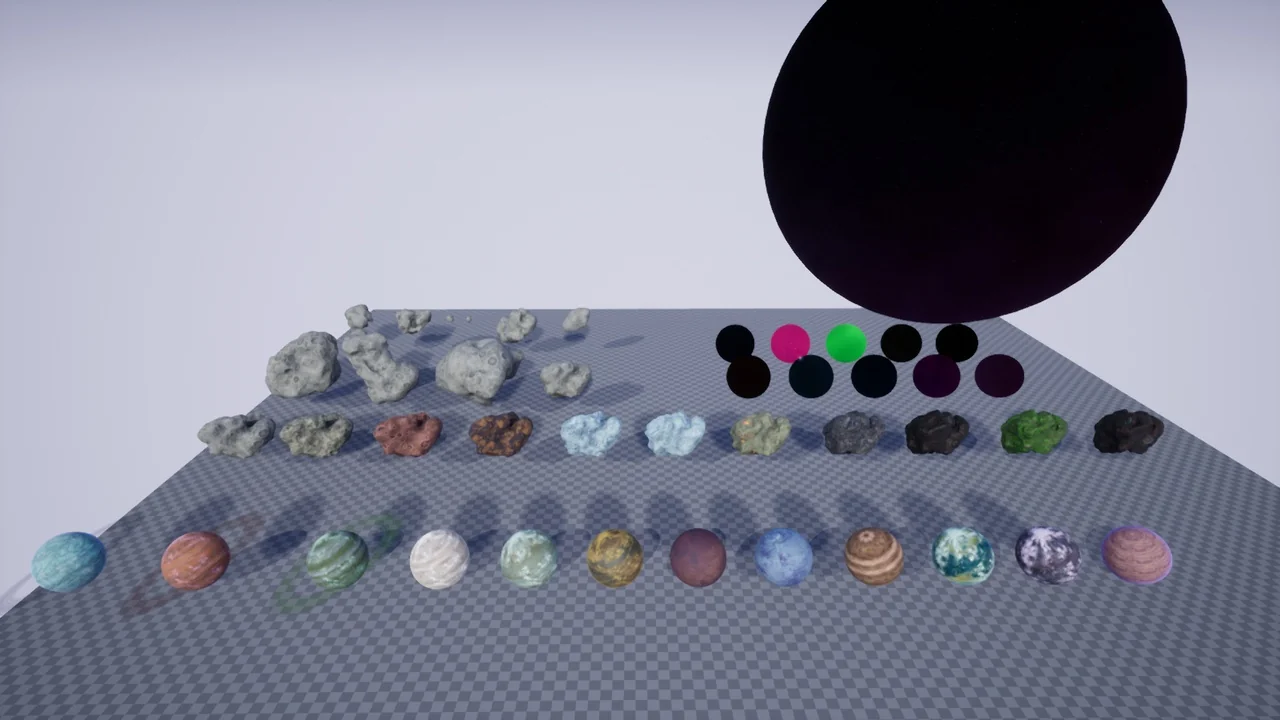
Planetary bodies dominate deep-space vistas, serving as primary visual anchors that orient the player in the void. Asteroids Planet features 12 Materials of Planets, providing diverse surface treatments for distant or mid-ground spheres. In a realistic level design pipeline, these planet materials allow developers to populate orbital spaces with a wide variety of planetary types—ranging from barren, crater-swept terrestrial worlds and frozen rock spheres to complex atmospheric gas giants and volcanic surfaces.
Because the collection offers twelve distinct planet materials, environmental artists can establish narrative context across multiple stages or zones without reusing the exact same planetary shader. A stage set in low orbit around a volatile, cracked world can easily be repurposed into an icy moon system or an arid planetary fringe simply by swapping the applied planet material. These shaders rely on a substantial portion of the pack's 91 textures, generating realistic surface relief, specular variation, and limb darkening that holds up under dynamic space lighting.
Asteroid Meshes, Asteroid Materials, and Materials of Loot
While planets and sky domes establish the distant vista, navigable fields require distinct physical geometry. The package provides 10 Models of Asteroids, featuring irregular silhouettes, varied impact craters, and jagged geometric profiles characteristic of realistic cosmic debris. These models supply the structural foundation for everything from solitary landmark rocks to dense, navigable minefields.
Surface diversity across these ten meshes is driven by 11 Materials of Asteroids. Rather than locking each 3D model to a single static texture set, the availability of eleven dedicated rock materials enables cross-application. Applying different asteroid materials across the ten asteroid models yields over a hundred potential combinations. A single asteroid mesh can appear as porous, weathered silicate in one cluster, and metallic or dark carbonaceous stone in another, preventing visual repetition across large asteroid belts.
Beyond natural rock formations, the collection incorporates dedicated Materials of Loot. In interactive gameplay scenarios, distinguishing between inert environmental obstacles and harvestable or objective-focused objects is critical. The materials of loot provide targeted surface treatments to denote resource-rich deposits, valuable mineral veins, or interactable debris embedded directly within the asteroid fields. This allows developers to integrate game mechanics directly into the realistic rock formations without breaking the visual cohesion of the environment.
Scene Layout and Architecture in the 10 Demonstration Maps
Understanding how disparate models, sky domes, and materials integrate into a cohesive scene is made straightforward through 10 Demonstration Maps. These pre-built maps illustrate functional compositions of the pack's assets, showing how the Sky Blueprint, 10 Space SkyDome variants, and 12 planet materials interact under realistic lighting setups.
Studying these demonstration maps offers direct insight into level staging:
Focal Composition: Examining the placement and scaling of planet bodies relative to the playable volume.
Cluster Density: Observing how the 10 asteroid models are layered and rotated to generate dense fields without obvious repetition.
Lighting Integration: Reviewing how directional lighting works in tandem with the sky domes to bring out the normal and roughness detail from the 91 textures.
Rather than starting from a blank scene, these demonstration maps can be used as functional testing grounds, direct references for lighting balance, or structural jumping-off points for complete production levels.
Texture Budget and Practical Implementation
The visual fidelity of the pack is backed by a library of 91 textures distributed across the meshes, sky domes, and material shaders. These textures deliver the realistic surface data needed for crisp asteroid fissures, fine planetary atmospheric banding, and crisp celestial sky maps. Because the textures are shared across multiple material archetypes—spanning planets, asteroid rocks, loot, and sky domes—memory footprint remains structured while visual variety is maximized.
Asteroids Planet is built for developers and technical artists building space-flight combat games, orbital simulators, space exploration environments, and cinematic sci-fi scenes. The modular separation between geometry, sky blueprints, planetary shaders, and interactive loot materials provides a versatile toolkit. Teams needing rapid, realistic space level staging can leverage the demonstration maps immediately, while those constructing custom procedural belts can utilize the asteroid models and material combinations to populate wide-scale cosmic sandboxes with consistent visual fidelity.
 Sky & Space
 Sky & Space
 Sky & Space
 Sky & Space