"efaa631e936fd3ee"{"id":"1002211","slug":"stealth-finishers-knife-and-hand","title":"Stealth Finishers - knife and hand","category":"Combat","engine":"4.24+,5.0+","assetVersion":"","engineVersion":"Engine Version: 4.24+,5.0+","tag":"Combat","accent":"blue","visual":"mech","summary":"A comprehensive breakdown of knife and hand stealth finishers, paired takedowns, crouch locomotion, wall cover, and body-dragging animations.","platform":"Unreal Engine","publishedAt":"2026-10-29T14:55:11.500Z","updatedAt":"2026-10-29T14:55:11.500Z","sourceNotes":[],"fileContents":[],"compatibility":["Unreal Engine","Engine Version: 4.24+,5.0+"],"featuredImage":{"alt":"Stealth Finishers - knife and hand","src":"/wp-content/uploads/published/2026/10/7f71d6620f55-356e9fdb-d59f-4463-95d3-4cf0884cd260-6c55180582.webp"},"hasDownloadLink":true,"downloads":0,"terms":[{"taxonomy":"category","slug":"combat","name":"Combat"}],"galleryImages":[{"src":"/wp-content/uploads/published/2026/10/a436a39fc94f-05d6948f-9e5c-4e8a-bbc0-7d58c7338cf4-9d51a769b7.webp","alt":"Stealth Finishers - knife and hand"},{"src":"/wp-content/uploads/published/2026/10/5937810a2e2b-d46f7eeb-42e0-489d-a76f-98f4db77551e-0be63b04a6.webp","alt":"Stealth Finishers - knife and hand"},{"src":"/wp-content/uploads/published/2026/10/2a22c2aea99f-fb708145-7e61-4e89-93d5-35c6b3ea5148-ebbd401766.webp","alt":"Stealth Finishers - knife and hand"},{"src":"/wp-content/uploads/published/2026/10/f41b8b9de4b8-24f3b5b8-2f78-4b7a-8fa4-43d9f8ade51c-322dab0c31.webp","alt":"Stealth Finishers - knife and hand"},{"src":"/wp-content/uploads/published/2026/10/5985fc364c1a-3dce2c47-34cb-4bfe-b901-6bab8bbb0cb2-c074a1a1a3.webp","alt":"Stealth Finishers - knife and hand"},{"src":"/wp-content/uploads/published/2026/10/e7ab292c8155-9402b54b-3c69-4d61-8e0b-06950b36e810-d995f00137.webp","alt":"Stealth Finishers - knife and hand"},{"src":"/wp-content/uploads/published/2026/10/6c2476c6365a-bb4525a5-fc24-4439-876e-303b86feef52-299914071f.webp","alt":"Stealth Finishers - knife and hand"},{"src":"/wp-content/uploads/published/2026/10/3904556ee632-a661379a-c3f0-486b-9a0b-329fd71786b4-8bb98141de.webp","alt":"Stealth Finishers - knife and hand"},{"src":"/wp-content/uploads/published/2026/10/37837aec07aa-628b046d-3b70-4353-bcf4-dce1dd758a07-c2736fb1eb.webp","alt":"Stealth Finishers - knife and hand"}],"accessPanel":{"kind":"resource","title":"Download this resource","eyebrow":"Free Download","message":"Log in or create a free account to start your download.","fileName":"Content.7z","safetyNote":"Resources are manually reviewed before listing to improve quality and reduce obvious risks.","actionLabel":"Download Free","resourceType":"Resource archive"},"contentHtml":"\u003ch2\u003eConstructing Close-Quarters Infiltration Sequences\u003c/h2\u003e\n\u003cp\u003eTactical stealth gameplay relies heavily on physical proximity, deliberate pacing, and sudden transitions into lethal combat. Building an infiltration sequence requires continuous flow between quiet movement along patrol paths, hiding behind structural obstacles, and executing clean takedowns when an enemy is vulnerable. The core challenge in setting up these interactions lies in alignment: synchronizing the precise spatial relationship between an aggressor and a target so that a blade strike or bare-handed restraint connects seamlessly in world space.\u003c/p\u003e\n\u003cp\u003eThe collection assembled in Stealth Finishers - knife and hand addresses this pipeline challenge by delivering dedicated synchronized pairs alongside foundational stealth movement. Instead of relying solely on isolated attack swings, the system treats quiet eliminations as collaborative two-character events. This allows developers to stage tense corridor encounters, sudden corner ambushes, and hostage-style interrogations with exact frame-by-frame character interaction.\u003c/p\u003e \u003ch2\u003ePaired Knife and Hand Stealth Finishers\u003c/h2\u003e\n\u003cp\u003eAt the center of the animation library is a large suite of paired combat clips, dividing every interaction cleanly between an attacker (Att) and a victim (Vic). Standard unarmed finishers account for 11 attacker clips and 11 matching victim clips, covering close-range physical takedowns executed purely with bare hands. These motions emphasize control, neck manipulation, and rapid takedowns to ground levels.\u003c/p\u003e\n\u003cp\u003eLethal bladed sequences expand this selection with dedicated knife finishers containing 5 attacker motions matched to 5 victim responses. To complement active kills, the set includes knife interrogation sequences consisting of 4 attacker animations and 4 victim animations. These interrogation states provide extended holds where an operative restrains an enemy at knifepoint, enabling narrative pauses, mechanic checks, or dialogue moments before an elimination takes place.\u003c/p\u003e\n\u003cp\u003eNot every stealth encounter goes as planned, and the pack accounts for execution breakdowns with a paired failed attack set (1 attacker, 1 victim). This allows logic trees to break out of a guaranteed kill sequence if an alert triggers or an input window fails. Managing knife readiness is supported directly through dedicated knife equip and unequip animations, establishing natural visual transitions between passive locomotion and weaponized readiness.\u003c/p\u003e \u003ch2\u003eCrouch Movement, Wall Cover, and Sneak Rolls\u003c/h2\u003e\n\u003cp\u003eBefore an operative reaches striking distance, player controllers require comprehensive stealth locomotion to navigate sightlines and avoid detection cones. The library provides 21 crouch movement animations, mapping out directional creeping, turns, and deliberate low-profile pacing necessary for moving through patrolled zones.\u003c/p\u003e\n\u003cp\u003eEnvironmental concealment is handled through an 8-clip wall cover set. These assets allow characters to snap against vertical surfaces, hold positions, and peer past sightline edges without breaking stealth stance. When a player must cross open doorways or dart between separate cover nodes under pressure, sneak rolls across 4 distinct directions supply rapid, evasive repositioning while keeping the character profile compressed to the floor. When movement ceases entirely, 3 stealth idles sustain character presence without jarring pops or static posturing.\u003c/p\u003e \u003ch2\u003eCarrying, Dragging, and Disposing of Bodies\u003c/h2\u003e\n\u003cp\u003eStealth design frequently requires clearing the play space of evidence after a patrol guard has been neutralized. The library accounts for the post-kill phase through a dedicated carry and drag body system containing 10 attacker clips and 10 victim clips. These paired files handle picking up incapacitated targets, shifting their weight, and navigating them out of active patrol pathways.\u003c/p\u003e\n\u003cp\u003eSuccessive development milestones expanded the body-handling workflow considerably. Update v1.4 introduced 12 specific animations focused squarely on transport fidelity. These additions include:\u003c/p\u003e\n\u003cul\u003e \u003cli\u003eA dedicated carry body throw animation for dumping weight over ledges or into drop zones.\u003c/li\u003e \u003cli\u003eA smoother root version of the drag body loop to eliminate trajectory stutter during sustained hauling.\u003c/li\u003e \u003cli\u003eA root version with smoother root transitions for drag body walks, maintaining consistent ground contact.\u003c/li\u003e \u003cli\u003eA faster drag body walk variation suited to higher-urgency relocation under tighter patrol timers.\u003c/li\u003e\n\u003c/ul\u003e \u003ch2\u003eAnimation Count Breakdown and Technical Integration\u003c/h2\u003e\n\u003cp\u003eThe package contains a base roster of 43 animations, expanded by an additional 56 update animations produced across incremental revisions. Tracking the version history outlines the technical progression of the set:\u003c/p\u003e\n\u003cul\u003e \u003cli\u003eV1.1 delivered 6 new animations.\u003c/li\u003e \u003cli\u003eV1.2 introduced 15 new animations alongside a critical fix for IK root bones, stabilizing foot and limb placement for inverse kinematics solvers.\u003c/li\u003e \u003cli\u003eV1.3 brought 14 new animations.\u003c/li\u003e \u003cli\u003eV1.3.1 contributed 16 new animations to the baseline collection.\u003c/li\u003e \u003cli\u003eV1.3.2 added an extra knife kill alongside specialized 'In place Z Axis' versions of the existing kills to support game engines and movement components that isolate vertical translation from ground-plane root motion.\u003c/li\u003e \u003cli\u003eV1.4 added the 12 advanced carrying and body disposal variations.\u003c/li\u003e\n\u003c/ul\u003e\n\u003cp\u003eFrom an implementation standpoint, the package functions purely as an animation resource. Blueprints are not included, and 3D models are not included. Rigging and animation data also demonstrate direct compatibility with Zombie Animations skeleton standards, broadening potential integration across hostile NPC archetypes. Setting up these animations requires importing the motion files onto a compatible humanoid rig, configuring paired montage triggers inside game code or state machines, and defining interaction transforms to guarantee attacker and victim bones align accurately at the moment of engagement.\u003c/p\u003e\n\n\u003ch2\u003eMore From The Same Workflow\u003c/h2\u003e\n\u003cul\u003e\n\u003cli\u003e\u003ca href=\"https://3dcghub.com/hand-to-hand-finishers-volume-2/\" title=\"Hand to hand finishers Volume 2\"\u003eHand to hand finishers Volume 2\u003c/a\u003e\u003c/li\u003e\n\u003cli\u003e\u003ca href=\"https://3dcghub.com/fps-pistol-and-knife-animations/\" title=\"FPS Pistol And Knife Animations\"\u003eFPS Pistol And Knife Animations\u003c/a\u003e\u003c/li\u003e\n\u003cli\u003e\u003ca href=\"https://3dcghub.com/hand-to-hand-finishers-volume-1/\" title=\"Hand to Hand finishers Volume 1\"\u003eHand to Hand finishers Volume 1\u003c/a\u003e\u003c/li\u003e\n\u003cli\u003e\u003ca href=\"https://3dcghub.com/first-person-knife/\" title=\"First Person Knife\"\u003eFirst Person Knife\u003c/a\u003e\u003c/li\u003e\n\u003cli\u003e\u003ca href=\"https://3dcghub.com/one-hand-sword-attacks-and-finishers/\" title=\"One Hand Sword Attacks And Finishers\"\u003eOne Hand Sword Attacks And Finishers\u003c/a\u003e\u003c/li\u003e\n\u003c/ul\u003e","contentTextLength":6049,"navigation":{"current":74,"total":4209,"previous":{"id":"1002212","slug":"steampunk-assault-rifle","title":"SteamPunk Assault Rifle","category":"Weapons \u0026 Combat","platform":"Unreal Engine","updatedAt":"2026-10-29T14:57:19.839Z"},"next":{"id":"1002210","slug":"starry-sky","title":"Starry Sky","category":"Sky \u0026 Space","platform":"Unreal Engine","updatedAt":"2026-10-29T14:54:09.713Z"}},"relatedResources":[{"id":"1000520","slug":"hand-to-hand-finishers-volume-2","title":"Hand to hand finishers Volume 2","category":"Combat","engine":"4.26+,5.0+","assetVersion":"","engineVersion":"Engine Version: 4.26+,5.0+","tag":"Combat","accent":"blue","visual":"mech","summary":"A set of 26 paired hand-to-hand finisher animations built on the Unreal Mannequin skeleton, covering attacker and victim choreography for combat games.","platform":"Unreal Engine","publishedAt":"2026-07-14T13:05:15.439Z","updatedAt":"2026-07-14T13:05:15.439Z","sourceNotes":[],"fileContents":[],"compatibility":["Unreal Engine","Engine Version: 4.26+,5.0+"],"featuredImage":{"alt":"Hand to hand finishers Volume 2","src":"/wp-content/uploads/published/2026/07/1d183fef9d28-cac528bb-6b9c-4a3d-971d-37d7237e6fd7-a2bc220a51.webp"},"hasDownloadLink":true,"downloads":7},{"id":"1000368","slug":"fps-pistol-and-knife-animations","title":"FPS Pistol And Knife Animations","category":"Combat","engine":"4.26+,5.0+","assetVersion":"","engineVersion":"Engine Version: 4.26+,5.0+","tag":"Combat","accent":"blue","visual":"animation","summary":"A focused first-person animation package featuring a lowpoly realistic pistol, a knife, multiple hand skins, and a comprehensive suite of movement and combat an","platform":"Unreal Engine","publishedAt":"2026-07-06T08:29:39.574Z","updatedAt":"2026-07-06T08:29:39.574Z","sourceNotes":[],"fileContents":[],"compatibility":["Unreal Engine","Engine Version: 4.26+,5.0+"],"featuredImage":{"alt":"FPS Pistol And Knife Animations","src":"/wp-content/uploads/published/2026/07/abde68c64c0a-cc6a489e-7533-4873-aac3-50fc2af822f0-1f84b54845.webp"},"hasDownloadLink":true,"downloads":6},{"id":"1000514","slug":"hand-to-hand-finishers-volume-1","title":"Hand to Hand finishers Volume 1","category":"Combat","engine":"4.26+,5.0+","assetVersion":"","engineVersion":"Engine Version: 4.26+,5.0+","tag":"Combat","accent":"blue","visual":"mech","summary":"Hand to Hand finishers Volume 1 provides 25+ Unreal Mannequin animations, including paired combat finishers, individual attacks, and idles for melee projects.","platform":"Unreal Engine","publishedAt":"2026-07-13T13:59:47.127Z","updatedAt":"2026-07-13T13:59:47.127Z","sourceNotes":[],"fileContents":[],"compatibility":["Unreal Engine","Engine Version: 4.26+,5.0+"],"featuredImage":{"alt":"Hand to Hand finishers Volume 1","src":"/wp-content/uploads/published/2026/07/d8344be05cc2-b9229e40-187d-4503-8792-f555f16bb160-92c7205df8.webp"},"hasDownloadLink":true,"downloads":4}]}
Combat
Stealth Finishers - knife and hand
A comprehensive breakdown of knife and hand stealth finishers, paired takedowns, crouch locomotion, wall cover, and body-dragging animations.
Category:Unreal Engine,CombatPlatform: Unreal EngineEngine Version: 4.24+,5.0+Published: Oct 29, 2026
Tactical stealth gameplay relies heavily on physical proximity, deliberate pacing, and sudden transitions into lethal combat. Building an infiltration sequence requires continuous flow between quiet movement along patrol paths, hiding behind structural obstacles, and executing clean takedowns when an enemy is vulnerable. The core challenge in setting up these interactions lies in alignment: synchronizing the precise spatial relationship between an aggressor and a target so that a blade strike or bare-handed restraint connects seamlessly in world space.
The collection assembled in Stealth Finishers - knife and hand addresses this pipeline challenge by delivering dedicated synchronized pairs alongside foundational stealth movement. Instead of relying solely on isolated attack swings, the system treats quiet eliminations as collaborative two-character events. This allows developers to stage tense corridor encounters, sudden corner ambushes, and hostage-style interrogations with exact frame-by-frame character interaction.
Paired Knife and Hand Stealth Finishers
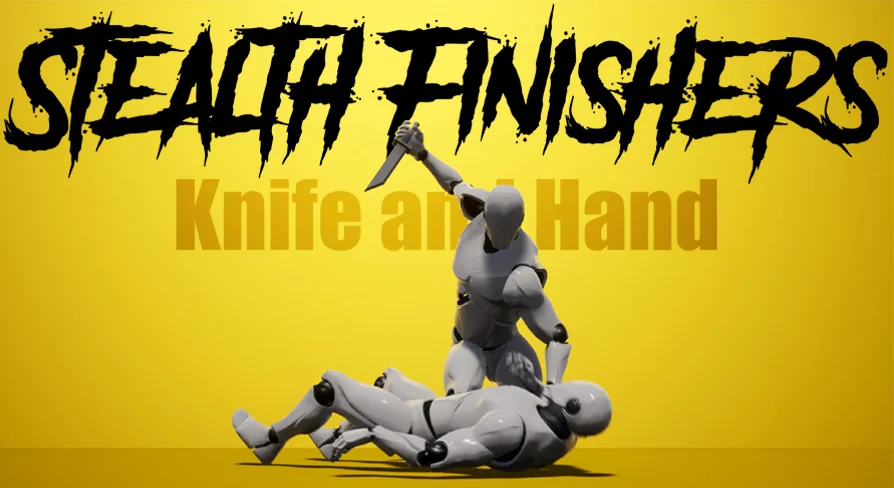
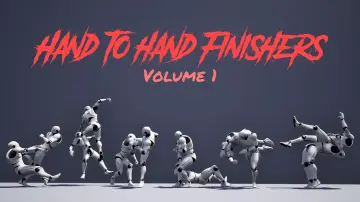
At the center of the animation library is a large suite of paired combat clips, dividing every interaction cleanly between an attacker (Att) and a victim (Vic). Standard unarmed finishers account for 11 attacker clips and 11 matching victim clips, covering close-range physical takedowns executed purely with bare hands. These motions emphasize control, neck manipulation, and rapid takedowns to ground levels.
Lethal bladed sequences expand this selection with dedicated knife finishers containing 5 attacker motions matched to 5 victim responses. To complement active kills, the set includes knife interrogation sequences consisting of 4 attacker animations and 4 victim animations. These interrogation states provide extended holds where an operative restrains an enemy at knifepoint, enabling narrative pauses, mechanic checks, or dialogue moments before an elimination takes place.
Not every stealth encounter goes as planned, and the pack accounts for execution breakdowns with a paired failed attack set (1 attacker, 1 victim). This allows logic trees to break out of a guaranteed kill sequence if an alert triggers or an input window fails. Managing knife readiness is supported directly through dedicated knife equip and unequip animations, establishing natural visual transitions between passive locomotion and weaponized readiness.
Crouch Movement, Wall Cover, and Sneak Rolls
Before an operative reaches striking distance, player controllers require comprehensive stealth locomotion to navigate sightlines and avoid detection cones. The library provides 21 crouch movement animations, mapping out directional creeping, turns, and deliberate low-profile pacing necessary for moving through patrolled zones.
Environmental concealment is handled through an 8-clip wall cover set. These assets allow characters to snap against vertical surfaces, hold positions, and peer past sightline edges without breaking stealth stance. When a player must cross open doorways or dart between separate cover nodes under pressure, sneak rolls across 4 distinct directions supply rapid, evasive repositioning while keeping the character profile compressed to the floor. When movement ceases entirely, 3 stealth idles sustain character presence without jarring pops or static posturing.
Carrying, Dragging, and Disposing of Bodies
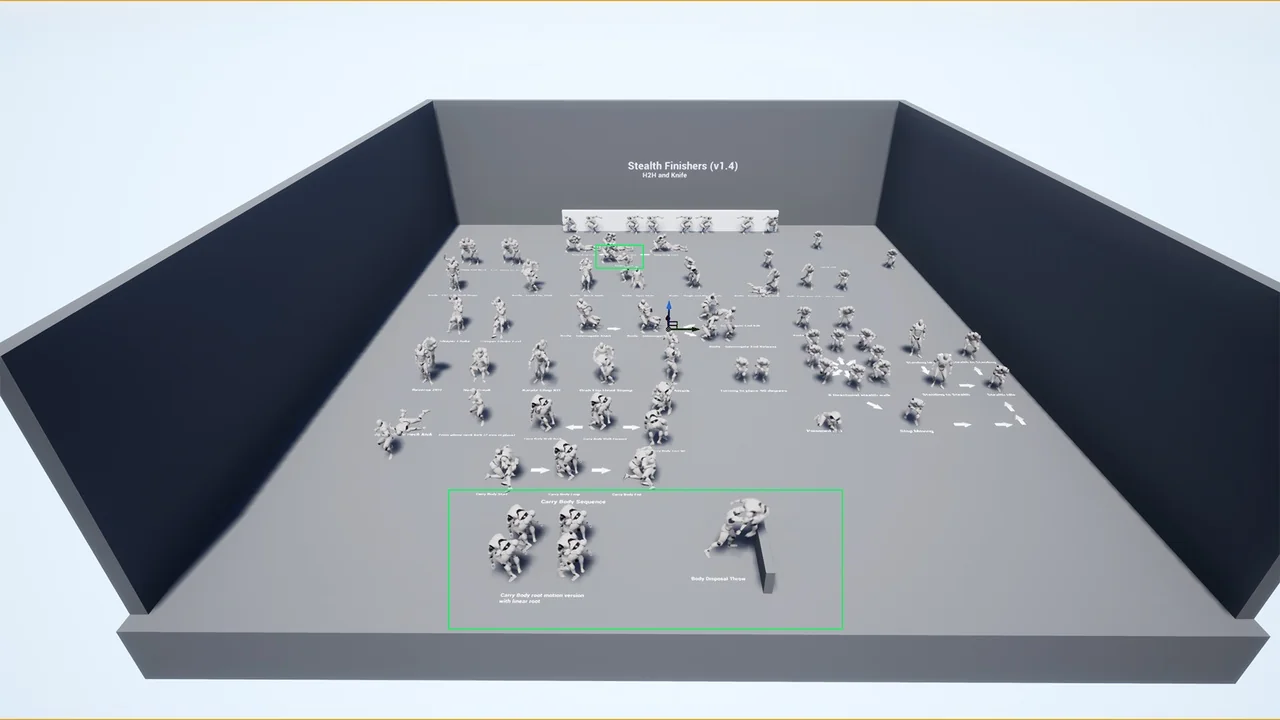
Stealth design frequently requires clearing the play space of evidence after a patrol guard has been neutralized. The library accounts for the post-kill phase through a dedicated carry and drag body system containing 10 attacker clips and 10 victim clips. These paired files handle picking up incapacitated targets, shifting their weight, and navigating them out of active patrol pathways.
Successive development milestones expanded the body-handling workflow considerably. Update v1.4 introduced 12 specific animations focused squarely on transport fidelity. These additions include:
A dedicated carry body throw animation for dumping weight over ledges or into drop zones.
A smoother root version of the drag body loop to eliminate trajectory stutter during sustained hauling.
A root version with smoother root transitions for drag body walks, maintaining consistent ground contact.
A faster drag body walk variation suited to higher-urgency relocation under tighter patrol timers.
Animation Count Breakdown and Technical Integration
The package contains a base roster of 43 animations, expanded by an additional 56 update animations produced across incremental revisions. Tracking the version history outlines the technical progression of the set:
V1.1 delivered 6 new animations.
V1.2 introduced 15 new animations alongside a critical fix for IK root bones, stabilizing foot and limb placement for inverse kinematics solvers.
V1.3 brought 14 new animations.
V1.3.1 contributed 16 new animations to the baseline collection.
V1.3.2 added an extra knife kill alongside specialized 'In place Z Axis' versions of the existing kills to support game engines and movement components that isolate vertical translation from ground-plane root motion.
V1.4 added the 12 advanced carrying and body disposal variations.
From an implementation standpoint, the package functions purely as an animation resource. Blueprints are not included, and 3D models are not included. Rigging and animation data also demonstrate direct compatibility with Zombie Animations skeleton standards, broadening potential integration across hostile NPC archetypes. Setting up these animations requires importing the motion files onto a compatible humanoid rig, configuring paired montage triggers inside game code or state machines, and defining interaction transforms to guarantee attacker and victim bones align accurately at the moment of engagement.
 Combat
 Combat
 Combat
 Combat