"c68a05d5e51405b3"{"id":"1000684","slug":"spatial-system","title":"Spatial System","category":"Gameplay Features","engine":"5.6","assetVersion":"Asset Version: 1.3","engineVersion":"Engine Version: 5.6","tag":"Gameplay Features","accent":"blue","visual":"mech","summary":"Unreal Engine plugin for spatial computation, entity management, movement processing, and collision optimization across large-scale game environments.","platform":"Unreal Engine","publishedAt":"2026-07-22T16:46:36.800Z","updatedAt":"2026-07-22T16:46:36.800Z","sourceNotes":[],"fileContents":[],"compatibility":["Unreal Engine","Asset Version: 1.3","Engine Version: 5.6"],"featuredImage":{"alt":"Spatial System","src":"/wp-content/uploads/published/2026/07/ed09bfe937d6-40d8bc1d-58db-45fa-9c70-38397a017d06-fccf883e73.webp"},"hasDownloadLink":true,"downloads":0,"terms":[{"taxonomy":"category","slug":"gameplay-features-tools-and-plugins","name":"Gameplay Features"}],"galleryImages":[{"src":"/wp-content/uploads/published/2026/07/3f77692bf307-e4ee7686-b267-45a7-9be6-4d014daa581b-5a05d36bcf.webp","alt":"Spatial System"}],"accessPanel":{"kind":"resource","title":"Download this resource","eyebrow":"Free Download","message":"Log in or create a free account to start your download.","fileName":"5.6.7z","safetyNote":"Resources are manually reviewed before listing to improve quality and reduce obvious risks.","actionLabel":"Download Free","resourceType":"Resource archive"},"contentHtml":"\u003cp\u003eThe Spatial System is an Unreal Engine framework based on spatial computations and entity management. At its core, the package provides tools for managing large collections of entities, executing spatial queries, and optimizing how movement and collision behaviors are processed. The focus is on gameplay elements and the efficient optimizations required when dealing with dense, interactive environments. For projects relying on movement processors, the framework targets games and simulations where dynamic interactions unfold across large, complex spaces.\u003c/p\u003e\n\n\u003ch2\u003eManaging Large Entity Collections and Spatial Queries\u003c/h2\u003e\n\u003cp\u003eHandling thousands of individual Actors demands a structured approach to how those Actors are tracked and queried. The Spatial System provides a toolset for managing large collections of entities, which allows projects to maintain performance during intensive operations. Spatial queries are the primary method used to interact with these collections. Instead of relying on brute-force checks, the system computes spatial relationships to filter and retrieve relevant entities. This directly impacts how movement and collision behaviors are optimized, as the framework can isolate the specific entities that require processing during a given frame.\u003c/p\u003e\n\u003cp\u003eThe tag set associated with the framework—Trace, Gameplay, Grid, Collision, Spatial, Movement, and Selection—outlines the operational axes of the system. Tracing and spatial queries handle the detection of entities within defined volumes. Grid and collision components manage the spatial partitioning necessary to prevent performance bottlenecks. Movement and selection tools give developers the ability to manipulate grouped entities, which is particularly relevant for simulations where many agents must react to environmental changes simultaneously.\u003c/p\u003e\n\n\u003ch2\u003eBuilding Extensible Gameplay for ARPG, RTS, and Crowd Simulations\u003c/h2\u003e\n\u003cp\u003eThe framework is designed to be extensible. Developers can build on its foundation to create specialized gameplay systems tailored to specific genres. The system directly references several use cases where this extensibility applies, including action RPGs, real-time strategy unit management, and crowd simulations. In an RTS context, the entity management tools provide a means to handle large numbers of units, while the spatial query system allows for efficient selection and targeting across a battlefield. For ARPGs, the framework supports the processing of projectiles, orientation targeting, and pickups, which require precise spatial tracking and collision response.\u003c/p\u003e\n\u003cp\u003eDynamic world generation is another targeted use case. The same spatial computation and grid-based management tools used for unit movement can be applied to the construction and management of procedurally generated environments. The framework provides the underlying structure for determining where elements should be placed and how they interact with existing entities in the world.\u003c/p\u003e\n\n\u003ch2\u003eUE Mass Framework and SIMD Operations\u003c/h2\u003e\n\u003cp\u003eBeyond raw entity tracking, the system includes gameplay components for animation. These components are built to allow seamless integration with the Unreal Engine StateTree. A specific movement component included in the framework utilizes the UE Mass framework. By operating across multiple threads and leveraging highly optimized SIMD (Single Instruction, Multiple Data) instructions, this multithreaded approach allows the system to process massive volumes of entity updates without stalling the main game thread.\u003c/p\u003e\n\u003cp\u003eThe integration with the UE StateTree provides a direct link between the spatial entity management and the animation behavior of those entities. When a movement processor updates an entity's position, the StateTree integration allows the corresponding animation logic to respond. This combination of the Mass framework for movement and the StateTree for animation behavior creates a workflow where large groups of entities can move and react with minimal manual synchronization between systems.\u003c/p\u003e\n\n\u003ch2\u003eWorkflow Context for Movement Processors in Complex Environments\u003c/h2\u003e\n\u003cp\u003eThe package fits into a production workflow where standard Actor processing becomes a bottleneck. In large, complex environments, traditional collision and movement checks can consume significant frame time. The Spatial System addresses this by shifting the processing load to spatial computations and multi-threaded entity management. For games and simulations with dynamic interactions, the system provides a foundation where movement processors can operate on grouped entities rather than individual Actors. This approach is applicable to scenarios ranging from RTS battles with hundreds of units to ARPG combat with numerous projectiles and interactable pickups.\u003c/p\u003e\n\n\u003ch2\u003eVertex Animation Manager and Forward Compatibility\u003c/h2\u003e\n\u003cp\u003eThe framework has a noted compatibility path with the Vertex Animation Manager Plugin. For developers using that plugin, the next update of the Spatial System will compile alongside it to enable Spatial ISM Components. This integration is set to function without requiring code changes to the Vertex Animation Manager Plugin. The goal is to allow the two systems to work together, linking vertex animation workflows with the spatial entity management provided by the Spatial System.\u003c/p\u003e\n\n\u003ch2\u003eEarly Development Features and Progression\u003c/h2\u003e\n\u003cp\u003eCertain features within the framework are still in early development. The system may not function seamlessly in every situation without adjustments. The developer notes that feedback is important for shaping the future of the product, and users encountering issues or requiring specific features are directed to the community channels for support and updates. This indicates that the framework is an active project, with ongoing development focused on refining the spatial computation tools and expanding the gameplay components.\u003c/p\u003e\n\u003cp\u003eThe Spatial System is set up to handle the processing of large-scale entity interactions in Unreal Engine. By combining spatial queries, multi-threaded movement processing via UE Mass, and integration with the StateTree, the framework provides a foundation for projects that require efficient entity management in complex environments.\u003c/p\u003e\n\n\u003ch2\u003eMore From The Same Workflow\u003c/h2\u003e\n\u003cul\u003e\n\u003cli\u003e\u003ca href=\"https://3dcghub.com/flex-partition-optimization-system/\" title=\"Flex Partition - Optimization System\"\u003eFlex Partition - Optimization System\u003c/a\u003e\u003c/li\u003e\n\u003cli\u003e\u003ca href=\"https://3dcghub.com/gbwflowmove-high-speed-movement-system-multiplayer-ready/\" title=\"GBWFlowMove - High-speed Movement system, Multiplayer Ready!\"\u003eGBWFlowMove - High-speed Movement system, Multiplayer Ready!\u003c/a\u003e\u003c/li\u003e\n\u003cli\u003e\u003ca href=\"https://3dcghub.com/flexpath-smooth-navigation/\" title=\"FlexPath – Smooth Navigation\"\u003eFlexPath – Smooth Navigation\u003c/a\u003e\u003c/li\u003e\n\u003cli\u003e\u003ca href=\"https://3dcghub.com/significance-optimizer-game-thread-cpu-optimization/\" title=\"Significance Optimizer - Game Thread/CPU Optimization\"\u003eSignificance Optimizer - Game Thread/CPU Optimization\u003c/a\u003e\u003c/li\u003e\n\u003cli\u003e\u003ca href=\"https://3dcghub.com/ultimate-gameplay-camera/\" title=\"Ultimate Gameplay Camera\"\u003eUltimate Gameplay Camera\u003c/a\u003e\u003c/li\u003e\n\u003c/ul\u003e","contentTextLength":6397,"navigation":{"current":1321,"total":3860,"previous":{"id":"1000685","slug":"steam-package-and-publish-tool","title":"Steam Package \u0026 Publish Tool","category":"Engine Tools","platform":"Unreal Engine","updatedAt":"2026-07-22T17:25:15.449Z"},"next":{"id":"1000683","slug":"space-colony-and-sci-fi-city","title":"Space Colony \u0026 Sci-Fi City","category":"Sci-Fi","platform":"Unreal Engine","updatedAt":"2026-07-22T16:41:05.632Z"}},"relatedResources":[{"id":"15012","slug":"flex-partition-optimization-system","title":"Flex Partition - Optimization System","category":"Gameplay Features","engine":"5.5","assetVersion":"Engine version: 5.5","engineVersion":"Asset Version:1.7","tag":"Gameplay Features","accent":"blue","visual":"luts","summary":"Flex Partition - Optimization System offers a sophisticated way to manage runtime and procedural actors using spatial hash grids. It prevents frame spikes through rate-limited streaming while maintaining actor states during activation cycles.","platform":"Unreal Engine","publishedAt":"2026-03-12T07:25:29.000Z","updatedAt":"2026-04-19T15:45:37.000Z","sourceNotes":[],"fileContents":[],"compatibility":["Unreal Engine","Engine version: 5.5","Asset Version: 1.7"],"featuredImage":{"alt":"Flex Partition - Optimization System","src":"https://3dcghub.com/wp-content/uploads/2026/03/df6dfa1a-d220-474e-a529-dd86fc919bf8.webp"},"hasDownloadLink":true,"downloads":0},{"id":"15092","slug":"tile-based-minimap","title":"Tile Based Minimap","category":"Gameplay Features","engine":"5.3 - 5.5","assetVersion":"Asset Version: 1.2.2 - 2.1.1","engineVersion":"Engine Version: 5.3 - 5.5","tag":"Gameplay Features","accent":"blue","visual":"mech","summary":"The Tile Based Minimap system provides a robust solution for creating tiled in-game maps using pre-rendered level images. It features GPS-style routing, multi-grid support, and full Blueprint extensibility.","platform":"Unreal Engine","publishedAt":"2026-03-12T07:51:23.000Z","updatedAt":"2026-10-08T12:57:55.645Z","sourceNotes":[],"fileContents":[],"compatibility":["Unreal Engine","Asset Version: 1.2.2 - 2.1.1","Engine Version: 5.3 - 5.5"],"featuredImage":{"alt":"Tile Based Minimap","src":"https://3dcghub.com/wp-content/uploads/2026/03/768cc7d5-0ca5-439b-b02a-f4807a2c39bd.webp"},"hasDownloadLink":true,"downloads":4},{"id":"14999","slug":"customizable-interaction-plugin","title":"Customizable Interaction Plugin","category":"Gameplay Features","engine":"5.2 - 5.7","assetVersion":"Asset Version:1.0.1 - 2.0.4","engineVersion":"Engine version: 5.2 - 5.7","tag":"Gameplay Features","accent":"blue","visual":"character","summary":"The Customizable Interaction Plugin is a high-performance C++ tool designed for easy implementation. It features various interaction modes, detection settings, and full network replication.","platform":"Unreal Engine","publishedAt":"2026-03-12T07:22:15.000Z","updatedAt":"2026-09-30T04:21:56.258Z","sourceNotes":[],"fileContents":[],"compatibility":["Unreal Engine","Asset Version:1.0.1 - 2.0.4","Engine version: 5.2 - 5.7"],"featuredImage":{"alt":"Customizable Interaction Plugin","src":"https://3dcghub.com/wp-content/uploads/2026/03/61633308-c75d-4c5d-99bd-54efe2e0d535.webp"},"hasDownloadLink":true,"downloads":3}]}
Gameplay Features
Spatial System
Unreal Engine plugin for spatial computation, entity management, movement processing, and collision optimization across large-scale game environments.
The Spatial System is an Unreal Engine framework based on spatial computations and entity management. At its core, the package provides tools for managing large collections of entities, executing spatial queries, and optimizing how movement and collision behaviors are processed. The focus is on gameplay elements and the efficient optimizations required when dealing with dense, interactive environments. For projects relying on movement processors, the framework targets games and simulations where dynamic interactions unfold across large, complex spaces.
Managing Large Entity Collections and Spatial Queries
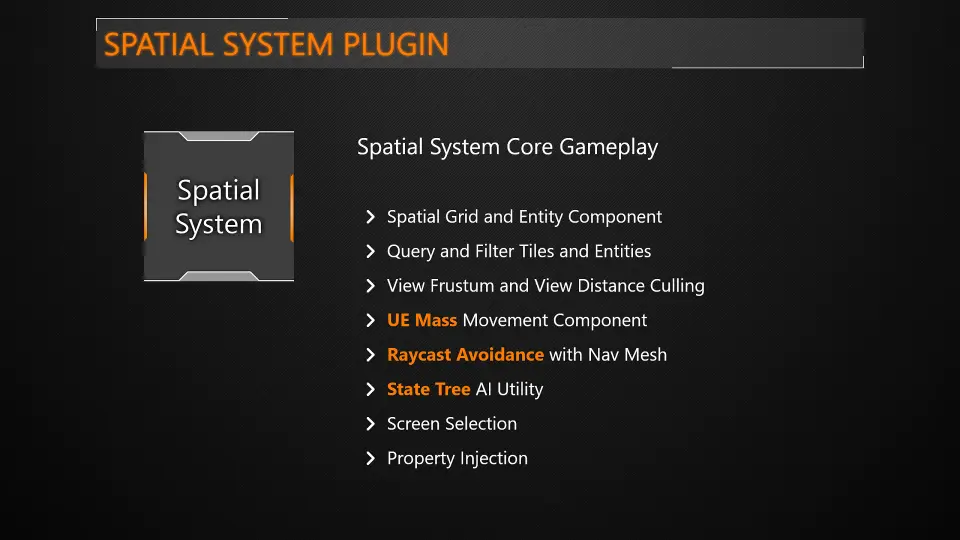
Handling thousands of individual Actors demands a structured approach to how those Actors are tracked and queried. The Spatial System provides a toolset for managing large collections of entities, which allows projects to maintain performance during intensive operations. Spatial queries are the primary method used to interact with these collections. Instead of relying on brute-force checks, the system computes spatial relationships to filter and retrieve relevant entities. This directly impacts how movement and collision behaviors are optimized, as the framework can isolate the specific entities that require processing during a given frame.
The tag set associated with the framework—Trace, Gameplay, Grid, Collision, Spatial, Movement, and Selection—outlines the operational axes of the system. Tracing and spatial queries handle the detection of entities within defined volumes. Grid and collision components manage the spatial partitioning necessary to prevent performance bottlenecks. Movement and selection tools give developers the ability to manipulate grouped entities, which is particularly relevant for simulations where many agents must react to environmental changes simultaneously.
Building Extensible Gameplay for ARPG, RTS, and Crowd Simulations
The framework is designed to be extensible. Developers can build on its foundation to create specialized gameplay systems tailored to specific genres. The system directly references several use cases where this extensibility applies, including action RPGs, real-time strategy unit management, and crowd simulations. In an RTS context, the entity management tools provide a means to handle large numbers of units, while the spatial query system allows for efficient selection and targeting across a battlefield. For ARPGs, the framework supports the processing of projectiles, orientation targeting, and pickups, which require precise spatial tracking and collision response.
Dynamic world generation is another targeted use case. The same spatial computation and grid-based management tools used for unit movement can be applied to the construction and management of procedurally generated environments. The framework provides the underlying structure for determining where elements should be placed and how they interact with existing entities in the world.
UE Mass Framework and SIMD Operations
Beyond raw entity tracking, the system includes gameplay components for animation. These components are built to allow seamless integration with the Unreal Engine StateTree. A specific movement component included in the framework utilizes the UE Mass framework. By operating across multiple threads and leveraging highly optimized SIMD (Single Instruction, Multiple Data) instructions, this multithreaded approach allows the system to process massive volumes of entity updates without stalling the main game thread.
The integration with the UE StateTree provides a direct link between the spatial entity management and the animation behavior of those entities. When a movement processor updates an entity's position, the StateTree integration allows the corresponding animation logic to respond. This combination of the Mass framework for movement and the StateTree for animation behavior creates a workflow where large groups of entities can move and react with minimal manual synchronization between systems.
Workflow Context for Movement Processors in Complex Environments
The package fits into a production workflow where standard Actor processing becomes a bottleneck. In large, complex environments, traditional collision and movement checks can consume significant frame time. The Spatial System addresses this by shifting the processing load to spatial computations and multi-threaded entity management. For games and simulations with dynamic interactions, the system provides a foundation where movement processors can operate on grouped entities rather than individual Actors. This approach is applicable to scenarios ranging from RTS battles with hundreds of units to ARPG combat with numerous projectiles and interactable pickups.
Vertex Animation Manager and Forward Compatibility
The framework has a noted compatibility path with the Vertex Animation Manager Plugin. For developers using that plugin, the next update of the Spatial System will compile alongside it to enable Spatial ISM Components. This integration is set to function without requiring code changes to the Vertex Animation Manager Plugin. The goal is to allow the two systems to work together, linking vertex animation workflows with the spatial entity management provided by the Spatial System.
Early Development Features and Progression
Certain features within the framework are still in early development. The system may not function seamlessly in every situation without adjustments. The developer notes that feedback is important for shaping the future of the product, and users encountering issues or requiring specific features are directed to the community channels for support and updates. This indicates that the framework is an active project, with ongoing development focused on refining the spatial computation tools and expanding the gameplay components.
The Spatial System is set up to handle the processing of large-scale entity interactions in Unreal Engine. By combining spatial queries, multi-threaded movement processing via UE Mass, and integration with the StateTree, the framework provides a foundation for projects that require efficient entity management in complex environments.
 Gameplay Features
 Gameplay Features
 Gameplay Features
 Gameplay Features