"059e11fbf316ed56"{"id":"1000252","slug":"smooth-sync","title":"Smooth Sync","category":"Network \u0026 Multiplayer","engine":"4.26 - 5.7","assetVersion":"Asset Version: 1.38 - 1.48","engineVersion":"Engine Version: 4.26 - 5.7","tag":"Network","accent":"blue","visual":"mech","summary":"A drop-in multiplayer networking plugin that replaces default Replicate Movement with customizable interpolation, extrapolation, and optional client authority.","platform":"Unreal Engine","publishedAt":"2026-06-30T21:38:04.429Z","updatedAt":"2026-07-06T18:48:58.674Z","sourceNotes":[],"fileContents":[],"compatibility":["Unreal Engine","Asset Version: 1.38 - 1.48","Engine Version: 4.26 - 5.7"],"featuredImage":{"alt":"Smooth Sync","src":"/wp-content/uploads/published/2026/06/44159333889a-4cc1c298-8f30-43e2-b240-a933394c9e0e-b5a28d1d92.webp"},"hasDownloadLink":true,"downloads":1,"terms":[{"taxonomy":"category","slug":"network-and-multiplayer-tools-and-plugins","name":"Network \u0026 Multiplayer"}],"galleryImages":[{"src":"/wp-content/uploads/published/2026/06/6a238381282f-e2b546be-0aa5-4ece-a9cf-1b7c32bed187-c4a4166cdd.webp","alt":"Smooth Sync"},{"src":"/wp-content/uploads/published/2026/06/f3f5b35fcceb-c6a2d347-022f-4a77-b4de-31a3791a642a-c1cff17435.webp","alt":"Smooth Sync"}],"accessPanel":{"kind":"video-resource","title":"Download this video resource","eyebrow":"Free Download","message":"Log in or create a free account to start your download.","fileName":"Smooth Sync.7z","safetyNote":"Resources are manually reviewed before listing to improve quality and reduce obvious risks.","actionLabel":"Download Free","resourceType":"Video download"},"contentHtml":"\u003cp\u003eSmooth Sync operates as a dedicated multiplayer networking plugin built to handle the replication of Actor transforms across a networked environment. Designed as a drop-in module, the system provides a robust alternative to Unreal Engine’s default Replicate Movement mechanics. Rather than relying on the standard engine replication pipeline, the plugin utilizes highly customizable interpolation and extrapolation to smooth out positional updates. This minimizes the visual impact of latency and packet loss during online gameplay. The package is structured to function seamlessly without requiring any initial coding, allowing development teams to immediately apply the syncing logic to their multiplayer projects and see immediate results in how objects move across the network.\u003c/p\u003e \u003ch2\u003eCustom Interpolation and Lag Compensation\u003c/h2\u003e\n\u003cp\u003eNetworked environments inherently suffer from latency, which frequently causes moving objects to stutter, jump, or teleport as positional updates arrive at irregular intervals. Smooth Sync addresses this technical hurdle by performing real-time interpolation and extrapolation to aggressively compensate for lag. Interpolation works by smoothing the transition between known data points received over the network, ensuring that the movement between distinct updates appears continuous and natural to the player.\u003c/p\u003e\n\u003cp\u003eExtrapolation handles situations where data packets are delayed or dropped, mathematically predicting the Actor's trajectory based on its most recent velocity and direction. Because multiplayer games have vastly different requirements depending on their pace, scale, and core mechanics, the plugin’s interpolation and extrapolation algorithms are entirely exposed for adjustment. Developers can tune these settings to match their game's specific needs, creating a customized smoothing profile rather than relying on a rigid, one-size-fits-all networking approach.\u003c/p\u003e \u003ch2\u003eActor Ownership and Data Routing\u003c/h2\u003e\n\u003cp\u003eThe method by which transform data is distributed across the network depends entirely on the ownership status of the Actor in question. Smooth Sync employs distinct routing logic to ensure that positional updates are handled efficiently and logically. For Owned Actors—objects directly controlled by a specific player or client—the plugin takes the transform data from the owning client and transmits it directly to all non-owners in the session. This ensures that the controlling player’s immediate inputs and movements are accurately and rapidly reflected on everyone else’s screen.\u003c/p\u003e\n\u003cp\u003eConversely, for Unowned Actors—such as environmental hazards, neutral AI, moving platforms, or dynamic props—the server maintains strict authority. In these cases, the system reads the transform data directly from the server and broadcasts it out to all connected clients simultaneously. This distinct separation of data routing helps maintain a consistent, synchronized game state across the entire network. Furthermore, the plugin supports this dual-routing functionality seamlessly across both dedicated servers and player-hosted listen servers.\u003c/p\u003e \u003ch2\u003eBypassing Client-Side Prediction\u003c/h2\u003e\n\u003cp\u003eOne of the most significant deviations from standard Unreal Engine replication is the system's unique approach to client authority. Traditionally, networked movement relies heavily on complex client-side prediction algorithms to keep the local player's actions feeling responsive while waiting for the server to validate and confirm the movement. If the server disagrees with the client's predicted position due to latency, the Actor experiences a jarring visual correction, commonly known as rubber-banding.\u003c/p\u003e\n\u003cp\u003eSmooth Sync offers an optional, highly impactful setting that allows clients to determine the definitive position of any Actor they control. By granting this client-level authority over the transform data, the system effectively removes the need for intricate client-side prediction setups. The client simply dictates where the Actor is located in world space, and the network trusts that data, broadcasting the transform to the rest of the session. This configuration can drastically simplify the development of movement mechanics, particularly in fast-paced scenarios where immediate input responsiveness is prioritized over strict, server-side validation.\u003c/p\u003e \u003ch2\u003ePhysics Compatibility and Bandwidth Optimization\u003c/h2\u003e\n\u003cp\u003eIn many multiplayer projects, networking physics-simulated objects can be highly unstable and prone to jitter when compared to syncing standard, kinematically driven characters. Smooth Sync is engineered to handle both physics Actors and non-physics Actors with equal stability. It applies its smoothing algorithms to ensure that tumbling rigid bodies, bouncing projectiles, and standard character meshes all update consistently across all networked screens.\u003c/p\u003e\n\u003cp\u003eTo manage the network load generated by continuous, real-time transform updates, the plugin includes built-in data optimization features. Developers can choose to enable an optional float compression system, which mathematically converts standard transform coordinates into half-floats before they are transmitted across the network. This compression drastically reduces the overall bandwidth footprint required to sync the scene, which is particularly critical in dense environments featuring a high volume of replicated Actors. The system remains highly configurable throughout this entire process, allowing developers to precisely dictate what specific data points to send, the exact frequency at which they are sent, and exactly what the receiving client or server should do with that data upon arrival.\u003c/p\u003e \u003ch2\u003eSource Code Access and Project Integration\u003c/h2\u003e\n\u003cp\u003eWhile the plugin is deliberately designed to operate as a zero-coding, drop-in solution for rapid deployment, it remains fully transparent for technical teams and network engineers. The complete source code is provided alongside the package, featuring highly detailed comments throughout the underlying logic. This allows developers to deeply inspect exactly how the transforms are being routed, how the half-float compression is executed, and how the interpolation mathematics function under the hood.\u003c/p\u003e\n\u003cp\u003eFor projects requiring tight, bespoke integration, this commented source code ensures that the syncing behavior can be modified, optimized, or extended to fit perfectly alongside custom network architecture. Ultimately, Smooth Sync serves as a flexible, bandwidth-conscious foundation for maintaining smooth, consistent Actor movement across any networked environment, ensuring that both client-driven and server-driven entities remain perfectly in sync.\u003c/p\u003e\n\n\u003ch2\u003eMore From The Same Workflow\u003c/h2\u003e\n\u003cul\u003e\n\u003cli\u003e\u003ca href=\"https://3dcghub.com/host-migration-system-v2/\" title=\"Host Migration System V2\"\u003eHost Migration System V2\u003c/a\u003e\u003c/li\u003e\n\u003cli\u003e\u003ca href=\"https://3dcghub.com/mysql-and-mariadb-integration/\" title=\"MySQL and MariaDB Integration\"\u003eMySQL and MariaDB Integration\u003c/a\u003e\u003c/li\u003e\n\u003cli\u003e\u003ca href=\"https://3dcghub.com/fps-first-person-shooter-framework-skg-shooter-framework-v2/\" title=\"FPS First Person Shooter Framework (SKG Shooter Framework V2)\"\u003eFPS First Person Shooter Framework (SKG Shooter Framework V2)\u003c/a\u003e\u003c/li\u003e\n\u003cli\u003e\u003ca href=\"https://3dcghub.com/skills-indicators-customizable/\" title=\"Skills Indicators (Customizable)\"\u003eSkills Indicators (Customizable)\u003c/a\u003e\u003c/li\u003e\n\u003cli\u003e\u003ca href=\"https://3dcghub.com/eos-integration-kit/\" title=\"EOS Integration Kit\"\u003eEOS Integration Kit\u003c/a\u003e\u003c/li\u003e\n\u003c/ul\u003e","contentTextLength":6782,"navigation":{"current":984,"total":3238,"previous":{"id":"1000379","slug":"metro-15-environment-pack","title":"Metro 15 - Environment Pack","category":"Horror","platform":"Unreal Engine","updatedAt":"2026-07-07T06:49:53.161Z"},"next":{"id":"1000378","slug":"merlins-cave-environment-fantasy-dungeon-cave-fantasy-dungeon-cave-cave-cave","title":"Merlins Cave Environment ( Fantasy Dungeon Cave Fantasy Dungeon Cave Cave Cave )","category":"Dungeon","platform":"Unreal Engine","updatedAt":"2026-07-06T18:41:47.502Z"}},"relatedResources":[{"id":"1001277","slug":"http-request","title":"Http Request","category":"Network \u0026 Multiplayer","engine":"4.27 - 5.8","assetVersion":"Asset Version: 1.1","engineVersion":"Engine Version: 4.27 - 5.8","tag":"Network","accent":"blue","visual":"mech","summary":"Implement HTTP request sending with GET, POST, PUT, and DELETE methods across JSON, XML, and form-urlencoded content types, compatible with Mqtt Client.","platform":"Unreal Engine","publishedAt":"2026-09-30T06:10:41.021Z","updatedAt":"2026-09-30T06:10:41.021Z","sourceNotes":[],"fileContents":[],"compatibility":["Unreal Engine","Asset Version: 1.1","Engine Version: 4.27 - 5.8"],"featuredImage":{"alt":"Http Request","src":"/wp-content/uploads/published/2026/09/45d2746b540e-4fbda408-4442-4c3f-8b23-18cb993992e5-cd6e3c4b58.webp"},"hasDownloadLink":true,"downloads":0},{"id":"1001276","slug":"http-requests-for-blueprints","title":"HTTP Requests for Blueprints","category":"Network \u0026 Multiplayer","engine":"4.27 - 5.7","assetVersion":"Asset Version: 4.0 - 5.0","engineVersion":"Engine Version: 4.27 - 5.7","tag":"Network","accent":"blue","visual":"mech","summary":"A single-node solution for HTTP requests in Blueprints, supporting REST operations like Post, Patch, Update, and Firebase Blueprint Plugin Library workflows.","platform":"Unreal Engine","publishedAt":"2026-09-30T06:08:29.849Z","updatedAt":"2026-09-30T06:08:29.849Z","sourceNotes":[],"fileContents":[],"compatibility":["Unreal Engine","Asset Version: 4.0 - 5.0","Engine Version: 4.27 - 5.7"],"featuredImage":{"alt":"HTTP Requests for Blueprints","src":"/wp-content/uploads/published/2026/09/478970c6959b-1b247fe7-cecd-4a38-9746-ea940704ae37-4d097fc191.webp"},"hasDownloadLink":true,"downloads":0},{"id":"15167","slug":"universal-mp-indicator","title":"Universal MP Indicator","category":"Network \u0026 Multiplayer","engine":"4.27 - 5.8","assetVersion":"Asset Version:1.0 - 1.4","engineVersion":"Engine version: 4.27 - 5.8","tag":"Network","accent":"blue","visual":"character","summary":"The Universal MP Indicator is a high-performance C++ plugin designed for tracking targets in 2D screen space. It offers versatile on-screen and off-screen modes with deep customization for any game project.","platform":"Unreal Engine","publishedAt":"2026-03-12T08:08:42.000Z","updatedAt":"2026-09-30T04:40:38.530Z","sourceNotes":[],"fileContents":[],"compatibility":["Unreal Engine","Asset Version:1.0 - 1.4","Engine version: 4.27 - 5.8"],"featuredImage":{"alt":"Universal MP Indicator","src":"https://3dcghub.com/wp-content/uploads/2026/03/425f1a5c-f01e-46ad-8217-6e746d0a12fd.webp"},"hasDownloadLink":true,"downloads":0}]}
Network
Smooth Sync
A drop-in multiplayer networking plugin that replaces default Replicate Movement with customizable interpolation, extrapolation, and optional client authority.
Smooth Sync operates as a dedicated multiplayer networking plugin built to handle the replication of Actor transforms across a networked environment. Designed as a drop-in module, the system provides a robust alternative to Unreal Engine’s default Replicate Movement mechanics. Rather than relying on the standard engine replication pipeline, the plugin utilizes highly customizable interpolation and extrapolation to smooth out positional updates. This minimizes the visual impact of latency and packet loss during online gameplay. The package is structured to function seamlessly without requiring any initial coding, allowing development teams to immediately apply the syncing logic to their multiplayer projects and see immediate results in how objects move across the network.
Custom Interpolation and Lag Compensation
Networked environments inherently suffer from latency, which frequently causes moving objects to stutter, jump, or teleport as positional updates arrive at irregular intervals. Smooth Sync addresses this technical hurdle by performing real-time interpolation and extrapolation to aggressively compensate for lag. Interpolation works by smoothing the transition between known data points received over the network, ensuring that the movement between distinct updates appears continuous and natural to the player.
Extrapolation handles situations where data packets are delayed or dropped, mathematically predicting the Actor's trajectory based on its most recent velocity and direction. Because multiplayer games have vastly different requirements depending on their pace, scale, and core mechanics, the plugin’s interpolation and extrapolation algorithms are entirely exposed for adjustment. Developers can tune these settings to match their game's specific needs, creating a customized smoothing profile rather than relying on a rigid, one-size-fits-all networking approach.
Actor Ownership and Data Routing
The method by which transform data is distributed across the network depends entirely on the ownership status of the Actor in question. Smooth Sync employs distinct routing logic to ensure that positional updates are handled efficiently and logically. For Owned Actors—objects directly controlled by a specific player or client—the plugin takes the transform data from the owning client and transmits it directly to all non-owners in the session. This ensures that the controlling player’s immediate inputs and movements are accurately and rapidly reflected on everyone else’s screen.
Conversely, for Unowned Actors—such as environmental hazards, neutral AI, moving platforms, or dynamic props—the server maintains strict authority. In these cases, the system reads the transform data directly from the server and broadcasts it out to all connected clients simultaneously. This distinct separation of data routing helps maintain a consistent, synchronized game state across the entire network. Furthermore, the plugin supports this dual-routing functionality seamlessly across both dedicated servers and player-hosted listen servers.
Bypassing Client-Side Prediction
One of the most significant deviations from standard Unreal Engine replication is the system's unique approach to client authority. Traditionally, networked movement relies heavily on complex client-side prediction algorithms to keep the local player's actions feeling responsive while waiting for the server to validate and confirm the movement. If the server disagrees with the client's predicted position due to latency, the Actor experiences a jarring visual correction, commonly known as rubber-banding.
Smooth Sync offers an optional, highly impactful setting that allows clients to determine the definitive position of any Actor they control. By granting this client-level authority over the transform data, the system effectively removes the need for intricate client-side prediction setups. The client simply dictates where the Actor is located in world space, and the network trusts that data, broadcasting the transform to the rest of the session. This configuration can drastically simplify the development of movement mechanics, particularly in fast-paced scenarios where immediate input responsiveness is prioritized over strict, server-side validation.
Physics Compatibility and Bandwidth Optimization
In many multiplayer projects, networking physics-simulated objects can be highly unstable and prone to jitter when compared to syncing standard, kinematically driven characters. Smooth Sync is engineered to handle both physics Actors and non-physics Actors with equal stability. It applies its smoothing algorithms to ensure that tumbling rigid bodies, bouncing projectiles, and standard character meshes all update consistently across all networked screens.
To manage the network load generated by continuous, real-time transform updates, the plugin includes built-in data optimization features. Developers can choose to enable an optional float compression system, which mathematically converts standard transform coordinates into half-floats before they are transmitted across the network. This compression drastically reduces the overall bandwidth footprint required to sync the scene, which is particularly critical in dense environments featuring a high volume of replicated Actors. The system remains highly configurable throughout this entire process, allowing developers to precisely dictate what specific data points to send, the exact frequency at which they are sent, and exactly what the receiving client or server should do with that data upon arrival.
Source Code Access and Project Integration
While the plugin is deliberately designed to operate as a zero-coding, drop-in solution for rapid deployment, it remains fully transparent for technical teams and network engineers. The complete source code is provided alongside the package, featuring highly detailed comments throughout the underlying logic. This allows developers to deeply inspect exactly how the transforms are being routed, how the half-float compression is executed, and how the interpolation mathematics function under the hood.
For projects requiring tight, bespoke integration, this commented source code ensures that the syncing behavior can be modified, optimized, or extended to fit perfectly alongside custom network architecture. Ultimately, Smooth Sync serves as a flexible, bandwidth-conscious foundation for maintaining smooth, consistent Actor movement across any networked environment, ensuring that both client-driven and server-driven entities remain perfectly in sync.
 Network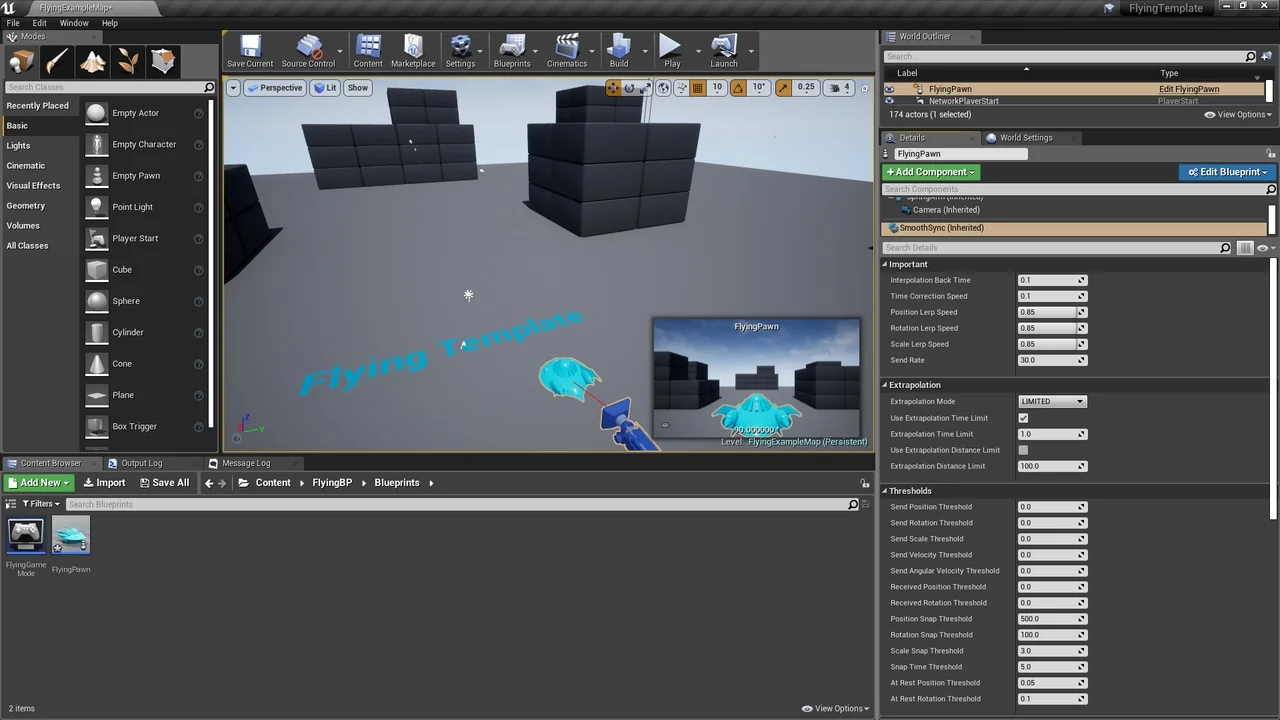
 Network
 Network
 Network