"b00678cacce53329"{"id":"1002831","slug":"scan-fx","title":"Scan FX","category":"Variety","engine":"4.18+,5.0+","assetVersion":"","engineVersion":"Engine Version: 4.18+,5.0+","tag":"Variety","accent":"blue","visual":"mech","summary":"A close look at Scan FX, featuring customizable laser rays, projection grids, x-rays, full-screen post-processing waves, and sensory perception modes.","platform":"Unreal Engine","indexPolicy":"index","publishedAt":"2026-11-20T12:01:23.630Z","updatedAt":"2026-11-20T12:01:23.630Z","sourceNotes":[],"fileContents":[],"compatibility":["Unreal Engine","Engine Version: 4.18+,5.0+"],"featuredImage":{"alt":"Scan FX","src":"/wp-content/uploads/published/2026/11/dbbc2af04e7a-fa545948-7450-4630-bb74-7621b33c5cee-dd442c4355.webp"},"fileSizeBytes":100213068,"hasDownloadLink":true,"downloads":0,"terms":[{"taxonomy":"category","slug":"variety-vfx","name":"Variety"}],"galleryImages":[{"src":"/wp-content/uploads/published/2026/11/628c5386be9e-2ace1870-0153-439a-a3d9-fbbdeb41521e-f9a9102dfd.webp","alt":"Scan FX"},{"src":"/wp-content/uploads/published/2026/11/f14b6b3e5571-e22a0eca-66d4-4683-8170-5c0cdeebc843-1d8333708f.webp","alt":"Scan FX"},{"src":"/wp-content/uploads/published/2026/11/ed5ba4ff5e13-9f0b648c-6706-4d13-80ba-4b65df225d6f-982f066c4a.webp","alt":"Scan FX"},{"src":"/wp-content/uploads/published/2026/11/c676fad6ef37-aaf10ce0-5ac3-4be1-ae32-e0be36f3490e-a92ee1ee0a.webp","alt":"Scan FX"},{"src":"/wp-content/uploads/published/2026/11/71025ba4342e-443cbd0d-3200-4480-ad9c-3c6f7f8ff0e4-b7cb82de42.webp","alt":"Scan FX"},{"src":"/wp-content/uploads/published/2026/11/5fc8b7c3e088-f15d21f5-fe66-4e1a-9c0a-08da6a80bd00-0c1e446319.webp","alt":"Scan FX"},{"src":"/wp-content/uploads/published/2026/11/17f7c29d2e68-2a17d1bc-3cef-4c0c-92b8-d42905a84e5c-9243b82eeb.webp","alt":"Scan FX"},{"src":"/wp-content/uploads/published/2026/11/a0d62b83ef38-9a22d112-2e49-43c0-bbc5-9c14c41d1a19-13016d125e.webp","alt":"Scan FX"},{"src":"/wp-content/uploads/published/2026/11/7b0de35cd3ef-e94cd4de-33b1-4a0c-a56a-b82a3ea5d977-adb96fb5db.webp","alt":"Scan FX"},{"src":"/wp-content/uploads/published/2026/11/ee28bcef1d5d-c9aa939d-050f-455b-bd2b-2b22c7002c9c-8b8183176b.webp","alt":"Scan FX"}],"accessPanel":{"kind":"resource","title":"Get this resource","safetyNote":"Resources are manually reviewed before listing to improve quality and reduce obvious risks.","fileName":"Content.7z","resourceType":"Resource archive","versions":[]},"contentHtml":"\u003ch2\u003eLaser Rays, Planes, and Grid Projections in Scan FX\u003c/h2\u003e\n\u003cp\u003eSpatial environmental interrogation relies heavily on sharp, readable shapes that communicate distance, structural geometry, and digital analysis. Scan FX supplies a collection of primary diagnostic vectors, emphasizing distinct geometric configurations such as directional laser rays, planar sweeps, and planar or volumetric grids. These visual elements provide instantaneous feedback in environments where high-tech surveillance, mechanical sensor sweeps, or forensic examinations take place.\u003c/p\u003e\n\u003cp\u003eLaser rays project tight, directional lines through a scene, ideal for security trigger volumes, robotic targeting cones, or laser-guided perimeter alerts. By casting a clean optical trajectory across surfaces, these ray elements trace collision contours and immediately identify obstructions. Planes function on a broader cross-sectional basis, slicing through complex meshes with a continuous illuminated edge. When a scan plane intersects a room, every surface it touches momentarily illuminates along that intersection, mapping out architectural perimeters, concealed doors, or uneven terrain contours.\u003c/p\u003e\n\u003cp\u003eGrid projections introduce structured digital measurement across irregular organic or synthetic geometry. By overlaying regular square patterns onto uneven floor plans, walls, or props, grids create the impression of active metric calculation and topographic terrain mapping. Because the materials include extensive customization controls and ready-to-use presets, developers can adapt the frequency, illumination, and color balance of these grids to suit anything from clean industrial telemetry to unstable electronic interference.\u003c/p\u003e \u003ch2\u003eEnhanced Perception Modes: Thermal, Night, and Electro Vision\u003c/h2\u003e\n\u003cp\u003eBeyond external projections that sweep through a 3D environment, Scan FX equips projects with dedicated first-person or camera-level optical filters. These enhanced perception modes shift the entire rendering profile to emulate tactical optic hardware, robotic visual arrays, or augmented vision implants. The primary perception styles delivered in the collection comprise night vision, thermal vision, and electro vision.\u003c/p\u003e\n\u003cp\u003eNight vision focuses on low-light amplification, lifting dark interiors and nocturnal outdoor settings into a legible, high-contrast spectrum. It rebalances environmental values to simulate sensitivity to faint ambient light, establishing an immediate tactical surveillance atmosphere. In contrast, thermal vision discards standard surface reflectance in favor of heat signatures. By isolating thermal gradients, it highlights active subjects, machinery, or temperature differentials against cooler ambient backgrounds, serving tactical targeting systems or specialized investigative gameplay mechanics.\u003c/p\u003e\n\u003cp\u003eElectro vision provides a dedicated aesthetic for registering electrical currents, synthetic conduits, and powered infrastructure. This mode translates hidden energy networks and electronic signatures into vibrant visual readouts, distinguishing active machinery or wired conduits from inert stone, metal, and wood. As with the spatial projection sweeps, each enhanced perception material is equipped with a selection of options and presets, allowing users to tune luminescence, color ramps, and filter intensity to match precise art directions.\u003c/p\u003e \u003ch2\u003eFull-Screen Waves and X-Ray Visualization Systems\u003c/h2\u003e\n\u003cp\u003eWide-area detection often calls for broader spatial feedback than a focused laser beam or stationary grid can offer. Scan FX incorporates full-screen post-processing waves designed to pulse outwards across entire environments. These waves function at the camera level, rippling over geometry in screen space and world space to visually tag distant landmarks, sweep for invisible hazards, or broadcast sonar pulses across vast subterranean chambers.\u003c/p\u003e\n\u003cp\u003eThe post-processing wave materials trace distance fields and scene depth, wrapping around obstacles and receding over far horizons. This makes the wave effect particularly effective for player-activated scanning pulses, where activating a radar sweep must paint the geometry of an entire sector in sequential waves of light. Developers can modify the wave boundary thickness, color dissipation, and propagation characteristics by adjusting the parameters embedded in each post-process material preset.\u003c/p\u003e\n\u003cp\u003eWorking alongside full-screen waves are dedicated x-ray rendering effects. These materials peel back outer surfaces to expose internal framing, skeletal silhouettes, or interior mechanical mechanisms. By rendering an interior layer visible through dense exterior geometry, the x-ray materials handle diagnostic medical screens, high-security screening equipment, or supernatural sighting abilities where standard visual occlusions must be bypassed.\u003c/p\u003e \u003ch2\u003eModular Material Functions Inside the Scan FX Pipeline\u003c/h2\u003e\n\u003cp\u003eA core architectural strength of Scan FX is its reliance on modular material functions. Rather than locking visual logic into rigid, monolithic shader networks, the provided materials are assembled using discrete functional blocks. Each material function encapsulates a specific piece of the mathematical or visual pipeline, such as edge detection, wave modulation, noise generation, or coordinate mapping.\u003c/p\u003e\n\u003cp\u003eThis modular structure means that the pre-built scanning materials are not closed systems. Developers and technical artists can open any existing shader, isolate the modular material functions that drive its look, and recombine them into entirely custom materials. If a project requires a hybrid effect—such as a thermal vision mode that simultaneously traces an x-ray grid across active energy conduits—the underlying functions can be assembled directly within a new material graph without needing to rewrite complex procedural math from scratch.\u003c/p\u003e\n\u003cp\u003eThe flexibility of this modular construction ensures that the library scales alongside project requirements. Whether the task involves applying a subtle scanning wave to an isolated holographic prop or creating an elaborate, multi-layered post-processing stack for an augmented reality HUD, the material functions supply the foundational logic blocks necessary to author novel scan effects rapidly.\u003c/p\u003e \u003ch2\u003eIn-Graph Documentation and Workflow Implementation\u003c/h2\u003e\n\u003cp\u003eNavigating complex visual effects systems can often slow down iteration when parameters and logic branches are poorly identified. Scan FX avoids this obstacle by embedding documentation directly inside the assets themselves. Every blueprint, material, and material function contains descriptive commentary placed straight into the workflow graphs.\u003c/p\u003e\n\u003cp\u003eComment nodes frame major functional blocks within the node networks, spelling out how signals are routed, where mask calculations happen, and which nodes control temporal animation. In tandem with visual comment groupings, description properties are filled out across individual parameters and functions. When an artist hovers over an exposed property inside a material instance or inspects a blueprint node, the built-in descriptions clarify precisely what the parameter influences and how changes alter the visual output.\u003c/p\u003e\n\u003cp\u003eThis transparent documentation makes inspecting and modifying presets straightforward. Teams can adjust scan wave speeds, laser falloff ranges, and perception color channels with an immediate understanding of the underlying network, eliminating guesswork and accelerating implementation across all supported scanning archetypes.\u003c/p\u003e\n\n\u003ch2\u003eMore From The Same Workflow\u003c/h2\u003e\n\u003cul\u003e\n\u003cli\u003e\u003ca href=\"https://3dcghub.com/simple-cartoon-fx-pack/\" rel=\"noopener noreferrer\"\u003eSimple Cartoon FX Pack\u003c/a\u003e\u003c/li\u003e\n\u003cli\u003e\u003ca href=\"https://3dcghub.com/retro-shooter-fx-pack/\" rel=\"noopener noreferrer\"\u003eRetro Shooter FX Pack\u003c/a\u003e\u003c/li\u003e\n\u003cli\u003e\u003ca href=\"https://3dcghub.com/mega-sci-fi-particle-fx-bundle-3in1/\" rel=\"noopener noreferrer\"\u003eMega Sci-Fi Particle FX Bundle 3in1\u003c/a\u003e\u003c/li\u003e\n\u003cli\u003e\u003ca href=\"https://3dcghub.com/cartoony-impact-fx-second-edition/\" rel=\"noopener noreferrer\"\u003eCartoony Impact FX - Second Edition\u003c/a\u003e\u003c/li\u003e\n\u003cli\u003e\u003ca href=\"https://3dcghub.com/character-body-fx-vol-3/\" rel=\"noopener noreferrer\"\u003eCharacter Body FX Vol. 3\u003c/a\u003e\u003c/li\u003e\n\u003c/ul\u003e","contentTextLength":7604,"navigation":{"current":49,"total":4797,"previous":{"id":"1002832","slug":"sci-fi-fx","title":"Sci Fi FX","category":"Variety","platform":"Unreal Engine","updatedAt":"2026-11-20T12:02:17.924Z"},"next":{"id":"1002830","slug":"retro-shooter-fx-pack","title":"Retro Shooter FX Pack","category":"Variety","platform":"Unreal Engine","updatedAt":"2026-11-20T12:00:08.209Z"}},"relatedResources":[{"id":"1001666","slug":"simple-cartoon-fx-pack","title":"Simple Cartoon FX Pack","category":"Variety","engine":"4.10+,5.0+","assetVersion":"","engineVersion":"Engine Version: 4.10+,5.0+","tag":"Variety","accent":"blue","visual":"mech","summary":"Explore the Simple Cartoon FX Pack, featuring 10 stylized game particles with cartoon shading and editable material instances for casual game workflows.","platform":"Unreal Engine","indexPolicy":"index","publishedAt":"2026-10-13T15:07:26.502Z","updatedAt":"2026-10-13T15:07:26.502Z","sourceNotes":[],"fileContents":[],"compatibility":["Unreal Engine","Engine Version: 4.10+,5.0+"],"featuredImage":{"alt":"Simple Cartoon FX Pack","src":"/wp-content/uploads/published/2026/10/43e6ff1aa10a-e7eed192-5502-4a94-a4a9-c2409c0d8613-2453e9c1e9.webp"},"fileSizeBytes":75912447,"hasDownloadLink":true,"downloads":3},{"id":"1002868","slug":"fireworks-niagara-fx","title":"Fireworks Niagara FX","category":"Variety","engine":"4.25+,5.0+","assetVersion":"","engineVersion":"Engine Version: 4.25+,5.0+","tag":"Variety","accent":"blue","visual":"mech","summary":"Explore Fireworks Niagara FX, featuring nine shell types, direct and rocket spawn modes, customizable shape effects, and volumetric smoke illumination.","platform":"Unreal Engine","indexPolicy":"index","publishedAt":"2026-11-20T16:31:03.944Z","updatedAt":"2026-11-20T16:31:03.944Z","sourceNotes":[],"fileContents":[],"compatibility":["Unreal Engine","Engine Version: 4.25+,5.0+"],"featuredImage":{"alt":"Fireworks Niagara FX","src":"/wp-content/uploads/published/2026/11/45478d2360d8-3ed009ea-0797-411e-bf5d-e3d5ff0227aa-8c344bc6c5.webp"},"fileSizeBytes":36424846,"hasDownloadLink":true,"downloads":0},{"id":"1002867","slug":"action-fx-pack","title":"Action FX Pack","category":"Variety","engine":"4.19+,5.0+","assetVersion":"","engineVersion":"Engine Version: 4.19+,5.0+","tag":"Variety","accent":"blue","visual":"mech","summary":"Explore the design and implementation of the Action FX Pack, tailored for high-tempo combat feedback and stylish, stylized visual aesthetics in game development","platform":"Unreal Engine","indexPolicy":"index","publishedAt":"2026-11-20T15:16:23.239Z","updatedAt":"2026-11-20T15:16:23.239Z","sourceNotes":[],"fileContents":[],"compatibility":["Unreal Engine","Engine Version: 4.19+,5.0+"],"featuredImage":{"alt":"Action FX Pack","src":"/wp-content/uploads/published/2026/11/2b9004428987-48031500-ee25-424a-9597-ada262c965b1-c3d10c813d.webp"},"fileSizeBytes":60377861,"hasDownloadLink":true,"downloads":0}]}
Resource screenshots
1 / 10
Join our channel
Follow 3DCGHUB on Telegram for new resource drops, migration updates, and community notices.
Laser Rays, Planes, and Grid Projections in Scan FX
Spatial environmental interrogation relies heavily on sharp, readable shapes that communicate distance, structural geometry, and digital analysis. Scan FX supplies a collection of primary diagnostic vectors, emphasizing distinct geometric configurations such as directional laser rays, planar sweeps, and planar or volumetric grids. These visual elements provide instantaneous feedback in environments where high-tech surveillance, mechanical sensor sweeps, or forensic examinations take place.
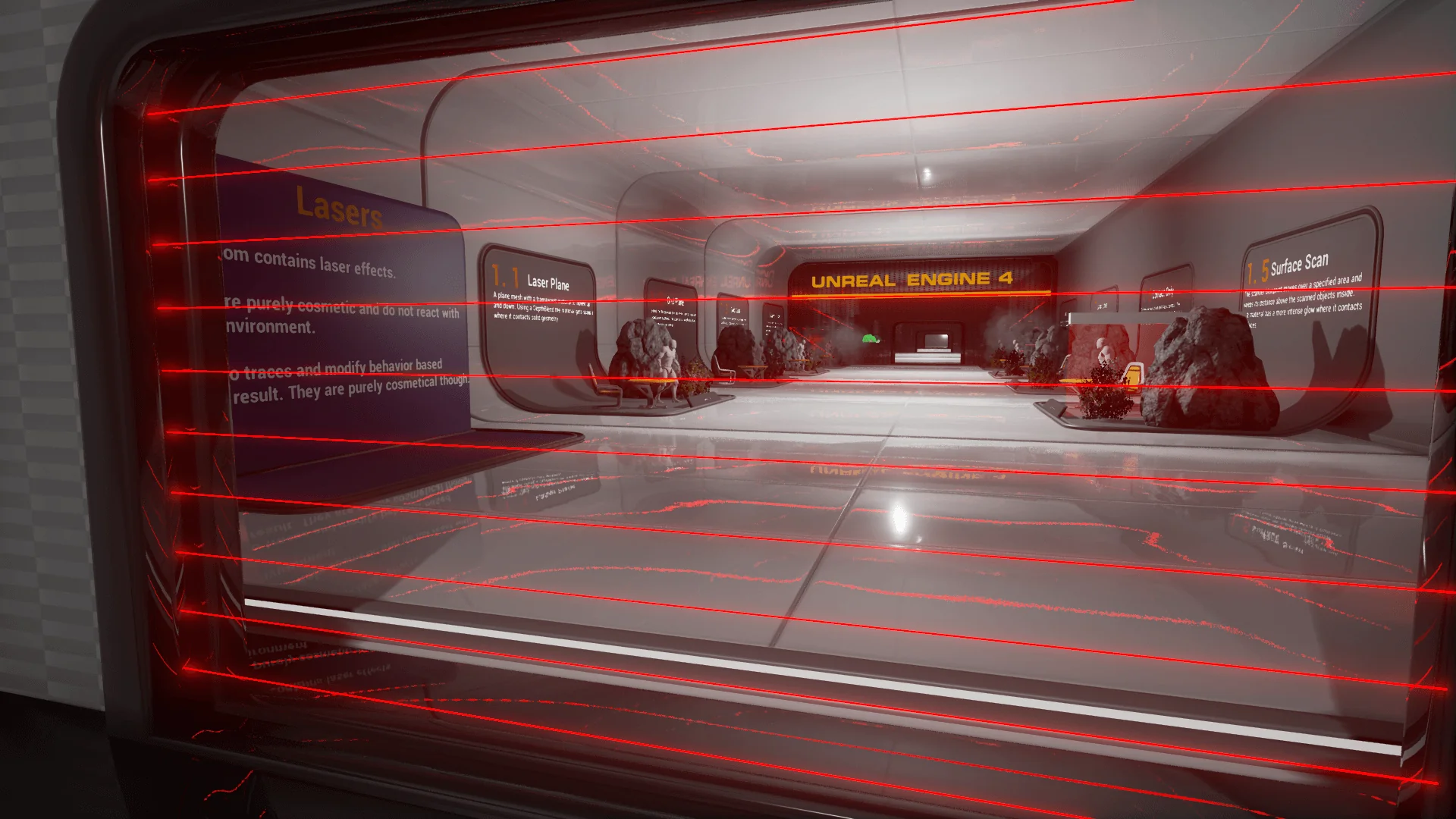
Laser rays project tight, directional lines through a scene, ideal for security trigger volumes, robotic targeting cones, or laser-guided perimeter alerts. By casting a clean optical trajectory across surfaces, these ray elements trace collision contours and immediately identify obstructions. Planes function on a broader cross-sectional basis, slicing through complex meshes with a continuous illuminated edge. When a scan plane intersects a room, every surface it touches momentarily illuminates along that intersection, mapping out architectural perimeters, concealed doors, or uneven terrain contours.
Grid projections introduce structured digital measurement across irregular organic or synthetic geometry. By overlaying regular square patterns onto uneven floor plans, walls, or props, grids create the impression of active metric calculation and topographic terrain mapping. Because the materials include extensive customization controls and ready-to-use presets, developers can adapt the frequency, illumination, and color balance of these grids to suit anything from clean industrial telemetry to unstable electronic interference.
Enhanced Perception Modes: Thermal, Night, and Electro Vision
Beyond external projections that sweep through a 3D environment, Scan FX equips projects with dedicated first-person or camera-level optical filters. These enhanced perception modes shift the entire rendering profile to emulate tactical optic hardware, robotic visual arrays, or augmented vision implants. The primary perception styles delivered in the collection comprise night vision, thermal vision, and electro vision.
Night vision focuses on low-light amplification, lifting dark interiors and nocturnal outdoor settings into a legible, high-contrast spectrum. It rebalances environmental values to simulate sensitivity to faint ambient light, establishing an immediate tactical surveillance atmosphere. In contrast, thermal vision discards standard surface reflectance in favor of heat signatures. By isolating thermal gradients, it highlights active subjects, machinery, or temperature differentials against cooler ambient backgrounds, serving tactical targeting systems or specialized investigative gameplay mechanics.
Electro vision provides a dedicated aesthetic for registering electrical currents, synthetic conduits, and powered infrastructure. This mode translates hidden energy networks and electronic signatures into vibrant visual readouts, distinguishing active machinery or wired conduits from inert stone, metal, and wood. As with the spatial projection sweeps, each enhanced perception material is equipped with a selection of options and presets, allowing users to tune luminescence, color ramps, and filter intensity to match precise art directions.
Full-Screen Waves and X-Ray Visualization Systems
Wide-area detection often calls for broader spatial feedback than a focused laser beam or stationary grid can offer. Scan FX incorporates full-screen post-processing waves designed to pulse outwards across entire environments. These waves function at the camera level, rippling over geometry in screen space and world space to visually tag distant landmarks, sweep for invisible hazards, or broadcast sonar pulses across vast subterranean chambers.
The post-processing wave materials trace distance fields and scene depth, wrapping around obstacles and receding over far horizons. This makes the wave effect particularly effective for player-activated scanning pulses, where activating a radar sweep must paint the geometry of an entire sector in sequential waves of light. Developers can modify the wave boundary thickness, color dissipation, and propagation characteristics by adjusting the parameters embedded in each post-process material preset.
Working alongside full-screen waves are dedicated x-ray rendering effects. These materials peel back outer surfaces to expose internal framing, skeletal silhouettes, or interior mechanical mechanisms. By rendering an interior layer visible through dense exterior geometry, the x-ray materials handle diagnostic medical screens, high-security screening equipment, or supernatural sighting abilities where standard visual occlusions must be bypassed.
Modular Material Functions Inside the Scan FX Pipeline
A core architectural strength of Scan FX is its reliance on modular material functions. Rather than locking visual logic into rigid, monolithic shader networks, the provided materials are assembled using discrete functional blocks. Each material function encapsulates a specific piece of the mathematical or visual pipeline, such as edge detection, wave modulation, noise generation, or coordinate mapping.
This modular structure means that the pre-built scanning materials are not closed systems. Developers and technical artists can open any existing shader, isolate the modular material functions that drive its look, and recombine them into entirely custom materials. If a project requires a hybrid effect—such as a thermal vision mode that simultaneously traces an x-ray grid across active energy conduits—the underlying functions can be assembled directly within a new material graph without needing to rewrite complex procedural math from scratch.
The flexibility of this modular construction ensures that the library scales alongside project requirements. Whether the task involves applying a subtle scanning wave to an isolated holographic prop or creating an elaborate, multi-layered post-processing stack for an augmented reality HUD, the material functions supply the foundational logic blocks necessary to author novel scan effects rapidly.
In-Graph Documentation and Workflow Implementation
Navigating complex visual effects systems can often slow down iteration when parameters and logic branches are poorly identified. Scan FX avoids this obstacle by embedding documentation directly inside the assets themselves. Every blueprint, material, and material function contains descriptive commentary placed straight into the workflow graphs.
Comment nodes frame major functional blocks within the node networks, spelling out how signals are routed, where mask calculations happen, and which nodes control temporal animation. In tandem with visual comment groupings, description properties are filled out across individual parameters and functions. When an artist hovers over an exposed property inside a material instance or inspects a blueprint node, the built-in descriptions clarify precisely what the parameter influences and how changes alter the visual output.
This transparent documentation makes inspecting and modifying presets straightforward. Teams can adjust scan wave speeds, laser falloff ranges, and perception color channels with an immediate understanding of the underlying network, eliminating guesswork and accelerating implementation across all supported scanning archetypes.
 Variety
 Variety
 Variety