"b00678cacce53329"{"id":"1002868","slug":"fireworks-niagara-fx","title":"Fireworks Niagara FX","category":"Variety","engine":"4.25+,5.0+","assetVersion":"","engineVersion":"Engine Version: 4.25+,5.0+","tag":"Variety","accent":"blue","visual":"mech","summary":"Explore Fireworks Niagara FX, featuring nine shell types, direct and rocket spawn modes, customizable shape effects, and volumetric smoke illumination.","platform":"Unreal Engine","indexPolicy":"index","publishedAt":"2026-11-20T16:31:03.944Z","updatedAt":"2026-11-20T16:31:03.944Z","sourceNotes":[],"fileContents":[],"compatibility":["Unreal Engine","Engine Version: 4.25+,5.0+"],"featuredImage":{"alt":"Fireworks Niagara FX","src":"/wp-content/uploads/published/2026/11/45478d2360d8-3ed009ea-0797-411e-bf5d-e3d5ff0227aa-8c344bc6c5.webp"},"fileSizeBytes":36424846,"hasDownloadLink":true,"downloads":0,"terms":[{"taxonomy":"category","slug":"variety-vfx","name":"Variety"}],"galleryImages":[{"src":"/wp-content/uploads/published/2026/11/64d35793edde-17b499ce-84db-41f9-a748-f99de20215f6-8cbb822127.webp","alt":"Fireworks Niagara FX"},{"src":"/wp-content/uploads/published/2026/11/51bfc8ba2214-b8ebd44e-b990-4076-93c6-ba801b1674c9-3cbbb57cea.webp","alt":"Fireworks Niagara FX"},{"src":"/wp-content/uploads/published/2026/11/1aad30fcc225-3d9b0d3e-e215-47e9-98f4-1b5ae6416d2b-a20f7e8b8e.webp","alt":"Fireworks Niagara FX"},{"src":"/wp-content/uploads/published/2026/11/277e09ee36c1-b28c65b4-7b40-48f4-a201-8fd260a7f599-f042b0c319.webp","alt":"Fireworks Niagara FX"},{"src":"/wp-content/uploads/published/2026/11/2740223f0733-1c12ab4e-a844-4055-a997-a0a16fb4d5ec-d76445bb91.webp","alt":"Fireworks Niagara FX"},{"src":"/wp-content/uploads/published/2026/11/da93ffb72f8c-d8ae6055-ecfc-4c5e-8901-a0ce8e302c8b-7a2788f0fd.webp","alt":"Fireworks Niagara FX"},{"src":"/wp-content/uploads/published/2026/11/31c21201eb6c-017cfde1-459d-45cb-be50-5a3062810321-a4d3d5d60d.webp","alt":"Fireworks Niagara FX"},{"src":"/wp-content/uploads/published/2026/11/039f8c53ac1d-f359a200-cc10-4822-bc1c-d21a09b0bc41-550fa51532.webp","alt":"Fireworks Niagara FX"},{"src":"/wp-content/uploads/published/2026/11/b25418981848-7861ed0f-29ce-42c1-b4b4-2683bba5a9af-9d5969fb24.webp","alt":"Fireworks Niagara FX"}],"accessPanel":{"kind":"resource","title":"Get this resource","safetyNote":"Resources are manually reviewed before listing to improve quality and reduce obvious risks.","fileName":"Content.7z","resourceType":"Resource archive","versions":[]},"contentHtml":"\u003ch2\u003eBurst Physics and Visual Varieties in Fireworks Niagara FX\u003c/h2\u003e\n\u003cp\u003eBright pyrotechnic bursts instantly shift the visual atmosphere of a virtual scene, throwing vivid points of light across dark environments. Fireworks Niagara FX delivers real-time particle simulations based on realistic shell behaviors, high-intensity color emission, and rapid explosive expansion. Rather than relying on simple billboard sprites that fade out uniformly, the system utilizes Niagara particle dynamics to model the energetic dispersal of glowing embers, sparkles, and fiery projectile trails.\u003c/p\u003e\n\u003cp\u003eEach burst begins with a high-velocity detonation that propels burning particulate outward from a central point. The system balances vibrant color saturation with sharp, bright highlights, ensuring that explosions remain clearly legible against dusk, midnight, or complex urban skies. Trailing sparkles decay naturally over their lifespan, shifting in brightness and velocity to mirror the cooling behavior of physical chemical pyrotechnics. This creates an authentic progression from the violent initial detonation to the delicate, falling embers that drift downward under simulated gravity.\u003c/p\u003e \u003ch2\u003eNine Shell Profiles from Peony to Willow\u003c/h2\u003e\n\u003cp\u003eReal-world pyrotechnic displays rely on specific mechanical packing inside mortar shells to produce recognizable geometric breaks. Fireworks Niagara FX translates these principles into nine distinct firework profiles, each exhibiting unique velocity curves, tail lengths, and dispersal arrangements.\u003c/p\u003e\n\u003cul\u003e \u003cli\u003e\u003cstrong\u003ePeony:\u003c/strong\u003e The foundational aerial shell, generating a spherical ball of bright, colorful stars that break evenly and burn out without leaving behind long trails of sparks.\u003c/li\u003e \u003cli\u003e\u003cstrong\u003eChrysanthemum:\u003c/strong\u003e Similar in round break geometry to the Peony, but distinguished by burning stars that leave visible, glittering spark trails behind them as they push toward the outer boundary of the sphere.\u003c/li\u003e \u003cli\u003e\u003cstrong\u003eCrossette:\u003c/strong\u003e A dynamic burst where individual flying stars split apart mid-flight, fracturing into smaller secondary trails that create a criss-cross pattern across the sky.\u003c/li\u003e \u003cli\u003e\u003cstrong\u003eComet:\u003c/strong\u003e A focused, intense projectile that discharges a solid, bright tail of sparkles along its flight path, emphasizing directional speed over wide spherical expansion.\u003c/li\u003e \u003cli\u003e\u003cstrong\u003eHorsetail:\u003c/strong\u003e A compact break with minimal initial burst charge, allowing heavy, glittering sparks to fall almost immediately downward in a drooping, waterfall-like arc.\u003c/li\u003e \u003cli\u003e\u003cstrong\u003ePalm:\u003c/strong\u003e A burst featuring thick, powerful trails that push outward and downward, mimicking the sweeping, curved fronds of a palm tree.\u003c/li\u003e \u003cli\u003e\u003cstrong\u003ePearl:\u003c/strong\u003e Discrete, exceptionally luminous points of light that travel through the air with clean, sharp edges and minimal trailing debris, offering high-contrast illumination.\u003c/li\u003e \u003cli\u003e\u003cstrong\u003eRing:\u003c/strong\u003e Shell geometry configured to scatter stars outward in a focused, circular plane rather than a complete sphere, creating a distinct glowing ring in the sky.\u003c/li\u003e \u003cli\u003e\u003cstrong\u003eWillow:\u003c/strong\u003e Characterized by long-burning, lightweight stars that leave persistent, delicate trails drifting lazily downward, hanging in the airspace long after the initial detonation has cleared.\u003c/li\u003e\n\u003c/ul\u003e\n\u003cp\u003eHaving access to these traditional configurations allows creators to stage varied aerial sequences that feel deliberate and authentic rather than repetitive.\u003c/p\u003e \u003ch2\u003eSky Illumination Through Integrated Smoke Layers\u003c/h2\u003e\n\u003cp\u003eAn explosive aerial detonation produces substantial smoke, which plays a major role in how pyrotechnics interact with environmental lighting. Fireworks Niagara FX incorporates dedicated smoke covering elements that deploy directly alongside the explosive particle bursts.\u003c/p\u003e\n\u003cp\u003eWhen the shell explodes, the intense flash of light catches the surrounding smoke particles, scattering color and brightness across the immediate atmosphere. In dark environments, raw particle sparks can feel isolated if they only exist as floating points of light. By incorporating smoke volumes that catch the burst radiation, the lighting visually couples with the skybox and surrounding air, delivering a fuller, softer atmospheric glow around the hard-edged sparkles. As the embers dissipate, the smoke lingers momentarily, catching ambient light before thinning out into the night.\u003c/p\u003e \u003ch2\u003eCustom Shapes and Parameter Control in Niagara Fireworks\u003c/h2\u003e\n\u003cp\u003eBeyond standard circular shells, modern shows frequently incorporate novelty aerial shapes such as hearts, logos, and stylized emblems. Fireworks Niagara FX addresses this through a dedicated firework shape effect that allows artists to replace the underlying projection with any custom texture.\u003c/p\u003e\n\u003cp\u003eUser parameters exposed inside the Niagara effect handle the setup process. When assigning an image to drive the particle emission pattern, non-square source files can cause uneven spreading if left unadjusted. The effect includes dedicated scaling controls so developers can adjust the horizontal and vertical aspect ratios of the emitter, matching non-square textures without visual distortion. The parameter setup allows users to fine-tune shape scale, dispersal force, and visual alignment directly in the editor, making it possible to project recognizable silhouettes into the sky alongside traditional shell bursts.\u003c/p\u003e \u003ch2\u003eStaging Displays with Direct and Rocket Variants\u003c/h2\u003e\n\u003cp\u003ePacing a firework sequence depends heavily on how particles enter the scene. Fireworks Niagara FX accommodates two operational deployment methods: standard rocket launches and direct-spawn configurations.\u003c/p\u003e\n\u003cp\u003eThe rocket configuration represents physical mortar launches, starting from ground level or a designated platform. A rising projectile travels upward, emitting a trailing stream of bright sparkles and smoke before reaching its detonation altitude and triggering the terminal burst. This mode is well-suited for interactive ground perspectives where the audience watches shells lift off and ascend toward the clouds.\u003c/p\u003e\n\u003cp\u003eThe direct version bypasses the launch and flight stage entirely, spawning the burst immediately at target spatial coordinates. This setup proves useful when orchestrating intricate aerial choreography, time-synced musical displays, or cinematic sequences where the camera is framed high in the sky. Spawning on the spot eliminates ascent timing delays, allowing level designers and cinematographers to trigger instantaneous detonations precisely when an event, beat, or cut occurs.\u003c/p\u003e\n\n\u003ch2\u003eRelated Resources Worth Checking\u003c/h2\u003e\n\u003cul\u003e\n\u003cli\u003e\u003ca href=\"https://3dcghub.com/niagara-hologram-aura/\" rel=\"noopener noreferrer\"\u003eNiagara Hologram Aura\u003c/a\u003e\u003c/li\u003e\n\u003cli\u003e\u003ca href=\"https://3dcghub.com/mixed-vfx-pack-3-niagara/\" rel=\"noopener noreferrer\"\u003eMixed Vfx Pack 3 (Niagara)\u003c/a\u003e\u003c/li\u003e\n\u003cli\u003e\u003ca href=\"https://3dcghub.com/character-body-fx-vol-3/\" rel=\"noopener noreferrer\"\u003eCharacter Body FX Vol. 3\u003c/a\u003e\u003c/li\u003e\n\u003cli\u003e\u003ca href=\"https://3dcghub.com/comic-sound-effect-fx/\" rel=\"noopener noreferrer\"\u003eComic Sound Effect FX\u003c/a\u003e\u003c/li\u003e\n\u003cli\u003e\u003ca href=\"https://3dcghub.com/kick-up-fx/\" rel=\"noopener noreferrer\"\u003eKick Up FX\u003c/a\u003e\u003c/li\u003e\n\u003c/ul\u003e","contentTextLength":6383,"navigation":{"current":12,"total":4797,"previous":{"id":"1002869","slug":"advanced-magic-fx-14","title":"Advanced Magic FX 14","category":"Spells \u0026 Combat","platform":"Unreal Engine","updatedAt":"2026-11-20T16:32:06.460Z"},"next":{"id":"1002867","slug":"action-fx-pack","title":"Action FX Pack","category":"Variety","platform":"Unreal Engine","updatedAt":"2026-11-20T15:16:23.239Z"}},"relatedResources":[{"id":"1002820","slug":"niagara-hologram-aura","title":"Niagara Hologram Aura","category":"Variety","engine":"4.27+,5.0+","assetVersion":"","engineVersion":"Engine Version: 4.27+,5.0+","tag":"Variety","accent":"blue","visual":"mech","summary":"Explore Niagara Hologram Aura, featuring mesh reconstruction experiments using Scene Capture, Mesh Distance Fields, Niagara FX, and Blueprints.","platform":"Unreal Engine","indexPolicy":"index","publishedAt":"2026-11-20T07:55:15.549Z","updatedAt":"2026-11-20T07:55:15.549Z","sourceNotes":[],"fileContents":[],"compatibility":["Unreal Engine","Engine Version: 4.27+,5.0+"],"featuredImage":{"alt":"Niagara Hologram Aura","src":"/wp-content/uploads/published/2026/11/5fa85276a05e-799fca1c-36aa-4ab9-987f-0e3a7d395a2e-fc7451a0c3.webp"},"fileSizeBytes":72151251,"hasDownloadLink":true,"downloads":0},{"id":"1002812","slug":"mixed-vfx-pack-3-niagara","title":"Mixed Vfx Pack 3 (Niagara)","category":"Variety","engine":"4.25+,5.0+","assetVersion":"","engineVersion":"Engine Version: 4.25+,5.0+","tag":"Variety","accent":"blue","visual":"mech","summary":"Mixed Vfx Pack 3 provides 16 unique Niagara skill effects and 20 total FX covering flame, portal, gas, and toxic smoke styles for dynamic game scenes.","platform":"Unreal Engine","indexPolicy":"index","publishedAt":"2026-11-20T07:42:22.831Z","updatedAt":"2026-11-20T07:42:22.831Z","sourceNotes":[],"fileContents":[],"compatibility":["Unreal Engine","Engine Version: 4.25+,5.0+"],"featuredImage":{"alt":"Mixed Vfx Pack 3 (Niagara)","src":"/wp-content/uploads/published/2026/11/cf5fccdbc52d-16f3bc00-181e-449f-9adf-b83aac58d9c1-3b26126747.webp"},"fileSizeBytes":41900581,"hasDownloadLink":true,"downloads":0},{"id":"1001976","slug":"character-body-fx-vol-3","title":"Character Body FX Vol. 3","category":"Variety","engine":"4.27+,5.0+","assetVersion":"","engineVersion":"Engine Version: 4.27+,5.0+","tag":"Variety","accent":"blue","visual":"character","summary":"Explore Niagara character visual effects for skeletal meshes, covering GPU distance field setup, regional mesh sampling, and elemental presets.","platform":"Unreal Engine","indexPolicy":"index","publishedAt":"2026-10-24T14:07:03.848Z","updatedAt":"2026-10-24T14:07:03.848Z","sourceNotes":[],"fileContents":[],"compatibility":["Unreal Engine","Engine Version: 4.27+,5.0+"],"featuredImage":{"alt":"Character Body FX Vol. 3","src":"/wp-content/uploads/published/2026/10/1a33fb059d6b-bd702f6d-b042-44b5-a5bf-f4ba963dfc1b-e8e00fc35f.webp"},"fileSizeBytes":48358273,"hasDownloadLink":true,"downloads":0}]}
Resource screenshots
1 / 9
Join our channel
Follow 3DCGHUB on Telegram for new resource drops, migration updates, and community notices.
Resources are manually reviewed before listing to improve quality and reduce obvious risks.
No account required
Variety
Fireworks Niagara FX
Explore Fireworks Niagara FX, featuring nine shell types, direct and rocket spawn modes, customizable shape effects, and volumetric smoke illumination.
Burst Physics and Visual Varieties in Fireworks Niagara FX
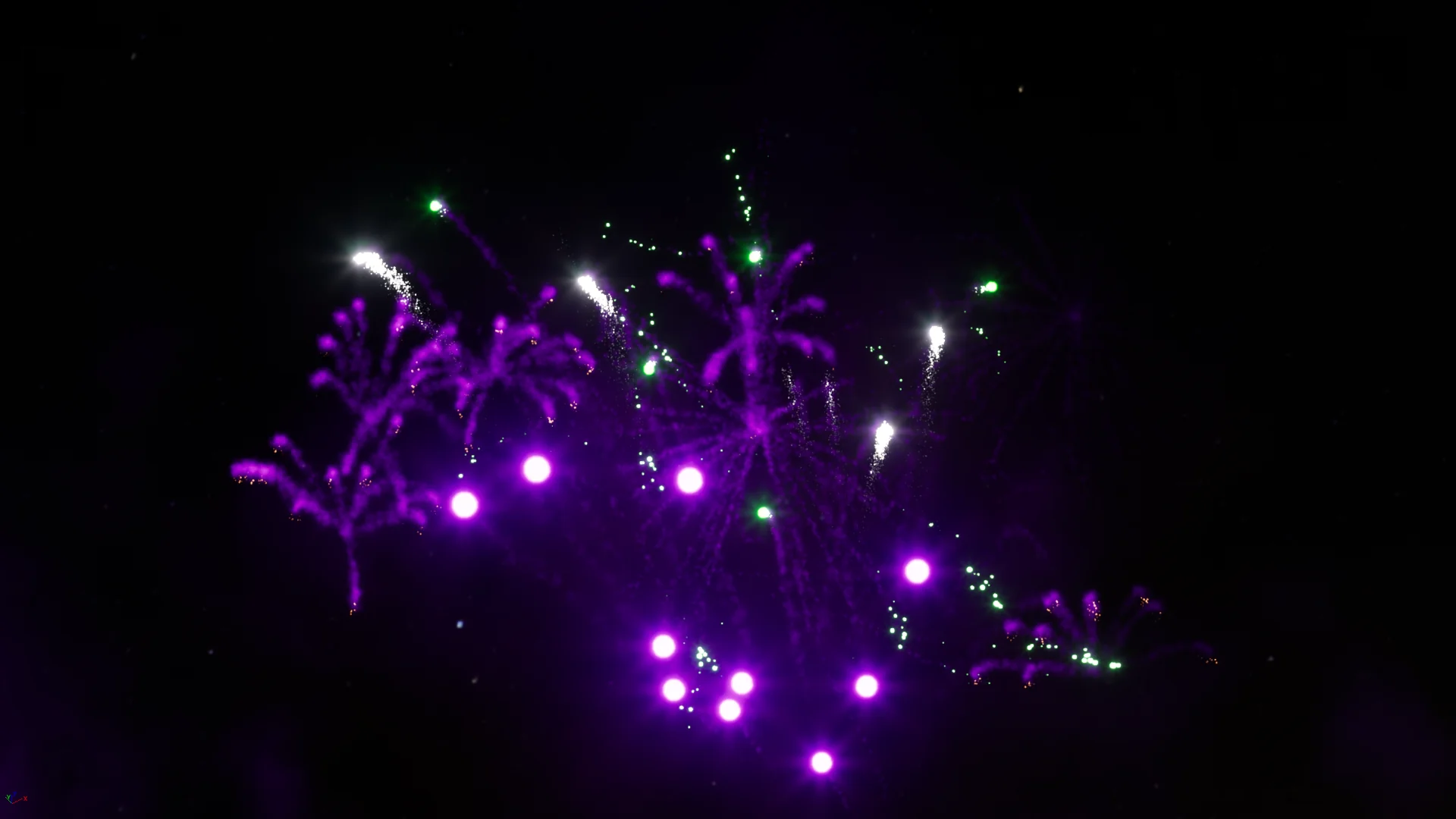
Bright pyrotechnic bursts instantly shift the visual atmosphere of a virtual scene, throwing vivid points of light across dark environments. Fireworks Niagara FX delivers real-time particle simulations based on realistic shell behaviors, high-intensity color emission, and rapid explosive expansion. Rather than relying on simple billboard sprites that fade out uniformly, the system utilizes Niagara particle dynamics to model the energetic dispersal of glowing embers, sparkles, and fiery projectile trails.
Each burst begins with a high-velocity detonation that propels burning particulate outward from a central point. The system balances vibrant color saturation with sharp, bright highlights, ensuring that explosions remain clearly legible against dusk, midnight, or complex urban skies. Trailing sparkles decay naturally over their lifespan, shifting in brightness and velocity to mirror the cooling behavior of physical chemical pyrotechnics. This creates an authentic progression from the violent initial detonation to the delicate, falling embers that drift downward under simulated gravity.
Nine Shell Profiles from Peony to Willow
Real-world pyrotechnic displays rely on specific mechanical packing inside mortar shells to produce recognizable geometric breaks. Fireworks Niagara FX translates these principles into nine distinct firework profiles, each exhibiting unique velocity curves, tail lengths, and dispersal arrangements.
Peony: The foundational aerial shell, generating a spherical ball of bright, colorful stars that break evenly and burn out without leaving behind long trails of sparks.
Chrysanthemum: Similar in round break geometry to the Peony, but distinguished by burning stars that leave visible, glittering spark trails behind them as they push toward the outer boundary of the sphere.
Crossette: A dynamic burst where individual flying stars split apart mid-flight, fracturing into smaller secondary trails that create a criss-cross pattern across the sky.
Comet: A focused, intense projectile that discharges a solid, bright tail of sparkles along its flight path, emphasizing directional speed over wide spherical expansion.
Horsetail: A compact break with minimal initial burst charge, allowing heavy, glittering sparks to fall almost immediately downward in a drooping, waterfall-like arc.
Palm: A burst featuring thick, powerful trails that push outward and downward, mimicking the sweeping, curved fronds of a palm tree.
Pearl: Discrete, exceptionally luminous points of light that travel through the air with clean, sharp edges and minimal trailing debris, offering high-contrast illumination.
Ring: Shell geometry configured to scatter stars outward in a focused, circular plane rather than a complete sphere, creating a distinct glowing ring in the sky.
Willow: Characterized by long-burning, lightweight stars that leave persistent, delicate trails drifting lazily downward, hanging in the airspace long after the initial detonation has cleared.
Having access to these traditional configurations allows creators to stage varied aerial sequences that feel deliberate and authentic rather than repetitive.
Sky Illumination Through Integrated Smoke Layers
An explosive aerial detonation produces substantial smoke, which plays a major role in how pyrotechnics interact with environmental lighting. Fireworks Niagara FX incorporates dedicated smoke covering elements that deploy directly alongside the explosive particle bursts.
When the shell explodes, the intense flash of light catches the surrounding smoke particles, scattering color and brightness across the immediate atmosphere. In dark environments, raw particle sparks can feel isolated if they only exist as floating points of light. By incorporating smoke volumes that catch the burst radiation, the lighting visually couples with the skybox and surrounding air, delivering a fuller, softer atmospheric glow around the hard-edged sparkles. As the embers dissipate, the smoke lingers momentarily, catching ambient light before thinning out into the night.
Custom Shapes and Parameter Control in Niagara Fireworks
Beyond standard circular shells, modern shows frequently incorporate novelty aerial shapes such as hearts, logos, and stylized emblems. Fireworks Niagara FX addresses this through a dedicated firework shape effect that allows artists to replace the underlying projection with any custom texture.
User parameters exposed inside the Niagara effect handle the setup process. When assigning an image to drive the particle emission pattern, non-square source files can cause uneven spreading if left unadjusted. The effect includes dedicated scaling controls so developers can adjust the horizontal and vertical aspect ratios of the emitter, matching non-square textures without visual distortion. The parameter setup allows users to fine-tune shape scale, dispersal force, and visual alignment directly in the editor, making it possible to project recognizable silhouettes into the sky alongside traditional shell bursts.
Staging Displays with Direct and Rocket Variants
Pacing a firework sequence depends heavily on how particles enter the scene. Fireworks Niagara FX accommodates two operational deployment methods: standard rocket launches and direct-spawn configurations.
The rocket configuration represents physical mortar launches, starting from ground level or a designated platform. A rising projectile travels upward, emitting a trailing stream of bright sparkles and smoke before reaching its detonation altitude and triggering the terminal burst. This mode is well-suited for interactive ground perspectives where the audience watches shells lift off and ascend toward the clouds.
The direct version bypasses the launch and flight stage entirely, spawning the burst immediately at target spatial coordinates. This setup proves useful when orchestrating intricate aerial choreography, time-synced musical displays, or cinematic sequences where the camera is framed high in the sky. Spawning on the spot eliminates ascent timing delays, allowing level designers and cinematographers to trigger instantaneous detonations precisely when an event, beat, or cut occurs.
 Variety
 Variety
 Variety