"82ee98b2ee2793f1"{"id":"1002442","slug":"poly-art-raccoons","title":"Poly Art Raccoons","category":"Characters \u0026 Creatures","engine":"4.26+,5.0+","assetVersion":"","engineVersion":"Engine Version: 4.26+,5.0+","tag":"Characters","accent":"blue","visual":"character","summary":"Explore the visual style, technical setup, and integration workflows for Poly Art Raccoons, featuring low-poly animal meshes and motion assets.","platform":"Unreal Engine","indexPolicy":"index","publishedAt":"2026-11-10T18:39:06.961Z","updatedAt":"2026-11-10T18:39:06.961Z","sourceNotes":[],"fileContents":[],"compatibility":["Unreal Engine","Engine Version: 4.26+,5.0+"],"featuredImage":{"alt":"Poly Art Raccoons","src":"/wp-content/uploads/published/2026/11/2a5beb3e246b-1132895b-afbb-4fc9-afa5-b62410cdf1bd-84d6b02c36.webp"},"hasDownloadLink":true,"downloads":0,"terms":[{"taxonomy":"category","slug":"characters-and-creatures","name":"Characters \u0026 Creatures"}],"galleryImages":[{"src":"/wp-content/uploads/published/2026/11/1b0b267fd724-a3e844e3-0ff5-464b-9d6b-07e5effb2721-dd79cc2e52.webp","alt":"Poly Art Raccoons"},{"src":"/wp-content/uploads/published/2026/11/953bf40f29e8-324afd69-260a-486d-8dc2-94af54ecfc7b-7366281aff.webp","alt":"Poly Art Raccoons"},{"src":"/wp-content/uploads/published/2026/11/3c72c51af3ae-75d96591-0e00-4b24-b8fe-c75d599ad5d1-b8476fa3c8.webp","alt":"Poly Art Raccoons"},{"src":"/wp-content/uploads/published/2026/11/334934226f13-4d8023cf-dfc3-4fb4-b309-be415acef99f-d5d2028f16.webp","alt":"Poly Art Raccoons"},{"src":"/wp-content/uploads/published/2026/11/d0a90a74d13a-b0f02158-fd55-413b-a3c6-1266f4f8fb47-84bb96274c.webp","alt":"Poly Art Raccoons"},{"src":"/wp-content/uploads/published/2026/11/d5dfacdd0aa7-3d7e75f9-f868-4a9d-96ee-918419fce0ac-c6c1e50849.webp","alt":"Poly Art Raccoons"},{"src":"/wp-content/uploads/published/2026/11/8d362df9b9ba-cd017245-53d5-47bd-a52f-ed793b197ca9-de4d891ddf.webp","alt":"Poly Art Raccoons"},{"src":"/wp-content/uploads/published/2026/11/1f26889c58d3-29da3e26-e912-46b3-868a-fbd4705ac5a1-a66e2389b6.webp","alt":"Poly Art Raccoons"},{"src":"/wp-content/uploads/published/2026/11/34a0fda27377-e60065b4-bda7-42d6-bcf8-fddcaf00b753-85b9e1347a.webp","alt":"Poly Art Raccoons"},{"src":"/wp-content/uploads/published/2026/11/a5c00e4ef789-8959d176-8698-4743-b04e-e69adc602ab1-fa6cfc0968.webp","alt":"Poly Art Raccoons"}],"accessPanel":{"kind":"resource","title":"Get this resource","eyebrow":"Free resource","message":"Download this resource in your browser.","fileName":"Content.7z","safetyNote":"Resources are manually reviewed before listing to improve quality and reduce obvious risks.","actionLabel":"Get this resource","resourceType":"Resource archive","versions":[]},"contentHtml":"\u003cp\u003eLow-poly natural environments frequently suffer from a conspicuous absence of life. Broad sweeps of faceted terrain, blocky tree trunks, and sharp geometric foliage often remain completely static, leaving scenes feeling static or deserted. Introducing active wildlife directly into these stylized spaces breaks the uniformity of static vegetation and rigid ground meshes. Poly Art Raccoons fills this specific atmospheric niche by delivering low-poly critter assets intended to populate nature biomes with recognizable small forest creatures, notably raccoons and red pandas.\u003c/p\u003e \u003ch2\u003eBreathing Motion into Low-Poly Forests with Poly Art Raccoons\u003c/h2\u003e\n\u003cp\u003eStylized natural scenes require a delicate balance between visual simplification and identifiable biological form. Poly Art Raccoons achieves this balance by maintaining clear silhouettes while embracing the flat-shaded, polygonal aesthetic common to minimalist 3D landscapes. The asset collection includes both raccoons and red pandas, providing visual variety within the same broad critter classification. Having both species allows level designers to diversify animal behavior and thematic settings across temperate woodlands, mountain foothills, or Asian-inspired bamboo glades without breaking aesthetic continuity.\u003c/p\u003e\n\u003cp\u003eThe faceted surface treatment ensures that light bounces cleanly across directional planes, mirroring the lighting models typical of low-poly environment kits. Because these models do not rely on heavy, photorealistic surface shaders, their visual identity remains sharp and clean under both dynamic daylight setups and simple unlit rendering pipelines. The distinctive facial markings, banded tails, and compact bodies of both the standard raccoon and the red panda remain instantly legible even when viewed from wide aerial perspectives or through dense underbrush.\u003c/p\u003e \u003ch2\u003eIntegrating Poly Art Raccoons into Custom Gameplay Systems\u003c/h2\u003e\n\u003cp\u003eA critical consideration when planning technical integration is the intentional absence of pre-built Blueprints or player character controllers. The delivery focuses strictly on the core assets: the 3D models, textures, and animations. Rather than constraining developers to an opinionated player pawn or an inflexible third-person character script, the assets function as clean, unencumbered building blocks suited for proprietary architectures.\u003c/p\u003e\n\u003cp\u003eThis layout gives gameplay engineers and technical artists the freedom to attach the skeletal meshes directly to their existing non-player character (NPC) systems. In a stealth or survival game, an engineering team might bind the raccoon mesh to an AI perception system that governs scavenging routines, trash-can raids, or flee-on-sight reactions when a player approaches. In an open-world exploration title, the same assets can easily link to a simple ambient spawner that triggers procedural wander paths across a terrain mesh. Because no rigid gameplay scripts come embedded in the package, developers bypass the tedious chore of stripping out unwanted character logic or resolving redundant input bindings before getting the animals into the game loop.\u003c/p\u003e \u003ch2\u003eAnimation Blueprints and Horse Animset Compatibility\u003c/h2\u003e\n\u003cp\u003eMotion brings stylized characters to life, turning rigid polygonal forms into convincing living entities. The package includes dedicated motion data, providing the foundational cycles necessary to drive locomotion, idling, and reactive critter behavior. Within standard technical pipelines, these motion clips route smoothly into Animation Blueprints and custom state machines to govern transitions between resting, trotting, and sudden movement bursts.\u003c/p\u003e\n\u003cp\u003eOn the animation framework level, the assets carry compatibility considerations tied to the Horse Animset standard. This structural alignment allows animators to leverage consistent retargeting or motion-sharing pipelines across different quadruped types. When managing larger wildlife rosters, aligning skeleton hierarchies and root behaviors with established locomotion sets reduces the workload required to calibrate turn rates, root motion trajectories, and movement blending. Technical teams can script blend trees that seamlessly transition the animals from low-speed wandering to high-speed escapes using standard animation state logic.\u003c/p\u003e \u003ch2\u003eEcosystem Scaling Within the Poly Art Forest Set\u003c/h2\u003e\n\u003cp\u003ePoly Art Raccoons exists as part of a wider continuum of stylized nature assets, directly connecting to the broader Poly Art Forest Set. That overarching collection establishes an extensive ecosystem featuring an assortment of woodland and wilderness inhabitants, including foxes, wolves, bears, tigers, rabbits, moose, deer, boars, and cats. Placing the raccoons and red pandas within this broader context gives creators a consistent visual path to populate an entire wildlife biome without clashing art styles.\u003c/p\u003e\n\u003cp\u003eThe aesthetic lineage of the models also traces back to the Realistic Raccoon Package, which provides the underlying structural reference for this poly-art realization. While the realistic counterpart serves games requiring organic fur shaders and lifelike anatomy, this polygonal interpretation strips away high-frequency surface noise in favor of clean planar forms. Because no environment meshes are bundled with the animal models, artists maintain complete freedom to select their own terrain kits, rock collections, and foliage libraries. Whether dropping these critters into an enchanted woodland, an urban park edge, or an arid survival landscape, the models adapt readily to whatever environment pipeline a project requires.\u003c/p\u003e \u003ch2\u003ePractical Technical Handoff\u003c/h2\u003e\n\u003cp\u003eImplementing Poly Art Raccoons succeeds best when treated as a specialized visual and motion kit for engineers and level artists who already have an environment framework and AI infrastructure in place. The core models provide distinct, recognizable silhouettes for low-poly biomes, while the uncoupled models, textures, and motion assets allow developers to build lightweight, performant ambient wildlife systems without dealing with inherited controller dependencies.\u003c/p\u003e\n\n\u003ch2\u003eExplore Similar Assets\u003c/h2\u003e\n\u003cul\u003e\n\u003cli\u003e\u003ca href=\"https://3dcghub.com/poly-art-rabbits/\" rel=\"noopener noreferrer\"\u003ePoly Art Rabbits\u003c/a\u003e\u003c/li\u003e\n\u003cli\u003e\u003ca href=\"https://3dcghub.com/poly-art-deer/\" rel=\"noopener noreferrer\"\u003ePoly Art Deer\u003c/a\u003e\u003c/li\u003e\n\u003cli\u003e\u003ca href=\"https://3dcghub.com/poly-art-cougars-and-panthers/\" rel=\"noopener noreferrer\"\u003ePoly Art Cougars and Panthers\u003c/a\u003e\u003c/li\u003e\n\u003cli\u003e\u003ca href=\"https://3dcghub.com/poly-art-boar/\" rel=\"noopener noreferrer\"\u003ePoly Art Boar\u003c/a\u003e\u003c/li\u003e\n\u003cli\u003e\u003ca href=\"https://3dcghub.com/poly-art-bear/\" rel=\"noopener noreferrer\"\u003ePoly Art Bear\u003c/a\u003e\u003c/li\u003e\n\u003c/ul\u003e","contentTextLength":6146,"navigation":{"current":8,"total":4372,"previous":{"id":"1002443","slug":"poly-art-tiger","title":"Poly Art Tiger","category":"Characters \u0026 Creatures","platform":"Unreal Engine","updatedAt":"2026-11-10T18:40:16.839Z"},"next":{"id":"1002441","slug":"poly-art-rabbits","title":"Poly Art Rabbits","category":"Characters \u0026 Creatures","platform":"Unreal Engine","updatedAt":"2026-11-10T18:38:18.662Z"}},"relatedResources":[{"id":"1002444","slug":"poly-art-wolf","title":"Poly Art Wolf","category":"Characters \u0026 Creatures","engine":"4.26+,5.0+","assetVersion":"","engineVersion":"Engine Version: 4.26+,5.0+","tag":"Characters","accent":"blue","visual":"character","summary":"Explore the Poly Art Wolf asset package, featuring low-poly animal models, textures, animations, and compatibility with the Horse Animset pipeline.","platform":"Unreal Engine","indexPolicy":"index","publishedAt":"2026-11-10T18:41:27.353Z","updatedAt":"2026-11-10T18:41:27.353Z","sourceNotes":[],"fileContents":[],"compatibility":["Unreal Engine","Engine Version: 4.26+,5.0+"],"featuredImage":{"alt":"Poly Art Wolf","src":"/wp-content/uploads/published/2026/11/8982d6af3886-f8d2f00b-53a6-4387-97e9-d89f139adfed-49b4d1b9c5.webp"},"hasDownloadLink":true,"downloads":0},{"id":"1002443","slug":"poly-art-tiger","title":"Poly Art Tiger","category":"Characters \u0026 Creatures","engine":"4.26+,5.0+","assetVersion":"","engineVersion":"Engine Version: 4.26+,5.0+","tag":"Characters","accent":"blue","visual":"character","summary":"Explore technical setup, animation pipelines, and integration strategies for the Poly Art Tiger asset, featuring custom locomotion and forest styling.","platform":"Unreal Engine","indexPolicy":"index","publishedAt":"2026-11-10T18:40:16.839Z","updatedAt":"2026-11-10T18:40:16.839Z","sourceNotes":[],"fileContents":[],"compatibility":["Unreal Engine","Engine Version: 4.26+,5.0+"],"featuredImage":{"alt":"Poly Art Tiger","src":"/wp-content/uploads/published/2026/11/7e64ec46a324-2464de9e-6ef8-4031-acfb-3b526669425e-c00f85e812.webp"},"hasDownloadLink":true,"downloads":0},{"id":"1002441","slug":"poly-art-rabbits","title":"Poly Art Rabbits","category":"Characters \u0026 Creatures","engine":"4.26+,5.0+","assetVersion":"","engineVersion":"Engine Version: 4.26+,5.0+","tag":"Characters","accent":"blue","visual":"character","summary":"A technical breakdown of Poly Art Rabbits, covering integration, animation pipeline handling, custom blueprint setup, and stylized wildlife staging.","platform":"Unreal Engine","indexPolicy":"index","publishedAt":"2026-11-10T18:38:18.662Z","updatedAt":"2026-11-10T18:38:18.662Z","sourceNotes":[],"fileContents":[],"compatibility":["Unreal Engine","Engine Version: 4.26+,5.0+"],"featuredImage":{"alt":"Poly Art Rabbits","src":"/wp-content/uploads/published/2026/11/c9395ea58539-bbd6bb17-3d03-4b0f-9852-4c80a295bed7-172a43a78f.webp"},"hasDownloadLink":true,"downloads":0}]}
Characters
Poly Art Raccoons
Explore the visual style, technical setup, and integration workflows for Poly Art Raccoons, featuring low-poly animal meshes and motion assets.
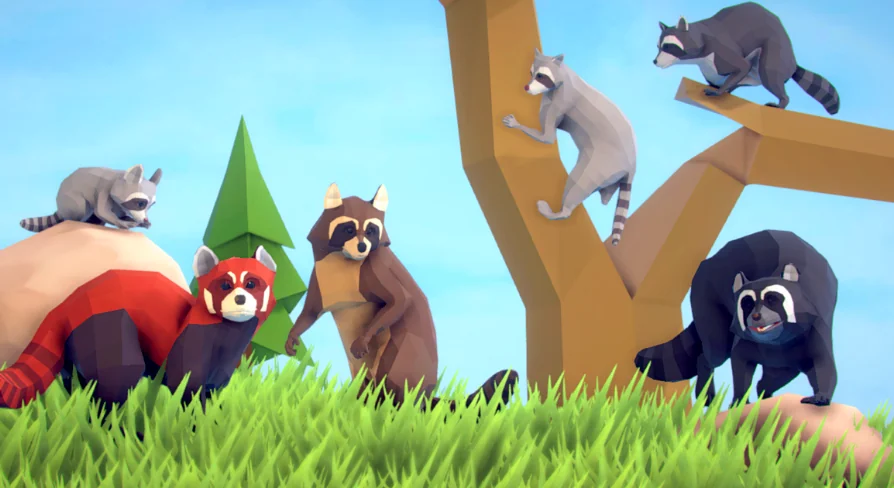
Low-poly natural environments frequently suffer from a conspicuous absence of life. Broad sweeps of faceted terrain, blocky tree trunks, and sharp geometric foliage often remain completely static, leaving scenes feeling static or deserted. Introducing active wildlife directly into these stylized spaces breaks the uniformity of static vegetation and rigid ground meshes. Poly Art Raccoons fills this specific atmospheric niche by delivering low-poly critter assets intended to populate nature biomes with recognizable small forest creatures, notably raccoons and red pandas.
Breathing Motion into Low-Poly Forests with Poly Art Raccoons
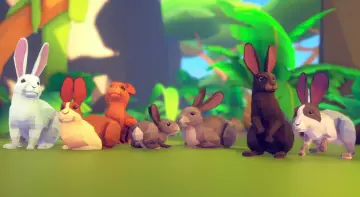
Stylized natural scenes require a delicate balance between visual simplification and identifiable biological form. Poly Art Raccoons achieves this balance by maintaining clear silhouettes while embracing the flat-shaded, polygonal aesthetic common to minimalist 3D landscapes. The asset collection includes both raccoons and red pandas, providing visual variety within the same broad critter classification. Having both species allows level designers to diversify animal behavior and thematic settings across temperate woodlands, mountain foothills, or Asian-inspired bamboo glades without breaking aesthetic continuity.
The faceted surface treatment ensures that light bounces cleanly across directional planes, mirroring the lighting models typical of low-poly environment kits. Because these models do not rely on heavy, photorealistic surface shaders, their visual identity remains sharp and clean under both dynamic daylight setups and simple unlit rendering pipelines. The distinctive facial markings, banded tails, and compact bodies of both the standard raccoon and the red panda remain instantly legible even when viewed from wide aerial perspectives or through dense underbrush.
Integrating Poly Art Raccoons into Custom Gameplay Systems
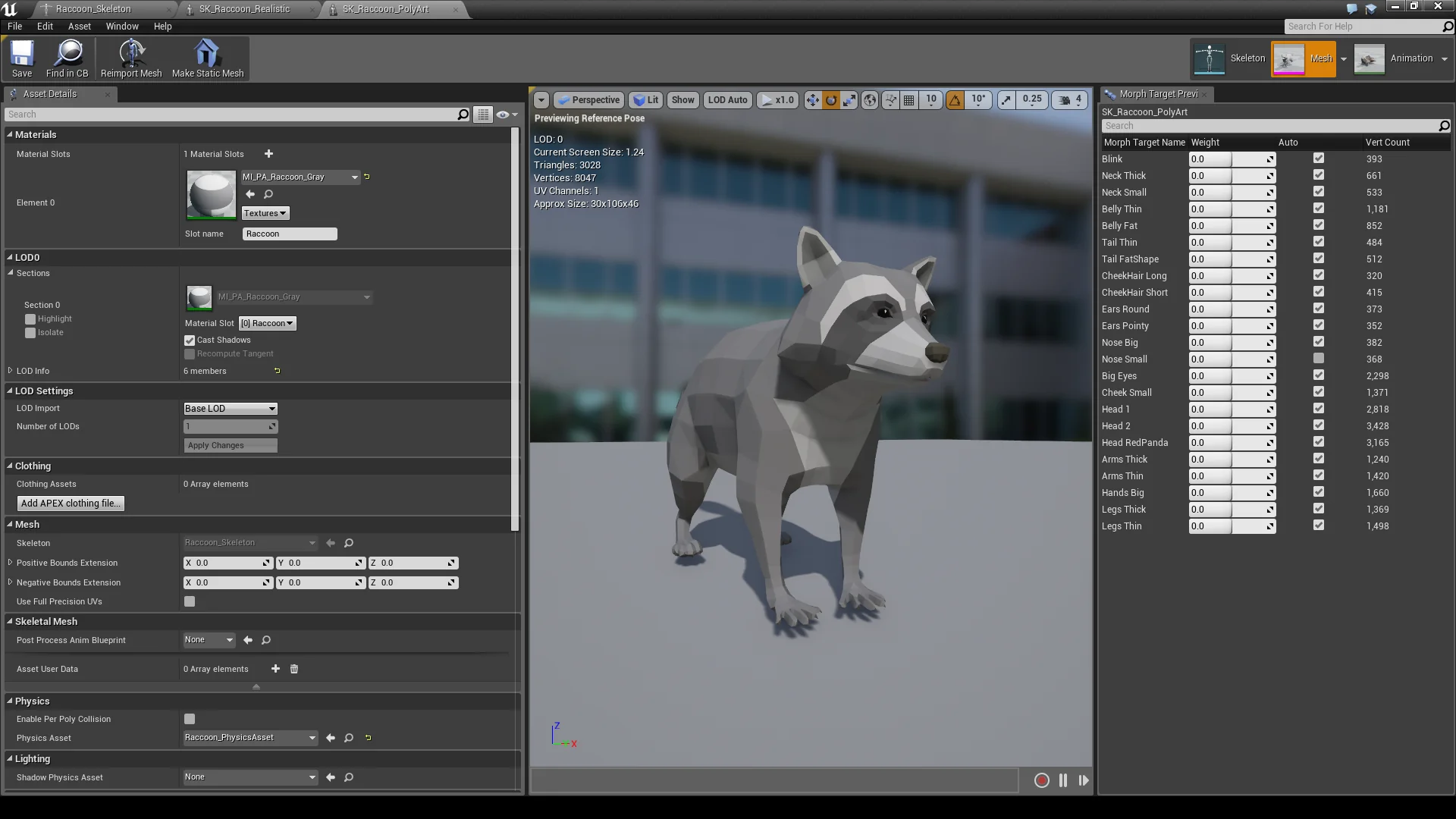
A critical consideration when planning technical integration is the intentional absence of pre-built Blueprints or player character controllers. The delivery focuses strictly on the core assets: the 3D models, textures, and animations. Rather than constraining developers to an opinionated player pawn or an inflexible third-person character script, the assets function as clean, unencumbered building blocks suited for proprietary architectures.
This layout gives gameplay engineers and technical artists the freedom to attach the skeletal meshes directly to their existing non-player character (NPC) systems. In a stealth or survival game, an engineering team might bind the raccoon mesh to an AI perception system that governs scavenging routines, trash-can raids, or flee-on-sight reactions when a player approaches. In an open-world exploration title, the same assets can easily link to a simple ambient spawner that triggers procedural wander paths across a terrain mesh. Because no rigid gameplay scripts come embedded in the package, developers bypass the tedious chore of stripping out unwanted character logic or resolving redundant input bindings before getting the animals into the game loop.
Animation Blueprints and Horse Animset Compatibility
Motion brings stylized characters to life, turning rigid polygonal forms into convincing living entities. The package includes dedicated motion data, providing the foundational cycles necessary to drive locomotion, idling, and reactive critter behavior. Within standard technical pipelines, these motion clips route smoothly into Animation Blueprints and custom state machines to govern transitions between resting, trotting, and sudden movement bursts.
On the animation framework level, the assets carry compatibility considerations tied to the Horse Animset standard. This structural alignment allows animators to leverage consistent retargeting or motion-sharing pipelines across different quadruped types. When managing larger wildlife rosters, aligning skeleton hierarchies and root behaviors with established locomotion sets reduces the workload required to calibrate turn rates, root motion trajectories, and movement blending. Technical teams can script blend trees that seamlessly transition the animals from low-speed wandering to high-speed escapes using standard animation state logic.
Ecosystem Scaling Within the Poly Art Forest Set
Poly Art Raccoons exists as part of a wider continuum of stylized nature assets, directly connecting to the broader Poly Art Forest Set. That overarching collection establishes an extensive ecosystem featuring an assortment of woodland and wilderness inhabitants, including foxes, wolves, bears, tigers, rabbits, moose, deer, boars, and cats. Placing the raccoons and red pandas within this broader context gives creators a consistent visual path to populate an entire wildlife biome without clashing art styles.
The aesthetic lineage of the models also traces back to the Realistic Raccoon Package, which provides the underlying structural reference for this poly-art realization. While the realistic counterpart serves games requiring organic fur shaders and lifelike anatomy, this polygonal interpretation strips away high-frequency surface noise in favor of clean planar forms. Because no environment meshes are bundled with the animal models, artists maintain complete freedom to select their own terrain kits, rock collections, and foliage libraries. Whether dropping these critters into an enchanted woodland, an urban park edge, or an arid survival landscape, the models adapt readily to whatever environment pipeline a project requires.
Practical Technical Handoff
Implementing Poly Art Raccoons succeeds best when treated as a specialized visual and motion kit for engineers and level artists who already have an environment framework and AI infrastructure in place. The core models provide distinct, recognizable silhouettes for low-poly biomes, while the uncoupled models, textures, and motion assets allow developers to build lightweight, performant ambient wildlife systems without dealing with inherited controller dependencies.
 Characters
 Characters
 Characters
 Characters