"a7cfa646d0d8ae55"{"id":"1000861","slug":"package-delivery-simulator-v2-template","title":"Package Delivery Simulator v2 - Template","category":"Simulation","engine":"5.4+","assetVersion":"","engineVersion":"Engine Version: 5.4+","tag":"Simulation","accent":"blue","visual":"mech","summary":"A delivery simulation template for Unreal Engine featuring an electric truck, GPS panel, pie menu, modular roads, auto-generated minimap, charging, repairs, and","platform":"Unreal Engine","publishedAt":"2026-08-05T06:27:29.928Z","updatedAt":"2026-08-05T06:27:29.928Z","sourceNotes":[],"fileContents":[],"compatibility":["Unreal Engine","Engine Version: 5.4+"],"featuredImage":{"alt":"Package Delivery Simulator v2 - Template","src":"/wp-content/uploads/published/2026/08/69ec3dbe7a36-0d0cfd93-6e19-4dcc-be8a-04a476f59611-7cb9cbeccf.webp"},"hasDownloadLink":true,"downloads":0,"terms":[{"taxonomy":"category","slug":"simulation","name":"Simulation"}],"galleryImages":[{"src":"/wp-content/uploads/published/2026/08/535cb2efe212-7bb0b6c2-5980-4025-b4a9-0a3be5d1565d-ba59adc333.webp","alt":"Package Delivery Simulator v2 - Template"},{"src":"/wp-content/uploads/published/2026/08/cfcbba4b31cf-cb5f477a-fe7f-4d19-aa68-badb4ee3f0c2-0915e82395.webp","alt":"Package Delivery Simulator v2 - Template"},{"src":"/wp-content/uploads/published/2026/08/a152f5d0d90b-0ae746db-0258-40ac-876f-d94e41f6690d-e568fd452a.webp","alt":"Package Delivery Simulator v2 - Template"},{"src":"/wp-content/uploads/published/2026/08/0b290e23cb7d-3509d981-e87f-40e3-a157-de297986d436-08e0dc625e.webp","alt":"Package Delivery Simulator v2 - Template"},{"src":"/wp-content/uploads/published/2026/08/4ad2c5cfd4bc-471ea511-8cbd-412e-8391-ae236b269455-fc8b09f0fe.webp","alt":"Package Delivery Simulator v2 - Template"},{"src":"/wp-content/uploads/published/2026/08/ce621e75a96b-8e48afd3-5fb0-44a5-8d43-4bf2e1f6f0fb-087cc5f9e4.webp","alt":"Package Delivery Simulator v2 - Template"},{"src":"/wp-content/uploads/published/2026/08/98e7f6384183-3eb75c91-8904-49df-8934-7204d2c1b0d0-c5be0cf7c7.webp","alt":"Package Delivery Simulator v2 - Template"},{"src":"/wp-content/uploads/published/2026/08/8abcaf6ae69f-494ceb04-0b67-44f5-82fc-bc495a9ffcd6-2648a75a1d.webp","alt":"Package Delivery Simulator v2 - Template"},{"src":"/wp-content/uploads/published/2026/08/8eec0b84261f-b287425a-7875-4cfa-9c1e-5b3d16a4cef9-4f06fc74a1.webp","alt":"Package Delivery Simulator v2 - Template"},{"src":"/wp-content/uploads/published/2026/08/fb3df492728e-4886fc40-321d-487a-8590-6a21ac1fdff5-24b824b2a7.webp","alt":"Package Delivery Simulator v2 - Template"}],"accessPanel":{"kind":"resource","title":"Download this resource","eyebrow":"Free Download","message":"Log in or create a free account to start your download.","fileName":"PackageDeliverySimulatorv.7z","safetyNote":"Resources are manually reviewed before listing to improve quality and reduce obvious risks.","actionLabel":"Download Free","resourceType":"Resource archive"},"contentHtml":"\u003cp\u003eDelivery routes are everywhere in game development, and building a believable 1 from scratch takes time. \u003cem\u003ePackage Delivery Simulator V2\u003c/em\u003e is an Unreal Engine Template that provides the core loop ready to drop into a project. You start at a warehouse, load packages into an electric truck, and drive to customer houses. The template handles the rest: GPS guidance, a \u003ccode\u003ePie Menu\u003c/code\u003e for quick destinations, money tracking, battery management, and even roadside rescue when you run out of charge.\u003c/p\u003e\n\n\u003ch2\u003eA Delivery Route That Starts at the Warehouse\u003c/h2\u003e\n\n\u003cp\u003eThe template's workflow mirrors real logistics. Pick up packages from the warehouse, then deliver them to customer houses scattered around the map. Every successful delivery adds money to your balance. That money feeds back into the truck itself, so the template forms a complete gameplay economy rather than a simple driving demo. The delivery system is paired with a Notification System that keeps you informed of what is happening. The \u003ccode\u003eIn-Game Menu\u003c/code\u003e brings these elements together, letting you keep track of progress without leaving the simulation.\u003c/p\u003e\n\n\u003ch2\u003eThe Truck's Onboard Panel and Pie Menu\u003c/h2\u003e\n\n\u003cp\u003eGetting directions inside the cab is handled through a truck panel that works like a GPS. It shows where to go, and you can also pull up a \u003ccode\u003ePie Menu\u003c/code\u003e to choose quick destinations without digging through submenus. This keeps the driver focused on the road. The truck itself is an electric vehicle, so it carries a battery system that needs attention. There is also a truck gear shifter, which adds a bit more driving feel than a simple forward-reverse toggle. These controls are built into the Blueprint Template, making it straightforward to adapt them for different vehicle projects.\u003c/p\u003e\n\n\u003ch2\u003eCharging, Repairs, and the Tow Truck Safety Net\u003c/h2\u003e\n\n\u003cp\u003eBattery drain is something you have to plan around. When the charge gets low, you can take the truck to a charging station and recharge it using the money you earned from deliveries. But money is not just for electricity. An auto repair shop lets you improve the truck in 2 meaningful ways: you can expand its cargo space to carry more packages per run, and you can upgrade efficiency so the battery lasts longer. These upgrades create a natural progression curve. If you misjudge the range and the battery dies on the road, the template provides a tow truck option. You spend money, and the truck teleports to the nearest charging station, so a failed run never becomes a dead end. This combination of charging, repair, and recovery systems keeps the simulation moving.\u003c/p\u003e\n\n\u003ch2\u003eModular Roads and an Automatically Generated Minimap\u003c/h2\u003e\n\n\u003cp\u003eThe world layout in the template is built from modular roads. You can arrange them in different ways to create new routes or expand the map without having to hand-place landscaping or manually draw road networks. The GPS Minimap is also generated automatically from these roads, which is a key time-saver. Instead of baking in a pre-rendered map texture or scripting road connections by hand, the template calculates the Minimap from the modular pieces themselves. That makes the template a solid base for prototypes or even larger delivery projects where Level layout changes frequently during development.\u003c/p\u003e\n\n\u003ch2\u003eSaving Progress Across Money, Battery, and Upgrades\u003c/h2\u003e\n\n\u003cp\u003ePersistence is handled by the \u003ccode\u003eSave and Load Menu\u003c/code\u003e. The saved data tracks 3 core variables: the amount of money you have, how full the truck's battery is, and the level of your upgrades. This means a player can step away and come back to the same truck state, with the same cargo capacity and efficiency. For a template, this is especially useful because it gives you a clean reference for building your own save systems around core gameplay values. The \u003ccode\u003eIn-Game Menu\u003c/code\u003e ties save/load into the rest of the interface, so it feels like a natural part of the simulation rather than a set of disconnected User Interface (UI) screens.\u003c/p\u003e\n\n\u003ch2\u003eWhere This Template Fits in an Unreal Engine Project\u003c/h2\u003e\n\n\u003cp\u003e\u003cem\u003ePackage Delivery Simulator V2\u003c/em\u003e is aimed at developers who want a working delivery gameplay loop inside Unreal Engine without building the systems from nothing. The source includes delivery, money, GPS, notification, battery, and upgrade systems as a unified Blueprint Template. Alongside the electric truck and its panel, you get the warehouse, customer houses, charging station, auto repair building, and modular road pieces. Because the roads are modular and the Minimap regenerates automatically, it is particularly useful for testing multiple map layouts. For a solo developer or a small team, this template can serve as the foundation for a delivery sim, a courier game, or even a broader driving game that needs a mission structure and a persistent player progression.\u003c/p\u003e\n\n\u003cp\u003eThe most practical takeaway is that the template closes most of the gaps in a typical delivery simulation: the loop is there, the economy is there, and the failure state is forgiving. You can spend your time customizing the visuals, adding new delivery types, or expanding the road network instead of wiring up battery drain and save files for the 1st time. If you are starting a vehicle-based project in Unreal Engine and want a proven starting point, this is exactly the kind of foundation that lets you push straight into the interesting part—building the game around a working core.\u003c/p\u003e\n\n\u003ch2\u003eMore From The Same Workflow\u003c/h2\u003e\n\u003cul\u003e\n\u003cli\u003e\u003ca href=\"https://3dcghub.com/renovation-simulator/\" title=\"Renovation simulator\"\u003eRenovation simulator\u003c/a\u003e\u003c/li\u003e\n\u003cli\u003e\u003ca href=\"https://3dcghub.com/space-game-starter-kit/\" title=\"Space Game Starter kit\"\u003eSpace Game Starter kit\u003c/a\u003e\u003c/li\u003e\n\u003cli\u003e\u003ca href=\"https://3dcghub.com/silantro-flight-simulator-toolkit/\" title=\"Silantro Flight Simulator Toolkit\"\u003eSilantro Flight Simulator Toolkit\u003c/a\u003e\u003c/li\u003e\n\u003cli\u003e\u003ca href=\"https://3dcghub.com/replicated-modular-vehicle-v2/\" title=\"Replicated Modular Vehicle V2\"\u003eReplicated Modular Vehicle V2\u003c/a\u003e\u003c/li\u003e\n\u003cli\u003e\u003ca href=\"https://3dcghub.com/archviz-template-lite/\" title=\"| ArchViz Template Lite |\"\u003e| ArchViz Template Lite |\u003c/a\u003e\u003c/li\u003e\n\u003c/ul\u003e","contentTextLength":5437,"navigation":{"current":389,"total":3167,"previous":{"id":"1000862","slug":"package-deliveryman-anims","title":"Package Deliveryman Anims","category":"Locomotion / Gaits","platform":"Unreal Engine","updatedAt":"2026-08-05T06:30:37.279Z"},"next":{"id":"1000860","slug":"open-world-audio-system","title":"Open World Audio System","category":"Gameplay Features","platform":"Unreal Engine","updatedAt":"2026-08-05T06:24:43.389Z"}},"relatedResources":[{"id":"12118","slug":"renovation-simulator","title":"Renovation simulator","category":"Simulation","engine":"5.2+","assetVersion":"Engine version: 5.2+","engineVersion":"5.2","tag":"Simulation","accent":"blue","visual":"mech","summary":"Build your own renovation game using this versatile toolset featuring painting mechanics, a monetary system, and environment modification tools.","platform":"Unreal Engine","publishedAt":"2026-03-06T16:46:44.000Z","updatedAt":"2026-04-19T15:48:03.000Z","sourceNotes":[],"fileContents":[],"compatibility":["Unreal Engine","Engine version: 5.2+"],"featuredImage":{"alt":"Renovation simulator","src":"https://3dcghub.com/wp-content/uploads/2026/03/248780b1-3c33-4787-bb91-5d1262079479.webp"},"hasDownloadLink":true,"downloads":0},{"id":"12129","slug":"space-game-starter-kit","title":"Space Game Starter kit","category":"Simulation","engine":"5.3+","assetVersion":"Engine version: 5.3+","engineVersion":"5.3","tag":"Simulation","accent":"blue","visual":"audio","summary":"Launch your game development journey with the Space Game Starter kit. This package features a dynamic spaceship system and planetary environments designed specifically for beginners.","platform":"Unreal Engine","publishedAt":"2026-03-06T16:54:05.000Z","updatedAt":"2026-04-19T15:48:03.000Z","sourceNotes":[],"fileContents":[],"compatibility":["Unreal Engine","Engine version: 5.3+"],"featuredImage":{"alt":"Space Game Starter kit","src":"https://3dcghub.com/wp-content/uploads/2026/03/2c0cadf5-0536-4c3a-b1b6-e5d944fd5e66.webp"},"hasDownloadLink":true,"downloads":0},{"id":"23495","slug":"silantro-flight-simulator-toolkit","title":"Silantro Flight Simulator Toolkit","category":"Physics","engine":"Original Unity version: 2019.3.0","assetVersion":"Original Unity version: 2019.3.0","engineVersion":"Asset Version:3.5.15","tag":"Physics","accent":"cyan","visual":"city","summary":"Silantro Flight Simulator Toolkit is a Unity package for setting up and simulating fixed-wing aircraft with detailed aerodynamics, engine models, cockpit instruments, and input support. It also includes sample scenes that show manual, mobile, stabilized, an...","platform":"Unity","publishedAt":"2026-04-09T17:42:33.000Z","updatedAt":"2026-04-19T15:35:23.000Z","sourceNotes":[],"fileContents":[],"compatibility":["Unity","Original Unity version: 2019.3.0","Asset Version: 3.5.15"],"featuredImage":{"alt":"Silantro Flight Simulator Toolkit","src":"https://3dcghub.com/wp-content/uploads/2026/04/40950f9dc369_c00f37d3-2929-4ee4-a088-72108b308b42_1280x720_stretch.webp"},"hasDownloadLink":true,"downloads":1}]}
Simulation
Package Delivery Simulator v2 - Template
A delivery simulation template for Unreal Engine featuring an electric truck, GPS panel, pie menu, modular roads, auto-generated minimap, charging, repairs, and
Category:Unreal Engine, SimulationPlatform: Unreal EngineEngine Version: 5.4+Published: Aug 5, 2026
Simulation
Resource overview
Delivery routes are everywhere in game development, and building a believable 1 from scratch takes time. Package Delivery Simulator V2 is an Unreal Engine Template that provides the core loop ready to drop into a project. You start at a warehouse, load packages into an electric truck, and drive to customer houses. The template handles the rest: GPS guidance, a Pie Menu for quick destinations, money tracking, battery management, and even roadside rescue when you run out of charge.
A Delivery Route That Starts at the Warehouse
The template's workflow mirrors real logistics. Pick up packages from the warehouse, then deliver them to customer houses scattered around the map. Every successful delivery adds money to your balance. That money feeds back into the truck itself, so the template forms a complete gameplay economy rather than a simple driving demo. The delivery system is paired with a Notification System that keeps you informed of what is happening. The In-Game Menu brings these elements together, letting you keep track of progress without leaving the simulation.
The Truck's Onboard Panel and Pie Menu
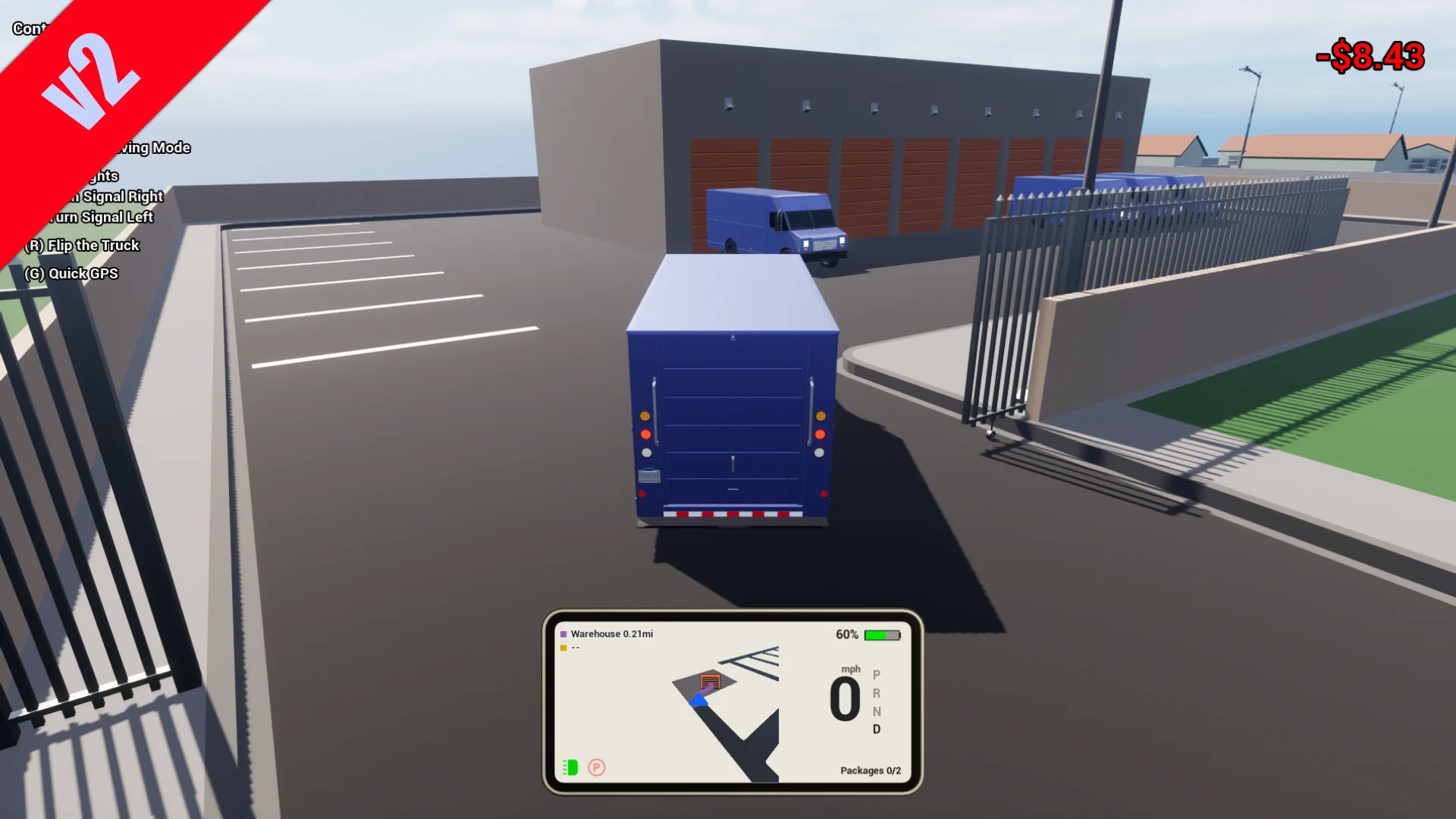
Getting directions inside the cab is handled through a truck panel that works like a GPS. It shows where to go, and you can also pull up a Pie Menu to choose quick destinations without digging through submenus. This keeps the driver focused on the road. The truck itself is an electric vehicle, so it carries a battery system that needs attention. There is also a truck gear shifter, which adds a bit more driving feel than a simple forward-reverse toggle. These controls are built into the Blueprint Template, making it straightforward to adapt them for different vehicle projects.
Charging, Repairs, and the Tow Truck Safety Net
Battery drain is something you have to plan around. When the charge gets low, you can take the truck to a charging station and recharge it using the money you earned from deliveries. But money is not just for electricity. An auto repair shop lets you improve the truck in 2 meaningful ways: you can expand its cargo space to carry more packages per run, and you can upgrade efficiency so the battery lasts longer. These upgrades create a natural progression curve. If you misjudge the range and the battery dies on the road, the template provides a tow truck option. You spend money, and the truck teleports to the nearest charging station, so a failed run never becomes a dead end. This combination of charging, repair, and recovery systems keeps the simulation moving.
Modular Roads and an Automatically Generated Minimap
The world layout in the template is built from modular roads. You can arrange them in different ways to create new routes or expand the map without having to hand-place landscaping or manually draw road networks. The GPS Minimap is also generated automatically from these roads, which is a key time-saver. Instead of baking in a pre-rendered map texture or scripting road connections by hand, the template calculates the Minimap from the modular pieces themselves. That makes the template a solid base for prototypes or even larger delivery projects where Level layout changes frequently during development.
Saving Progress Across Money, Battery, and Upgrades
Persistence is handled by the Save and Load Menu. The saved data tracks 3 core variables: the amount of money you have, how full the truck's battery is, and the level of your upgrades. This means a player can step away and come back to the same truck state, with the same cargo capacity and efficiency. For a template, this is especially useful because it gives you a clean reference for building your own save systems around core gameplay values. The In-Game Menu ties save/load into the rest of the interface, so it feels like a natural part of the simulation rather than a set of disconnected User Interface (UI) screens.
Where This Template Fits in an Unreal Engine Project
Package Delivery Simulator V2 is aimed at developers who want a working delivery gameplay loop inside Unreal Engine without building the systems from nothing. The source includes delivery, money, GPS, notification, battery, and upgrade systems as a unified Blueprint Template. Alongside the electric truck and its panel, you get the warehouse, customer houses, charging station, auto repair building, and modular road pieces. Because the roads are modular and the Minimap regenerates automatically, it is particularly useful for testing multiple map layouts. For a solo developer or a small team, this template can serve as the foundation for a delivery sim, a courier game, or even a broader driving game that needs a mission structure and a persistent player progression.
The most practical takeaway is that the template closes most of the gaps in a typical delivery simulation: the loop is there, the economy is there, and the failure state is forgiving. You can spend your time customizing the visuals, adding new delivery types, or expanding the road network instead of wiring up battery drain and save files for the 1st time. If you are starting a vehicle-based project in Unreal Engine and want a proven starting point, this is exactly the kind of foundation that lets you push straight into the interesting part—building the game around a working core.
 Simulation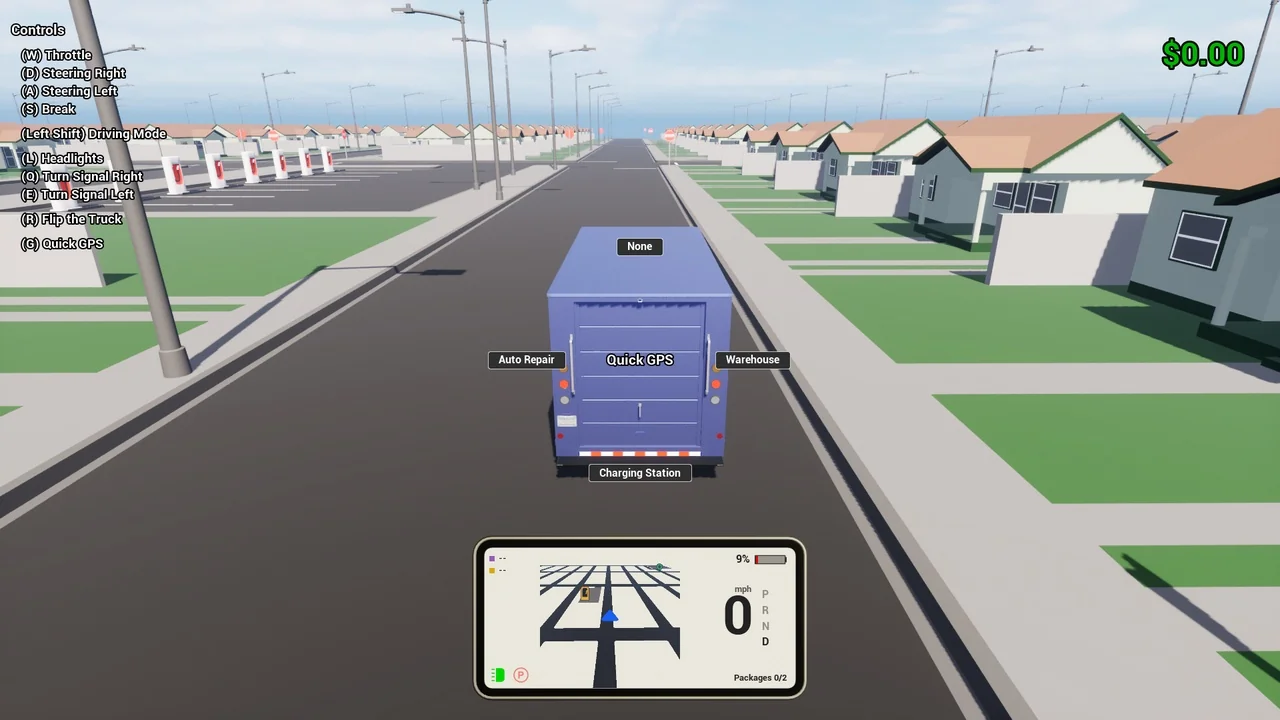
 Simulation
 Simulation
 Physics