"c68a05d5e51405b3"{"id":"1001903","slug":"omniwalk-planetary-antigravity-magne-boots-hovercraft-traversal-system","title":"OmniWalk: Planetary AntiGravity, Magne-Boots, Hovercraft Traversal System","category":"Game Mechanics","engine":"5.7","assetVersion":"Asset Version: 1.0.0","engineVersion":"Engine Version: 5.7","tag":"Game Mechanics","accent":"blue","visual":"mech","summary":"Explore OmniWalk 0.7.1 for Unreal Engine 5.5+, a C++ locomotion system delivering planetary gravity, magnetic boots, camera stabilization, and setup tooling.","platform":"Unreal Engine","publishedAt":"2026-10-22T11:41:48.786Z","updatedAt":"2026-10-22T11:41:48.786Z","sourceNotes":[],"fileContents":[],"compatibility":["Unreal Engine","Asset Version: 1.0.0","Engine Version: 5.7"],"featuredImage":{"alt":"OmniWalk: Planetary AntiGravity, Magne-Boots, Hovercraft Traversal System","src":"/wp-content/uploads/published/2026/10/3ace24704c09-b4804de5-4f26-4e36-afb4-67b2f0906089-aa87605ead.webp"},"hasDownloadLink":true,"downloads":0,"terms":[{"taxonomy":"category","slug":"game-mechanics-tools-and-plugins","name":"Game Mechanics"}],"galleryImages":[{"src":"/wp-content/uploads/published/2026/10/c13811721e6c-87bb35d3-b72a-41c4-89ad-f85ea6ece797-dab101c859.webp","alt":"OmniWalk: Planetary AntiGravity, Magne-Boots, Hovercraft Traversal System"},{"src":"/wp-content/uploads/published/2026/10/6b9f92d8fa92-3e44bdf9-0535-4ef6-81eb-8813c8cd96df-7e2a1d1135.webp","alt":"OmniWalk: Planetary AntiGravity, Magne-Boots, Hovercraft Traversal System"},{"src":"/wp-content/uploads/published/2026/10/e088a87bad9b-20a74a9d-5d32-4c37-9df2-133bfa9539bb-e74ce18c37.webp","alt":"OmniWalk: Planetary AntiGravity, Magne-Boots, Hovercraft Traversal System"},{"src":"/wp-content/uploads/published/2026/10/ed7ac270ac8c-ed316dcc-8f71-482c-ae8a-137e4869d862-cea18539bc.webp","alt":"OmniWalk: Planetary AntiGravity, Magne-Boots, Hovercraft Traversal System"},{"src":"/wp-content/uploads/published/2026/10/feae1d2cf486-4bcd20b8-2907-426b-bb8e-1b2b9fb0126f-9c97095498.webp","alt":"OmniWalk: Planetary AntiGravity, Magne-Boots, Hovercraft Traversal System"},{"src":"/wp-content/uploads/published/2026/10/83e97ad8f234-34e6e3bc-9ab6-414f-bfb6-3e4266bb467a-e8b97c72e0.webp","alt":"OmniWalk: Planetary AntiGravity, Magne-Boots, Hovercraft Traversal System"},{"src":"/wp-content/uploads/published/2026/10/2aa358752431-43fc37b1-5ad2-4a1d-9384-a1f4e4c2b32d-ed9dce9af3.webp","alt":"OmniWalk: Planetary AntiGravity, Magne-Boots, Hovercraft Traversal System"},{"src":"/wp-content/uploads/published/2026/10/9b2b5c722780-86d476ea-ace4-45fd-a7dd-5c4eaf8231a3-42f43972b1.webp","alt":"OmniWalk: Planetary AntiGravity, Magne-Boots, Hovercraft Traversal System"},{"src":"/wp-content/uploads/published/2026/10/3af26fb05db9-716a67c4-4e66-445e-ab69-33f3d482e6ea-d8b954461d.webp","alt":"OmniWalk: Planetary AntiGravity, Magne-Boots, Hovercraft Traversal System"},{"src":"/wp-content/uploads/published/2026/10/8a6f2152a389-22f8dab5-b908-4ad5-877b-6959fd761c04-4eac54f3e1.webp","alt":"OmniWalk: Planetary AntiGravity, Magne-Boots, Hovercraft Traversal System"}],"accessPanel":{"kind":"resource","title":"Download this resource","eyebrow":"Free Download","message":"Log in or create a free account to start your download.","fileName":"OmniWalk Planetary AntiGravity, Magne-Boots, Hovercraft Traversal System.7z","safetyNote":"Resources are manually reviewed before listing to improve quality and reduce obvious risks.","actionLabel":"Download Free","resourceType":"Resource archive"},"contentHtml":"\u003ch2\u003eLocomotion Scenarios for Arbitrary Gravity Environments\u003c/h2\u003e\u003cp\u003eNavigating curved geometry, vertical bulkheads, and exterior hulls presents unique gameplay challenges in sci-fi environments. In titles exploring rotating orbital stations, deep-space salvage hulks, or compact planetary bodies, traditional single-vector downward gravity restricts how level spaces are built. OmniWalk addresses these environments by enabling characters to traverse arbitrary geometry, replicating the deliberate, high-fidelity magnetism familiar from games like Dead Space and Ratchet \u0026amp; Clank.\u003c/p\u003e\u003cp\u003eInstead of restricting gameplay to flat decks, characters can step across exterior pipes, traverse ceilings, ascend vertical towers, and loop around entire spherical planets. Sci-fi traversal, planetary movement, wall-running, and ceiling navigation all lean on the same underlying locomotion core. The framework supports experimental movement setups and complex character controllers where dynamic surfaces, interior hulls, or moving level elements require characters to orient themselves relative to their immediate contact points rather than a fixed global down direction.\u003c/p\u003e\u003ch2\u003eSurface Adhesion, Normals, and Camera Stabilization\u003c/h2\u003e\u003cp\u003eMulti-directional gravity frequently falters when transitioning between different surface planes. OmniWalk handles these transitions by detecting surface normals directly, implementing a no-volume workflow. Level designers do not need to enclose every corridor, strut, or spherical surface inside specialized gravity volumes. Characters detect surface geometry automatically, adhering firmly to the terrain beneath them.\u003c/p\u003e\u003cp\u003eInput translation must adapt seamlessly when player orientation shifts by 90 or 180 degrees. OmniWalk translates stick and keyboard inputs relative to the active gravity vector, keeping controls intuitive whether sprinting up a vertical wall or across an inverted ceiling. The framework includes specialized transition logic that manages movement across abrupt angles, curved meshes, and uneven terrain without breaking character balance or detaching from the surface.\u003c/p\u003e\u003cp\u003eCamera behavior is another critical hurdle in arbitrary gravity. Standard third-person and first-person camera rigs commonly suffer from gimbal lock, jarring camera flips, and disorientation when flipping upside down. OmniWalk integrates camera stabilization routines that manage the reorientation process, preventing sudden inversions and preserving visual clarity across changing surface angles.\u003c/p\u003e\u003ch2\u003eThe OmniWalk Setup Wizard and Onboarding Workflow\u003c/h2\u003e\u003cp\u003eIntegrating unconventional movement mechanics into an established Unreal Engine project can require extensive configuration. OmniWalk mitigates friction through an integrated editor tool accessible via \u003ccode\u003eWindow -\u0026gt; OmniWalk -\u0026gt; OmniWalk Setup Wizard\u003c/code\u003e.\u003c/p\u003e\u003cp\u003eThe Setup Wizard automates the core setup pipeline:\u003c/p\u003e\u003cul\u003e\u003cli\u003eAudits existing project settings to identify missing requirements.\u003c/li\u003e\u003cli\u003eGenerates starter Character, Controller, and GameMode Blueprints based on the system.\u003c/li\u003e\u003cli\u003eApplies the OmniWalk-configured GameMode directly to the active level.\u003c/li\u003e\u003cli\u003eTags designated Character actors for no-code auto-injection of traversal mechanics.\u003c/li\u003e\u003cli\u003eProvides tools to generate optional test and demo assets in an isolated directory without cluttering production folders.\u003c/li\u003e\u003c/ul\u003e\u003cp\u003eFor existing character hierarchies, developers can skip the full wizard generation and follow a drop-in workflow, attaching the OmniWalk component directly to compatible Character actors and applying actor tags to initialize functionality.\u003c/p\u003e\u003ch2\u003eC++ Engine Requirements and Editor Telemetry Tools\u003c/h2\u003e\u003cp\u003eOmniWalk is built specifically for Unreal Engine 5.5 and newer versions. Performance-critical movement calculations, trace operations, and mathematical transformations run within a native C++ core, supplied with full C++ source code. The framework requires Unreal Engine's Enhanced Input system to handle its gravity-relative direction mapping.\u003c/p\u003e\u003cp\u003eTo assist with setup and debugging, the package incorporates editor debugger interfaces and telemetry utilities. Developers can inspect contact states, surface normals, adhesion forces, and transition thresholds directly in the viewport. These telemetry readouts simplify the process of fine-tuning character adhesion on custom meshes, irregular geometric forms, and high-velocity surfaces.\u003c/p\u003e\u003ch2\u003eTechnical Skill Demands and Extension Modules\u003c/h2\u003e\u003cp\u003eWhile the Setup Wizard streamlines initial adoption, working with multi-directional traversal requires a solid foundation in Unreal Engine 5 workflows, asset structures, and editor tooling. Teams customizing the runtime logic, extending the framework, or integrating custom movement abilities will need familiarity with reading and modifying C++ code.\u003c/p\u003e\u003cp\u003eOmniWalk is distributed across two tiers. An open-source Core FOSS version hosted on GitHub offers a starting point for developers who want to inspect the architectural foundation, review setup requirements, and evaluate integration mechanics. The Pro release hosted on Fab delivers a fully vetted, actively supported build expanded with comprehensive extension modules, starter Blueprint workflows, and dedicated test tooling. Teams building sci-fi action titles, planetary exploration games, and gravity-defying platformers will find the system best suited for projects where non-standard locomotion forms the core mechanic of the experience.\u003c/p\u003e\n\n\u003ch2\u003eRelated Resources Worth Checking\u003c/h2\u003e\n\u003cul\u003e\n\u003cli\u003e\u003ca href=\"https://3dcghub.com/advanced-hover-vehicle-system/\" title=\"Advanced Hover Vehicle System\"\u003eAdvanced Hover Vehicle System\u003c/a\u003e\u003c/li\u003e\n\u003cli\u003e\u003ca href=\"https://3dcghub.com/rts-rpg-unit-template-massai-multiplayer-gameplay-ability-system/\" title=\"RTS/RPG Unit Template - MassAI - Multiplayer - Gameplay Ability System\"\u003eRTS/RPG Unit Template - MassAI - Multiplayer - Gameplay Ability System\u003c/a\u003e\u003c/li\u003e\n\u003cli\u003e\u003ca href=\"https://3dcghub.com/interactive-foliage-and-vegetation-system/\" title=\"Interactive Foliage and Vegetation System\"\u003eInteractive Foliage and Vegetation System\u003c/a\u003e\u003c/li\u003e\n\u003cli\u003e\u003ca href=\"https://3dcghub.com/operating-system-simulator-plugin/\" title=\"Operating System Simulator Plugin\"\u003eOperating System Simulator Plugin\u003c/a\u003e\u003c/li\u003e\n\u003cli\u003e\u003ca href=\"https://3dcghub.com/smart-shooting-npc-and-player-projectile-target-prediction-and-ballistic-system/\" title=\"Smart Shooting - NPC \u0026amp; Player Projectile Target Prediction \u0026amp; Ballistic System\"\u003eSmart Shooting - NPC \u0026amp; Player Projectile Target Prediction \u0026amp; Ballistic System\u003c/a\u003e\u003c/li\u003e\n\u003c/ul\u003e","contentTextLength":5638,"navigation":{"current":22,"total":3860,"previous":{"id":"1001904","slug":"ontario-pbr-plant-pack","title":"Ontario PBR Plant Pack","category":"Plants","platform":"Unreal Engine","updatedAt":"2026-10-22T11:42:29.891Z"},"next":{"id":"1001902","slug":"old-gramophones-pack","title":"Old Gramophones pack","category":"Furniture \u0026 Fixtures","platform":"Unreal Engine","updatedAt":"2026-10-22T11:41:03.408Z"}},"relatedResources":[{"id":"1001040","slug":"advanced-hover-vehicle-system","title":"Advanced Hover Vehicle System","category":"Game Mechanics","engine":"5.3","assetVersion":"Asset Version: 1.0","engineVersion":"Engine Version: 5.3","tag":"Game Mechanics","accent":"blue","visual":"mech","summary":"A framerate-independent hover vehicle system with planetary, directional, and flying gravity modes. Hover, fly, or surf on a simple StaticMesh with no code setu","platform":"Unreal Engine","publishedAt":"2026-08-27T10:28:28.025Z","updatedAt":"2026-08-27T10:28:28.025Z","sourceNotes":[],"fileContents":[],"compatibility":["Unreal Engine","Asset Version: 1.0","Engine Version: 5.3"],"featuredImage":{"alt":"Advanced Hover Vehicle System","src":"/wp-content/uploads/published/2026/08/81b0e53283d7-380b07d3-c011-4b22-a44c-124e2cbee48e-5a24c46d97.webp"},"hasDownloadLink":true,"downloads":0},{"id":"1001549","slug":"rts-rpg-unit-template-massai-multiplayer-gameplay-ability-system","title":"RTS/RPG Unit Template - MassAI - Multiplayer - Gameplay Ability System","category":"Game Mechanics","engine":"5.5","assetVersion":"Asset Version: 5.0.1","engineVersion":"Engine Version: 5.5","tag":"Game Mechanics","accent":"blue","visual":"mech","summary":"Explore the RTSUnitTemplate framework for Unreal Engine 5.7+, pairing MassAI, Character classes, GAS attributes, and responsive multiplayer replication.","platform":"Unreal Engine","publishedAt":"2026-10-10T03:11:48.672Z","updatedAt":"2026-10-10T03:11:48.672Z","sourceNotes":[],"fileContents":[],"compatibility":["Unreal Engine","Asset Version: 5.0.1","Engine Version: 5.5"],"featuredImage":{"alt":"RTS/RPG Unit Template - MassAI - Multiplayer - Gameplay Ability System","src":"/wp-content/uploads/published/2026/10/2c9885371932-8a9e3208-607e-4e16-a97e-3d31e7e9c132-917c5503ec.webp"},"hasDownloadLink":true,"downloads":0},{"id":"1001521","slug":"interactive-foliage-and-vegetation-system","title":"Interactive Foliage and Vegetation System","category":"Game Mechanics","engine":"5.4","assetVersion":"Asset Version: 1.0.0","engineVersion":"Engine Version: 5.4","tag":"Game Mechanics","accent":"blue","visual":"mech","summary":"Examine the Interactive Foliage and Vegetation System, exploring its C++ architecture, skeletal mesh physics, shader displacement, and PCG limits.","platform":"Unreal Engine","publishedAt":"2026-10-09T13:33:45.442Z","updatedAt":"2026-10-09T13:33:45.442Z","sourceNotes":[],"fileContents":[],"compatibility":["Unreal Engine","Asset Version: 1.0.0","Engine Version: 5.4"],"featuredImage":{"alt":"Interactive Foliage and Vegetation System","src":"/wp-content/uploads/published/2026/10/bb775a3c739a-57db783a-4718-4b1b-9c19-526bd2dd4808-38a2876edf.webp"},"hasDownloadLink":true,"downloads":0}]}
Game Mechanics
OmniWalk: Planetary AntiGravity, Magne-Boots, Hovercraft Traversal System
Explore OmniWalk 0.7.1 for Unreal Engine 5.5+, a C++ locomotion system delivering planetary gravity, magnetic boots, camera stabilization, and setup tooling.
Locomotion Scenarios for Arbitrary Gravity Environments
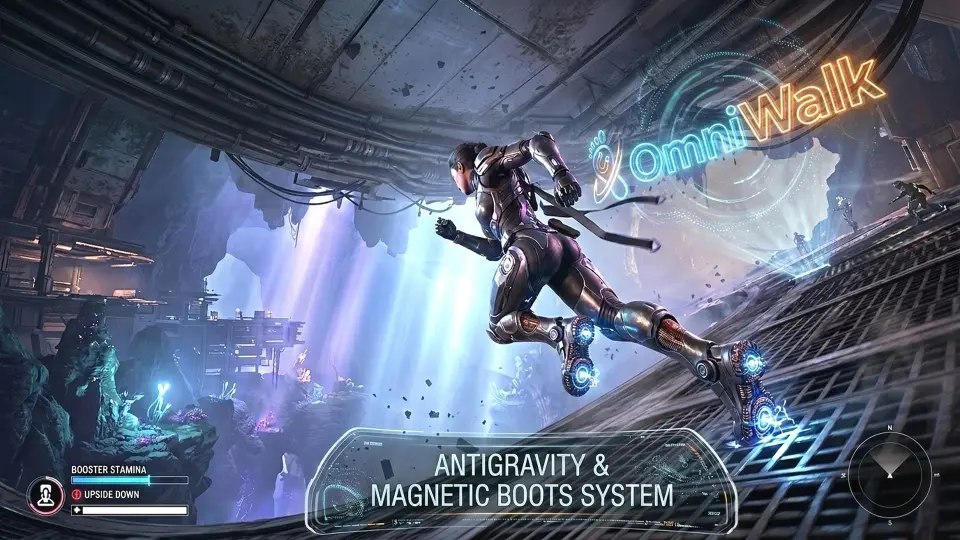
Navigating curved geometry, vertical bulkheads, and exterior hulls presents unique gameplay challenges in sci-fi environments. In titles exploring rotating orbital stations, deep-space salvage hulks, or compact planetary bodies, traditional single-vector downward gravity restricts how level spaces are built. OmniWalk addresses these environments by enabling characters to traverse arbitrary geometry, replicating the deliberate, high-fidelity magnetism familiar from games like Dead Space and Ratchet & Clank.
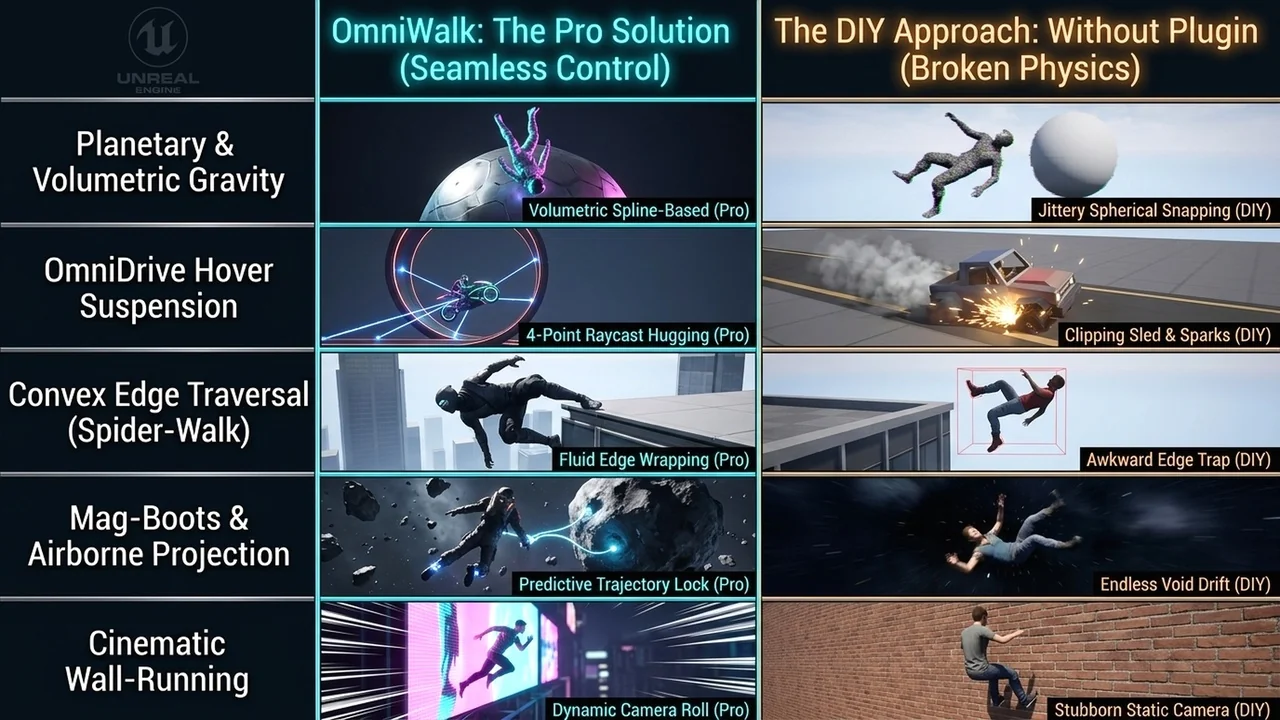
Instead of restricting gameplay to flat decks, characters can step across exterior pipes, traverse ceilings, ascend vertical towers, and loop around entire spherical planets. Sci-fi traversal, planetary movement, wall-running, and ceiling navigation all lean on the same underlying locomotion core. The framework supports experimental movement setups and complex character controllers where dynamic surfaces, interior hulls, or moving level elements require characters to orient themselves relative to their immediate contact points rather than a fixed global down direction.
Surface Adhesion, Normals, and Camera Stabilization
Multi-directional gravity frequently falters when transitioning between different surface planes. OmniWalk handles these transitions by detecting surface normals directly, implementing a no-volume workflow. Level designers do not need to enclose every corridor, strut, or spherical surface inside specialized gravity volumes. Characters detect surface geometry automatically, adhering firmly to the terrain beneath them.
Input translation must adapt seamlessly when player orientation shifts by 90 or 180 degrees. OmniWalk translates stick and keyboard inputs relative to the active gravity vector, keeping controls intuitive whether sprinting up a vertical wall or across an inverted ceiling. The framework includes specialized transition logic that manages movement across abrupt angles, curved meshes, and uneven terrain without breaking character balance or detaching from the surface.
Camera behavior is another critical hurdle in arbitrary gravity. Standard third-person and first-person camera rigs commonly suffer from gimbal lock, jarring camera flips, and disorientation when flipping upside down. OmniWalk integrates camera stabilization routines that manage the reorientation process, preventing sudden inversions and preserving visual clarity across changing surface angles.
The OmniWalk Setup Wizard and Onboarding Workflow
Integrating unconventional movement mechanics into an established Unreal Engine project can require extensive configuration. OmniWalk mitigates friction through an integrated editor tool accessible via Window -> OmniWalk -> OmniWalk Setup Wizard.
The Setup Wizard automates the core setup pipeline:
Audits existing project settings to identify missing requirements.
Generates starter Character, Controller, and GameMode Blueprints based on the system.
Applies the OmniWalk-configured GameMode directly to the active level.
Tags designated Character actors for no-code auto-injection of traversal mechanics.
Provides tools to generate optional test and demo assets in an isolated directory without cluttering production folders.
For existing character hierarchies, developers can skip the full wizard generation and follow a drop-in workflow, attaching the OmniWalk component directly to compatible Character actors and applying actor tags to initialize functionality.
C++ Engine Requirements and Editor Telemetry Tools
OmniWalk is built specifically for Unreal Engine 5.5 and newer versions. Performance-critical movement calculations, trace operations, and mathematical transformations run within a native C++ core, supplied with full C++ source code. The framework requires Unreal Engine's Enhanced Input system to handle its gravity-relative direction mapping.
To assist with setup and debugging, the package incorporates editor debugger interfaces and telemetry utilities. Developers can inspect contact states, surface normals, adhesion forces, and transition thresholds directly in the viewport. These telemetry readouts simplify the process of fine-tuning character adhesion on custom meshes, irregular geometric forms, and high-velocity surfaces.
Technical Skill Demands and Extension Modules
While the Setup Wizard streamlines initial adoption, working with multi-directional traversal requires a solid foundation in Unreal Engine 5 workflows, asset structures, and editor tooling. Teams customizing the runtime logic, extending the framework, or integrating custom movement abilities will need familiarity with reading and modifying C++ code.
OmniWalk is distributed across two tiers. An open-source Core FOSS version hosted on GitHub offers a starting point for developers who want to inspect the architectural foundation, review setup requirements, and evaluate integration mechanics. The Pro release hosted on Fab delivers a fully vetted, actively supported build expanded with comprehensive extension modules, starter Blueprint workflows, and dedicated test tooling. Teams building sci-fi action titles, planetary exploration games, and gravity-defying platformers will find the system best suited for projects where non-standard locomotion forms the core mechanic of the experience.
 Game Mechanics
 Game Mechanics
 Game Mechanics
 Game Mechanics